The phrase “well drilling contractors by state” sounds like a simple directory request. For an owner, it is usually a market question hiding inside a list question.
You may be looking for competitors in a new state, a subcontractor for overflow work, a referral partner, a hiring pool, or evidence that a territory is worth entering. A list of business names can help. It cannot make the decision for you.
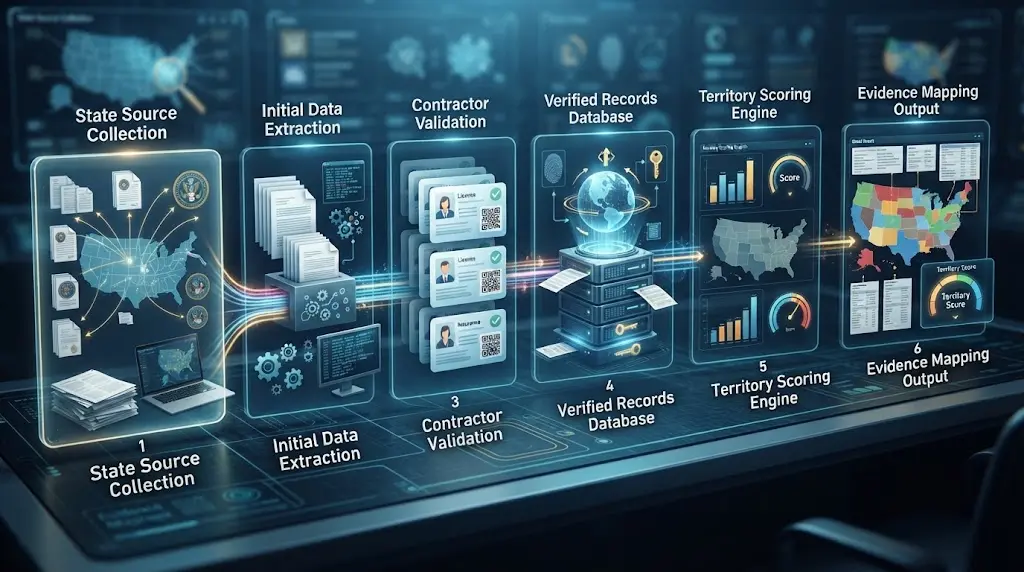
This guide gives you the reliable path: discover names, verify the right public record, normalize the service and county information, then decide whether the state or territory fits your operation. It is built for US water well drilling and pump companies. It does not recommend individual contractors, publish a scraped directory, or treat a directory count as market truth.

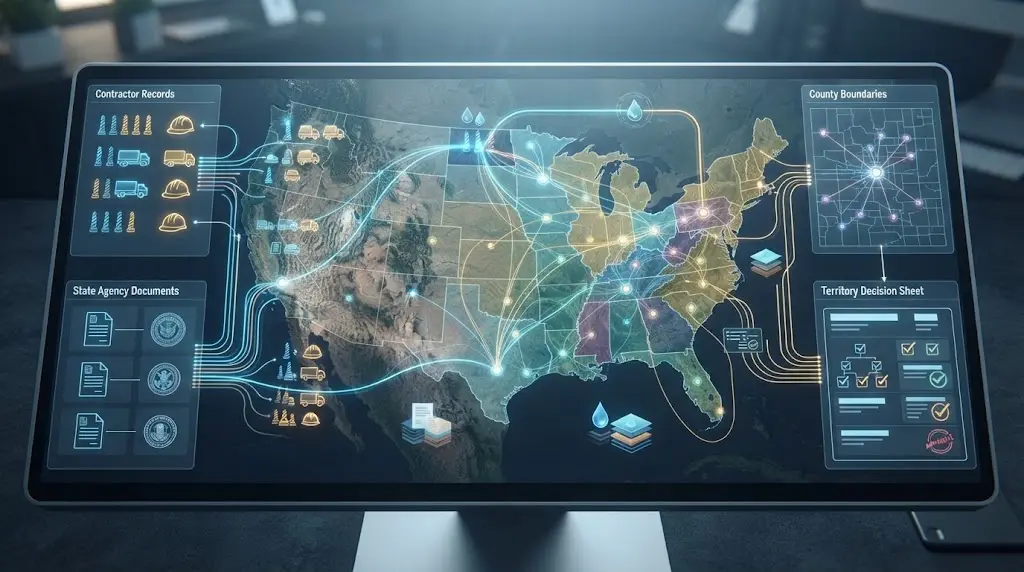
What does “well drilling contractors by state” really mean for an owner?
For an owner or operator, the query usually has one of five jobs. Identify which one you are doing before you collect names.
| The real job | What you need from the list | What the list cannot prove by itself |
|---|---|---|
| Competitor research | Business name, base, counties, services, public visibility, evidence date | Current capacity, margins, close rate, or whether the company wants more work |
| Subcontractor or referral discovery | Service capability, territory, licenses, contact path, project fit | Insurance, workmanship, response time, or commercial terms |
| State expansion | Public well and groundwater context, rules, competition, travel, buyer fit | That the state will produce profitable jobs for your crew |
| Recruiting | Local companies, associations, licensing paths, visible operators | Who is available, qualified, or willing to move |
| Marketing planning | Services and territories that need better visibility and intake | That a higher contractor count means higher search demand |
The distinction keeps a public list from doing a job it was never designed to do. A state agency may publish licensed individuals or firms. An industry directory may show members. A well-log system may show completed wells. A business profile may show a service claim. None of those records automatically says the contractor is accepting new work next month.
A state list is a discovery input, not a territory decision.
Start with the state, then narrow to the service, county, buyer type, and operating radius. “Drilling contractor in Texas” is too broad for a useful competitive set if your company only wants agricultural wells in three counties. “Pump replacement company near a county seat” may be the real decision hiding behind the original query.
Which sources should you use to find contractors by state?
Use a source stack, not one directory. The source stack separates discovery from verification and market context.
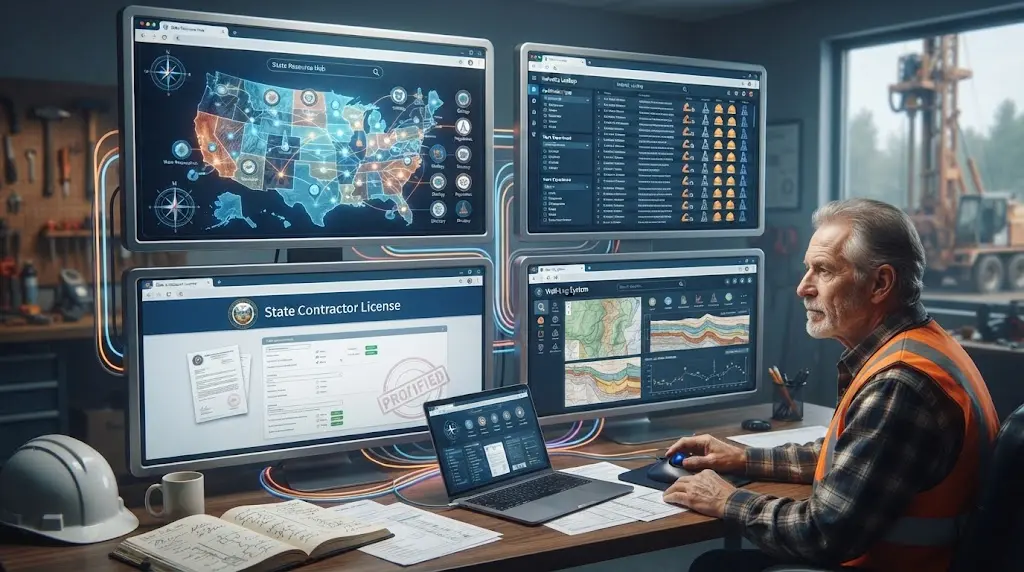
1. Start with the NGWA state-resources hub
The National Ground Water Association state-resources hub links all 50 states. NGWA says the state pages include licensing agencies for contractors, regulatory agencies, groundwater-use summaries, groundwater-quality reports, well-log information, and related resources.
This is the best first stop because it gives you a consistent starting path while acknowledging that the actual authority may be a state department, a professional board, a county, a city, or another local body. Open the page for the state you are researching and collect four links:
- Construction or permitting authority.
- Licensing, registration, or professional-credential authority.
- Well-log or completion-record system.
- Groundwater use, quality, or aquifer context.
Do not assume the NGWA page itself is the current license registry. The state pages carry a snapshot disclaimer and direct readers to the relevant agency. Use the page as a map.
2. Use WellOwner.org for an industry lookup
WellOwner.org's contractor lookup exposes state browsing and filters for water well professionals who are NGWA members. It is useful for finding companies that may not appear in a generic business search.
It also gives you the warning you need. The page says users should verify compliance with state-specific requirements and that NGWA does not endorse or guarantee the companies listed. That makes it a discovery source, not a final verification source.
Use it to seed a list. Then check the state or local authority for the exact work you care about. A pump installation record is not automatically evidence of drilling authority. A certified individual is not automatically proof that every employee or crew can perform every service.
3. Check the state or local licensing and permitting authority
The legal gate may apply to the individual driller, the business, the pump installer, the well contractor, the project, or a combination of these. The answer differs by state and sometimes by county or city.
NGWA's current Contractor State Licensing and Exams page says fourteen states and two counties use NGWA certification exams to some extent in well construction or water-systems installation licensure programs. It lists Alabama, Arizona, Bucks County in Pennsylvania, Colorado, Georgia, Kentucky, Massachusetts, New Jersey, New Mexico, New York, Tennessee, Vermont, West Virginia, Wisconsin, and Wyoming. The page also describes variations in required exams, experience, references, bonds or insurance, fees, and retesting.
The list is useful because it shows why a national shortcut is unsafe. NGWA is clear about the operating rule:
“Because of the variations between states, you should contact your state’s representative for further details.” - National Ground Water Association, Contractor State Licensing and Exams
That sentence should shape your recordkeeping. If a state page, local ordinance, or current license lookup is missing, mark the contractor as unverified. Do not fill the gap with a directory badge or an old profile.
4. Use public well-log and groundwater data for context
The USGS National Water-Well Database is not a contractor directory. It is a compilation of state-managed well records. USGS says those records can include well locations, construction materials, completion depths, lithologic logs, groundwater levels, and pumping or aquifer-test results.
That information can help an operator understand the work environment. Are the wells concentrated in a few counties? Are there many records for a service type you perform? Does the state provide enough public data to make a county comparison possible? Those are research questions.
They are not the same as asking how many contractors are active, how many calls exist, or how profitable a market will be. Keep those fields separate in your sheet.
5. Use state and county lists when they exist
Indiana provides a useful example. Its Department of Natural Resources contractor page publishes lists of contractors employing Indiana-licensed drillers or pump installers. The page includes addresses, phone numbers, counts of licensed personnel associated with the contractor, and service-type abbreviations. It says the lists include only contractors with current-year licensed personnel and explains how to verify an individual license.
That is stronger evidence than a generic directory entry, but it is still bounded. Indiana's list tells you about its licensing program and its records. It does not establish a national standard or guarantee availability.
Some states or counties publish similar lists. Others route you through an individual license lookup, permit database, public-record request, professional board, or local health agency. Your job is to record which path you used.
How should you read the 50-state map?
The map below is a starting index to the current NGWA state-resource pages. Each page links toward the state or local authority. It is not a claim that the state has a uniform statewide license, a public contractor count, or a current list of all businesses.
The practical use is simple. Open the state page, follow the construction and licensing links, and copy the agency URLs into your research record. If the work crosses a county or city boundary, add that local authority too.
Alabama through Maryland
| State | State research starting page | First operator check |
|---|---|---|
| Alabama | Alabama resources | Construction and professional licensing authority |
| Alaska | Alaska resources | Local permitting, general contractor requirements, and WELTS |
| Arizona | Arizona resources | Well permitting, contractor registration, and well records |
| Arkansas | Arkansas resources | Water Well Construction Commission and well records |
| California | California resources | Local permit agency and C-57 or pump-related license scope |
| Colorado | Colorado resources | Contractor licensing and state well construction rules |
| Connecticut | Connecticut resources | State well construction and local health requirements |
| Delaware | Delaware resources | State construction and professional registration path |
| Florida | Florida resources | State or water-management district rules |
| Georgia | Georgia resources | Driller and pump licensing path |
| Hawaii | Hawaii resources | State and county construction requirements |
| Idaho | Idaho resources | Well construction, drilling license, and well logs |
| Illinois | Illinois resources | Driller or pump installer credential and county rules |
| Indiana | Indiana resources | Current licensed-contractor list and individual license check |
| Iowa | Iowa resources | Well construction permit and contractor credentials |
| Kansas | Kansas resources | State licensing and groundwater records |
| Kentucky | Kentucky resources | State license, exam, and well construction rules |
| Louisiana | Louisiana resources | Licensing and parish or local construction process |
| Maine | Maine resources | Well driller and pump installer license path |
| Maryland | Maryland resources | State Board of Well Drillers and local permit process |
The first-check wording above is a research prompt, not a legal conclusion. Follow the linked state page and confirm what the current authority calls the credential or permit.
Massachusetts through North Dakota
| State | State research starting page | First operator check |
|---|---|---|
| Massachusetts | Massachusetts resources | Well driller license, pump work, and local requirements |
| Michigan | Michigan resources | Well construction program and licensed professional path |
| Minnesota | Minnesota resources | Well contractor license and county construction requirements |
| Mississippi | Mississippi resources | State licensing, permit, and well-log sources |
| Missouri | Missouri resources | Well construction permit and driller registration |
| Montana | Montana resources | Board of Water Well Contractors and well records |
| Nebraska | Nebraska resources | Water well standards, license path, and DNR records |
| Nevada | Nevada resources | Division of Water Resources drilling requirements |
| New Hampshire | New Hampshire resources | State well construction and local health rules |
| New Jersey | New Jersey resources | License and state exam requirements |
| New Mexico | New Mexico resources | Well driller license and Office of the State Engineer records |
| New York | New York resources | State and county registration or permit requirements |
| North Carolina | North Carolina resources | Well contractor certification and county health process |
| North Dakota | North Dakota resources | Water well contractor license and well reports |
If you are comparing two states, use the same fields in both. Do not give one state a detailed regulatory review and the other only a directory count. That creates a false comparison before the marketing question even starts.
Ohio through South Dakota
| State | State research starting page | First operator check |
|---|---|---|
| Ohio | Ohio resources | State contractor license and well record access |
| Oklahoma | Oklahoma resources | Water well driller license and well-log authority |
| Oregon | Oregon resources | Well construction and licensed driller requirements |
| Pennsylvania | Pennsylvania resources | County rules, licensing, and local permitting |
| Rhode Island | Rhode Island resources | State construction and professional registration path |
| South Carolina | South Carolina resources | Well standards, permit, and license information |
| South Dakota | South Dakota resources | Well driller license and state well records |
The small-state cases deserve the same discipline as large states. A compact geography can still have multiple authorities, county boundaries, service gaps, or a thin public directory. Do not infer that a shorter list means a simpler market.
Tennessee through Wyoming
| State | State research starting page | First operator check |
|---|---|---|
| Tennessee | Tennessee resources | Well driller license, exam, and construction rules |
| Texas | Texas resources | State license, local authority, and well records |
| Utah | Utah resources | Well driller license and Division of Water Rights records |
| Vermont | Vermont resources | License, exam, and construction standards |
| Virginia | Virginia resources | Water well contractor license and local health permit |
| Washington | Washington resources | Well construction license and county requirements |
| West Virginia | West Virginia resources | Driller license, exam, and well records |
| Wisconsin | Wisconsin resources | Driller and pump installer license path |
| Wyoming | Wyoming resources | State license, NGWA exam use, and well records |
The map covers the 50 states. Washington, DC and US territories are separate research questions and are not included in this state list.
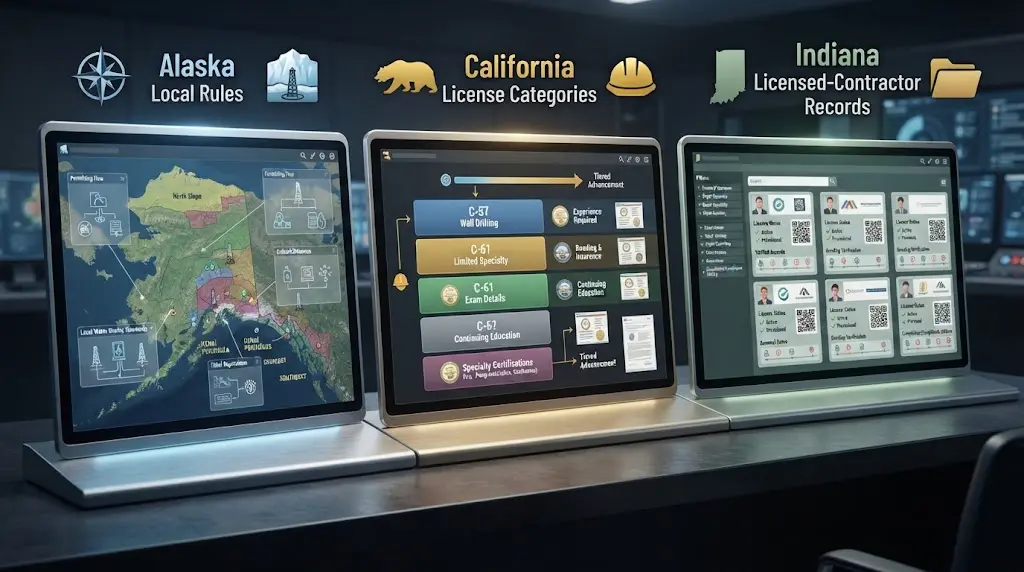
Which state examples show why verification matters?
Two public examples make the point without pretending that one state's system applies everywhere.
What should you learn from Alaska?
The NGWA Alaska state page says there is no specific statewide license for water well drillers and that a State of Alaska general contractor license is required outside the Municipality of Anchorage. It also says local governments may have their own requirements. The state page directs readers to local and state resources.
Alaska's Well Log Tracking System is a different kind of record. Alaska says contractors must file well and aquifer data, including location, driller's logs, pumping tests, flow measurements, estimated elevation, and water-quality determinations within 45 days of completion.
That creates three separate fields in an owner research sheet:
- Legal or professional requirement.
- Local permit or certification requirement.
- Public well-log or completion record.
Do not turn the existence of a well log into proof of current availability. Do not turn a general contractor record into proof of every drilling or pump service. Verify the specific project and work scope.
What should you learn from California?
California shows why a state list may still be too broad. California's Department of Water Resources says local environmental health agencies or water districts issue well permits. It identifies C-57 as the well-drilling contractor license and explains that pump installation, repair, or replacement may be performed by a C-57 or C-61/D-21 contractor.
For a California competitor set, “well contractor” is not enough. Record whether the company performs:
- New well construction.
- Well alteration or destruction.
- Pump installation or replacement.
- Pump repair or service.
- Work in the county or water district you care about.
This is the pattern to copy in every state. Ask what the authority calls the work, the credential, and the jurisdiction. Do not copy California's license names into another state.
What should you learn from Indiana?
Indiana's DNR gives a useful model for a state-level contractor list. The department says it licenses individuals as water well drillers or pump installers and lists contractors with current-year licensed personnel. Its published list includes the company address, phone number, number of licensed drillers or installers associated with the company, and primary service abbreviations.
For an operator, the lesson is not “Indiana has the best list.” The lesson is to look for the same evidence pattern elsewhere:
- Is the person licensed, the firm licensed, or both?
- Does the list show the current year?
- Does it distinguish drilling from pumping?
- Does it identify the county or service region?
- Does it give a way to confirm status?
If the answer is no, mark the record accordingly. A missing field is not a reason to invent one.
How do you separate a contractor list from a market signal?
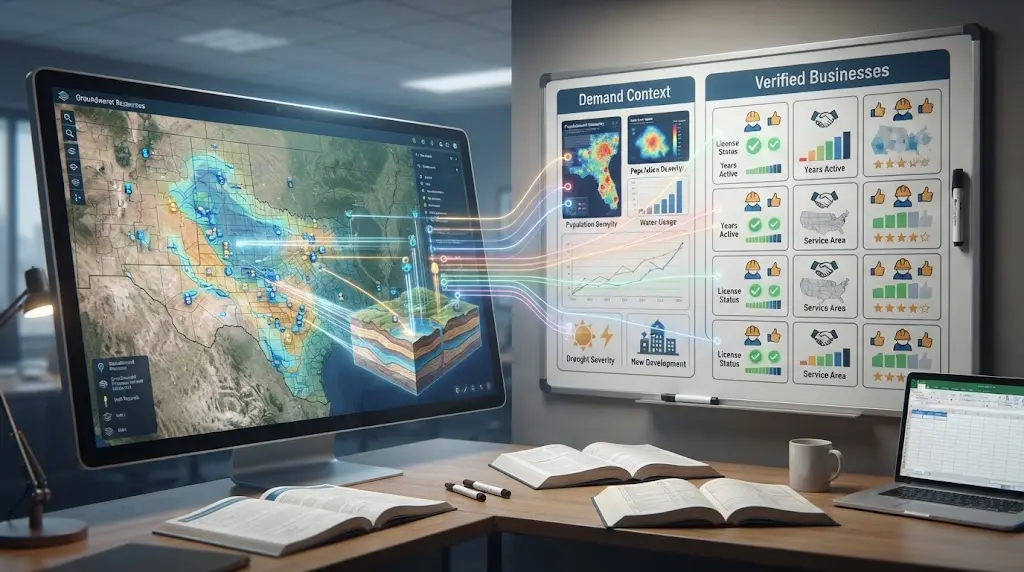
The most common error is to treat the number of listed contractors as the size of the opportunity. That number may reflect directory coverage, search visibility, membership, licensing records, or a data vendor's collection method. It does not necessarily represent active firms, available crews, qualified demand, or profitable work.
Use four different signal groups.
| Signal group | What it can tell you | What it cannot tell you |
|---|---|---|
| Contractor records | Who is publicly listed and what evidence is attached | How busy, profitable, responsive, or available the company is |
| Licensing and permits | What legal or regulatory gate may apply | Whether a licensed firm wants your project or has the right equipment |
| Well logs and completion records | Where wells exist and what public technical context is available | How many new jobs are coming or which contractor will win them |
| Groundwater and water-use data | State or county context for groundwater activity | Residential search volume, lead quality, margin, or booked-job rate |
The USGS Groundwater Use page is useful here. Its 2015 summary reports 84,700 million gallons per day of groundwater withdrawals, with 97 percent classified as freshwater. It identifies California, Arkansas, Texas, Nebraska, and Idaho as the top states by share of groundwater withdrawals.
That fact can help you choose where to do deeper research. It cannot tell you that California is the best state for a residential drilling company, that Arkansas has the most qualified calls, or that Idaho has an easy market. The data includes categories such as irrigation and public supply, not only the jobs your company wants.
Groundwater withdrawal is a context signal, not a booked-job forecast.
Use the USGS number as a prompt:
- Which counties account for the relevant water use?
- Are the services tied to irrigation, public supply, domestic wells, industry, or another category?
- Does the public well-log data cover those counties well enough to compare them?
- Can your crew serve the locations without an unacceptable mobilization burden?
- Are the licensing and permit requirements understood?
If you cannot answer those questions, you have a research lead, not a market conclusion.
What should you record for every contractor?
Use one row per business and one column per evidence type. Do not save only names and phone numbers. Those fields disappear into a weak spreadsheet the first time two companies use similar brands or one company serves several states.
The contractor evidence record
| Field | What to enter | Why it matters |
|---|---|---|
| Legal or public business name | Exact wording from the source | Prevents duplicate records and brand confusion |
| State and base | Office, mailing, or listed location | Helps separate home base from service territory |
| Counties or regions | Only when the source states them or you verify them | A state name is too broad for dispatch or competition |
| Service family | Drilling, pump install, pump repair, replacement, testing, rehabilitation, commercial, agricultural, or other | Stops unlike businesses from being compared |
| Source type | State authority, county, NGWA lookup, website, business profile, well-log record, association | Shows the strength and purpose of the evidence |
| License or registration detail | Number, category, holder, status, or “not found” | Makes verification auditable |
| Permit authority | State, county, city, water district, or unknown | Surfaces local gates before a project or expansion |
| Public proof | Website page, project record, service page, or profile | Shows whether the service claim is visible and specific |
| Evidence URL | Direct link, not only a search result | Lets another person repeat the check |
| Checked date | YYYY-MM-DD | Makes stale rows visible |
| Verification status | Verified, partially verified, discovery only, or stale | Prevents false certainty |
| Operating note | Travel, emergency response, commercial focus, equipment, or unknown | Adds context without inventing a fact |
Use “unknown” freely. Unknown is a useful data state. It tells the owner what to verify next and protects the sheet from becoming a polished collection of guesses.
What verification status should mean
Use four labels:
- Verified: The relevant authority or current official list confirms the required credential or the record matches the stated scope. This does not prove capacity or quality.
- Partially verified: One important source is confirmed, but service scope, county coverage, local permit, or current status is unresolved.
- Discovery only: The company appears in a directory, website, or search result but has no confirmed authority record attached.
- Stale: The source is old, broken, or outside the review window you set.
Set your review window based on the decision. A live bid or subcontractor choice may need direct confirmation now. A high-level state research map may be reviewed monthly or quarterly. State rules and license records still control.
How should you score a state or territory before marketing it?
A state is too large to be a useful first campaign for most local or regional contractors. Score the county cluster or operating corridor that your crew could actually serve.
The State-to-Territory Evidence Map below is a Brictale operating framework. It is not a government statistic, Google ranking formula, or market-size estimate. The weights force an owner to consider the operation before buying attention.
| Factor | Weight | Score it by asking |
|---|---|---|
| Service fit | 25 | Does the territory need the exact drilling, pump, testing, or rehabilitation service you want to sell? |
| Public well or groundwater context | 20 | Is there enough public well, groundwater, or water-use evidence to justify deeper county research? |
| Regulatory clarity | 15 | Do you understand the license, permit, reporting, and local-authority path for the intended work? |
| Capacity and response | 15 | Can the current crew, equipment, phone coverage, and schedule take suitable work? |
| Competitive visibility gap | 15 | Are direct competitors visible for the service and towns, and is there an observable gap worth testing? |
| Travel and job economics | 10 | Do mobilization, fuel, time, and follow-up fit the job economics and operating radius? |
| Total | 100 | A decision score, not a demand promise. |
Give each factor 0, 1, or 2 before applying the weight:
- 0: Unknown, unsuitable, or blocked.
- 1: Partial evidence or workable with a clear next check.
- 2: Evidence supports the territory and the operation can act on it.
The score is intentionally conservative. A territory with strong groundwater context but no capacity should not receive a green light. A territory with low competitive visibility but unclear licensing should not receive a green light either.
How to interpret the score
| Weighted result | Decision |
|---|---|
| 75-100 | Run a bounded demand or partner test after confirming the remaining legal and operating gates. |
| 50-74 | Research the missing evidence and repair the weakest constraint before scaling attention. |
| 0-49 | Do not market the territory yet. Keep it on a research list or reject it. |
The threshold is a planning rule, not proof that a campaign will work. It is designed to prevent the common move of selecting a state from a directory count and only later discovering that the crew cannot serve it, the service is not licensed, or the phone cannot absorb the response.
The best territory is the one your crew can serve profitably and your phone can convert.
How do you build the map in one working session?
Use this procedure for one state or one two-state corridor. The output should be a dated working sheet, not a folder of links.
Step 1: Define the job you are researching
Write one sentence:
“We are researching [service] for [buyer type] in [counties or corridor] because [business decision].”
Examples include:
- “We are researching pump replacement for rural residential properties in three counties because our service crew has open capacity on weekdays.”
- “We are researching agricultural well drilling in a neighboring state because a partner can support mobilization.”
- “We are researching commercial well contractors because we need a referral path for work outside our current license or equipment scope.”
Do not start with “all contractors in the state.” That is a data-collection goal, not a business decision.
Step 2: Open the NGWA state page
Copy the links for construction, licensing, well logs, groundwater use, and any affiliate association. Record the date. If a link is broken, search the named authority directly and record the replacement URL.
Step 3: Seed the contractor list
Use WellOwner.org, the state or county list, an association roster, public business profiles, and targeted searches for the exact service. Add each candidate only once. Keep the source type beside the name.
Step 4: Normalize the service
Put each company into one or more service families. Separate drilling from pump work. Separate emergency repair from scheduled installation. Separate residential, agricultural, commercial, municipal, geothermal, and monitoring work when the buyer or operating requirements change.
If the source only says “water services,” leave the exact service as unknown. Do not upgrade the label because the business name contains “drilling” or “well.”
Step 5: Verify the legal or regulatory path
Follow the authority's current lookup or contact instruction. Capture the license or registration number where public, the holder, the category, the status, and the date. If the state uses a local permit, name the local authority. If no statewide driller license exists, record that only when the current authority says so, and add the local rule.
Step 6: Check the operating territory
Compare the office location with the counties where the company says it works. Look for service-area statements, county pages, project records, well logs, or direct company confirmation. A directory may show a company in a state without showing where its crew travels.
Step 7: Add public well or groundwater context
Use the state's well-log source and the USGS National Water-Well Database where coverage exists. Use USGS groundwater-use data for broad context. Label the reporting year and the category.
Step 8: Compare real competitors
Search the exact service plus the target town or county. Record the visible businesses, service pages, profile categories, reviews if relevant, call path, and whether the page gives a qualified buyer a reason to call. Do not treat every name in a national directory as a competitor.
Step 9: Score the territory
Use the six-factor map. Give each factor a score and a next check. The next check matters more than the number. “Regulatory clarity = 1, confirm county permit authority” is useful. “Opportunity = 68” is not useful on its own.
Step 10: Set a stop rule
Stop research when you can answer the business decision, not when you have collected every company. A stop rule might be:
- Three serviceable counties have verified regulatory paths.
- The company has a clear service offer and available response capacity.
- The direct competitor set is large enough to test visibility.
- The owner can measure qualified calls, estimates, and booked jobs.
- Remaining unknowns are acceptable and documented.
If those conditions are not met, do not add more names. Resolve the blocking uncertainty.
How can a contractor use the map for competitor research?
Competitor research is more useful when it describes a service decision rather than a company in the abstract.
Build one comparison row per competitor-service-county combination. The same company may be a direct competitor for pump repair in one county, a referral option for agricultural drilling in another, and irrelevant to your commercial work.
The competitor comparison fields
| Question | Evidence to capture | Why an owner cares |
|---|---|---|
| Do they offer the same work? | Service page, state classification, project evidence, or direct confirmation | Avoids comparing a pump-only business with a drilling competitor |
| Do they work in the same place? | County page, service area, project record, profile, or direct confirmation | Keeps the comparison inside the real operating radius |
| Can a buyer understand the offer? | Service wording, fit notes, exclusions, intake questions | Shows whether your own page or phone process is clearer |
| Is the company visible? | Search results, Maps profile, association listing, public record | Identifies a visibility gap, not just a company count |
| Can you contact them? | Current phone, form, email, or referral path | Matters for a partner list and for observed conversion friction |
| Is the evidence current? | Source date and checked date | Prevents an old company record from driving a current decision |
You do not need to publish the competitor table. It is an internal operating artifact. The public article gives you the method so you can build one honestly for the state and services that matter to your company.
What not to infer from a competitor list
Do not infer that a company is weak because its website is quiet. Do not infer that a company is strong because it has many reviews. Do not infer that a listed license means current capacity. Do not infer that a company with no state page cannot serve the county.
You can record observations. For example, “no dedicated pump-repair page found on 2026-08-20” is an observation. “The company does not perform pump repair” is a claim that requires stronger evidence.
That discipline keeps the map useful for both strategy and sales. An owner needs to know what is known, what is likely, and what needs a phone call.
How can the map improve your marketing decision?
The state map becomes commercially useful when you connect it to a defined service and a real response path.
If you want more qualified calls, the map tells you what to make clear:
- The service you want, such as new well drilling, pump repair, pump replacement, or pressure-tank work.
- The buyer or property type you can serve.
- The counties and towns your crew can reach.
- The evidence that makes the service credible.
- The next step a qualified caller should take.
- The questions your dispatcher needs to ask before sending a crew.
Your website and profile should agree with the service-territory record. The well drilling service-page coverage benchmark can help you decide whether a priority service is actually explained. The Google Maps territory scan for well contractors can help you test whether the company is visible in the towns you can serve. The well drilling contractor capacity planning guide can help you decide whether the operation is ready for more demand.
Those are three separate decisions. Do not use a marketing page to solve a licensing problem. Do not use a review campaign to solve an unanswered phone. Do not use a larger service area to solve a crew bottleneck.
What should you measure after choosing a territory?
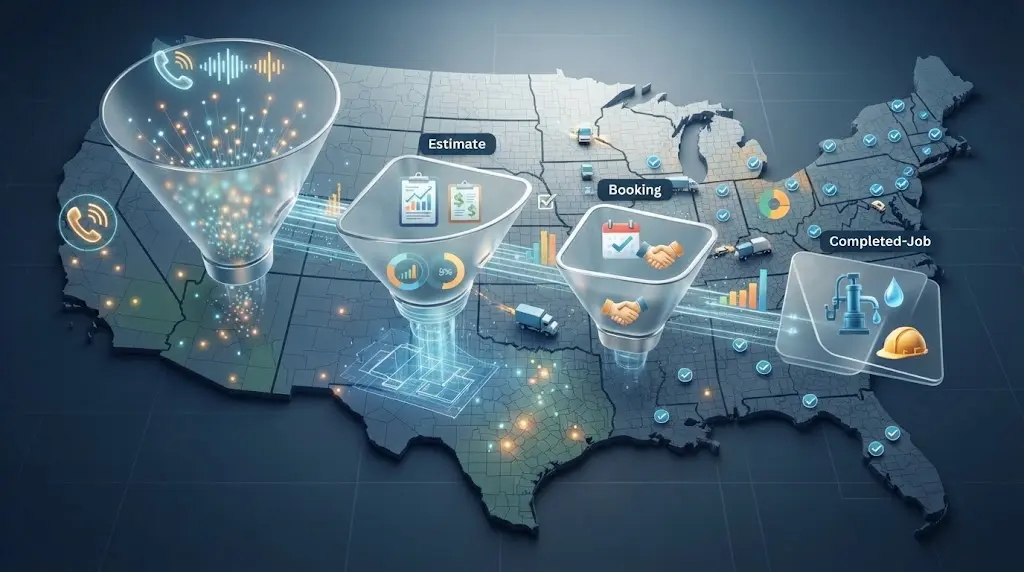
Track the path from visibility to completed work. A useful record includes:
- Search or referral source.
- Service requested.
- County or town.
- Call answered or missed.
- Qualified or unqualified.
- Estimate issued.
- Job booked.
- Job completed.
- Reason lost, if known.
- Direct cost or margin signal, if your system supports it.
The state map does not replace call tracking or a CRM. It tells you where to look and what to normalize. A call-tracking checklist is useful when the missing piece is source and outcome capture.
When should you create a state or location page?
Create a public page only when the company has a truthful, useful reason to discuss that state, county, or service area. The page should explain the actual work, the real boundary, the buyer fit, and the next action. It should not be a city-name swap built from a generic paragraph.
A territory map may show that your company has a genuine opportunity in a neighboring county. That is a reason to research and possibly improve one page. It is not automatic permission to publish dozens of local URLs.
Every public territory claim should survive a dispatcher, a crew lead, and a regulator reading it.
When should you not use a national contractor list?
There are situations where a national list creates more noise than value.
Do not use it as a license registry
A directory can be stale, incomplete, membership-based, or organized around a different service. Use the authority that controls the credential or permit.
Do not use it to forecast demand
A state with many listed businesses may have strong directory coverage. It may also have many competitors, a different directory sampling method, or a broad category that includes unrelated drilling. The list does not replace call, estimate, booking, or margin data.
Do not use it to justify a statewide campaign
Most local and regional well companies need a county cluster or corridor, not a state-wide promise. A broad claim can create calls outside the serviceable area and weaken the information a buyer needs to choose the right provider.
Do not use it when the service is undefined
“Well drilling contractor” can refer to residential, agricultural, commercial, municipal, monitoring, geothermal, or other work. If the intended job is pump repair, search and compare pump-service companies. If the intended job is commercial drilling, build a commercial set.
Do not use it as a substitute for a partner call
Public records tell you who exists. They do not tell you whether the company takes overflow work, accepts referrals, has the equipment, or can meet the schedule. Ask directly and save the answer with a date.
Do not use it when your own operation is the constraint
If you miss calls, delay estimates, lack a qualified operator, or have no capacity, a larger contractor list will not fix the business. Repair intake and delivery first. The state map can wait.
What mistakes make a state contractor map unreliable?
These mistakes are common because they make the spreadsheet look complete while making the decision less trustworthy.
Mistake 1: Copying directory counts into the plan
Counts are easy to quote and hard to compare. Treat them as provider-specific observations with a source date, not as total market size.
Mistake 2: Treating an office address as a service area
An address tells you where a company is listed. It does not tell you its travel radius, project mix, or current work area.
Mistake 3: Combining drilling and pump work
The same business may do both. The buyer, credential, equipment, urgency, and economics may still differ. Keep the service families separate.
Mistake 4: Assuming a state rule is a local rule
California and Alaska show the problem in different ways. Local agencies may control permits or add requirements. Follow the current authority.
Mistake 5: Ignoring the evidence date
A list from three years ago can contain real companies and still be useless for a live decision. Store the date beside the record.
Mistake 6: Treating a well log as a lead
A completion record tells you something about a well. It is not a consented sales lead and not proof that the property owner needs a new contractor.
Mistake 7: Scoring a territory without capacity
A strong demand signal becomes a customer-experience problem when the phone, estimator, crew, or equipment cannot respond.
Mistake 8: Writing the page for the data collector
The point is a decision. End the research with “enter,” “test,” “partner,” “repair,” or “do not pursue,” and state what evidence supports that choice.
How should you choose between two states?
Use the same evidence card for both states, then compare the missing information before comparing the scores.
| Decision card | State A | State B |
|---|---|---|
| Target service | ||
| Target buyer | ||
| Counties in scope | ||
| State resource page checked | ||
| License or registration path | ||
| Permit authority | ||
| Well-log source | ||
| Groundwater-use year and category | ||
| Direct competitor rows verified | ||
| Current crew and equipment fit | ||
| Travel and mobilization fit | ||
| Phone and estimate capacity | ||
| Weighted score | ||
| Blocking unknown | ||
| Decision |
The blocking unknown is the most important field. If State A scores 78 only because the permit path is unknown, it is not a stronger opportunity than State B at 66 with a verified path. The owner should resolve the blocking unknown before buying traffic or hiring around the decision.
What if the state scores well but the search results are weak?
That may be an opportunity, but first test whether the weakness is real. Search the exact service in the target towns, check whether Google is returning directories, general contractors, or adjacent services, and review whether your company can publish a more complete answer.
Then check the non-search reasons for weak visibility. Your company may not have a clear service page, a truthful territory statement, a usable phone path, or enough proof for the intended job. Search visibility is one factor in the map, not the whole score.
The broader well drilling SEO mechanism matters after the state-to-territory decision is clear, not before.
What if the state has strong public well data but heavy competition?
Do not reject it automatically. Strong competition can mean the market matters, but it also raises the standard for service fit, proof, response, and economics. Compare direct competitors by county and service. A large state can contain small local gaps that a statewide count hides.
What if the state has weak public data?
Lower your confidence. Do not automatically lower the opportunity. Ask whether the authority has another route, such as a local permit office, association, records request, or public well-log system. If the missing data cannot be resolved, keep the territory in the research lane and avoid a large commitment.
What is the right next move for an owner?
The right next move is not “find more contractors.” It is to decide what the contractor list is for.
If the purpose is partner discovery, verify scope, location, and direct availability. If the purpose is competitor research, compare the same service in the same county. If the purpose is expansion, score regulation, public context, capacity, and travel before marketing. If the purpose is more qualified calls, turn the selected service and territory into a clear website, profile, phone, and measurement system.
Keep the first map small enough to inspect. One service. One buyer type. One county cluster. One decision. Add states when the evidence and operation justify it.
Brictale can use a free territory audit to show where a well or pump company is visible, where its service and geographic coverage are unclear, and where the public evidence suggests a better next question. The useful output is not a national list. It is a bounded territory decision tied to qualified calls and booked work.
If your state list cannot tell you what to verify next, it is not finished. If it can, use it.
A contractor record without a source date is a research lead, not decision evidence.