
Capacity planning can be a dangerous phrase in a drilling office.
It can mean a fuller schedule, a second rig, a larger service territory, a new pump division, or simply fewer empty days. Those are not the same decision. They carry different staffing, cash-flow, equipment, compliance, and marketing requirements.
Quick Answer: Well drilling contractor capacity planning starts with the next suitable job: define service and territory, check crew, equipment, safety, cash flow, and call handling, then set a stop rule before adding demand. Use one-page gates and a weekly scorecard to decide whether to repair the operation, test a channel, or add capacity.
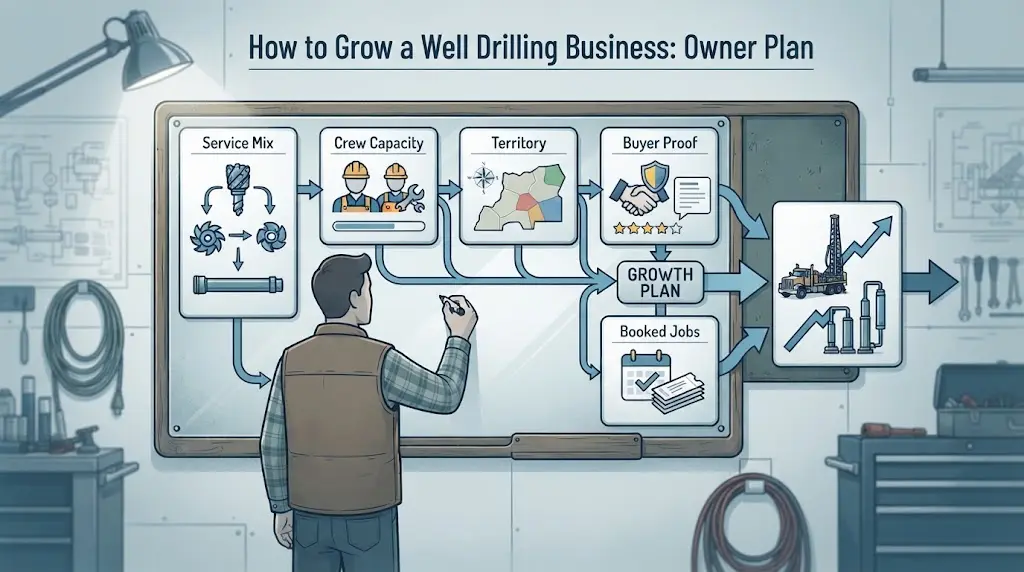
The practical answer is not “do more marketing.” It is to find the constraint that is holding back suitable booked work, then remove that constraint in order.
For one company, that might be a weak Google Business Profile. For another, it might be a phone that rings while the owner is on a rig, estimates that sit for a week, or a territory so broad that every job becomes a mobilization problem. The marketing channel matters, but it is rarely the first decision.
This guide gives you a way to make that decision. It is written for US water well drilling and pump companies, including operators that handle drilling, pump installation, pump repair, replacement, rehabilitation, testing, or related groundwater work. The U.S. Census Bureau places water well drilling and water well pump and well piping system installation within NAICS 237110 in the 2022 classification system, but the business decisions inside that category still vary sharply by state, service mix, and territory. The Census classification is useful for naming the industry, not for predicting your demand or profit.
What does capacity planning mean for a well drilling business?
Growth means increasing the amount of suitable, profitable work the company can complete without letting service quality, cash flow, safety, or control deteriorate.
That definition has four parts:
- Suitable work. The job fits the licenses, equipment, skills, geography, schedule, and services you actually want to sell.
- Profitable work. The work produces enough gross profit after direct labor, materials, fuel, subcontractors, mobilization, warranty exposure, and other direct costs to justify taking it.
- Completable work. The team can answer, quote, schedule, perform, document, and collect without creating a new backlog that damages the next job.
- Repeatable work. The company can win and deliver the work again, instead of relying on one lucky referral or one unusually large project.
An owner who defines growth only as revenue can miss the warning signs. Revenue can rise while margin falls. Calls can rise while the crew spends more time on out-of-area estimates. A new service can add sales but also add callbacks, inventory, training, or insurance complexity.
The U.S. Small Business Administration recommends that a business plan describe the company’s market, organization, marketing and sales approach, and financial projections. It calls the plan a roadmap for how a business is structured, run, and grown. SBA planning guidance is general, but the principle is important for a well contractor: your growth plan has to connect the market decision to the operating and financial decision.
A fuller calendar is not the same thing as a stronger well drilling business.
Use these questions to define the growth you actually want:
| Growth question | Better answer than “more” |
|---|---|
| More of what? | Residential drilling, commercial drilling, pump repair, replacement, rehabilitation, testing, or another named service |
| From where? | A core territory, a defined expansion zone, or a partner-referred area |
| For whom? | Property owners, builders, farms, facilities, developers, municipalities, or another buyer group |
| At what operational cost? | A known crew, equipment, mobilization, response, and follow-up requirement |
| Measured by what? | Qualified calls, estimates, booked jobs, completed jobs, gross profit, and collection time |
If you cannot answer the first three questions, more traffic will not clarify the business. It will only make the ambiguity louder.
Which constraint should you fix before chasing growth?
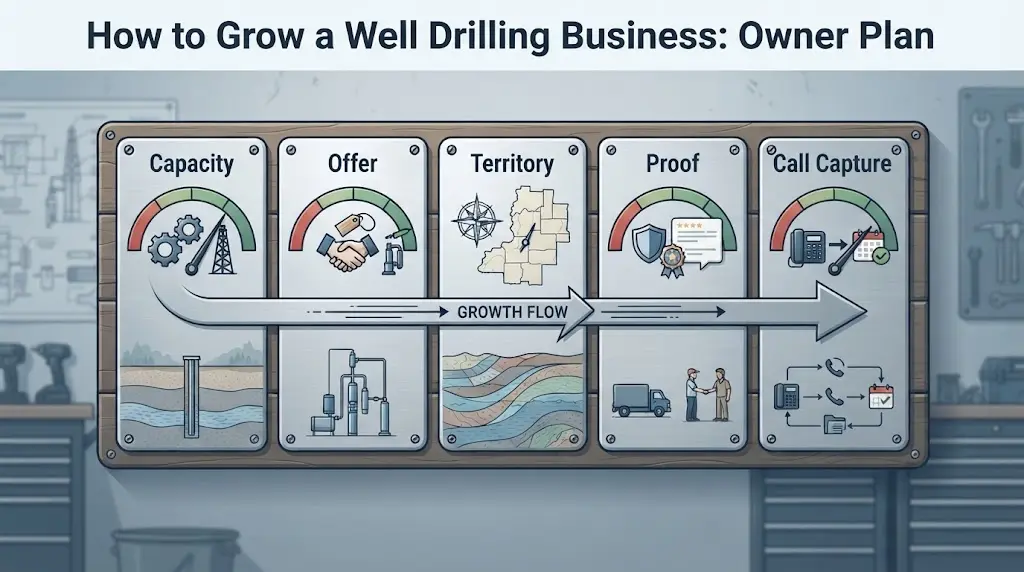
Before adding demand, score the five conditions that determine whether demand can become good work. Brictale calls this the Growth Control Board. It is an owner framework, not a Google ranking factor, a market benchmark, or a promise of results.
The five gates
| Gate | The question | Score 0 | Score 1 | Score 2 |
|---|---|---|---|---|
| Capacity | Can the operation accept the next suitable job? | No reliable availability, response rule, or ownership | Some availability, but a visible bottleneck | Clear capacity, dispatch ownership, and response rule |
| Offer | Is the target work clear? | “We do everything” | Services are listed but priorities are unclear | Core, supporting, and declined work are explicit |
| Territory | Is the geography worth serving? | Broad coverage with no economic filter | Coverage is known but not prioritized | Core, expansion, and exclusion zones are written |
| Proof | Can a buyer verify fit? | Generic claims and thin evidence | Some reviews, photos, or project detail | Accurate business facts and relevant service proof are easy to verify |
| Capture | Can inquiries become booked jobs? | Missed calls and no disposition record | Calls are answered but outcomes are inconsistent | Calls, estimates, bookings, completions, and sources are recorded |
Add the five scores.
- 0-4: Repair first. Do not buy broad demand. Fix the lowest gate and re-score in two weeks.
- 5-7: Test carefully. Choose one service-territory combination, run one controlled demand test, and repair the weakest gate at the same time.
- 8-10: Scale in stages. The business has a reasonable base for increasing demand or testing capacity expansion, but it still needs a stop rule.
The value is not the number. The value is forcing the owner to name the constraint.
How to use the board in an owner meeting
Take one sheet of paper and write the score beside each gate. Do not let everyone average their opinion. Ask for the evidence behind each score.
For capacity, look at the next realistic opening, not the theoretical maximum number of rig hours. For offer, list the jobs you want more of and the jobs you routinely decline. For territory, compare drive time and mobilization with the work’s economics. For proof, open the profile and website as a new prospect would. For capture, review a sample of real calls and estimates.
Then ask a blunt question: If 20 more relevant inquiries arrived next month, where would the system fail?
That answer is the next growth project.
If the phone would go unanswered, improve call ownership and after-hours routing. If the crew has no availability, improve scheduling, pricing, or job selection before buying traffic. If the company gets calls but few estimates, fix qualification and quoting. If suitable jobs exist but no one can find the company, work on local visibility and service proof.
A growth plan that cannot name its stop rule is a spending plan, not an operating plan.
OSHA’s small-business safety guidance is also relevant to this gate. OSHA recommends a proactive safety and health program built around seven core elements, including management leadership, worker participation, hazard identification and assessment, education and training, and program improvement. OSHA’s safety-management guidance says these programs can support compliance, lower costs, worker engagement, productivity, and overall operations. Growth that ignores safety is not growth you can defend to your crew, insurer, customers, or regulator.
How should you choose the services to grow?
Choose the service that combines real demand with fit, margin, capacity, and proof. Do not add an adjacent service simply because it sounds close to drilling.
A combined well-and-pump company can have several offers that look related to an outsider but behave differently in the business:
- New residential well drilling can involve long sales cycles, site questions, permitting, geology, and a large mobilization decision.
- Pump repair can be urgent, response-sensitive, and dependent on parts, technicians, and after-hours coverage.
- Pump replacement can sit between emergency service and planned work, depending on the failure and system.
- Well rehabilitation or testing may rely more on technical trust and commercial relationships than on emergency search demand.
- Commercial, agricultural, or municipal work can involve bid processes, procurement requirements, longer timelines, and different proof.
The fact that the U.S. Census classification includes both well drilling and pump or piping installation does not mean they should share one offer, one page, one campaign, or one operating target. Treat each meaningful service as its own service-territory decision.
Build a service scorecard
For each service, record the following from your own books and team knowledge:
| Field | What to record |
|---|---|
| Desired job | The exact job type you would willingly book more often |
| Buyer | The person or organization who usually authorizes it |
| Trigger | New construction, failure, replacement, inspection, expansion, compliance, or another event |
| Gross-profit pattern | Your own recent range after direct costs, not an online industry average |
| Mobilization | Travel, equipment movement, site preparation, and return requirements |
| Crew requirement | Skills, certifications, number of people, and supervision |
| Response expectation | Same day, scheduled estimate, bid timeline, or another real standard |
| Evidence | Photos, project notes, reviews, certifications, permits, partners, or case material you can publish honestly |
| Disqualifiers | Areas, job types, conditions, or timing you do not want |
| Next bottleneck | The thing that would break if demand increased |
Score each field as strong, mixed, or weak. A service with strong demand but weak capacity is not ready for aggressive promotion. A service with strong margin but no proof may need a partner or customer-evidence plan before it needs more ad spend.
Use a three-bucket offer architecture
Put each service into one of three buckets:
- Core growth service. You want more of it, can deliver it well, and have a credible path to demand.
- Supporting service. It helps existing customers, referrals, or job value, but it is not the primary growth bet.
- Protected or declined service. You perform it selectively or do not want it because the fit, economics, risk, or capacity is wrong.
This architecture prevents a common mistake: advertising every service equally and then wondering why the schedule contains a random mix of low-fit inquiries.
The service page, profile language, referral conversations, and intake questions should all reflect the same buckets. If pump repair is a protected service during a drilling backlog, say so internally before publishing “24/7” language that the team cannot honor.
Your best marketing message is often a decision about what not to sell.
When should you add a new service?
Add a service only when you can answer five questions:
- Which existing customers or partners will ask for it?
- What equipment, parts, skills, licenses, insurance, and training does it require?
- Who owns the work from first call through completion and warranty?
- What will make the offer credible to a buyer who does not already know you?
- What existing service could be delayed or weakened while the team learns it?
If you cannot answer those questions, treat the service as a research item, not a growth campaign.
Which territory should you grow into?
Expand by serviceable economics, not by drawing the largest possible radius around the office.
Google’s official local-ranking guidance says, “Local results are mainly based on relevance, distance, and prominence.” The same page explains that complete and accurate Business Profile information helps relevance, that distance relates to the searcher and business, and that prominence can reflect links, reviews, and how well-known the business is. Google’s local-ranking guidance does not offer a way to pay for a better organic local position.
That creates a practical limit for service-area companies. A website can explain that you travel to a county. It cannot make every searcher equally close, and it cannot make an unprofitable mobilization worthwhile.
Build a territory map with three zones
Create three zones for each priority service:
| Zone | Meaning | Marketing decision | Operating decision |
|---|---|---|---|
| Core | The area where you can respond, quote, and complete work reliably | Full proof and visibility effort | Protect response time and route density |
| Expansion | An area with plausible demand but higher uncertainty or mobilization | Test one service with clear limits | Track travel, win rate, and contribution separately |
| Exclusion | An area or job type you do not want to pursue | Do not buy broad demand there | Refer, partner, or decline honestly |
Your core zone may differ by service. Pump repair may need a tighter response area than scheduled drilling. Commercial work may justify more travel than a small service call. Agricultural work may cluster around a different geography than residential work.
Do not add a territory to the map until you can add a route to the schedule.
Score a territory before expanding
Use a simple five-part test. You do not need a market-size report to make the first cut.
- Service fit: Do buyers there need the exact service you want to grow?
- Route fit: Can the crew reach it without turning every job into an exceptional trip?
- Proof fit: Do you have local projects, partners, permits, reviews, or other evidence that will make the offer credible?
- Competition fit: Can a buyer understand why to call you, or would you be an unknown provider with no local context?
- Capacity fit: Can the current team serve the area without weakening the core zone?
Rate each from 0 to 2 and compare territories. This is not a market forecast. It is a way to choose which territory deserves a real test.

What counts as local proof?
Local proof is not a page with a city name inserted five times. It is evidence that a buyer can verify:
- Completed work in the area, described accurately.
- The services you actually perform there.
- A real service area, office, or operating base represented correctly.
- Reviews that mention the work or customer experience without being fabricated or incentivized.
- Trade, supplier, builder, engineering, or community relationships that are real and permissioned.
- Clear answers about timing, site evaluation, estimates, and next steps.
Google’s local guidance says more reviews and positive ratings can help local ranking, but that is not a reason to buy, fake, or reward reviews. It is a reason to build a legitimate process for asking satisfied customers for honest feedback and to monitor what buyers repeatedly value or question.
The territory decision should also respect local law. Regulations are not uniform across the United States. For example, Michigan EGLE states that Michigan requires registration before engaging in water well drilling or repair, or pump installation or servicing, and it recommends continuing education and professional involvement. Michigan’s state guidance is evidence for the state-specific principle, not a national rule. Check the regulator, licensing board, permitting office, and insurance requirements for each territory before you market there.
Is your operation ready for more demand?
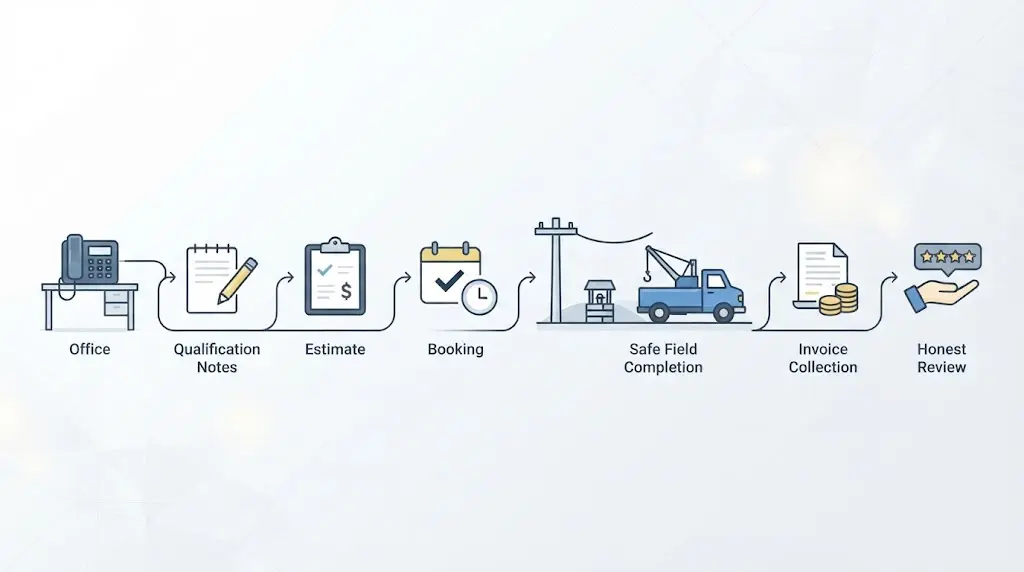
The operation is ready when the next suitable inquiry has a clear path to an answered call, qualified estimate, scheduled job, safe completion, and collected payment.
Do not judge readiness only by whether the rig has an open day. Look at the complete path:
- A prospect finds the company.
- Someone answers or returns the call.
- The company confirms location, service need, urgency, and fit.
- The right person estimates or visits the site.
- The prospect receives a clear next step and timeframe.
- The work is scheduled with the correct crew and equipment.
- The job is delivered safely and documented.
- The invoice is collected.
- The customer is invited to provide honest feedback and refer suitable work.
The weakest step sets the practical limit on growth.
Check the capacity signals owners usually miss
Review the last eight to twelve weeks, or another period long enough to show your normal pattern. Use your own records.
- How many jobs were completed by service line?
- How many days were lost to weather, equipment, crew absence, permits, or material delays?
- How many suitable inquiries could not be scheduled in a reasonable window?
- How many jobs required an owner to do work that someone else could be trained to own?
- How often did the company decline work because of geography or timing?
- How many open estimates are still waiting for a decision?
- How many callbacks or warranty issues consumed capacity after completion?
- How long did it take to collect from completed work?
- Which role becomes the bottleneck if booked work rises by one job per week?
This list does not produce a universal utilization target. It tells you where your own operation is losing capacity.
Add a capacity stop rule
Write the conditions that pause new demand. For example:
- The priority service has no acceptable opening inside the response standard.
- The owner cannot review and qualify new estimates within the agreed window.
- The company has a safety, compliance, equipment, or staffing issue that is not controlled.
- The cash required for materials, payroll, fuel, or equipment is not visible.
- The company cannot answer the phone or return suitable calls consistently.
When a stop rule triggers, pause the channel that creates the most excess demand and fix the constraint. A pause is not failure. It protects the business from paying to disappoint people.
How should you build a capacity plan that operations can support?
Build the plan in this order: service, territory, capacity, proof, capture, demand, measurement, reinvestment.
The order is deliberate. A marketing plan that starts with channels can create inquiries before the company knows what it wants to sell or how it will process them.
The SBA’s marketing guidance says marketing takes time, money, and preparation. It recommends defining a target market, competitive advantage, sales plan, goals, action plan, and budget, then comparing marketing cost with revenue and updating the plan. SBA marketing and sales guidance also says operations can shape customer experience and loyalty. For a drilling company, the “sales plan” includes the phone, estimating, dispatch, and follow-up process, not just the ad account.
Use the one-page owner plan
Write one sentence or short line for each field:
| Field | Your answer should name |
|---|---|
| Growth objective | The service, buyer, territory, and period |
| Constraint | The current weakest Growth Control Board gate |
| Proof | The evidence you already have and the evidence you need |
| Demand test | One channel, one service, one territory, one time window |
| Owner | The person responsible for the next action |
| Stop rule | The condition that pauses the test |
| Economic test | The job outcome that makes continuation sensible |
| Review date | A fixed date when the company will decide what to keep, change, or stop |
The plan should fit on a page because an owner and crew can use it. If it needs a strategy deck to explain what happens next Tuesday, it is not operational enough.
Set one primary growth bet
Choose one service-territory combination for the first test. Examples of the shape, not prescriptions, include:
- Scheduled residential well drilling in the core counties.
- Pump replacement for existing customers within a defined response area.
- Commercial well evaluation for a small set of builder or engineering partners.
- Well rehabilitation for facilities where the company already has technical credibility.
Do not launch a residential drilling campaign, a pump emergency campaign, a commercial bid program, and five new county pages at the same time. When everything changes, you cannot tell what worked or what created the new bottleneck.
Which demand channels should a well drilling company use?
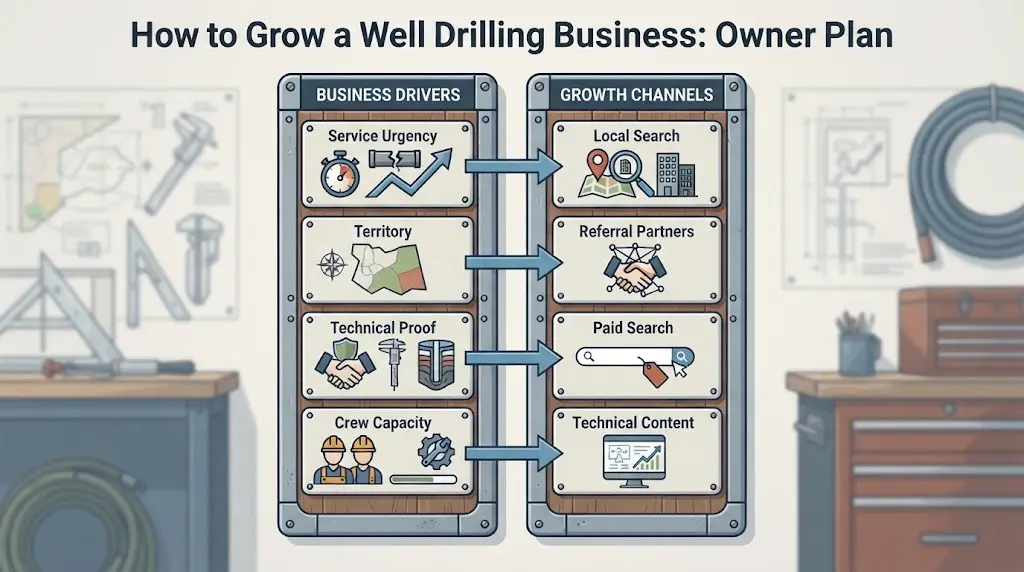
Use the channel that matches the trigger, urgency, geography, proof requirement, and capacity of the chosen service. No channel is automatically best for every well contractor.
Local visibility and the website
Local visibility helps a buyer discover the company when the service and location match. Start with accurate business information, a verified Business Profile where eligible, clear service categories, real service areas, useful photos, honest reviews, and a website that explains the actual offer.
Google says complete and accurate Business Profile information can help a business appear for relevant local searches. It also says relevance, distance, and prominence are the main local factors. That gives an owner a practical checklist, but not a ranking guarantee.
The website should make five things obvious:
- Which well or pump services you provide.
- Where you serve them.
- What kind of buyer or job is a fit.
- What evidence supports the offer.
- What the next step is.
The existing well drilling SEO system covers the search and site mechanism in more detail. Link to it when the owner has decided that discovery is the bottleneck. Do not treat SEO as the whole growth plan.
Google Search Central recommends people-first content with original information and substantial value, and it explicitly says there is no preferred word count. Google’s helpful-content guidance supports the same editorial rule used here: create a page because the owner or buyer needs it, not because a keyword tool suggested a page.
Referral partners
Referral partners can be especially useful when the buyer needs more than a quick service call or when the job requires trust before a quote. Potential partners may include builders, excavators, septic companies, geotechnical professionals, engineering firms, property managers, water treatment providers, equipment suppliers, and other contractors whose customers need groundwater work.
The partner list should be based on real overlap, not a mass email campaign. For each partner, record:
- Which customer problem creates the referral.
- What work you can accept.
- What work you do not accept.
- The territory and response expectation.
- How the partner should contact you.
- Whether there is any legal, contractual, or professional rule affecting referrals.
- How the referred inquiry will be recorded and reported back.
The strongest partner message is specific. “We do well work” is weak. “We handle pump replacement and well-system troubleshooting in these counties, and here is how we qualify the request” is useful.
Existing customers and past relationships
Past customers can create referrals, reviews, maintenance work, and future service needs. The follow-up must be appropriate to the relationship and the service. Do not promise annual work that the company cannot support, and do not send marketing messages without handling consent and applicable rules.
A simple sequence might include:
- Completion confirmation and contact information.
- A check that the customer received the relevant documentation.
- A request for honest feedback.
- A reminder that the company can be contacted for the services it actually provides.
- A referral request that names the kinds of work and areas you want.
The point is not to turn a drilling company into a newsletter publisher. The point is to stop treating every completed job as the end of the relationship.
Paid search
Paid search can create faster visibility for a defined service and territory, but it also creates faster waste when the offer or intake is unclear. Test it after the company can answer, qualify, and track inquiries.
Use a narrow test:
- One service.
- One territory.
- A written list of suitable and unsuitable searches.
- A landing page that matches the service.
- A daily or weekly budget the company can afford to learn from.
- A call and form tracking setup.
- A stop rule for irrelevant inquiries, missed calls, or unacceptable booked-job economics.
Google Ads documents conversion actions for calls from ads, calls from a phone number on a website, and imported offline call conversions. Google’s phone-call conversion guidance also explains that a company can connect call outcomes to its reporting rather than treating every phone event as equal.
Use that capability to record outcomes, not to make the report look sophisticated. A call that lasts longer than a configured threshold is not automatically a qualified call. A qualified call is not automatically an estimate. An estimate is not automatically a booked job.
Video and technical proof
Technical work is often easier to understand when a buyer can see the process, equipment, site conditions, or decision points. A short, accurate video can support a service page, partner conversation, estimate follow-up, or social post.
Do not film a customer’s property, documents, or workers without the necessary permission. Do not reveal sensitive site information. Do not turn a technical process into a claim that guarantees water yield, timing, or outcome.
The content should answer a buyer’s real question:
- What happens during a site visit?
- What information is needed before an estimate?
- What can change the scope of a pump replacement?
- What does the company document after a job?
- Which conditions cause the company to decline or refer work?
The best proof makes the buying decision clearer. It does not simply show a rig in motion.
How to choose the first channel
Use this decision table:
| If the main problem is... | Start with... | Do not start with... |
|---|---|---|
| People do not understand what you do or where | Profile accuracy, service pages, and territory clarity | Broad ads to a generic homepage |
| Suitable people know you but do not call | Proof, contact path, phone ownership, and response | More impressions without conversion review |
| The core area is known but the schedule has openings | A controlled local or partner demand test | A wide radius with no stop rule |
| Calls arrive but fit is poor | Qualification language, exclusions, intake questions | More budget |
| Estimates are slow or inconsistent | Estimating ownership, templates, and follow-up | More lead sources |
| Demand is strong but work cannot be completed | Staffing, equipment, routing, safety, and cash-flow review | Scaling ads or buying a rig immediately |
This is where the broad query becomes an owner decision. Growth is not a channel checklist. It is a sequence of constraint decisions.
How should you turn calls into booked jobs?
Treat the phone and estimate process as part of marketing. The company has not generated business when a call arrives. It has generated a business opportunity that still needs an owner, a qualification step, an estimate, follow-up, scheduling, completion, and collection.
Define a minimum call record
For every inquiry, record enough information to decide what happened:
- Date and time.
- Source, if known.
- Caller location.
- Service requested.
- Urgency or trigger.
- Fit or disqualifier.
- Call answered, missed, or returned.
- Estimate needed, sent, accepted, declined, or pending.
- Booked, completed, canceled, or referred.
- Reason for losing the opportunity.
You can start this in a shared sheet or the system you already use. The tool matters less than consistent categories. If “bad lead” is the only outcome, the company cannot learn whether the problem was geography, service mismatch, timing, price, missed response, or an estimate that never went out.
Write the intake questions
The first conversation should not feel like an interrogation. It should protect both sides from a poor fit. The exact questions depend on your service, but the structure is stable:
- Where is the property or job site?
- What service is needed?
- What happened, or what project is being planned?
- What timing matters?
- Who is responsible for the decision?
- What information, photos, reports, or access details are available?
- What is the next step and who owns it?
For emergency pump work, the response and safety rules may differ from scheduled drilling. For commercial work, procurement and site information may matter more than a quick appointment. Write the intake around the service bucket instead of using one generic script.
Measure the response failure separately
A missed call is not the same as a low-quality call. A caller outside your territory is not the same as a caller who was never contacted. An estimate lost on price is not the same as an estimate that took ten days.
Separate these failures in the scorecard. Then choose the fix:
| Failure | Likely fix |
|---|---|
| Missed calls during field work | Phone ownership, live answering, or a clear return-call process |
| Calls outside the service area | Better territory language, profile accuracy, and intake filtering |
| Suitable calls with no estimate | Estimating owner, site-visit slots, and follow-up deadline |
| Estimates with no decision | Scope clarity, proof, expectation setting, and follow-up process |
| Booked jobs canceled | Scheduling, confirmation, deposit or contract process where appropriate, and clear scope |
| Completed jobs with slow collection | Payment terms, invoice ownership, documentation, and accounts-receivable review |
Do not solve every failure with more traffic. That is how a small operator buys a bigger version of the same leak.
How should you decide whether growth is profitable?
Use your own job economics to decide what you can pay to acquire an additional booked job. Do not use a generic lead-cost article as a substitute for your books.
Start with gross profit per booked job
For a chosen service, calculate:
gross profit per completed job = collected revenue - direct labor - materials - subcontractors - fuel and travel - equipment-specific direct cost - other direct job cost
Use a period that represents normal work. If the service has wide variation, use separate bands or scenarios. Keep overhead such as office rent, general software, and owner salary visible elsewhere rather than hiding it inside a number that changes from job to job.
Then decide what share of that gross profit you are willing to spend to acquire a booked job. That share is a management choice. It depends on cash, backlog, repeat or referral value, warranty exposure, and the owner’s growth objective.
Use an allowable acquisition-cost formula
Brictale’s planning formula is:
allowable acquisition cost per qualified opportunity = gross profit per completed job × acceptable acquisition share × estimate-to-book rate × qualification rate
This is a planning model, not a market benchmark. Insert your own values. If a qualified opportunity becomes an estimate at a known rate and estimates become booked jobs at another known rate, the formula makes the expected economics visible.
If you already track cost per booked job directly, use that. If you do not, start with a conservative assumption, label it as an estimate, and replace it with actuals as the pipeline fills.
Example with variables, not invented market prices
Suppose your records show:
G= gross profit per completed job.S= the share of gross profit you allow for acquisition.E= the share of qualified opportunities that receive an estimate.B= the share of estimates that become booked jobs.
Then:
allowable cost per opportunity = G × S × E × B
The formula is intentionally boring. That is a benefit. It stops the team from comparing a platform’s reported “lead” with a completed job and calling the difference ROI.
Add the fully loaded cost
Include more than the ad invoice or agency bill. Your comparison should include:
- Media spend.
- Agency or contractor cost, if any.
- Landing-page or creative work.
- Call-tracking or software cost.
- Staff time spent answering, qualifying, estimating, and following up.
- Travel or site-visit cost that is directly caused by the test.
- Rework from poor-fit jobs.
The right result is not the channel with the cheapest inquiry. It is the channel and service combination that produces acceptable booked and completed work without creating a constraint the business cannot afford.
The cheapest qualified call is the one your team can answer and convert.
The owned page how much should a well contractor spend on marketing goes deeper on budget guardrails. This article’s job is to put spending inside the wider growth sequence.
Track time, not only money
A channel that produces a few high-value estimates may still be a poor choice if it consumes the owner’s field time, creates long-distance site visits, or generates work that disrupts a stronger service line. Record owner and crew time when comparing tests.
That is especially important for a small company. A dollar of direct marketing cost is visible. A day pulled away from productive field work is often buried.
What should a well drilling business publish to build trust?
Publish the information a serious buyer needs before calling, with the precision you can support.
For a drilling or pump company, useful proof usually comes from the work itself:
- The services and conditions you handle.
- The territories and job types you accept.
- The steps in an estimate or site evaluation.
- What affects timing and scope.
- What customers can expect before, during, and after the job.
- The equipment or technical process when it is safe and appropriate to explain.
- Licenses, registrations, certifications, memberships, or training that are current and relevant.
- Real project photographs and descriptions with permission.
- Honest customer feedback.
- Clear boundaries around work you do not perform.
Do not create a “service area” page for every town if the page has no unique evidence and the company does not meaningfully serve the town. Do not publish a project story that blurs a pump replacement into a new well drilling result. Do not turn a general claim such as “quality work” into a testimonial.
Google’s people-first content guidance asks whether a page provides original information, substantial value, and enough information for someone to achieve their goal. That is a useful standard for service proof even when the page is not intended to rank. The buyer should leave with a better decision, not another reason to search.
Use a service-proof brief
Before a page, video, or partner sheet is published, complete this brief:
- What service does this prove?
- Which buyer does it help?
- Which territory does it support?
- What part of the process does it explain?
- What source or first-party record supports the statement?
- What should the reader do next?
- What should the company refuse to promise?
The last question matters. A credible company explains uncertainty. Groundwater conditions, site access, permits, existing equipment, material availability, and other factors can affect scope and timing. The page should help buyers understand the process without pretending that every job has a guaranteed outcome.
What should the owner do in the first 30 days?
Use the first month to remove uncertainty and run one small test, not to rebuild every channel at once.
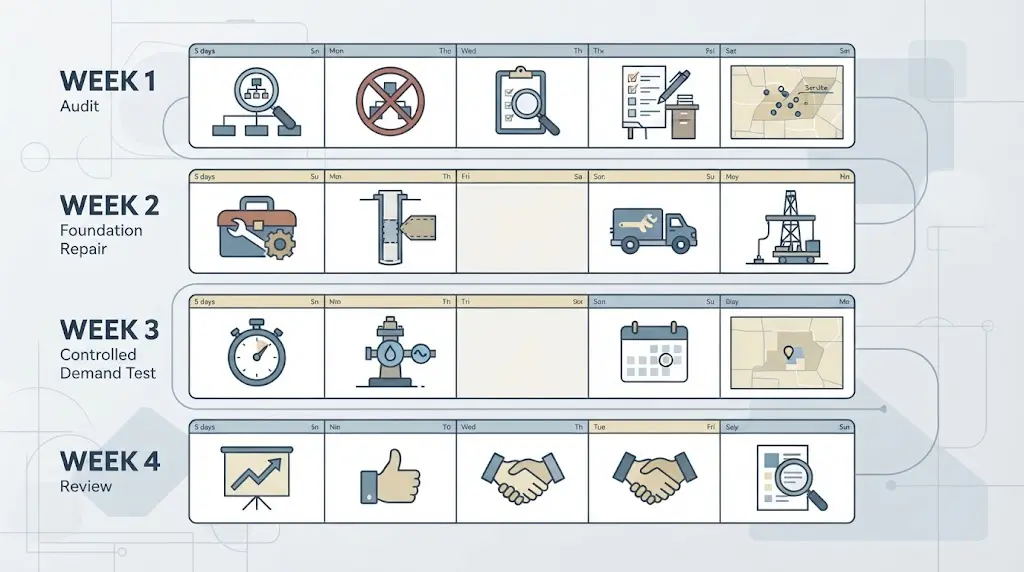
Days 1-5: score the business
Complete the Growth Control Board. Pull recent job and call data. List the services, territories, referral sources, and marketing sources that already exist.
At the end of day five, you should know:
- The one service-territory combination you are testing.
- The weakest gate.
- The person who owns the next action.
- The stop rule.
- The fields you will record for every inquiry.
If you do not know those five things, spend another week on the audit. Do not start with ad copy.
Days 6-10: repair the foundation
Fix the smallest set of issues that block a fair test:
- Business name, phone, hours, and service information.
- Core territory and exclusion language.
- The service page or landing page for the chosen offer.
- A visible contact path on mobile and desktop.
- Call ownership and return-call process.
- Estimate template and follow-up owner.
- Tracking categories for source, fit, estimate, booking, and completion.
Google’s local guidance supports accurate, complete Business Profile information. Google Ads’ documentation supports call conversion and offline outcome tracking. Together, they make the measurement standard practical, but they do not create the data for you. The owner still has to classify the job correctly.
Days 11-20: run one demand test
Choose one channel that matches the constraint. If local discovery is weak, improve the profile and service page. If the company has a strong profile but open capacity, test tightly scoped paid search or partner outreach. If the company has a strong customer base but weak referral flow, build a simple follow-up and referral process.
Keep a change log. Write down:
- What changed.
- When it changed.
- What service and territory it affected.
- What outcome you expected.
- What you will measure.
Do not change the offer, territory, budget, intake process, landing page, and follow-up timing every other day. You will create movement without learning.
Days 21-25: inspect call and estimate quality
Review the actual inquiries. Listen to calls where allowed and appropriate. Check whether the page and profile attracted the right service and territory. Look for unanswered calls, slow returns, unclear next steps, and repeated disqualifiers.
At this point, the best improvement may be operational. A small change in phone ownership or estimating can be more valuable than a new creative asset.
Days 26-30: decide what to keep
Use the same scorecard. Compare qualified inquiries, estimates, booked jobs, completed work, and fully loaded cost with your starting assumptions. Decide one of four outcomes:
- Keep and extend the test.
- Keep the channel but repair a specific gate.
- Stop the channel because the service-territory fit is poor.
- Move to capacity work because demand is now adequate.
Do not declare success because the phone rang. Do not declare failure because a single week was quiet. Use the review date and the data you said you would collect.
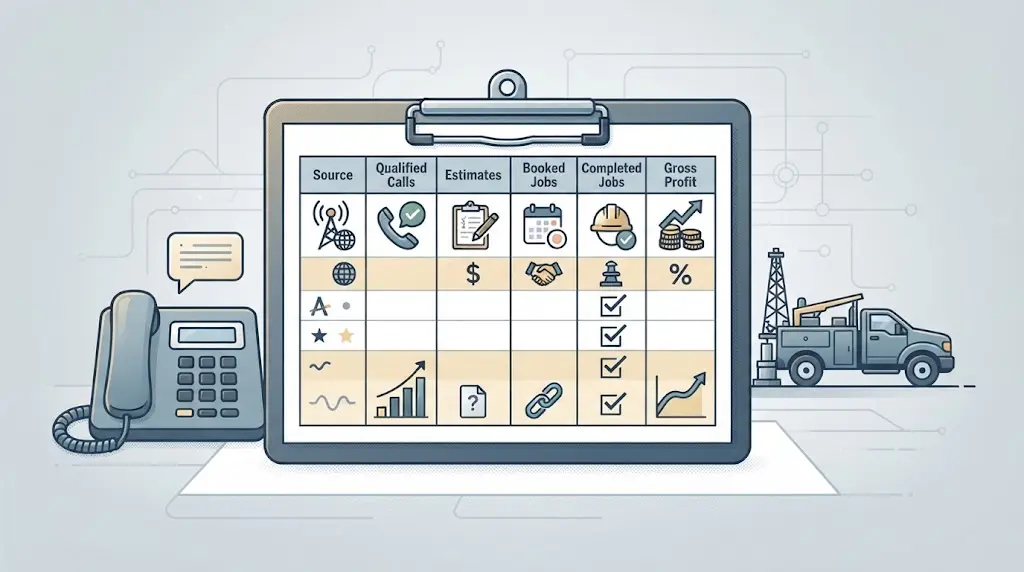
What should the owner measure every week?
Measure the pipeline from visibility to collected work, while keeping each stage separate.
The weekly scorecard
| Stage | Metric | Owner question |
|---|---|---|
| Discovery | Profile views, website visits, search impressions, referral introductions | Are suitable buyers finding the company? |
| Contact | Calls, forms, answered calls, returned calls | Did the company make contact possible? |
| Qualification | In-area calls, service-fit calls, disqualified calls | Is demand aligned with the offer and territory? |
| Estimating | Site visits, estimates sent, estimate age | Is the company moving suitable opportunities forward? |
| Booking | Jobs booked, booking rate, time to book | Is the sales process producing scheduled work? |
| Completion | Jobs completed, cancellations, callbacks, warranty work | Can the operation deliver the work well? |
| Economics | Collected revenue, direct cost, gross profit, acquisition cost | Is the growth test worth continuing? |
| Learning | Top lost reasons and next constraint | What should change next week? |
Do not compare a marketing channel at the discovery stage with a completed job at the revenue stage. Keep the stages connected, but do not collapse them.
Use source labels carefully
A customer may see a profile, visit a website, call from a referral, and mention a neighbor. Attribution is not always perfect. Record the best available source and mark uncertainty. A useful “unknown” category is more honest than forcing every job into a channel.
For paid campaigns, use the platform’s tracking where configured, then reconcile with your own call and CRM records. Google documents that website call conversion tracking can identify calls from people who visited the site after an ad click and that call outcomes can be imported. Google Ads conversion guidance supports the technical path, but business judgment still determines whether the call was good.
Review lost work, not just won work
Every week, choose a handful of lost inquiries and classify the reason:
- Outside territory.
- Wrong service.
- No capacity.
- Could not reach the caller.
- Caller did not respond.
- Estimate not sent.
- Price or scope mismatch.
- Competitor selected.
- Timing mismatch.
- Compliance or site condition.
- Unknown.
The lost-work list often reveals a better growth move than the winning list. If 30 percent of calls are outside the area, the solution may be territory communication. If suitable calls are waiting for estimates, the solution may be office process. If a service line wins well but lacks capacity, the next move may be hiring or routing rather than marketing.
What common growth mistakes should a well contractor avoid?
Avoid growth decisions that create activity without a way to learn from it.
Mistake 1: Treating every service as equal
An owner lists drilling, pumps, testing, treatment, rehabilitation, and emergency work on every page, then promotes all of it in one message. The buyer cannot tell what the company is best suited for, and the business cannot tell which service the demand supports.
Fix it with core, supporting, and protected service buckets.
Mistake 2: Expanding the map before the route
A company adds counties because a keyword tool shows search volume. The crew spends more time driving, the owner attends more estimates, and the core area receives slower service.
Fix it with core, expansion, and exclusion zones. Track the expansion separately.
Mistake 3: Buying leads before fixing the phone
More inquiries do not help if nobody owns the line, after-hours coverage is unclear, or calls are not returned. Paid traffic makes this mistake expensive quickly.
Fix call ownership and return-call standards first.
Mistake 4: Using reviews as a substitute for proof
Reviews can help local prominence and trust, but they cannot explain the service, territory, process, or next step by themselves. Never buy, fabricate, or incentivize reviews. Google treats fake or incentivized reviews as a policy problem and can restrict a Business Profile.
Fix the service proof, then ask satisfied customers for honest feedback through a compliant process. Google says fake and incentivized reviews can lead to restrictions on a Business Profile in its policy-violation guidance.
Mistake 5: Buying a rig to solve a demand problem
A second rig does not create suitable inquiries. It creates capital cost, maintenance, staffing, training, scheduling, and utilization requirements.
Fix demand and booking visibility first. Consider equipment only when the company can show that the current constraint is real capacity and that the financial and safety systems can support expansion.
Mistake 6: Chasing rankings as the outcome
Rankings are a discovery signal. They are not estimates, bookings, collections, or gross profit. Google’s people-first guidance also warns against creating content primarily to attract search visits and says there is no preferred word count. Google’s guidance supports a better standard: the page should help a buyer make the next decision.
Mistake 7: Copying generic marketing advice
“Do SEO, social media, content, and email” is not an operating plan. It does not name the service, territory, proof, owner, stop rule, or economic test.
Fix the sequence. The right channel is the one that removes the current constraint for the chosen service and territory.
Mistake 8: Hiding compliance until after the sale
Registration, licensing, permits, insurance, environmental requirements, labor rules, and customer documentation can change by state and locality. A growth plan that ignores them can create work the company should not accept.
Fix the compliance check before expanding a service or territory. The Michigan example cited earlier is a reminder that the rules are not universal.
When should a well drilling business not grow?
Do not pursue more demand when the company cannot safely, legally, or profitably serve the work it would attract.
Pause growth work when:
- The owner cannot state the service and territory being grown.
- The company is missing calls or has no return-call ownership.
- The estimate backlog is aging without a clear reason.
- The crew is already missing commitments or generating avoidable callbacks.
- A required license, registration, permit, insurance condition, or safety control is unresolved.
- Cash flow cannot support the direct cost of additional work.
- The company has no record of where inquiries came from or what happened to them.
- The only argument for growth is that a competitor appears to be doing more.
- The proposed expansion would damage the core territory.
- The owner is trying to use content to solve a capacity or collections problem.
This is not anti-growth. It is a guardrail against buying demand that the company has not earned the right to handle.
What to do during a pause
Use the pause to improve the business that existing customers already experience:
- Finish open estimates.
- Return calls and document outcomes.
- Reduce avoidable repeat visits.
- Clarify job scopes and customer expectations.
- Reconcile collections and direct costs.
- Train the next person who can own a bottleneck.
- Build proof from completed work with permission.
- Re-score the Growth Control Board.
The company may emerge with a smaller, more profitable growth bet than the one it would have chosen during a busy sales conversation.
Should you handle growth in-house or get outside help?
Handle the work in-house when the owner or team can keep the service-territory decision, proof, intake, and scorecard current. Get outside help when the team needs specialist capacity, an independent territory view, or a system that will actually be maintained.
The choice is not “agency or no marketing.” It is “who will own the growth system, and what evidence will they produce?”
If you speak with an agency, ask them to show:
- How they will identify the service and territory to prioritize.
- How they will protect the company from irrelevant demand.
- What they will change in the profile, website, proof, and call path.
- How they will distinguish calls, qualified opportunities, estimates, bookings, and completed work.
- Which accounts and data remain owned by the contractor.
- What would cause them to stop or change a test.
- Which claims are based on your data and which are recommendations.
The existing well drilling lead-generation system goes deeper on source-to-booked-job measurement. Use it when the company has chosen the growth objective and needs to design the lead system behind it.
Brictale’s role is narrower and practical. Brictale helps US well drilling and pump companies get more qualified calls and booked jobs. A free territory audit can identify the service and territory gaps, local visibility issues, proof gaps, conversion friction, and tracking problems that should be resolved before an owner funds the next growth move.
What is the right next step for your company?
Start with the Growth Control Board, not a channel purchase.
Write down one service, one territory, one constraint, one owner, one stop rule, and one economic test. Then spend the next 30 days making that small system more reliable. If the company can handle suitable demand, build one measured source. If it cannot, fix the bottleneck and protect the core operation.
That is how a well drilling business grows without confusing activity for progress. More calls are useful only when the right crew can answer them, quote the work, complete it safely, and collect the money.