
Marketing spend is not a badge of ambition. It is a purchasing decision: how much are you willing to pay to add the next profitable drilling, pump-installation, or pump-repair job to the calendar?
For a well company, the right answer changes with crew capacity, the work you want more of, your gross profit, and how reliably the office turns an inquiry into an estimate and an accepted job. A percentage of revenue can keep the conversation from drifting. It cannot run the business for you.
The U.S. Census classification that includes water-well drilling also includes water-well pump and piping installation. That is a useful reminder that companies in this space can carry very different mixes of project work, service calls, and installation work under one roof. Census NAICS 237110 does not imply a shared marketing budget, and neither should a generic contractor benchmark.
This guide gives you a way to decide the number without pretending there is a universal well-contractor percentage. It is written for the owner who has to protect cash, keep crews productive, and know whether next month's spend bought real work.
Your marketing budget should buy profitable booked capacity, not a comforting number of leads.
Why is a percentage of revenue only a guardrail?
A revenue percentage is useful as a sanity check. It is weak as an operating rule because revenue tells you little about open capacity, job margin, sales follow-up, market conditions, or whether you are building a durable demand asset instead of renting attention for a month.
The Small Business Administration puts the limitation plainly:
"There’s no hard and fast answer to how much your marketing budget should be."
- Rieva Lesonsky, U.S. Small Business Administration
In the same article, Lesonsky says many businesses use a percentage of revenue as a guide and that a newer business may need to budget more while it is building awareness. Read that as a warning against false precision, not a license to spend without a plan.
Owners usually ask for a percentage because it is fast. The question underneath is better: “What can we spend to keep the right work coming in, without buying work we cannot staff or work that does not clear our margin?” That answer starts with the next three months, not last year's revenue.
Consider two companies with the same annual sales. One has a drilling rig booked six weeks out, a one-person pump-service crew with a two-day gap, and a backlog of profitable work. The other has a rig sitting, estimates aging, and no dependable source of calls beyond referrals. Giving both the same percentage-of-revenue answer would be careless. The first may need to protect schedule quality and strengthen long-term visibility. The second may need to create measured demand now.
Use a revenue percentage in one narrow way: as a board-level or owner-level guardrail. It can flag an implausibly small or implausibly large number. Then use the Booked-Job Budget Ladder below to approve the actual monthly commitment.
There is another reason to avoid treating the percentage as scripture. A marketing budget is not only media. If you call $2,000 in ads “marketing” but leave out the estimator's follow-up time, the call-tracking tool, landing-page repair, agency fee, photos, and lead fees, you will understate what it took to acquire the job. The channel looks cheaper only because the accounting is incomplete.
What should count in a well contractor's marketing budget?
Count every controllable cost required to create, capture, qualify, and convert demand. Keep one-time foundation work separate from recurring acquisition spend, but do not pretend the foundation was free.
For most well and pump companies, the budget has four buckets:
| Budget bucket | What belongs in it | Why it matters | How to judge it |
|---|---|---|---|
| Demand capture | Search ads, directory or lead fees, trade advertising, local sponsorships, direct mail where tracked | Puts you in front of people who may need work now | Qualified calls, estimates, booked jobs, cost per booked job |
| Demand conversion | Landing pages, estimate-request flow, phone handling, call tracking, CRM setup, follow-up | Prevents paid and organic interest from leaking out | Contact rate, estimate rate, close rate, response time |
| Demand ownership | Service pages, Google Business Profile work, review process, local listings, useful project content, photography | Builds assets that can produce future discovery without a per-click charge | Search visibility, Profile actions, qualified organic calls, booked jobs over time |
| Measurement and management | Reporting, analytics, attribution, agency management, marketing staff time | Makes the rest governable | Whether source-to-booked-job records are complete and decisions improve |
The IRS includes advertising among common business expenses in its small-business tax material. That does not make every marketing choice wise or tell you how to classify every expense. It does mean your accounting should not treat promotion as an invisible personal preference. Ask your tax adviser how the rules apply to your entity and facts. IRS Publication 334
One-time work needs its own line because it has a different job. Rebuilding a broken estimate form, installing call tracking, correcting service pages, or commissioning jobsite photography may cost money this quarter but should not be used to declare that a recurring channel has a terrible cost per booked job. Conversely, you should not hide those costs forever. Amortize a foundation investment over a stated review window when you are deciding whether the whole program was sensible.
For example, suppose you spend $3,000 on a new pump-repair landing page and call tracking. If you expect that system to be useful for 12 months, the planning allocation is $250 per month. That is an internal planning treatment, not tax advice. Write the period down. If the page is replaced after three months, revisit the assumption instead of quietly leaving the $250 in the worksheet.
If a cost is necessary to get from search to signed work, include it before judging the channel.
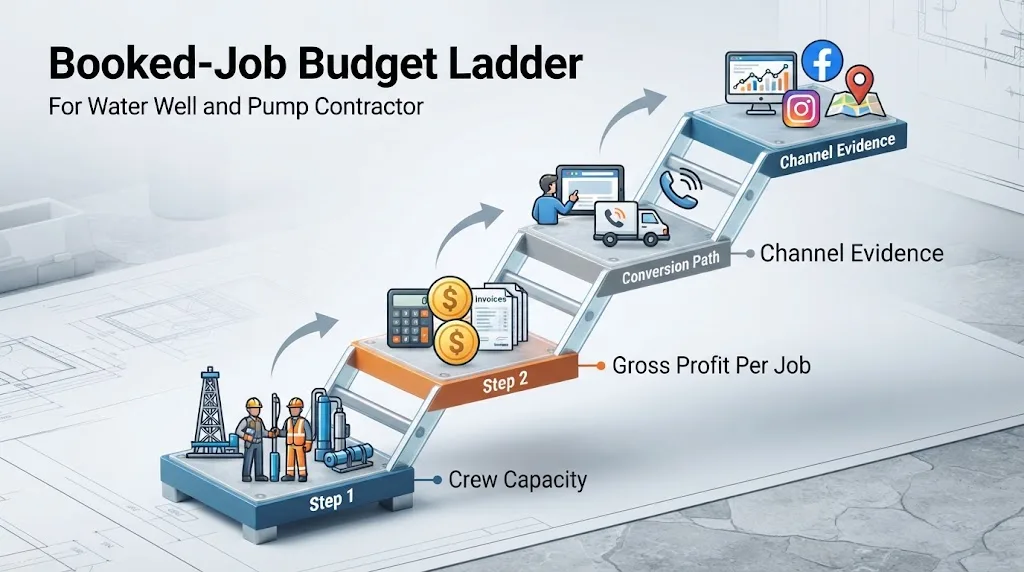
How does the Booked-Job Budget Ladder work?
The Booked-Job Budget Ladder is Brictale's planning framework for well and pump companies. It has four gates. You do not move to the next gate until the previous one has an answer you can defend.
- Capacity gate: What additional work can you take in the next 30, 60, and 90 days without creating unsafe schedules, long delays, or poor service?
- Contribution gate: What gross profit or contribution is available from each additional job type after direct job costs?
- Conversion gate: How many inquiries, qualified conversations, and estimates are required to produce one booked job at your current response and close rates?
- Evidence gate: Can you attribute the channel's fully loaded cost to booked jobs closely enough to scale, hold, or stop it?
This is intentionally a ladder, not a funnel diagram. The sequence matters. A company that has no open capacity does not solve a marketing problem by buying more calls. A company that cannot state rough gross profit per job cannot set an acquisition ceiling rationally. A company that never records whether calls turn into jobs cannot know whether a channel is working, even if the phone rings.
Here is the core calculation:
Allowable acquisition cost per booked job
= gross profit per job × chosen acquisition-share limit

Fully loaded cost per booked job
= total channel cost in the period ÷ booked jobs credited to that channel
The acquisition-share limit is a management decision. It is not an industry benchmark. Some owners will allow a lower share while cash is tight or when a job type creates warranty exposure. Others may allow a higher first-job cost when the work leads to repeat service, maintenance, treatment work, or a strong referral relationship. The important part is to choose the number before reviewing results, state why it is appropriate, and count all acquisition costs.
Do not use top-line revenue in place of gross profit. Revenue pays for more than marketing. It must cover labor, materials, equipment, fuel, overhead, debt service, taxes, and owner return. Your bookkeeper or controller can help define the margin measure that reflects your company. The framework needs a conservative number, not a perfect theoretical one.
The result is a ceiling, not a target. You can acquire a job below the ceiling and still decide not to scale because the work is outside your preferred territory, creates a scheduling bottleneck, attracts poor-fit customers, or pulls a skilled technician from more profitable work.
Which revenue number should you use for a first budget?
Use a forward-looking, conservative revenue base if you need a percentage guardrail. Then override it with capacity and booked-job economics. Do not use a banner year, an uncollected estimate total, or a hoped-for growth number as permission to spend.
For a stable company, a trailing 12-month collected-revenue figure is often a cleaner starting point than a single strong month. For a new branch, new rig, or newly added pump-service crew, projected revenue may be relevant, but it should be tied to documented capacity and a cash plan. The SBA also notes that startups may use projected revenue when applying a percentage guide. SBA guidance
Break the base out by service line if the business is mixed. A company may have drilling work that is geographically constrained and booked well ahead, while pump repair has short-notice demand and an underused technician. The first line does not need more volume just because the second does. A single blended percentage can hide that fact.
Use this simple planning sheet before anyone selects a channel:
| Service line | Next-90-day capacity | Preferred territory | Typical gross-profit range | Current source of work | Marketing need |
|---|---|---|---|---|---|
| New well drilling | Fill in open rig days or jobs | Fill in counties or radius | Fill in from job-costing | Referrals, organic, bids, other | Protect, fill, or pause |
| Pump repair | Fill in technician slots | Fill in dispatch area | Fill in from job-costing | Maps, past customers, ads, other | Protect, fill, or pause |
| Pump replacement | Fill in install slots | Fill in service area | Fill in from job-costing | Existing customers, search, other | Protect, fill, or pause |
| Rehabilitation or specialty work | Fill in capacity | Fill in territory | Fill in from job-costing | Existing network, search, other | Protect, fill, or pause |
The row that says “pause” is not a failure. It may be the best decision. Continue low-cost reputation and ownership work so you do not disappear from local search, but do not flood a full schedule with paid demand. You can reserve budget for hiring, equipment, scheduling changes, or the next seasonal opening.
This distinction matters especially for companies that have one bottleneck. If every drilling job requires a particular rig, estimator, permit process, or experienced operator, marketing can create frustration faster than revenue. More inquiries are not automatically an improvement when the company cannot quote promptly or start within a reasonable period.
How do you calculate an allowable cost per booked job?
Calculate it from conservative job economics, then set a stricter number when risk or capacity calls for it. The calculation gives an owner a ceiling to use in channel reviews, not a promise that every job will look the same.
Start with a job type you actually want more of. Do not blend an emergency pump repair, a complete pump replacement, and a drilled well into one “average” if their margin, sales cycle, crew burden, and lead quality differ.
- Pull a recent set of completed jobs from the same service line.
- Use your job-costing method to estimate a conservative gross profit per job.
- Decide what share of that gross profit you can devote to acquiring a first-time booked job.
- Multiply those two numbers to get the allowable acquisition cost.
- Compare that ceiling with fully loaded channel cost per booked job for at least one defined review period.
- Check whether the jobs fit capacity and territory before increasing spend.
Here is a deliberately hypothetical example. It is not a statement about well-industry averages.
| Hypothetical pump-replacement input | Example value | Calculation use |
|---|---|---|
| Average collected job revenue | $4,800 | Context only, not the acquisition ceiling |
| Conservative gross profit per job | $1,700 | Starting economic contribution |
| Chosen acquisition-share limit | 25% | Owner's risk decision |
| Allowable acquisition cost | $425 | $1,700 × 0.25 |
| Channel cost for the month | $2,550 | Ads, management, tracking allocation |
| Booked jobs credited after review | 8 | Use accepted, scheduled work under your rule |
| Fully loaded cost per booked job | $318.75 | $2,550 ÷ 8 |
On those assumptions, the channel is under the chosen $425 ceiling. That does not mean “double it tomorrow.” First inspect whether the eight jobs were really incremental, whether the office answered promptly, whether close rate held, whether the jobs came from your desired territory, and whether there are still slots to fill. But it does give the owner a reasoned basis for a controlled increase.
Now change one thing: the same $2,550 produces three booked jobs. Fully loaded cost per booked job becomes $850. That is above the $425 ceiling. The response is not automatically to fire every vendor or slash all spending. Ask where the conversion path failed. Did the ads attract irrelevant calls? Were calls missed? Did the landing page misstate the service area? Did the estimator price or follow up differently? Were the booked jobs recorded under another source? Fix the signal before you make a broad conclusion.
A cheap lead can be an expensive booked job when contact, qualification, or close rate is weak.
What does a complete budget example look like?
A complete example separates the amount you can afford, the amount you need to test, and the amount you are committing to durable assets. It does not assume that every dollar should go into ads.
Assume, only for illustration, that a company has room for six additional preferred jobs a month in a specific service line. The owner has set a $400 allowable acquisition cost per booked job. The maximum variable acquisition exposure for those six jobs is $2,400 for the month. That is a ceiling for the testable demand-capture portion, not the whole marketing department and not a forecast.
The owner might choose this monthly plan:
| Purpose | Hypothetical monthly allocation | What the owner expects to learn or build | Primary evidence |
|---|---|---|---|
| Paid search test for high-intent service terms | $1,200 | Whether a narrow campaign can create qualified calls in the open territory | Qualified calls, estimates, booked jobs |
| Call tracking and reporting allocation | $200 | Which calls become real conversations and jobs | Source, disposition, booked-job record |
| Service-page and quote-flow improvements | $500 | Better conversion and a durable local-search asset | Form and call completion, organic visibility |
| Review and Business Profile operations | $250 | More complete and current local presence | Profile actions, review process completion |
| Photography and project proof allocation | $250 | Better service pages and estimate confidence | Asset completion, use on pages and estimates |
| Management or specialist help | $600 | Campaign hygiene, analysis, and correction | Full cost is included in channel economics |
| Total | $3,000 | A controlled mixed investment | Review by bucket and by booked job |
The table does not say that $3,000 is correct for every company. It shows why a single “ad budget” number is incomplete. Only $1,200 is media in this example. Yet the other costs can determine whether the $1,200 creates bookable work or generates calls that nobody can attribute.
If the company has only $1,000 available, it should not mimic the table at one-third scale. Thinly spreading the money across ads, content, listings, a tool, photography, and a sponsorship often produces six weak efforts. Pick the one bottleneck that is most likely to keep profitable work from arriving or converting. For a company with urgent pump-repair capacity and a working website, a small tightly tracked demand test may be logical. For a company with broken phone routing and no accurate service pages, repair the conversion foundation first.
The owner should also decide whether the spend is a maintenance budget or a growth budget. Maintenance protects visibility, reviews, listings, referral follow-up, and the assets you already own. Growth creates a measurable increase in desired job volume. Mixing those goals makes the review muddy because maintenance may be worthwhile even when it cannot be credited to a single job that month.
When is your marketing budget too low, too high, or simply misallocated?
Your budget is too low when you have profitable open capacity, can identify a trackable path to desired work, and have no reasoned way to fund that path. It is too high when it creates work you cannot serve, buys jobs above your allowable acquisition cost, or continues after the evidence says the service line is full.
“Misallocated” is more common than either. A company may spend enough in total but aim it at the wrong job type, wrong geography, wrong moment in the buyer's decision, or wrong step in the conversion process.
Use the following diagnostic table in a monthly owner meeting:
| What you see | Likely interpretation | First decision |
|---|---|---|
| Open crew slots, little qualified demand, tracking in place | Budget may be too low or channel coverage may be absent | Fund one measured acquisition test tied to the open service line |
| Many calls, few estimates | Intake, qualification, service-area messaging, or response process may be failing | Listen to calls, inspect dispositions, fix intake before increasing media |
| Many estimates, few accepted jobs | Pricing, timing, follow-up, fit, or competitive context may be failing | Review estimate aging and loss reasons before buying more leads |
| Booked work above capacity | Budget may be too high for this service line right now | Reduce paid capture, tighten geo and schedule, preserve ownership work |
| Calls from areas you will not serve | Targeting and message are too broad | Constrain service area, negative terms, page copy, and intake script |
| Good cost per lead but high cost per booked job | Lead metric is hiding conversion leakage | Recalculate with all channel costs and booked jobs only |
| One source appears “free” | Attribution is probably incomplete | Allocate labor, tools, and foundation cost before comparing |
Do not punish a channel for a problem it cannot control. If an office takes two days to return calls, a demand-capture channel may appear unprofitable even when the underlying search intent is strong. That is a conversion and operations issue. Equally, do not protect a channel because the team likes it. If the response process is healthy and booked-job cost stays above the stated ceiling, the channel needs a different offer, different targeting, or a smaller role.
Capacity needs the same discipline. A full schedule does not necessarily mean stop all marketing. It may mean spend the next dollar on customer communication, estimates for future dates, past-customer follow-up, reputation, or the service line that actually has room. The rule is simple: market the work you can deliver well.
How should you split a well-company budget across channels?
Split it by purpose and time horizon, not by a fashionable channel list. Use fast, measured demand capture only where capacity needs it. Use conversion work to stop waste. Keep some investment in owned local visibility when the company wants a future pipeline.
The right mix is driven by your current position:
| Company situation | Primary budget priority | Secondary priority | What not to do |
|---|---|---|---|
| New company with little search presence and open capacity | Accurate site, verified profile, tracking, narrow demand test | Review process and service-area clarity | Spread a small budget across every platform |
| Established referral-heavy company with uneven calendar | Measure the gaps and build local search coverage for desired services | Small tests around open periods | Assume referrals will always fill the same job mix |
| Drilling side full, pump side open | Market pump repair or replacement specifically | Protect drilling reputation and future visibility | Buy generic “well services” leads that burden the full crew |
| High call volume, poor booking | Intake, response time, qualification, estimate follow-up | Source tracking | Increase ads because the call count looks encouraging |
| Strong local visibility, weak conversion | Service pages, estimate flow, proof, call handling | Retargeting or controlled paid test | Rebuild the entire channel mix without diagnosing leakage |
| Limited cash and a broken foundation | Phone, website, profile accuracy, tracking | One carefully selected priority | Commit to recurring media before you can measure it |
Google's own local-ranking guidance says that local results are mainly based on relevance, distance, and prominence. It also says there is no way to request or pay for a better local ranking. That is why a well company should not treat paid media as a substitute for accurate business information, service relevance, reviews, and a usable website. Google Business Profile Help
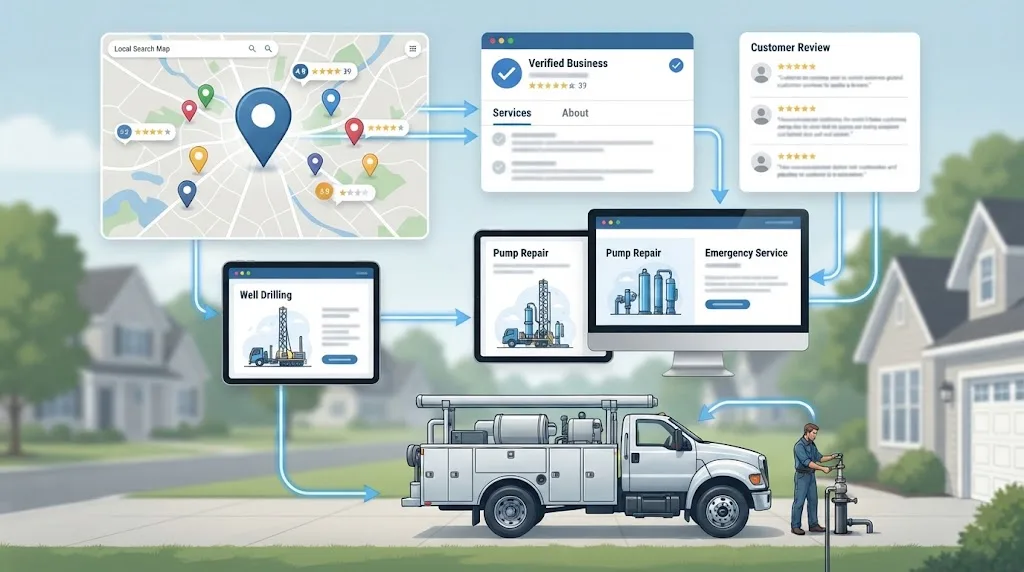
That does not mean local-search work is free or immediate. It means it belongs in a separate, durable-assets bucket. A clean service page for pump replacement, accurate service-area information, a verified Business Profile, review responses, and jobsite photos can improve a customer's ability to understand and choose the company. Google says complete and accurate business information can make a Business Profile more likely to show for relevant searches, and that more reviews and positive ratings can help local ranking. Google's local-ranking guidance
For more on the service-page and local visibility side, see Brictale's guide to well drilling SEO. Treat it as a complement to a budget decision, not a reason to avoid the numbers.

Which channels deserve a test first?
Test the channel that best matches the work you need, the speed you need it, and the measurement you can support. Do not start with the channel an agency, platform, or competitor happens to promote most loudly.
For an urgent capacity gap, search demand can be testable because a person searching for a specific service may be close to calling. But you need a working landing experience, live phone coverage, defined territory, and a way to label the outcome. Google Ads allows you to set an average daily budget. Google says the corresponding monthly spending limit is generally that daily amount multiplied by 30.4, while actual daily spend can reach up to twice the average daily budget on a day. Build that pacing into cash planning before the campaign starts. Google Ads budget documentation
For a company whose main issue is weak discovery in its service territory, allocate more to accurate local foundations and useful service coverage. This is slower to judge and harder to assign to one click, but it can strengthen the places where homeowners and property managers decide whether to call. It should still have evidence: profile actions, organic calls, visibility for services and places you actually serve, and ultimately booked work.
For a referral-heavy company, past-customer communication and review operations can be high-value maintenance work. The purpose is not to badger people. It is to make sure a satisfied customer can find the correct number, understand your services, and remember you when a neighbor asks. Your process must follow platform policies and should never solicit fake reviews.
Trade association or local sponsorship activity may fit some markets, particularly when it reaches a defined decision-maker group. But it needs a tracking mechanism before it earns a large allocation. Use a unique landing page, call extension, offer code where appropriate, or a disciplined “how did you hear about us?” field. If no mechanism is possible, categorize the expense as relationship or brand activity, not as a directly attributable booked-job channel.
Directories and lead platforms deserve extra caution. Ask whether leads are exclusive, whether the platform's definition of a lead matches yours, whether you can dispute invalid contacts, and whether staff can respond within the expected window. A low price per contact is not evidence of value. The Booked-Job Budget Ladder will expose the difference when you count accepted work.
Fund one channel to a learnable level before splitting it into five unanswerable experiments.
How should drilling and pump work change the budget decision?
Separate budgets by operating constraint. Drilling work, pump repair, pump replacement, rehabilitation, testing, and commercial or agricultural work may share a brand, but they do not necessarily share urgency, margin, sales cycle, staffing, or geographic reach.
Drilling often involves a longer decision path and capacity tied to equipment, permitting, geology, and crew scheduling. A marketing plan may therefore focus on keeping an estimate pipeline healthy, showing relevant project proof, clarifying territory and process, and protecting visibility before an open period becomes a crisis. A sudden flood of poorly targeted calls can distract the team without improving the schedule.
Pump repair can have a different rhythm. Customers may need help promptly, and the office needs to know which calls are in area, which are real failures, which are warranty or existing-customer matters, and which belong to a different service provider. If response time is slow, no amount of audience refinement will fully repair the economics.
Pump replacement may sit between the two. It can involve a diagnosis, a recommendation, financing or price discussions, scheduling, and an installed-work close. The budget should follow the point where work falls out: discovery, phone answer, visit scheduled, estimate sent, or approval.
This is why “average job value” alone is not enough. A high-revenue drilling project with thin or uncertain margin might justify a lower acquisition share than a repeatable pump-service job with reliable gross profit and existing local demand. The owner decides the share based on risk and cash, then checks actual outcomes.
Use a separate source code or CRM service-line label for each priority. If every inquiry is tagged simply “website,” you will not know whether the pump-replacement page, the drilling page, Maps, a paid campaign, or a referral produced the job. The same problem appears when a person calls after searching more than once. Attribution will not be perfect, but a disciplined process is much better than guessing.
The National Ground Water Association's consumer guidance urges customers to obtain a written contract that specifies job terms and notes that unexpected events can happen while drilling. That buyer-side reality is another reason a booked drilling job should be defined carefully in your records. A call, an estimate, and a signed agreement are different stages with different economic meaning. NGWA contractor guidance
How do you track spend from a call to a booked job?
Track the path in one system of record, then reconcile it monthly. The essential requirement is not a particular software package. It is a shared definition of each stage and someone responsible for completing the record.
At minimum, every inquiry should have these fields:
| Field | Why it belongs in the record |
|---|---|
| First known source | Preserves the initial discovery path, such as Maps, organic search, paid search, referral, direct mail, or trade event |
| Service line requested | Separates drilling, repair, replacement, testing, and other work |
| Geography | Reveals out-of-area demand and territory waste |
| Contacted? | Exposes missed-call and follow-up failures |
| Qualified? | Separates viable work from wrong-fit inquiries |
| Estimate or visit scheduled? | Shows whether the office created a real sales opportunity |
| Estimate sent? | Locates drop-off after the first conversation |
| Booked or lost? | Makes the final budget calculation possible |
| Revenue and gross-profit estimate | Lets you compare acquisition cost with job economics |
| Loss reason | Prevents the same mistake from becoming a recurring expense |
Google Business Profile performance can report interactions such as call-button clicks and website clicks for a verified profile. That is useful directional evidence, but it is not a booked-job report. Google Business Profile performance documentation Make sure someone on the team can carry the source through to the scheduled or accepted job.
Google Ads has a similar distinction. Its phone-call conversion tools can count calls based on criteria such as a duration you set. Google also allows businesses to import call conversions tracked in another system and choose to count only calls that include sales, with sales values if available. That is closer to how an owner should evaluate spend, though your own CRM and accounting rules still define the actual booked job. Google Ads phone-call conversion tracking

Set a source hierarchy before there is an argument. For example: first known source, last non-direct source, and owner-confirmed source can each be recorded, but only one should be used for the monthly channel scoreboard. If you count the same accepted job as a Google Ads job, a Maps job, and a website job, the budget report will overstate results. If you do not count source at all, it will under-inform every decision.
Call recording may help with quality review, but use it only with appropriate notice, consent, access controls, and legal advice for the states where you operate. The budget framework works without recordings. A consistent disposition process is more important than sophisticated software that nobody updates.
What should a 90-day marketing-budget test look like?
Use 90 days as a structured review period when the work and sales cycle allow it, not as a magic window. The goal is to give a controlled experiment enough time to collect outcomes while preserving the ability to stop waste early.
Days 1-14: establish the control points
First, choose one service line and one geography you want more of. Confirm actual crew capacity by week, not by a vague feeling. Define your booked-job event. For a pump repair, it might be a completed paid service call. For pump replacement, it might be an accepted and scheduled install. For drilling, it might be a signed agreement with a scheduled start or a defined deposit event. Use the definition consistently.
Then audit the path. Call the number after hours and during business hours. Submit the form. Check the confirmation email. Confirm that the Business Profile has correct hours, category, phone number, website, and service information. Google advises businesses to keep Business Profile information complete and accurate, including hours, category, and other details. Google Business Profile Help
Write the baseline on one page: current weekly open slots, average response time, last 30 days of inquiries, estimates, booked jobs, and source completeness. If the baseline is missing, start collecting it. Do not fabricate a baseline from memory.
Days 15-45: run a narrow test and repair leakage
Choose a narrow campaign or initiative with a single job. A search test might focus on one service line and a tight service area. A local-search project might focus on correcting service pages and Profile information for a priority service. A past-customer initiative might focus on obtaining accurate reviews through a policy-compliant request process.
Do not change five major variables on the same day. If you rebuild the site, change the phone system, turn on new ads, add a lead platform, and replace the estimator, you will not know what altered results. Keep a change log with dates and names.
Review calls and records at least weekly. The question is not “did we get leads?” It is “what happened to each inquiry, and what can we fix before spending more?” Missed calls, wrong geography, unclear service descriptions, long response times, unavailable technicians, and stale estimates are all evidence.
Days 46-75: compare booked-job economics
Now calculate fully loaded cost per booked job by source where you have enough data to make the arithmetic meaningful. Include media, platform fees, management, and the stated monthly allocation for necessary tools or foundation work. Compare the result with the allowable acquisition cost you set at the start.
If a source has no booked jobs yet, do not force a return-on-investment conclusion. Label it “insufficient evidence,” then decide whether the remaining test can plausibly resolve the uncertainty. You may need more time for a drilling sales cycle. You may instead see a clear intake failure that makes further spend irresponsible until it is fixed.
Days 76-90: decide scale, hold, repair, or stop
At the end, make one of four decisions:
- Scale: The channel is below the acquisition ceiling, capacity remains, job fit is good, and tracking is credible. Increase in a controlled increment.
- Hold: The channel works but capacity, cash, or data quality does not justify growth yet. Keep it stable while improving the weak link.
- Repair: The signal is promising but a specific problem is visible, such as poor response, a weak landing page, wrong geography, or missing source records. Fix the problem before adding spend.
- Stop or pause: The channel is above the acquisition ceiling after a fair test, the work is poor-fit, or the company has no capacity. Preserve the lesson in the record.
This is a management cadence, not an agency ritual. The owner or operator should be able to state the decision in one sentence. “We are holding pump-replacement spend because cost per booked job is acceptable but the installer is at capacity.” That is a real operating decision. “The campaign seems good” is not.
When should you spend less or stop spending altogether?
Spend less on demand capture when crews are full, job quality is falling, response capacity is compromised, or a channel has crossed its acquisition ceiling with no identified repair. Keep enough maintenance investment to protect accurate information, customer communication, and long-term local visibility if those activities remain useful.
The wrong response to a full calendar is often to turn every marketing activity off. That can create a dry pipeline later, especially if reviews, profile accuracy, service pages, and past-customer follow-up go dormant. The better move is to reduce the part that buys immediate demand while preserving the part that keeps your market position intact.
Stop or pause a channel quickly when it creates a safety or service problem. If office staff are overwhelmed, after-hours calls are being missed, or jobs are landing outside the service area, more volume is not a marketing victory. Fix the operating constraint first.
Also stop using last month's success as proof that a channel will work forever. Search demand, competitor activity, weather, staffing, and local conditions move. Refresh the worksheet every quarter, and any time you add a crew, lose a technician, change territory, add a service, or face a material shift in margin.
A full calendar is a reason to reallocate demand spend, not a reason to stop measuring.
What marketing-budget mistakes cost well companies the most?
The expensive mistakes are usually simple. They happen when an owner accepts a convenient metric or a vendor's dashboard instead of following the work through the business.
Treating ad spend as the whole cost
Ad platforms report media spend because that is what they bill. Your business needs the full channel cost. Include management, lead fees, tracking, landing-page work, tools, and the stated share of staff time. Otherwise comparison between paid, organic, referral, and directory sources is distorted from the beginning.
Counting calls as booked jobs
A call can be a wrong number, a service you do not provide, an out-of-area homeowner, a warranty question, a vendor, or a real buyer. Google itself distinguishes phone-call conversions from imported calls that can be tied to sales outcomes. Google Ads Your company should make the same distinction.
Using one blended average for incompatible services
Drilling, emergency repair, replacement, and specialty rehabilitation can have different margins and operational load. A blended average creates a fake ceiling. If you must begin blended because data is thin, label it temporary and split it by service line as soon as records permit.
Buying leads before the office can respond
The first investment may be dispatch process, phone coverage, routing, and estimate follow-up. More media will magnify a poor response system. Set a target response behavior that the team can actually meet, then audit it with real inquiries.
Chasing cheap impressions or low cost per lead
An inexpensive form submission can be worthless if it never becomes a conversation. A more expensive inquiry can be excellent if it reliably becomes preferred work. Cost per booked job is not perfect, but it keeps the review connected to the business outcome.
Expecting paid media to purchase local rank
Google says there is no way to request or pay for a better local ranking. Paid ads may create paid visibility. They do not let you buy a higher organic local position. Build relevance, accurate information, reviews, and prominent local proof as their own workstream. Google Business Profile Help
Scaling a channel before it has earned trust
One good week can be luck, a backlog effect, or a changed sales process. Scale only after you can see booked-job outcomes, full cost, capacity, and job fit. A small increase with a written hypothesis teaches more than a big jump made on confidence.
How should you review the budget with your team each month?
Run a 45-minute owner review with a one-page scorecard. Keep it operational. The meeting should decide what changes next month, not merely admire charts.
Use this agenda:
- Confirm open capacity by service line and territory for the next 30, 60, and 90 days.
- Review total spend by bucket, separating one-time foundation work from recurring acquisition costs.
- Review source records: inquiries, qualified conversations, estimates, booked jobs, collected revenue where available, and known loss reasons.
- Calculate fully loaded cost per booked job for each channel with enough evidence.
- Compare each result with the stated allowable acquisition cost and desired job mix.
- Check conversion leakage: missed calls, response delays, estimate aging, out-of-area demand, and no-shows.
- Choose one decision for every meaningful channel: scale, hold, repair, stop, or keep measuring.
- Assign an owner and due date for each repair.
The scorecard should include qualitative notes. Did a particular campaign bring work in a county that is too far from the yard? Did a new service page clarify a service that callers were confusing? Did a recent storm create unusual inquiry volume? Numbers without context can create the same bad decisions as no numbers.
When you use Google Ads, reconcile platform cost against your own monthly records rather than assuming a daily number is a fixed cap. Google explains that the average daily budget is used to calculate monthly limits, generally at 30.4 times the daily amount, and that spending can vary from day to day. Google Ads budget guide That is a platform billing mechanic, not a booked-job budget.
Make the meeting useful to field and office staff. The dispatcher may know why calls are poor fit. The estimator may know why a service line is losing work. The technician may know that the next open capacity is in a different job type than the dashboard assumes. Marketing should reflect that information, not override it.
When should a well contractor hire help with marketing?
Hire help when the constraint is expertise, time, or measurement discipline, and when the company can describe the commercial problem it wants solved. Do not hire a marketing firm merely to make activity look organized.
An outside specialist can help audit local visibility, repair tracking, structure service pages, manage a controlled demand test, and create a reporting rhythm. But the contractor still owns key inputs: capacity, preferred work, territory, close process, job economics, and the definition of a good lead. No agency dashboard can infer those reliably without your involvement.
Before hiring, ask these questions:
| Question | Why it protects the budget |
|---|---|
| What exact service lines and territories are we trying to grow? | Prevents generic traffic and irrelevant lead volume |
| What will be counted as a booked job? | Prevents a report from stopping at clicks or calls |
| Which costs are included in channel reporting? | Makes fully loaded economics possible |
| What can the office answer and schedule this month? | Aligns campaigns with capacity |
| What does the first 90 days need to prove? | Creates a testable scope instead of vague activity |
| What data will we retain if the engagement ends? | Protects business ownership of accounts and learning |
Brictale's guide to well drilling lead generation covers the booked-job system beyond the budget. If you are comparing outside partners, the well drilling marketing agency guide can help you ask sharper questions. Neither replaces the budget worksheet. A partner can improve execution, but it cannot decide how much margin you are willing to spend acquiring a job.
Avoid a provider that promises a fixed number of leads without first discussing capacity, job mix, response process, and tracking. The promise may sound concrete, but a lead definition can be too loose to protect your calendar. Ask for the exact reporting fields and the exact point at which a channel will be judged.
What should you decide before next month's budget is approved?
Decide what work you want more of, where you can perform it, how much gross profit it creates, what you can afford to pay for an additional booked job, and what evidence you require before increasing spend. Then approve the smallest coherent plan that can answer the next question.
Do not start by asking, “What percentage should we spend?” Start with, “Which preferred capacity are we trying to fill, and what can we pay to fill it?” A percentage can still sit at the top of the sheet as a guardrail. It should not be the steering wheel.
The practical next step is to fill in the four gates of the Booked-Job Budget Ladder with your actual numbers. If you need an outside view of service-area demand, local visibility, tracking gaps, and the work that may be leaking before it reaches a booked job, Brictale's free territory audit is designed for that conversation.