
More calls are not the goal. A calendar full of work your crew can actually take is the goal.
For a well drilling or pump company, lead generation breaks down when marketing sends calls from outside the territory, for work you do not perform, at hours nobody answers, or during weeks when the rig and service trucks are already committed. Those are not harmless leads. They consume dispatch time, create bad customer experiences, and make good marketing look wasteful.
This guide gives you a system for generating demand and deciding what it is worth. It is built for US owners and operators who need booked drilling, pump, rehabilitation, inspection, or related groundwater work. It is not homeowner advice and it is not a list of random social-media ideas.
A lead is useful only when it can become work your company can profitably perform.
What does well drilling lead generation actually mean?
Well drilling lead generation is the process of making the right local buyers find, contact, and choose your company, then moving those inquiries through qualification, estimate, and booked-job stages. The useful unit is not a form fill or a click. It is a serviceable opportunity with a known source and a clear next step.
That definition sounds obvious. It changes decisions.
If you count every call as a lead, a homeowner seeking a free depth estimate three counties away counts the same as a commercial property manager asking for a site visit inside your normal territory. If you count every click as success, a campaign can look healthy while your dispatcher is sorting irrelevant calls. And if you count only revenue, you learn too late that a channel was attracting the wrong work.
Use four stages instead:
- Inquiry: a person calls, texts, submits a form, or sends a message.
- Qualified lead: the job matches your service, territory, and basic commercial rules.
- Estimate or dispatch opportunity: your team has accepted the next operational step.
- Booked job: work is scheduled or contractually committed under your normal process.
Keep the stages separate. A receptionist can classify an inquiry. A dispatcher or estimator can decide whether it is serviceable. The owner can review whether that lead source produces booked jobs.
The National Ground Water Association's buyer guidance is a useful reminder of why generic home-service copy falls short. Its list of contractor-selection considerations includes licensing, equipment, insurance, reputation, a written contract, and itemized charges. That means buyers are not simply choosing the first phone number they see. Your marketing has to route them to evidence that answers their risk questions. NGWA: How to Hire a Water Well Contractor
Which leads should a well or pump company want?
The right answer depends on your equipment, crew, margin, weather window, licensing, and geography. But you should be able to state the answer in one page before buying leads or expanding campaigns.
Make a simple serviceable-lead definition for each profitable line of work. For example, a company may take residential drilling in named counties, pump repair within a shorter drive time, agricultural well work only after a site conversation, and no water-treatment-only calls. Another company may want pump replacements now but have no drilling capacity until next season.
Do not hide these choices in the owner's head. Put them in the intake script, website routing, ad targeting, and weekly review.
| Gate | Question to answer before accepting the lead | Example action if the answer is no |
|---|---|---|
| Service fit | Do we perform this exact work? | Refer out or record as non-target demand. |
| Territory fit | Is the site inside the territory we can serve profitably? | Decline promptly or give an honest referral path. |
| Capacity fit | Can the appropriate crew inspect, estimate, or schedule it in a credible window? | Offer the realistic next date or pause the campaign. |
| Commercial fit | Is there a real job, a reachable decision maker, and a viable next step? | Request missing details or close as unqualified. |
This is the Serviceable-Lead Operating System. It is a Brictale framework, not a claimed industry benchmark. Its value is that it forces a shared definition across marketing, the person answering the phone, the estimator, and the owner.
Do not buy more demand until your team agrees on what a good lead is.
How do you build the Serviceable-Lead Operating System?
Build it in this order: capacity, offer, territory, proof, acquisition, measurement. Most companies start at acquisition because it feels active. That is how they pay to discover that their process is unclear.
First, calculate the next four to eight weeks of sellable capacity by service line. You do not need false precision. Mark each line as open, selective, waitlist, or closed. Then define the work you want to fill. A drilling company might have room for two additional site evaluations in a certain area. A pump team may have same-week space for no-water calls but not for low-priority inspections.
Second, write the offer as a customer can understand it. A strong offer is not "contact us." It tells the prospect what happens next: request a site evaluation, ask for pump service, speak with the office about a drilling project, or schedule a diagnostic visit. Avoid promising an exact price, yield, drilling depth, or completion date before your normal evaluation process supports it.
Third, name the actual places you serve. Google allows service-area businesses to specify up to 20 areas and advises that the overall boundary should not usually exceed about two hours of driving time from the base. Its guidance also says the areas should be specific and accurate. Use that as an operational guardrail, not a map-ranking trick. Google: Manage service areas
Fourth, decide what proof belongs beside each offer. A drilling-page visitor may need licensing, insurance, crew experience, equipment, process, service territory, and a clear way to begin. A pump-repair visitor may need hours, response expectations, common service types, reviews, and a direct call path. Never invent credentials or results. Use what is public, current, and true for your business.
Finally, connect every acquisition source to the right offer and to a measurable intake path. That creates a system instead of a collection of marketing activities.

Which channels deserve attention first?
Start where local intent and buyer trust already meet. For most established well and pump companies, that means your Google Business Profile, referral capture, service pages that answer real questions, and a phone path that is answered. Paid search comes next when you can control geography, terms, budget, and call handling.
Google says businesses with complete and accurate information are more likely to appear in local results. It also says, "Local results are mainly based on relevance, distance, and popularity." The practical meaning is simple: accurate profile details and reviews matter, but no edit can make a company equally local to every searcher. Google: Tips to improve local ranking
Use this decision table instead of treating every channel as a must-have.
| Channel | Best use | What must be ready | First metric to inspect | When to pause |
|---|---|---|---|---|
| Google Business Profile and Maps | Nearby, high-intent discovery | Accurate category, hours, phone, service area, reviews, service detail | Calls, direction requests, messages, then booked jobs | Profile information is inaccurate or calls cannot be answered |
| Existing customer referrals | High-trust local work | A clear ask, fast response, easy referral handoff | Referred inquiries and booked jobs | Nobody logs the referrer or follows up |
| Service pages and organic search | Planned drilling, pump replacement, and research-heavy demand | A page for each real service, territory clarity, proof, call-to-action | Relevant queries, calls, estimates | Pages are generic or do not match your work |
| Google Ads | Controlled demand for open capacity | Exact service and geography rules, negatives, call tracking, live answer coverage | Qualified calls and booked jobs | You can only report clicks or calls, not outcomes |
| Trade and association visibility | Credibility and referral relationships | Current membership or participation, truthful listing | Referred opportunities | It is treated as a substitute for local discovery |
| Social content | Familiarity and proof for an existing local audience | Real job documentation and response process | Assisted inquiries, not vanity engagement | It becomes a time sink with no owner or purpose |
The right order can change. A new company with a thin review profile may have to combine paid demand with strong operational proof. A long-established operator with more work than capacity may need to restrict ads and improve qualification instead. This is a capacity decision, not a marketer's preference.
A channel is not good because it creates calls. It is good because it creates acceptable work.
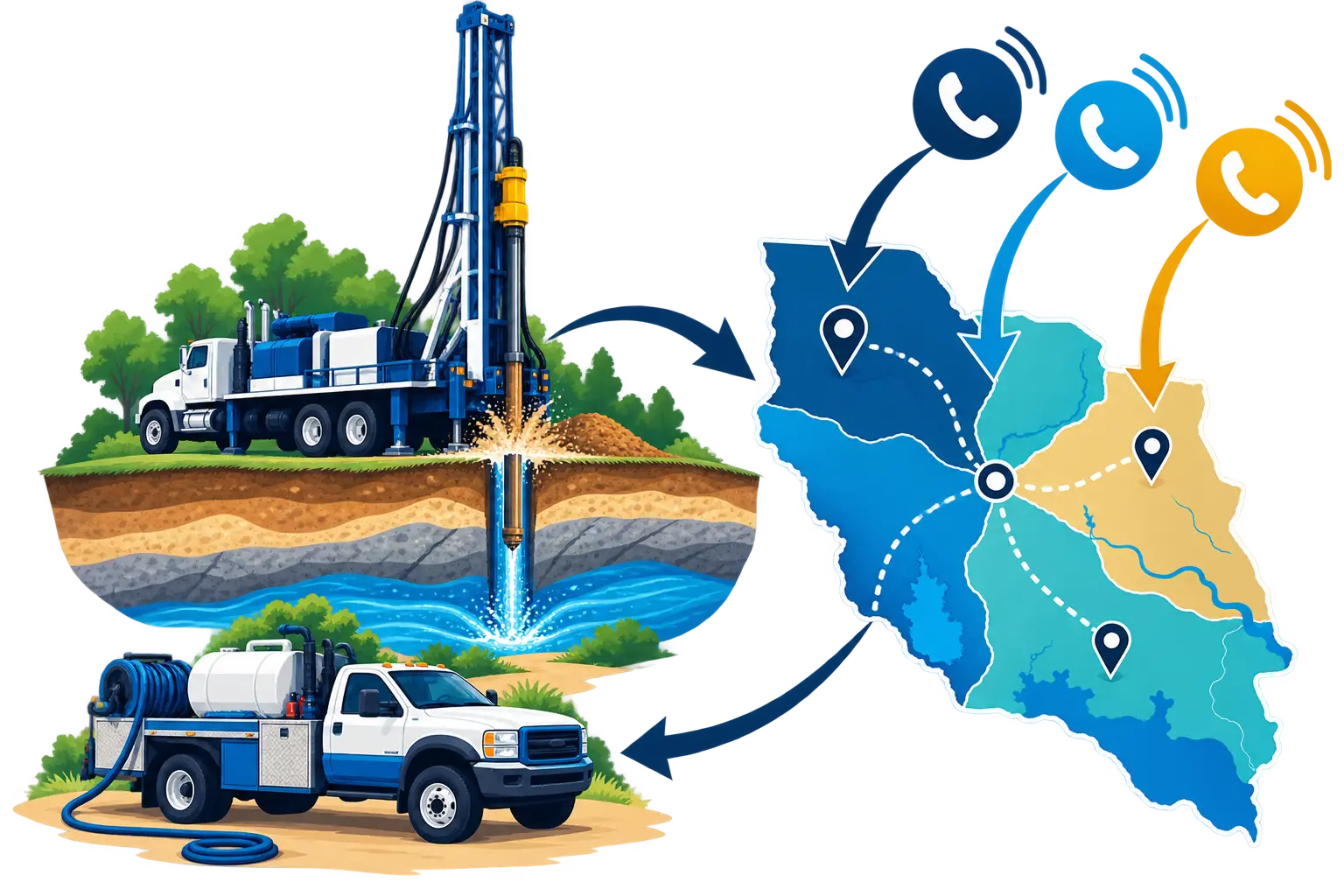
How do drilling leads differ from pump-service leads?
Drilling and pump-service demand can belong in the same company, but they should not automatically share the same offer, ad group, page, call path, or success metric. The time horizon and operational consequence are different.
A planned drilling inquiry may start with land, access, a construction timetable, a farm need, an expected use, or a question about the evaluation process. It often needs a more considered conversation and may involve a site visit. It is usually wrong to promise the outcome before the company reviews the location and normal regulatory requirements. A good lead path gives the caller a clear next step and tells the office which facts to collect.
Pump work can be very different. A no-water call may require immediate triage. Other calls concern a pressure issue, a planned replacement, an inspection, or a related service. The page and intake should make the response expectation clear without making an emergency claim the business cannot meet. If the office has limited same-day capacity, do not leave a paid campaign running that implies otherwise.
Separate the data as well. A pump call that becomes a dispatched diagnosis should not be compared mechanically with a drilling inquiry that becomes a scheduled site evaluation. Each may be a successful next step, but the cycle time and gross economics differ. Use service-specific stages in the ledger where needed.
The key is not to create needless complexity. It is to prevent the owner from asking one metric to explain two different businesses. If the company has one dispatcher and a small budget, start with the service line that has open capacity and the clearest intake. Expand only after the team can see what happens to the first group of calls.
How do you protect a crew schedule while creating demand?
Make capacity an input to marketing, not an after-the-fact excuse. The owner, dispatcher, and whoever manages visibility should have a short weekly conversation before changing ads, profile hours, referral requests, or website calls to action.
Use a traffic-light status for each service family and territory. Green means the team can accept new work in its normal response window. Yellow means selective acceptance, such as a smaller named territory, higher-priority work, or appointments beyond a stated date. Red means no new demand should be purchased or actively encouraged. The status should change the actual assets customers see. A red drilling service should not have an aggressive request-estimate ad. A yellow pump team might still take existing-customer emergency calls while pausing broad acquisition.
This avoids a common owner mistake: celebrating a busy phone while the crew loses time sorting leads that could have been prevented by better targeting. It also protects reputation. A fast, honest response that says the company cannot take work this week is better than a form that disappears into a full schedule.
Check the calendar before launching campaigns around weather, seasonal demand, crew vacation, rig maintenance, and permitting workload. This is not a prediction about the market. It is basic operational alignment. Marketing cannot create equipment, licensing, or staffed hours that are not there.
How do you audit a lead path before putting more money behind it?
Walk the route as a customer would. Search the service from a mobile phone, open the profile, follow the website link, call the number, submit the form, and inspect what your team receives. Do this from the perspective of a buyer inside the intended territory and again from outside it.
Write down friction at every point. Does the profile show an old seasonal schedule? Is the service page missing the location language? Does a phone button become a click metric but not a traceable call? Does the confirmation set no response expectation? Is a form routed to a personal inbox? Does the office know the source? Does an estimator receive enough information to act?
Then choose the narrowest repair. You may need a better page, a faster callback rule, a profile correction, an exclusion in a paid campaign, or a simple field added to the intake sheet. Do not respond by publishing ten pages or adding another channel. One fixed handoff can be more valuable than another month of posts.
Google's guidance also gives a useful compliance check. Businesses should use a phone number that connects to the individual location or a website representing it, and the phone number must be under the business's direct control. That supports an owner-controlled measurement system rather than a vendor-controlled mystery number. Google: Business Profile guidelines
Repeat this audit after major capacity changes and at least once each season. The lead path is part of the operating system. It deserves the same attention you would give the equipment, dispatch board, and estimate process.
How should Google Maps fit into a lead plan?
Google Maps should be the local discovery layer, not your entire lead strategy. It catches people who are already looking for a nearby contractor, but it cannot solve a weak website, a poor phone response, or a territory you cannot serve.
Treat the profile like an operational listing. The business name should reflect the real-world name. Google asks businesses to use accurate service areas, use the fewest categories needed to describe their core business, and keep one profile per business unless distinct staffed locations qualify. It also says a service-area business should use one profile for its central office or location with a designated service area. Google: Business Profile guidelines
That eliminates several tempting bad ideas: rented virtual offices, duplicate profiles for neighboring towns, stuffed business names, or locations that no staffed team actually operates. Those may create short-lived appearances. They also create suspension risk and break customer trust.
For a well contractor, the profile review should include:
- The exact business name used on trucks, invoices, signage, and the website.
- A phone number your office controls and answers.
- Accurate regular and seasonal hours, including what happens after hours.
- The narrowest truthful category set that describes the core business.
- Named service areas that match dispatch reality.
- Recent photos that show actual equipment, crews, completed work where appropriate, and office identity.
- A process for asking for reviews after a completed job without pressuring customers or filtering feedback.
- A website link that lands on a helpful local service page rather than a generic home page.
Responding to reviews is worthwhile because it shows customers their feedback is valued, according to Google. But don't turn every response into an advertisement. Thank the reviewer, stay within privacy limits, and do not disclose job details without permission. Google: Tips to improve local ranking

When should you use paid search for well drilling leads?
Use paid search when you need to create demand in a defined service, territory, and capacity window, and can measure whether calls turn into viable jobs. Do not use it to cover an unclear offer or an office that cannot return calls.
Paid search is particularly useful for the gap between your current visibility and an immediate need for work. It can also test whether a specific service page and call script attract the right questions before you commit to a larger organic program. But it needs guardrails because search terms in this field can mix drilling, oil and gas, DIY repair, jobs, equipment, and homeowner research.
Build a campaign around a single service family. Separate drilling from pump repair. Separate pump repair from replacement if the conversations, service area, and urgency differ. Use geographic targeting that follows your real service boundary. Add negative keywords based on actual search-term reports, not a borrowed universal list. And keep the landing page specific enough to prequalify people before they call.
Google can track calls from ads, calls after someone clicks an ad and calls a Google forwarding number on your website, clicks on a mobile number, calls from call assets, and imported call outcomes. Crucially, a mobile number click is just a click measurement, not confirmation that a call occurred. Imported call conversions let an advertiser choose to count calls only when they included a sale and can include sales values, if the company tracks the required call details in a CRM or another system. Google Ads: About phone call conversion tracking
That distinction matters. A campaign with 30 tap-to-call clicks did not necessarily create 30 conversations. A campaign with 10 long calls did not necessarily create 10 estimates. And a campaign with five estimates may still be poor if none are booked.
Set your first paid-search objective as a qualified call or accepted estimate opportunity. Then add the booked-job import or a manual booked-job ledger as soon as your process can support it. Do not allow an ad platform to decide that a click is the same as revenue.
How do you set a lead-source budget without guessing?
Set a budget from the amount of work you can accept and measure, then expand only after a source produces serviceable booked jobs. A budget is not a vote of confidence in a channel. It is a controlled test with a clear stop rule.
Start with the service line that has real room in the schedule. That might be planned pump replacements in two counties, drilling site evaluations before a seasonal push, or no-water service during a period when a technician can respond. Do not begin with every service just because a platform makes broad targeting easy. When the offer is narrow, the office can hear patterns quickly. You can see whether callers ask for the job you advertised, whether they live in the stated territory, and whether the next step actually happens.
Before assigning any spend, write down the costs you can observe. Include media spend, agency or staff time if you track it, landing-page work, call handling, and any offer-specific follow-up. Then choose the outcome you are willing to pay to learn about. Early in a new campaign, that may be a qualified conversation or accepted estimate, because booked-job data has not accumulated yet. Move to cost per booked job when the ledger is reliable. Do not present a cost per lead as a profitability result when the lead has not passed your service, territory, and capacity gates.
Use this budget worksheet at the owner review. The entries should be your own recorded figures, not averages copied from another trade or market.
| Budget question | Record from your business | Decision it supports |
|---|---|---|
| Which service has sellable capacity? | Open crew time, acceptable start window, and the work type | Select one service family to promote |
| Which territory can we serve well? | Counties, drive time, licensing, and dispatch constraints | Set location language and campaign boundaries |
| What did the source cost this period? | Media, vendor, and tracked setup costs | Establish the actual test cost |
| What did callers ask for? | Inquiry notes and search terms | Add negatives, clarify pages, or stop irrelevant demand |
| How many were serviceable? | Qualified calls, estimates, and booked jobs | Judge quality before volume |
| What changed in capacity? | Rig, technician, or estimator availability | Increase, hold, restrict, or pause the source |
Keep the first test small enough that someone can inspect every lead. If an ad group produces calls for water-treatment-only work, equipment sales, oil and gas drilling, or locations outside your reach, you need more than a lower bid. Check the search terms, the ad wording, the landing page, and the intake script. A missed qualification signal can appear in any of those places. The remedy may be a negative keyword, a more explicit service page, a smaller map boundary, or a direct question at the start of the call.
For organic and referral sources, use the same discipline even though no daily media budget is attached. A service page consumes writing, technical, and review time. A referral relationship consumes staff attention and response capacity. Track their booked outcomes beside paid campaigns so the owner can compare opportunity cost, not just invoice cost. Google Search Console can show the queries and pages attracting visits, while your ledger shows whether that interest became acceptable work. Google Search Console: Performance report use cases
Set stop rules before the test begins. Pause when calls are routinely unanswered, territory fit is poor, service requests do not match the offer, capacity closes, or the office cannot record outcomes. Set a repair rule too. If the source sends the right calls but estimates do not happen, investigate response time, scheduling, proof, or the handoff before declaring the channel a failure. If booked jobs appear but margin or fulfillment is weak, the operational offer needs attention. Marketing should not be asked to hide a service problem.
At the end of the review period, write a plain-language conclusion: keep, narrow, repair, pause, or expand. Include the evidence and the next review date. That small habit prevents budget decisions from drifting into memory and opinion. It also gives a new marketing partner a truthful starting point instead of a demand for instant volume.
What should a drilling or pump landing page say?
The best landing page answers the question behind the call and helps the right caller identify themselves. It should not try to sound broad enough for every water-related need.
Start with the service in plain language. Then say who the service is for, where you perform it, what happens after contact, and what proof can be checked. A pump page could differentiate emergency no-water service, diagnosis, repair, pressure-tank work, and planned replacement if those are genuinely offered. A drilling page could explain the evaluation process, service area, job types, and why exact scope depends on site conditions and required approvals.
The NGWA contractor guide illustrates the kind of proof buyers may seek. It points them to contractor licensing, certification, well logs, equipment, liability and workers' compensation insurance, familiarity with codes, reputation, and written contracts. It also notes that an itemized list of charges makes offers easier to compare. Put the information you can honestly provide in clear reach. NGWA: How to Hire a Water Well Contractor
Do not put a generic form above all else. Include a prominent phone option for people who need a fast answer, but make it clear when the office can respond. Use a short form for people who want to explain a planned job. The useful fields are service needed, job location, preferred contact, and enough detail to choose the next step. Avoid using a form as a substitute for an intake process.
Your website should prequalify a call, not merely collect it.
How do you turn calls into booked jobs?
Use a small intake script, a clear owner for every next step, and one lead ledger. This is where many lead programs lose value. The marketing source generated interest, but nobody captured the geography, service, urgency, or outcome.
Here is a practical call flow:
- Answer with the company name and the person’s name. If the line is missed, return it quickly and record the missed-call outcome.
- Ask what the caller needs in their own words. Do not assume a pump issue is a drilling lead or vice versa.
- Confirm the job address or at least city and county. This is a qualification field, not small talk.
- Ask the minimum service-specific question needed to route the next step. For example, a no-water call, an existing well issue, a new construction project, or a planned agricultural need may have different paths.
- State the next step and timing honestly: technician callback, scheduled diagnostic, site evaluation, estimate appointment, or a polite decline.
- Record the source as the caller provides it, then use a catch-all option when it is unknown. Do not make staff guess.
- Close the loop after the estimate or dispatch. Mark booked, lost, unqualified, deferred, or no response. Add a reason when known.
The ledger can live in a CRM, field-service platform, spreadsheet, or paper-to-digital process at first. The tool matters less than consistency. Required columns should include date, source, campaign or referring partner where known, service requested, city or county, answer status, qualification result, next step, estimate status, booked status, and revenue or job type if your system captures it.
Google's call conversion guidance supports this outcome-first approach: importing conversions gives the advertiser more control because it can count only calls that include sales and add sales values. The company must track the caller number and call start time, along with the outcome, in an eligible system. Google Ads: About phone call conversion tracking

How should you measure organic lead generation?
Measure the demand before the call, the call itself, and the booked outcome. No one report does all three.
Google Search Console shows the query terms that led to your site and lets you assess clicks, impressions, and click-through rate. Use it to see whether your service pages attract drilling, pump repair, location, and brand queries that match the work you want. Google explains that you can filter the performance report by query and sort by clicks, CTR, or impressions. Google Search Console: Performance report use cases
But Search Console cannot tell you whether a caller booked a job. That is why it belongs alongside the call and job ledger. A page may draw lots of impressions for research terms yet generate few serviceable calls. Another page may receive low traffic but produce three valuable scheduled jobs. The second one may deserve more investment.
Use a monthly review sheet with these questions:
| Question | What it reveals | Decision it can support |
|---|---|---|
| Which queries increased? | Demand and page relevance | Add or clarify service content |
| Which source produced qualified leads? | Channel quality | Keep, improve, or restrict targeting |
| Which sources reached estimates? | Intake and dispatch fit | Fix response time or qualification |
| Which sources booked work? | Commercial value | Allocate budget and owner attention |
| Which reasons lost jobs? | Objections and capacity gaps | Improve proof, pricing process, or scheduling |
| Which locations waste time? | Territory friction | Exclude or change expectations |
Do not compute a made-up return-on-investment number when job values, fulfillment cost, or close outcomes are not recorded. Start with observed counts and reasons. When the data is clean enough, calculate spend per qualified lead, spend per estimate, and spend per booked job using your actual costs.
Clicks tell you where attention started. Booked jobs tell you where marketing earned its place.
What should you do in the first 30 days?
The first month should create control, not chase every channel. Begin by making the invisible handoffs visible.
In week one, write the serviceable-lead definitions and ask the office what happens to an incoming call today. Listen for uncertainty: "we usually call them back," "the owner knows," or "we don't know where that one came from." That is not a personnel failure. It is a missing system.
In week two, audit the paths that already generate demand. Test every phone number, contact form, confirmation, after-hours message, Google Business Profile link, and major service page. Check profile accuracy against Google's rules. Fix wrong hours, old phone numbers, out-of-date service areas, and links that go to dead or generic pages. Do not create extra profiles or virtual locations. Google says businesses should represent themselves accurately and use one profile per business unless separate qualified locations apply. Google: Business Profile guidelines
In week three, choose one open service family and one territory. Build or improve its page, create a short intake path, and begin recording sources. If you run ads, keep the scope narrow enough that you can read every relevant inquiry. If you do not run ads, focus on profile completeness, service-page clarity, referral follow-up, and review operations.
In week four, hold a 30-minute review with the person who answers calls, the estimator or dispatcher, and the owner. Count inquiries, qualified leads, estimates, booked jobs, lost reasons, and source unknowns. If source unknown is high, improve the question. If out-of-territory calls are high, tighten targeting and page language. If the right calls are not answered, fix staffing before spending more.

Which mistakes waste the most lead-generation budget?
The biggest mistakes are usually operational. They hide behind activity because activity is easier to report than outcomes.
The first is treating all calls as equal. A missed call, a do-it-yourself question, a job outside the territory, and a booked pump replacement are different events. Put them in different buckets.
The second is advertising an open-ended service. "Water well help" may sound inclusive, but it forces the caller and staff to discover whether the company actually handles their need. Specific pages and campaigns are kinder to both parties.
The third is expanding the service area on a profile to chase visibility. Google says service areas help people understand where you provide service, but local results also depend on distance. A giant territory does not make a company the nearest answer, and it can produce calls your team cannot serve well. Google: Service areas
The fourth is letting platform metrics become business metrics. A call click is not always a call. A call is not always a qualified lead. A qualified lead is not always a booked job. Google itself distinguishes these measurement types. Google Ads: About phone call conversion tracking
The fifth is forcing a review request before the job has reached a natural close. Ask after a completed, appropriate customer interaction. Make the process easy. Never buy, fabricate, gate, or selectively solicit reviews in a way that misrepresents customer experience.
The sixth is hiring a generalist who reports rankings, clicks, and posts but cannot tell you which service and territory generated acceptable jobs. A good partner may not control every outcome. They should be able to show the measurement path and explain what the evidence does and does not prove.
When should you not spend on lead generation?
Do not increase demand when the business cannot handle it responsibly. That is a valid business decision, not a marketing failure.
Pause or restrict campaigns when the office is routinely missing calls, the next available appointment is beyond what you can credibly communicate, the rig is fully committed, a key technician is unavailable, the service territory is being redrawn, or your estimate process cannot follow up. Also pause when you cannot tell whether a source produced any acceptable work after a fair test.
Use the time to fix the bottleneck. Improve the answer coverage, set accurate hours, make an after-hours path, define a waitlist process, remove closed services from ads, and update the website's expectation. When capacity returns, reopen only the sources and geography that match it.
There is one more reason to pause: bad data. If the office is not recording sources and outcomes, a higher budget only makes the unknown pile larger. Build the ledger first.
How do referrals fit into a modern well-company lead system?
Referrals remain valuable because they arrive with borrowed trust. But they need a system too. A referral that goes unanswered is not a marketing success.
At job completion, identify whether the customer had a good, consent-safe reason to recommend the company. Give staff a simple way to ask: if someone in your area needs this kind of work, we would appreciate the introduction. Do not promise incentives that conflict with local rules, contracts, or review policies. Track the actual source as customer referral, builder referral, plumber referral, real estate referral, engineer, supplier, or another named category. That shows where relationships are producing viable work.
You can also make referral partners more effective by explaining what jobs you want, your territory, your normal response path, and the details that help you triage. A vague "send us anything" creates poor expectations. A clear handoff makes you easier to refer.
The same principle applies to industry visibility. NGWA's guide tells buyers to compare contractor qualifications and points them to contractor lookup resources. Membership or industry listing can support credibility where it is real, but it cannot replace accurate local profiles, a useful website, and live call handling. NGWA: How to Hire a Water Well Contractor
How can content and AI-answer visibility help without attracting the wrong calls?
Content should answer the questions a qualified buyer asks before contacting you. That can include what your service covers, how a site evaluation works, which territory you serve, what information helps the office route a request, and how you handle the next step. Do not publish homeowner repair instructions simply to chase traffic if you do not want those calls.
Search and answer engines need clear, accurate information to understand a company. Put the important facts in readable pages, keep the business entity consistent, show real qualifications, and cite public standards or official guidance where it helps. For broader visibility strategy, see Brictale's guide to what generative engine optimization is and its explanation of how a brand can be mentioned in ChatGPT. Those ideas do not replace local proof or operational readiness. They make your truthful information easier to find and verify.
Write a page because it helps a buyer choose the right next step, not because a keyword tool found a phrase. The best content also helps your staff: it sets expectations before the phone rings.

What should an owner ask a lead-generation provider?
Ask for the operating design, not a promise of more leads. A provider should be comfortable discussing service fit, territory, capacity, call handling, tracking, and the difference between a call and a booked job.
Ask these questions before signing:
- Which specific service and geography will we target first, and why?
- What will a caller see before they contact us?
- How will you prevent obviously irrelevant search terms or out-of-area demand?
- Who owns the Business Profile, website accounts, ad account, tracking numbers, and data?
- What exactly is counted as an inquiry, qualified lead, estimate, and booked job?
- How will the office record outcomes, and who will review them?
- What happens when our capacity changes next week?
- Which claims, reviews, categories, and locations are off limits because they are not true or do not follow platform rules?
Be wary of anyone who guarantees a map position, promises a fixed number of calls without defining quality, wants to create locations where you do not operate, or refuses to connect reporting to the booking process. Google explicitly says there is no way to request or pay for a better local ranking. Google: Tips to improve local ranking
Brictale's free territory audit is useful when you need an outside view of where your visibility, service-page coverage, local proof, or lead tracking breaks between search and a booked job.
What should the monthly owner review decide?
The monthly review should end with decisions, not a longer report. Bring the source ledger, a view of open capacity, missed-call outcomes, and the top search queries or campaigns. Then decide what to increase, what to restrict, what to repair, and what to stop.
For each source, ask four questions. Did it send inquiries for the service we wanted? Did those inquiries fall inside the territory? Did the office reach them and create a viable next step? Did the work book, or did a recurring loss reason appear? A source can pass the first two and fail because callbacks are slow. Another can generate fewer inquiries but consistently reach estimates. Treat that as useful evidence, not an excuse to chase volume.
Choose only one change per weak link when possible. If pump leads are good but callbacks are late, fix answer coverage before rewriting the campaign. If a drilling page attracts the wrong county, correct its location language before launching another page. If referrals book well but are not logged, fix the source field before adding a referral incentive.
Keep a short decision log: date, evidence reviewed, change made, owner, and date to recheck. Over time it becomes the company's marketing memory. It prevents the familiar cycle where a campaign is judged by vague recollection, paused too early, or kept running because nobody can connect it to the work schedule.
What is the practical verdict?
Well drilling lead generation is not about filling a spreadsheet with names. It is about creating a repeatable path from local demand to serviceable work.
Define the jobs you can take. Match each channel to that capacity. Give buyers enough truthful proof to choose you. Answer and classify every inquiry. Then measure through the booked-job stage before you call a channel successful.
That is slower than chasing volume for a week. It is also the system that lets an owner know whether more marketing will help or merely make the office busier.