If your website says “we handle all well services,” you may still have a coverage problem.
That sentence names a company. It does not tell a buyer, search engine, or dispatcher which work you want, where you do it, or what happens after the call.
This benchmark gives an owner a practical answer. Inventory the services you actually want, score the pages you have, and build only the pages that add a real answer.


What does a service page coverage benchmark measure?
A service page coverage benchmark measures whether your website gives each priority service enough specific information to support discovery, qualification, and contact. It does not measure how many URLs you have, how often a phrase appears, or whether an agency delivered a fixed number of pages.
The unit is a service decision. A service decision is the combination of:
- The work you perform.
- The buyer or property type you want.
- The territory you can serve.
- The proof you can provide.
- The next action you want the searcher to take.
For a well and pump contractor, “well drilling” is often too broad to be a useful inventory item. A company may want new residential wells, agricultural wells, commercial drilling, pump repair, pump replacement, pressure tank work, well rehabilitation, water testing, pre-purchase inspection, filtration, irrigation, or abandonment. Those services have different urgency, equipment, qualifications, and intake questions.
The benchmark asks whether your site explains those differences where they matter.
Google's own guidance supports the general principle. Its people-first content guidance asks whether a page offers original information, substantial value, and a complete answer. Its SEO Starter Guide says search optimization helps search engines understand content and helps users decide whether to visit, while also warning that there are no automatic secrets that put a site first. Google's people-first guidance and the SEO Starter Guide support the benchmark's purpose, but neither source sets a service-page count for well contractors.
"There are no secrets here that'll automatically rank your site first in Google." - Google Search Central, SEO Starter Guide
A page count is not a coverage benchmark. A useful answer is.
The score in this article is Brictale's operating recommendation. It is not a Google ranking formula, an industry average, or a promise of traffic. Use it to decide what deserves work next.
Why does page coverage matter to a well or pump company?
Page coverage matters because the services that make up your revenue are not interchangeable in the buyer's mind or in your operation. A person looking for a new well has a different decision from a property owner with no water. A commercial project manager has different documentation questions from a rural homeowner. A real-estate transaction may require an inspection or water-quality report, while a pump-repair call may need the pump type, symptoms, and access details first.
When one general page carries every service, four things can go wrong.
First, the page becomes vague. It mentions drilling, pumps, testing, treatment, and repairs without explaining any of them. The reader still has to call to find out whether you handle the job.
Second, the page can attract work you do not want. A sentence about “24-hour service” or “all areas” can create calls your crew cannot answer or travel to.
Third, proof gets diluted. A photo of a drilling rig may help a drilling page, but it does not prove that you handle pressure tanks, well rehabilitation, or certified water testing.
Fourth, reporting becomes muddy. You may see that the website gets traffic, but not which service page attracts a qualified request or which gap is producing avoidable intake calls.
Coverage is not an argument for publishing everything. It is an argument for matching the site to the company's actual service mix.
The well drilling SEO guide covers the broader relationship between demand, proof, discovery, and revenue. This benchmark narrows the question to one part of that system: whether the service layer tells the truth clearly enough to be found and acted on.
Which service families belong in a coverage inventory?
Start with service families, then split them only when the buyer, proof, or operating decision changes. The following inventory is a starting taxonomy for US well and pump companies. It is not a required menu and it does not assume that every company offers every service.
| Service family | Examples of distinct work | Split into separate pages when | Keep together when |
|---|---|---|---|
| New well drilling | Residential, agricultural, commercial, industrial drilling | Property type, permitting, project size, or buyer changes the decision | The same crew, process, territory, and proof apply to the work |
| Pump repair and diagnosis | No-water calls, submersible pumps, jet pumps, electrical checks | Urgency, pump type, or intake path needs different treatment | The repair process and customer fit are substantially the same |
| Pump replacement and installation | Replacement, new pump installation, upgrades, constant-pressure systems | Replacement buyers need different options, equipment, or qualification | Replacement is a small part of the same pump-service decision |
| Pressure tank and controls | Tank replacement, pressure switch, control box, system controls | It is a priority profit center with its own symptoms and proof | It is only a minor part of general pump service |
| Well rehabilitation | Cleaning, development, yield recovery, disinfection | The service has a different buyer problem and technical process | The company rarely performs it and has no evidence to show |
| Water testing and quality | Bacteria, nitrate, mineral, chemical, real-estate testing | The company offers a distinct test or reporting workflow | Testing is only an incidental handoff to a certified lab |
| Inspection and flow testing | Pre-purchase, lender, annual, system inspection | The audience, report, or appointment path differs | It is a small component of a broader inspection service |
| Water treatment and filtration | Filtration, softening, disinfection, treatment design | Treatment is sold and serviced as a real line of business | The contractor only refers the work elsewhere |
| Irrigation and related systems | Irrigation wells, pumps, controls, lightning damage | The buyer and equipment are materially different | The work is occasional and needs only a short clarification |
| Well abandonment or retirement | Plugging, sealing, compliance work | State requirements and documentation create a separate job | It is rare and can be explained accurately on a general well-services page |
| Commercial or industrial water systems | Large-diameter wells, project engineering, municipal work | Procurement, specifications, and stakeholders differ | Commercial work is genuinely the same scope as residential work |
| Emergency or after-hours service | No-water response, storm or lightning damage | The operating promise and intake process are different | The company does not offer a separate response commitment |
The purpose of the inventory is not to create twelve pages. It is to force a decision about what the business means when it uses a service label.
Several families have public evidence behind them. CDC distinguishes drilled, dug, bored, and driven wells, which is a reminder that the asset and technical context matter. EPA guidance discusses testing private wells, certified laboratories, and testing after certain system changes. Those sources are not marketing instructions, but they show why “well service” can hide several different buyer questions. See the CDC well water safety guidance and the EPA private-well water guidance.

What is the six-part coverage score?
Score each priority service across six dimensions. Give each dimension 0, 1, or 2 points.
- 0 means missing. The page does not provide the information, or the service has no useful page-level coverage.
- 1 means partial. The page mentions the idea, but a buyer still needs to guess, call for basic fit, or search again.
- 2 means covered. The page answers the decision clearly enough for a qualified buyer and gives the company a usable next step.
The six dimensions are identity, job fit, audience or property fit, territory fit, proof, and action. The maximum score is 12.
| Dimension | 0 points | 1 point | 2 points |
|---|---|---|---|
| Identity | Service is absent or only implied | Service is mentioned in a broad list | Page names the service and distinguishes adjacent work |
| Job fit | No explanation of what the company handles | Generic description with limited fit signals | Clear job types, symptoms, stages, exclusions, or constraints |
| Audience or property fit | No audience or property context | One vague audience reference | Relevant residential, agricultural, commercial, industrial, or other fit is clear |
| Territory fit | No honest coverage statement | Broad state or regional claim with little detail | Service area and real operating boundary are specific and credible |
| Proof | No service-specific evidence | General trust language or unrelated photos | Process, equipment, credentials where true, project evidence, or useful FAQs support the claim |
| Action | No clear contact path | Generic “contact us” with no qualification help | Clear call, request, or intake path for the service |
Use the total as follows:
| Total | Benchmark label | Operating decision |
|---|---|---|
| 10-12 | Covered | Maintain, improve conversion, and measure qualified demand |
| 7-9 | Partial | Fix the weakest dimensions before creating another variant |
| 1-6 | Thin | Rewrite or consolidate; do not treat the page as reliable coverage |
| 0 | Missing | Decide whether the service deserves a new page |
The thresholds are intentionally simple. A contractor can use a printed sheet, a spreadsheet, or an audit document. Do not add decimal precision. The input evidence will not support it.
How should you interpret a high score?
A high score means the page is a useful service explanation. It does not mean the page ranks, generates calls, or converts traffic. Local results still depend on relevance, distance, and prominence, according to Google's local ranking guidance. A page cannot remove the distance between a searcher and a service truck, and it cannot manufacture prominence by repeating the same city name.
A high score also does not excuse inaccurate claims. If the page says you serve a territory your crew does not reach, the territory dimension is not a 2. If the page says you perform certified testing but you only refer samples to another organization, describe the workflow accurately.
How should you interpret a low score?
A low score means the page is not doing enough explanatory work. It does not automatically mean “publish another URL.” First ask whether the service is a real priority, whether the company has proof, and whether a stronger parent page can cover it without confusing the buyer.
If the service is not a priority, mark it as intentionally uncovered. That is a business decision, not an SEO failure.
The best coverage score is the one that improves a service decision, not the one that creates the most URLs.
How do you decide between one page, a combined page, and a new page?
Use a decision rule based on differences in buyer intent and operating reality. Search wording alone is not enough.
| Situation | Recommended structure | Why |
|---|---|---|
| Two services share the same buyer, proof, territory, and call path | One page with clear sections | A combined answer is simpler and avoids thin pages |
| One service is a small add-on to a priority service | Parent service page plus a short section | The add-on can be explained without creating a weak URL |
| Services have different urgency or symptoms | Separate pages under a service hub | A no-water repair call needs different information from a planned new well |
| Services target different property types | Separate pages or clearly separated audience sections | Agricultural or commercial buyers may need different scope and proof |
| Services require different evidence or qualifications | Separate pages when evidence exists | The buyer needs to verify the specific capability |
| Service is offered only through a third party | Explain the relationship honestly, no standalone sales page | Do not imply the contractor performs work it only refers |
| Service is outside the territory or capacity | No page, or a clear exclusion note | A page can create low-quality inquiries and operational waste |
| New page would only swap a city or phrase | Do not publish | Keyword variation is not a distinct service decision |
The page architecture should reflect the company, not a keyword list. Google says its language systems can understand how a page relates to variations without requiring every variation to appear explicitly. The SEO Starter Guide also recommends useful, unique, current content rather than copied pages.
When should drilling and pump repair be separate?
Usually when both are priority services. The urgency, symptoms, equipment, proof, and intake questions differ. A planned new well page might explain site assessment, drilling, casing, permits, completion, and pump-system coordination. A pump-repair page might explain no-water symptoms, diagnosis, pump types, repair versus replacement, access, and emergency availability.
They can still live under one service hub. The hub answers “what do we do?” The child pages answer “can you handle my specific job?”
When should pump repair and pump replacement be separate?
Separate them when replacement is a meaningful line of work with different equipment decisions, financing or estimate questions, warranty language, or project scope. Keep them together when most inquiries begin with diagnosis and the company decides repair versus replacement after inspection.
The page should not force a buyer to choose the technical outcome before the contractor can diagnose the system. A combined “pump repair and replacement” page can be correct if it clearly explains that the next step is evaluation.
When should commercial drilling be separate from residential drilling?
Separate it when commercial work involves different procurement, engineering specifications, permitting, well diameter, reporting, stakeholders, or project timeline. DFW Well Service, for example, publicly separates commercial and industrial drilling from its broader North Texas well service offering. That is an observation of one company, not a universal architecture rule, but it shows the type of business difference that justifies a distinct page.
What makes a service page covered instead of merely present?
Presence is binary. Coverage is not.
A page is present when a URL exists. It is covered when a qualified reader can use it to decide whether to contact the company. The six score dimensions turn that difference into a review.
Does the page identify the service precisely?
The first screen should make the service unmistakable. “Water solutions” is a category. “Water well drilling for residential and agricultural properties in our operating counties” is a service statement.
Use the terms your crews and buyers use. If you repair submersible and jet pumps, say so when that is true. If you install pressure tanks and adjust pressure switches, describe those tasks accurately. If you offer testing but send samples to a state-certified lab, explain your role.
Do not inflate identity with a list of neighboring services. A page called “well drilling, pumps, filtration, irrigation, testing, and more” may be a good hub. It is not automatically a good drilling page.
Does the page explain job fit?
Job fit tells the reader what kind of request belongs on the page. It can include symptoms, project stages, systems, property types, or conditions.
For new drilling, fit may include new construction, replacement wells, residential, agricultural, or commercial projects. For pump repair, fit may include no water, low pressure, short cycling, a failed pump, electrical symptoms, or a pressure-tank issue. Those are examples of content decisions, not a script to claim every service.
Job fit also includes when not to call. If you do not service a pump brand, do not imply that you do. If you do not handle municipal work, say that commercial work is limited to the scope you actually accept.
Does the page identify the audience or property type?
Audience language can be simple. “Residential and agricultural well drilling” is useful. “For homes, farms, and commercial properties” is useful only if the company actually serves all three.
The goal is not to insert demographic labels for search engines. It is to help the buyer recognize the fit and help the office qualify the inquiry.
CDC's public guidance distinguishes different well types and connects proper construction and maintenance with water safety. That is a useful reminder that an asset category can change the work. Cite the CDC source when you discuss well-type distinctions, and keep the page focused on the contractor's service rather than turning it into homeowner education.
Does the page state territory honestly?
Territory fit is more than a list of towns. It is the relationship between the company base, service truck, crew capacity, and type of work.
Google's service-area guidance says a service-area business can have one profile for the area it serves, should be specific and accurate, can list up to 20 service areas, and should keep the overall area to about two hours of driving time from its base. Google's service-area guidance applies to Business Profiles. It is not a formula for creating website pages, but it is a useful guardrail against pretending to have a local office everywhere.
The service page should use the same truth. If drilling is limited to a wider radius than pump repair, say so. If commercial work is limited to certain counties or project types, say so. If emergency response is tighter than planned drilling, make that distinction visible.
Does the page carry service-specific proof?
Proof is not a paragraph of adjectives. It is evidence that helps a buyer understand how the company handles this work.
Useful proof can include:
- A clear process, such as diagnosis, site assessment, repair, testing, or reporting.
- Equipment or system types the company actually handles.
- Project photos with context, not a gallery with no labels.
- License, certification, or association information when true and current.
- Service-specific questions and answers.
- Regulations or permitting steps that the company actually handles.
- A realistic response or scheduling explanation.
- A description of what the office needs to qualify the job.
Do not use a generic “quality workmanship” statement as the only proof. It may support the page, but it does not show service fit.
Does the page offer a usable action?
The next step should match the service. A pump-repair page may need a call path and an “ask for these details” intake prompt. A commercial drilling page may need a project brief or estimate request. A water-testing page may need to explain how samples and certified laboratory results are handled.
The action does not need to be complicated. It needs to be clear, working, and owned by someone on the team.
The well drilling website conversion checklist covers the next layer, including contact friction and phone paths. The coverage benchmark should tell you whether the right service is explained before you measure how well the page converts.

How should you run the benchmark on a real website?
Run the benchmark in four passes. Keep the first pass factual and the later passes commercial.
Pass 1: Build the real service inventory
Pull service names from five places:
- The services your owner or operations lead says the company wants.
- Invoices, estimates, and job records from a recent representative period.
- The current website navigation, service pages, and FAQs.
- The verified Business Profile services and categories.
- Search Console queries and landing pages that already attract relevant attention.
Do not start with a keyword tool. Start with the business.
Mark each service as one of four types:
- Priority: the company wants more of it and can serve it.
- Maintain: the company wants a steady flow and already has adequate coverage.
- Selective: the company accepts it only under specific conditions.
- Exclude: the company does not want, cannot prove, or cannot serve it.
This classification prevents the benchmark from recommending pages for work that is not commercially useful.
Pass 2: Map services to pages
For each service, record the strongest current URL, whether the service is clearly named, and whether the page is canonical or just a mention. A spreadsheet works.
| Service | Priority | Current URL | Explicitly named? | Separate proof? | Territory stated? | Page score |
|---|---|---|---|---|---|---|
| New residential well drilling | Priority | /services |
Yes | Partial | Yes | 7 |
| Pump repair | Priority | /pump-service |
Yes | Yes | Yes | 10 |
| Pressure tank replacement | Selective | /services |
Mentioned | No | No | 3 |
| Commercial drilling | Priority | None | No | No | No | 0 |
The rows above are a hypothetical example. They are not a reported contractor result. The point is to expose the decisions that a generic site audit usually hides.
If a service has three possible URLs, choose the page that should own the intent and mark the others as supporting references. Multiple weak pages can create internal confusion, especially when each repeats the same service and territory language.
Pass 3: Score the six dimensions
Use the same standard for every page. Do not give a page 2 points because it looks polished. Give 2 points only when the page contains enough evidence for a buyer to make a service-fit decision.
Write one sentence of evidence beside every score. “The page says we offer testing” is not enough for a proof score. “The page explains sample handling, report timing, and who performs the laboratory analysis” is evidence if it is true and visible.
The score should be reproducible by another person. That is more valuable than a complex audit dashboard no one can explain.
Pass 4: Connect coverage to outcomes
After scoring, connect the page list to performance. Google says Search Console can show performance by queries, pages, and countries, as well as indexing status and URL inspection data. Use Search Console's official guidance to check whether the page is indexed and which relevant queries and pages receive impressions or clicks.
Then add the business layer:
- Calls by landing page or tracking source.
- Answered versus missed calls.
- Qualified versus unqualified inquiries.
- Estimates created.
- Jobs booked.
- Jobs declined because of territory, service fit, timing, or capacity.
Search performance can tell you that a page is seen. It cannot tell you whether the caller was a good fit. The office and field records complete the benchmark.
Which page should you build first after the audit?
Prioritize the gap with the strongest combination of business fit, evidence readiness, and demand signal. Do not automatically start with the lowest score.
Use this priority model:
Priority = business fit + evidence readiness + demand signal + operational readiness - duplication risk.
Score each factor from 0 to 3. The arithmetic is a planning aid, not external research.
| Factor | 0 | 1 | 2 | 3 |
|---|---|---|---|---|
| Business fit | Excluded service | Selective or low-margin | Maintain service | Priority service with capacity |
| Evidence readiness | No proof available | General proof only | Some service proof | Strong, verifiable service proof |
| Demand signal | No relevant data | Anecdotal interest | Relevant impressions or inquiries | Relevant qualified demand already visible |
| Operational readiness | Cannot accept work | Unclear intake or schedule | Can accept with constraints | Clear owner, crew, and intake path |
| Duplication risk | Same answer already exists | Large overlap | Some overlap can be resolved | Clearly distinct decision |
Do not use a negative duplication score as a reason to publish. Treat it as a stop signal. If another page already owns the decision, improve that page.
What does a high-priority missing page look like?
A high-priority missing page usually has five traits:
- The company wants the work.
- The crew can accept it in a defined territory.
- The company has real proof or can collect it without inventing anything.
- The current site only mentions the service or sends the buyer to a generic page.
- Calls, estimates, job records, or Search Console data show that the question exists.
For example, a company that actively performs commercial drilling but only has a residential “well drilling” page may have a real coverage gap. A company that occasionally replaces a pressure tank but has no separate proof or capacity may not.
What does a low-priority missing page look like?
A low-priority gap is often a service variation with no meaningful business difference. “Pump repair in Town A,” “pump repair in Town B,” and “pump repair in Town C” may not deserve three pages when the company has the same crew, proof, process, and territory for all three.
It can also be a service the company does not actually want. An agency may find a phrase with apparent demand, but if the calls go to the wrong technician or create unprofitable travel, the page is a liability.
How can you use contractor websites as a benchmark without copying them?
Use public contractor websites to expand your inventory and challenge your assumptions. Do not treat them as a page-count standard or copy their service claims.
In a dated manual observation on 2026-08-19, four public contractor websites in adjacent search results showed different service groupings:
- Dunham Well Drilling publicly discusses water well drilling, pump repair, water filtration, irrigation work, lightning damage repair, and well abandonment.
- High Plains Drilling describes well drilling, pump repair and replacement, and residential, agricultural, and commercial properties.
- Southern California Well Service exposes well drilling, pump repair, well maintenance, and water testing in a services hub.
- DFW Well Service lists well drilling, pump repair and service, water testing, pre-purchase inspection, well rehabilitation, pressure tank service, and a separate commercial and industrial drilling path.
These are primary observations from public company pages. They show that real service menus vary. They do not show that one menu is best, that a certain number of pages is normal, or that the companies rank because of the menu.
The useful comparison questions are:
- Which service families appear in more than one contractor's public menu?
- Which services are tied to different audiences or project stages?
- Which pages show a real process instead of a label?
- Which services have clear territory and next action?
- Which claims would you need to verify before using them in your own copy?
Treat the sample as a prompt for investigation. The benchmark score still belongs to your operation.
What should a service hub contain?
A service hub should help a buyer choose the right path. It should not be a wall of linked keywords.
Use a hub when your company has several related services and a buyer may reasonably be unsure which one applies. A useful hub can include:
- A concise statement of the overall service area.
- A short description of each major service.
- Clear links to priority service pages.
- The types of properties or projects served.
- A simple explanation of what information to provide.
- Emergency or scheduling boundaries when they matter.
- Proof that applies to the group, with service-specific proof on child pages.
The hub is not a substitute for a child page when the decision is materially different. It is the index that makes the service system understandable.
Schema.org's Service vocabulary includes properties such as areaServed, audience, availableChannel, and relationships between services. That can help a technical team describe a real service model in structured data. It does not replace readable page content and it does not guarantee a ranking feature.
How should the hub link to service pages?
Use labels a contractor or buyer understands. “Pump repair and replacement” is clearer than “solutions.” “Commercial water well drilling” is clearer than “special projects.”
The link should promise the next page's decision. If the page explains commercial drilling scope, label it accordingly. If the page explains no-water diagnosis, do not hide it behind “water systems.”
Keep navigation stable. A service page that moves every month is hard for people, search engines, and reporting systems to interpret.
What belongs on a service page but not on the hub?
Put the details that help qualify a specific job on the child page:
- Service-specific symptoms or project stages.
- Equipment types.
- What the contractor does and does not handle.
- Process and documentation.
- The service-specific call or request path.
- Frequently asked questions that relate to that service.
- Proof tied to that service.
The hub should stay readable. The child page should do the detailed explanatory work.

How should territory coverage work with service coverage?
Treat territory as a service attribute, not a reason to publish a location-page grid by default. The same company may have different geographic boundaries for different services.
For example:
| Service | Core territory | Extended territory | Boundary or qualification |
|---|---|---|---|
| Emergency pump repair | Close operating area | Limited after-hours reach | Depends on crew and parts availability |
| New residential drilling | Core counties | Wider planned-work area | Site access, geology, permits, and schedule matter |
| Commercial drilling | Selected project areas | Case by case | Project specification and mobilization matter |
| Water testing coordination | Service region | Lab-dependent | Sample handling and certified lab workflow matter |
This table is a planning example, not a claim about any company.
Google says local results are influenced by distance and that service-area businesses should describe their actual service area. A website can add useful service detail, but it cannot turn a distant company into a nearby one. Do not publish a page for every town merely because your truck could theoretically reach it.
When does a location page add value?
A location page can add value when the company has a genuine operating reason to discuss the area, meaningful service detail, local proof, and a different buyer decision. A page that only replaces one town name with another is not enough.
Evidence can include completed work in the area, known local geology or permitting context described accurately, a real service boundary, local project examples, or a clear explanation of which services are available there. Do not invent jobs, offices, or local presence.
When should you combine service and territory information?
Keep it on the service page when the territory differences are small and the service remains the main decision. Use a dedicated territory page only when the location changes the buyer's problem enough to justify a separate answer.
This protects the site from a common failure: dozens of pages with nearly identical service copy and no new proof. Google asks whether content provides substantial value compared with other results. A city swap does not meet that test by itself.
How do Business Profile services fit the benchmark?
Treat Business Profile services as a supporting surface, not a replacement for website coverage. Google says service businesses may showcase offerings directly on a Business Profile, group services by category, and add descriptions or custom services. See Manage your services on your Business Profile.
Use the profile as a consistency check:
- Do your priority website services appear in the profile where the feature is available?
- Are the names understandable and accurate?
- Do the descriptions match the website without making broader claims?
- Are excluded or referral-only services represented honestly?
- Do the profile categories and service area match the real business?
The profile can surface a service when a local customer searches for that offering, according to Google. That makes it worth maintaining. But a short profile service description cannot answer the full project question for a new well, a commercial drilling scope, or a rehabilitation job.
Should every Business Profile service get a website page?
No. Use the same decision test. A profile item can be a small add-on, a parent-page section, or a distinct service page depending on buyer intent and business priority.
The reverse is also true. A complex service page may not map neatly to one profile service. Keep the website's information architecture faithful to the company's work, then make the profile a concise, accurate summary.
How do you connect page coverage to qualified calls?
Connect each priority page to a measurable intake path. Coverage is useful only when it improves the quality of the next conversation.
Track these fields where your systems support them:
- Landing page or referring source.
- Service requested.
- Property or project type.
- Service territory.
- Urgency.
- Call answered, missed, or returned.
- Qualified, unqualified, or needs review.
- Estimate created.
- Booked, declined, or lost.
- Reason for decline.
The decline reason is valuable. A page that attracts many calls but most are outside territory is not necessarily a success. A page with modest traffic but a strong qualified-job rate may deserve more attention.
The well drilling call tracking checklist is an existing resource for the measurement layer. This article's contribution is to ensure the pages being tracked correspond to real service decisions.
What should the weekly coverage report show?
Keep the report close to owner decisions. A useful weekly or monthly view can include:
| Report row | What to show | Decision it supports |
|---|---|---|
| Service | Priority and current coverage score | Which service needs work? |
| Page | URL, index status, impressions, clicks | Is the page discoverable and seen? |
| Inquiry | Calls and forms by service | Is attention becoming contact? |
| Quality | Qualified rate and decline reason | Is the page attracting the right work? |
| Revenue step | Estimates and booked jobs | Is the service contributing to the operation? |
| Constraint | Capacity, territory, proof, or intake issue | What should be fixed before more demand? |
Google's Search Console documentation makes the pre-contact layer available through query and page reports. The CRM, call system, or job records supply the post-contact layer. Do not collapse them into a single “SEO leads” number without definitions.
What if the page has impressions but no calls?
Check coverage before changing the title. The page may rank for a related but wrong service, describe the service without stating territory, lack proof, or send the buyer to a generic contact page.
Then check the conversion path. Is the phone number visible and working? Does the request form ask for useful information without becoming a barrier? Does someone answer? The well drilling website conversion checklist can help after the coverage score identifies that the page is supposed to own the right decision.
What if the page gets calls but they are poor quality?
Treat that as a fit problem until the evidence says otherwise. Read the call notes and decline reasons. Look for out-of-area requests, homeowner price shopping, unrelated plumbing work, services you do not offer, and urgency promises your team cannot keep.
Tighten the page. State who you serve, what the service includes, what you do not handle, and what information the caller should have ready. More traffic is not the repair if the page is inviting the wrong job.
A service page should qualify the call before it tries to maximize the call.
What mistakes make a service coverage audit unreliable?
Avoid these mistakes when you score your site.
Mistake 1: Counting URLs instead of answers
Ten pages can still cover one service poorly. The benchmark scores service decisions, not the number of files in a CMS.
Mistake 2: Treating every keyword as a service
“Water well drilling,” “water well drilling company,” and “well drilling contractor” may be variations around one decision. Do not create a page for each phrase unless the service, buyer, territory, or proof actually changes.
Mistake 3: Publishing a city page before proving the service
If the core service page is thin, a city variant spreads the weakness. Fix the service answer first.
Mistake 4: Mixing homeowner education with contractor intent
Official EPA and CDC sources are valuable for factual context, but a Brictale page for contractor owners should not become a private-well maintenance guide. The purpose is to help the company decide what service coverage it needs, not to give homeowners a substitute for professional advice.
Mistake 5: Using generic proof for every service
“Family-owned” and “quality work” may be true. They do not prove pump diagnosis, commercial drilling, water-testing coordination, or rehabilitation.
Mistake 6: Letting an agency fill the inventory from a keyword export
A keyword export does not know which jobs are profitable, which counties are reachable, which crew owns the work, or which services are referral-only. The owner has to set those constraints.
Mistake 7: Treating structured data as page coverage
Schema can describe a real Service, area served, audience, or channel. It cannot make absent text, absent proof, or an inaccurate claim true. Write the page first.
Mistake 8: Giving every dimension a 2 because the page looks professional
Design is not evidence. Write the sentence that earned the score. If another reviewer cannot find it, lower the score.
Mistake 9: Reporting rankings as booked jobs
Rankings and impressions are useful diagnostics. They are not estimates or revenue. Keep the path from page to call to estimate to booked job visible.
Mistake 10: Never revisiting the inventory
Service mix changes. Crews change. Territories change. A page that was useful last year may now invite work you no longer accept.
When should you not create another service page?
Do not create another page when the missing information belongs on an existing page, when the service is not a business priority, or when you cannot provide truthful proof and a workable intake path.
Here is the stop test:
- Does the company want more of this work?
- Can the company serve it in a defined territory?
- Can the company explain the work without making technical or compliance claims it cannot support?
- Does the work have a different buyer decision from the nearest existing page?
- Can the office route and qualify the inquiry?
- Is there a reason this page should exist beyond a new keyword or town name?
If you answer no to the first two, stop. If you answer no to the fourth or sixth, consolidate or improve the existing page. If you answer no to the third or fifth, collect evidence or fix operations before creating demand.
This is where a benchmark earns its keep. It can tell you that the correct move is no new page.
A deliberate no-page decision is better than an inaccurate invitation to call.
How should a contractor implement the benchmark on Monday morning?
Use this procedure with the owner, operations lead, and whoever handles the phone.
- Write the priority list. Name the three to eight services the company wants to grow or protect. Add the property types and territories that matter. Mark selective and excluded work.
- Collect the evidence. Open the current pages, Business Profile services, Search Console pages and queries, recent estimates, call notes, and booked-job records.
- Assign one page owner per service. If several pages compete, choose the canonical page and mark supporting mentions separately.
- Score every service. Give 0, 1, or 2 for identity, job fit, audience, territory, proof, and action. Write one evidence note per dimension.
- Sort the partial and missing rows. Apply business fit, evidence readiness, demand signal, operational readiness, and duplication risk.
- Choose one repair. Rewrite, consolidate, add proof, clarify territory, fix the action, or create one new page. Do not launch a batch before the first page has a clear owner and measurement path.
- Set the intake fields. Make sure the office can record service, property type, territory, qualification, estimate, and booked-job outcome.
- Review after a defined period. Compare query and page visibility, calls, qualification, estimates, bookings, and decline reasons. Re-score only after the page has had a fair chance to be crawled and used.
The procedure is intentionally small. A page inventory that no one uses is just another report.
What would a worked coverage review look like?
Consider a hypothetical company that drills residential wells, takes selected agricultural projects, repairs pumps, replaces pressure tanks, and coordinates water testing. It serves a core set of counties and does not offer municipal work.
Its current website has a homepage, a single “well services” page, a contact page, and a Google Business Profile with several services listed. The owner wants more drilling and pump work but does not want more out-of-area testing requests.
The review might look like this:
| Service | Identity | Job fit | Audience | Territory | Proof | Action | Total | Decision |
|---|---|---|---|---|---|---|---|---|
| Residential well drilling | 2 | 1 | 1 | 2 | 1 | 2 | 9 | Improve the existing service page, then measure |
| Agricultural drilling | 1 | 0 | 1 | 1 | 0 | 1 | 4 | Build only if the company can document scope and capacity |
| Pump repair | 2 | 2 | 2 | 2 | 1 | 2 | 11 | Maintain and add service-specific proof |
| Pressure tank replacement | 1 | 1 | 1 | 1 | 0 | 1 | 5 | Keep as a section until proof and demand justify more |
| Water-testing coordination | 1 | 1 | 1 | 1 | 1 | 1 | 6 | Clarify lab role, territory, and intake before expanding |
| Municipal drilling | 0 | 0 | 0 | 0 | 0 | 0 | 0 | Exclude; the company does not offer it |
The owner should not start by publishing six pages. The review points to a better sequence:
- Improve residential drilling because it is priority work but only partial.
- Maintain pump repair and strengthen proof because it is already covered and commercially important.
- Gather agricultural project evidence and define the operating boundary before building a page.
- Keep pressure tanks and testing in the relevant parent page until the service decision is clearer.
- Do not create municipal drilling coverage.
The scores are hypothetical. The value is the reasoning trail. Anyone on the team can see why a page was built, delayed, combined, or excluded.
What evidence would change the decision?
The owner may discover that agricultural drilling produces strong estimates and the crew has room. That would increase business fit and operational readiness. Project photos, specifications, permits, or a clear process would increase evidence readiness. Search Console impressions or call notes could increase demand signal.
The owner may also discover that testing requests are handled entirely by another organization and the company does not want to own the service. That would lower business fit and support a simple referral or clarification instead of a new page.
The benchmark is designed to change when the business evidence changes.
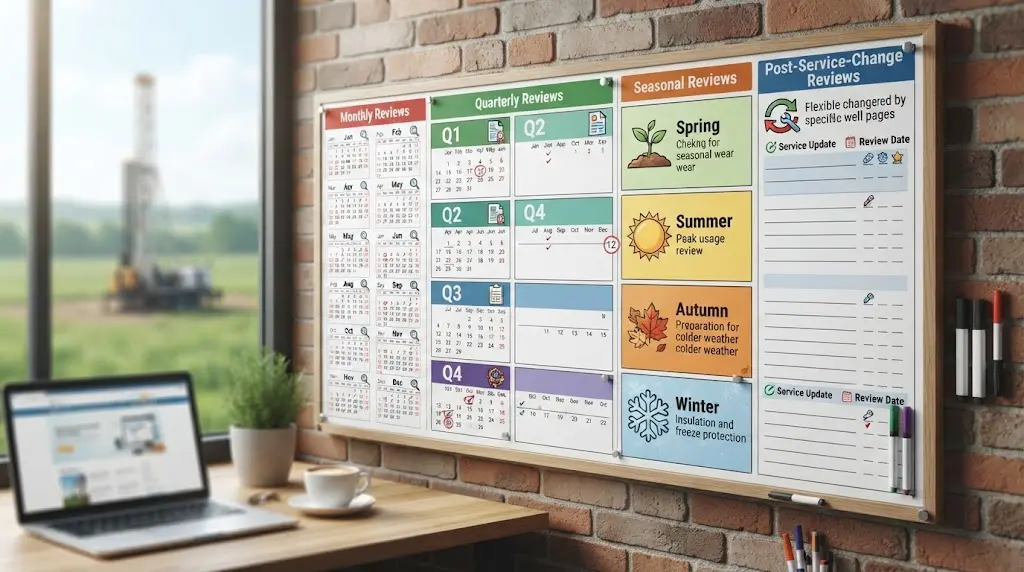
How often should service-page coverage be refreshed?
Review the full inventory at least when the business changes its service mix, crew capacity, territory, or intake process. Review priority pages after meaningful changes in search performance, call quality, or booked-job mix.
Use a light maintenance loop:
- Monthly: check that priority pages, phone paths, territory statements, and Business Profile services are accurate.
- Quarterly: review Search Console queries and pages, call dispositions, estimates, bookings, and decline reasons.
- Seasonally: ask operations whether the service mix, response area, emergency promise, or project types changed.
- After a major service change: re-score the affected page and update evidence, FAQs, and intake instructions.
Google's Search Console guidance says the tool can help monitor search performance and indexing, while Google Business Profile guidance stresses accurate business information and service areas. Those are maintenance tasks, not one-time setup steps.
Do not change the updated date without a substantive review. The page should earn its freshness.
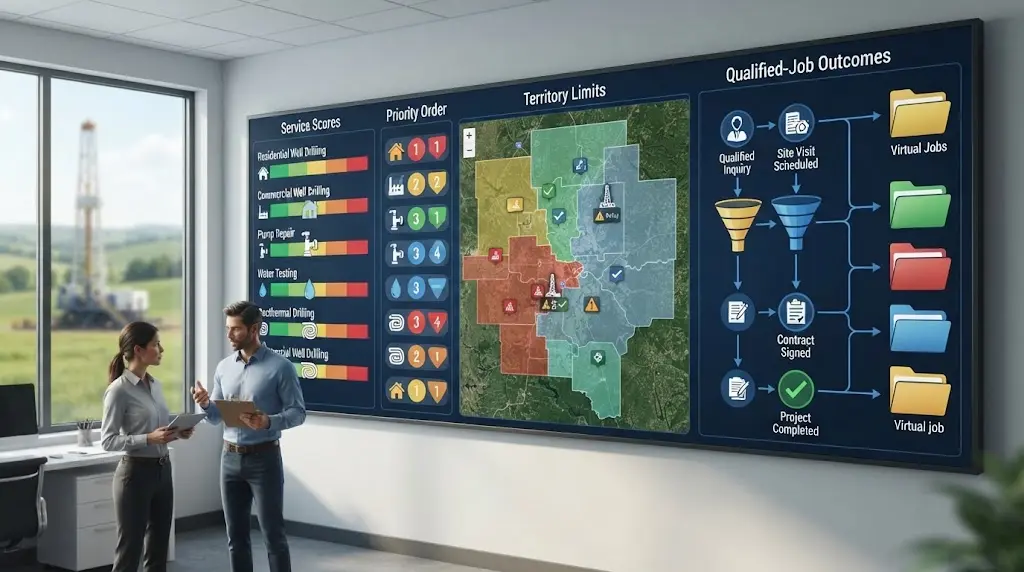
How does this benchmark support SEO and answer engines?
The same facts help a human buyer, a search crawler, and an answer engine understand the company. The difference is whether the information is clear, specific, and supported.
For organic search, the benchmark creates a logical site structure. A service hub links to pages that answer distinct decisions. Each page has a descriptive title, clear content, useful internal links, and honest territory language. Google recommends readable, well-organized, unique content and descriptive URLs in its SEO Starter Guide.
For answer engines, the benchmark makes the entity easier to describe. A page can state:
- What the contractor does.
- Which property types it accepts.
- Where it operates.
- What evidence supports the service.
- How the buyer starts.
That is more useful to retrieval than a page that lists twenty phrases but never resolves the service decision.
The framework itself is also citable because its definitions and thresholds are explicit. A reader can quote the six dimensions, apply the 0-to-2 scoring, and understand that the thresholds are a Brictale recommendation rather than a Google factor.
Do not promise that this structure guarantees rankings or AI recommendations. It makes the company's service information clearer. Visibility still depends on the broader site, local context, links, competition, technical accessibility, and the quality of the answer.
What should an agency deliver after a service coverage audit?
Ask for a decision document, not only a keyword spreadsheet.
A useful deliverable should include:
- The service inventory with priority, maintain, selective, and excluded labels.
- One proposed owner page for each priority service.
- Current URL, status, and duplication notes.
- The six-dimension score with evidence notes.
- The page decision: improve, combine, create, maintain, or exclude.
- Territory and property-type constraints.
- Proof needed before publication.
- Intake fields and measurement owner.
- A short implementation order tied to crew capacity.
- A review date and the signals that would change the decision.
If the document only says “create 30 service pages,” it has not completed the job. It has transferred the page-count problem to the owner.
Brictale can use a free territory audit to compare a contractor's service coverage with the visible market, the company's operating area, and the paths that lead to qualified calls. The audit is the next step for an owner who wants a second set of eyes on the inventory, not a promise that every gap becomes a new page.
What is the verdict for a well drilling service page coverage benchmark?
Use 10-12 as the working definition of covered, 7-9 as partial, 1-6 as thin, and 0 as missing. Then use business fit and evidence to decide what happens next.
The benchmark's main lesson is simple: service coverage is not URL coverage. A page earns its place when it explains a real service decision, fits a real territory, carries real proof, and leads to a usable next action.
Start with the service mix your crews want. Score what exists. Repair one high-value gap. Leave the rest alone until the evidence says otherwise.