
Most well companies don't have a traffic problem in the abstract. They have a leak somewhere between a buyer's search, the website, the phone, and the estimate process.
That distinction changes the work.
When a well drilling website is not generating calls, the answer is rarely "publish more pages" by itself. You need to locate the broken step, determine whether it is a discovery problem, a message problem, a trust problem, a contact problem, or an intake problem, then fix that step before adding more demand. The goal is not more visitors. It is more suitable conversations that your team can answer and move toward booked work.
Why is your well drilling website not generating calls?
Start by separating the symptom from the cause. A well drilling website can receive no useful visibility, receive visibility but no visits, receive visits but no contact attempts, receive calls that are not answered, or receive calls that do not qualify. Those are different failures. Treating all of them as an SEO problem sends the company toward the wrong repair.
Google describes SEO as helping search engines understand content and helping users decide whether to visit a site. That matters here because a page can be technically discoverable and still fail the buyer. Google's SEO Starter Guide also says there are no automatic secrets that put a site first. Visibility is an input to the call system, not the system's final outcome.
"There are no secrets here that'll automatically rank your site first in Google." - Google Search Central
That is not a reason to shrug at a weak website. It is a reason to inspect the whole path.
The useful unit is a service-territory-to-call path. For example, a company might decide that drilled residential wells within its core counties and pump replacements within a tighter response area are the work it wants more of. The website then needs to make those choices obvious, prove them honestly, and give the right buyer a simple way to call. It may decide emergency no-water calls are valuable only when an on-call tech is available. The page should say so rather than inviting a promise the operation cannot keep.
A well drilling website should make the right job easy to recognize and the next call easy to place.
Brictale uses the following original operating model to keep that connection visible. It is a planning framework, not a claim that Google uses four ranking factors.
| Surface | Owner question | Evidence to assemble | Failure mode |
|---|---|---|---|
| Demand | Which services, job types, and areas do we want? | Service mix, capacity, target territories, disqualifiers | Chasing calls the crew does not want or cannot serve |
| Proof | Why should a buyer and platform believe us? | Accurate business facts, service detail, reviews, project evidence, relevant links | Generic claims with nothing specific behind them |
| Discovery | Where can a buyer find that proof? | Business Profile, service pages, location context, crawlable links, indexation | Good information hidden on unindexed or confusing pages |
| Revenue | Did visibility turn into profitable work? | Call source, answer status, qualification, estimate, booked job | Treating a click or rank as the finish line |
Call this the Brictale Four-Surface Well SEO System. It gives an owner a way to inspect an agency proposal or an internal plan. If it starts with a generic keyword list and cannot name the demand and revenue surfaces, it is incomplete.
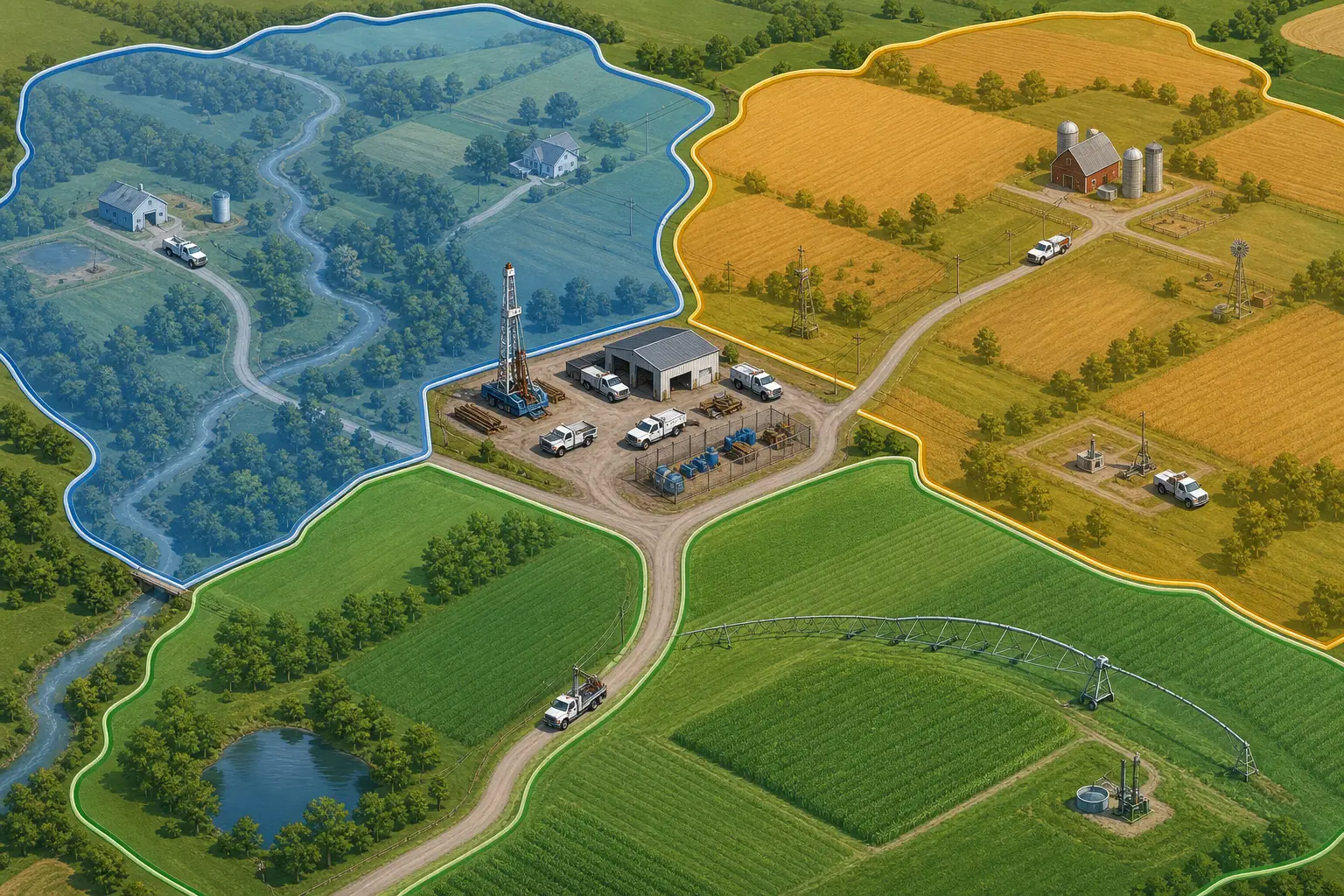
The order matters. A beautiful service page cannot rescue a company that routinely misses calls. A pile of reviews does not make a distant location close to a searcher. And an impressive rank tracker is not evidence that the work coming in is worth taking.
What does the call gap tell you about the website?
Usually the gap is a mix, but the next action should match the dominant constraint. Google says its local results are mainly based on relevance, distance, and prominence. It says complete, detailed Business Profile information can help it understand relevance, while reviews, ratings, links, and general notoriety can contribute to prominence. Google's local-ranking guidance helps explain discovery, but it cannot tell you whether a human reached your office.
Maps and ordinary organic results solve different discovery problems. A searcher who wants a nearby provider right now may encounter a local result. Another buyer may spend time researching well rehabilitation, a pump replacement, or a new well before making a call. Your website needs a serious answer for that second moment, then the phone path must work on the first try. Both paths eventually meet the same office, dispatcher, and estimate process.
| Symptom you see | Likely dominant constraint | First diagnostic question | First useful move |
|---|---|---|---|
| Few map impressions for core service searches | Local relevance, profile completeness, or distance | Is the profile accurate, verified, and tied to the actual operating area? | Audit real-world name, category, hours, phone, service area, and service information |
| Map views but few calls | Trust or conversion | Does the profile and landing page explain the service and make contact easy? | Review photos, description, review themes, phone routing, and landing-page clarity |
| Pages have impressions but weak clicks | Search-result relevance | Does the title and visible page answer the query's specific service and location need? | Rewrite page title, opening, headings, and internal links around the actual service decision |
| Visitors reach service pages but do not contact you | On-page conversion or offer mismatch | Can a buyer tell service area, service scope, and next step within seconds? | Put service fit, territory, phone, and request path above the fold |
| Calls arrive but don't turn into estimates | Intake or capacity, not SEO | Are calls answered, tagged, qualified, and followed up quickly? | Fix intake and disposition tracking before expanding demand |
| You rank in a town but calls are low quality | Demand mismatch | Does the page attract DIY, price-shopping, or out-of-area demand? | Tighten copy, qualification, coverage language, and intake scripts |
A Maps impression, a website visit, and a booked drilling job are three different events. Keep them separate in the report.
Do not make the common mistake of treating local SEO as an alternative to website SEO. Google says Business Profile information can be compiled from crawled official website content, licensed data, user contributions, and Google's interactions with a business. In other words, the profile is not a sealed-off listing. Your official site can reinforce or contradict the business information people see in Search and Maps. Google's explanation of Business Profile information sources makes the connection explicit.
The conversion constraint deserves extra respect. A company that takes two days to return a pump-repair call does not need another article first. It needs a clear after-hours rule, ownership of the phone, and a way to count what happened. More demand magnifies an unhandled process.
Which service pages should you repair or build first?
Prioritize pages by business value and visible failure, not by which phrase sounds largest in a keyword tool. The owner needs a written decision about the work worth winning and the page that should carry that decision. That protects the company from spending months attracting inquiries it declines or confusing buyers who need a different service.
Start with a service-territory inventory. List each service that the company actually performs, then note whether it is a core growth service, a supporting service, an emergency service, or a service to de-emphasize. Repeat the exercise for the geographic area. A county boundary is not automatically a useful marketing boundary. Drive time, crew availability, geology, permitting familiarity, and job economics can be more meaningful.
Here is a decision table you can use before anyone writes a page.
| Service or job type | Core territory | Capacity and timing | Proof available now | Page priority | Why |
|---|---|---|---|---|---|
| New residential well drilling | Define actual counties or drive-time zone | Planned work, longer sales cycle | Rig photos, process explanation, credentials where applicable, project examples | High when strategic | Large decision, needs a clear service page and trust signals |
| Pump replacement | Tighter service area if response time matters | Technician and stock availability | Pump brands or systems served, diagnostic process, review themes | High when profitable | Often urgent, requires clear call path and service scope |
| No-water diagnostics | Only where coverage is real | On-call rules and dispatch capacity | Hours, dispatch policy, diagnostic scope | Conditional | Can create costly unqualified demand if coverage is vague |
| Well rehabilitation | Areas where equipment and crew are available | Specialized scheduling | Technical process, before/after evidence if public and permitted | High if differentiated | A specific commercial problem needs a specific explanation |
| Water testing or inspection | Varies by license and operating model | Appointment capacity | Credentials, turnaround expectations, scope | Medium | Useful only if it supports the intended work mix |
| Agricultural or commercial wells | Project-specific territory | Bid capacity and sales cycle | Equipment capability, safety program, project scope | High when strategic | Requires different proof and buyer language from residential work |
This is not a universal ranking of services. It is a discipline. A two-rig company focused on drilling may decide pump repair is a supporting page, not its lead acquisition center. A pump-heavy company may make the opposite decision. The web structure should follow the operating model.
Repair the page closest to a profitable call before building a page farther from the money.
Build a short do-not-target list too. Include distant towns where dispatch is uneconomic, work types your company subcontracts, price-only inquiries you do not pursue, and services you are not licensed or equipped to provide. It prevents vague page language from inviting the wrong calls.

The same exercise also tells you whether you should create location context at all. A city or county should earn a page by having real service relevance and unique helpful information, not because someone wants one page for every dot on a map. Useful location context may include the actual area served, how the service is scheduled there, local permitting links when relevant, practical ground or access considerations stated carefully, and projects or proof you are authorized to show. It should not be a template with a town name swapped into every heading.
Is Google Maps sending the right people to the right page?
Get the real-world facts right before blaming the website. An eligible business can have a Business Profile if customers visit it at a physical location or it travels to customers. Google requires the business to reflect how it is consistently represented in the real world and to keep its address and/or service area accurate and precise. Read the Business Profile representation guidelines before changing a name, address, or service area.
For a drilling or pump company, that leads to a plain checklist:
- Use the business's real-world name. Do not attach a row of service and city keywords to it.
- Confirm that the address, service area, hours, and phone route match how the company actually operates.
- Choose categories and services that describe the real business. Do not select a category merely because a competitor uses it.
- Make the website link lead to a page a buyer can use, not a generic home page with no obvious next step.
- Add useful, current photos that help a buyer recognize the operation and understand its work. A staged stock image cannot show the same proof as real equipment, team, or project context.
- Respond to reviews as a business, without publishing private job details or pressuring customers for a particular rating.
- Check the profile routinely for incorrect edits, duplicate listings, changed hours, or a broken phone number.
Google says more reviews and positive ratings can help local ranking. That does not make reviews a substitute for everything else. Its local-ranking guidance puts reviews within a wider prominence picture that includes links and general visibility. A company with a polished review request but unclear services, weak pages, and an unanswered phone has not built a durable acquisition system.
There is a practical compliance line here. The profile should communicate a service-area business accurately. It should not invent storefronts, borrowed addresses, or names that a customer would not recognize in the field. Incorrect profile data can waste demand and create a policy problem at the same time.
The owner question is simple: if a prospective customer who has never heard of us sees this profile for ten seconds, can they tell what work we do, where we actually go, and how to reach the right person? If not, improve clarity before chasing volume.
What should a well drilling website explain before asking for a call?
Your site should remove enough uncertainty for a serious buyer to take the next step. A profile is compact by design. It cannot carry every qualification, service boundary, process detail, proof point, or decision aid a drilling or pump customer needs. If the page makes the visitor work to answer those questions, the phone number will not rescue it.
Begin with a clean architecture. Keep a clear main navigation, a service hub if one is useful, individual service pages for priority work, obvious contact paths, and descriptive internal links. Google says the vast majority of new pages it finds each day are found through links. It also explains that meaningful link text helps people and search engines understand the destination. The SEO Starter Guide is direct on both points.
That does not mean building a maze. It means that a visitor reading about well rehabilitation should be able to reach the relevant service page, contact route, and perhaps an explanation of inspection or pump work without hunting through a hamburger menu.
Every priority service page should answer the buyer's obvious business questions:
| Page element | What it should answer | What to avoid |
|---|---|---|
| Service definition | What exactly does the company do? | A vague headline such as "quality solutions" |
| Fit and exclusions | What jobs, systems, or customers fit? What is outside scope? | Promising every service to every caller |
| Territory | Where does the company normally perform the work? | Pretending all towns are equally close |
| Process | What happens between first contact and estimate or scheduling? | Technical detail that never explains the next step |
| Proof | What makes the company credible? | Unverified superlatives or anonymous stock claims |
| Contact route | How should a qualified buyer call or request help? | A buried form with no expectations set |
| Related services | What adjacent work may matter? | Random internal links that confuse the decision |
A service page earns its place by reducing uncertainty for a buyer who is deciding whether to call.
Use field language when it brings precision. If you install submersible pumps, say so where it matters. If a rehabilitation scope is different from drilling a new borehole, explain the difference. If you only inspect certain systems or regions, state it. Specificity filters poor-fit inquiries and reassures good-fit ones.
Avoid writing consumer how-to articles merely to collect visits. A page that teaches a homeowner to troubleshoot a pressure switch may attract traffic, but it may not bring the kind of calls you want. A better commercial page can explain when a no-water situation merits professional diagnosis, the service territory, the process, and the contact path without becoming a DIY repair manual.
Technical work still matters. Pages must be accessible to crawlers, mobile usable, fast enough to use in the field, and free of avoidable broken links or duplicates. But do not let a technical audit become a hiding place for a weak offer. Technical fixes create the conditions for discovery. They do not decide which service should be sold or persuade a buyer that your company is the right one.
How do you build a page that earns a call without thin city content?
Use a page only when it owns a distinct customer decision. A new-well-drilling page, a pump replacement page, and a well-rehabilitation page can each be distinct because the buyer's question, urgency, proof, and process differ. Ten pages that say the same thing about the same service in ten nearby towns do not gain that distinction by changing the place name.
Google's people-first content guidance asks whether a page provides original information, research, or analysis beyond what is already obvious and whether the reader leaves having learned enough to achieve a goal. It also warns against creating content mainly for search traffic or producing lots of pages across topics without real value. Read Google's self-assessment questions as an owner-side test: would this page help a potential buyer decide, even if a search engine did not exist?
Use the following page brief before commissioning any service or territory page.
| Brief field | Required answer |
|---|---|
| Buyer | Who is making the decision: homeowner, property manager, farm operator, general contractor, or another commercial buyer? |
| Job to be done | What work do they need arranged, evaluated, or quoted? |
| Service scope | What does your company do, and what does it not do? |
| Territory truth | Where can you serve this job at a workable response time and cost? |
| Proof | What can you show or state truthfully that supports this page? |
| Distinct content | What would be missing from the site if this page did not exist? |
| Next action | What is the sensible contact or estimate step? |
| Measurement | Which source and call tag will let you tell whether it produced qualified work? |
If the distinct-content cell is blank, do not publish the page. Improve a stronger existing page instead.
Here is what a healthy sequence can look like for a company whose core work is drilling and pump replacement:
- Fix the home page so it states the core services, true coverage, and clear contact path.
- Build or improve the main drilling service page with scope, qualifications, process, and related work.
- Build or improve the pump replacement page with system scope, service area, urgency expectations, and call path.
- Link those pages from relevant navigation, the home page, and useful supporting pages with descriptive anchors.
- Add location context only where the company has real coverage and the page adds useful information that does not simply duplicate the core service page.
- Review Search Console, profile actions, call data, and estimates before multiplying pages.
The sequence changes when the business model changes. That is the point. SEO cannot choose a strategy for you, but it can make your choices legible to buyers and platforms.
What proof makes a well company easier to trust?
Proof is not a gallery of logos or a paragraph that calls the company "trusted." It is the information a buyer can check and use. For a well contractor, useful proof usually has four jobs: confirm identity, show service competence, reduce uncertainty about the process, and make the next contact feel safe.
Start with the basics that should agree everywhere: business name, phone, hours, service information, real address handling, and website. Google says it can assemble Business Profile information from multiple sources. Inconsistent facts make it harder for customers and platforms to understand the business. Google's overview of profile sources is a reminder to check the whole public footprint, not only the profile editor.
Then move to proof that belongs to your company. Depending on what is true and publishable, that can include:
- Clear descriptions of equipment capability and service scope.
- Named certifications, licenses, memberships, or safety information where current and relevant.
- Original photos of equipment, crews, work stages, or completed systems, with sensible privacy and safety review.
- Reviews that naturally mention the work buyers care about.
- Project examples only when you have permission and can describe them accurately.
- Links or mentions from relevant suppliers, trade associations, local institutions, or partners when earned on merit.
Do not manufacture proof. Do not write reviews for customers. Do not turn every relationship into a link request. And do not publish a project detail that exposes a customer's location or private information without permission.
Relevant links still matter because they help discovery and context. Google says links connect users and search engines to other resources, and notes that the vast majority of new pages it finds daily are through links. It specifically recommends meaningful link text. Google's guidance on links supports a simple approach: earn and use links because they are useful, not because someone sold a numerical quota.
Proof works when it makes a specific claim easier to believe, not when it makes the page look busy.
One field-tested test is to underline every claim on the page that asks for trust. "We serve this area." "We work on this system." "We are available at this time." "We have this qualification." For each one, ask what public fact, process, photo, policy, review theme, or named credential supports it. If there is no answer, soften the claim or remove it.
What should the first 90 days of website call repair look like?
The first 90 days should establish a baseline, repair false or missing facts, publish the few pages that matter most, and create a measurement habit. It should not be judged by a promise that a certain phrase will be number one by a certain date.
Here is a practical sequence. Adjust it to actual site condition, access, and crew capacity.
Days 1-14: define demand and establish the baseline
First, have the owner or operator make the service-territory decisions. Set the core services, the areas worth serving, emergency boundaries, capacity constraints, and work you want to avoid. Without this step, every later task is generic.
Second, record the current public footprint. Capture the Business Profile information, website pages, phone numbers, contact routes, reviews, obvious duplicate listings, and indexed page count where tools make that available. Save screenshots and dates. You need a before state that does not rely on memory.
Third, verify measurement. Google says Business Profile performance can show views, searches, and actions, including calls and website clicks. Its definition of a call is a click on the profile's call button, not confirmation that a person spoke to your dispatcher or booked work. Google's Business Profile performance documentation makes that limit clear. Decide how your staff will record answered calls, qualified opportunities, estimates, and booked jobs.
Days 15-45: repair the foundation and publish priority answers
Correct business facts across the profile and official website. Make sure the site can be crawled and that important pages are linked from pages already easy to find. Google recommends monitoring indexing issues in Search Console and says a sitemap can help discovery, even though it is not a guarantee of indexing. Google's Search Console guidance explains the relevant reports.
Then improve the home page and one or two priority service pages. Do not launch ten lookalike location pages to create the appearance of activity. Give each page a direct opening, real service scope, territory clarity, useful proof, and an obvious contact route.
At the same time, agree on the review process. The goal is to make it easy for satisfied customers to leave an honest review after a completed job. Do not offer incentives for a particular sentiment and do not let a review project distract from solving missed-call or scheduling problems.
Days 46-90: connect pages, test the path, and make decisions from data
Add internal links that help a reader move between related services. Check title and opening language against the actual queries and job types that matter. Google says the Search performance report breaks search traffic down by queries, pages, and countries, which lets you inspect whether a page is being shown for the work you actually want. Google's Search Console documentation is more useful here than a dashboard that shows only a sitewide traffic line.
Review the call ledger with operations. Which sources created answered calls? Which calls were within the territory? Which were qualified? Which became estimates and booked jobs? A page that gets modest traffic but drives qualified pump replacement work may be more valuable than a broad page that draws research traffic and no estimates.
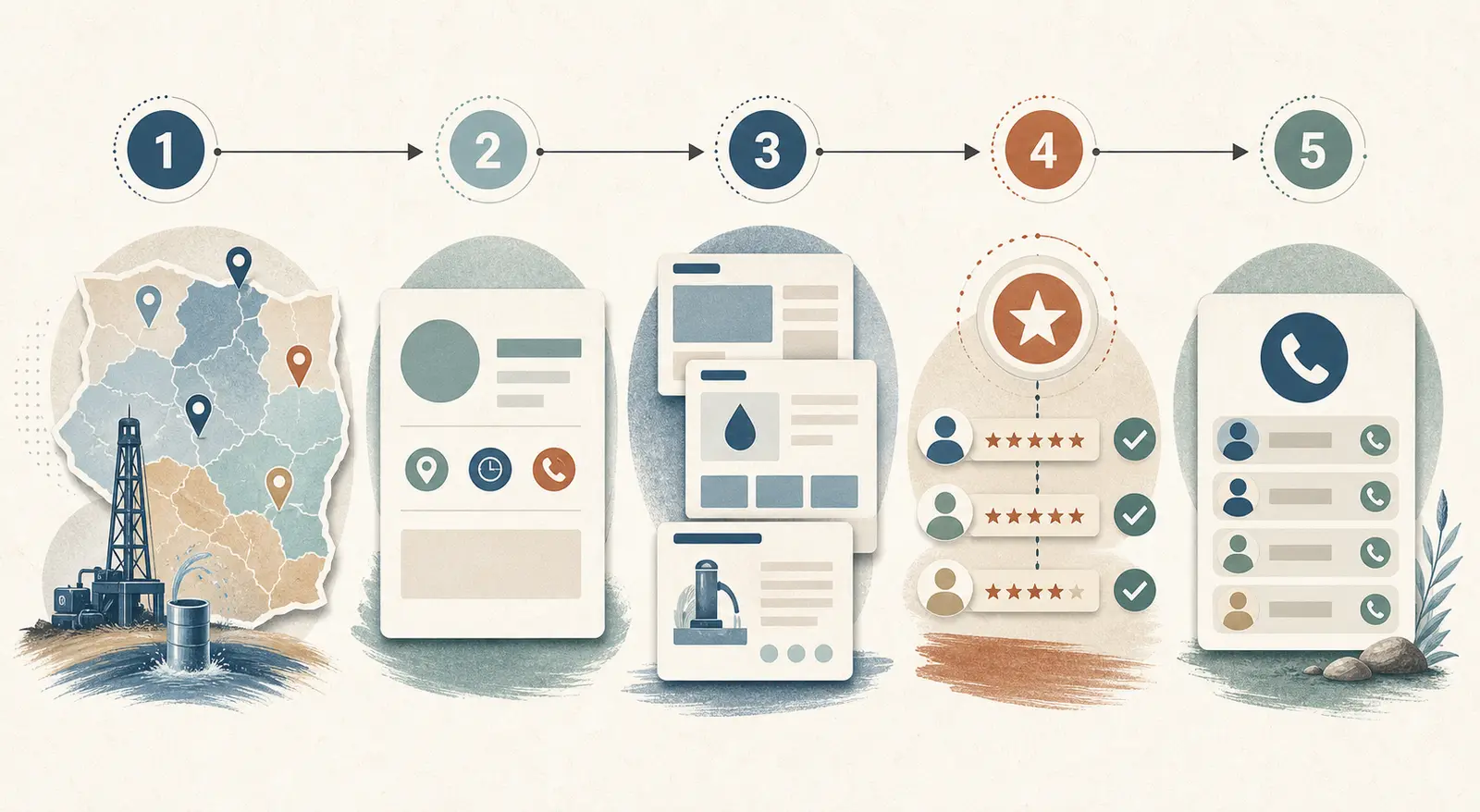
Use the first 90 days to learn, not to lock yourself into a story. If a page is not indexed, solve the technical or content reason before writing five more. If calls are out of area, change the coverage language and intake. If the profile gets action but the website produces no estimate requests, inspect the page and phone path. The learning loop is the work.
How should you measure a website from visit to booked job?
Measure a chain of events, not a single vanity metric. A rank, a page visit, or a profile call-click can be useful leading information. It is not enough to tell you whether a drilling crew has more profitable work or where the website loses the buyer.
Use this original Territory-to-Booked-Job Scorecard from Brictale. It is a simple operational bridge between public search data and the company's own intake data.
| Stage | Metric | Where it comes from | Owner question |
|---|---|---|---|
| Visibility | Relevant query impressions and page impressions | Google Search Console | Are we being seen for services and areas we want? |
| Local discovery | Profile searches, views, call clicks, website clicks | Google Business Profile | Is the profile being found and used? |
| Contact | Answered calls, form submissions, text conversations | Phone and intake system | Did a person actually reach us? |
| Qualification | In-territory, correct service, viable customer | Call disposition field | Was this a job we want and can serve? |
| Sales | Estimates created, estimate value, close status | CRM or estimate system | Did qualified interest become a real opportunity? |
| Revenue | Booked jobs and value, if recorded | Job-management system | Did the channel support work worth doing? |
| Learning | Lost-reason codes and territory gaps | Weekly owner review | What should change next? |
The report should include a few plain-language definitions. Define a qualified lead for your own company. It might mean a caller inside the core territory who needs a service you perform, has a reachable decision maker, and is willing to schedule an estimate or diagnostic. It will not be identical for every business.
Separate source from outcome. A Business Profile call is a profile action. A tracking number can help identify a call route. An answered conversation is an intake event. A qualified opportunity is a sales judgment. A booked job is an operational record. Blending them into a single "lead" column makes it impossible to find the leak.
The only website report an owner can run a business on connects visibility to qualified opportunities and booked work.
Google provides useful platform signals, but its own definitions matter. Profile call data records call-button clicks, and website clicks record clicks on the profile's website link. Google's performance documentation does not call either one a booked job. Your system has to close that gap.
A weekly 20-minute review can be enough when it is structured. Ask these questions:
- Which core services and territories produced visibility this week?
- Did the phone or form path create any missed or untracked contacts?
- How many contacts met the company's qualified-lead definition?
- Which pages, queries, or profile paths were associated with those contacts?
- What did the unqualified calls reveal: unclear territory, missing scope, wrong hours, or an actual market opportunity?
- What one page, profile fact, process, or intake change should happen next?
Do not demand false precision. Organic discovery can involve multiple visits and an offline recommendation before a call. Use a source field and ask callers a plain question such as "How did you find us?" alongside available analytics. When the answer is uncertain, record it as uncertain. A clean unknown category is better than a dashboard that pretends every job had one touchpoint.
What should you require from a website or marketing provider?
Require decisions, evidence, and a measurement path. A website or marketing provider does not need to know every detail of rig operations on day one. But they do need to ask enough questions to understand which jobs you want, which territory you can serve, which claims can be substantiated, and who owns the calls after a visitor becomes a contact.
Use this evaluation table in a sales conversation or internal planning meeting.
| Ask for this | A credible answer sounds like | A warning sign sounds like |
|---|---|---|
| Service and territory priorities | "Let's identify profitable services, coverage limits, capacity, and the pages that support them." | "We'll target every nearby city and every service phrase." |
| Business Profile approach | "We'll verify real-world facts and follow platform guidelines." | "We'll add service keywords to the business name or create extra locations." |
| Content plan | "Each page needs a distinct buyer decision, real scope, and proof." | "We publish a fixed number of city blogs every month." |
| Technical plan | "We'll identify crawl, indexing, link, and conversion blockers, then prioritize by impact." | "We have a 200-point audit, but cannot explain which issue affects a call." |
| Link strategy | "We'll improve internal linking and seek relevant earned mentions where there is a reason." | "We guarantee a monthly number of backlinks from unspecified sites." |
| Reporting | "We'll report queries, pages, profile actions, contacts, qualification, and booked-job feedback." | "You'll receive a ranking screenshot and traffic chart." |
| Timeframe | "We'll establish baselines and leading measures, then assess compounding progress honestly." | "We guarantee first place by a fixed date." |
You should also ask what the provider will need from the company. Real photos, service details, access to profile ownership, call outcomes, review-process cooperation, and timely approval all affect what can be done. A vendor who claims to need nothing from you may be planning to make the site generic.
Ask how they will document changes. A simple change log should state what changed, why it changed, the page or profile affected, and the date. This prevents the monthly-report problem where nobody remembers whether visibility moved after a useful improvement or after an unrelated seasonal shift.
Brictale's role is to make that operating system visible for well and pump companies. The free territory audit should identify the gap between your true service footprint, what buyers can find, and what your intake process can prove. It should not promise rankings before it understands the business.
When is a website repair not the next best investment?
Website repair is valuable when a company has services worth promoting, a service area it can serve, a site and profile that can be improved, and a way to handle the demand. It is not automatically the first move.
Pause or narrow the website plan when one of these conditions is true:
- The company cannot reliably answer or return calls during the hours it advertises.
- Crews are already booked beyond a sensible planning horizon for the target service.
- The company has not decided which work or territories it actually wants.
- The website, phone system, or profile contains materially wrong facts that could send buyers to the wrong person or place.
- The business lacks a usable estimate and follow-up process.
- The only plan is to target towns where the company does not truly compete or travel economically.
- A short-term demand gap requires a channel with faster controllable testing, while SEO continues as a longer-term foundation.
This is not an argument against a stronger website. It is an argument against treating a page as a cure for every revenue problem. Fix the bottleneck nearest the money. If callers cannot reach the right person, improve intake. If the company has no capacity, protect reputation and scheduling. If the territory decision is fuzzy, settle it before asking a page to distribute a fuzzy message.
More traffic is a liability when the business cannot turn the right calls into good work.
The right alternative may be process work, reputation cleanup, paid demand capture with strict controls, or simply declining growth activity for a period. An honest marketing partner should be able to say that.
Which website-to-call mistakes create the most expensive waste?
The expensive mistakes are not always technical. Many come from misalignment between the website, the profile, and the business itself.
Mistake 1: trying to outrank distance with a service-area setting
Google says distance is one of the main factors in local results. A service-area field helps communicate where you go. It does not make a company next door to every searcher. Google's local-ranking guidance is clear on that point. Use accurate service information, build actual prominence and relevance, and make decisions about far-away demand honestly.
Mistake 2: publishing one thin page per town
Ten nearly identical city pages do not create ten distinct reasons to choose you. They create maintenance work, weak copy, and a poor buyer experience. Build a service page that owns the core decision. Add location-specific material only where you can give it a real job: explain true coverage, solve a local decision, or present authorized evidence that helps the reader.
Mistake 3: treating the Google Business Profile as a side project
The profile often sits closest to a local call, yet companies leave the phone number, hours, photos, service information, and review response process unattended. Google says Profiles are used in Search and Maps and that profile performance can show search and action data. Its Business Profile documentation supports making one person accountable for a recurring review, even when an agency assists.
Mistake 4: measuring only rankings
Rank tracking can alert you to a change. It cannot tell you whether a caller was in territory, needed a service you offer, or booked work. Pair query and page visibility with call disposition and estimate data. If your internal systems cannot provide that yet, fix the measurement design before declaring SEO successful or unsuccessful.
Mistake 5: confusing a call click with a call handled well
Google's call metric is a click on the call button. That is useful, but it cannot tell you whether the call connected, whether staff answered it, or whether the caller was qualified. Add call outcome fields. Review missed and lost calls. Then act on what you learn.
Mistake 6: asking content to do the work of proof
No amount of polished writing proves a false claim. If a page says you serve a territory, publish the real service boundary. If it says you work on a type of system, be ready to explain the scope. If a credential is expired or not relevant, do not use it as decoration. Content should clarify evidence, not substitute for it.
Mistake 7: buying vague links or fabricated reviews
This is a short path to noisy reports and a long path to distrust. Build useful internal links. Earn references by being a legitimate company in the market. Ask for honest reviews through a normal completed-job process. It takes more care, but it supports the public reputation that a local buyer can actually see.
Mistake 8: accepting a report that cannot say what changed
Every month should answer four questions: what changed on the public footprint, what changed in visibility, what changed in contacts and qualified demand, and what is the next decision? If the report only shows a green arrow, it cannot guide the business.
How should a well drilling website prepare for answer engines without chasing hype?
Answer engines are another discovery surface, not a shortcut around the basics. A buyer may ask a tool which type of contractor to call, what questions to ask, or which local options meet a need. Clear, useful, well-sourced pages are easier for any retrieval system to understand than generic sales copy.
Do not make promises about appearing in a particular answer. Microsoft's own AI Performance documentation says its report can show pages cited in supported AI experiences, citation trends, and grounding queries. It also states that the report does not measure ranking, authority, performance, or importance. Treat a citation as a signal to study, not a trophy that proves market leadership.
The same Four-Surface system applies:
- Demand remains the service and territory you truly want.
- Proof remains accurate, specific, verifiable business information.
- Discovery expands to include a page being retrieved or cited in an answer.
- Revenue still requires a buyer to contact you and your team to handle the opportunity.
For the broader mechanics, see Brictale's guide to what generative engine optimization means and the practical guide on earning brand mentions in ChatGPT. The important distinction for a contractor is that answer-engine visibility should never replace local search fundamentals or call tracking.
Write pages that answer one real decision cleanly. Use exact service language. Attribute material claims. Keep business details consistent. State what you do and do not do. Those practices help a buyer today and make the content more legible to systems that retrieve it tomorrow.
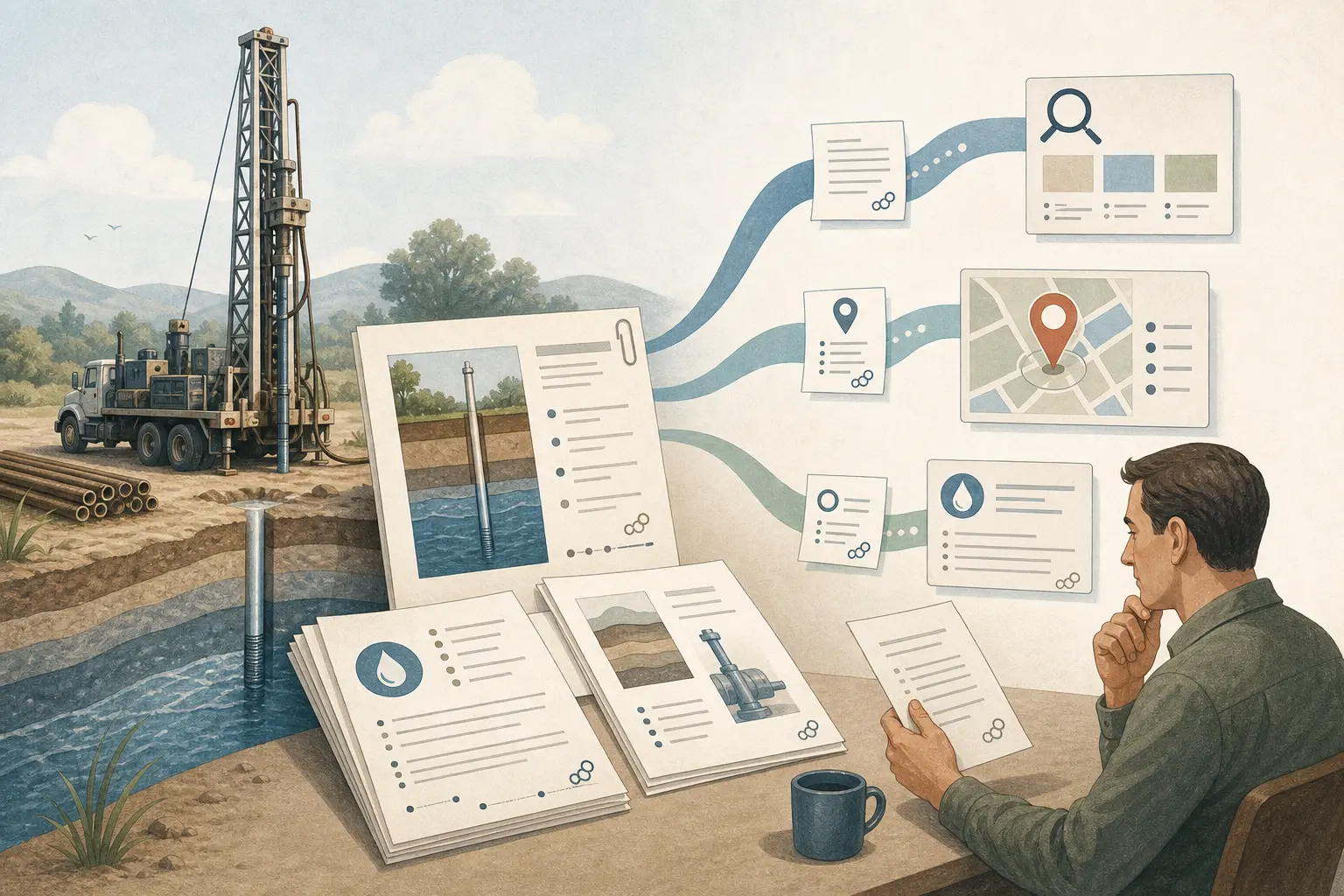
There is also a measurement distinction. Bing Webmaster Tools' normal Search Performance report includes pages, keywords, impressions, clicks, and separate traffic sources such as web and chat. Bing's documentation says keyword and page tables are only available for web traffic, not chat and other verticals. Keep ordinary organic visibility, answer-engine citations, and booked-job outcomes in separate columns. Combining them creates confidence without clarity.
What should an owner test on Monday morning?
Do not start by asking for more blog posts. Start with a 60-minute working session that ends in decisions.
Bring the owner, whoever answers the phone, and the person who can edit the website or profile. Pull up the current website, Business Profile, recent calls, and a map of where crews actually travel. Then complete this checklist.
- Circle the three services you want more of in the next two quarters.
- Draw the core territory where those services are profitable and operationally realistic.
- Write the jobs, areas, and situations you should not actively attract.
- Check the business name, phone, hours, website, address handling, and service information against the real operation.
- Open the home page and priority service pages on a phone. In ten seconds, can a buyer identify service, territory, proof, and contact path?
- Listen to a sample of recent inbound calls or inspect call notes. Can you tell which were answered, in territory, qualified, estimated, booked, and lost?
- Choose one profile correction, one priority-page improvement, and one intake fix for the next week.

Then assign an owner to each action. Marketing without ownership becomes an idea. A corrected phone number, an honest service-area statement, a stronger pump-replacement page, or a required call-disposition field can have more value than a month of general discussion.
Keep the first week small. The goal is to create a clean baseline and a repeatable decision cycle. Once you know what services, territories, and calls matter, website work becomes much easier to judge. And once the company can show what changed from search visibility to booked work, it becomes much harder for anyone to sell you activity disguised as progress.
Your well drilling website is doing its job when the right buyer can recognize the service, confirm the territory, see a reason to trust the company, and reach a person without friction. Test that path honestly. Then use Brictale's free territory audit to compare your public search presence, service coverage, page clarity, and call path against the work your company is actually trying to win.