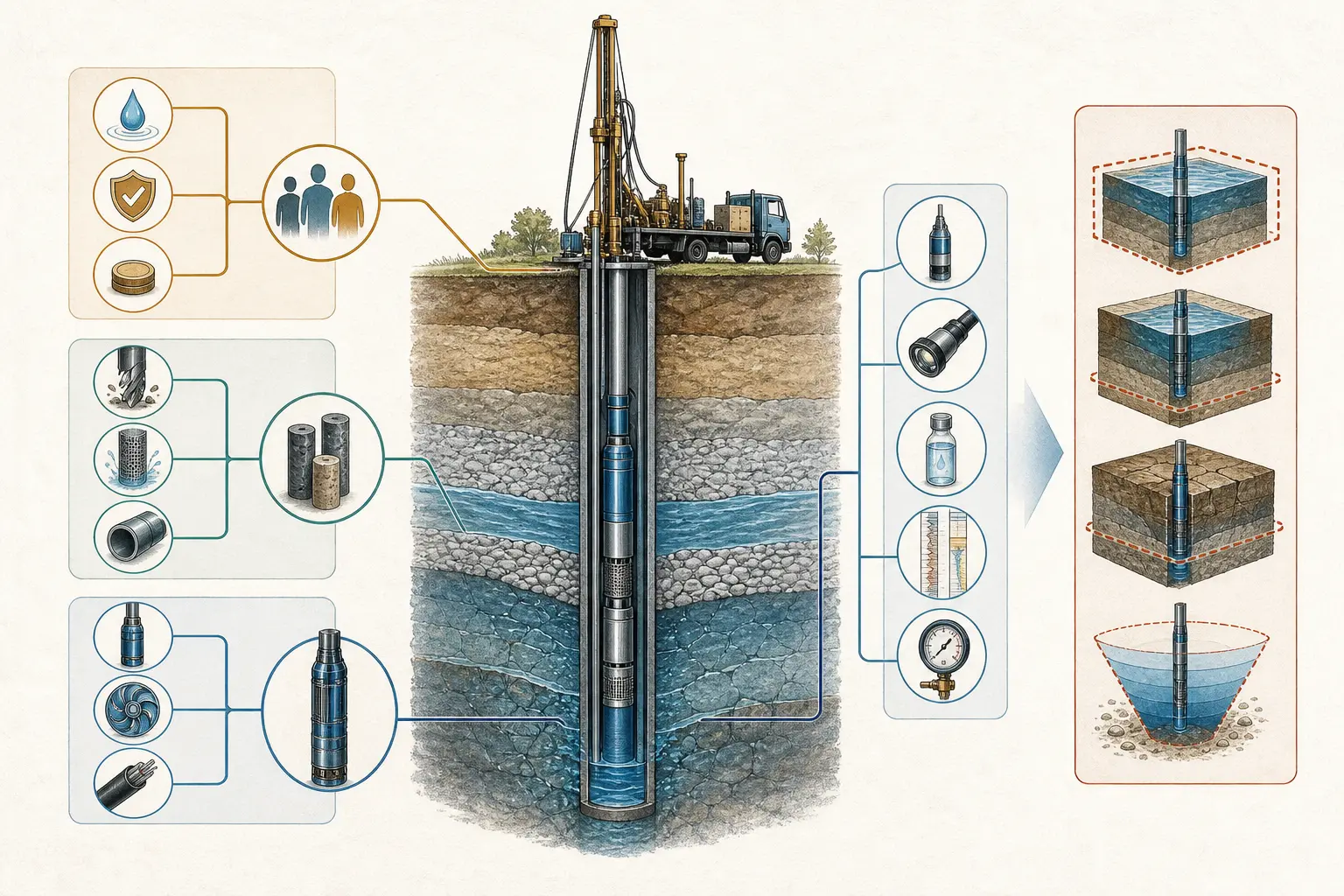
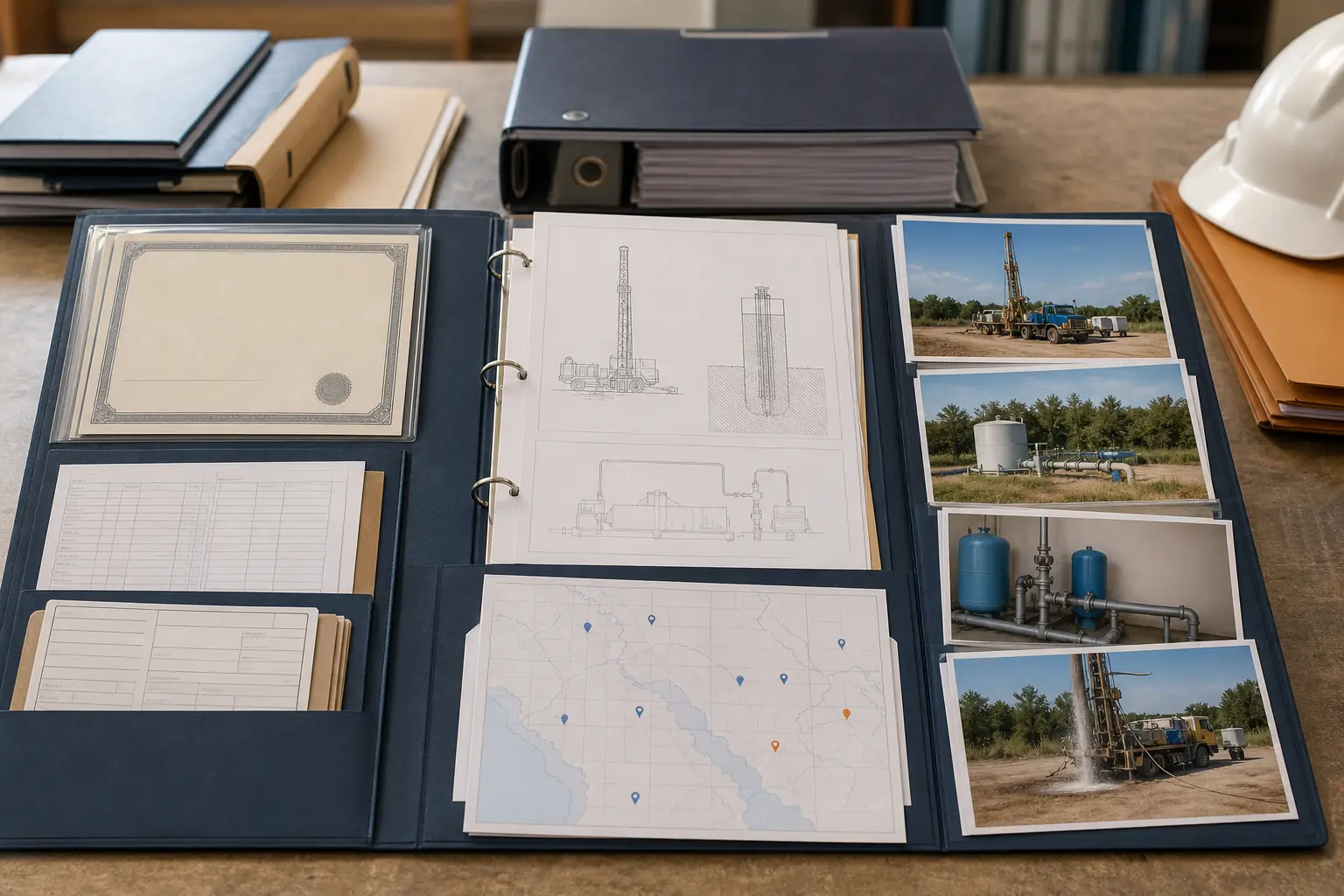
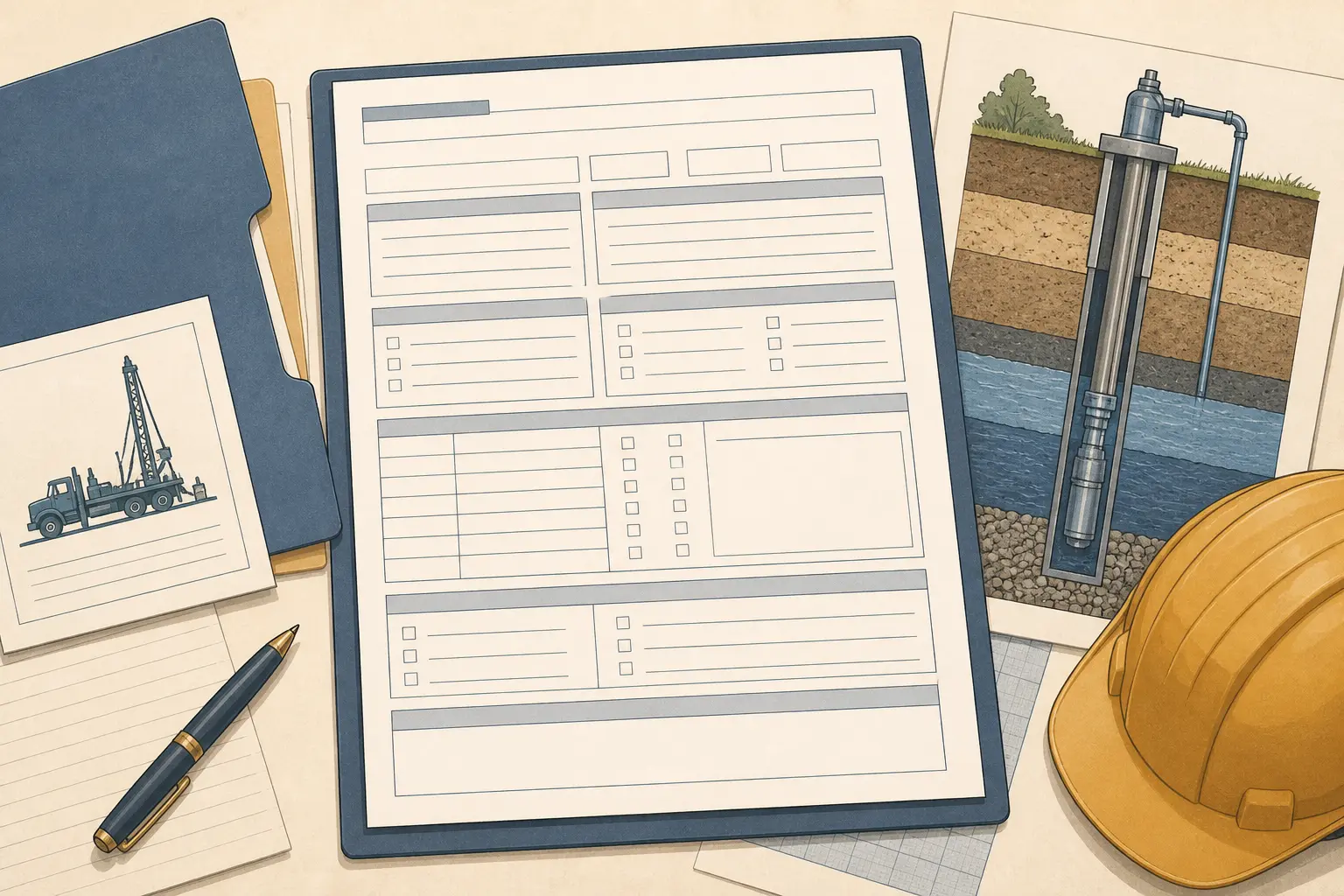
Prequalification fails for a simple reason: the contractor sends a polished document before checking whether every important claim matches the operation a buyer can verify.
For a water well drilling or pump company, the qualification process has to do more than list a rig and a few broad services. It has to make the buyer's next decision easy. Can this contractor perform the required work? In the required territory? With the required license, people, equipment, capacity, and reporting? What should happen next?
This guide gives you a practical prequalification checklist, a fill-in capability statement, a proof framework, and a review process for answering those questions without inventing credentials or promising capacity you do not have.
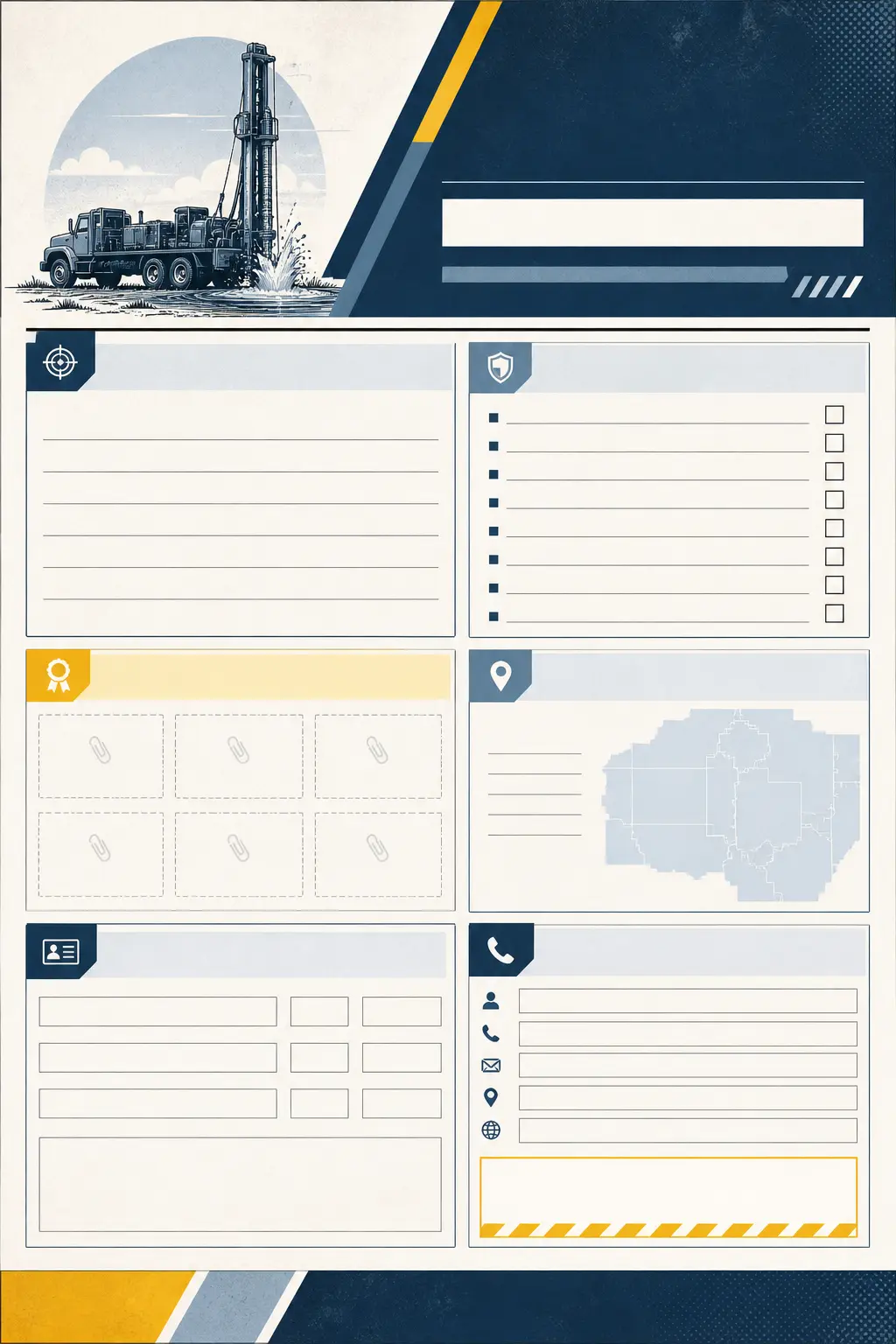
What does a water well contractor prequalification checklist verify?
A prequalification checklist verifies that the contractor's proposed scope, evidence, operating boundaries, and submission materials agree with the buyer's actual requirement. It is a control sheet for the owner or business-development lead, not a promise that a generic PDF will satisfy every procurement.
Use it before you send a capability statement to a public agency, utility, engineering firm, prime contractor, commercial buyer, or partner. The checklist should force five decisions: what work is in scope, what proof supports it, where and when the company can perform it, which document the buyer requested, and who owns the next contact.
Prequalification is a verification job before it becomes a design job.
What is a water well drilling capability statement?
A water well drilling capability statement is a short business document that tells a potential buyer what your company can perform, where it operates, what evidence supports those claims, and how to contact the right person. It is used with public agencies, utilities, engineering firms, prime contractors, commercial property owners, developers, agricultural operators, and referral partners.
The word capability matters. The document is not mainly a history of the company. It is not a list of every service you have ever considered. It is not a page of slogans. It is a buyer-facing answer to a narrower question:
Can this company perform the work I may need, under the conditions I care about, with a level of risk I can accept?
The best statement lets a reader find four things quickly:
- The relevant service or project capability.
- The territory, buyer type, and project conditions the company can serve.
- The license, personnel, equipment, experience, or process that supports the claim.
- The next contact or verification step.
HHS lists a similar set of building blocks, including company description, core capabilities, services, certifications, contract vehicles, clients, NAICS codes, staff credentials, general company information, and contact details. Its guidance also recommends concise presentation with bullets and simple tables. See How to Write a Good Capability Statement.
The document can be one page, front and back, when the buyer has not provided another format. It can also be an online capability profile, a PDF attachment, or a leave-behind after a meeting. The medium changes. The discipline does not.
A capability statement should reduce buyer uncertainty, not increase the number of claims on the page.
What does it not do?
A capability statement is not automatically any of these documents:
- A response to a request for proposals.
- A statement of qualifications with required forms and references.
- A source-sought response.
- A technical proposal.
- A price sheet.
- A safety plan.
- A license application.
- A website home page.
It can introduce your company before one of those documents is requested. It cannot override a buyer's instructions. If an agency gives you a page limit, a response order, a form, a portal, a deadline, or a requirement to separate prices, follow those instructions even when a generic capability-statement template suggests something else.
Should you use a capability statement, an SOQ, or a proposal?
Choose the document by the buyer's request and the stage of the relationship. A one-page capability statement is a flexible introduction. An SOQ or proposal is a formal response that must answer the buyer's exact requirement.
| Situation | Best first document | What the buyer needs to learn | What you should not assume |
|---|---|---|---|
| You are introducing the company to a public buyer, prime, engineer, or partner | Capability statement | What you do, where you work, relevant proof, and who to contact | That a one-page PDF satisfies a future solicitation |
| The buyer requests qualifications or a shortlist | SOQ or qualifications package | Relevant experience, personnel, licenses, approach, references, and required forms | That generic company history will earn credit |
| The buyer publishes a request for proposals | Proposal response | Compliance with every instruction, technical approach, schedule, price, and required attachments | That your marketing PDF can replace the response |
| An agency asks whether qualified vendors exist | Source-sought response | Whether your company matches the described scope and market category | That the response should read like an advertisement |
| A prime contractor is assembling a team | Subcontractor capability sheet or tailored statement | The exact work package you can take, evidence, territory, capacity, and interface with the prime | That the prime needs your entire service catalog |
| A commercial buyer is comparing providers | Buyer-specific capability statement or qualifications profile | Fit, process, service area, proof, and contact path | That public-sector identifiers are more persuasive than relevant work |
A recent public RFQ for on-call water well and well-pump maintenance is a useful reminder. Sweetwater Authority required a concise statement of qualifications, a specified order, relevant licenses, public-works experience, a project manager, and separate cost material. Those are requirements of that opportunity, not a national template. Read the Sweetwater Authority request for qualifications when you want to see how a real water-well buyer can move beyond a generic one-page introduction.
How do you recognize a formal response?
Look for language such as:
- Submit a statement of qualifications.
- Respond in the following order.
- Include the attached forms.
- Demonstrate experience with the scope of work.
- Provide references.
- State exceptions.
- Observe the page limit.
- Submit through the named portal.
- Provide pricing in a separate file.
- Responses that do not meet the requirements will be deemed non-responsive.
When those instructions appear, use the capability statement as source material, not as the final response. Copying a generic template into a formal procurement can make a contractor look careless even when the field work is strong.
What should a one-page statement contain?
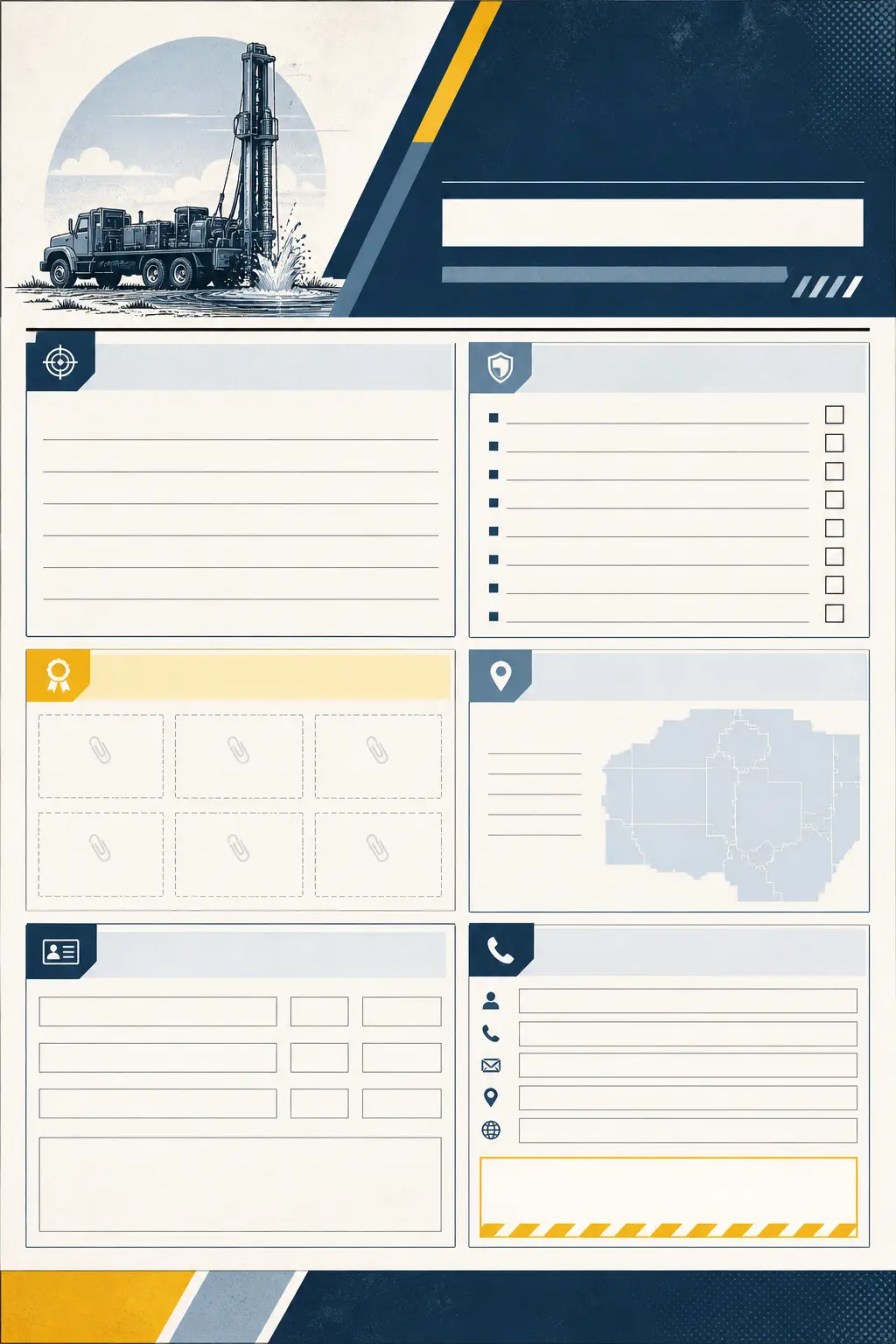
Put the information in the order a buyer needs it, not the order your office happens to have it. Lead with the company identity and the most relevant capability, then show proof, boundaries, identifiers, and contact details.
Here is the recommended one-page sequence for a water well drilling or pump contractor:
| Section | Job on the page | Water-well detail to include |
|---|---|---|
| Header | Identify the company and the reason to keep reading | Legal or brand name, logo, phone, email, service area, and a plain-language capability line |
| Buyer-relevant summary | Explain the work you perform | Types of drilling, pump, rehabilitation, testing, or related work that are actually offered |
| Core capabilities | Match the buyer's likely need | A short bullet list tied to project types, not a service catalog |
| Evidence and differentiators | Reduce risk | Licenses, relevant equipment, staff qualifications, past performance, process controls, or documented partnerships |
| Territory and capacity | Set an honest boundary | States, counties, service radius, mobilization conditions, current availability language, and subcontractor role if relevant |
| Identifiers and certifications | Help the buyer route and verify the company | UEI, CAGE, NAICS, license numbers, certifications, or contract vehicles only when applicable and current |
| Contact and next step | Move the conversation forward | Named contact, direct phone and email, website, and the specific next step the buyer can request |
HHS says a statement should be “visually appealing,” “present information concisely,” and use “bullets, simple tables, highlighted sections for readability.” That is good operating advice for a field where a procurement officer, estimator, engineer, or prime contractor may be scanning many documents. See HHS capability-statement guidance.
The word count is not the target. The target is decision speed with enough evidence to avoid a misleading impression.
What belongs above the fold?
The top quarter of the page should answer:
- Who are you?
- What kind of water-well or pump work do you perform?
- Where do you perform it?
- Who should contact you?
Do not make a buyer decode a logo, a slogan, and a photograph before discovering whether you perform the required work. A rig photograph can support the document, but it cannot replace a capability line.
A useful capability line follows this structure:
[Company] performs [specific work] for [buyer or project type] in [territory], supported by [relevant proof].
Example structure, with blanks:
[Company] provides [new water well drilling / pump installation / well rehabilitation / commercial well service] for [utilities / agriculture / commercial sites / public agencies] in [named territory]. Our work is supported by [license or certification], [relevant equipment or personnel], and [relevant past performance or documented process].
Use only the parts that are true. If the company does not serve public agencies, do not write as if it does. If the company can support commercial projects only through a partner, say so and name the partner role accurately.
How should a driller describe core capabilities?
Describe capability as work a buyer can recognize, not as broad industry vocabulary. A capability bullet should name the service, context, and boundary that matter to the buyer.
The Census Bureau's industry taxonomy describes water well drilling contractors in terms that include drilling, tapping, capping, geothermal drilling, servicing, maintenance, and repairs. That classification is useful for understanding the market category, but a capability statement still needs to describe your actual work and current qualifications. See the Census Bureau NAICS reference.
What capability buckets should you consider?
Use the buckets below as a selection menu. Do not include a bucket merely because it sounds complete.
| Capability bucket | Possible statement topics | Evidence or boundary to add |
|---|---|---|
| New water wells | Residential, agricultural, commercial, municipal, monitoring, or geothermal work if actually offered | State license, project type, drilling method, relevant past work, and territory |
| Well servicing | Rehabilitation, redevelopment, cleaning, testing, repair, or abandonment where allowed | Procedure, license, equipment, reporting, and applicable state or owner requirements |
| Pump work | Submersible pump installation, replacement, troubleshooting, pressure systems, controls, or related piping if actually offered | Pump scope, trained personnel, license, manufacturer relationship if real, and service limits |
| Site and project support | Mobilization, access review, coordination, documentation, restoration, or subcontracted work | What your crew handles, what the owner handles, and who controls the interface |
| Testing and records | Yield or pumping tests, water sampling coordination, well logs, as-built records, or maintenance reporting if part of the service | Instrumentation, staff responsibility, report deliverable, and any laboratory or engineer role |
| Emergency or on-call work | Response windows, service coverage, or after-hours dispatch if the company truly provides it | Hours, territory, dispatch limit, and what counts as an emergency |
A weak bullet says:
Full-service water well solutions for all residential and commercial needs.
A stronger bullet has a decision in it:
Pump installation and replacement for submersible well systems in [territory], with [license or qualified role] responsible for field work and [documentation] provided at closeout.
The stronger version still needs company-specific facts. Its value is structural. It tells the writer what kind of detail the buyer needs.
How many capabilities should you list?
Start with three to six capabilities. Add more only when the buyer's scope requires them and you can attach proof. A short list is not a sign of weakness. It can signal that the company knows where it creates value.
Prioritize in this order:
- The exact service named by the buyer.
- A directly related service that reduces coordination risk.
- A service that proves the company can handle the project lifecycle.
- A differentiating capability the buyer is likely to value.
- An adjacent service only when it changes the buyer's decision.
Do not place pump repair, water testing, geothermal drilling, well abandonment, and commercial construction in the same list just to capture more keywords. A procurement reader may interpret that as a lack of focus or as unsupported breadth.
The right capability list is the smallest list that makes the buyer's requirement feel covered.
What proof belongs beside each capability claim?
Every material claim should have a proof source or a verification path. The proof does not need to be printed in full on the one-page statement, but the company should know where it lives and be able to provide it when asked.
This is the Brictale Capability-to-Proof Framework:
buyer need → exact capability → evidence → boundary or verification path
It keeps a statement from jumping directly from “we do everything” to “call us.”
| Claim you want to make | Evidence that may support it | Boundary or verification path |
|---|---|---|
| We drill water wells | Current license or registration, project records, rig and crew records, relevant references | State, well type, method, and project size the company actually accepts |
| We install and service pumps | License or credential where required, personnel qualifications, work orders, equipment records | Pump types, control systems, territory, and work excluded |
| We handle commercial or public work | Relevant contracts, completion records, references, insurance, bonding, safety or reporting procedures | Role as prime, subcontractor, or partner; project size and public-works experience |
| We can mobilize quickly | Dispatch records, stated service hours, crew schedule, equipment availability | Define response area, response window, and conditions that affect mobilization |
| We can perform testing or documentation | Sample reports, instruments, trained staff, laboratory or engineer relationship | State who performs, reviews, and signs the result |
| We are licensed in a state | State license record or official lookup | License class, number, expiration, qualifying individual, and work allowed |
| We have experienced personnel | Resumes, certifications, training records, years or project history | Say whether the person is current staff, a subcontractor, or a proposed resource |
| We use specialized equipment | Owned, leased, or partner equipment records | State what is available for the opportunity and who operates it |
| We serve a territory | Actual service map, project history, office or crew location | Named counties, drive-time limits, mobilization conditions, and exclusions |
The words “licensed,” “certified,” “approved,” “authorized,” “bonded,” and “insured” are not interchangeable. Use the exact term supported by the record. If a manufacturer has authorized a person or company, identify the scope of that authorization. If the company simply buys a manufacturer's products, do not call itself an authorized dealer.
USGS notes that water-well work is shaped by local geology, hydrology, state regulation, licensed drillers, permits, construction, testing, and records of previously drilled wells. That is why the statement should not treat a national service slogan as proof of local suitability. See USGS guidance on water-well siting and drilling.
How do you build the proof file?
Create a private evidence folder before writing the PDF. It can be a simple shared folder with a dated index.
Suggested index:
| Evidence ID | Record | Owner | Current through | Can be shared publicly? |
|---|---|---|---|---|
| E-01 | State drilling or pump license | Operations or qualifying individual | [date] | [yes / no / on request] |
| E-02 | Insurance certificate | Office or broker | [date] | [yes / no / on request] |
| E-03 | Equipment list and ownership status | Fleet manager | [date] | [yes / no / on request] |
| E-04 | Staff qualifications and training | Operations | [date] | [yes / no / on request] |
| E-05 | Relevant project record | Estimating or project manager | [date] | [yes / no / client permission] |
| E-06 | Sample report or closeout package | Project manager | [date] | [yes / no / redacted] |
| E-07 | UEI, CAGE, NAICS, or certification record | Administrator | [date] | [yes / no / public lookup] |
| E-08 | Service territory and mobilization rule | Owner or dispatcher | [date] | [yes / no] |
The evidence index is not a reason to publish sensitive information. It is a way to stop the PDF from drifting away from the company's actual records.
How should you write the company overview?
Write the overview for the buyer's requirement, not for the founder's biography. The buyer needs to know what the company performs, who it serves, and why it belongs in the next conversation.
Use this four-sentence pattern:
- State the company name and primary work.
- Name the buyer or project types served.
- Name the territory or mobilization area.
- Point to the strongest evidence and the next contact.
Fill-in version:
[Company legal name or brand] provides [specific water well, pump, or related services] for [buyer or project types] in [state, counties, or region]. The company performs [most relevant scope] with [licensed role, qualified team, equipment, process, or partner structure]. Relevant work includes [project types or customer categories that may be disclosed]. Contact [name and role] at [phone and email] to discuss [specific next step].
Avoid opening with founding year, family history, values, or an adjective such as “premier” unless the buyer's decision depends on it. Those details can appear in a second paragraph or the website. They should not push the actual capability below the fold.
What if the company has several business lines?
Use the buyer's requirement as the organizing principle. A company that drills wells, installs pumps, and provides water treatment may need three versions of the statement:
- A drilling-focused version for a drilling project or prime contractor.
- A pump-focused version for a maintenance or replacement requirement.
- A broader water-system version for a commercial partner that needs multiple trades.
These are not deceptive versions. They are different views of the same verified operation. Each version should use the same legal name, contact details, license facts, and current records. The service list and proof order can change.
Do not create a separate PDF for every keyword or city. Create a separate version only when the buyer, scope, or qualification decision changes.
How should you describe territory and regulatory boundaries?
Name the places and conditions the company can serve, then make the limits visible. Water-well work is not a generic national service. State licensing, permits, local geology, access, environmental conditions, mobilization distance, and project rules can change the company's fit.
The territory section can include:
- States where the company or qualifying individual is licensed, if relevant.
- Counties or regions served regularly.
- A service radius from the office or crew base.
- Public or commercial project areas the company can mobilize to.
- Conditions that affect travel, access, rig movement, or response.
- States or project types excluded from the current statement.
- Partner or subcontractor coverage, clearly labeled.
The sentence “We serve the entire United States” is usually a poor capability claim for a local or regional contractor. It creates a verification problem before the first call.
Use dated language for capacity and coverage:
Primary service territory, reviewed [month year]: [territory]. Projects outside this area are evaluated based on scope, access, schedule, licensing, and mobilization requirements.
This language does not promise that every out-of-area project is accepted. It gives the buyer a way to ask.
Which license details belong on the page?
Include the license class, issuing state, number, and expiration date when the buyer needs that information and the company has verified it. If the license belongs to a qualifying individual rather than the company, state that relationship accurately.
Do not copy a license number from an old proposal without checking the current state record. Do not list a license from one state as if it applies to another. Do not assume a pump installation credential authorizes drilling, construction, testing, or public-works work.
NGWA's public position paper supports licensing programs as a way to protect groundwater, support public confidence, and establish a minimum level of competence. It is an industry position, not a replacement for the rule in the state or on the project. Read Water Well Contractor Licensing, then verify the actual state requirement before publishing a claim.
A license line is only useful when the scope, issuing authority, status, and relationship are accurate.
Which identifiers and certifications should you include?
Include identifiers that help the specific buyer locate, classify, or qualify the company. Do not fill the footer with numbers because a generic template has empty boxes.
For federal opportunities, SBA says a company needs a UEI before bidding on federal proposals and should match products or services to NAICS codes. SBA also says SAM is a database agencies search and that accurate, descriptive terms matter in the profile. See SBA's contracting guidance and SAM.gov.
Possible fields include:
| Field | Use it when | Check before publishing |
|---|---|---|
| Legal name and DBA | Always, when the names differ | The name matches contracts, invoices, registration, and the contact route |
| UEI | Federal contracting or a buyer requests it | The UEI is current and belongs to the legal entity shown |
| CAGE code | Federal or buyer-specific requirement | The code is current and tied to the right entity |
| NAICS code | Federal market research, agency outreach, or a buyer requests it | The code describes the work and is current in the relevant system |
| State license | The project or state requires it, or it is a meaningful differentiator | Class, number, status, qualifier, and expiration |
| SBA or state certification | The company actually holds the certification and it is relevant | Certification name, issuing program, current status, and permitted use of marks |
| Contract vehicle | The company actually holds or participates in it | Vehicle name, contract number, scope, and expiration or status |
| Insurance or bonding | The buyer needs the evidence or the coverage affects qualification | Limits and dates match the certificate, not memory |
| PSC or other code | The target buyer uses it and the company understands the classification | Code is appropriate for the scope and not copied from a different opportunity |
The HHS sample includes general company information, certifications, contract vehicles, NAICS codes, and contact information. It is a useful model of structure, but its old sample fields should not be treated as current federal requirements. See (Sample) Capability Statement.
What should a commercial version include?
For a private commercial buyer, utility owner, engineer, developer, or prime contractor, relevant project experience and operating fit may matter more than federal identifiers. The page may need:
- Commercial service categories.
- State licenses and insurance.
- Relevant equipment and crew roles.
- Service territory and mobilization approach.
- Safety, documentation, and closeout process.
- References or project examples that can be disclosed.
- Subcontractor or partner structure.
- Direct office and field contact details.
The field is not “federal” or “non-federal” in a strict sense. The rule is relevance. If the buyer is a utility, a list of federal certification acronyms may be less useful than a clear explanation of pump maintenance coverage, reporting, response, and project manager responsibility.
How should you show equipment, people, and current capacity?
Show the resources that make the requested work believable. Do not turn the page into a fleet brochure.
Which equipment details matter?
Mention equipment when it changes the buyer's decision. Examples include:
- Rig type or drilling method, if relevant to the scope.
- Pump removal or installation equipment.
- Test equipment and reporting tools.
- Fleet or access capability that affects mobilization.
- Owned, leased, or partner equipment.
- Equipment available for the specific project window.
Avoid unsupported specifications. “Modern drilling fleet” says little. “Company-owned [equipment type], operated by [role], available for [scope] in [territory]” is more useful if the record supports it.
How should you describe personnel?
Name roles and qualifications that matter to the buyer:
- Project manager.
- Licensed driller.
- Qualified pump installer.
- Field supervisor.
- Safety or compliance lead.
- Estimator or engineer interface.
- Reporting or closeout responsibility.
If a person is proposed but not yet assigned, say that. If the person is a subcontractor, say that. A public buyer may evaluate the person named in the statement, so the company must be able to produce the relevant resume or credential.
How should you state capacity without making a false promise?
Capacity is a dated operating condition, not a permanent company trait. A rig may be down, a crew may be committed, or a key license holder may be unavailable. A statement that says “available for immediate nationwide response” can create more risk than value.
Use a capacity note such as:
Current capacity: [one sentence describing the work the company is accepting] as reviewed on [date]. Final scheduling depends on scope, access, permitting, licensing, equipment, and crew availability.
For an on-call or emergency opportunity, define the dispatch boundary:
- Normal hours.
- After-hours availability.
- Territory.
- Work categories accepted.
- Information required before dispatch.
- What happens when the company is fully committed.
Do not promise response time, completion date, production volume, or crew count unless the company has decided what the promise means and can measure it.
How should you show past performance without inventing proof?
Show the closest relevant work the company is permitted to disclose. Relevance is more valuable than an impressive but unrelated client logo.
HHS includes major commercial and government clients in its list of common capability-statement fields. The VA's capability-statement packet makes the practical point that past performance should start with related customers and work. Read the VA Capabilities Statement Packet for that distinction.
What makes a project example useful?
Use five fields:
- Buyer or customer type, if the name cannot be disclosed.
- Project type and service performed.
- Your company's role.
- Territory and approximate period, if permitted.
- Verifiable contact, record, or reference path.
Fill-in example:
[Customer name or customer type], [state or region], [month year]. [Company] performed [specific scope] as [prime contractor / subcontractor / service provider]. The work included [relevant deliverable or responsibility]. Reference available from [name and role] with permission.
If you cannot disclose a customer's name, do not imply that the buyer can call the customer directly. Say “reference available on request” only when a real reference has agreed to that arrangement.
What if the company is new?
A new company can use:
- The founders' relevant experience, labeled as personnel experience rather than company past performance.
- Completed work performed under a previous employer, only when disclosure is permitted.
- Subcontract work, labeled as subcontract work.
- Equipment, licenses, and process evidence.
- A partner's record, labeled as the partner's record and tied to the proposed role.
- A clear explanation of what the company can perform now.
Do not write “our company has 20 years of experience” when the company was formed last year and the 20 years belong to the owner. Write “the owner brings 20 years of [relevant] experience” if that is accurate and documented.
Which results should you leave out?
Leave out a project when:
- The company did not perform the claimed scope.
- The customer did not authorize disclosure.
- The project is unrelated to the buyer's need.
- The outcome cannot be verified.
- The example depends on a partner who will not be involved in the new work.
- The description would reveal confidential information.
A shorter record with a clear role is stronger than a long list of vague names.
What should differentiators say?
Differentiators should explain why the buyer's work becomes easier, safer, more predictable, or less risky with your company involved. They should not be adjectives.
Weak differentiators:
- Quality service.
- Customer-focused.
- Experienced team.
- Competitive pricing.
- The best in the industry.
Stronger structures:
One project manager owns [communication, scheduling, reporting] from [start] through [closeout].The company maintains [specific record or reporting process] for [project type].The company can perform [specific related scope] without transferring [specific coordination burden] to the buyer.For [territory], the company uses [dispatch or mobilization rule] reviewed by [role].When the scope exceeds [boundary], the company coordinates with [named partner role] rather than representing unsupported in-house capacity.
Every differentiator should pass three tests:
- Is it relevant to the buyer's risk?
- Can the company show how it works?
- Is it different from a claim any competitor can print?
If the statement says “we communicate well,” show the contact role, reporting cadence, closeout package, or escalation process. If it says “we respond fast,” state the territory, time window, and conditions.
How should you tailor the statement to the buyer?
Make one short buyer brief before editing the statement. This is the step generic templates skip.
Write down:
| Buyer brief field | Your answer |
|---|---|
| Buyer or prime | [agency, utility, engineer, developer, prime contractor, commercial operator] |
| Opportunity type | [introduction, market research, SOQ, proposal, subcontracting, maintenance list] |
| Work named by the buyer | [copy the buyer's words] |
| Evaluation concern | [license, relevant experience, capacity, response, safety, documentation, territory] |
| Required geography | [state, counties, project sites, travel range] |
| Required identifiers | [UEI, CAGE, NAICS, license, certification, vendor number] |
| Proof allowed | [public references, project examples, certificates, photos, sample reports] |
| Submission rules | [page limit, format, portal, deadline, response order] |
| Next step | [meeting, vendor registration, site walk, qualification review, quote] |
Then change the page in three places:
- Put the buyer's required service first.
- Move the proof that answers the buyer's main concern close to that service.
- Remove facts that do not affect this opportunity.
Do not force the buyer's wording into every bullet. Use it where precision matters, then write in plain language. The goal is recognition, not keyword stuffing.
How do you tailor for a prime contractor?
A prime contractor usually wants a reliable work package, a clean interface, and less delivery risk. Emphasize:
- The exact portion of work you can take.
- Who manages your crew.
- What the prime must provide.
- What records or reports you return.
- Your territory and mobilization limits.
- Your license, insurance, and bonding status when relevant.
- Whether the capability is in-house or subcontracted.
- Which similar scopes you have performed.
Do not make the prime read a residential service brochure if it needs a commercial drilling subcontractor. Build the version around the package you want to win.
What should the water well contractor prequalification checklist contain?
Copy the structure below into a document editor. Replace every bracket. Remove any section that does not apply. Keep the final page short enough to scan, and keep supporting proof in a separate evidence folder.
Header
[LEGAL COMPANY NAME]
[DBA, if applicable] | [Logo]
[Primary capability line: what you do, for whom, and where]
Phone: [direct number] | Email: [named contact email] | Web: [website]
Primary territory: [states, counties, or region] | Reviewed: [month year]
Company summary
[Company] provides [specific water well drilling, pump, rehabilitation, testing, or related work] for [buyer or project type] in [territory]. Our current scope includes [three to six relevant capabilities]. Work is supported by [license, personnel, equipment, process, or relevant experience]. Contact [name and role] to discuss [next step].
Core capabilities
[Capability 1]: [specific work] for [project or buyer context].[Capability 2]: [specific work] with [relevant equipment, person, process, or deliverable].[Capability 3]: [specific work] in [territory or project condition].[Capability 4, only if relevant]: [specific work] with [boundary or proof].[Capability 5, only if relevant]: [specific work] with [boundary or proof].
Relevant proof and differentiators
License or registration: [issuing state, class, number, status, expiration, or “available on request”].Personnel: [role and qualification relevant to the buyer].Equipment: [equipment relevant to this scope, ownership or availability status].Process: [reporting, safety, closeout, dispatch, or quality process that can be shown].Relevant experience: [customer or customer type, project type, role, territory, period, reference status].Differentiator: [specific buyer risk reduced by the way your company operates].
Territory and capacity
Service area: [named territory]. Projects outside this area are evaluated for [licensing, access, mobilization, schedule, and scope].
Current capacity, reviewed [date]: [what the company is accepting or evaluating]. Final scheduling depends on [scope, permitting, equipment, crew, and access].
Identifiers and certifications
UEI: [only when relevant and verified]CAGE: [only when relevant and verified]NAICS: [current code or codes relevant to the opportunity]State licenses: [current, accurate entries]Certifications: [current, relevant entries]Contract vehicles or vendor registrations: [current, relevant entries]
Contact and next step
[Name], [role]
[Phone] | [Email] | [Website]
Next step: [request a qualification call / confirm territory and scope / discuss a subcontract package / schedule a site or project conversation].
That is the page. The writing is short because the evidence does the heavy lifting. Do not add a second page of company history simply because there is room.
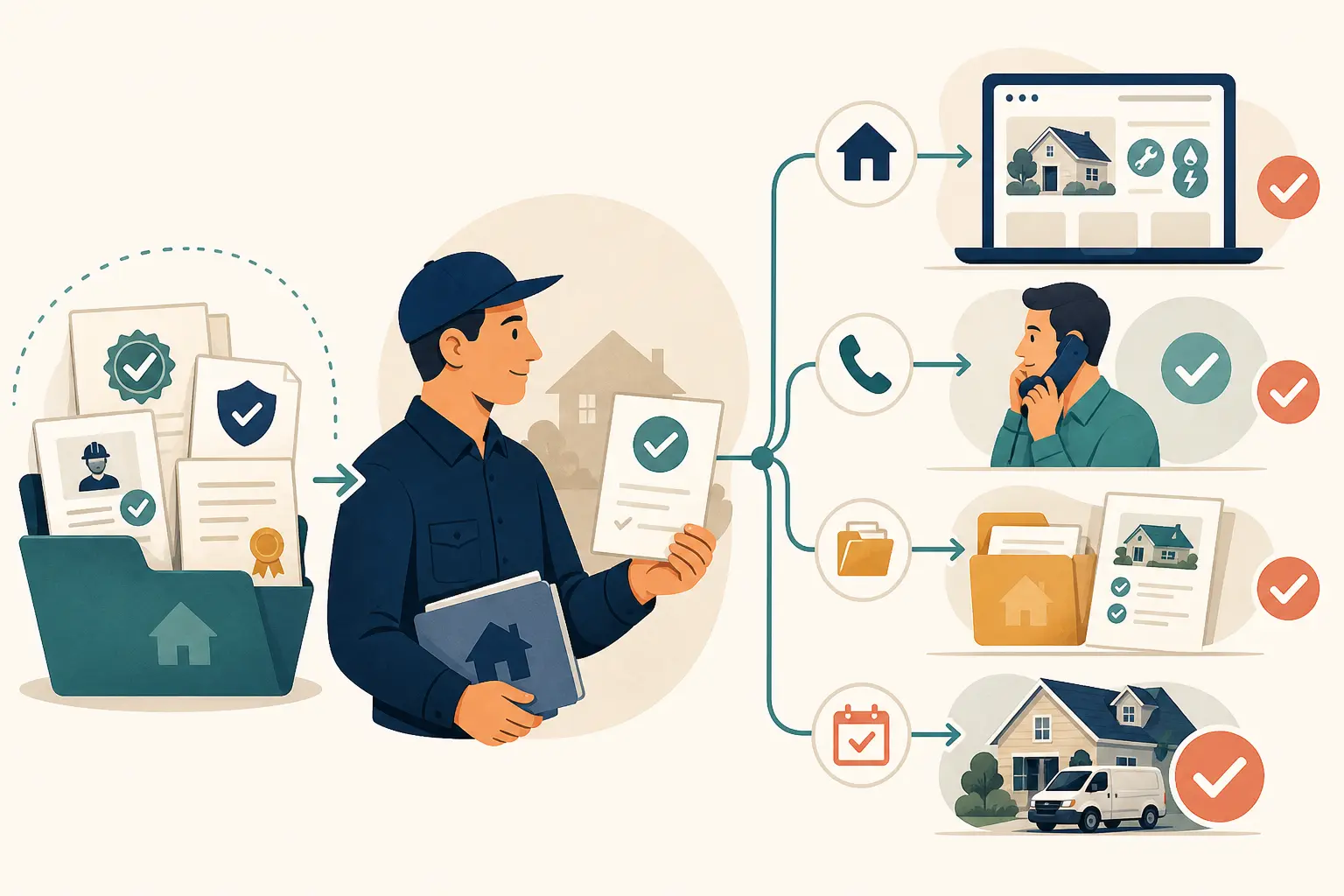
How do you use the checklist before sending a capability statement?
Use a deterministic review. A second person should be able to check the document without asking the writer what each claim was supposed to mean.
The 30-minute send-ready procedure
- Read the buyer's request first. Copy the scope, geography, page limit, format, required fields, response order, deadline, and portal into the buyer brief.
- Choose the document type. Mark the file as capability statement, SOQ, source-sought response, proposal support, or subcontractor sheet. If the buyer's instructions conflict with this template, the instructions win.
- Delete unqualified breadth. Remove services, states, equipment, certificates, and client names that are not relevant or current.
- Trace every material claim. Add an evidence ID from the proof folder to each line in the working draft. Remove any claim with no record or verification path.
- Check names and identifiers. Compare the legal name, DBA, UEI, CAGE, NAICS, license number, certification, phone, email, and website with the current source record.
- Check operating reality. Ask the owner, dispatcher, fleet lead, and project manager whether the territory, capacity, crew, equipment, response language, and partner roles are true today.
- Check the project examples. Confirm the company's role, scope, dates, permission to disclose, and reference status. Change “company experience” to “personnel experience” when that is the truth.
- Check the contact path. Call the number, send a test email, open the website, and verify that the recipient reaches a person who knows why the document was sent.
- Export and inspect the PDF. Search the PDF for missing brackets, wrong dates, broken links, unreadable type, cropped logos, and pages that are too dense on a phone.
- Name the final file clearly. Use
[company]-water-well-capability-statement-[month-year].pdfor the buyer's requested naming convention. Keep the source document and evidence index together.
The procedure is intentionally ordinary. Accuracy is usually lost in the handoff between the person who knows the work and the person who formats the PDF.
What should the owner sign off?
Use a final sign-off block in the source file:
| Check | Owner | Date | Status |
|---|---|---|---|
| Scope and capabilities are current | [name] | [date] | [pass / fix] |
| Licenses and certifications are current | [name] | [date] | [pass / fix] |
| Territory and capacity are accurate | [name] | [date] | [pass / fix] |
| Project examples are permitted and correctly described | [name] | [date] | [pass / fix] |
| Buyer instructions are satisfied | [name] | [date] | [pass / fix] |
| Contact route works | [name] | [date] | [pass / fix] |
Do not send the PDF with “we will update that later” in any field a buyer may use to judge fit.
Which mistakes make capability statements fail?
Most failures are not design failures. They are failures of fit, evidence, and boundaries.
Mistake 1: Treating the template as a proposal
A one-page capability statement cannot answer a detailed performance work statement, provide every required form, or substitute for a price response. It is source material and an introduction unless the buyer says otherwise.
Mistake 2: Listing every service
A company that lists drilling, pump repair, geothermal work, water treatment, environmental consulting, excavation, engineering, and emergency response may look broad but unverified. The buyer cannot tell which capability is real, current, or relevant.
Mistake 3: Using adjectives as evidence
“Reliable,” “experienced,” and “high quality” are conclusions. Show the license, record, process, role, project, territory, or reference that lets the buyer reach a conclusion.
Mistake 4: Copying a generic federal footer into every version
UEI, CAGE, NAICS, and certification fields can help in federal market research. They can also distract a commercial buyer who wants to know whether your crew can service a pump system next month. Tailor the fields to the buyer.
Mistake 5: Confusing a company license with a person's license
A qualifier, employee, partner, or subcontractor may hold the credential. Name the relationship precisely. A buyer may need to know who will be responsible for the work.
Mistake 6: Claiming experience the company did not perform
Founder experience, partner experience, subcontract experience, and company experience are different. The distinction is simple, but it must survive the final rewrite.
Mistake 7: Publishing stale capacity
An old statement that promises immediate response, a named crew, or an available rig can become false while the PDF is still circulating. Add a review date and keep capacity language bounded.
Mistake 8: Making the territory vague
“Serving the US” or “serving all surrounding areas” does not help a buyer route a project. Name the territory and state what happens outside it.
Mistake 9: Hiding the next step
A generic “contact us” footer forces the buyer to decide who to call and what to say. Use a named contact and a next step tied to the opportunity.
Mistake 10: Designing for the owner instead of the buyer
Large equipment photos, long origin stories, and logo walls can consume the page without answering the qualification question. The design should support scanning and verification.
Mistake 11: Linking to a website that tells a different story
If the PDF says pump repair and the website only describes drilling, the buyer has to resolve the conflict. The public page, Google Business Profile, directory listing, and PDF should agree on the core services and territory. The well drilling website conversion checklist covers the broader path from service clarity to contact action.
Mistake 12: Sending the same PDF to everyone
A capability statement should be reusable, not frozen. Make a controlled base version, then tailor the service order, proof, and next step for the specific buyer. Keep one source of truth for licenses and company information.
A reusable statement should be modular, not generic.
When should you not use this checklist or template?
Do not use the one-page version as the primary artifact when:
- The solicitation provides its own form.
- The buyer demands a statement of qualifications with a required order.
- The evaluation includes a detailed technical approach.
- The buyer requires signed certifications, disclosures, references, or schedules.
- The project is complex enough that personnel, safety, schedule, subcontracting, and quality controls need separate narratives.
- Pricing or rates must be submitted in a separate file.
- The company cannot verify the license, insurance, capacity, equipment, or past-performance claims.
- The company is not actually pursuing the buyer or work type represented on the page.
You should also pause when the company has an operations problem that the document cannot solve. A capability statement will not create qualified work if the company does not know its profitable territory, cannot answer calls, cannot schedule the work, or cannot track what turns into a booked job.
If the goal is a stronger demand path for the services the company can actually accept, the well drilling lead generation guide explains how to connect service scope, territory, channels, qualification, and booked-job tracking. If the goal is to evaluate a marketing partner, the well drilling marketing agency guide covers how to test vertical understanding, ownership, reporting, and operating commitments.
What if the company has no formal marketing system?
Start with the capability statement as an internal alignment document. Ask the owner, field lead, dispatcher, and office manager to agree on:
- The three services the company wants more of.
- The territory it can serve profitably.
- The work it does not want.
- The proof it can publish or provide.
- The capacity it can accept this quarter.
- The phone, email, or form that should receive the next conversation.
That exercise may reveal a sales or operational gap before it reveals a design gap. That is useful. Fix the claim and routing problem before paying for a polished PDF.
How should the capability statement connect to the website and qualified calls?
The capability statement is one surface of the company's public proof system. It should agree with the website, directory profiles, proposal language, and intake process.
Use the PDF to answer a buyer's first qualification question. Use the website to provide deeper proof. Use the call or form path to capture the project scope and route it to a person who can make a decision.
What should the website contain?
At minimum, the public site should make these facts easy to find:
- The specific drilling, pump, rehabilitation, testing, or related services offered.
- The actual service area.
- The contact route and operating hours.
- The qualifications or licenses the company can state publicly.
- Relevant projects, equipment, people, or process details.
- A clear next step for the buyer.
Do not publish a capability statement that is more precise than the website and then send buyers to a home page that makes them start over. Link the document to the relevant service or qualifications page when a link is permitted.
How should you measure whether it is working?
Track business-development outcomes, not downloads alone. Useful fields include:
| Stage | Record |
|---|---|
| Sent | Buyer, date, version, opportunity, contact owner |
| Opened or acknowledged | Date and response, when available |
| Qualified conversation | Scope, territory, timing, buyer type, next step |
| Opportunity | Estimated project, role, submission requirement, owner |
| Won or lost | Outcome and reason |
| Follow-up | Date, owner, promised material, current status |
For inbound calls, record whether the caller is a homeowner, builder, utility, engineer, prime contractor, public agency, or another business. This page is aimed at contractor decision makers and business-development conversations, not homeowner demand. A download from the wrong audience is not a win.
Brictale helps US well drilling and pump companies get more qualified calls and booked jobs. A free territory audit can compare the services and territory you want buyers to find with the public pages, local visibility, proof, and contact paths those buyers can actually see. The audit is useful when you want a market-specific diagnosis, not when you need a generic PDF design.

What should a well contractor do this week?
Use the template in this order:
- Choose one buyer and one opportunity type.
- Copy the buyer's scope and submission rules into a brief.
- Select three to six relevant capabilities.
- Add proof IDs for licenses, personnel, equipment, projects, and process.
- State territory and capacity with a review date.
- Remove any claim that belongs to a partner, founder, or former employer unless the relationship is labeled.
- Give the buyer one named contact and one next step.
- Have operations verify the page before it leaves the office.
- Tailor the final version to the buyer instead of sending the base file unchanged.
- Update the website and intake path if they contradict the statement.
The finished document should leave a buyer with a clear answer to five questions: what you do, where you do it, why you are qualified, what you can accept, and how to start a real conversation.
If it cannot answer those questions, do not add more design. Fix the evidence and the boundaries. Then use Brictale's free territory audit to see whether the same services, proof, and contact path are visible in the market where you want the next qualified job.