Private Well Rehabilitation vs. Replacement: A Homeowner Decision Guide
Compare pump repair, well rehabilitation, liner or screen work, and a new well using yield, water levels, inspections, testing, permits, connection, and abandonment scope.
The short answer
Do not choose rehabilitation or replacement from low pressure, sand, or a dry spell alone. First separate a pump or pressure-system fault from a well-yield or well-structure fault. Compare baseline and current yield, static and pumping levels, sand, water tests, camera findings, permits, retesting, connection work, and old-well abandonment. A qualified well professional must diagnose and define the success test.Private Well Rehabilitation vs. Replacement: A Homeowner Decision Guide
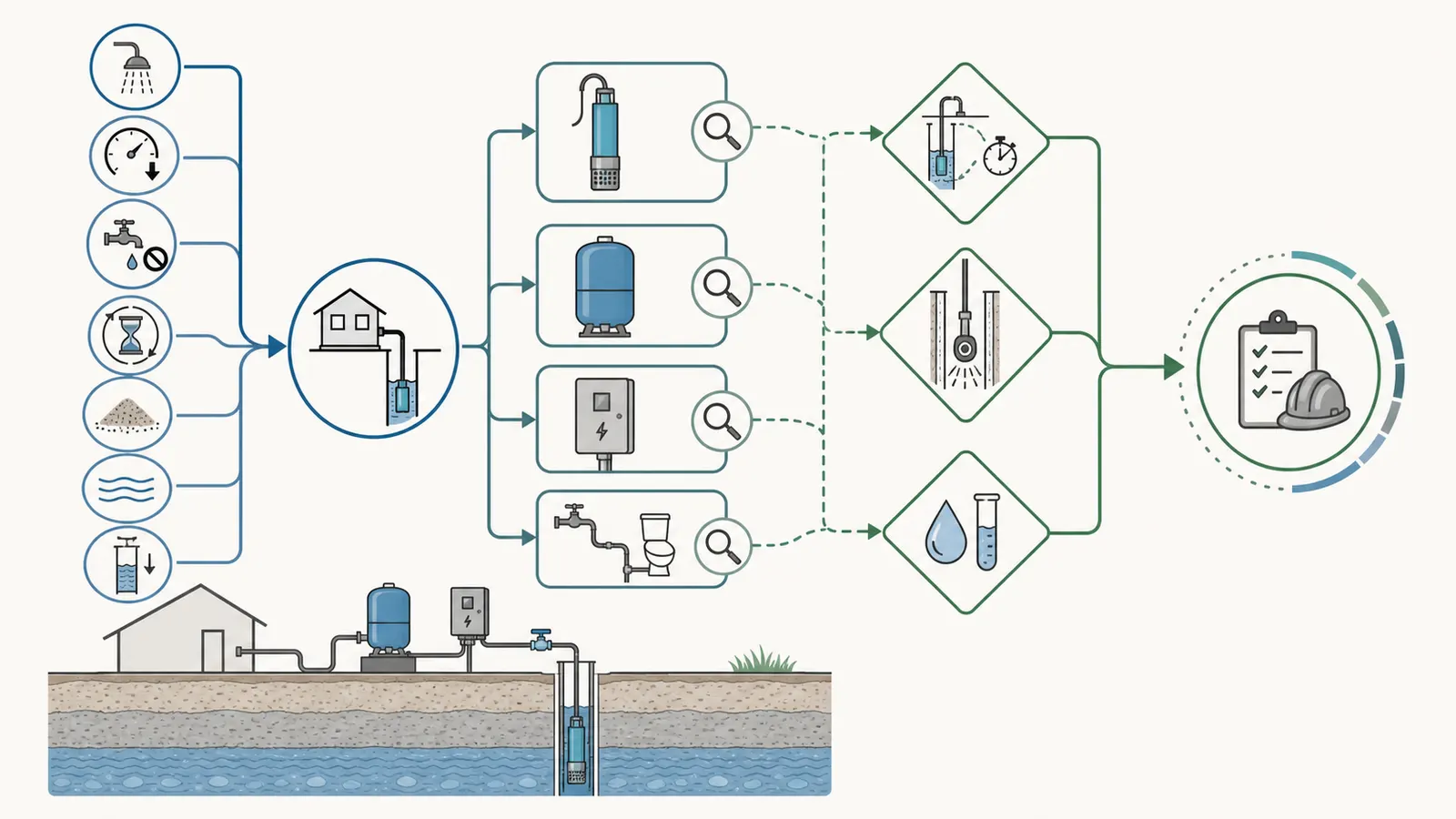
Do not choose rehabilitation or a new well from one symptom or one headline price. A pump, pressure tank, pressure switch, electrical control, treatment device, or household restriction can mimic a failing well. A well-yield or well-structure problem can also damage the pump and create low pressure. The defensible sequence is:
- Separate the pump and pressure system from the well itself.
- Compare the original well log or pump test with current, documented measurements.
- Use water-quality results and inspection evidence to identify the failure mode.
- Ask for rehabilitation, liner or screen work, and replacement quotes with the same testing, connection, permit, and old-well-abandonment assumptions.
- Agree on a measurable success test and a stop point before work begins.
Penn State Extension says rehabilitation success depends on the cause of poor performance and how far the problem has progressed; it lists mineral incrustation, bio-fouling, sediment plugging, sand pumping, corrosion, and pump damage as different failure paths. Its well-maintenance guidance is why a homeowner cannot safely select the remedy from “low pressure” or “less water” alone.
1. First separate a pump problem from a well problem
The first decision is not “rehabilitate or replace.” It is “what part of the system has actually changed?” A private well is a source and borehole. The pump, drop pipe, wiring, controls, pressure tank, pressure switch, distribution piping, and treatment equipment are separate parts of the water system. A quote for a new well should not be used to solve a problem that has not been shown to be in the well.
Provisional questions for the service professional
These observations do not identify a failed component. They turn a symptom into a question for the service professional; the proposed possibilities are prompts to check, not factual pointers to a remedy:
| Observation | Provisional question to investigate | What it cannot prove | Appropriate next action |
|---|---|---|---|
| Pump runs but pressure is weak at every fixture | Could pump output, pressure equipment, a filter or restriction, or source capacity be involved? Which system-flow and pressure measurements will distinguish them? | That the well is bad | Ask for a system-flow and pressure diagnosis before authorizing a well remedy |
| Pressure gauge moves rapidly between start and stop or the pump short-cycles | Could pressure-tank condition, switch settings, a leak, a check valve, or controls account for the pattern? What will the professional test? | That the pressure tank is the only cause | Record the visible behavior and have a qualified pump professional test the system |
| One fixture is weak while others are normal | Could an aerator, valve, branch pipe, or local treatment restriction explain an isolated symptom? Can another cold fixture be compared? | That the well-yield is the problem | Compare another cold fixture before scheduling well work |
| Water pressure is normal until sustained use, then falls | Could storage, pump capacity, source yield, drawdown, or a restriction be contributing? Which controlled test will separate them? | That the casing or screen is failing | Request a controlled flow, yield, and drawdown assessment |
| Sand increases, pump wears, or water becomes cloudy after pumping | Could screen or casing condition, formation material, pumping rate, or another source be involved? Is camera inspection and sand characterization warranted? | That a new well is automatically required | Ask whether a camera inspection and sand analysis are warranted |
| Water quality changes but flow is stable | Could well integrity, source-water change, plumbing, treatment, or contamination be involved? Which laboratory test and sample point are appropriate? | That the yield is the problem | Use a certified laboratory and local health guidance before choosing a water-system remedy |
Penn State describes pump damage as one possible cause of reduced well performance, while also describing sand pumping, corrosion, incrustation, and biological fouling as well-related causes. That distinction matters: the same extension guidance recommends professional inspection, preferably with a downhole camera, after a loss of performance. The camera is evidence about the borehole and casing; it is not a substitute for a performance test or water-quality test.
Do not infer that a pump is healthy because it still runs. Do not infer that the well is failing because the pump runs continuously. A low-yield well can leave a pump unable to keep up with demand, while a weak or damaged pump can fail to draw the available water. Ask the professional to state which measurement separates those possibilities.
The homeowner-safe boundary
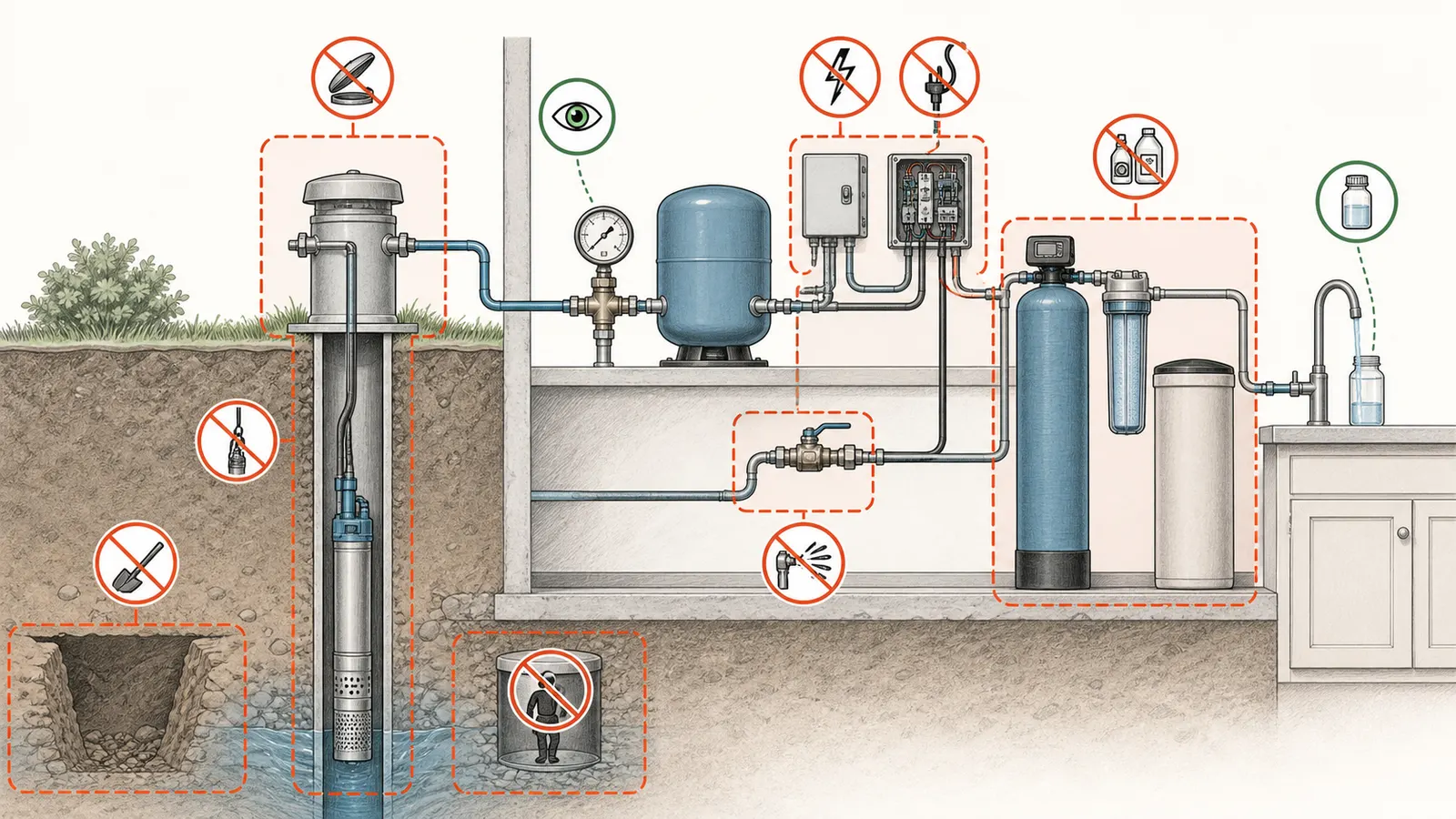
You may record an already-visible pressure gauge, note whether a faucet runs steadily or spurts, photograph the wellhead from the outside, collect a laboratory-directed tap sample, and gather old records. That is enough to improve the service call.
Do not attempt opening energized controls or testing live wiring. Do not remove a control-panel cover, open the well cap or casing, insert a measuring device into the well, pull a pump, disconnect pressurized piping, adjust a pressure switch, manipulate a pressure-tank valve, enter a pit or confined space, or handle chlorine, acid, or other rehabilitation chemicals. Those actions can create electrical, pressure, contamination, chemical, lifting, or confined-space hazards. Assign them to a qualified well, pump, electrical, or water-treatment professional as appropriate.
2. Build a baseline and current performance record
“The well used to be fine” is useful context, but it is not a baseline. Look for the original well completion report, construction log, original pump test, pump setting, casing and screen details, prior service reports, water-quality tests, and treatment invoices. Penn State says original construction and pump-test data are useful reference points for detecting deterioration and recommends keeping well records such as depth, casing, grouting, screen, yield, test reports, inspections, and contractor invoices. Use its recordkeeping guidance as the starting inventory.
Record the following in two columns: “baseline or prior known condition” and “current professional measurement.” Add the date, units, method, and who measured it. A number without a method is difficult to compare.
Quantity and well-condition record
- Well depth and construction type: drilled, bored, dug, or another type; casing diameter and material if known; screen or open-borehole interval if known.
- Original and current pumping rate in gallons per minute, with the test duration and discharge method.
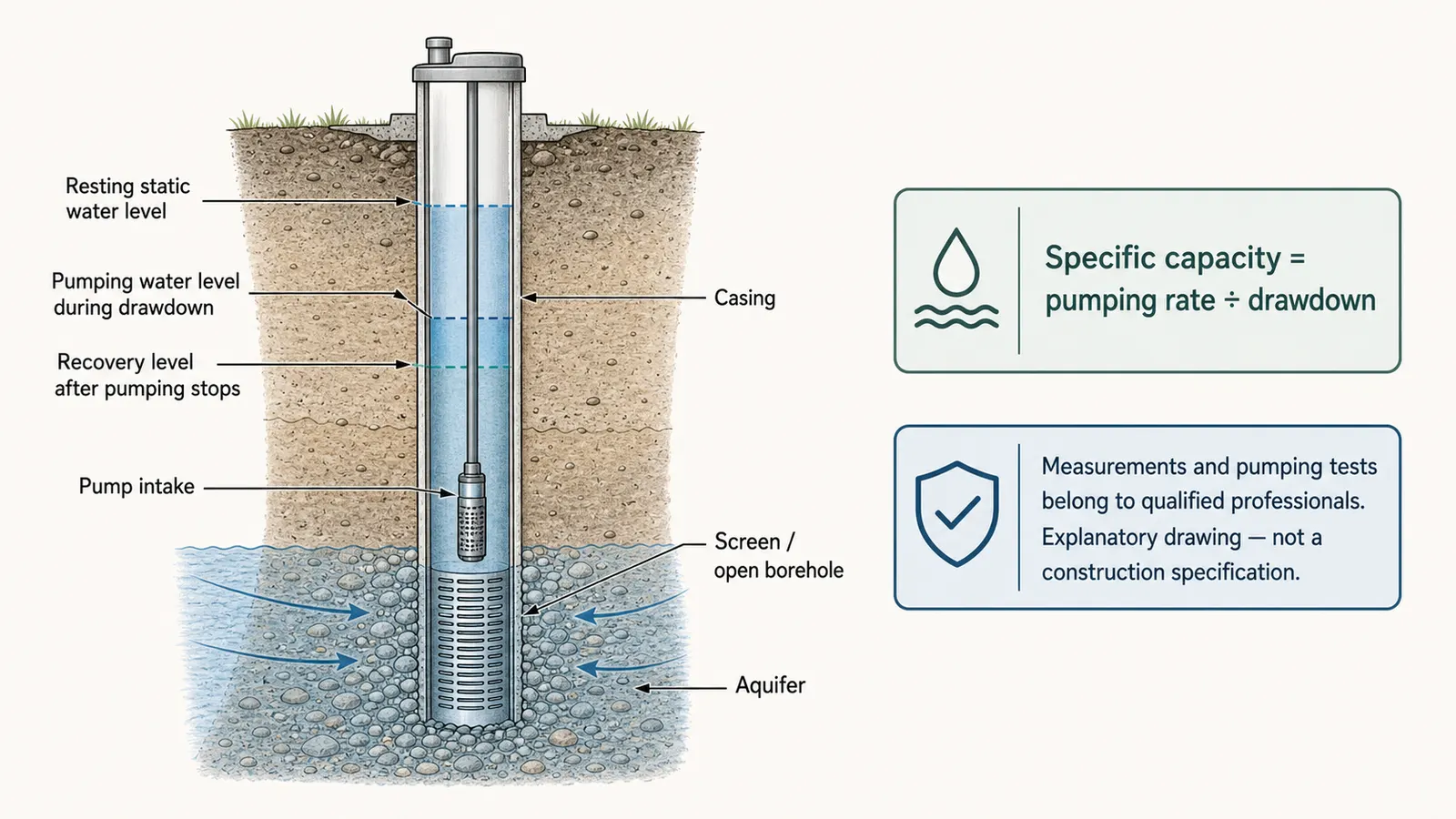
- Static water level: the resting depth to water, measured from the same reference point if possible.
- Pumping water level: the water level while pumping at a stated rate.
- Drawdown: the change between static and pumping level at that test rate.
- Recovery: the water-level behavior after pumping stops, including the observation interval used.
- Pump setting and intake position, pump model if known, motor rating, pressure settings, pressure tank size, and any low-water cutoff.
- Sand or sediment: whether it is visible, how much was observed, whether it settles, and whether it appears at startup or during sustained pumping.
- Total depth now, obstructions, casing condition, screen condition, corrosion, deposits, biological growth, and camera findings where a professional inspection was performed.
- Household demand: simultaneous showers, laundry, irrigation, livestock, fire protection, or other peak uses that may have changed since the original installation.
Oregon State University distinguishes static, pumping, and recovering water levels. It says static level should be measured after the well has rested for several hours and cautions that pumping and recovering levels do not reflect the surrounding aquifer well enough to decide by themselves whether a well is going dry. Read the OSU definitions here. That is a measurement boundary, not a DIY instruction to open your well: local rules and the equipment arrangement may require a professional.
Penn State defines specific capacity as pumping rate divided by drawdown. It is a useful way to compare performance when the test conditions are comparable:
specific capacity = pumping rate (gallons per minute) ÷ drawdown (feet)
For example, if a professional documents 8 gallons per minute at 20 feet of drawdown, the specific capacity is 0.4 gallons per minute per foot. If a later test documents 6 gallons per minute at 30 feet of drawdown, the result is 0.2 gallons per minute per foot. That change is a signal to investigate, not proof that one particular rehabilitation method will work. It may reflect a different pumping rate, season, water level, pump setting, or test method. Penn State's rehabilitation guidance explains why comparable baseline data matter.
Water-quality record
Keep water quality separate from quantity. A well can produce enough water and still have a contamination or treatment problem. Conversely, a clean water test does not prove that a pump, screen, or casing will meet peak demand.
At minimum, assemble the last test date, laboratory, sample point, tests, result, units, detection limit if reported, and whether the sample was before or after treatment. EPA says private wells should be tested annually for total coliform bacteria, nitrates, total dissolved solids, and pH, and immediately after well repair or replacement or a change in water quality. EPA also directs owners to certified laboratories and local health departments. Local requirements and groundwater risks can add tests for metals, volatile chemicals, pesticides, radionuclides, or other contaminants.
3. Read symptoms as branches, not diagnoses
Symptoms tell you what to measure next. They do not select rehabilitation, liner work, or replacement.
Low flow or a well that cannot keep up
Penn State defines well yield as the maximum pumping rate that does not lower the water level below the pump intake. It defines a low-yield well in relation to the household’s peak demand, not simply its gallons-per-minute label. A well producing a modest, steady amount can be adequate when demand is spread out or storage is designed correctly, but inadequate during simultaneous showers, laundry, and other use. Its low-yield guidance describes conservation, pressure storage, intermediate storage, and pump controls as possible system responses.
Ask the professional to separate four questions:
- What flow enters the well over the test period?
- How far does the water level draw down at that flow?
- Where is the pump intake relative to the pumping level?
- What is the household’s actual peak demand and what storage is available?
A new well may be reasonable when the existing source cannot meet the required demand, the borehole is structurally unsound, or the documented failure mode is not proportionately repairable. But a low-yield well may also be managed by reducing demand or adding properly designed storage. That is why a quote should state whether it solves source capacity, peak-demand timing, or only pressure delivery.
Sand, grit, and cloudy water
Sand is more consequential than a cosmetic complaint. Penn State says physical plugging can relate to screen design, incomplete initial development, formation material, corrosion, or pumping beyond design capacity. It says corroded and enlarged screen holes can lead to sand pumping and abrasive pump deterioration. See the extension discussion of sand and corrosion.
Do not infer that a finer cartridge is the well repair. A downstream filter may protect fixtures temporarily, but it does not restore a corroding screen, stabilize an aquifer, or prevent pump abrasion at the source. Ask for the sand quantity, particle character, point of entry, pump damage assessment, and camera findings. If a contractor proposes a liner, ask what screen opening or flow-path problem it addresses and how the liner changes usable diameter, pump selection, cleaning access, and future maintenance.
Water-quality change
If color, odor, or taste changes after well or pump work, treat it as a testing trigger, not as proof that the work failed or succeeded. EPA says treatment suitability depends on the contaminant, concentration, and condition of the well; it also says that some cases may require a new water source or new well and that health-standard exceedances should be discussed with the health department and confirmed by retesting. Use EPA's treatment boundary.
Collect samples exactly as the laboratory directs. Do not open the well or disconnect treatment to create a “before” sample unless a qualified professional and the lab have told you how to do it safely. If contamination is suspected, use a known-safe alternative for drinking and cooking while waiting for current health guidance.
4. Compare the three well-level paths
The options are not interchangeable. The right comparison is “what failure mode does this scope address, what evidence supports it, what remains uncertain, and how will success be tested?”
| Path | Evidence that makes it reasonable | What it may address | Main uncertainty or risk | Required closeout |
|---|---|---|---|---|
| Rehabilitation: chemical cleaning, disinfection when appropriate, brushing, jetting, surging, development, or another professional method | Camera or other inspection, performance trend, deposits, fouling, or plugging consistent with the proposed method | Incrustation, bio-fouling, physical plugging, or some development-related performance loss | The method can be ineffective, temporary, or damaging if the cause is corrosion, structural failure, or incompatible chemistry; aggressive treatment can accelerate corrosion | Written method, chemical and disposal plan, post-work yield/drawdown test, water-quality retest, and warranty or re-treatment boundary |
| Liner or screen intervention inside the existing bore | Camera-confirmed screen or casing condition, adequate bore geometry, and a design showing the intervention fits | Some severe screen or casing problems, especially where a new well is not feasible | Reduced inside diameter, changed entrance flow, access and pump limitations, unresolved aquifer or water-quality issues, and uncertain service life | Liner material and dimensions, installation method, remaining usable diameter, pump compatibility, yield test, sand check, and water-quality retest |
| New replacement well | Existing well has severe structural deterioration, recurring sand, inadequate source capacity, or a repair path that is not proportionate; siting and permits are feasible | A new source and new construction matched to the site and demand | Water quantity and quality are not guaranteed by drilling; location, geology, permits, connection, electrical work, and abandoned-well obligations add scope | Construction log, casing and screen details, development, yield/drawdown test, disinfection, certified water tests, connection commissioning, and old-well status documented |
Penn State specifically says recurring sand pumping can make total replacement more economical than rehabilitation and describes a smaller internal liner as a possible remedy when new drilling is not feasible. That is a conditional comparison, not a rule that sand always means replacement. Read the exact scope in Penn State's guidance.
Do not treat “new well” as a guaranteed water supply. Geology, siting, drilling depth, construction quality, development, and local requirements still control the result. Do not treat “rehabilitation” as a guaranteed extension of life. If corrosion has enlarged openings or compromised the casing, cleaning can expose more weakness. The professional should explain the failure mechanism and the downside if the chosen remedy does not meet the test.
5. Make rehabilitation and replacement quotes comparable
The National Ground Water Association says a written contract should describe materials, development and yield-evaluation procedures, screen, cap or seal, disinfection, cleanup, guarantees, and itemized charges. It also lists drilling, casing, grouting, developing, test pumping, disinfection, deeper drilling, a second well, and abandonment as items that may need separate pricing. Use the NGWA contract checklist before comparing a headline total.
Ask every bidder to return the same scope matrix. Mark every row as included, allowance, excluded, or unknown, and require a quantity, unit, assumption, or change-order trigger where applicable.
Diagnosis and preparation
- Review of the well log, prior pump test, repair history, and water tests.
- Site visit and visible wellhead inspection.
- Pump and pressure-system diagnosis, including the question of whether the well itself was tested.
- Downhole camera inspection, if feasible and justified, with video or stills retained by the homeowner.
- Sand or sediment characterization if sand is present.
- Yield, drawdown, and recovery test method, rate, duration, discharge route, and report format.
- Identification of the pump setting, casing or screen interval, and obstructions before liner or screen work.
Rehabilitation scope
- Exact method: chemical, mechanical, jetting, surging, development, disinfection, or combination.
- Chemical name, concentration, contact time, neutralization or disposal plan, and who handles it.
- Whether the method can affect casing, screen, seals, pump, treatment equipment, or water quality.
- Mobilization, pump removal and reinstallation, temporary water, and site protection.
- Post-work development and how dislodged material will be removed.
- Retest timing and what counts as improvement.
Liner or screen scope
- Diagnosis of the original casing or screen failure.
- Liner or replacement-screen material, diameter, length, slot or opening design, and installation method.
- Usable inside diameter after installation.
- Pump and drop-pipe compatibility, intake position, and service access.
- Grout, seal, annular space, development, and disinfection.
- Sand-control expectation and test method.
New-well scope
- Site selection, setbacks, access, mobilization, and drilling method.
- Permit, start-card, inspection, and well-log responsibilities.
- Drilling depth assumptions, casing diameter and material, screen or open-hole design, grout, seal, cap, and pitless connection.
- Development procedure and yield/drawdown test rate and duration.
- Disinfection, water-quality testing, and who pays for retesting.
- Pump, drop pipe, wire, controls, pressure tank, plumbing, electrical connection, and treatment changes.
- Restoration, excess drilling material, driveway or landscape assumptions, and cleanup.
- What happens if the hole is dry, the yield is below the target, water quality is unacceptable, or the proposed location cannot be drilled.
The old well and the house connection
Replacement quotes frequently become incomparable at the edges. Ask whether the old well will be abandoned or left temporarily secured, who obtains the approval, who removes obstructions, what sealing materials are used, and what document proves completion. Ask whether the new well connects to the existing pressure system or requires new wiring, piping, tank, controls, treatment, or trenching.
Oregon's 2026-27 homeowner guidance is a useful example of how broad a project can become: its program lists permits, liner, pump, pressure tank, plumbing, electrical connection, and seal material for abandonment among possible costs, and its process uses professional work, inspection, estimates, and post-work documentation. That list applies to the Oregon program only, but it illustrates the line items that disappear from an underspecified quote.
Permit and licensing rules are local. Loudoun County, Virginia, for example, uses separate permit categories for modification, replacement, and abandonment and requires licensed professionals for well construction, installation, maintenance, and repair under its local process. Use your own state and local authority, not this Virginia example, to determine what applies.
6. Set a measurable success test and stop-loss
“Restore the well” is not a success criterion. It does not say how much water, at what drawdown, for how long, with what sand level, water quality, or household demand. Before signing, write the outcome in a form that can be measured and compared.
A practical success-test table
| Measure | Baseline or target to write down | Test condition to specify | What a failure means |
|---|---|---|---|
| Sustained yield | Prior documented rate or household design requirement | Pumping rate, duration, discharge, and stabilization rule | Reopen the repair-versus-replace decision; do not accept “it seems better” |
| Static level | Prior seasonal or same-condition reading | Rest period and reference point | Seasonal difference or incomplete recovery may make the comparison invalid |
| Pumping level and drawdown | Prior value at a comparable rate | Flow rate, duration, and water-level measurement method | A higher drawdown may show worsening performance, but only with comparable conditions |
| Recovery | Time-stamped recovery readings | Defined interval after pumping stops | Slow or incomplete recovery may need professional interpretation, not an immediate replacement conclusion |
| Sand or sediment | None, a stated amount, or prior documented level | Sample point, duration of pumping, and observation method | Persistent sand can indicate an unresolved source problem or a failed intervention |
| Water quality | Contaminant results and units | Certified lab, sample point, timing, and post-work condition | Retest, health-department escalation, treatment revision, or safe-water use may be needed |
| System delivery | Pressure and flow at the house under stated use | Pump, tank, controls, filters, and fixtures identified | A well result can pass while the house-side system still fails |
Indiana's recommended private-well standards show why a test report needs more than one number: they call for stabilized yield and drawdown information and list test rate, test duration, casing and screen specifications, total depth, and static water level among well records. Those are Indiana recommendations, not a national code; use them as a model for a complete handoff and ask your local authority what test is required.
Decide the stop point before rehabilitation
If rehabilitation is the first step, the contract should answer:
- What evidence says this method targets the likely cause?
- What result is enough to continue using the well?
- What result is not enough?
- Is one repeat treatment included, and under what conditions?
- What new damage, corrosion, water-quality change, or sand level ends the attempt?
- If the target is missed, how much of the rehabilitation cost is credited toward liner work or replacement?
- Who pays for pump removal, temporary water, retesting, permits, and disposal if the plan changes?
This is not a demand for a guaranteed yield. It is a way to avoid an open-ended sequence of chemical or mechanical attempts after the evidence has moved toward structural deterioration. A contractor may reasonably decline to guarantee a result. The homeowner can still require a clear method, evidence, test, exclusions, and decision point.
7. Account for abandonment, permits, and water safety
An old well does not disappear when a new well is drilled. It may need to be abandoned, sealed, secured, documented, or kept in service under a local rule. The correct action depends on the state, well type, construction, location, and whether the old well remains usable.
Michigan EGLE explains that an unused or nonoperational well that will not be repaired should be properly plugged, that the owner is responsible for arranging it, and that well type and geology affect the sealing method. It recommends a registered well drilling contractor because obstructions can interfere with a complete seal. Read Michigan's guidance for the reason the old-well line item matters; do not generalize its rules or timing to another state.
Ask the local well authority these questions before accepting a replacement scope:
- Is a permit needed for rehabilitation, deepening, liner work, replacement, or abandonment?
- Must a licensed or registered well professional perform the work?
- Is a pre-work inspection or notice required?
- What is the required abandonment method for this well construction and geology?
- Can the old well remain temporarily in service or securely sealed?
- What report, form, photograph, or inspection closes the job?
- Are there setback, septic, flood, access, drilling, or discharge requirements?
After repair or replacement, follow EPA's private-well testing guidance and use a certified laboratory or local health department for the applicable testing and interpretation. Do not release a newly rehabilitated or replaced well for drinking merely because water is flowing or the pump reaches pressure. A quantity test and a drinking-water test answer different questions.
If a test shows a contaminant above a health standard or a condition that could affect drinking safety, use alternative drinking and cooking water and contact the health department or a qualified water professional for current instructions. EPA says treatment depends on the contaminant, concentration, and well condition and may sometimes require a new source. That is a health-and-source decision, not a contractor upsell.
8. Use this handoff packet to make the decision
Before asking for final quotes, assemble one packet. Give the same packet and the same scope matrix to each bidder.
Homeowner packet checklist
- Well log, completion report, or drilling record.
- Original pump test or yield report, if available.
- Current professional yield, drawdown, recovery, and system-flow results.
- Static and pumping water levels with dates, reference point, method, and conditions.
- Pump setting, pump and motor details, pressure settings, pressure-tank details, filter and treatment model numbers.
- Photos of the exterior wellhead and equipment; do not remove covers or guards for the photos.
- Sand or sediment observations, including when it appears and whether it settles.
- Water-quality reports with laboratory, sample point, date, units, and treatment status.
- Notes about peak household demand and any recent irrigation, livestock, construction, drought, flooding, or land disturbance.
- Camera inspection report or video, if performed.
- Local permit, licensing, setback, and abandonment questions and the authority’s answers.
- The same quote matrix for every contractor.
Ask each professional to answer these questions in writing:
- Is the failure in the pump or pressure system, the well’s water supply, the casing or screen, the aquifer connection, the household demand, or more than one component?
- What measurement or inspection supports that conclusion?
- What does the proposed work physically change, and what does it leave unchanged?
- What is the post-work yield, drawdown, sand, water-quality, and house-delivery test?
- What is included, excluded, an allowance, or a change-order trigger?
- What happens if the well misses the target or the proposed method reveals worse damage?
- What permits, inspections, reports, licenses, disinfection, retesting, connection work, cleanup, and warranty apply?
- What is the status and cost of the old well if a new well is installed?
The most defensible choice is usually the option that matches a documented failure mode, has a bounded and testable scope, leaves fewer safety or water-quality uncertainties, and compares complete installed cost rather than the lowest initial number. Rehabilitation is more defensible when the cause is identifiable and the post-work test is meaningful. Liner or screen work is more defensible when the existing bore is usable and a professional design addresses a specific structural or sand problem. Replacement is more defensible when the existing well is severely deteriorated, repeatedly produces sand, cannot meet documented demand, or lacks a proportionate repair path—but the new well still needs a defined yield, water-quality, connection, permit, and old-well closeout scope.
The homeowner decision is therefore not “repair or replace based on symptoms.” It is: what failed, what was measured, what will this scope change, how will success be tested, and what is the complete installed obligation if the plan changes?
Sources and scope
Evidence behind this page
- Penn State Extension — Water Well Maintenance and Rehabilitation
University extension guidance for private water wells; it supports cause-first diagnosis and does not guarantee a rehabilitation outcome for an individual well.
- Penn State Extension — Water Well Maintenance and Rehabilitation
Penn State's performance-monitoring guidance; the article uses the formula as an explanatory recordkeeping tool, not as a homeowner pump-test protocol.
- Penn State Extension — Water Well Maintenance and Rehabilitation
Penn State's discussion of corrosion, sand, liner work, and replacement; it is not a national rule or a prediction for a particular casing.
- Penn State Extension — Using Low-Yielding Wells
Penn State guidance on low-yield wells and household peak demand; any storage design must be engineered for the site and local requirements.
- Oregon State University Well Water Program — Measuring Well Water Levels
Oregon State University educational guidance on terminology and measurement context; it does not replace a jurisdiction-required yield test or professional inspection.
- U.S. EPA — Protect Your Home's Water
EPA guidance for private domestic wells in the United States; local programs can require additional tests or different timing.
- U.S. EPA — Protect Your Home's Water
EPA private-well treatment guidance; it supports escalation and confirmation, not a product selection or guarantee.
- WellOwner.org / National Ground Water Association — Guidelines for Written Contracts
NGWA homeowner contract guidance for drilled wells; the exact contract, license, and required line items remain subject to state and local law.
- Oregon Water Resources Department — Water Well Abandonment, Repair, and Replacement Funding: Guidance for Homeowners 2026-27
Oregon's 2026-27 funding program only; its eligible-cost list is a scope model, not a national reimbursement promise or construction rule.
- Oregon Water Resources Department — Water Well Abandonment, Repair, and Replacement Funding: Guidance for Homeowners 2026-27
Oregon program process only; licensing and inspection requirements vary by state and locality.
- Michigan Department of Environment, Great Lakes, and Energy — FAQ: Abandoned Water Wells
Michigan abandoned-well guidance; it demonstrates why abandonment must be checked locally and does not state a national deadline or method.
- Indiana Department of Health — Recommended Standards for Private Water Wells
Indiana recommended standards, not a national code; the article uses the recordkeeping principle and directs homeowners to local requirements for the actual test.
- Loudoun County, Virginia — Wells and Onsite Septic Systems
A local Virginia example used only to show that permit categories and licensing rules are jurisdiction-specific; it is not generalized to all US homeowners.