Private Well After a Power Outage: Can You Use the Water Yet?
A source-linked homeowner decision surface for pressure loss, treatment outages, damage, generator safety, testing, flushing, and safe-water release.
The short answer
Do not decide from restored electricity alone. Check whether water comes out steadily or spurts, record any color or odor change, and ask whether UV or other treatment lost power. If pressure was lost, treatment was off while water was used, damage is visible, or chemicals are suspected, use alternate water, contact local health officials, and arrange certified testing. Keep electrical and well work to qualified professionals.Observation flow
What is the system doing?
Choose the closest visible pattern. Stop immediately for sparking, hot wiring, uncontrolled pressure, or a damaged tank.
Private Well After a Power Outage: Can You Use the Water Yet?
Short answer: restored electricity is not the release signal. First determine whether the well-and-house system actually lost pressure, whether water was drawn while pressure was absent, whether a UV or other treatment device was powered, and whether any well, piping, control, or nearby chemical damage occurred. If pressure was lost, water spurts, treatment was off during use, damage is visible, or fuel or chemical contamination is possible, use alternate water and keep using it until local advice, appropriate repair, and certified testing establish the next step.
This page is for a private-well homeowner making a safe first decision. It is not a substitute for your health department, a state-certified drinking-water laboratory, the exact treatment manual, or a qualified well, pump, electrical, or septic professional. Private wells are not monitored like public water systems: CDC says the owner is responsible for testing private-well water, while local authorities can help select tests and interpret results.
1. Make the water decision before troubleshooting the equipment
Use this first-pass rule:
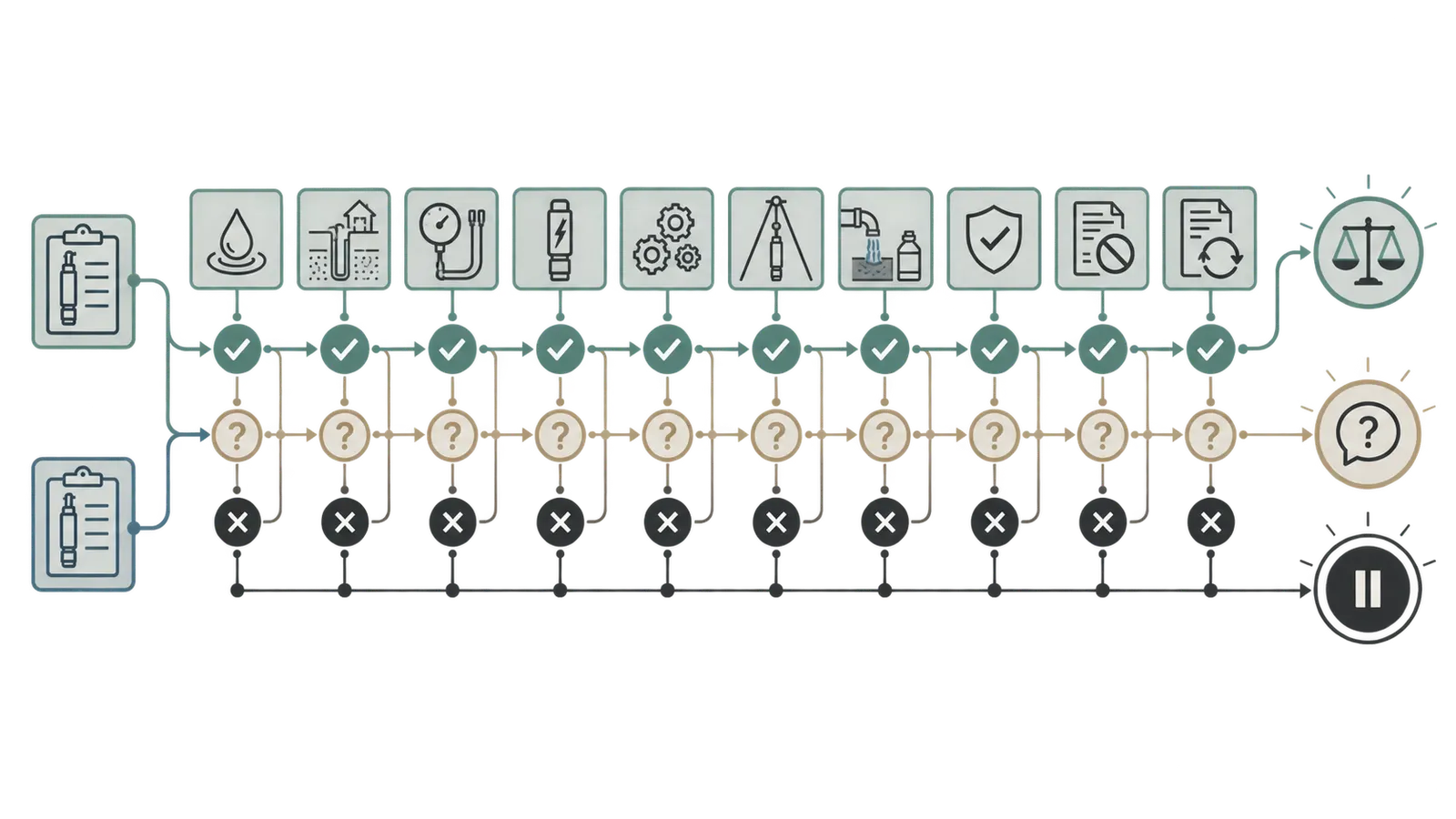
| What you observe after or during the outage | Drinking-water decision now | Next action |
|---|---|---|
| Water comes from a cold faucet in a steady, uninterrupted stream; no pressure-loss evidence; no water-quality or equipment change; treatment stayed powered | The outage alone is not enough evidence to call the water contaminated. If you are unsure whether pressure was maintained, use alternate water while you verify. | Flush household lines as appropriate, record the event, and follow the testing branch if any fact is uncertain or the system was repaired. |
| Water intermittently spurts, air comes out, flow stops, no water comes out, or the system lost all pressure | Do not drink or cook with the well water. Use bottled water or another known-safe source. | Contact the local or state health department, arrange the appropriate certified-lab testing, and have the system inspected if pressure does not recover normally. |
| A UV, chlorinator, filter, or other treatment unit lost power while water was used, or its alarm/status is unknown | Do not assume the treatment protected water used during the interruption. Use alternate water until the unit is restored and its exact instructions and testing advice are followed. | Record treatment model and outage interval; verify operation without bypassing safety features; ask the health department, lab, or qualified treatment professional what to test. |
| Water smells like gasoline, fuel, solvent, smoke, or another chemical; a tank or chemical container leaked; fire, flood, or a nearby spill occurred | Do not drink, boil, chlorinate, or “flush it away.” Use alternate water. | Call the local health or environmental department and describe the suspected contaminant. Chemical water needs event-specific advice and testing. |
| Wires, conduits, controls, pump equipment, piping, wellhead, or treatment equipment are wet, melted, charred, exposed, or burned | Do not touch, energize, open, test, or repair the equipment. Use alternate water. | Contact a qualified electrician, well/pump contractor, or power company. If a septic system was damaged, limit water use and call a septic professional. |
CDC’s emergency well guidance is clear that suspected contamination means bottled or another safe water source until safety is known. The table is deliberately conservative where the homeowner cannot establish what happened. A gauge reading, clear water, or a pump that starts is useful evidence about system behavior; none is a laboratory result.
Do not improvise around the well system. For this high-safety event, the homeowner boundary is observation and documentation. Do not open an energized control box, test live wiring, pull a pump, open a well, enter a well pit, disconnect a pressure switch, pressurize or depressurize a tank, remove a relief valve, or manipulate pressurized fittings. Do not enter a confined space. CDC warns that well work after an emergency can be hazardous, says not to enter a well pit, and calls for qualified wiring checks before the well is re-energized.
2. Establish whether pressure was actually lost
Power loss and pressure loss are related but not identical observations. A pressure tank may still contain pressurized water when the pump is off. The important event question is not “was the electricity out?” but “did the well-and-house plumbing lose pressure, and did anyone draw water while it was unpressurized?”
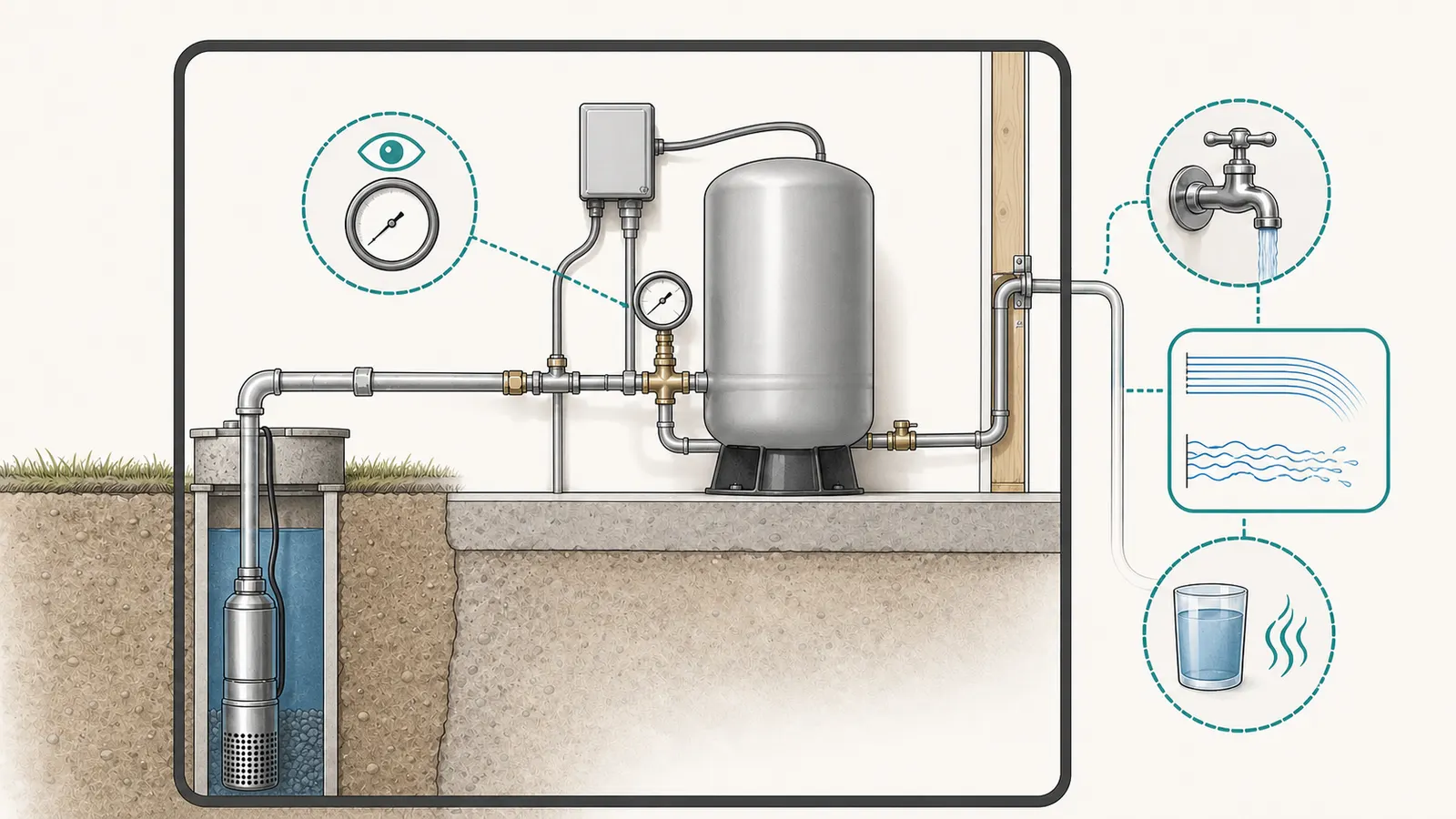
Chester County Health Department explains in its local guidance that pressurization forms a physical barrier in a private-well system and that opening faucets during an extended outage can depressurize the system. It advises checking water quality if all pressure is lost. Read the county notice as jurisdiction-specific public-health guidance, not as a national plumbing rule.
A safe observation sequence
Stop discretionary water use. Until you know what happened, do not run showers, laundry, irrigation, or repeated faucet tests. If your local emergency notice says to avoid all household water use, follow it.
Choose one ordinary cold faucet. A kitchen or bathroom cold faucet is easier to observe than a fixture with a mixing valve. Do not remove an aerator or disconnect anything to improve flow.
Open it briefly and watch the first flow. CDC’s private-well emergency branch uses the faucet as the observation point: steady flow suggests the system has pressure; intermittent spurting suggests air escaping and loss of pressure in the well and household plumbing. See the CDC observation instructions.
Record the behavior, then close the faucet. Write “steady,” “spurting,” “air then water,” “weak and falling,” or “no water.” Record whether the pump starts, stops, runs continuously, or does not run only if you can observe that without approaching unsafe equipment. Do not keep cycling the pump to make it prove itself.
Read an already-visible gauge only if it is safely accessible. Record the value and time without removing a cover or touching a switch. If the gauge is absent, fogged, stuck, or its meaning is uncertain, mark it “unknown.” Do not infer that a gauge reading proves the tank precharge, pump output, or bacterial safety.
Separate no-flow from no-pressure evidence. No water may reflect a pump/control fault, a closed valve, frozen piping, an empty or depleted source, or pressure that was already exhausted. Those possibilities cannot be distinguished safely by opening controls. If water does not return in a normal, steady manner after power is restored, the next action is professional diagnosis, not a larger generator or repeated resets.
What the faucet can and cannot tell you
| Observation | Reasonable interpretation | What it does not prove |
|---|---|---|
| Steady, uninterrupted flow | Pressure is present at that fixture at the moment of observation. | That pressure was never lost, that treatment worked, or that water is free of germs or chemicals. |
| Intermittent spurting or air | Consistent with pressure loss in the well and household plumbing under CDC’s emergency guidance. | The cause, duration, contaminant type, or whether a single flush repaired the risk. |
| No flow | Pressure is absent at the fixture or a delivery/control problem exists. | Whether the well itself is contaminated or whether the pump is damaged. |
| Normal color, taste, or odor | No sensory change was noticed. | Safety. Water may be contaminated without a noticeable change; Chester County and CDC both warn against using the senses as proof. |
| Brown, cloudy, smoky, earthy, burnt, or unusual water | A water-quality change needs an appropriate stop-use and testing decision. | Which contaminant is present or whether ordinary flushing is sufficient. |
If you opened faucets during the outage and cannot say whether pressure remained, mark pressure status uncertain. Uncertainty is a valid decision state. Use alternate water while you contact the health department or a qualified professional rather than converting an unknown into “probably fine.”
3. Follow the pressure-and-water branch
Branch A: pressure stayed steady and nothing else changed
This is the narrowest, lowest-concern branch. You saw a steady flow, did not observe spurting or a complete loss of pressure, the pump and controls show no damage, water looks and smells normal, and every health-protective treatment device remained powered and operating.
The practical inference is limited: the outage by itself has not demonstrated a pressure-loss event. It does not create a national exemption from routine testing, and it does not certify the treatment train. Open a cold faucet long enough to clear stagnant water from the household line according to your local guidance; Chester County’s notice says to flush lines for a few minutes before drinking after an outage. That timing is county guidance, not a universal measured requirement.
Then record:
- outage start and end, if known;
- whether anyone opened faucets, flushed toilets, showered, or ran appliances;
- the first-flow observation and any visible gauge reading;
- whether the pump ran normally after restoration;
- treatment power, alarms, bypass status, and filter condition;
- any unusual color, odor, taste, leak, or nearby spill; and
- the date and result of the last well-water test.
If any of those facts is unknown, move to the more protective branch. Also test immediately if a component was repaired or replaced, if the water changes, or if the routine test is due. CDC’s baseline is annual testing for total coliform bacteria, nitrates, total dissolved solids, and pH, with local advice for other concerns. Use a state-certified laboratory.
Branch B: pressure was lost, water spurted, or the result is uncertain
Treat this as a possible contamination event. Stop drinking and cooking with the water. Use bottled water or another known-safe source for drinking, cooking, ice, brushing teeth, and infant formula. Keep a supply for the disinfection or repair period; CDC’s emergency procedure says residents should have a 24-hour supply of safe drinking water before starting well disinfection. See CDC’s emergency-well guidance.
Contact your local or state health department before selecting the test panel or disinfecting. For a pressure-loss branch, bacterial testing is the minimum in CDC’s wildfire guidance. That means a certified laboratory test appropriate to your state, not a home strip, a taste test, or a “clear water” visual check. CDC explains the role of total coliforms and state-certified laboratories.
Ask whether the event adds chemical testing. Expanded testing is especially important to discuss if there was fire damage, a fuel or chemical release, heavy damage to well components, or synthetic PVC, HDPE, or rubber components affected by heat or smoke. CDC’s wildfire page names VOCs, SVOCs, and other local contaminants of concern in those conditions. Do not order a broad panel blindly: tell the health department or laboratory what happened, where it happened, what materials were damaged, and what the water smelled like.
Branch C: pressure is present, but the water changed
A steady stream does not override a new color or odor. Stop drinking and cooking with the water and document the change before flushing extensively. CDC advises flushing lines until color returns and odor is gone when a well has pressure but the water looks or smells different, while still withholding drinking water until it has been tested. Use the CDC branch as the event-specific reference.
If the odor is fuel, solvent, pesticide, or another chemical, do not treat this as ordinary sediment or trapped air. CDC says chemical contamination is not made safe by boiling or disinfection. Preserve the description, stop unnecessary water use, and call the local health or environmental department. Flushing can move contamination into the house, septic system, soil, or a drain; ask where and how any discharge should be managed.
4. Branch on UV and other treatment power
Treatment status changes the answer even when the pump restored pressure. Write down each treatment device between the pressure tank and the fixtures: sediment filter, UV chamber, chlorinator, carbon unit, softener, reverse-osmosis unit, or other system. Identify which devices treat drinking water only and which treat the whole house. A softener is not a germ barrier; a sediment filter is not a chemical or bacterial certificate; and a UV unit is not a universal contaminant remover.
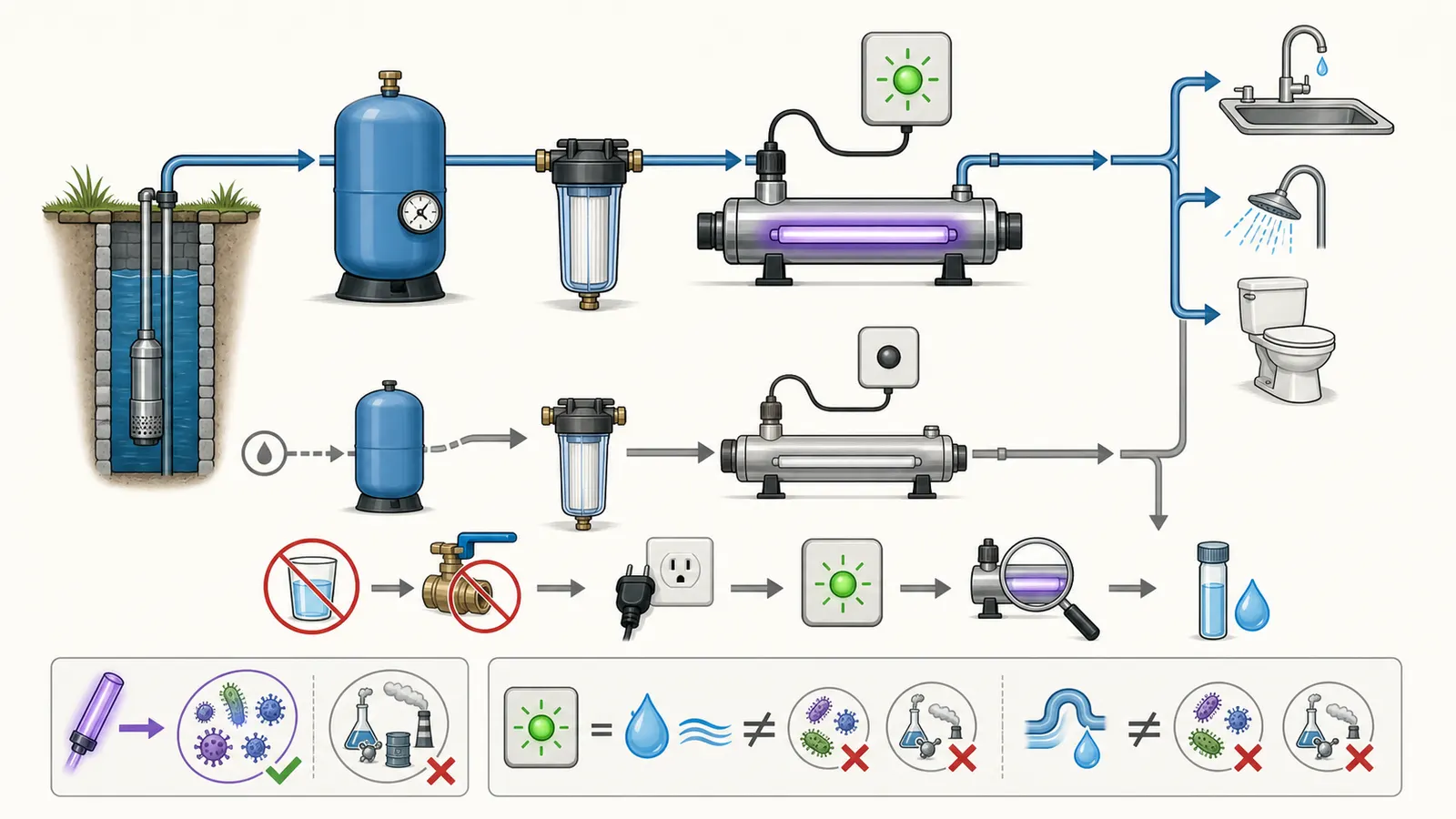
CDC explains that different home-treatment systems address different germs or chemicals. It describes UV systems as using ultraviolet light to disinfect or reduce germs, says prefiltration improves UV performance, and says UV does not remove chemicals. That is why the treatment branch must be model-specific and event-specific.
If UV or another germ treatment lost power
Use alternate water if people used the water while the treatment unit was unpowered, alarmed, bypassed, or unable to confirm operation. Do not assume that turning the lamp back on disinfects water that already passed through during the outage. Do not bypass the unit to get flow. Do not open the chamber, handle a lamp, change electrical parts, or reset an unfamiliar controller unless the exact manufacturer instructions make that action demonstrably safe and you can do it without opening energized equipment.
Record:
- treatment brand and exact model;
- whether it is point-of-entry or point-of-use;
- the time power was lost and restored;
- whether anyone used water during that interval;
- alarm, lamp, flow, or dose indicators before and after restoration;
- the last lamp, cartridge, sleeve, or media service; and
- the untreated and treated sample points, if your professional or laboratory asks for them.
Restore treatment only within the manual’s operating boundary. Ask the health department, certified laboratory, or qualified treatment professional whether a bacterial sample, a system service visit, or both are needed. A powered indicator is evidence that the device has power; it is not proof that the lamp, sensor, flow rate, prefilter, dose, or downstream plumbing meets the device’s treatment conditions.
If a filter, softener, chlorinator, or other device lost power
First identify the device’s actual job. A softener may improve hardness but is not a substitute for disinfection. A carbon unit may address selected taste or chemical contaminants only when its exact claim and capacity match the water. A cartridge may be physically present but loaded, bypassed, installed backward, or past its service interval. A chlorinator may need chemical feed, contact time, and monitoring rather than a simple power reset.
Do not make a treatment decision from the device name alone. CDC recommends testing first and matching treatment to the specific germ or chemical. If treatment was unpowered while water was used, report the interruption as part of the laboratory and professional brief even if the treatment now appears normal.
5. Stop for damage, generators, or hazardous conditions
The electrical and well stop boundary
Look from a safe location for charring, melting, broken insulation, wet enclosures, exposed conductors, burned-plastic odor, damaged conduit, leaking pipe, a displaced cap, standing water, a compromised well house, or damage to the pressure tank, pump, treatment equipment, or septic system. Do not touch wiring or controls. Do not restore power to visibly damaged equipment. Do not open a control box to “see if a fuse blew.” CDC directs homeowners to qualified electricians, well contractors, pump contractors, or the power company when components are damaged.
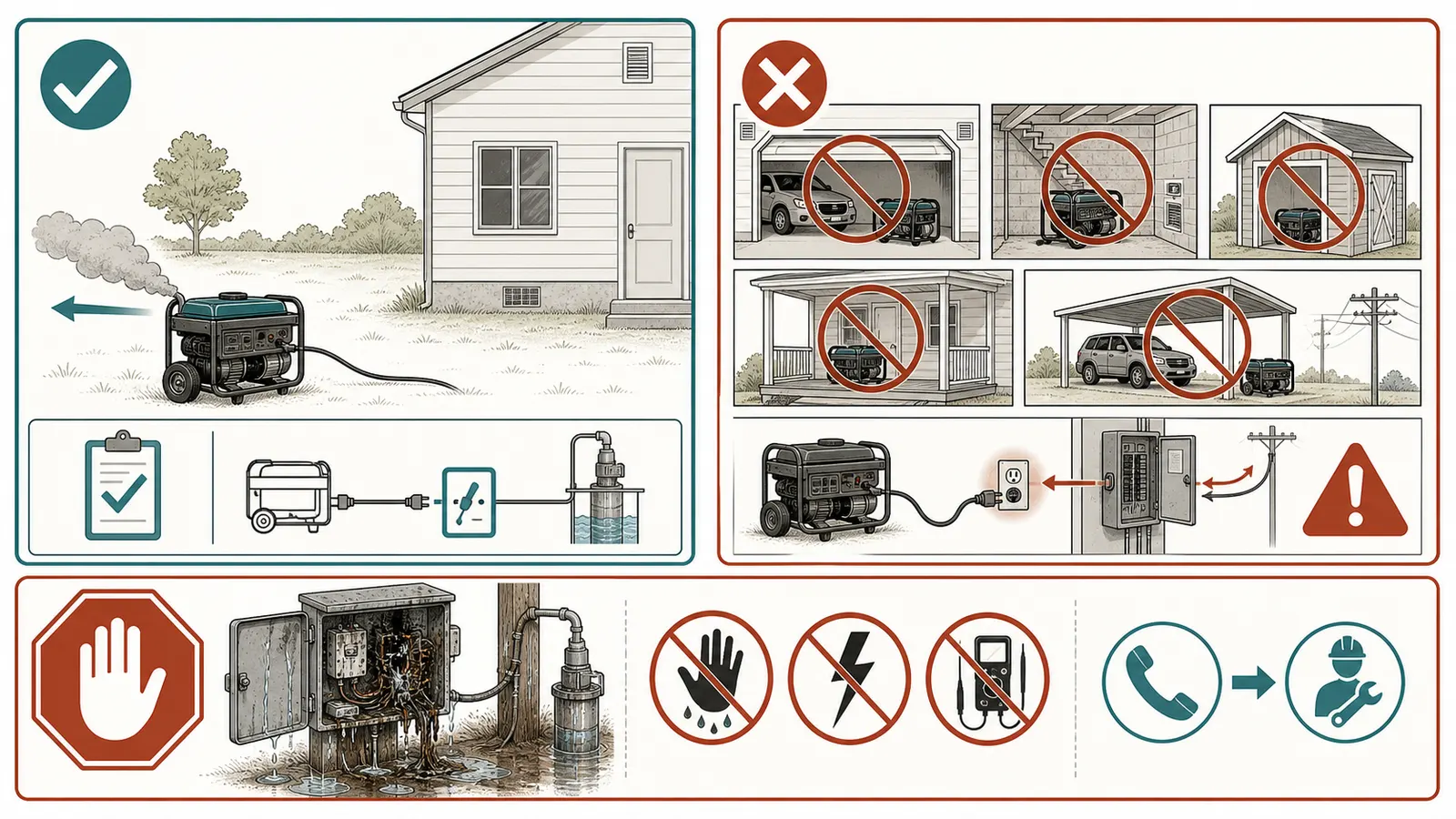
Do not enter a well pit or other confined space. Do not work near downed power lines, wet electrical equipment, unstable ground, sharp debris, or a flooded pump. If the wellhead is damaged or open, keep children and animals away and call a qualified well professional. If the septic system or drain field was damaged, limit household water use until it is inspected; do not move contaminated water around the property.
The professional needs a specific scope, not “the well is acting weird.” Give them the event log, photographs taken from a safe location, equipment model numbers, the last known normal pressure or treatment status, outage duration, any generator connection, and every symptom in time order.
Generator use is a separate life-safety decision
A generator can restore power and still damage a pump or create an electrocution or carbon-monoxide emergency. CDC says the proper generator size for a well pumping system should be determined by a licensed well contractor, electrician, or power company. Do not size a generator from the pump’s nameplate alone.
For portable-generator placement, CPSC says never to operate one inside a home, garage, basement, crawlspace, shed, or other enclosed area. Operate it outdoors at least 20 feet from the home or building, with exhaust directed away from doors, windows, and vents. A porch or carport is not a safe shortcut. Follow the generator manual’s wet-weather instructions, keep the equipment dry as specified, and use a proper transfer arrangement installed or approved by a qualified electrician. Never backfeed a house through a receptacle.
If generator power is being considered only to run the well, ask the professional three questions:
- Is the pump and control equipment dry, undamaged, and safe to energize?
- What starting and running load, voltage, phase, transfer method, and grounding arrangement apply to this exact system?
- How will the UV, chlorinator, controls, and other treatment equipment be powered and verified at the same time?
If those answers are not documented, use alternate water and wait for qualified help. Water scarcity does not justify an improvised electrical connection.
6. Test, disinfect, flush, and release water in the right order
The sequence matters because disinfection can alter the sample and flushing can move contaminated water. Use this order as a planning map, then follow your local health department, certified laboratory, and professional instructions:
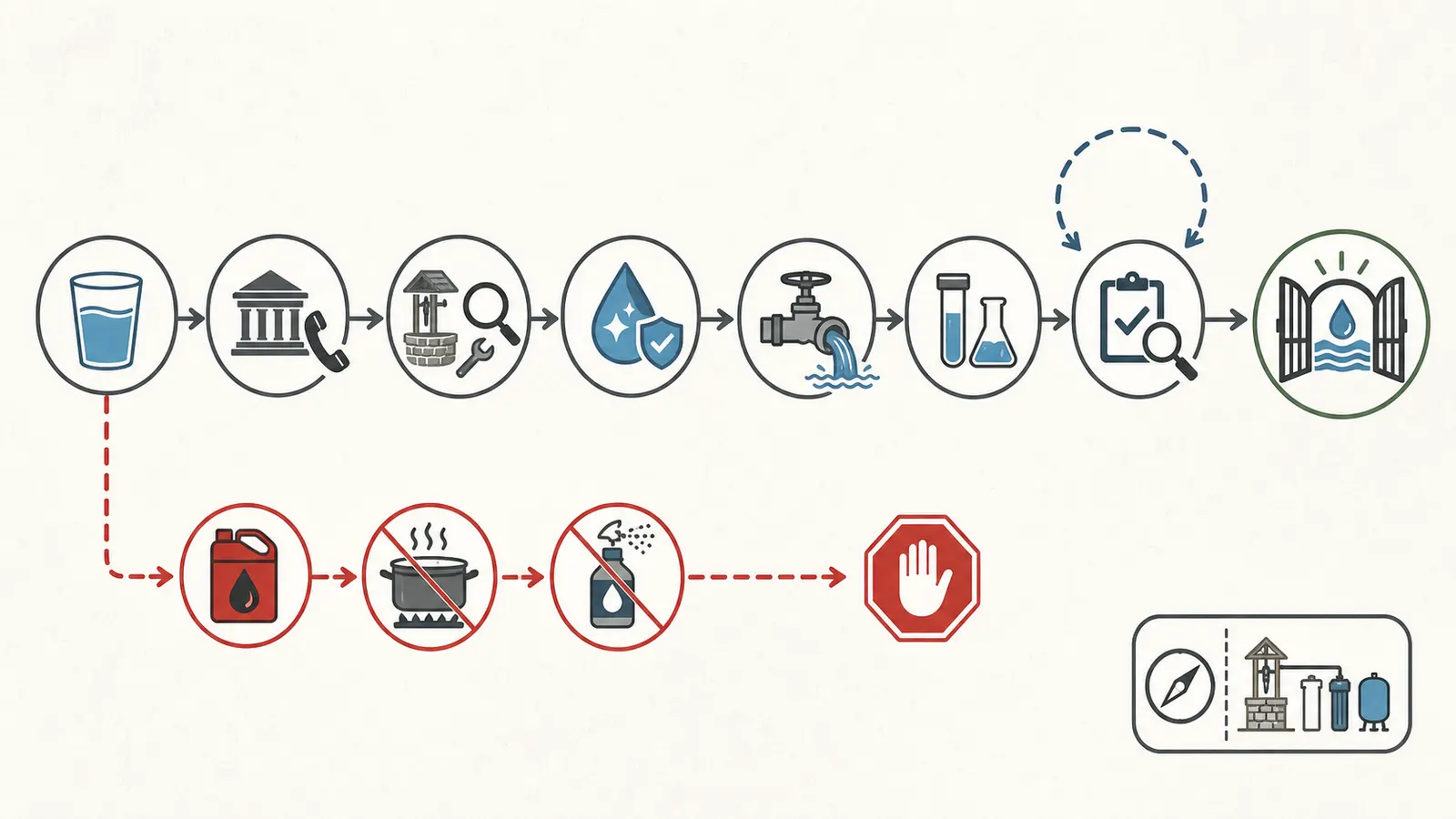
Hold alternate water. Keep people and pets from drinking or bathing in water under a disinfection or contamination hold. Do not rely on boiling when chemicals are possible.
Call the health department or environmental agency. Explain the outage, pressure behavior, treatment interruption, nearby fire, flood, fuel, chemical, septic, or wellhead damage. Ask whether an emergency notice, special sample bottle, or contaminant-specific panel applies.
Arrange qualified inspection and repair. Before disinfection, the electrical system, pump, wellhead, pressure equipment, piping, and treatment train must be safe to operate. CDC says emergency well work should be done by a well or pump contractor because of safety concerns. Read the complete CDC disinfection safety boundary.
Disinfect only when appropriate and instructed. Disinfection targets microbes; it is not a remedy for fuel, solvents, pesticides, or other toxic chemicals. The exact procedure depends on well type, diameter, water depth, bleach concentration, treatment equipment, plumbing, septic capacity, discharge location, and local rules. A homeowner should not lift a well cap, pour chemicals near wiring, or mix chlorine without a safe, model- and event-specific instruction set. CDC’s published procedure uses unscented liquid bleach for specified well types, calls for protective equipment and ventilation, and warns users not to drink or bathe during the process. Follow CDC’s current procedure only within that safety and local-advice boundary.
Flush under control. CDC’s drilled-well procedure uses the outside faucet nearest the well for initial draining when possible, then flushes the well and household lines after the contact period. The page warns about where chlorinated water is discharged. Do not overload a septic system, drain to a stream or pond, or assume the first clear water is safe. Ask the health department or professional where discharge may go.
Sample after chlorine is gone and at the advised interval. CDC’s procedure says to wait at least 7–10 days after disinfection before sampling and says all chlorine traces must be flushed before sampling. That interval is tied to the cited procedure, not a universal promise that every well is safe on day 7. Use the laboratory’s bottle, preservation, sampling, and delivery instructions exactly.
Interpret the result with the agency or laboratory. A passing bacterial result does not answer an untested VOC, SVOC, nitrate, metal, fuel, or treatment-performance question. A failed result does not tell you which repair or treatment is correct without context. CDC says to contact the health department after harmful germs or chemicals are found and to test again after treatment to confirm it worked. Use the CDC treatment guidance for the return-to-use gate.
The minimum release gate
Do not mark “safe to resume drinking” until all applicable boxes are true:
- There is no unresolved well, pump, pressure, electrical, piping, septic, treatment, fire, flood, fuel, or chemical damage.
- The local health or environmental authority and the certified laboratory have received the event facts that could change the test panel.
- Any required professional repair or disinfection is complete and documented.
- The water was flushed in a way that protects the home, septic system, and environment.
- Samples were collected at the correct time and point using the certified laboratory’s instructions.
- Results cover the contaminants relevant to this event and have been interpreted by the lab or health authority.
- Treatment equipment is operating within the exact manufacturer’s instructions, with no unknown bypass or alarm.
- Any required confirmation or post-treatment retest passed.
If one box is unknown, the decision remains hold. That is not a diagnosis; it is a safe status while evidence is collected.
7. Preserve the event record and prevent the next scramble
The most useful record is a short timeline that lets a professional distinguish pressure loss, treatment interruption, and damage. Use the printable Private Well Power-Outage Event Log with this page, or copy the fields below.
| Field | Record |
|---|---|
| Property and well identifier | Address, well label, drilled/dug/bored if known, and location of wellhead |
| Outage | Start, restoration, utility or weather cause if known |
| Water use during outage | Faucets, toilets, showers, laundry, irrigation, cooking, drinking, and approximate timing |
| Pressure observation | Fixture, time, steady/spurting/no flow, visible gauge value, pump behavior |
| Water change | Color, cloudiness, sediment, odor, taste; write the exact description rather than “bad” |
| Treatment | Device, model, powered/unpowered, alarm, bypass, last service, sample point |
| Damage and surroundings | Wellhead, wiring, controls, piping, treatment, septic, flood, fire, fuel, or chemical clues |
| Alternate water | Source, amount on hand, and date the household switched or returned |
| Contacts | Health department, lab, well contractor, electrician, treatment professional, septic professional |
| Testing | Lab, sample ID, collection date/time, analytes, result date, interpretation, retest needed |
| Release decision | Hold, restricted use, or released; who gave the advice and when |
A small annual readiness routine
At a calm time—not during the outage—save the well completion record, pump and treatment manuals, pressure settings if documented, last laboratory reports, professional contacts, and photos of the normal equipment layout. Label the well shutoff and the safe electrical disconnect only if a qualified professional has identified them. Keep bottled water and a battery light available. Ask the treatment professional how a power interruption is indicated and what a homeowner may safely observe.
Plan for the edge cases that make a short outage record misleading. A home may have more than one pressure zone, a cistern or storage tank, a booster pump, a shared well, a low-pressure cut-off, or a treatment unit serving only the kitchen. A generator may run the lights while leaving the well pump or UV unit on a different circuit. A pressure gauge may show a normal-looking number while a downstream treatment alarm, closed valve, frozen line, or damaged control prevents safe delivery. Record the system layout rather than assuming one faucet represents every fixture.
Local requirements also vary. The correct laboratory panel, certified-lab list, well-contractor credential, disinfection method, discharge restriction, septic precaution, and release wording may be set by your state, county, tribal, or local health authority. Iowa DNR, for example, routes private-well owners through county health departments and state-certified well contractors for its program services; that program does not create a national licensing rule. Ask your own authority which local rule or advisory controls rather than copying a neighboring county’s checklist.
CDC recommends annual testing for total coliforms, nitrates, total dissolved solids, and pH, plus additional tests based on local conditions. EPA likewise says to test after a change in water quality, nearby flooding or land disturbance, or repair or replacement of a well component, and to use certified drinking-water laboratories. See EPA’s private-well protection guidance.
Finally, save the exact answer to the event question: what evidence allowed the household to resume drinking water, who interpreted it, and when? “The power came back” is an outage milestone. It is not, by itself, a water-safety result.
Sources and scope
Evidence behind this page
- CDC — Private Wells after a Wildfire
CDC guidance presented in wildfire-response context and useful for the pressure-loss observation branch; it does not establish that every outage contaminates every private well.
- Chester County, Pennsylvania — Well Water and Power Outages
A county public-health notice for Chester County, Pennsylvania. The pressure-barrier explanation and its conservative water-use advice are cited as local guidance, not a nationwide code or universal operating rule.
- Chester County, Pennsylvania — Well Water and Power Outages; CDC — Private Wells after a Wildfire
The sensory-observation limitation in the cited county and CDC guidance; clear-looking water is not treated as a test result.
- CDC — Guidelines for Testing Well Water
General CDC private-well testing guidance. The annual panel is baseline maintenance; post-event analytes depend on local conditions, the event, and health-department or laboratory advice.
- CDC — Private Wells after a Wildfire
A CDC branch written for wildfire-affected wells. This page adapts the bacterial minimum to an outage-related pressure-loss decision while reserving expanded chemical panels for event-specific risk and local advice.
- CDC — About Home Water Treatment Systems; CDC — Guidelines for Treating Well Water
General CDC description of treatment-system scope. It supports treating a powered-off UV or other treatment system as a separate branch, not a claim about a particular installed model.
- CDC — How to Disinfect Wells After an Emergency
CDC emergency-well safety precautions. The article applies the electrical, well-pit, energized-control, and professional-service boundary to outage recovery.
- CDC — How to Disinfect Wells After an Emergency
CDC emergency guidance for suspected chemical contamination. It supports a separate chemical branch and does not prescribe a universal contaminant panel.
- CDC — How to Disinfect Wells After an Emergency
The cited CDC drilled or driven well procedure. Timing, bleach amount, discharge location, well type, septic capacity, and local requirements must be confirmed before any disinfection.
- CDC — Private Wells after a Wildfire
CDC generator and well-pumping advice in wildfire-response context; it is not a sizing calculation for a particular pump or a substitute for the equipment manual and qualified electrical design.
- U.S. Consumer Product Safety Commission — Generator, Carbon Monoxide and Fire Hazards
General portable-generator carbon-monoxide and fire safety. The 20-foot placement does not establish electrical compatibility with a well pump.
- CDC — Guidelines for Treating Well Water
CDC return-to-use guidance for suspected or confirmed private-well contamination; local health or environmental authorities control the final testing and disinfection advice.
- Iowa Department of Natural Resources — Private Well Program
Iowa-specific contractor certification and program administration. It illustrates why the homeowner must check the applicable state or local licensing and certification system rather than assuming a national credential.
- U.S. EPA — Protect Your Home's Water
EPA private-well testing and emergency-protection guidance. The page supports additional testing triggers and certified-laboratory selection; it does not set a universal post-outage release rule or contaminant panel.