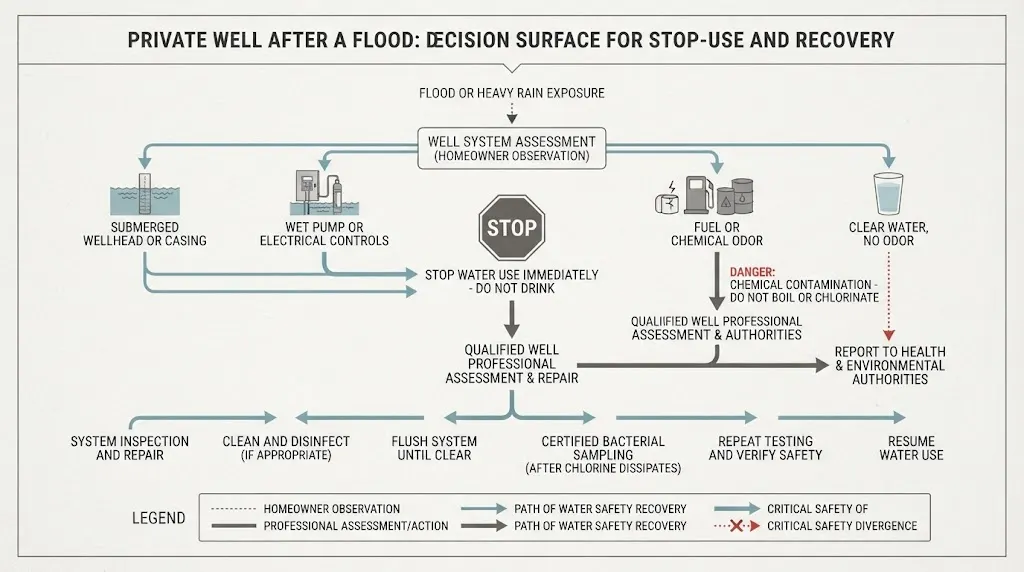
Private Well After a Flood: Stop-Use and Recovery Decision Surface
Record floodwater, wellhead, pump, electrical, and chemical clues, then sequence safe inspection, disinfection, certified testing, and retesting.
The short answer
If floodwater reached the well, pump, controls, or wellhead, stop using the water and keep wet electrical equipment off. A fuel or chemical odor is a separate emergency: boiling and chlorination do not make it safe. Record the event, contact local health officials, and have a qualified well or pump professional inspect the system. Only after repair, approved cleaning and disinfection, flushing, and a certified bacterial test should the water be released for use.Private Well After a Flood: Stop-Use and Recovery Decision Surface
If floodwater reached your wellhead, pump, controls, or the ground immediately around the well, stop using the well water now. Do not turn on a flooded pump, open a wet control box, or assume that water is safe because it looks clear. Use bottled or another known-safe source for drinking, cooking, brushing teeth, ice, and other household uses until the well system has been made safe, recovered, and tested.
There are two different risks to separate before anyone reaches for bleach:
- Microbial risk from floodwater, sewage, animals, sediment, or a compromised well seal. If no chemical contamination is suspected and no safer source is available, CDC says a rolling boil for 1 minute is an interim control while the well is recovered and tested. (CDC sampling and emergency-water guidance)
- Chemical or fuel risk from petroleum, pesticides, solvents, industrial materials, or other contaminants. Boiling and chlorine disinfection do not make that water safe. A fuel or chemical odor is a stop-use and health-department branch, not a disinfection recipe.
The sequence is: record what happened; keep people away from electrical and structural hazards; contact local or state health officials; have a qualified well or pump professional inspect the well, pump, controls, and visible damage; repair and clean the system; disinfect only when that route is appropriate; flush; collect a certified-laboratory sample after chlorine is gone; and keep using an alternate source until the result and local advice support release. CDC describes post-disaster well work as hazardous and recommends contractor involvement after local precautions have been checked. (CDC emergency well guidance)
The release decision is not “does it look clear?”
Clarity is useful evidence about sediment flushing, but it is not a safety certificate. EPA says a well owner may pump after recovery until water runs clear, yet says to seek county, state, or extension advice if it does not. The same EPA guidance also says to test immediately when well conditions change significantly, including flooding, and to use a drinking-water-certified laboratory. (EPA private-well flood response)
Use the table below as the first decision surface. “No” means you do not know; it does not mean the hazard is absent.
| What you observe or know | What it means | Do now | Release condition |
|---|---|---|---|
| Floodwater covered the wellhead, casing, cap, or nearby ground | Treat the well as potentially contaminated and possibly damaged | Stop drinking and washing with the well water; keep the pump off if it or its controls were wet; call local health officials and a qualified well professional | Repair or inspection as indicated, approved recovery, certified bacterial sample, and local advice |
| Pump, pressure switch, control box, wiring, or electrical connection was submerged or wet | Shock, fire, and equipment-damage risk is present even after the water recedes | Do not energize, open, dry by improvisation, or test live wiring; have a qualified electrician or well/pump professional assess it | Professional confirms the equipment and wiring are safe to restore |
| Fuel, solvent, pesticide, sewage-chemical, or other chemical clue; fuel or chemical odor | Chlorine and boiling are not a chemical cleanup plan | Stop all use, use bottled water, keep flames and sparks away from unknown spills, and contact the health or environmental authority | Authority identifies the contaminant and acceptable treatment or alternate source; bacterial clearance alone is insufficient |
| Cap, casing, conduit, seal, or ground around the well is cracked, loose, displaced, eroded, or buried in sediment | A pathway for surface contamination or structural damage may exist | Photograph from safe ground; do not lift the cap, probe the well, or pour anything into it; arrange inspection | Professional repairs or documents acceptable condition, then recovery and testing |
| Heavy rain but no known floodwater contact, no visible damage, and no odor or taste change | Risk may be lower, but runoff and groundwater conditions can still change | Inspect visible parts from dry ground; test if the well was affected, the water changed, or local officials advise it | Certified-lab result appropriate to the event and no unresolved hazard |
| Water is clear after pumping or sitting | Sediment has settled or flushed; microbes and dissolved chemicals may remain | Keep the stop-use boundary; do not release water based on appearance | Certified results and the professional or health authority’s release advice |
If you are unsure which row fits, use the more restrictive row. A missed floodwater contact is more consequential than a temporary delay in using the well.
Record the event before you touch anything
The first useful homeowner action is documentation from a safe, dry location. Do not walk into standing water to reach a breaker, wellhead, pump, or control. CDC warns that floodwater can carry bacteria from sewage and agricultural or industrial waste, and it separately warns against using wet electrical equipment while standing in water. (CDC disaster cleanup safety)
Capture the exposure
Write down the date and time of the flood peak or heaviest rain, the highest visible water line, and whether water reached each of these locations:
- well cap or sanitary seal;
- casing, conduit, or vent;
- jet-pump motor, submersible-pump controls, pressure switch, pressure tank area, or control box;
- treatment equipment, filters, softeners, or ultraviolet equipment;
- fuel tanks, generators, vehicles, farm chemicals, septic components, drums, or other material carried by the water.
Take wide and close photographs only from a stable, dry location. Include the wellhead, the surrounding grade, erosion, debris, waterline, damaged conduit, missing cap, disturbed soil, and any moved chemical container. Do not move a drum, open a container, or clean a spill yourself; use the fire department or environmental authority for dangerous materials. A photograph is evidence for the professional, not permission to restore power.
Record water clues without sampling from a questionable faucet
Note changes in color, cloudiness, grit, odor, taste, pressure, pump noise, or flow. Do not taste the water to compare it. If there is a fuel, solvent, pesticide, sewage, or unusual chemical smell, stop all uses and do not boil, chlorinate, or repeatedly pump it through the house. CDC explicitly says fuel- or toxic-chemical-contaminated water is not made safe by boiling or disinfection. (CDC chemical-contamination warning)
Also note whether the change was at every fixture or only one fixture. A single faucet can have a local aerator, filter, heater, or plumbing issue, but after a flood you should not use that distinction to override the stop-use rule. Give the professional the observation and let the sampling plan separate well, treatment, and household-plumbing causes.
Separate “flooded” from “rained on”
Heavy rain without direct floodwater contact is not automatically the same event as inundation. A properly constructed, intact well may have more protection, but heavy rain can expose cracks, poor drainage, loose caps, shallow construction, or groundwater changes. University of Minnesota Extension recommends inspecting for cracks or deterioration around the cap after heavy rains or flooding and working with a certified laboratory for testing. (University of Minnesota Extension flood-testing guidance)
For your record, choose one status:
- Confirmed contact: floodwater covered or entered the well area, or the water system was inundated.
- Possible contact: water level is uncertain, the cap or casing was surrounded by runoff, erosion moved soil, or debris obscures the evidence.
- No known contact: heavy rain occurred but the wellhead stayed above runoff and no damage or water-quality change is known.
Only the third status supports a less urgent inspection branch, and even then it does not eliminate testing when the water changes or a local authority recommends it.
Choose the branch that matches the damage
Flooded wellhead or submerged cap
Treat a submerged wellhead as both a contamination and a construction question. Floodwater can carry debris that loosens hardware, distort casing, erode pump components, and move sediment into an inadequately capped well. EPA’s flood fact sheet notes that a well may remain unsafe for an extended period when floodwater, septic failures, or chemicals continue to affect groundwater. (EPA flood fact sheet)
Do not lift the well cap to look inside. Do not insert a tape, hose, camera, or chlorine. Do not tighten, reseal, or straighten the casing while standing on saturated soil. Those actions can introduce contamination, damage a seal, expose you to an opening, or conceal a problem that the professional needs to see. Photograph the condition and arrange inspection.
Flooded pump, controls, or wiring
Keep the pump off if any pump motor, control box, pressure switch, junction, conduit, or wiring was submerged or wet. Do not open an energized control box. Do not turn a breaker on “just to see if it works.” Do not test live wiring with a household meter, and do not assume that a dry exterior means the inside is safe.
EPA says the wiring should be checked by a qualified electrician, well contractor, or pump contractor before equipment is turned on; its fact sheet also warns that rubber boots and gloves do not provide adequate protection from electric shock. (EPA electrical safety boundary) CDC likewise says to turn off electricity to the well area before clearing debris and not to attempt repair unless experienced with that work. (CDC well safety precautions)
If reaching the main disconnect requires entering standing water, stop and call an electrician or emergency utility service. Keep children, pets, and cleanup workers away. The same rule applies to a generator: never use it inside a home, basement, garage, or near an opening, and never improvise a connection to household circuits. (CDC electrical and generator safety)
Fuel, pesticide, solvent, or chemical evidence
This is not the “add bleach and wait” branch. EPA says well disinfection does not protect against pesticides, heavy metals, and other non-biological contamination. CDC says water that smells like fuel or chemicals, or water in an area with a high potential for fuel, pesticide, or chemical release, will not be made safe by boiling or disinfection. (EPA non-biological contamination warning; CDC fuel and chemical warning)
Use bottled water for drinking, cooking, brushing teeth, ice, infant formula, and other household uses. Avoid bathing, showering, dishwashing, and laundry with the questionable water until local authorities give specific advice. Do not light a flame near an unknown spill, do not pour contaminated water onto soil or into a septic system, and do not try to “flush it out” through the house.
Tell the health department or environmental agency what was released, where it was, how close it is to the well, when the odor began, and whether the odor is present at the raw-water point, treated tap, or both. EPA’s condition-to-test examples map gasoline or fuel-oil odor near a gas station or buried fuel tank to volatile organic compound testing, but the correct panel depends on the actual source and local groundwater conditions. (EPA contaminant test-selection examples)
Bored or dug well
Do not assume that a familiar chlorine recipe is enough for a shallow or open construction. CDC says bored and dug wells can be difficult to disinfect because their shallow construction and limited protection from floodwater can allow contaminants to re-enter. Persistent contamination may require a different well solution, such as an upgrade or new source, decided with local experts. (CDC bored and dug well guidance)
Record the well type if you know it, along with casing diameter, approximate water depth, construction record, pump type, and any previous disinfection. Do not infer these dimensions from the outside pipe or guess them for a bleach calculation. Give the records to the contractor or health department.
Get the system inspected and made safe
For a confirmed or possible flood, the first professional visit is not simply “shock the well.” Ask for a written scope that separates:
- electrical safety and restoration;
- wellhead, casing, cap, seal, conduit, and surface-drainage condition;
- pump, valves, controls, pressure tank, and visible silt or sand damage;
- treatment equipment and manufacturer-specific bypass or sanitation requirements;
- cleaning, flushing, and disinfection method;
- sampling location, laboratory, test panel, and release criteria.
CDC says disaster well work should be done by a well or pump contractor after local precautions are checked. (CDC contractor boundary) When selecting the professional, WellOwner.org recommends checking state licensing where applicable, certification or membership, equipment, insurance, references, and a written contract. Licensing is state-specific; a national resource does not replace your state’s requirements. (WellOwner.org contractor-selection guidance)
What you may safely observe
From dry, stable ground and with no contact with electrical equipment, you can photograph the cap, casing, grade, erosion, visible debris, waterline, and labels. You can read a dry, visible pressure gauge without opening anything. You can gather the well log, pump model, treatment manuals, prior laboratory reports, maintenance invoices, and utility outage timeline.
You may also call the local or state health department before the contractor arrives. Ask whether the county has a flood-well sampling protocol, whether a boil-water or do-not-use advisory applies, which laboratories are certified, which chemicals are locally relevant, and whether the authority requires a particular sample location or chain of custody.
What stays professional-only
This high-safety guide does not authorize a homeowner to:
- open a well cap, sanitary seal, casing, control box, pressure switch, or electrical enclosure;
- energize, reset, bypass, or test flooded electrical equipment;
- do not pull a pump, open a pressure vessel, disconnect pressurized piping, or manipulate a pressure tank;
- enter a well pit, vault, crawlspace, tank, or other confined space;
- climb unstable ground or handle flood-moved chemical containers;
- do not pour bleach into a well before the system and electrical condition are checked;
- collect a sample from a faucet or hose that the laboratory says is unsuitable.
The distinction matters because a homeowner can make a microbial situation harder to interpret by adding chlorine too early, and can turn an equipment problem into an electrical injury by restoring power too early.
Disinfect, flush, and keep treatment equipment isolated
Disinfection is a microbial-control step, not a universal flood remedy. The professional or local authority should first determine that the well is structurally and electrically suitable, that chemical contamination is not the controlling concern, and that the chosen procedure matches the well construction.
The recovery sequence
The decision record should show these gates in order:
Gate 1 — authority and hazard clearance. Local health or environmental officials identify any advisory, chemical concern, required test panel, or regional procedure. Electrical and physical hazards are cleared by qualified professionals.
Gate 2 — inspection and repair. The wellhead, casing, cap, conduit, pump, controls, pressure system, and visible treatment equipment are inspected. Damage is repaired before disinfection. Silt and debris are removed by the professional; a damaged pump should not be repeatedly run to see whether it survives.
Gate 3 — appropriate cleaning and disinfection. If the authority and professional determine that microbial contamination is the target, use the current EPA or CDC procedure for the exact well type. CDC’s drilled or driven well tables depend on water depth, casing diameter, and bleach concentration; its bored or dug well table uses a different geometry. The quantities are approximate, and CDC specifies unscented household liquid chlorine bleach generally in the 5–9% range. (CDC disinfection procedure and tables) Do not substitute scented, splashless, gel, pool, or mixed cleaners unless the applicable authority and product instructions specifically say they are suitable.
Gate 4 — protect treatment equipment. A softener, filter, ultraviolet unit, reverse-osmosis unit, or other treatment device is not automatically safe to expose to a high-chlorine shock. CDC warns that disinfection may damage water softeners and says to follow the manufacturer’s instructions; bypass or separately service treatment equipment when the procedure requires it. (CDC treatment-equipment caution) Record every bypass, cartridge change, membrane decision, and return-to-service step.
Gate 5 — contact time and controlled flushing. CDC’s procedure calls for chlorine to reach the faucets, a minimum 12-hour contact period, and controlled draining to an area without plants or vegetation and away from streams, ponds, or other open water. (CDC well-disinfection sequence) Do not discharge a large chlorine load into a septic system, garden, stream, or pond without following the authority’s instructions. Do not bathe, cook, drink, or wash with the chlorinated water during contact time.
Gate 6 — chlorine-free sampling. Chlorine must be flushed from the system before the sample. A chlorine smell is not a test result, and a clear sample taken while residual chlorine is present is not a valid release signal.
What not to infer from a successful shock
A well that accepts chlorine has not necessarily been structurally repaired. A pump that starts has not necessarily been electrically inspected. A faucet that runs clear has not necessarily cleared the aquifer. A negative bacterial test does not answer a fuel, pesticide, solvent, nitrate, metal, or other chemical question unless that analyte was actually included in a suitable test.
If treatment equipment was flooded, ask whether it must be discarded, sanitized separately, or tested before reconnecting it. Follow the equipment manufacturer’s instructions; do not invent a bleach concentration for a cartridge, membrane, resin bed, UV chamber, or storage tank.
Test, release, and retest
Build the test panel from the event
At minimum, the post-disinfection bacterial sample should follow the laboratory and local-health protocol. CDC specifies total coliform and either E. coli or fecal coliform for confirming bacterial safety after emergency well disinfection. (CDC post-disinfection sampling) EPA says to use a laboratory certified to perform drinking-water testing. (EPA certified-lab guidance)
Do not use “test the water” as if it were one universal bottle. Ask the health department or certified laboratory to translate the event into analytes. The following matrix helps you explain the event; it is not a substitute for local sampling advice.
| Event clue | Ask whether the panel should include | Why the clue matters | What a negative bacterial result does not prove |
|---|---|---|---|
| Floodwater or sewage contact, no chemical clue | Total coliform and E. coli or fecal coliform; local additions | Microbial contamination is the first concern | No proof against dissolved chemicals or a damaged well that can be recontaminated |
| Fuel, gasoline, diesel, solvent, or petroleum odor | Volatile organic compounds or the authority’s source-specific panel | EPA associates fuel-oil or gasoline odor with VOC testing examples | No proof that chlorine removed the odor or that boiling is safe |
| Pesticide, agricultural, industrial, or moved-container clue | Source-specific pesticides, metals, solvents, or other analytes selected by officials | Floodwater can move contaminants beyond the well pad | No proof against untested chemicals |
| Heavy rain, shallow or poorly sealed well, no odor | Bacterial panel and local groundwater concerns | Surface water can enter through construction or sealing defects | No proof that the cap, casing, or seal is sound |
| New color, taste, or odor after repair | Recheck the event-specific panel and the sample location | EPA treats water-quality change and system repair as reasons to test | No proof that the cause was only a dirty aerator or filter |
Release rule
Keep using alternate water until all of these are true:
- the electrical and physical system has been cleared or repaired;
- the applicable authority or qualified professional has completed the recovery steps;
- chlorine has been flushed and the laboratory’s sampling instructions were followed;
- the certified laboratory reports the required bacterial result as acceptable;
- chemical concerns have either been ruled out with appropriate tests or addressed by the authority;
- no local advisory or professional hold remains.
CDC advises waiting at least 7–10 days after disinfection before sampling, then follow-up testing in 2–4 weeks and again in 3–4 months; it also advises monitoring bacterial quality at least twice per year or more often when changes are suspected. (CDC retesting schedule) Treat those intervals as a recovery schedule, not as permission to drink during the waiting period. EPA’s older flood fact sheet also cautions that a well may not be safe for months when contamination continues to move through groundwater. (EPA flood-duration caution)
If coliforms remain, do not keep repeating chlorine by guesswork. CDC says to repeat disinfection and testing, and to contact the local health department if bacteria continue to be present. (CDC failed-result guidance) Persistent positives should prompt a construction, well-type, groundwater, septic, or source investigation rather than a larger dose chosen informally.
Print this recovery record and hand it to the professional
Copy this section into a note or print it. Leave unknown fields blank rather than guessing.
Event log
| Field | Record |
|---|---|
| Property and contact | |
| Date and time of flood or heavy rain | |
| Highest water level or waterline | |
| Well type and approximate depth | |
| Wellhead covered? yes / no / unknown | |
| Cap, casing, seal, conduit, or grade damage | |
| Pump or control equipment wet? | |
| Main power status and who isolated it | |
| Treatment equipment present and flood exposure | |
| Water color, sediment, odor, taste, pressure, or flow change | |
| Fuel, pesticide, solvent, sewage, drum, tank, or industrial clue | |
| Photos, well log, manuals, and prior tests attached | |
| Health department or environmental contact and advice | |
| Contractor, license or certification check, and scope | |
| Repair and inspection date | |
| Disinfection method and product recorded by | |
| Chlorine-flush completion date | |
| Certified lab, sample location, and chain-of-custody details | |
| Bacterial result | |
| Chemical result or unresolved concern | |
| Follow-up sample dates: 2–4 weeks / 3–4 months | |
| Final release decision and decision-maker |
Questions to ask before the visit ends
- Was the wellhead merely wet, or was floodwater confirmed inside the casing or system?
- Which components were submerged, and which were electrically tested or replaced?
- Was the cap, seal, casing, conduit, surface drainage, or well pit repaired?
- What well type and dimensions were used for any disinfection calculation?
- Which treatment devices were bypassed, removed, discarded, or sanitized separately?
- Where was chlorinated water discharged, and was septic or surface water protected?
- What analytes were selected for this event, and why?
- Which faucet or raw-water point was sampled, and did the laboratory provide the bottle and handling instructions?
- What exact result releases drinking, cooking, bathing, and treatment equipment for use?
- What is the next sample date, and who owns the follow-up?
The best outcome is not simply “the pump runs” or “the water is clear.” It is a documented chain from exposure to inspection, from inspection to an appropriate recovery method, and from recovery to certified evidence that matches the actual risk. If the event included fuel, chemicals, damaged electrical equipment, a submerged wellhead, or persistent bacterial positives, keep the conservative stop-use boundary until the responsible professional or public-health authority changes it.
Sources and scope
Evidence behind this page
- Protect Your Home's Water
US EPA private-well flood response guidance; applies to suspected contamination after flooding or another natural disaster and does not replace state or local instructions.
- What to Do After the Flood
EPA three-page private-well flood fact sheet; applies to flooded pump, control, and electrical systems and is a safety boundary, not a homeowner repair procedure.
- What to Do After the Flood
EPA flood fact sheet; applies when non-biological contamination is suspected from nearby sources, moved chemical containers, or other flood conditions.
- How to Disinfect Wells After an Emergency
CDC emergency private-well guidance; applies to chemical or fuel clues and does not identify the contaminant or substitute for local health or environmental assessment.
- How to Disinfect Wells After an Emergency
CDC emergency guidance for private wells after disasters; local health department or extension instructions govern regional precautions.
- How to Disinfect Wells After an Emergency
CDC sampling-after-disinfection guidance for emergency private-well recovery; testing panel and follow-up are bacterial-safety guidance, not a complete chemical panel.
- How to Disinfect Wells After an Emergency
CDC well-type-specific guidance; applies to bored or dug wells and should not be generalized to every drilled or driven well.
- Protect Your Home's Water
US EPA private-well testing guidance; exact analytes beyond routine bacterial testing depend on local conditions, observed clues, and health-department advice.
- Protect Your Home's Water
EPA examples of condition-to-contaminant test selection; not a complete national test list and not a conclusion that every odor has one cause.
- Test your well water after flooding
University of Minnesota Extension educational guidance; construction details such as cap height and licensing examples are Minnesota-specific and are not treated here as a national code.
- How to Find a Contractor
National Ground Water Association consumer resource hosted by WellOwner.org; state licensing requirements vary and the directory is not an endorsement of a listed company.
- Protect Your Home's Water
US EPA flood-response sequence; clarity is a flushing observation, not proof that microbial or chemical safety has been established.