How Many Gallons Are in My Well? Estimate Casing Storage
Estimate standing water in a private-well casing from your completion report, separate potentially usable storage, and avoid confusing gallons with well yield.
The short answer
Use total depth, static water level, and actual inside diameter: gallons ≈ 0.0408 × diameter² × water-column height. That estimates casing storage—the water standing in the borehole—not sustainable well yield or recovery rate. For a more useful planning number, calculate only the column above a documented pump intake or low-water cutoff. If the well has no approved access port, do not open it or insert a tape; use the record or call a qualified well professional.How Many Gallons Are in My Well? Estimate Casing Storage
The short answer
If you have a well-completion report, estimate the water standing in a cylindrical section of the well with:
gallons per foot = 0.0408 × (inside diameter in inches)²
water-column height = lower depth boundary − static water level
standing gallons = gallons per foot × water-column height
For a uniform 6-inch inside diameter, that is about 1.47 gallons per vertical foot. A well with a 300-foot bottom depth and a static water level 35 feet below the same reference point has 265 feet of standing water. Its rough total casing-storage estimate is:
0.0408 × 6² × 265 = 389 gallons
That 389 gallons is water sitting in the borehole at rest. It is not the well’s sustainable yield, recovery rate, pressure-tank drawdown, or proof that the water is safe to drink. Massachusetts’ well-yield guidance describes casing storage as water that has moved from the surrounding formation into the borehole, and uses the familiar 1.5-gallon-per-foot approximation for a typical 6-inch well. The diameter-specific number should not be copied onto a well with a different inside diameter. Massachusetts DEM’s estimating guide
For a planning number, calculate a second result: the water column only down to a documented pump intake or low-water cutoff. Call that “potentially usable casing storage,” not guaranteed household supply. If your well has no approved access port, do not remove the cap, insert a tape or string, move pump wiring, or disturb the seal to get a current reading. Use the record you already have or arrange a qualified well professional.
What this estimate can—and cannot—tell you
The calculation answers a narrow question: how much water would occupy a defined vertical section of the well if the water level and diameter recorded in your inputs are accurate. It is useful because the number in a completion report is often a depth, while the homeowner’s decision is about volume.
It can help you:
- translate a reported standing-water height into gallons;
- see how much of that volume lies above a documented pump intake;
- compare a stored-water buffer with a short, high-use household event;
- create a repeatable record when you later receive a new water-level or pump-test result; and
- identify when a well-yield evaluation or storage plan is more appropriate than another arithmetic estimate.
It cannot tell you:
- how many gallons per minute the aquifer can continuously supply;
- how quickly the water level recovers after pumping;
- whether the pump can deliver the water at the pressure and flow your fixtures need;
- whether the pressure tank is correctly sized or charged;
- whether the water is microbiologically or chemically safe; or
- whether a low-water cutoff, pump control, treatment device, or buried connection will operate correctly.
That separation is not just technical wording. Penn State defines well yield for planning as the maximum rate at which a well can be pumped without lowering the water level below the pump intake. Yield is therefore a rate tied to an operating limit, while casing storage is a volume already in the borehole. Penn State Extension’s water-system planning guidance also notes that storage and flow can vary substantially with groundwater levels and drought.
Alaska’s private-system guidance puts static level, drawdown, well yield, casing storage, total demand, and peak demand in separate planning categories. That is the right mental model for this page: use the volume estimate as one input to a decision, not as a substitute for a pump test. Alaska DEC’s Best Management Practices for Private Drinking Water Systems
Find the right inputs in your well record
Start with the well-completion report, well log, permit record, pump-installation invoice, or service record. Different states use different field names, and some older records are incomplete. Write the document date and the measurement reference point next to every number.
| Input | What to look for | Unit | Why it matters |
|---|---|---|---|
| Total well depth | Bottom or total depth on the completion report | feet | Sets the bottom boundary only if the lower section has the diameter you are using |
| Static water level | Depth to water when the well was not being pumped | feet below reference point | Sets the upper boundary of the standing-water column |
| Actual inside diameter | Inside diameter of the water-filled section, not just nominal casing size | inches | Volume changes with the square of diameter |
| Pump intake or lower operating limit | Pump intake depth, low-water cutoff depth, or other documented protective limit | feet below reference point | Defines the conservative lower boundary for potentially usable storage |
| Documented yield | Pump-test or completion-report rate and test duration | gallons per minute and hours | Describes inflow under a test, not stored volume |
| Pumping level or drawdown | Water level while pumping, if recorded | feet | Shows how far the level moves under a stated demand or test |
| Date and conditions | Date, season, drought, recent pumping, and nearby water use | notes | Makes a seasonal comparison meaningful |
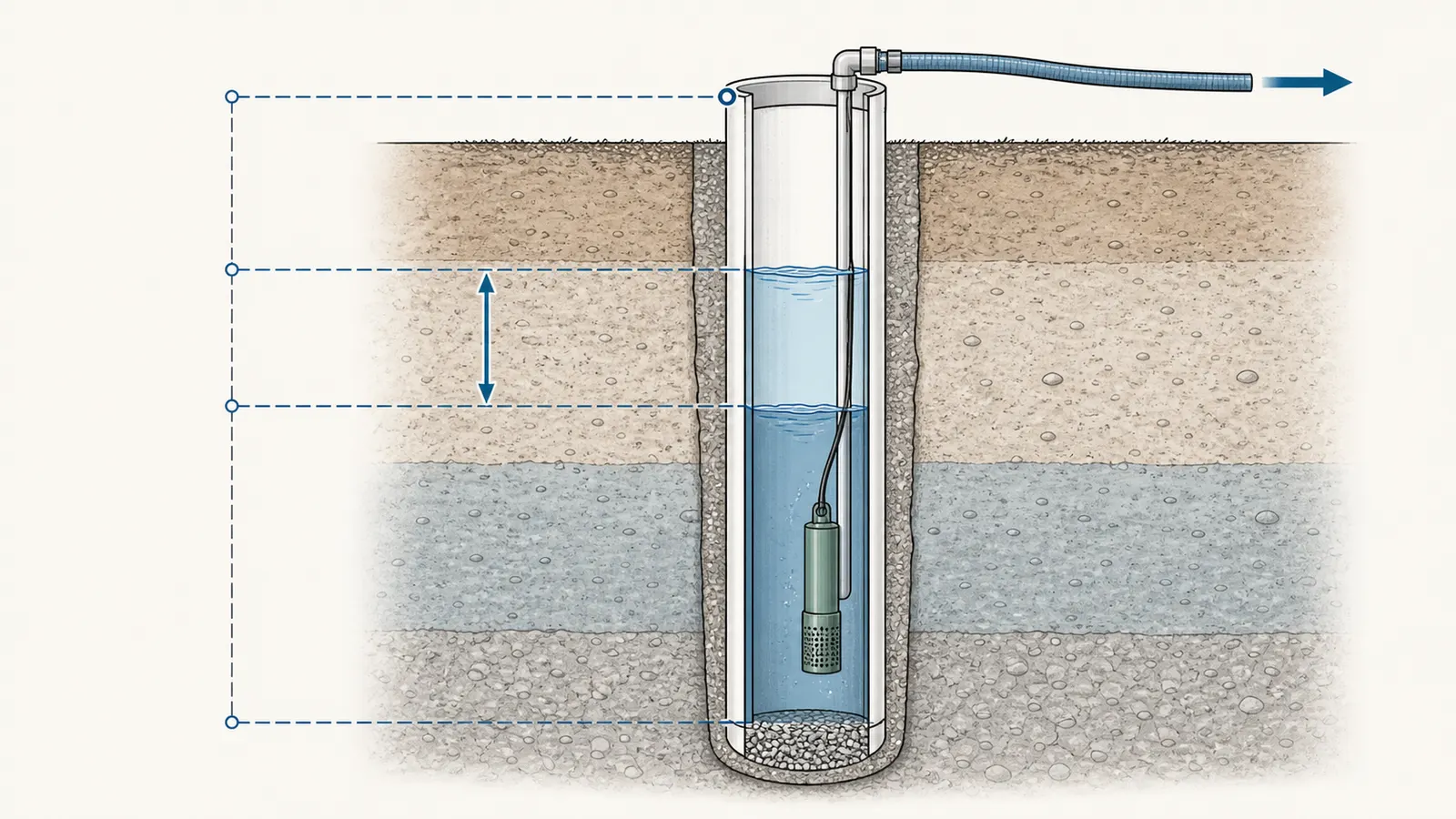
Keep all depths on the same datum
The calculation only works when the depths share a reference point. A static water level measured from the top of casing cannot be subtracted from a total depth measured from a basement floor unless you adjust them to the same point. The reference point may be the top of casing, a marked notch, or another documented datum.
EPA’s current field procedure says groundwater measurements should be made relative to an established reference point on the casing and that the reference point should be documented. It also calls for the measurement to be logged, rather than treated as a free-floating number detached from date and location. EPA’s Groundwater Level and Well Depth Measurement procedure
Use inside diameter, not a convenient label
“6-inch well” may be a nominal construction description. The water volume depends on the inside diameter of the section holding the water. A liner, wall thickness, scale, or a different open-borehole diameter can change the result. If the report gives only nominal diameter, label your result “approximate—nominal diameter.” Do not invent an inside diameter from a brand, pump size, or pipe outside measurement.
If the well has multiple diameters, calculate each segment separately:
segment gallons = 0.0408 × diameter² × segment height
total gallons = segment 1 + segment 2 + segment 3 …
For an open-hole bedrock well, the casing diameter may describe only the upper cased section; the uncased borehole below it may not have the same diameter. The National Ground Water Association explains that the lower intake zone and well construction determine how water enters the well, and that storage depends on diameter, pump setting, and water height. NGWA’s Well Owner Guide If your record does not describe the lower geometry, use a clearly labeled approximation or ask a well professional to interpret the record.
Calculate total standing-water storage
The volume formula is the cylinder conversion expressed in homeowner-friendly units:
gallons per vertical foot = 0.0408 × d²
Here, d is the inside diameter in inches. For a 6-inch inside diameter:
0.0408 × 6² = 1.4688 gallons per foot
The U.S. EPA’s groundwater-monitoring training material gives the equivalent rounded relationship, approximately 0.041 × diameter² × water depth, for gallons. EPA’s Subtitle D Technical Training Manual
For a uniform section, calculate the height first:
water-column height = lower boundary depth − static water-level depth
If the lower boundary is the recorded bottom depth:
total standing gallons = 0.0408 × inside diameter² × (total depth − static level)
Worked example: total water versus the lower boundary
Assume the record says:
- total depth: 300 feet below the top-of-casing reference point;
- static water level: 35 feet below that same point; and
- inside diameter: 6.0 inches.
The water column is 300 − 35 = 265 feet. The calculated volume is:
0.0408 × 6.0² × 265
= 0.0408 × 36 × 265
= 389.2 gallons
Round the result to about 389 gallons, not 389.2 gallons of certainty. The decimal only reflects the formula; it does not improve the accuracy of an old static-level reading or an uncertain diameter.
Quick reference for a uniform well
| Inside diameter | Approximate gallons per vertical foot | 100 feet of standing water | 200 feet of standing water |
|---|---|---|---|
| 4 inches | 0.65 gal/ft | 65 gallons | 131 gallons |
| 6 inches | 1.47 gal/ft | 147 gallons | 294 gallons |
| 8 inches | 2.61 gal/ft | 261 gallons | 522 gallons |
| 10 inches | 4.08 gal/ft | 408 gallons | 816 gallons |
These are geometry results rounded to the nearest gallon. They are not claims about the well’s recharge, water quality, pump capacity, or reliable household supply. Notice why diameter matters: doubling diameter increases the cross-sectional area—and therefore the gallons per foot—by four times.
Reject bad inputs before trusting the result
Stop and label the estimate “not calculable from this record” if:
- the static level is deeper than the reported lower boundary;
- the two depths use different reference points and cannot be reconciled;
- the diameter is missing and the well has more than one diameter;
- the report gives a pumping level but no static level and you are calling the result standing storage;
- the pump intake or cutoff is described only as “deep” or “near bottom”; or
- the well is a dug, bored, driven, flowing, or shared system for which this drilled-well cylinder model does not fit.
An obviously wrong number is safer than a precise-looking number built from mismatched fields.
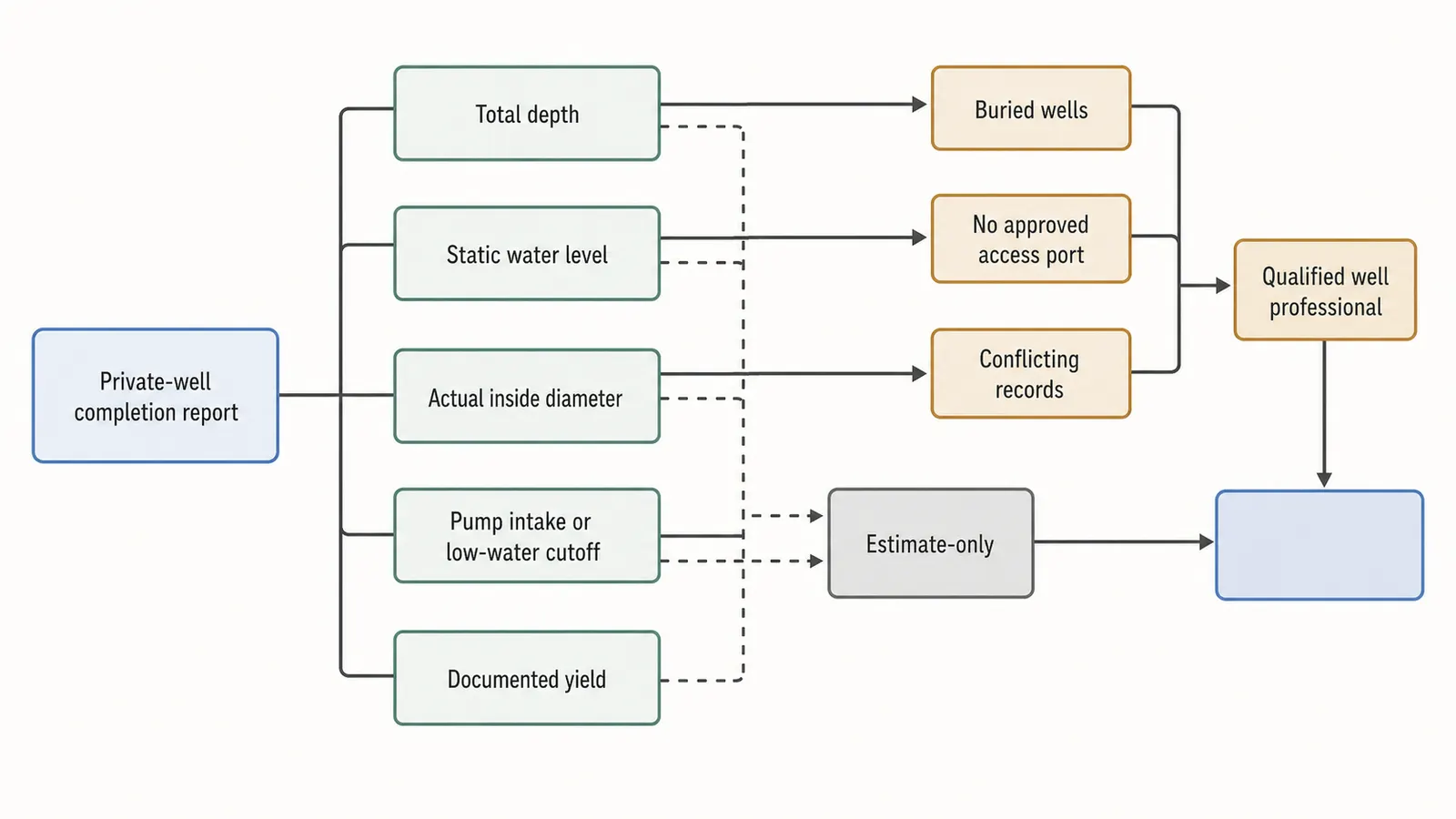
Separate potentially usable storage from total storage
The bottom of the well is not always the bottom of the water a pump can use. A submersible pump intake may sit above the bottom, or a low-water protection device may stop the pump before the intake is exposed. Massachusetts guidance explicitly notes that the pump’s position above the bottom shortens the column that should be treated as available for pumping. Massachusetts DEM’s casing-storage discussion
Use the documented lower operating limit for a conservative second calculation:
potentially usable water-column height
= lower operating limit − static water level

potentially usable gallons
= 0.0408 × inside diameter² × potentially usable water-column height
The “lower operating limit” is the shallowest documented depth at which the system is designed to stop relying on the stored column. It may be a low-water cutoff or, if no protective cutoff is documented, the pump intake depth used for planning. Do not guess which component controls. Record the field name and the document it came from.
Worked example: a pump intake above the bottom
Use the same 6-inch well with a 35-foot static level, but assume the pump intake is documented at 250 feet. The total standing-water calculation used the 300-foot bottom and returned about 389 gallons. The potentially usable calculation uses 250 feet:
0.0408 × 6² × (250 − 35)
= 0.0408 × 36 × 215
= 316.2 gallons
The result is about 316 gallons of casing storage above the documented intake. The roughly 73 gallons below that intake are still physically in the well when the water is static, but they are not a sensible household operating reserve for that pump setting.
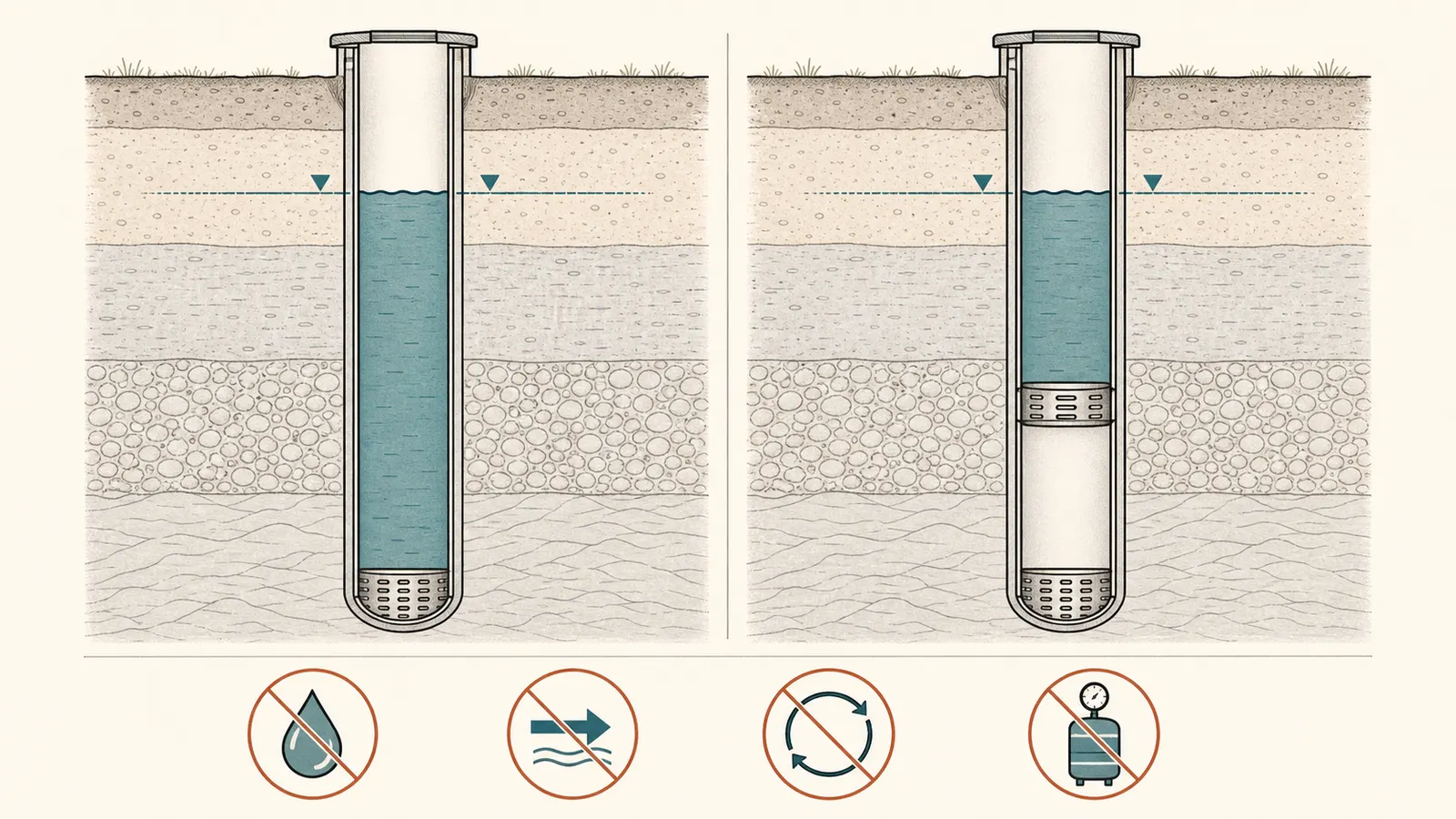
Even the 316-gallon figure has limits. As water is pumped, the level may fall, the aquifer may add water at a changing rate, and the pump may cycle. The volume is “potentially usable” because it describes a geometric buffer above a stated boundary; it does not promise that the pump will deliver every gallon at the pressure your home expects.
What changes when the static level changes?
If the static level rises 10 feet in the same 6-inch well, storage increases by about 14.7 gallons. If it falls 10 feet, storage decreases by about 14.7 gallons. In a larger-diameter well, the same level change represents more gallons; in a smaller well, fewer.
That is why one old completion-report static level is not a current inventory. Penn State notes that well storage and flow vary with the natural groundwater level and that drought can make the variation more severe. Penn State’s storage and drought guidance
Compare storage with yield and household peak demand
The most useful homeowner comparison is not “gallons in well versus gallons used today.” It is:
- How much stored water is above the operating limit?
- How much water can the well add during the same event?
- How much water does the household draw at its busiest time?
- Can the source recover before the next busy period?
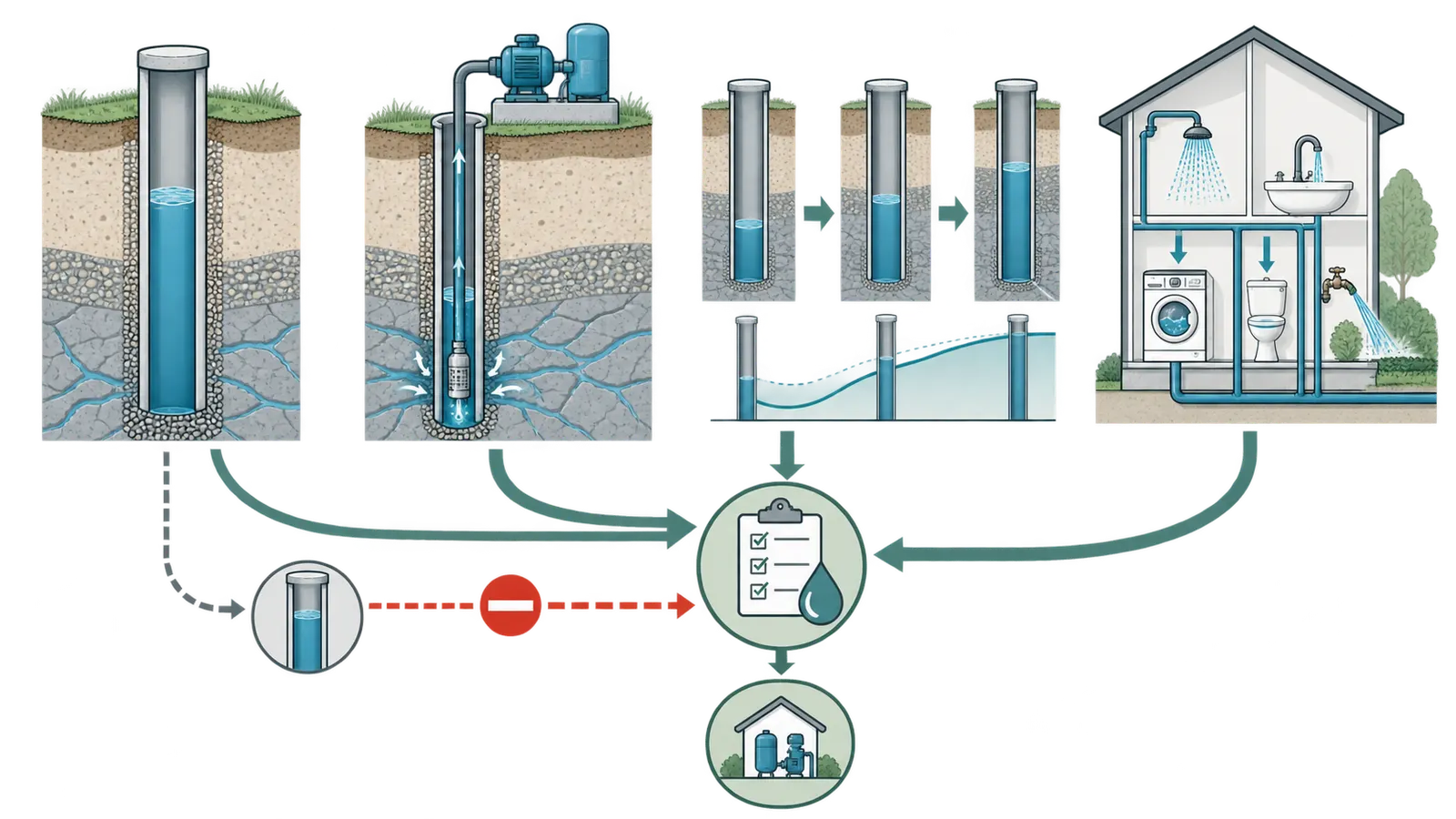
A screening equation
If you have a documented yield from a defined test, a deliberately simplified event screen is:
source available during event
≈ documented yield × event minutes + potentially usable casing storage

screening balance
≈ source available − household gallons used during event
This is not a pump-test model. It assumes the documented yield is relevant to the current conditions and that the stored column can be drawn without violating the pump’s lower operating limit. It does not model drawdown, changing inflow, pump cycling, pressure-tank drawdown, treatment backwash, irrigation, or a second event before recovery.
Massachusetts’ private-well guidelines use a similar planning screen: they compare peak demand with well yield over a stated period and borehole storage, then separately consider whether the yield can replenish the storage between peak-demand events. The Massachusetts private-well guideline example is useful as a planning structure, not as permission to size a system from this page alone.
Build a peak-use estimate from observed use
Peak use is simultaneous or closely grouped use, not the monthly bill divided by days. Penn State’s homeowner table gives bounded examples such as approximately 20 gallons for an 8-minute shower, 25 gallons for a front-loading washer load, 4.5 gallons for an efficient dishwasher cycle, 1.6 gallons for a low-flush toilet flush, and 5 gallons per minute for a half-inch outside hose. Actual fixtures and settings vary, so use your own labels, manuals, or measured fixture flow where available. Penn State’s household-use table
Use this worksheet for a morning or evening window:
| Use in the same window | Count or duration | Your estimated gallons | Source of estimate |
|---|---|---|---|
| Showers or baths | fixture label, manual, or household log | ||
| Toilets | tank label or fixture model | ||
| Clothes washer | appliance manual or cycle setting | ||
| Dishwasher | appliance manual or cycle setting | ||
| Outside hose or irrigation | measured or labeled flow, if applicable | ||
| Treatment regeneration or backwash | exact equipment manual | ||
| Other simultaneous use | note the assumption | ||
| Peak-window total | _____ gallons | date and time: __________ |
Do not use a generic daily-per-person number to declare a well adequate. Daily averages can hide a short event that drops pressure or lowers the pumping level. Alaska DEC likewise distinguishes total demand from peak demand and notes that planning must account for the system’s actual usage pattern.
A simple interpretation matrix
| What your records show | What it means | Safest next step |
|---|---|---|
| Storage estimate is large, yield is documented, no symptoms | A planning buffer may exist | Log seasonal levels and peak use; keep the records together |
| Storage is large but yield or recovery is unknown | Standing volume is known only approximately; inflow is unresolved | Arrange a qualified yield or recovery evaluation before major storage or pump decisions |
| Yield is documented but storage above intake is small | Short peak events may depend heavily on inflow and controls | Review peak use, pump setting, low-water protection, and storage options with a professional |
| Pressure falls, pump runs longer, water spurts, or the well appears to run dry | The issue may be yield, drawdown, pump, electrical, pressure-tank, or plumbing related | Stop treating the cylinder estimate as a diagnosis; call a qualified well/pump professional |
| Static level changed during drought or the season | The old volume is not a current guarantee | Recalculate from a professionally obtained current level and note the conditions |
NJDEP lists longer pump run time, lower pressure, and changes in water appearance or taste among signs that warrant diagnosis, while cautioning that static level alone may not explain the whole well and pumping system. NJDEP’s Private Well Owner FAQ
If you need a current water-level measurement
Use the completion report when your question is an estimate. Arrange a professional measurement when the current level changes a decision: a suspected dry well, a pump replacement, a storage-tank proposal, a drought comparison, a property transfer, or a recurring low-pressure complaint.
No approved access port: stop there
Do not remove an unapproved well cap, defeat a sanitary seal, insert a fishing line or household tape, lower a weighted object, move wires out of the way, disconnect a pitless adapter, or pull the pump to “see how much water is there.” Do not open energized controls, test live wiring, open pressurized equipment, or enter a well pit, vault, or confined space. Those tasks belong to a qualified well driller, pump installer, electrician, or other professional appropriate to the work.
NJDEP specifically tells New Jersey owners to contact a licensed well driller or pump installer for an individual water-level measurement. It warns that opening caps and seals can jeopardize sanitary integrity and that a measuring device can become lodged near pumping equipment. The licensing instruction is New Jersey-specific; the equipment and contamination cautions are a conservative boundary for homeowners anywhere. NJDEP’s measurement guidance
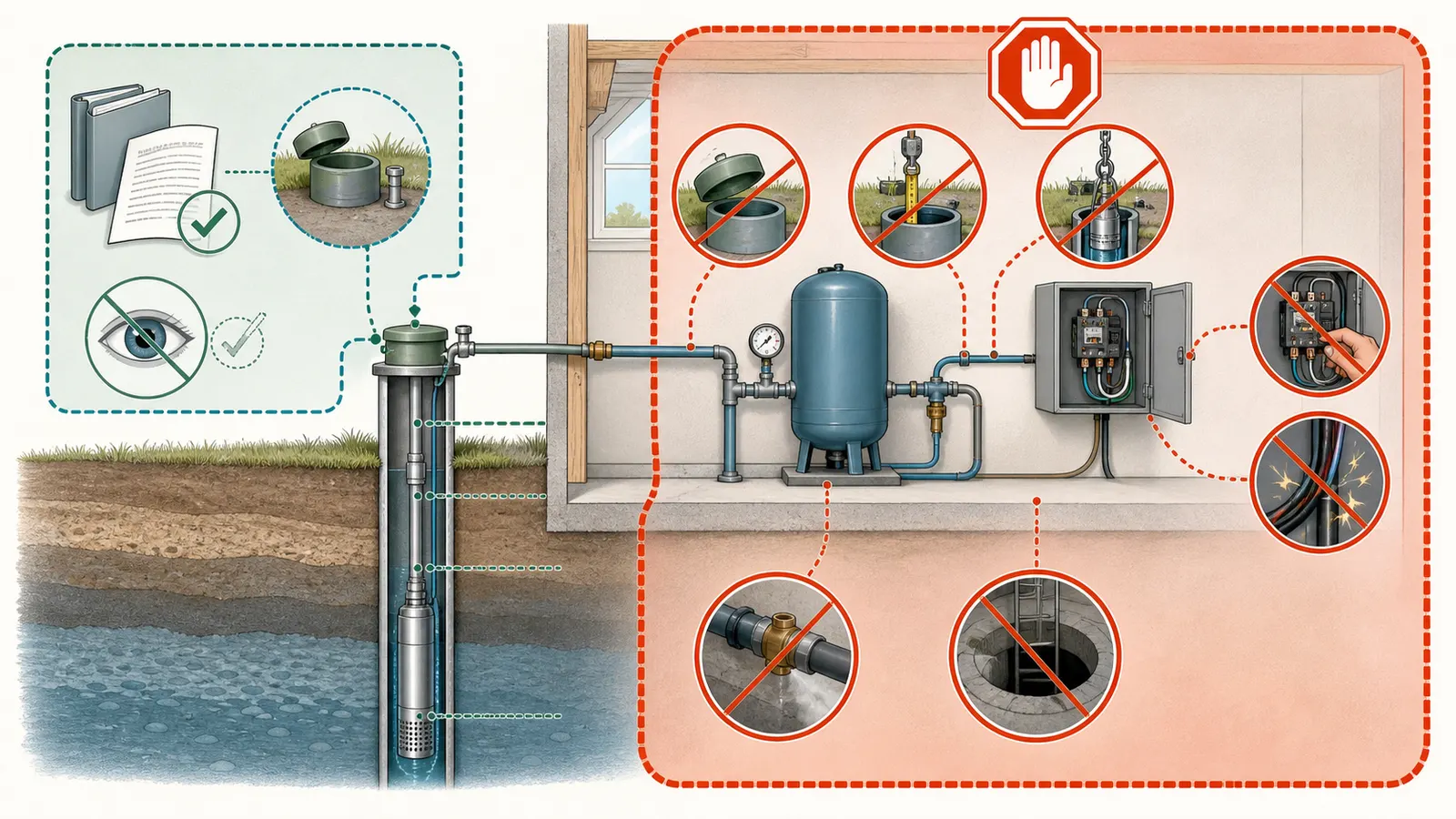
If the well is buried or has no documented access arrangement, do not excavate or expose it as a DIY measurement project. Ask a qualified professional what access, disinfection, equipment protection, and local requirements apply to that well construction.
What a professional measurement should document
EPA’s field procedure describes a disciplined record: allow the water level to equilibrate after a seal is removed, use an established reference point, document the method, and take care with deep wells, sediment, probe length, and bottom contact. It also says that water-level and depth measurements are used to determine casing volume or drawdown in field work. EPA’s measurement procedure
Ask for the result—not necessarily the equipment details—in a form you can reuse:
- date and time;
- weather, drought, and recent pumping conditions;
- reference point used;
- static water level and method;
- pumping level or drawdown, if a test was performed;
- total depth and any uncertainty at the bottom;
- pump intake, low-water cutoff, and pressure-control details;
- documented flow rate and test duration; and
- any recommendation for recovery observation or additional storage.
The goal is not to collect a dramatic number. It is to make the next comparison honest: same reference point, known conditions, known operating boundary, and a clear distinction between a level measurement and a yield test.
Choose the next action and keep a record
Use the following decision surface after you calculate the estimate.
Routine logging is reasonable when
Your completion report is internally consistent, the well has no current symptoms, the pump intake or operating limit is documented, and you only want a baseline. Record the calculation, date of the source document, season, and assumptions. Revisit it if the household changes, irrigation is added, drought conditions develop, or pressure behavior changes.
Schedule a professional evaluation when
You need a current level, the report is missing or contradictory, the well has multiple diameters, the pump setting is unknown, the well is open-hole below the casing, or a purchase, pump replacement, or storage design depends on the result. Ask for a yield or recovery evaluation when the real question is “how much can this well supply over time?” A casing-storage calculation alone cannot answer that.
Treat symptoms as a system problem, not a gallon-count problem
Longer pump run times, lower pressure, spurting water, visible sediment, or a change in taste or color can have more than one cause. Possible branches include changing groundwater conditions, drawdown, pump or control trouble, pressure-tank problems, a blocked or damaged component, treatment interruption, or a water-quality issue. Do not open controls or manipulate pressurized components to isolate the cause. Record when the symptom appears, what water use preceded it, whether it is hot or cold, and whether it changes with rainfall or drought. Give that timeline to the professional.
Bring this packet to the professional
- the complete well-completion report or well log;
- pump-installation and replacement records;
- pump model, setting depth, intake depth, and low-water protection information;
- pressure-tank model and visible pressure-switch settings, without opening the control enclosure;
- any prior yield-test or recovery records;
- your total and peak-use worksheet;
- dates and conditions for low pressure, long run time, spurting, or water changes;
- treatment equipment and recent water-quality results; and
- photographs of labels and visible equipment, taken without removing covers or touching wiring.
Homeowner casing-storage record sheet
Copy this section into your household records. It is a worksheet, not an official inspection, laboratory, legal, or code document.
| Field | Entry |
|---|---|
| Property / well ID | ______________________________________________ |
| Source document and date | ______________________________________________ |
| Reference point for every depth | ______________________________________________ |
| Total depth, ft | __________ |
| Static water level, ft below reference | __________ |
| Inside diameter, in | __________ |
| Lower operating limit, ft below reference | __________ |
| What that limit represents | pump intake / low-water cutoff / other: __________ |
| Documented yield and test duration | __________ gpm for __________ |
| Water-level date and conditions | ______________________________________________ |
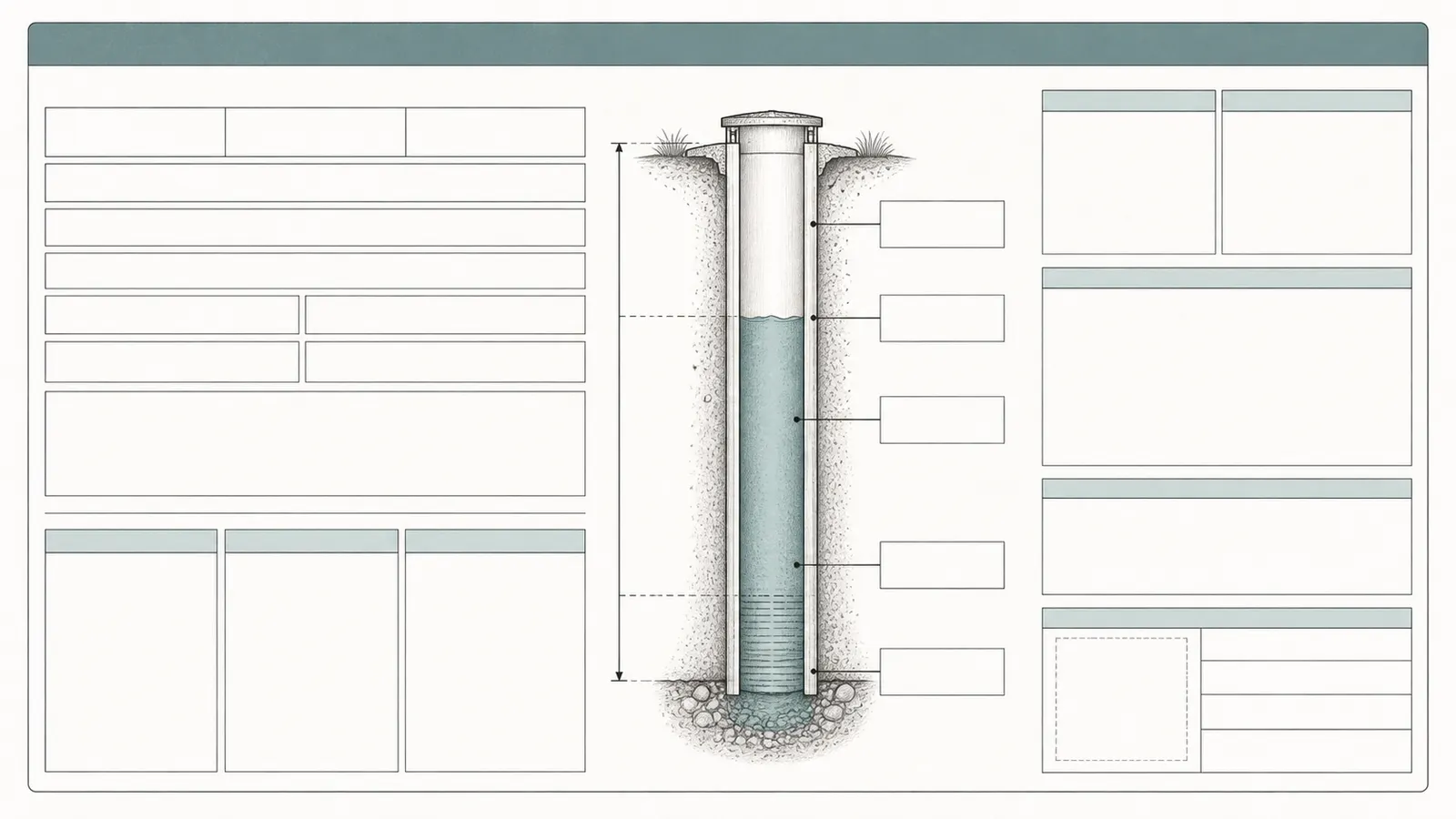
Gallons per foot = 0.0408 × (__________ in)² = __________ gal/ft

Total water column = __________ ft − __________ ft = __________ ft
Total standing storage = __________ gal/ft × __________ ft = __________ gal

Potentially usable column = __________ ft − __________ ft = __________ ft
Potentially usable storage = __________ gal/ft × __________ ft = __________ gal
Before filing it, write one sentence under “assumptions”: for example, “Uniform 6-inch inside diameter assumed because the record gives only nominal casing size.” If you cannot state the assumption plainly, the calculation is not ready to guide a pump or storage decision.
The durable answer to “how many gallons are in my well?” is therefore two numbers with labels: total standing casing storage and potentially usable storage above a documented lower operating limit. Keep both beside the yield, recovery, demand, and water-quality records. That makes the estimate useful without asking it to prove something it cannot.
Sources and scope
Evidence behind this page
- Estimating Private Well Yields using DEM’s Well
Massachusetts Department of Environmental Management guidance; the 1.5-gallon-per-foot value is specific to the stated typical 6-inch diameter example, not a universal value for every well.
- Subtitle D Technical Training Manual, Groundwater Monitoring
U.S. EPA technical training material for groundwater monitoring; the article uses the equivalent 0.0408 rounded relationship for a homeowner estimate and explains that nonuniform geometry requires segmentation or professional review.
- Water System Planning: Estimating Water Needs
Penn State Extension homeowner and farm water-system planning guidance; yield definitions and suggested flow rates are planning guidance, not a site-specific pump-test result.
- Water System Planning: Estimating Water Needs
Penn State Extension guidance; the 6-inch figure and household-use examples are approximate planning values and should not be treated as a guarantee for a particular aquifer or season.
- Best Management Practices for Private Drinking Water Systems
Alaska Department of Environmental Conservation voluntary private-system guidance; it is not a nationwide regulation and its residential demand examples are planning guidance.
- Private Well Guidelines
Massachusetts private-well planning example; the article presents this as a screening calculation, not a guarantee of pressure, recovery, water quality, or code compliance.
- Groundwater Level and Well Depth Measurement
U.S. EPA page linking the Region 4 FSBPROC-105-R6 operating procedure effective April 17, 2025; it describes field-investigator procedures and is not a homeowner license or universal local access rule.
- Private Well Owner FAQ
New Jersey Department of Environmental Protection FAQ; the licensing and buried-well statements are New Jersey-specific, while the article uses the access and equipment cautions as conservative safety guidance rather than a national legal rule.
- Well Construction, National Ground Water Association Well Owner Guide
National Ground Water Association homeowner education; construction details vary by well type, geology, state, and local requirements.