Can You Replace a Well Pressure-Tank Bladder? Use the Model, Failure, and Safety Gates
A source-linked homeowner decision surface for separating replaceable air-cell tanks, sealed diaphragm tanks, unsafe shells, and correctly matched whole-tank replacements.
The short answer
Sometimes. Replace the bladder or air cell only when the exact labeled tank design has a manufacturer service part, the failure is confirmed, and the shell passes a professional integrity inspection. Water at the air valve can confirm a barrier failure on some models, but lost precharge or a leaking valve core can mimic trouble. If the model, part, shell condition, pressure class, or drawdown match is unknown, quote a correctly specified whole-tank replacement instead.Observation flow
What is the system doing?
Choose the closest visible pattern. Stop immediately for sparking, hot wiring, uncontrolled pressure, or a damaged tank.
Can You Replace a Bladder in a Well Pressure Tank?
Sometimes—but “water at the Schrader valve” is not a universal instruction to replace the whole tank, and it is not a safe invitation to open the tank yourself.
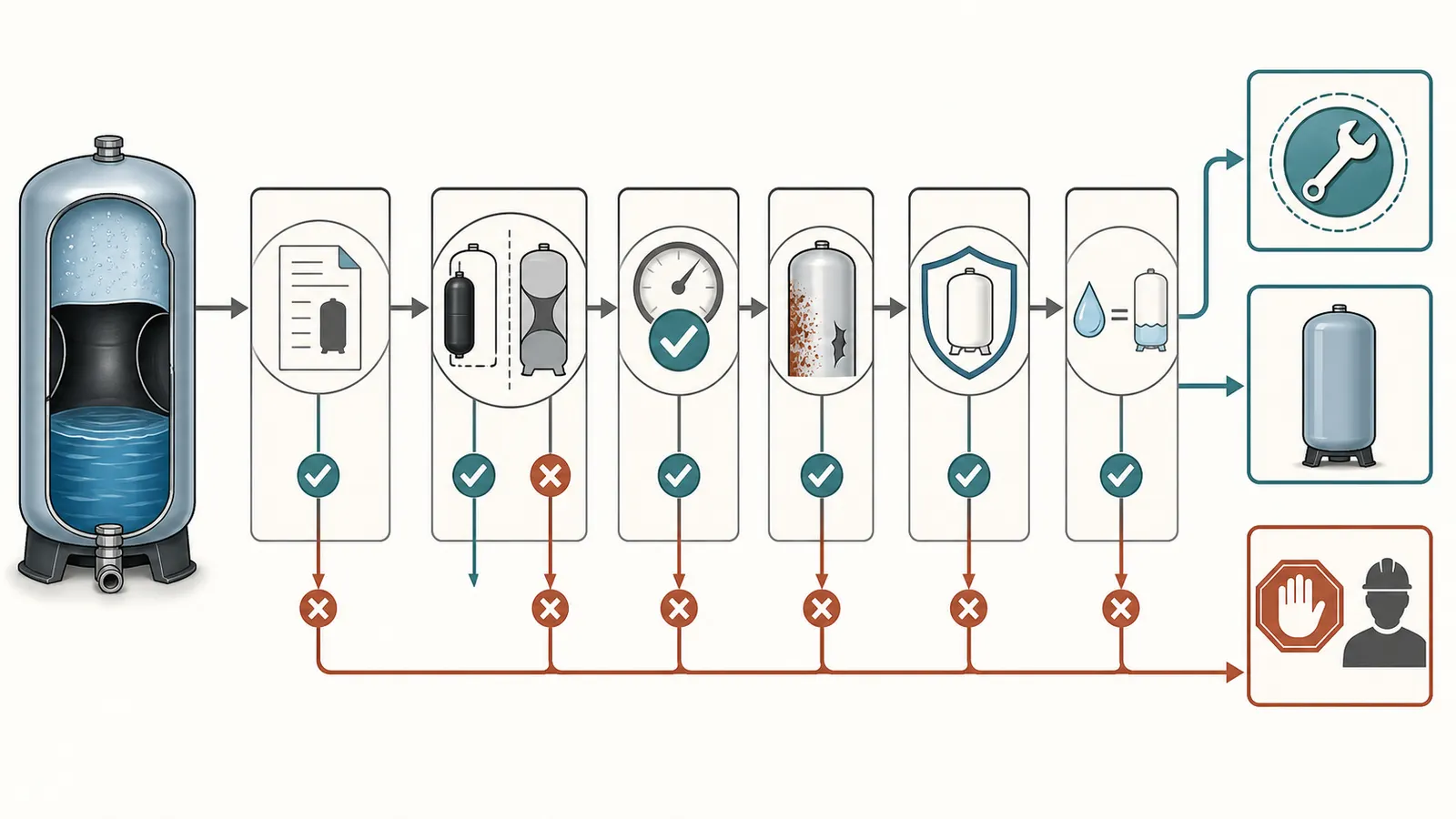
The defensible decision has four gates:
- The labeled design is serviceable. The exact model has a manufacturer-documented replaceable air cell or bladder and a current, matching part.
- The failure is real. A leaking valve core, lost precharge, waterlogging, a pump or pressure-switch problem, and a failed bladder can look similar from the faucet.
- The shell is safe to service. Corrosion, blisters, damaged fittings, an unknown pressure rating, or a tank that has been over-pressurized can end the bladder-repair path.
- The replacement preserves system performance. A whole-tank replacement must match the pressure class, connection, physical fit, and required usable drawdown—not just the old tank’s outside dimensions or total gallon label.
The homeowner’s job is to preserve the evidence trail: photograph the label, record the symptom, document what a qualified professional actually tested, and compare the proposed part or tank against the exact manual. Pressure release, valve-core removal, draining, disconnection, lifting, inversion, flange removal, precharge adjustment, energized controls, and electrical or well work belong to a qualified professional.
1. The answer is conditional: water at the air valve is a clue, not a universal diagnosis
There are three different questions hidden inside “Can I replace the bladder?”
- Is the barrier actually damaged?
- Does this model let a technician replace the barrier?
- Is the tank shell still safe and economically sensible to service?
Those questions must stay separate. A tank can have a low air charge without a failed bladder. A valve core can leak air. A tank can show very little usable water because the air charge is wrong, because the system is short-cycling for another reason, or because the barrier has failed. And a tank can have a documented replacement bladder while its shell or fittings are no longer fit to put back into service.
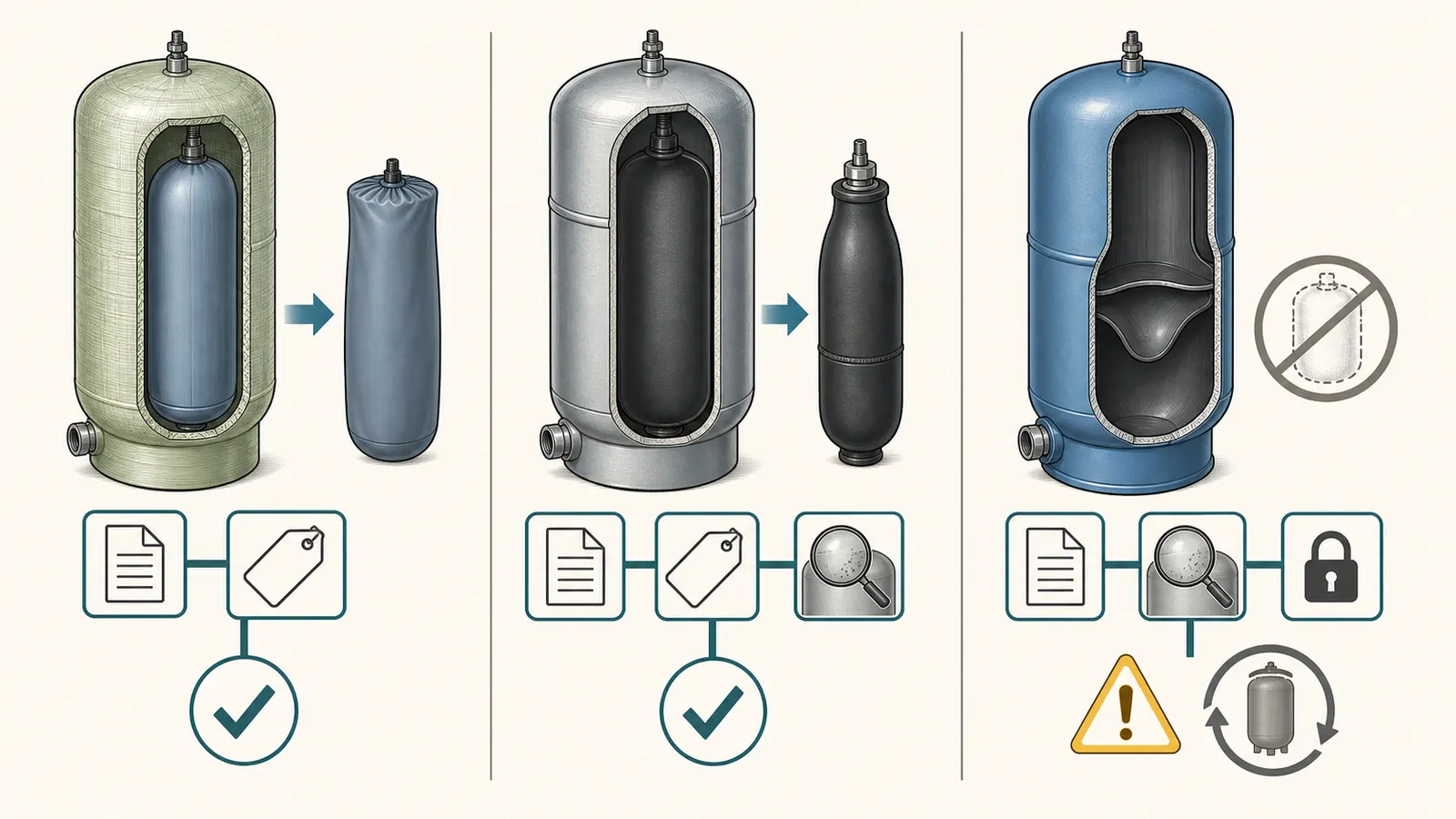
The manufacturer evidence does not support one universal answer. Amtrol’s Well-X-Trol product information distinguishes diaphragm designs from full-acceptance and partial-acceptance bladder designs, and specifically describes the two bladder groups as having replaceable bladders. That is a real model-family boundary, not permission to infer serviceability from the word “bladder” on a retailer page. Read the Amtrol Well-X-Trol product specifications against the label on the tank in front of you.
Pentair gives a second, more explicit example. Its WellMate FAQ says the air cell can be replaced, but the tank must be removed from the system and disassembled, with instructions supplied with the new installation kit. Pentair’s current parts listing then maps air-cell kits to particular model numbers such as WM-4, WM-6, WM-9, WM-12, WM-14WB, WM-20WB, WM-23, WM-25WB, WM-35WB, WM-6LP, and WM-10LP. See the WellMate FAQ and the WellMate replacement-parts listing. The model-to-part match is the evidence; the tank’s color, shape, or a similar-looking kit is not.
The Sta-Rite Pro-Source steel-tank manual is a third example. It includes a bladder-leakage test and a bladder-replacement procedure for the Pro-Source family. That does not turn every steel pressure tank into a serviceable tank. It tells you that a specific manual can define both a diagnostic path and a replacement path. Use the Pro-Source owner’s manual only when the tank label and manual actually match.
The first decision
Use this stopping rule before comparing prices:
| What is known | Decision boundary | Next action |
|---|---|---|
| Exact model has a manufacturer service procedure and an available matching bladder or air-cell part | Potentially serviceable | Obtain a qualified inspection and service quote; do not assume the shell passes |
| Exact model is a diaphragm design, or no manufacturer service part/procedure can be verified | Treat as non-serviceable for planning | Compare a model-matched whole-tank replacement |
| Water at the air valve is reported, but the test method and model are unknown | Failure evidence incomplete | Ask a professional to document the exact model-specific test and shell condition |
| Corrosion, damage, leaking fittings, unknown rating, or pressure exposure is present | Safety stop | Do not recharge or open the tank; obtain a professional replacement assessment |
| Replacement tank has lower or unknown usable drawdown, pressure rating, or connection compatibility | Replacement not specified | Request a corrected model and written comparison |
The phrase potentially serviceable matters. It means the paperwork opens a repair path; it does not mean the repair is approved.
2. Read the model label before choosing a repair path
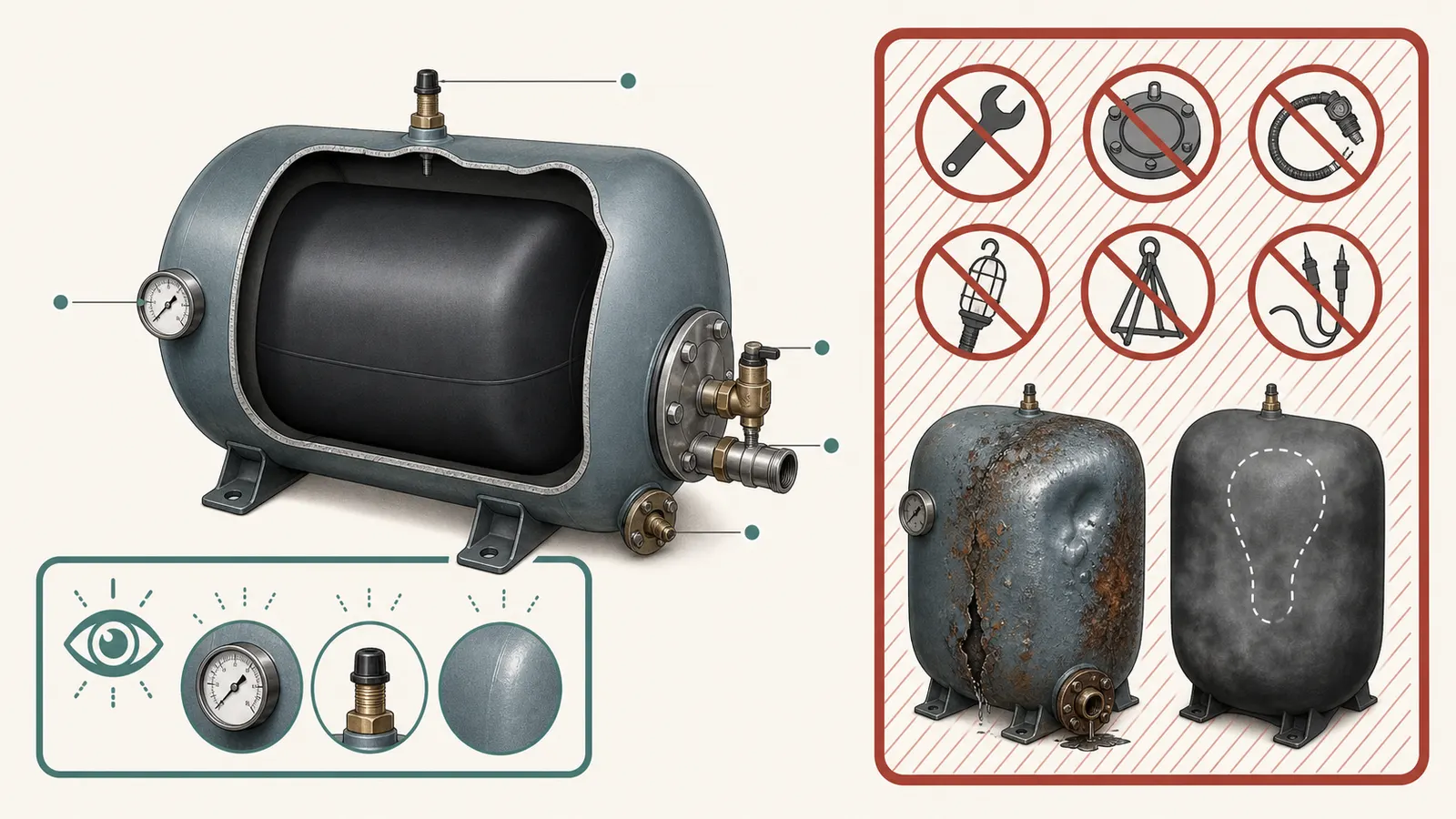
The tank label is the most valuable low-risk observation you can make. Photograph it square-on in good light. Record the manufacturer, complete model number, serial number, date or code if present, maximum working pressure, connection size, and any design description such as air cell, bladder, diaphragm, captive air, or precharged tank. Also photograph the pressure gauge, pressure switch label, tank tee, relief valve, visible air valve, and the full tank so a professional can see the installation context.
Do not treat a brand name alone as the model. A manufacturer may sell several tank constructions under one product family. Amtrol’s page, for example, lists diaphragm models separately from full- and partial-acceptance bladder models. Pentair’s WellMate parts page further separates original captive-air accessories from Classic and Classic QC air-cell replacement kits. The part list itself is evidence that the model suffix and family matter.
Use the label to make a four-line identification record:
| Evidence field | Record exactly | Why it changes the decision |
|---|---|---|
| Manufacturer and full model | __________________ | Determines which manual and parts catalog apply |
| Serial/date code | __________________ | Helps identify revisions, warranty, and age |
| Design wording | __________________ | Separates documented air-cell, bladder, diaphragm, or other construction |
| Maximum working pressure | __________________ | Sets a hard compatibility and safety limit |
Then locate the manufacturer’s current manual or support page. Look specifically for these words: replacement bladder, replacement air cell, service kit, tank disassembly, maximum working pressure, precharge, pressure-switch cut-in, drawdown, and inspection. A search result snippet or a retailer listing is not enough. The service part must be matched to the exact model, and the service document must describe the actual construction.
Pentair’s WellMate page is a useful example of what “good evidence” looks like: it names individual model mappings and says the Classic and Classic QC air-cell kits include the air cell, washers, O-rings, and instructions. That supports a parts-verification step for those named WellMate families. It does not support buying a generic bladder because the tank has a top valve.
Amtrol’s replacement-bladder document illustrates another important distinction: a service instruction may exist for a particular WX series, but the instruction also includes pressure, lifting, flange, gasket, torque, and corrosion warnings. A part number without the complete installation and safety procedure is not a complete repair scope.
How to classify the tank without opening it
You can classify the planning branch from documentation and external observations:
- Documented replaceable air cell: the manufacturer names an air-cell kit for the exact model or an exact model cross-reference. Pentair’s WellMate FAQ and parts list provide this kind of evidence.
- Documented replaceable bladder: the manufacturer names a replacement bladder and gives a model-specific service procedure. Amtrol’s WX instructions and the Pro-Source manual provide examples.
- Diaphragm design without a service procedure: treat the tank as a whole-tank replacement for planning. This is a conservative evidence boundary, not a claim that no diaphragm in the world can ever be serviced.
- Unknown or unreadable design: stop at identification. Do not let a contractor quote “bladder replacement” without naming the model, part, and procedure.
The label also anchors the pressure comparison. Pentair says WellMate operating pressure varies with size and application. Amtrol says maximum working pressure varies by model. Never substitute a pressure number from a different size, a different series, or a different manufacturer.
3. Confirm the actual failure without confusing the look-alikes
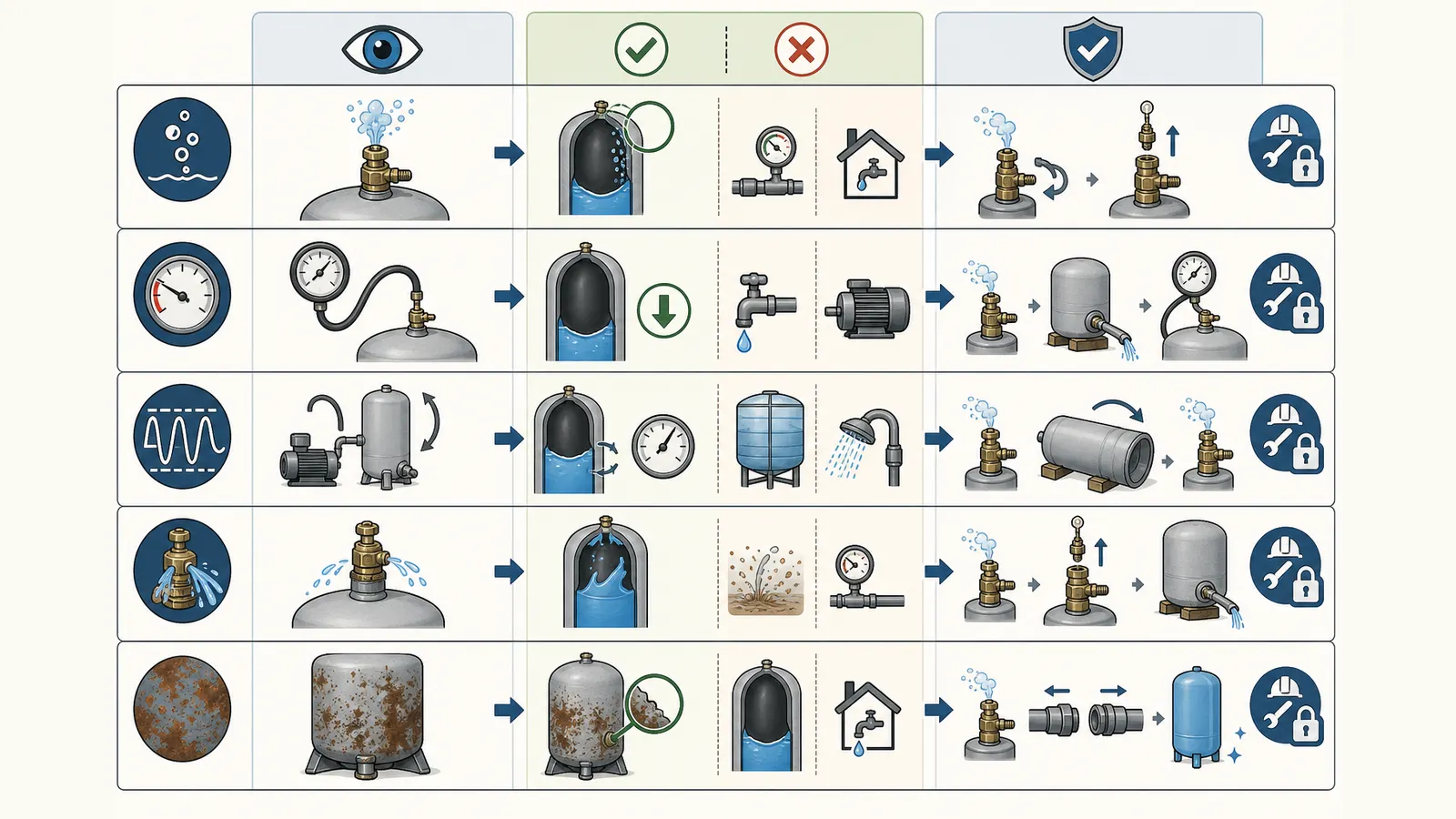
The symptom “the tank is waterlogged” is a starting observation, not a component diagnosis. The safe homeowner record should separate what was seen from what was concluded.
| Observation or test result | What it can support | What it does not prove | Safest next step |
|---|---|---|---|
| Continuous bubbles around the air valve during the applicable test | Air escaping at the valve; a leaking core may be involved | A failed bladder | Have a professional verify the valve/core and tank condition using the exact manual |
| Low precharge after the tank is safely drained and checked | Lost air, leaking core, or another precharge problem | A torn bladder | Document the measured value, switch cut-in, and whether the charge holds over time |
| Pump cycles rapidly or usable water between cycles is much lower | Low drawdown, waterlogging, system leak, pressure-control issue, or barrier problem | Which part failed | Have the professional separate tank, plumbing, pump, and pressure-switch causes |
| Water exits the air valve during a model-specific leak test | Barrier failure on a tank whose manual says that result indicates a leaking bladder | That the shell is safe or the tank is serviceable | Stop DIY testing; request a written repair-versus-replace assessment |
| Water at the air valve on an unknown model | A potentially serious barrier problem | A universal diagnosis or a safe repair path | Do not depress the valve core; provide the photo and label to a professional |
| Visible rust, blistering, denting, leakage, or damaged fittings | A shell or connection safety concern | Whether a new bladder would restore safe service | Treat as a safety stop and quote a replacement assessment |
A leaking valve core is not the same as a failed bladder
The Pro-Source manual provides a useful separation. In its air-charge procedure, it says to use soap or liquid detergent around the air valve and that continuous bubbling indicates an air leak; it says a new valve core may be needed. That is a valve-side failure path. The same manual separately describes a bladder-leakage test in which water runs out of the air valve after a much more invasive sequence. Read the Pro-Source manual’s air-charge and bladder-test sections as two different branches.
For a homeowner, the practical interpretation is:
- Bubbles at the valve: do not call the bladder failed. A valve core or valve-seat leak may be enough to lose air.
- Low air charge: do not call the bladder failed. The pressure may have escaped through the valve, a fitting, or another leak.
- Air charge that drops again: stronger evidence that the system is not holding air, but the exact source still needs professional confirmation.
- Water from the air valve during the correct model-specific test: strong evidence of barrier failure on that model, but the tank’s shell and serviceability remain separate questions.
The difference between “water at the valve” and “water from the valve during the documented test” is deliberate. A homeowner may report water from a valve after someone has pressed the core, after the tank has not been isolated, or after an unsafe test. The professional needs to know what was done, whether the tank was drained, whether the power was disconnected, and whether the result belongs to the exact manual.
Precharge numbers are not universal
Two manufacturer documents reviewed here use different values for different product families. Pentair’s WellMate FAQ says the air cell should be 4 psi below pump cut-in after power is off and the tank is drained. The Pro-Source manual says its steel tanks are set 2 psi below pump cut-in with no water in the tank. Amtrol’s WX replacement-bladder instruction also uses 2 psi below cut-in for that product’s service procedure. These numbers must stay attached to their source and model.
University of Nebraska–Lincoln Extension gives the broader homeowner context: it says the correct drained-tank pressure is found from the system information, commonly 2 psi below pump start in its example, and cautions that some manufacturers void the warranty if anyone other than a licensed professional removes the valve cap. See the Nebraska Extension private-well maintenance guide. That is why this worksheet records the manufacturer, model, switch settings, and professional method instead of publishing one “correct” Schrader reading for every tank.
4. Apply the shell-safety stop before talking about savings
A replaceable bladder is an internal component. The tank shell is the pressure vessel that contains the system. Replacing an internal barrier does not repair corrosion, a cracked fitting, a damaged flange, an over-pressure event, a weakened support, or an unknown maximum working pressure.
Amtrol’s replacement-bladder instructions are explicit about this boundary. They warn that a pressure product may corrode, weaken, burst, or explode, require installation by a licensed professional, direct the reader to call a licensed professional if the product shows corrosion or malfunction, and warn against adjusting precharge when the tank’s integrity and lack of internal or external corrosion have not been confirmed. The Amtrol service instruction also requires pressure to remain within the tank’s maximum working pressure.
That warning changes how to interpret an attractive service quote. “We can replace the bladder” is incomplete unless the scope says how the professional will evaluate:
- exterior shell corrosion, rust blisters, pitting, dents, bulges, or deformation;
- the tank bottom, feet, supports, and lifting points;
- the system connection, flange, drain plug, air valve, and threaded fittings;
- evidence of leakage, freezing, chemical exposure, or previous over-pressure;
- maximum working pressure compared with the actual pressure-switch cut-out and relief protection;
- space, access, lifting, and the risk of water release during service;
- the condition of the interior if the exact manual requires internal inspection.
The homeowner can record visible exterior condition and photograph suspicious areas. Do not scrape corrosion, remove paint, probe a blister, loosen a fitting, or add air to investigate. A tank may look acceptable from the front while a bottom seam, hidden fitting, or internal surface remains unknown.
The Pro-Source manual gives a second safety anchor: it says system pressure must be below 100 psi under any circumstances for that product and calls for a relief valve capable of passing the full pump volume at 100 psi if system discharge pressure can exceed that value. This is a Pro-Source instruction, not a national pressure rule. It shows why the maximum pressure printed on the exact tank and the actual pump-control settings must be part of the quote review.
Immediate stop conditions
Stop the bladder-service path and ask for a whole-tank or system-safety assessment when any of these is true:
- the model cannot be read or the replacement part cannot be matched;
- the manufacturer manual says whole-tank replacement or gives no service procedure;
- the shell has visible corrosion, rust blisters, pitting, deformation, or unexplained wetness;
- the tank or fitting has been exposed to pressure above its rating or the rating is unknown;
- the pressure relief valve is missing, inaccessible, corroded, or of unknown specification;
- the service requires lifting or inverting a large tank without a documented professional plan;
- the tank is in a location where a leak could damage finished space or lower floors;
- the system cannot be isolated and depressurized by a qualified person;
- a contractor proposes to recharge a corroded or damaged tank “just to see if it holds.”
The final condition is especially important. A pressure vessel is not a test object for a casual air-charge experiment.
5. Compare bladder or air-cell service with a whole-tank replacement
The decision should be made from scope and evidence, not from the phrase “repair costs less.” A bladder service quote may avoid disposal and preserve an existing tank footprint, connection, and pressure-system arrangement. It may also involve disassembly, water removal, new gaskets or O-rings, internal cleaning, lifting or inversion, reassembly, professional precharge, leak testing, and commissioning. A whole-tank replacement may be simpler to specify, but only if the replacement is correctly matched and the installation scope includes the associated fittings, support, isolation, relief protection, and pressure settings.
| Decision factor | Bladder or air-cell service | Whole-tank replacement |
|---|---|---|
| Model evidence | Exact service procedure and matching part required | Exact replacement model and data sheet required |
| Shell condition | Existing shell must pass professional inspection | New shell still needs the correct pressure class and installation support |
| Failure evidence | Barrier failure must be confirmed; valve-core and precharge faults may be repairable without bladder replacement | Appropriate when failure is uncertain, the design is sealed, or shell integrity is doubtful |
| Work scope | Isolate, drain, depressurize, disassemble, remove barrier, clean/inspect, install seals, reassemble, recharge, test | Isolate, drain, disconnect, remove, install, connect, recharge or commission, and verify operation |
| Pressure compatibility | Existing tank must remain within rating and pressure settings | New tank maximum working pressure must suit the system and relief protection |
| Drawdown | Existing usable storage is preserved only if service restores correct operation | New usable drawdown must equal or exceed the system requirement or documented old drawdown |
| Risk of hidden condition | Existing corrosion or damaged fittings can change the result after disassembly | New shell reduces old-shell risk, but old piping, controls, pump, and fittings remain to be reviewed |
| Documentation to demand | Part number, service manual, shell findings, gasket plan, test result | Model, pressure rating, drawdown, connection, footprint, precharge basis, and commissioning result |
When service is a rational option
A service quote is worth considering when all of the following are documented:
- The label matches a manufacturer service procedure.
- The part number is listed for the exact model or an official cross-reference confirms it.
- The part is currently available from a traceable source, with the correct gasket, O-rings, washers, or seals included or separately specified.
- A qualified professional has inspected the shell, fittings, supports, and pressure protection.
- The tank’s maximum working pressure exceeds the actual operating requirement with the manufacturer’s required margin.
- The repair scope includes safe isolation, pressure release, reassembly, correct precharge, leak testing, and a system-cycle check.
- The total scope makes sense against the age, condition, accessibility, and remaining support for the tank family.
The seventh item is not a made-up service-life cutoff. It is a decision question: if the work will require the same mobilization, disconnection, and recommissioning as a replacement, ask whether preserving the old shell materially improves the outcome. No universal age number answers that for every tank.
When a whole-tank replacement is the cleaner decision
Choose the replacement path for planning when the exact tank is a sealed diaphragm design without a documented service part, the part is discontinued or uncertain, the shell has corrosion or damage, the tank rating cannot be verified, the service procedure is unavailable, or the professional cannot establish that the old vessel will remain safe after opening.
Do not let “whole tank” become “any tank of the same gallons.” The replacement must be specified against the system fields in the next section.
6. Match drawdown, pressure, and physical fit—not just total gallons
Pressure tanks are not chosen by total tank volume alone. The homeowner needs to preserve the usable water delivered between pump cycles, often called drawdown, and keep the tank within the pressure system’s operating range.
Nebraska Extension states that a replacement tank should have storage volume equal to or greater than the old tank’s usable storage, and specifically distinguishes usable storage from total tank volume. Its table gives an example: a 30-gallon galvanized tank operating at 20–40 psi has 5.1 gallons of usable water storage, and the example replacement options include a 14-gallon diaphragm or bladder tank or a 14-gallon precharged steel tank with wafer. It also says to choose the next larger size if household demand has increased or the pressure-switch setting must increase. Read the Nebraska Extension table and replacement example as an illustration, not a universal conversion chart.
The Pro-Source manual reinforces the point by publishing model-specific drawdown values for 20–40, 30–50, and 40–60 psi settings. The same tank family can yield different gallons per pump cycle when the pressure band changes. See the Pro-Source drawdown table.
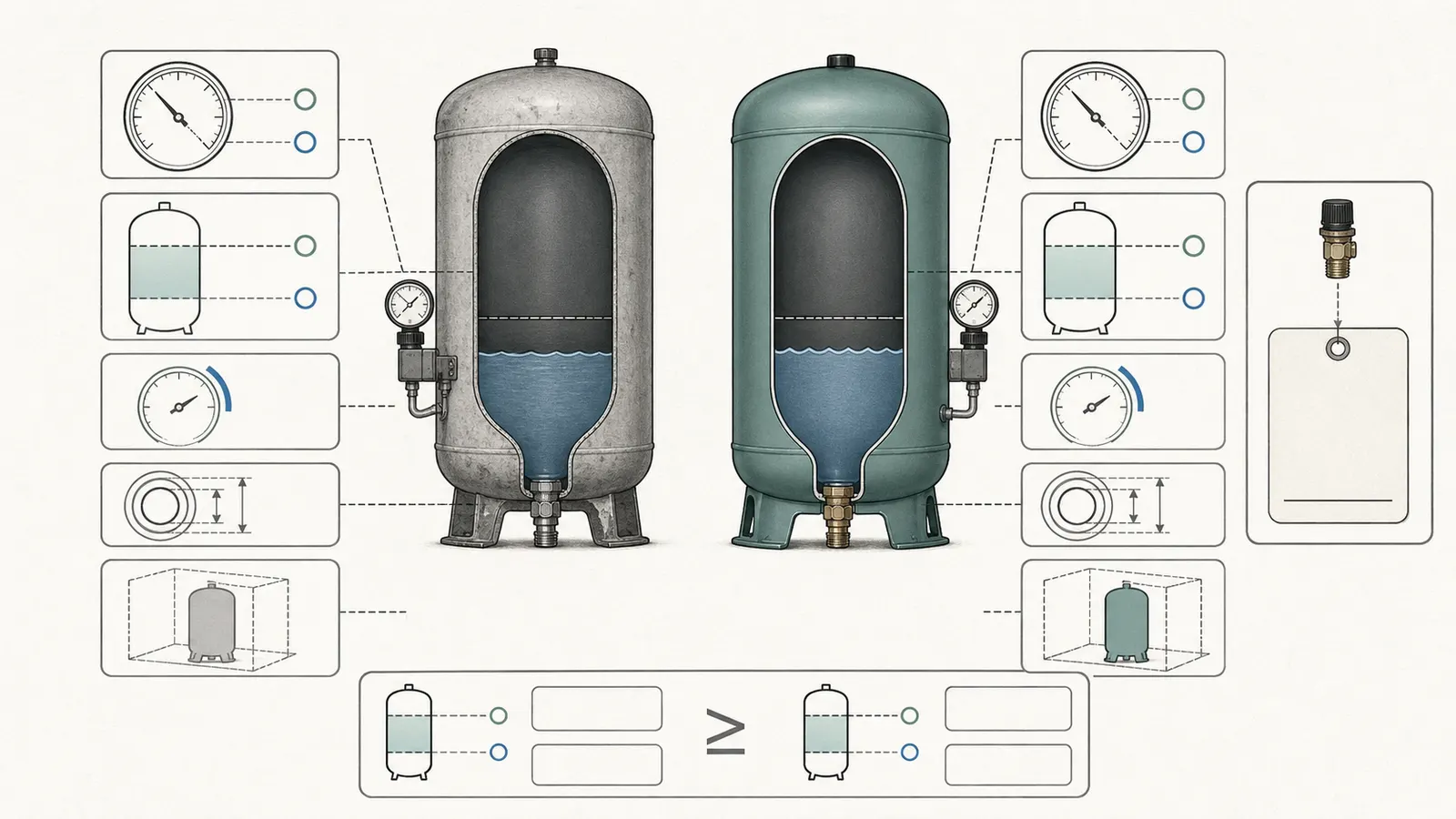
Replacement comparison worksheet
Ask the professional to complete both columns. If a field is blank, the replacement is not yet specified.
| Compatibility field | Existing tank | Proposed tank |
|---|---|---|
| Manufacturer and full model | __________________ | __________________ |
| Design: air cell, bladder, diaphragm, other | __________________ | __________________ |
| Total tank volume | __________________ | __________________ |
| Published usable drawdown at this pressure band | __________________ | __________________ |
| Actual pressure-switch cut-in | __________________ | __________________ |
| Actual pressure-switch cut-out | __________________ | __________________ |
| Manufacturer precharge instruction | __________________ | __________________ |
| Maximum working pressure | __________________ | __________________ |
| System pressure-relief protection | __________________ | __________________ |
| Water connection size and orientation | __________________ | __________________ |
| Tank diameter, height, base, and support | __________________ | __________________ |
| Required isolation and service access | __________________ | __________________ |
| Professional commissioning result | __________________ | __________________ |
A simple planning comparison is:
Proposed usable drawdown ≥ documented existing usable drawdown or the system’s required drawdown.
That inequality is a screening rule, not a substitute for a manufacturer table or a professional system calculation. If you know the system needs more water between pump starts because of household demand, irrigation, or a changed pressure band, the old tank’s drawdown may be only a minimum—not the target.
The pressure class is a separate gate. A tank that physically fits but has a lower maximum working pressure than the system is not an equivalent replacement. A tank with a higher rating may still be wrong if its connection, precharge range, drawdown table, support, or manufacturer application differs.
The pump and controls also remain in scope. A new tank cannot cure a failing pump, a leaking check valve, a defective pressure switch, a blocked fitting, or a house-side leak. If the reason for replacement is rapid cycling, ask the professional to document what was observed before and after service: pump starts, pump stops, pressure-gauge behavior, usable water between cycles, and whether the system reaches its intended cut-out.
7. Turn the evidence into a quote decision
The useful deliverable is not a generic “replace or repair” opinion. It is a documented choice that another professional can audit.
What to photograph and record before the visit
- Full tank label, including every model suffix and pressure marking.
- Tank, gauge, pressure switch, tank tee, relief valve, air valve, and surrounding piping.
- Any water at or around the air valve, without depressing the valve core.
- Visible corrosion, rust blisters, dents, wet fittings, staining, or support damage.
- Gauge reading during normal service, if readable and stable enough to record without touching controls.
- Symptoms: short cycling, low usable water, sputtering, low pressure, leakage, or inability to reach normal shutoff pressure.
- Date and time of the symptom, recent pump or plumbing work, freezing, flooding, or power event.
- Access constraints: tight closet, crawl space, stairs, finished flooring, or potential water-damage exposure.
Do not open the pressure-switch cover to read settings. If the cut-in or cut-out is not already documented, ask the professional to record it safely. Do not remove the air-valve cap or press the core just to see what happens. Nebraska Extension specifically notes that some manufacturers void the warranty if anyone other than a licensed professional removes the valve cap, and the manufacturer instructions reviewed here require controlled draining and pressure-release sequences.
Questions that make a bladder-service quote complete
Ask the bidder to answer in writing:
- What exact manufacturer, model, and design did you identify?
- What manufacturer document says the air cell or bladder is replaceable?
- What exact part number will be installed, and how was it matched?
- Is the part current and available, and are the required seals included?
- What failure evidence supports the repair? Is it a leaking core, lost precharge, waterlogging, or a documented barrier failure?
- What shell, flange, drain, fitting, and support inspection will be performed before reassembly?
- What condition would make you stop and recommend a new tank?
- What maximum working pressure and pressure-switch settings apply?
- What precharge will be used, and which exact manual supports it?
- How will the tank be isolated, depressurized, lifted, reassembled, leak-tested, and commissioned?
- What usable drawdown should the repaired tank provide at the current pressure band?
- What other component could be causing the original symptom if the barrier is not failed?
Questions that make a whole-tank quote equivalent
Ask for:
- exact proposed manufacturer and model;
- published usable drawdown at the actual pressure-switch range;
- maximum working pressure and relief-protection compatibility;
- connection size, orientation, tank height, diameter, base, and service access;
- precharge basis from the exact manual;
- new or reused tank tee, gauge, relief valve, isolation valve, fittings, and supports;
- disposal and water-containment plan;
- startup and cycle test;
- written record of the old symptom, final pressure readings, and any remaining issue.
Final decision matrix
| Evidence record | Choose | Scope to approve |
|---|---|---|
| Exact replaceable design, matching part verified, barrier failure documented, shell and fittings pass professional inspection | Qualified bladder or air-cell service | Model-specific part, seals, controlled disassembly, integrity stop criteria, precharge, leak test, and commissioning |
| Exact replaceable design, but failure is only low precharge or valve bubbling | Repair diagnosis first | Valve/core and air-retention diagnosis before ordering an internal barrier |
| Diaphragm or other design with no documented service part | Whole-tank replacement | Model-matched pressure class, drawdown, connection, footprint, and commissioning |
| Any design with corrosion, damaged shell, damaged flange, unknown rating, or over-pressure concern | Safety stop and replacement assessment | No recharge or disassembly until a qualified professional evaluates the vessel |
| Existing tank and proposed tank have unknown or lower drawdown | Hold the replacement quote | Add the pressure band, model table, and usable-storage comparison |
| Symptom persists after a documented tank service or replacement | System diagnosis | Check pump, pressure switch, check valve, house-side leak, gauge, and controls through qualified service |
The right answer may be “replace the tank,” but the evidence should explain why. It may also be “service the air cell,” but only when the exact tank, exact part, exact failure, and shell condition support that narrower scope.
8. Homeowner safety boundary and professional handoff
This is a high-safety pressure-vessel decision. Safe homeowner work is observation, labeling, photography, and recordkeeping. You can read an accessible label, note visible corrosion, photograph the piping, record a gauge reading that is already visible, and describe when the pump cycles or water pressure changes. Keep hands off the air valve, fittings, tank tee, relief valve, pressure switch, and electrical controls unless the exact manual clearly assigns a harmless observation and the professional has confirmed the system is safe.
Do not open energized controls, test live wiring, remove a pressure-switch cover, disconnect pump wiring, open the well, pull a pump, enter a crawl space or confined tank area, loosen pressurized fittings, depress the Schrader core, remove a valve core, drain or invert the tank, remove a flange, lift a tank, add air or nitrogen, or recharge a tank with corrosion or unknown integrity. Do not assume that switching a bypass, closing one valve, or turning off a visible switch has made the whole system safe. Electrical isolation, pressure release, well and pump work, internal tank service, and code-sensitive plumbing belong to a qualified professional. Requirements for well work, plumbing, electrical work, permits, inspections, and licensing vary by state and local authority. Before approving a quote, verify the applicable authority-having-jurisdiction (AHJ) requirements and the contractor's qualifications for this work. The Nebraska Extension reference to a licensed professional is Nebraska-specific educational guidance—not a nationwide licensing rule—and does not replace the exact manufacturer requirements or local law.
If there is an active leak, a tank that is moving or bulging, a damaged pressure relief valve, an electrical odor, exposed or wet wiring, uncontrolled pump cycling, or water damage, stop the investigation. Use only an existing, clearly identified emergency shutoff when you can do so without opening equipment or entering a hazardous area, and call qualified service.
Drinking-water safety is a separate handoff
A remote review can help organize tank evidence; it cannot establish that the water is safe to drink. If the potable system is opened, flooded, exposed to chemicals, or the water changes in appearance, taste, or odor after the event, treat drinking-water safety as unresolved. Use an alternate safe source for drinking, cooking, and ice while a qualified well-water professional and/or the local health authority tells you what sanitation and/or testing procedure applies. Follow the applicable manufacturer and health-authority procedure; do not infer a universal bleach dose, contact time, flushing rule, or “safe after one clear sample” rule from this page.
The Sta-Rite Pro-Source manual says to test well water for purity before using it and to check the local health department for the testing procedure. That instruction is a useful contamination boundary for this decision tool, but it does not certify every well or prescribe one sanitation method for every tank, event, or jurisdiction.
Bring this handoff record
Tank manufacturer: ______________________________________________
Full model and serial: __________________________________________
Design wording on label: ________________________________________
Maximum working pressure: ______________________________________

Observed symptom and date/time: _________________________________
Gauge reading(s) observed without touching controls: ______________
Pump cycling or low-drawdown observation: ________________________
Water reported at air valve?  yes / no / unknown
What action was taken at the valve? ______________________________

Visible shell or fitting condition: ______________________________
Pressure-switch cut-in / cut-out, if professionally recorded: _____
Manufacturer test or service document used: ______________________
Failure evidence documented by professional: _____________________
Matching service part and source, if applicable: _________________


Existing usable drawdown: _______________________________________
Proposed usable drawdown: ______________________________________
Existing / proposed pressure class: ______________________________
Connection and physical-fit comparison complete?  yes / no

Decision:  service air cell/bladder / replace whole tank / stop
Professional findings and conditions: ____________________________
Final commissioning or cycle test: _______________________________
The decision boundary is now clear: replace the air cell or bladder only when the exact model supports it, the failure is confirmed by the model-appropriate procedure, and the shell is professionally cleared. Choose a whole-tank replacement when the design is sealed, the part cannot be verified, the shell is unsafe or unknown, or the replacement can be specified more reliably. In either path, preserve equivalent or greater usable drawdown and an equal-or-better pressure fit.
Water at the Schrader valve can be valuable evidence, but it is not the whole answer. The model label, failure method, shell condition, pressure rating, service part, drawdown, and final test are what turn a costly guess into a defensible homeowner decision.
Sources and scope
Evidence behind this page
- Amtrol — Well-X-Trol Pressure Tanks
Amtrol's Well-X-Trol product-family page. It supports a design distinction and model-family verification, not a universal rule that every diaphragm or bladder tank is serviceable or non-serviceable.
- Pentair — WellMate FAQs
Pentair's WellMate FAQ for its pressure-vessel product family. It does not authorize a homeowner to disassemble a pressurized tank or establish serviceability for another manufacturer.
- Pentair — WellMate Tank Accessories and Replacement Parts
Pentair's published WellMate parts listing. A listed family mapping is evidence to verify the exact label and current part availability, not permission to substitute a visually similar kit.
- Pentair — WellMate FAQs
Pentair WellMate guidance. The 4-psi value is specific to the cited WellMate FAQ and must not be generalized to other tank families. The required power isolation and draining are service actions for a qualified professional in this high-safety context.
- Amtrol — Well-X-Trol WX Series Replacement Bladder Instructions
Amtrol's WX Series replacement-bladder instructions. The safety warning applies to the product covered by that document and is used here to set a conservative professional-service boundary for pressurized tanks.
- Amtrol — Well-X-Trol WX Series Replacement Bladder Instructions
Amtrol WX Series service instructions. The 2-psi setting is not a universal value for every pressure tank; the exact manual and switch setting govern.
- Sta-Rite — Pro-Source Steel Pressure Tanks Owner's Manual
The cited Pro-Source steel-tank manual. Its diagnostic sequence and valve-core language are model-family instructions, not a license to remove a valve core or release pressure on an unknown tank.
- Sta-Rite — Pro-Source Steel Pressure Tanks Owner's Manual
A model-specific Pro-Source steel-tank test and service procedure. The observation is not a universal homeowner test, and the required pressure release, disconnection, lifting or inversion, and replacement work belong to a qualified professional.
- Sta-Rite — Pro-Source Steel Pressure Tanks Owner's Manual
The cited Pro-Source manual. The 2-psi relationship is a model-family instruction and does not prove that low precharge alone means the bladder has failed.
- Sta-Rite — Pro-Source Steel Pressure Tanks Owner's Manual
The manual's general safety instruction for the Pro-Source product family. It supports a professional and local-health-authority testing handoff; it does not establish a universal sanitation method, testing schedule, or drinking-water certification for other systems.
- University of Nebraska–Lincoln Extension — Private Drinking Water Wells: Operation and Maintenance
Nebraska Extension educational guidance for private drinking-water wells. It is not a national licensing rule and does not replace the exact tank manual, warranty, or local requirements.
- University of Nebraska–Lincoln Extension — Private Drinking Water Wells: Operation and Maintenance
Nebraska Extension's table and example. The example is not a universal conversion chart; the actual replacement must match the system's pressure band, manufacturer data, pump behavior, physical fit, and required drawdown.
- Sta-Rite — Pro-Source Steel Pressure Tanks Owner's Manual
The cited Pro-Source model table. It demonstrates why a replacement comparison must use the exact model and pressure band; it does not establish drawdown for unrelated tanks.