Why Does My Well Pressure Drop Overnight When No Water Is Being Used?
Record the pressure loss, isolate only an existing house shutoff, and separate a fixture leak from a buried line, valve, or tank issue safely.
The short answer
A pressure drop during a verified no-use interval means pressure is leaving the system or the gauge/pump system is not holding it. Record the gauge, pump cycling, and timing; then use an existing house-side shutoff if present. A hold on the well side points toward the house. Continued loss with the house isolated needs a qualified well professional. This test narrows the branch; it does not identify a failed part remotely.Observation flow
What is the system doing?
Choose the closest visible pattern. Stop immediately for sparking, hot wiring, uncontrolled pressure, or a damaged tank.
Why Does My Well Pressure Drop Overnight When No Water Is Being Used?
If the pressure gauge falls during a verified no-use interval, pressure is leaving the system or the gauge/pump system is not holding it. The useful first question is not “Which part should I replace?” It is “What changed, when did it change, and does the pressure still fall when the house is separated with an existing shutoff?”
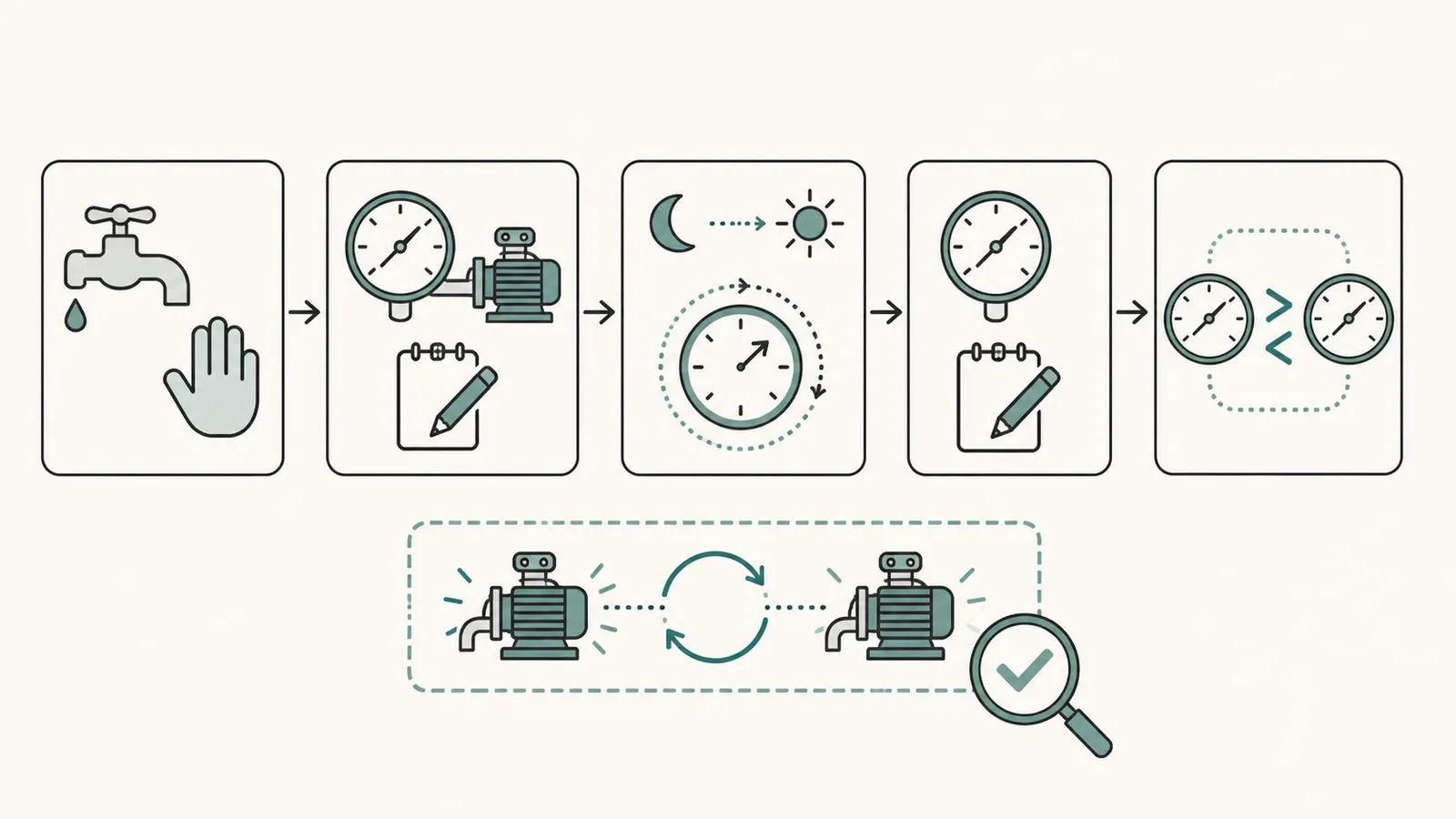
Use the gauge to create evidence:
- Stop every intentional water use, including toilets refilling, ice makers, water softeners, filters, irrigation, and automatic appliances.
- Record the gauge reading, time, whether the pump is running, and any visible leak.
- Wait one to two hours or, if the system is stable and there is no urgent loss of service, record it again in the morning.
- Repeat once to confirm the pattern.
- If an existing shutoff between the pressure equipment and the house is clearly identified and easy to operate without opening controls, repeat the observation with that valve closed for a short test.
The result narrows the next professional check. It does not prove that a check valve, buried line, pressure tank, or pump is defective. A pressure drop can also reflect a gauge that is inaccurate, a pump that is cycling, or a system arrangement different from the one assumed here.
First, make the overnight symptom measurable
“Nobody used water” is a good starting observation but not yet a controlled test. A toilet can refill silently. A softener can regenerate on a schedule. A reverse-osmosis system can send reject water to a drain. A water heater or treatment assembly can discharge through a line that is not in the room where the gauge is installed. Write down those possibilities before interpreting the gauge.
The Iowa State University Extension pressure-loss check is deliberately simple: with all taps and water-using devices shut off, note the pressure-tank gauge before and after a one- to two-hour period. A fall may signal water loss. Iowa State Extension’s leak guidance also uses the pressure gauge as the private-well equivalent of a water meter when a home has no meter.
A log that is actually useful
| Date | Start time / psi | End time / psi | Pump cycled during no-use? | House shutoff position | Intentional uses ruled out | Visible clues |
|---|---|---|---|---|---|---|
| Open / closed / unknown | ||||||
| Open / closed / unknown | ||||||
| Open / closed / unknown |
Record the gauge to the smallest division you can read consistently. Do not create false precision by estimating a needle between marks. Record whether the pump was running at the start and end. If you hear or see the pump start while no fixture is open, write down the time or approximate time. A pump start is often more actionable than the size of a small gauge change because it records a pump start/control event for a professional to evaluate; it does not prove that water escaped from the house side.
Repeat the test under similar conditions. A single reading can be distorted by a faucet that was not fully closed, a toilet that cycled, a pressure gauge that sticks, or a system that had not reached its normal cut-off. A repeatable fall after the pump has reached its normal high-pressure state is stronger evidence than a one-time difference.
Do not set a universal “acceptable” overnight psi loss from this page. Pressure-switch settings, elevation, system layout, gauge accuracy, tank type, and the location of check valves vary. The actionable finding is a repeatable fall or uncommanded pump cycle, not a magic number.
Read the sequence, not just the final number
The shape of the event can help a professional choose the next instrument or inspection. It is still a clue, not a diagnosis.
- If the gauge falls slowly and the pump never starts during the observation, record the start and end readings and the interval. The system may have a small leak, a slow reverse-flow path, or a gauge that is not reporting accurately.
- If the gauge falls until the pump starts, then climbs back to its usual high reading, note the time from pump stop to pump start and whether that cycle repeats. This records a pump start/control event after the gauge reached its start condition; it does not prove where water went or that the pump itself is defective.
- If the pump starts more than once during a no-use interval, record each start if you can do so without approaching the equipment. Repeated starts are a clue that a tank, leak, valve, or control issue may need professional evaluation.
- If the gauge drops quickly, the pump runs for an unusually long time, or service becomes intermittent, stop extending the test. A larger leak, pump problem, low supply, or electrical fault needs prompt professional attention.
- If the gauge stays steady but morning pressure feels low, the symptom may be downstream flow restriction, a fixture-specific issue, a gauge mismatch, or a problem that appears only under demand. Do not convert a steady static reading into proof that the pump and well are healthy.
Listen from a safe location for the normal sound of the pump starting and stopping. Do not remove a control-box cover to watch contacts, check voltage, or identify a pressure-switch setting. “The pump ran” is enough for the log; live testing is not part of this homeowner surface.
The gauge is measuring pressure at its own connection, not necessarily at every faucet. Elevation changes pressure between points, and treatment equipment, filters, regulators, and branch valves can change the relationship between the tank and the fixture. The house-side shutoff is useful only if its position relative to the gauge and the suspected branch is understood. Write down where the gauge is mounted and where the valve is located. If you do not know, label the result “unknown,” not “well side.”
System arrangements that change the meaning
Not every private-well installation has the same equipment. A submersible pump in a drilled well may have different check-valve locations from a shallow-well jet pump. Some homes have a separate booster pump, constant-pressure or variable-speed controls, multiple tanks, treatment equipment between the tank and house, or more than one service branch. Some pressure gauges are mounted on a tank tee; others are farther downstream.
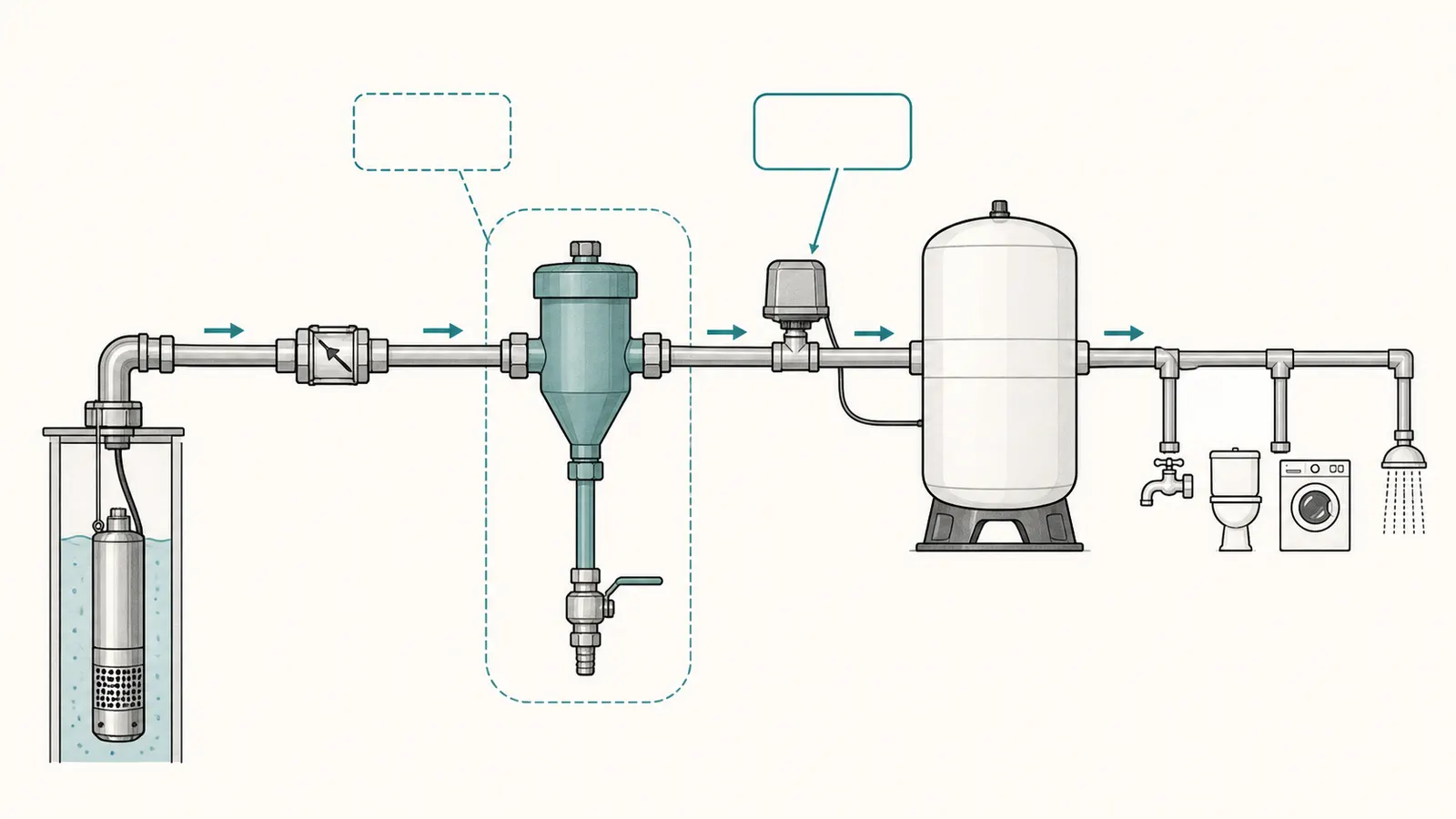
This page assumes a conventional arrangement in which the gauge is associated with the pressure tank and the homeowner can identify a normal service shutoff. If your system has a constant-pressure drive, a cistern, a booster tank, a storage tank, a shared well, or a commercial fire-protection or irrigation branch, do not apply the simple branch labels without professional interpretation. The observation log is still useful; the isolation logic may not be.
A pressure reading also does not measure the water level in the well, the well’s recharge rate, or the pump’s flow capacity. A low water table or a pump that cannot meet demand can cause low pressure while water is being used, but it does not by itself explain a static overnight loss. Conversely, a system can hold static pressure and still fail to deliver adequate flow when multiple fixtures run. Keep “pressure falls with no use” separate from “pressure is low under use.” They may share a cause, but they are different observations.
Do not use a garden-hose pressure gauge at an unrelated faucet as a substitute for the installed system gauge unless a professional tells you how to compare the locations. A second gauge can be useful for a qualified diagnostic, but installing one may require opening a pressurized fitting. Take the installed gauge reading and let the professional decide whether an independent measurement is warranted.
Use one bounded isolation test—only if your system already has the valve
Some installations have an accessible shutoff valve on the service line between the pressure tank and the house. Others do not. Some have treatment equipment, multiple branches, or a valve that is not clearly labeled. Do not remove a cover, disconnect piping, close an unfamiliar valve, or operate anything near exposed electrical parts just to create an isolation point.
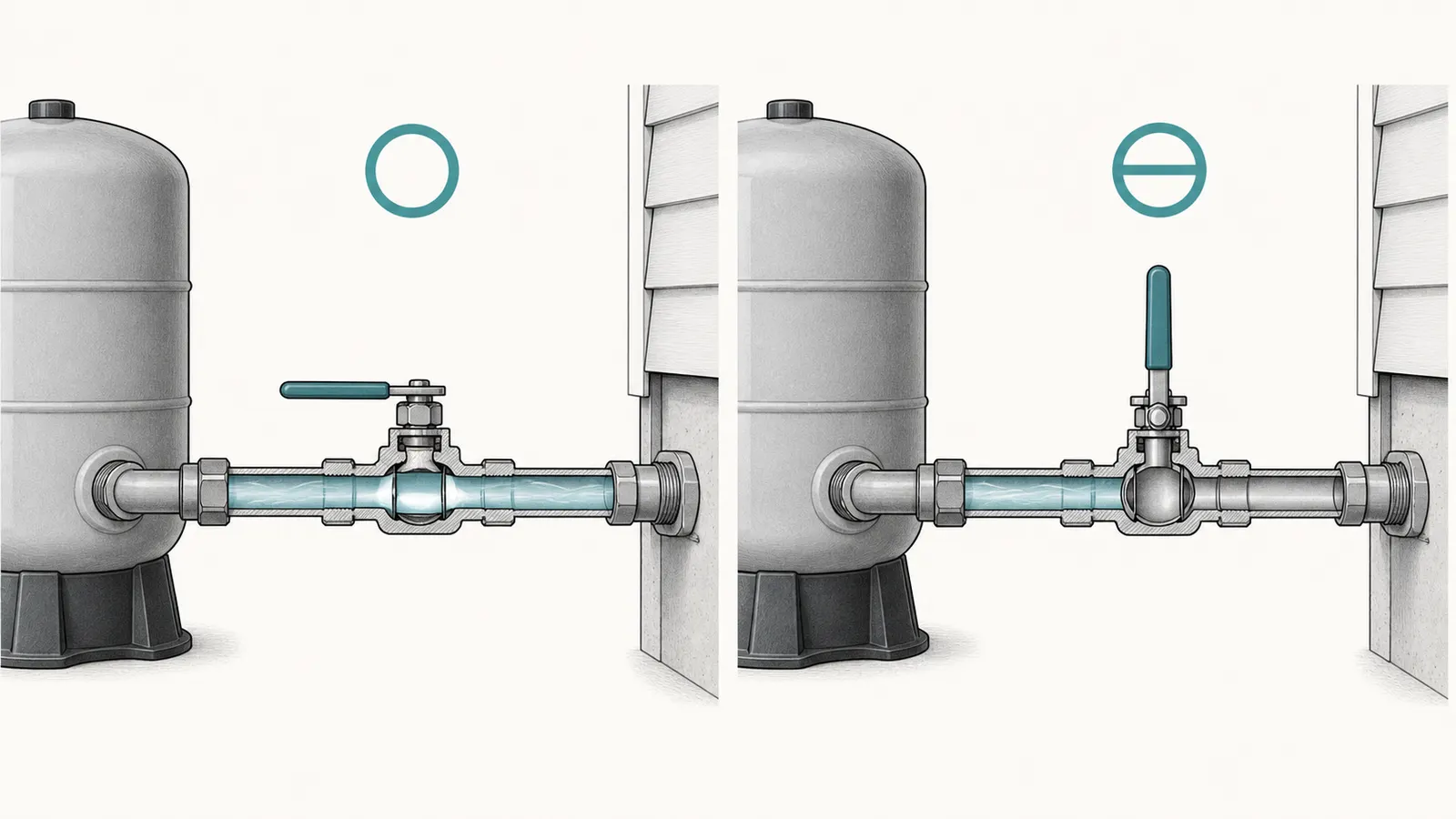
If—and only if—you can identify an existing house-side shutoff and it can be operated normally without opening the pressure switch, pump control box, well cap, or any pressurized component:
Before moving the valve, confirm that the pump is off. Never close the house-side shutoff while the pump is running. If the pump is running, wait for it to stop normally; if it runs continuously, will not shut off, or behaves abnormally, do not close the valve and end the homeowner test.
- Finish the open-system no-use reading first. Restore the system to its normal pressure if needed through ordinary household use; do not run the pump against a closed outlet.
- Close the house-side shutoff gently. Do not force a stuck valve. Do not use a wrench or attempt to repair it during the test.
- Make sure no one uses water on the house side while it is closed.
- Record the gauge and time, then observe for one to two hours, or use an overnight interval if the system is stable and it is safe and practical to do so. This is a repeatable observation window, not a validated pressure-loss threshold.
- Reopen the valve gently after the observation and check for normal service. If the pump starts during the closed-valve observation, do not approach the equipment; end the observation when it stops normally. If it runs continuously, will not shut off, or behaves abnormally, stop the test and call a plumber or well professional. If the valve will not reopen, leaks, or behaves unexpectedly, stop and call a plumber or well professional.
This is a location test, not a pressure test of the buried line. If pressure holds with the house shut off but falls when the house is connected, the evidence points toward the house side of that shutoff: fixtures, treatment equipment, visible plumbing, a water heater connection, an irrigation branch, or the service piping downstream of the valve. It does not identify which one.
If pressure continues to fall with the house shut off, the pressure loss is upstream of that valve or the gauge/tank/pump-side arrangement is involved. That branch includes a buried line between the well equipment and house shutoff, a check valve or foot valve allowing backflow, a tank or connection problem, a pump-side leak, or an instrument problem. Do not open the well or pull the pump to pursue the answer.
Missouri Department of Natural Resources gives the same important limitation for its private-well gauge check: dropping pressure indicates a leak only assuming the pump check valves are working and the pump pipe has no leaks. In a separate discussion of public-water lines, the same fact sheet gives a general water-line principle: a small leak may not leave a visible wet spot because water can move laterally through sand or gravel. That observation does not, by itself, establish a private-well service-line leak. Read the Missouri DNR fact sheet.
What the isolation result means
| Observation | Supports | Does not prove | Safest next action |
|---|---|---|---|
| Gauge holds with house shutoff closed, but falls with it open | House-side leak or downstream loss | A particular fixture, appliance, or buried branch | Inspect visible house-side points; schedule plumbing leak diagnosis if no source is visible |
| Gauge falls with house shutoff closed | Well-side, tank-side, valve, buried-line, or gauge issue | A failed check valve specifically | Stop homeowner testing and book a qualified well professional |
| Gauge holds in both tests | No loss during that interval, or intermittent condition | That the system is healthy indefinitely | Repeat with a longer log and note pump cycling, weather, and scheduled devices |
| Pump starts while no water is being used | Pressure is reaching the pump’s start condition or the control system is responding | The pump itself is failing | Record time and frequency; have the system evaluated if repeated |
| Valve is missing, unknown, stuck, or unsafe to reach | No safe homeowner isolation result | Where the leak is | Do not improvise; give the professional the open-system log |
Check the house side without opening anything
If the pressure holds with the house shutoff closed, inspect only what is visible and normally accessible. The aim is to find a water path, not to prove a component failure.
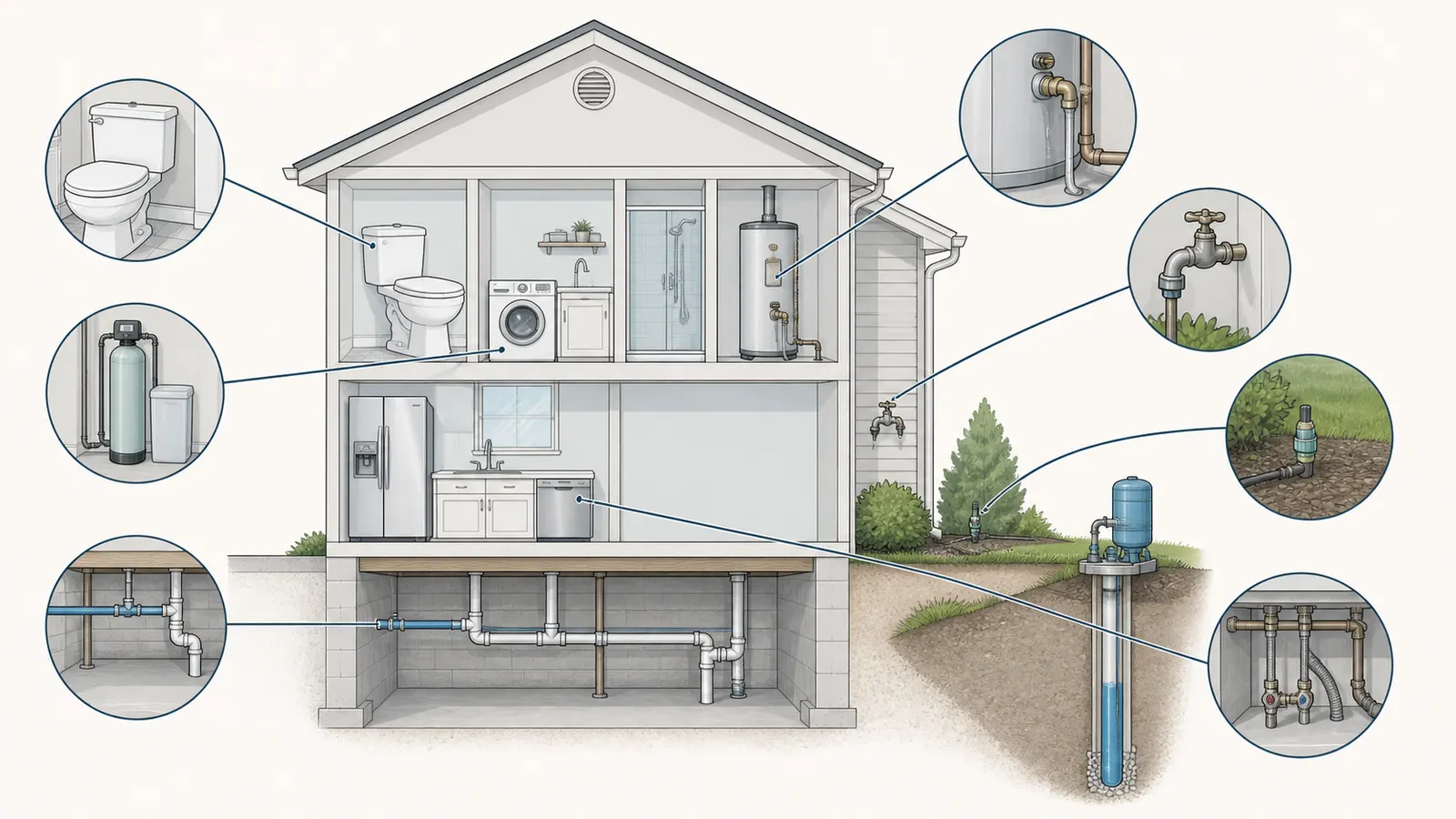
Start with toilets. Add a few drops of food coloring to the tank and wait without flushing; color appearing in the bowl indicates a leaking flush valve. Iowa State Extension identifies toilet leaks as a common, easily overlooked source of unintended water loss and gives this type of check. Do not use colored chemicals in the pressure equipment or water lines.
Then check:
- Water-treatment equipment: look for a steady drain flow, a wet floor, or a control head in a regeneration or backwash cycle. Follow the manufacturer’s normal user instructions; do not disassemble it.
- Water heater: look at the floor, visible connections, and the termination of the temperature-and-pressure relief discharge pipe. Do not lift the relief-valve test lever as a leak-finding experiment.
- Outdoor faucets and hose connections: check for dripping at the spout, vacuum-breaker area, and hose connection. Do not remove an anti-siphon or backflow device.
- Irrigation: check the controller schedule and visible valves or heads. An irrigation system can be a separate branch that uses water when the household is asleep.
- Appliances: inspect accessible refrigerator, dishwasher, washing-machine, and humidifier supply connections for drips or dampness. Do not pull appliances across wet floors or reach into energized equipment.
- Basement, crawl-space, and utility-room piping: look for fresh dampness, staining, or a sound of running water. Do not enter a confined space, excavate, open walls, or crawl under unsafe conditions.
If you find a visible leak, shut off the smallest safe downstream fixture or appliance valve if it is clearly intended for that purpose and easy to operate. If the leak is spraying, near electricity, or cannot be isolated without tools, leave it alone and call for help. Take a photograph for the service professional; do not treat a photograph as a substitute for diagnosis.
A house-side result does not rule out a second problem upstream. If the gauge also falls with the house shutoff closed, or if the pump cycles in both configurations, report both observations rather than choosing the most familiar explanation.
Separate the four common branches without guessing
Hidden house leak or buried service-line leak
A leak can be inside the house, in a crawl space, at treatment equipment, in an irrigation branch, or underground between the well and the house. A visible wet spot is helpful but not required. Missouri DNR’s separate public-water discussion describes the general principle that water from a leaking line can travel laterally and that small leaks may be difficult to find at the surface; it is not private-well service-line evidence by itself (Missouri DNR’s fact sheet). That is why a house-side shutoff result is more useful than walking the yard and declaring the line sound.
If pressure holds with the house shutoff closed, a licensed plumber or leak-detection professional can work downstream from that valve. If it falls with the shutoff closed, tell the well professional the exact valve location and whether the gauge is on the tank side or house side. Those details affect what the reading actually represents.
Check valve or foot valve allowing backflow
A check valve is intended to limit reverse flow, but the exact arrangement matters. The Minnesota Department of Health’s Well Owner’s Handbook describes a foot valve in a deep-well jet installation as a check valve that admits water while the pump runs and closes when the pump shuts off. If that valve does not close as intended, backflow is a professional branch that may be consistent with an overnight pressure drop; the gauge alone cannot locate or identify a failed valve.
Do not use the test as permission to loosen a check valve, open a well cap, pull a suction line, or pull a submersible pump. Access may involve pressurized water, electrical hazards, contamination exposure, or heavy equipment. Give the professional the time from pump shutoff to pressure loss, whether the pump starts again without use, whether faucets sputter in the morning, and whether the house-side isolation changed the result.
Pressure tank or pressure-control problem
A pressure-tank problem may be consistent with rapid pump cycling or low system pressure. Amtrol’s well-tank support guidance lists those as symptoms that may accompany a tank problem. That is a clue, not a diagnosis.
Tank precharge is not a casual homeowner adjustment. For the pre-pressurized tanks covered by its instructions, Amtrol specifies a precharge 2 psig below the pressure-switch cut-in setting and says the tank must be drained of water for the adjustment. The same manual warns of rupture or explosion hazards in unsafe conditions. See the Amtrol installation instructions.
Do not remove the air-valve cap to “see what happens,” pressurize a tank, drain a tank, tap it as a definitive test, adjust a pressure switch, or open an energized control. If the tank is visibly corroded, bulging, leaking, or damaged, keep people away and call a qualified professional. A professional can verify the tank type, pressure-switch settings, relief protection, gauge accuracy, and cycling behavior as a system.
Gauge or measurement problem
A gauge can stick, lag, be difficult to read, or disagree with the pressure elsewhere in the system. If the needle jumps, never returns to the same point after a known pump cycle, or conflicts with the actual water behavior, note that. Do not unscrew the gauge while the system is pressurized. Gauge replacement and pressure verification belong with a qualified person unless the exact installation and safe isolation procedure are known to that person.
Treat unexplained pressure loss as a water-safety signal too
Pressure loss does not automatically mean contaminated water. It does mean the system may have a leak, a depressurizing buried line, a damaged wellhead, or an opening or repair that deserves attention. A private well is not monitored like a public water system: EPA says private-well owners are responsible for delivering safe drinking water, and federal Safe Drinking Water Act protections for public systems do not operate the same way for private domestic wells.
Use extra caution if pressure loss follows flooding, heavy runoff, excavation, a broken well cap, a change in taste, odor, color, or clarity, or work that opened any part of the well-water system. Do not assume clear water is safe. EPA recommends annual testing for total coliform bacteria, nitrates, total dissolved solids, and pH, and says to test immediately after replacing or repairing part of the well system or after a water-quality change. See EPA’s private-well testing guidance.
If floodwater reached the wellhead, the well cap or casing is damaged, or the water changed after the pressure problem, use a known-safe alternative for drinking, cooking, ice, brushing teeth, and infant formula until local health guidance or a certified laboratory gives you a testing plan. University of Minnesota Extension recommends inspection and certified-laboratory testing after flooding. Do not open the well to inspect below grade. A qualified well professional should assess wellhead integrity and any repair or disinfection need.
Water testing and pressure diagnosis answer different questions. A satisfactory pressure log does not certify water quality. A positive bacteria or nitrate result does not tell you which pressure component failed. Keep both records and give them to the appropriate professional.
Do not infer more than the test can show
Several tempting conclusions are too strong for a homeowner gauge test:
- “The pressure dropped, so the tank bladder failed.” A tank problem can produce cycling or low pressure, but a leak or reverse-flow path can also make the gauge fall.
- “The pressure held with the house shut off, so the buried line is fine.” The test only supports a problem downstream of the shutoff, assuming the valve closed fully and the gauge remained connected to the tested side.
- “The pressure fell with the house shut off, so the check valve is bad.” The well-side branch still includes other valves, piping, tank connections, the pump, and the gauge.
- “There is no wet spot, so there is no buried leak.” Small leaks can be hidden or move through surrounding material before reaching the surface.
- “The water looks clear, so it is safe.” Appearance is not a private-well laboratory result.
- “The pump restarted, so the pump is working normally.” It shows that a start event occurred; it does not establish flow, electrical health, well yield, or safe shutoff.
The value of the test is disciplined uncertainty. It gives the next professional a time series, a branch result, and a list of ruled-out intentional uses. That is more useful than a replacement request based on a familiar internet symptom list.
If the first test is inconclusive, do not make the interval longer and longer while the pump is behaving abnormally. Instead, repeat the same short test after checking scheduled devices and noting weather or recent work. If the pattern disappears, label it intermittent and keep the log. If it appears only when a treatment cycle, irrigation schedule, or appliance operates, record that schedule. If the gauge reading conflicts with how water behaves at the fixtures, report both facts. A qualified person may then verify the gauge, inspect the valve arrangement, check for flow while the pump is idle, or perform a controlled line test with appropriate equipment. Those are professional follow-ups, not reasons to improvise a pressure test at home.
Know when the homeowner test is over
Stop testing and arrange qualified help when any of these applies:
- The gauge falls repeatedly while the house is isolated.
- The pump runs repeatedly with no intentional water use, runs continuously, will not shut off, or trips a breaker.
- The system loses normal service, sputters air, or produces sediment or a sudden water-quality change.
- The pressure tank, piping, wellhead, gauge, electrical enclosure, or relief discharge shows damage or leakage.
- The isolation valve is inaccessible, stuck, unlabeled, or not clearly on the house side.
- The next step would require opening a pressure switch or control box, testing live wiring, opening a well cap, pulling a pump or suction line, excavating, loosening pressurized fittings, or entering a confined space.
For a high-safety system, “qualified” is not a decorative disclaimer. Electrical, well, plumbing, and water-treatment work may involve different trades and different state or local licensing rules. Ask the person you call whether they service private wells and pressure systems in your area, and confirm what work they are qualified and insured to perform. Do not infer local code requirements from this article; ask the local authority or licensed professional.
What to send with the service request
Provide a compact evidence packet:
- The two or more gauge logs, including dates, times, starting and ending psi, and whether the pump cycled.
- A clear statement of what “no water use” excluded: toilets, treatment regeneration, irrigation, appliances, and outdoor fixtures.
- The result of the existing house-side shutoff observation, including the valve location and duration.
- Photos of the gauge, pressure tank, visible piping, wellhead, treatment equipment, and any wet areas—taken from a safe standing position.
- The well type if known: submersible or jet pump, approximate depth, pump age, tank brand/model, and pressure-switch setting if written on a label or in records. Do not open a control to find it.
- Recent repair, excavation, flood, drought, electrical, or water-quality history.
- Recent certified water-test results and the sample date.
EPA also advises private-well owners to keep accurate maintenance records. See EPA’s private-well protection guidance. Add those records to the service packet; a small log can save a second visit, but it cannot replace a system inspection.
The decision in one page
If the pressure drops overnight, first verify no-use conditions and log the gauge. If the pump cycles, log that separately. If an existing house-side shutoff can be operated safely, close it for a short observation and then restore it. A pressure hold with the house isolated supports a house-side search. Continued loss with the house isolated supports a well-side, buried-line, valve, tank, or measurement investigation. Neither result names a failed component.
Leave energized controls, pressure-switch adjustments, tank precharge work, well opening, pump pulling, buried-line pressure testing, excavation, and water-quality remediation to qualified professionals. If the cause is unexplained or the water quality changed, treat the pressure event as a reason to review private-well testing and wellhead safety as well as mechanical repair.
Sources and scope
Evidence behind this page
- Leak Prevention the Easiest Way to Conserve Water
Iowa State University Extension describes the pressure-gauge comparison as a homeowner leak signal during a one- to two-hour no-use interval. It is a screening observation, not a component diagnosis.
- Basement and Yard Water Problems - PUB2931
Missouri Department of Natural Resources gives a private-well gauge leak check and expressly conditions its interpretation on working check valves and a sound pump pipe. In a separate public-water discussion, it gives the general water-line principle that small leaks can be difficult to see and water can travel laterally; this does not by itself establish a private-well service-line leak.
- Well Owner’s Handbook - A Consumer’s Guide to Water Wells in Minnesota
Minnesota Department of Health’s handbook supports the valve-function description and the need to treat a suspected non-closing foot valve as a professional branch. It does not show that a homeowner gauge observation can identify a failed valve or that every well system uses a foot valve.
- Private Drinking Water Wells
U.S. EPA’s current private-well overview states the owner responsibility and the federal regulatory distinction. This article uses it to justify a water-safety checkpoint, not to make a state-specific legal claim.
- Protect Your Home’s Water
EPA’s current guidance covers general private-well testing frequency and triggers. Local health departments and state-certified laboratories may add location-specific recommendations.
- Precharged Well Tanks Installation and Operation Instructions
This is a manufacturer-specific installation and service instruction. The article uses it to explain why pressure-tank adjustment is not a casual overnight test and does not generalize the setting to every tank or system.
- Amtrol Well Tank Support
Manufacturer support guidance for Amtrol well tanks. It supports treating rapid cycling as a clue and assigning the pressure-zeroing and precharge check to a qualified professional when the homeowner is not specifically equipped and trained.
- Test your well water after flooding
University of Minnesota Extension guidance focused on flooding and wellhead inspection. This article applies the professional boundary to visible wellhead damage or a suspected well-side problem, without making Minnesota licensing rules national.