How to Compare Whole-House Well Water Treatment Quotes: An Apples-to-Apples Worksheet
Normalize well-water treatment quotes by lab evidence, contaminant claim, flow, pressure, drain, maintenance, warranty, and total ownership burden.
The short answer
Compare the treatment train, not the tank count. For each quote, match the same dated water test and sample point, name the exact contaminant claim and coverage, record rated service flow and pressure loss, and document backwash, drain, power, salt or chemical use, maintenance, warranty, financing, and exclusions. Reject any proposal that cannot show how it fits your measured water, peak demand, installation constraints, and post-install verification plan.Compare the treatment train, not the tank count. For every whole-house well-water proposal, put the same dated laboratory report and sample location beside the exact contaminant claim, exact model and media, rated service flow, pressure loss, backwash or regeneration demand, drain and power requirements, maintenance schedule, warranty, financing, and exclusions. A proposal is not comparable until you can tell what it treats, where it treats it, what it needs to operate, and what proof you will receive after installation.
Use the worksheet below for each proposal. Leave a field blank rather than accepting “standard,” “as needed,” “high flow,” “lifetime media,” or “covered” without a number, document, or named party responsible for the work. A blank is a decision signal: ask for the missing evidence or mark the quote incomplete.
| Comparison field | Proposal A | Proposal B | Proposal C |
|---|---|---|---|
| Water sample date, lab, sample point, analytes, units | |||
| Health concern, aesthetic concern, or operational concern | |||
| Exact contaminant claim and certification/listing | |||
| Point of entry, point of use, or both | |||
| Exact equipment model, media, volume, valve, and control | |||
| Rated service flow and peak-demand assumption | |||
| Clean and loaded pressure loss at stated flow | |||
| Backwash/regeneration flow, gallons, duration, frequency | |||
| Drain size, route, air gap or discharge method, and responsibility | |||
| Power, chemical, salt, or conditioning-agent requirement | |||
| Installed price and named inclusions | |||
| Annual consumables, service, testing, and replacement assumptions | |||
| Warranty, labor coverage, exclusions, and response time | |||
| Financing principal, APR, term, fees, and total repayment | |||
| Post-install test and acceptance condition |
The rest of this guide explains how to complete each row and how to decide when two proposals are not actually alternatives.
1. Turn each sales proposal into a defined treatment train
A quote may describe a “five-stage system,” “iron package,” “whole-house purification,” or a sequence of tanks. Those labels are not a normalized scope. Write the water path in order, from the well-side sample point to the house, and name the intended job of each stage:
- source or raw-water sample point;
- pressure tank and pump-side constraints;
- sediment or particulate stage;
- oxidation, neutralization, softening, adsorption, membrane, or other media stage;
- disinfection stage, if applicable;
- treated-water sample point;
- bypasses, drains, chemical feeds, and point-of-use branches.
The CDC treatment overview is the right starting boundary: filtration, ultraviolet treatment, reverse osmosis, distillation, and softeners do different jobs, and the homeowner should test water and select a system for the chemicals or germs of concern. The CDC also says a softener removes primarily calcium and magnesium and does not remove parasites, bacteria, or viruses. That makes “softener plus UV,” for example, a different train from “softener only,” even if both proposals show one resin tank and similar plumbing.
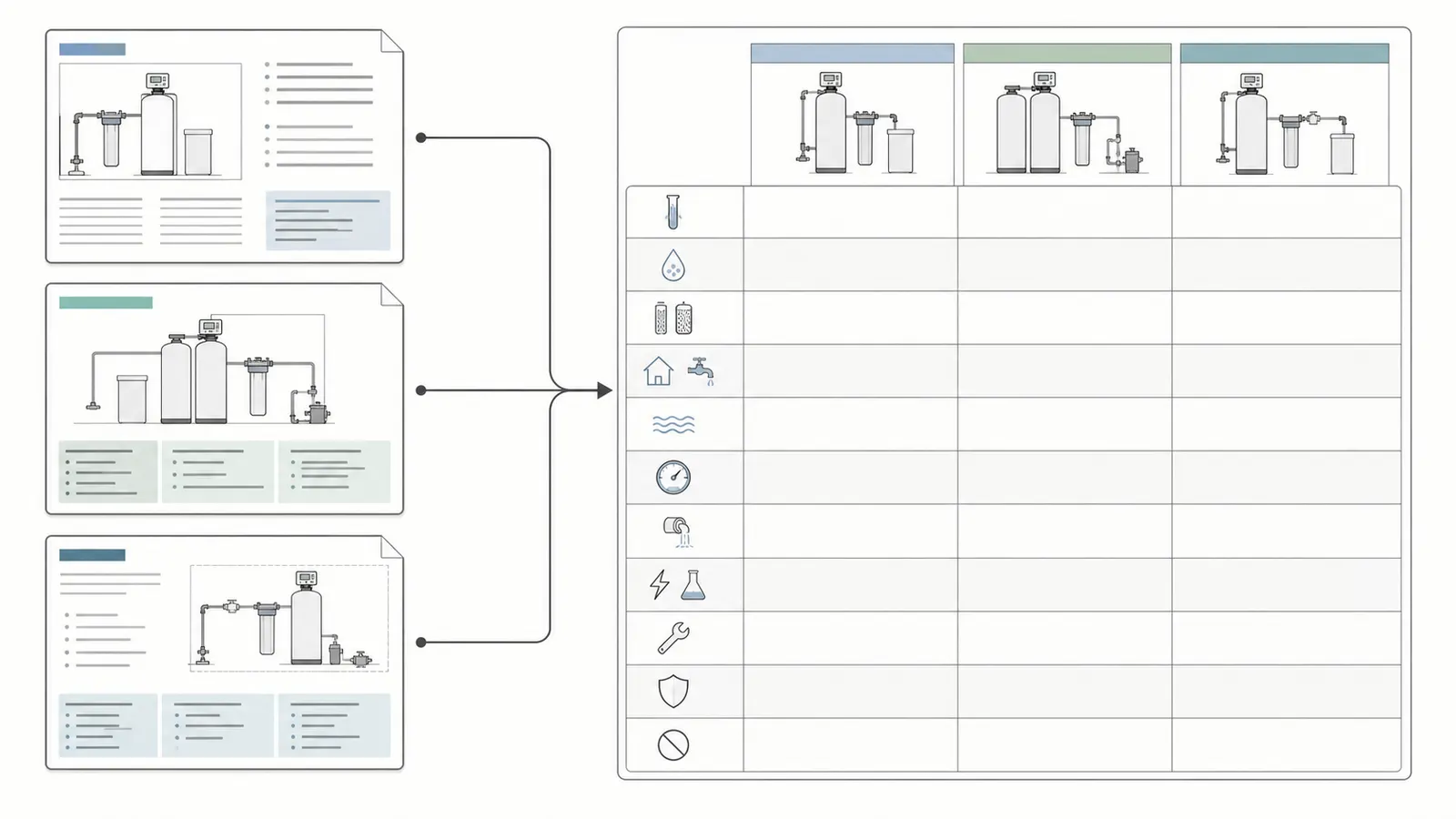
For each stage, record four separate things:
- the problem the seller says it addresses;
- the mechanism the equipment uses;
- the exact contaminant or outcome claim;
- the evidence that the stage is sized and certified for your water.
Do not let a single stage inherit a neighbor’s claim. A sediment cartridge may protect downstream equipment from particles without treating dissolved nitrate. Carbon may improve taste and odor without proving removal of a specific solvent or PFAS concentration. A UV unit may disinfect under its stated conditions without removing dissolved chemicals. A softener may improve scaling and soap behavior without making a bacteriologically unsafe well safe.
This is also where you identify redundancy. If one proposal includes two carbon tanks, ask what distinct contaminant or contact-time requirement each serves. If both tanks have the same media and the quote does not state a separate capacity or service-cycle reason, mark “duplicate function not explained.” Redundancy can be justified, but it should be visible as a design decision rather than a tank-count advantage.
What a comparable quote must identify
Ask for the manufacturer’s installation and operating manual, product data sheet, exact model number, media name and quantity, control-valve model, flow-control components, and any required pretreatment. “Equivalent media” is not enough for a comparison: media density, bed depth, contact time, pH window, oxidant demand, and backwash rate can change the installation and operating burden. If the seller proposes a custom blend, request the written composition, design basis, and replacement procedure.
A quote can remain conditional. For example, a professional may say that a final media choice depends on iron speciation or a confirmatory test. That is more useful than a confident but unsupported model number. Record the condition, the test required, who pays for it, and whether the price changes if the result differs.
2. Freeze the water evidence before comparing claims
The most important comparison input is not the equipment list. It is the water evidence that the equipment is supposed to solve. Attach the report to every proposal and write down:
- sample date and time;
- sample point, such as raw water before treatment or a kitchen tap after existing treatment;
- laboratory name and certification status for the analytes tested;
- analyte name, result, unit, reporting limit, and method if shown;
- whether the sample represents normal operation, a bypassed system, a recent shock chlorination, or an unusual event;
- nearby conditions or symptoms that justify additional analytes;
- household occupants or uses that change the consequence of a result.
EPA private-well guidance advises annual testing for total coliform bacteria, nitrates, total dissolved solids, and pH, with additional testing when local conditions suggest other contaminants. It also advises testing after a well-system repair or when water quality changes. Treat that as a baseline decision rule, not as a claim that one panel covers every property. Agriculture, mining, fuel storage, septic problems, flooding, corrosion, and local geology can change the relevant analytes.
Use a drinking-water laboratory certified by the applicable state program. EPA says to use certified laboratories, and its guidance says that a contaminant exceeding a health standard should be discussed with the public-health department and confirmed with retesting. A colorful in-home demonstration, an untreated sample with a reagent, or a seller’s handheld meter can help show a phenomenon, but it does not replace a properly scoped laboratory result for a health decision.
Separate three kinds of problems
Mark every result and symptom as one of these:
| Classification | Examples | How it changes the quote review |
|---|---|---|
| Health-related or potentially health-related | coliform bacteria, nitrate, arsenic, lead, uranium, PFAS, a contaminant above an applicable health benchmark | Require a named reduction claim, coverage decision, maintenance plan, and verification test. Involve the health department or qualified water professional when indicated. |
| Aesthetic | taste, odor, color, staining, scale, soap performance | Compare the measurable outcome and operating burden, but do not let an aesthetic improvement stand in for health protection. |
| Operational or protection-related | sediment, clogged aerators, pressure loss, pump cycling, media fouling, fixture protection | Confirm source cause, flow impact, service interval, and whether treatment is masking a well or plumbing problem. |
MassDEP’s homeowner guidance makes the same essential distinction: no single process removes all substances, the water should be tested first, and a unit should be certified and specifically labeled for the contaminant of concern. It also warns that poorly maintained units can lose effectiveness and in some cases make quality worse. Those statements are Massachusetts guidance, not a national installation rule, but the comparison principle is broadly useful.
Do not normalize a health proposal to an aesthetic proposal just because the equipment looks similar. If one seller responds to bacteria with UV and another responds to taste with carbon, they are not competing solutions until the health issue is separately resolved. If one quote treats the whole house and another treats only the kitchen tap, they may both be reasonable, but they serve different coverage goals.
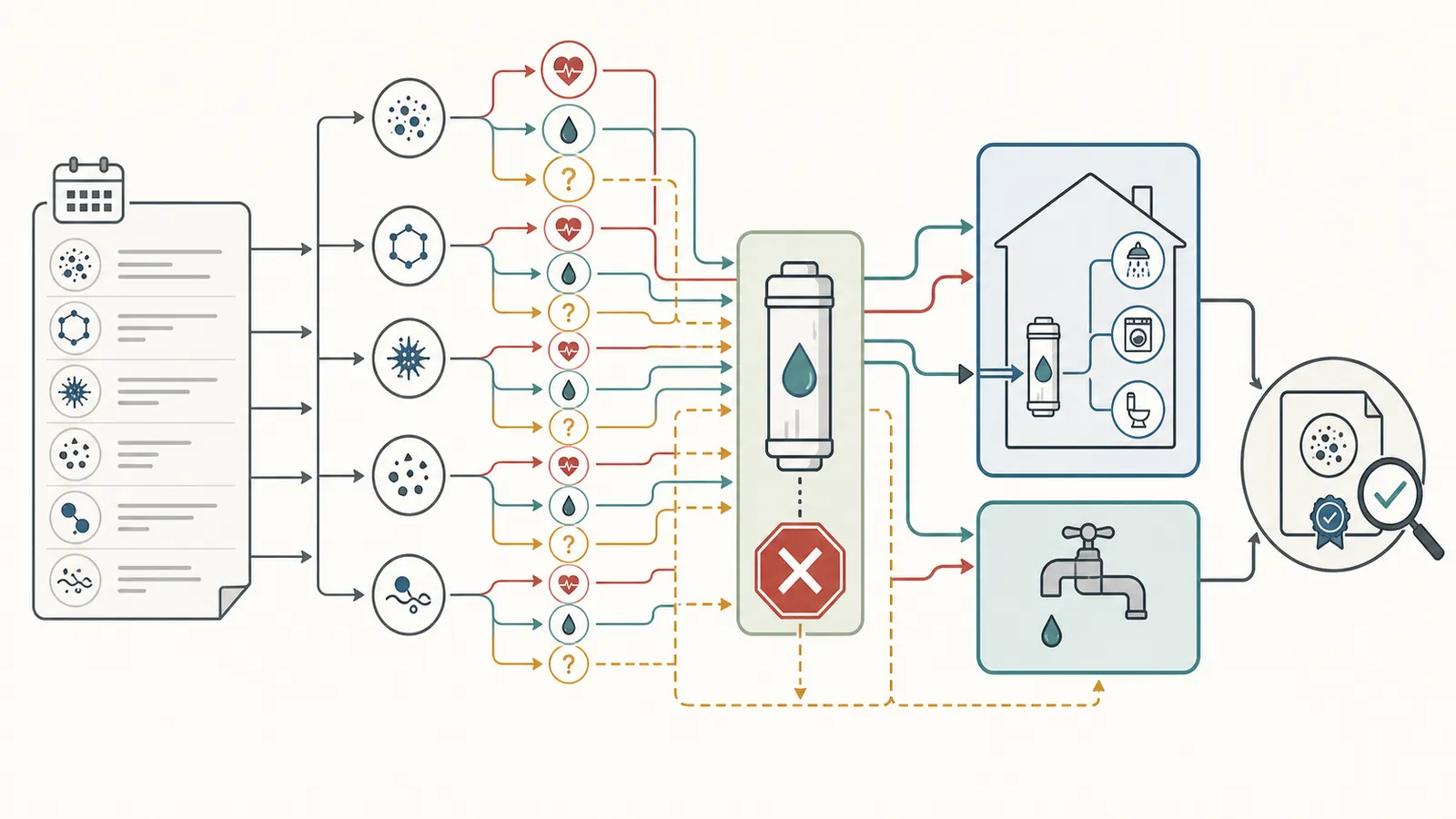
3. Verify the claim, certification, and coverage boundary
The phrase “removes contaminants” is incomplete. Your worksheet should contain the contaminant name, form where relevant, influent condition, expected treated-water condition, flow or capacity limit, and the exact model associated with the claim.
The NSF contaminant-reduction guide lists certified products by contaminant and treatment type. The NSF standards overview explains that certification to an NSF/ANSI standard or protocol does not mean a system will reduce every possible contaminant. Therefore, copy the exact claim from the product listing or certification record. Do not write “NSF certified” in your worksheet as if it were a universal health endorsement.
Check these claim details:
- Is the exact brand, model, configuration, and control setting listed?
- Is the claim for the contaminant in your report, not a related contaminant?
- Is the claim for the same form, such as a particular oxidation state, where the chemistry makes that distinction material?
- Does the certification cover whole-house point-of-entry equipment, a point-of-use device, or a component only?
- Is the claim tied to a service cycle, cartridge life, flow rate, capacity, or other operating condition?
- Does the warranty require a specific maintenance action or test record?
The NSF official drinking-water treatment listings expose product-level information such as replacement, service-cycle, and flow-rate fields. Use the current listing for the exact model rather than a screenshot, brochure, or a similar model family. If the seller says a product is “tested to” a standard, ask whether that means independent certification, a manufacturer test, or a material-safety listing. Those are not interchangeable.
Point-of-entry versus point-of-use is a design decision
CDC defines point-of-use as treatment for a single tap and point-of-entry or whole-home treatment as treatment for most or all water entering the home. Record exactly which fixtures are covered, and identify any bypasses around the treatment train: outside hose bibs, irrigation, a detached building, a water softener loop, a refrigerator line, or a kitchen reverse-osmosis branch.
Ask the seller to mark a simple plumbing plan with:
- raw-water entry;
- every treatment stage;
- sample taps before and after treatment;
- bypass valves and normally open or closed position;
- fixtures that receive treated water;
- fixtures that intentionally remain untreated;
- drain discharge and any air gap;
- electrical outlets and service clearances.
If a proposal uses a point-of-use reverse-osmosis unit to solve one drinking-water contaminant, do not compare its purchase price to a whole-house train as though the coverage were identical. Conversely, do not accept a whole-house quote as automatically better: it may add waste, pressure loss, maintenance, or installation complexity for a concern that only requires drinking and cooking water. The right scope follows the contaminant, exposure pathway, household use, and verified claim.
4. Test hydraulic and utility fit before accepting the equipment list
A treatment train can be chemically appropriate and still be a bad fit for a well system. Compare it at the actual operating conditions of the home, not at a marketing flow rate with no pressure context.
Service flow and pressure loss
Ask for rated continuous or service flow and peak flow, each with the pressure-drop condition used for the rating. Then write down your peak demand assumption: simultaneous showers, a tub fill, a washing machine, irrigation, or another known event. “High flow” without a stated pressure loss is not a usable comparison.
Install or use pressure gauges only where a qualified installer confirms they are safe and compatible. From a safe location, record pressure before treatment and at a downstream tap during a repeatable flow event. Do not infer pump capacity from a single gauge reading, and do not treat static pressure as delivered flow. A clogged cartridge, fouled media bed, undersized valve, partially closed bypass, or weak well pump can all affect the observation.
UMass specifically advises asking whether equipment was tested for the target contaminant over its advertised life under household conditions, including actual flow rates and pressures. Request clean pressure loss and a maintenance or replacement threshold. If the seller cannot provide a loaded pressure-loss criterion, ask how the homeowner will know the stage is exhausted.
Use this conservative calculation for a first screen:
available pressure at peak demand = pressure delivered by the well system at that demand - pressure loss of existing equipment - pressure loss of proposed train
Do not turn this into a universal pass/fail number without the pump, pressure-switch, plumbing, fixture, and local design information. Instead, compare the result with the minimum inlet pressure and operating range in each exact manual, and ask the installer to document the assumption. If the proposal needs a booster pump, larger service line, or pressure-tank change, price that work as part of the train.
Backwash, regeneration, drain, and power
Record the flow rate, gallons, duration, and frequency for every automatic backwash or regeneration. For salt-based equipment, record salt dose, water used, brine discharge, and the programmed capacity at that dose. For chemical feed, record chemical name, concentration, storage, injection point, calibration, spill response, and replenishment schedule. For UV, record lamp replacement, alarm or sensor requirements, and prefiltration requirement. For cartridges, record replacement interval under your actual sediment load, not only a calendar estimate.
The Penn State buying guide notes that some equipment must be routinely changed or backwashed to maintain water flow. That makes the maintenance mechanism part of the hydraulic comparison: a media tank that needs a periodic high-flow backwash is not equivalent to a cartridge that needs frequent lifting and disposal, even if both are called filtration.
Drain capacity is not an installer afterthought. A current Clack WS1/WS1.25 service manual specifies minimum drain-line sizing, a larger requirement for higher backwash flow or longer runs, uninterrupted power, and compliance with local plumbing codes. Those values belong to that control-valve family; do not copy them into another system. The lesson for the worksheet is to require the exact manual’s drain flow, line size, route, discharge method, power demand, outlet requirements, and installer responsibility.
Ask whether the system can discharge to the proposed drain without flooding, siphoning, cross-connection, or violating local requirements. Do not assume a nearby standpipe, sump, septic system, dry well, floor drain, or outdoor discharge is acceptable. Local plumbing, wastewater, electrical, well, and septic rules vary. Have the installer and the relevant authority resolve the site-specific question before the quote is accepted.
Installation changes that must be priced
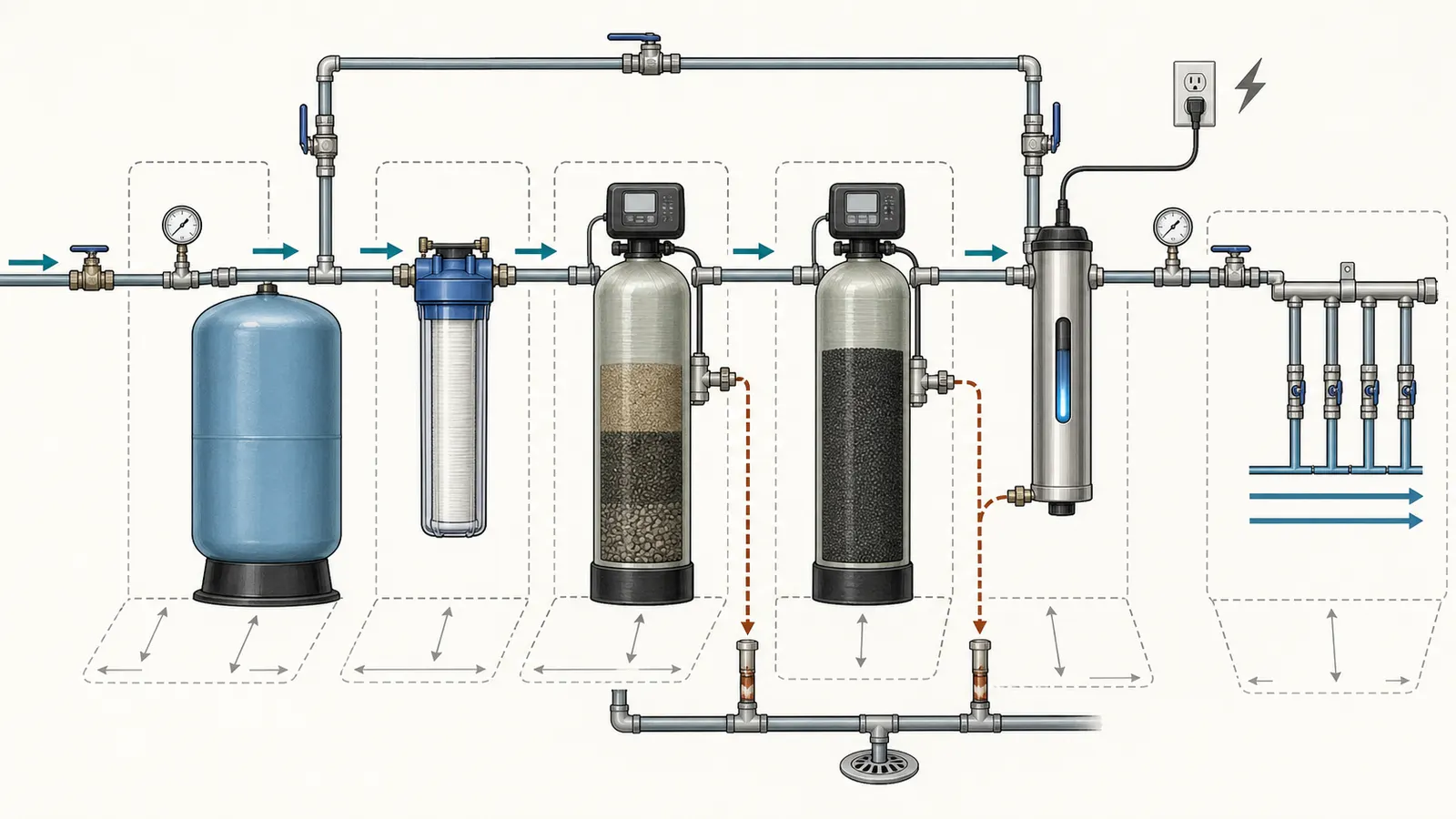
The scope should state whether it includes or excludes:
- cutting and rerouting the main service line;
- a bypass and isolation valves;
- pressure gauges or sampling taps;
- a drain connection and required air gap;
- a dedicated outlet, transformer, grounding, or electrical work;
- a neutralizer, booster pump, or pressure-tank adjustment;
- floor reinforcement, a platform, ventilation, or service clearance;
- media loading, sanitization, startup, and disposal of old equipment;
- permits, inspections, water hauling, temporary bypass, or restoration;
- laboratory testing before and after installation.
“Installation included” is not a scope. Ask who performs each trade and who pays if the existing plumbing, drain, outlet, or pressure system does not meet the manual.
5. Convert the installed quote into an ownership comparison
The lowest installed price is not necessarily the lowest-cost train. Build a five-year worksheet using the actual proposal, actual manual, and a clearly labeled assumption for each recurring item. Do not insert a national “typical cost” where your quote can provide the number.
five-year ownership cost = installed price + five-year consumables + five-year service + five-year testing + five-year utility/waste estimate + excluded site work + financing charges - documented credits
Use a range when the frequency is uncertain. For each recurring item, record low, expected, and high cases, plus the trigger that moves the estimate. For example, cartridge life may depend on turbidity or sediment load; salt use may depend on household demand and programmed dose; laboratory testing may be annual or event-triggered; media replacement may depend on breakthrough or a measured service interval. A range with its assumption is more honest than a precise number with no basis.
Recurring burden checklist
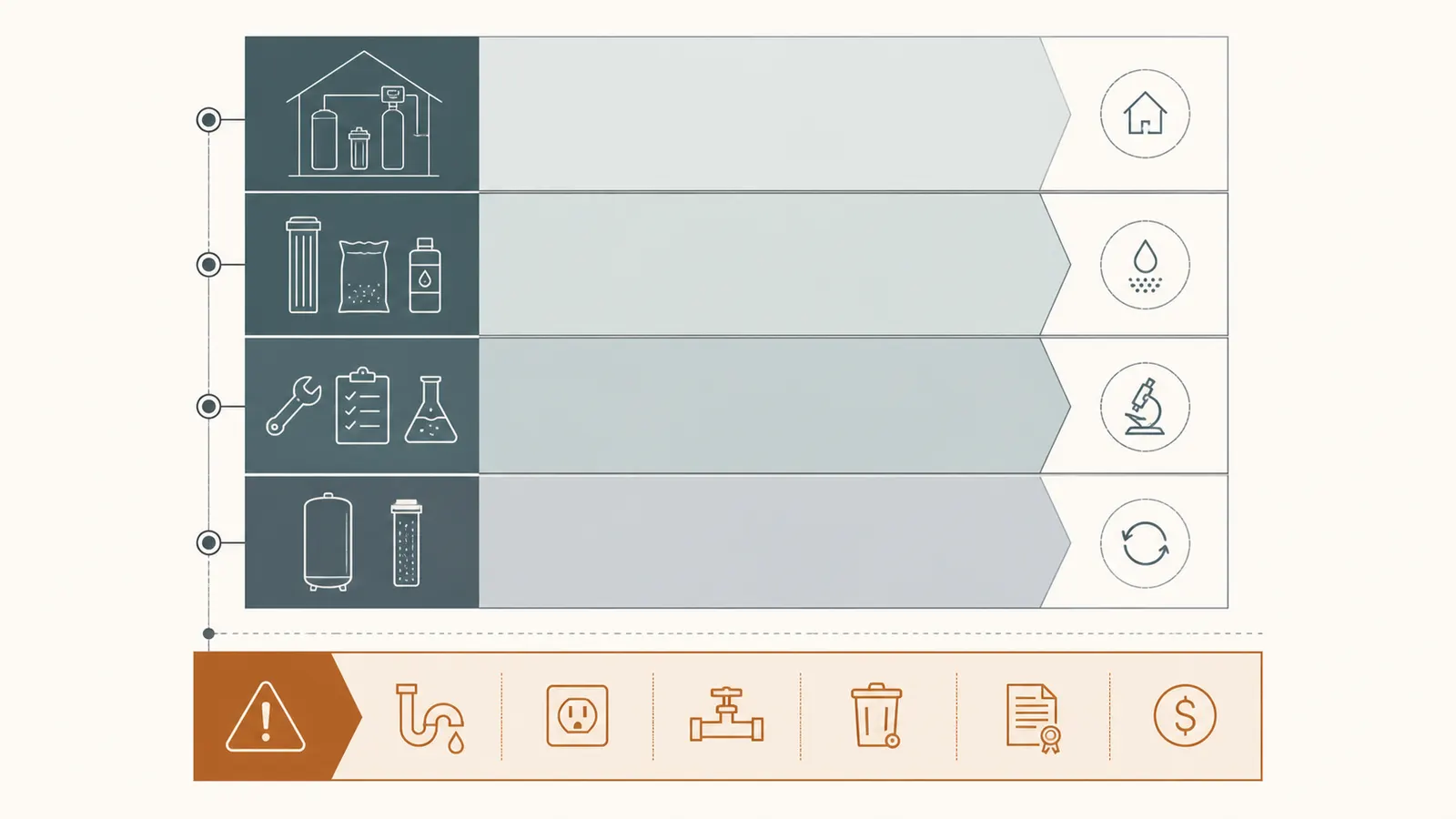
For every proposed train, ask:
- How often are cartridges changed, and what is the part number or media specification?
- How often is the tank backwashed or regenerated, and how many gallons go to drain each time?
- What salt, potassium chloride, oxidant, disinfectant, or other chemical is used?
- Who supplies and stores the chemical, and what happens during a missed service?
- Is electricity continuous, intermittent, or required only for a control valve, UV lamp, pump, alarm, or chemical feed?
- What is the annual service visit, what does it include, and what is excluded?
- Is laboratory verification included after installation and after media replacement?
- What is the expected replacement event for media, lamps, membranes, seals, control valves, or tanks?
- What waste stream is produced, and who determines whether its discharge is permitted at this property?
UMass also points buyers toward expected supplies and operating costs, and recommends comparing more than one treatment procedure or dealer. Its purchasing questions support asking for a second opinion and checking additional equipment recommendations. Use that comparison to test the design basis, not just to negotiate a lower number.
Warranty, service, and financing
Separate the tank warranty, valve warranty, media warranty, lamp warranty, labor warranty, leak warranty, and performance remedy. Ask:
- Does the warranty require the homeowner to use specified media, salt, cartridges, or service intervals?
- Does it cover a failed contaminant-reduction result, or only a defective part?
- Who collects a failed sample and pays for retesting?
- What is the response time for a leak, no-flow event, alarm, or contaminated result?
- Does bypassing the system, changing a setting, or using a different lab void coverage?
- Who owns the data, maintenance records, and test reports if the installer closes or the service plan ends?
For financing, write the cash price, deposit, financed principal, APR, term, origination or documentation fees, monthly payment, total repayment, prepayment terms, and any service-plan condition. Do not compare monthly payment to another quote’s installed price. Compare total repayment to total repayment, and keep optional service plans separate from required installation scope.
6. Score the proposals by evidence, fit, and burden
Use a gated review before adding points. A proposal cannot win on price if it fails a gate:
| Gate | Pass condition | If blank or failed |
|---|---|---|
| Water basis | Same current report, sample point, analytes, units, and relevant local conditions | Pause and obtain testing or a written conditional design. |
| Health claim | Exact contaminant, exact model, stated conditions, and certification or test evidence | Do not treat the claim as verified. Ask for documentation or involve a qualified professional. |
| Coverage | POE, POU, or both is drawn on the plumbing plan | Mark scope as different, not cheaper or equivalent. |
| Hydraulic fit | Flow, pressure loss, backwash/regeneration, and minimum pressure are documented | Obtain a site-specific calculation and manual. |
| Utilities | Drain, power, chemical, salt, and access requirements are named | Treat the price as incomplete. |
| Ownership | Consumables, service, testing, replacement, warranty, and exclusions are priced or explicitly assigned | Build a range and ask for a written allowance. |
| Verification | Startup records and post-install testing are defined | Add an acceptance step before final payment where contractually appropriate. |
After the gates, score each proposal from 0 to 3 in five categories. Use 0 for missing or unsupported, 1 for a broad assertion, 2 for documented but conditional, and 3 for documented and matched to your measured conditions:
| Category | Question | Score |
|---|---|---|
| Evidence match | Does the design respond to the same current water evidence? | 0–3 |
| Claim integrity | Is the exact model’s claim specific, relevant, and independently verifiable? | 0–3 |
| Hydraulic and site fit | Are peak flow, pressure, drain, power, access, and local installation constraints resolved? | 0–3 |
| Ownership clarity | Can you calculate recurring supplies, service, testing, replacement, and financing? | 0–3 |
| Verification and remedy | Is there a practical post-install test, record, warranty, and response path? | 0–3 |
Do not use the score to override a failed health or safety gate. A proposal with a lower score may simply have better documentation still to be supplied; a proposal with a high score but an untreated health contaminant is not acceptable. Keep a notes column for assumptions and an “owner” column naming the homeowner, installer, laboratory, plumber, electrician, or authority responsible for the next action.
A worked comparison without invented performance
Imagine Proposal A offers a sediment stage, carbon tank, and UV. Proposal B offers a cartridge, softener, and UV. Proposal C offers carbon, softener, and an under-sink reverse-osmosis unit. You cannot rank them from the tank count.
First, match the water report. If the only documented issue is hardness and odor, Proposal A’s UV may be unnecessary unless there is a microbiological reason; Proposal B may address hardness but still needs a claim for the odor; Proposal C’s point-of-use membrane has different coverage and waste behavior. If nitrate is present, the softener and carbon labels do not answer the question; the exact certified claim and coverage must be verified. If bacteria is present, a taste improvement is not evidence of disinfection.
Next, compare site fit. Proposal A may require a backwash drain and continuous UV power. Proposal B may add salt, regeneration water, and a larger drain event. Proposal C may preserve whole-house pressure but treat only one tap. The right next step is not “pick the best technology.” It is “obtain the missing claim, coverage, flow, drain, maintenance, and verification evidence for the concern that actually exists.”
7. Accept the work only after safe verification
Before installation, bring the installer:
- the complete laboratory report and any prior reports;
- well and pump records, pressure observations, and recent repair history;
- a list of peak water uses and any low-pressure symptoms;
- photos of the proposed equipment area, drain, outlet, bypass, and service clearances;
- the worksheet with every blank and assumption marked;
- local questions about plumbing, electrical, septic, wastewater, permits, and discharge;
- the requested manuals, certification records, warranty, and maintenance schedule.
At commissioning, obtain a written record of the installed model and media, initial settings, bypass position, sample points, pressure observations, flow or backwash settings, leak check, drain test, power or alarm test, and homeowner maintenance instructions. Ask how the installer will document a changed setting or replacement part.
For a health-related claim, plan matched verification: identify an untreated sample point and a treated sample point, use the same analytes and comparable laboratory reporting, and record the system state when samples are taken. MassDEP advises continued testing after installation because there may be no other way to know whether a treatment system has failed. A clear glass, improved smell, or a dramatic sales demonstration is not a substitute for the named test.
If the result is not as expected, do not immediately add another tank. Check sample point, bypass position, flow, maintenance state, cartridge or media age, regeneration or backwash history, and laboratory comparability. Then ask the installer or a qualified water professional to diagnose the failure. If a health contaminant remains above the applicable benchmark, use the public-health guidance for that contaminant and a known-safe drinking-water alternative until the response is clear.
Homeowner safety boundary
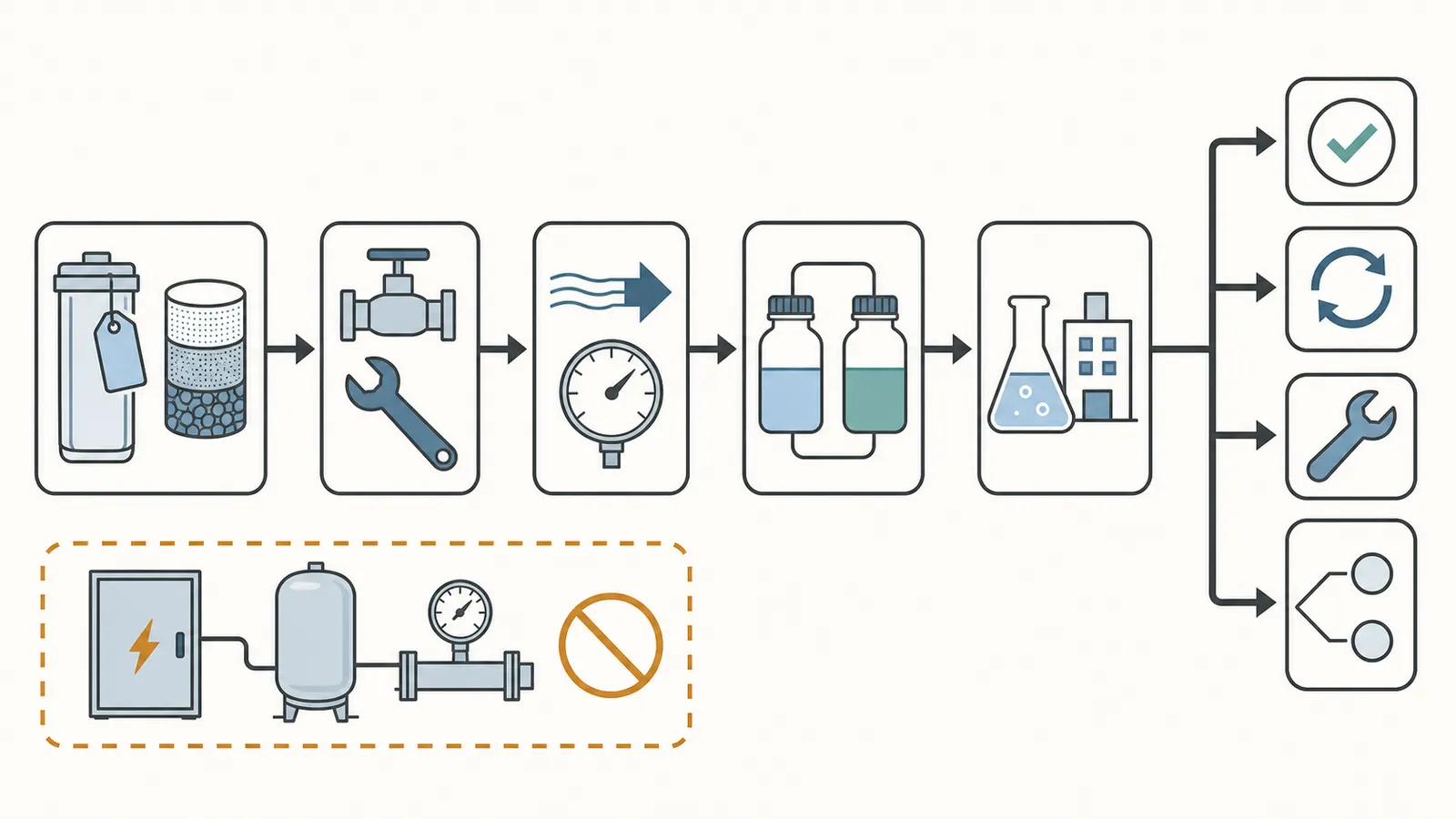
Do not open energized controls, test live wiring, pull a pump, open a well, enter a confined space, alter a pressure switch, disconnect pressurized piping, or manipulate pressurized equipment such as a tank or chemical feed unless the specific task is demonstrably safe under the exact manufacturer instructions and local requirements. This guide does not authorize electrical, well, pressure-vessel, chemical, or confined-space work. Assign those tasks to qualified professionals.
From a dry, safe location, a homeowner may organize records, photograph labels, read manuals, note bypass-handle position without forcing it, observe a normal display or alarm, record a visible gauge without opening anything, and collect a laboratory sample exactly as the certified laboratory instructs. Stop if there is a leak, electrical hazard, unusual pressure behavior, chemical exposure, flooding, contamination concern, or uncertainty about what is energized or pressurized.
The final decision is the proposal with the clearest evidence chain: the same water problem, a specific and verifiable claim, the right coverage, measured hydraulic fit, known site utilities, transparent ownership burden, and a post-install verification path. If two quotes still cannot be compared after the worksheet is complete, they are different scopes—not a meaningful low bid and high bid.
Sources and scope
Evidence behind this page
- About Home Water Treatment Systems
CDC overview of filtration, reverse osmosis, ultraviolet treatment, distillation, and softeners; applies to the need for contaminant-specific selection and does not establish performance for any unverified product.
- About Home Water Treatment Systems
CDC definitions of POU and whole-home/POE coverage; does not say that either scope is automatically appropriate for a particular contaminant.
- Protect Your Home's Water
EPA private-well guidance; annual testing and additional triggers are guidance, not a universal state or local legal schedule.
- Protect Your Home's Water
EPA private-well testing and treatment guidance; the applicable certifying authority and health standard can vary by jurisdiction and analyte.
- Home Water Treatment Devices - Point of Entry and Point of Use Drinking Water Treatment
Massachusetts Department of Environmental Protection homeowner guidance; certification, testing, and regulatory details may differ outside Massachusetts.
- NSF Standards for Water Treatment Systems
NSF explanation of voluntary residential water-treatment standards and claim scope; certification status should be checked for the exact model and current listing.
- NSF Product and Service Listings
NSF current official listings page as accessed on 2026-08-23; listing fields and certification status are product-specific and not a guarantee for an unnamed system.
- Questions to Ask When Purchasing Home Water Treatment Equipment
UMass Amherst consumer purchasing guidance; it supports requesting test evidence and operating conditions, not a performance claim for any particular quote.
- Questions to Ask When Purchasing Home Water Treatment Equipment
UMass Amherst purchasing guidance; a second opinion does not by itself validate a treatment claim or replace laboratory testing.
- Tips for Buying Water Treatment Equipment
Penn State Extension buying guidance; the required interval and operating burden depend on the specific device, water quality, and manufacturer instructions.
- WS1 & WS1.25 Drawings and Service Manual
Clack's specific WS1/WS1.25 control-valve manual; its dimensions, flow thresholds, and instructions must not be generalized to other valves or systems.