How to Verify a Well Water Treatment System Is Working
Use a paired raw-and-treated water test matched to the system claim, sample point, lab method, operating state, and maintenance record.
The short answer
Verify treatment with paired samples: identify the untreated water entering the equipment and the treated water leaving it, then have a state-certified lab test the same claimed analytes using matched units, methods, and reporting limits. Record bypass state, filter or media age, regeneration or backwash timing, flow, pressure, and sample handling. A clear taste or one reassuring tap result does not prove the claimed reduction.How to Verify a Well Water Treatment System Is Working
The defensible homeowner answer is a matched, paired-sample comparison—not clearer water, better taste, a pressure gauge that looks normal, or a single reassuring laboratory result.
First identify the exact contaminant claim you are trying to verify. Then identify a valid untreated sample point before the treatment equipment and a valid treated sample point after it. Ask a state-certified drinking-water laboratory how both samples must be collected, preserved, shipped, and analyzed. Collect the same claimed analytes from both points under a documented equipment state. Record bypass position, cartridge or media age, regeneration or backwash timing, flow, pressure, and sample conditions. Compare the two reports only when the analytes, units, methods, reporting limits, and sample context are comparable.
This is a verification plan for a homeowner. It does not certify a treatment device, establish compliance with a state rule, or replace a health department, laboratory, well professional, plumber, or treatment specialist. If a prior result shows a health-related contaminant above an applicable standard, follow the health department’s instructions and use a safe alternate source until the response is complete. CDC says treated water should be tested to confirm that treatment worked, and it warns that no single treatment type protects against every well-water problem. CDC’s treatment guidance is the safety boundary for this page.
1. Define what “working” is supposed to mean
“Working” has at least four different meanings. Do not let a treatment installer, laboratory report, or homeowner observation silently substitute one for another.
| Question | Evidence that answers it | Evidence that does not answer it |
|---|---|---|
| Is water moving through the equipment? | A safe observation of flow, pressure, valve position, drain flow, or a professional service record | A powered display, a full brine tank, or a filter housing that looks clean |
| Is the equipment operating in the intended state? | Model and manual, correct configuration, bypass state, cartridge/media identity, regeneration/backwash or lamp status, and service history | The equipment being installed somewhere in the plumbing |
| Is the claimed contaminant reduced? | Matched untreated and treated laboratory results for the exact claim | Clear water, less odor, taste improvement, or a test for a different analyte |
| Is the treated water safe for the intended use? | A current lab panel selected for the well, the household, and local hazards, interpreted with the health department or applicable standard | A passing result for only one contaminant or a product certification logo by itself |
Use the narrowest statement that the evidence supports. For example:
- “The paired samples show arsenic lower at the post-treatment point on this date, under the recorded operating conditions.”
- “The sample was below the laboratory reporting limit; an exact percentage reduction cannot be calculated from this report.”
- “The untreated sample was collected after a treatment bypass, so it does not establish a source-to-treated comparison.”
- “The report did not include the analyte named in the manufacturer’s claim; treatment performance remains unverified.”
Avoid the stronger statements “the filter works,” “the water is safe,” or “the treatment is certified” unless the evidence and the person making the statement are authorized to support that scope. Virginia Cooperative Extension recommends periodic testing before and after a treatment device to ensure it is working as intended, while also emphasizing that treatment devices have limitations and maintenance needs. Virginia Tech’s household-treatment guidance supports a narrower, device-specific conclusion.
The verification target should be written in one sentence before you order bottles:
“I am checking whether [model and treatment stage] reduces [exact analyte or analytes] from the water entering the equipment to the water leaving it, under [normal/bypass/regeneration/backwash or other stated condition], using results from [laboratory and method].”
If you cannot fill in the brackets, you are not ready to interpret a result.
2. Pull the original result and the exact equipment claim
Start with the independent pretreatment water result that led to the purchase or installation. If the system was installed after a test, preserve the full report, not just a salesperson’s summary. Record the sample date, source or tap, whether treatment was operating, analytes, units, numerical result, “less than” notation, reporting limit, method, and any laboratory qualification or comment.
Then collect the equipment evidence:
- Manufacturer, model, serial number, and every treatment stage in the water path.
- Installation date and installer’s scope or commissioning record.
- Performance data sheet, manual, warranty, certification listing, and the page or table containing the claim.
- Claimed contaminant, chemical form if specified, reduction target, rated service flow, rated capacity or service cycle, and any inlet-water limitations.
- Cartridge part number, media type and quantity, resin or membrane identity, ultraviolet lamp age if present, and the date or volume since service.
- Bypass position, control settings, salt or chemical settings where relevant, regeneration or backwash schedule, drain arrangement, and any alarm or fault code.
- The household flow or pressure conditions that matter: simultaneous showers, irrigation, a high-flow fixture, or a treatment stage that is only rated for point-of-use service.
NSF’s consumer guidance says labels and product literature should identify the contaminants for which performance was verified and disclose usage limitations; it gives the example that a system may reduce one form of arsenic but not another. NSF’s product-claims guidance is why “certified filter” is not a sufficient test target. Copy the exact claim, including the contaminant name and form, rather than translating it into a broader promise.
NSF also says a performance data sheet may include rated service flow, rated service cycle, warranty, installation conditions, ongoing maintenance requirements, the third-party testing organization, and the contaminants for which performance was validated. The same NSF guide supports treating those fields as operating conditions to record, not fine print to skip.
Build the claim-to-test line
Make one line for each claimed contaminant. Do not combine analytes merely because a laboratory offers a convenient package.
| Equipment claim | Independent pretreatment result | Verification analyte | Required match | Missing evidence means |
|---|---|---|---|---|
| “Reduces nitrate” | Nitrate result, unit, method, date, and sample point | Nitrate, not total nitrogen unless the claim says so | Same analyte definition, unit basis, comparable reporting limit, raw and treated points | Nitrate reduction is unverified |
| “Reduces pentavalent arsenic” | Arsenic result and any chemical-form detail | The claimed arsenic form or the method agreed with the lab and manufacturer | Same species or a clearly documented method scope | The result may not test the claimed form |
| “Reduces hardness” | Hardness result and unit basis | Hardness using the same or comparable basis | Same unit, such as the lab’s stated calcium-carbonate equivalent basis | A TDS result does not prove hardness removal |
| “Reduces bacteria” or disinfects | Total coliform, E. coli, or other exact claim | The exact organism or indicator and correct microbiological method | Correct sterile bottle, dechlorination or preservative instructions, holding time, and sample point | A chemical panel does not verify disinfection |
| “Reduces PFAS, VOCs, or another chemical” | Exact compound or group and result | The exact listed compound or method-defined group | Same compound definition, method, reporting limit, preservation, and lab capability | A general carbon-filter claim is not evidence for that chemical |
The table is a planning aid, not a replacement for the product’s current performance data sheet or the laboratory’s instructions. If the model number, claim, or replacement component cannot be identified, call the manufacturer or a qualified treatment professional before interpreting a sample.
3. Map the water path and choose valid sample points
The most important physical question is: where does the water come from before treatment, and where is it after treatment? Draw the path from well to pressure tank, pretreatment, treatment stages, storage, and the tap. Mark every branch, bypass, mixing valve, holding tank, recirculation line, and point-of-use device.
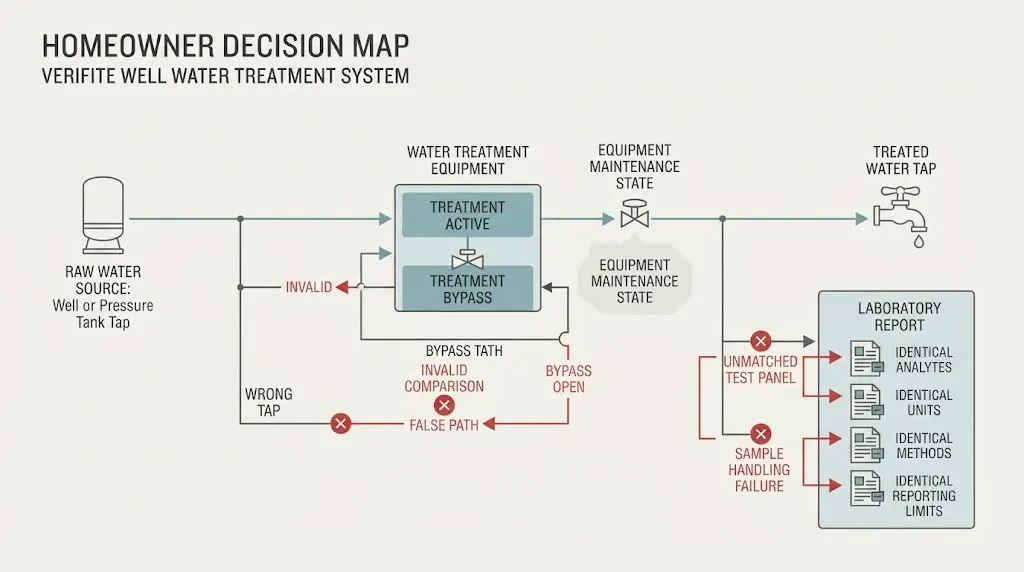
For a whole-house system, the ideal diagnostic arrangement is often:
well or pressure-tank source → raw sample tap → treatment equipment → treated sample tap → household plumbing
That arrangement is not guaranteed at every home. A source tap may not exist, the pressure tank may be downstream of one stage, or the “treated” kitchen tap may have a separate reverse-osmosis membrane that makes it incomparable with a whole-house bathroom tap. The point is to identify what each sample actually represents.
Arizona Cooperative Extension recommends analyzing well water at the wellhead if possible, after a treatment device, and at an untreated inside cold-water tap. It says wellhead and untreated-tap results should be similar; if they are not, the difference needs investigation. Arizona’s well-owner guide offers a useful three-point diagnostic model. It is not a national rule, and the laboratory must still approve the sample locations.
Label each point before sampling
Use fixed names in the field notes and on the lab submission forms:
- RAW-1: source or pressure-tank tap before all treatment, if it truly is before treatment.
- UNTREATED-1: a household cold-water tap that bypasses treatment, if the plumbing map proves it is untreated.
- TREATED-1: the treated line after the specific equipment under review.
- POU-1: a point-of-use device such as reverse osmosis, carbon, or a separate dispenser. Do not substitute it for TREATED-1.
- DRAIN-1 or BACKWASH-1: a process or drain point only if the laboratory and professional say that it is a valid sample for the question. It is not automatically drinking water.
Write the physical description, not only “kitchen sink”: “cold-water tap on treated branch, downstream of softener and carbon tank, upstream of under-sink RO.” Photograph the label or plumbing path only when it is safe and permitted. Note whether an aerator, hose, swivel, filter, faucet-mounted device, or storage tank sits between the treatment stage and the bottle.
Colorado State University Extension gives a bacteria-specific example: after disinfection, sample as close to the well as possible, and where a holding tank or in-house treatment exists, consider separate samples at the well and at a household faucet. CSU Extension’s bacteria guidance supports treating the sample location as part of the result—not as an administrative detail.
Decide whether the comparison is source-to-treated or tap-to-tap
The strongest homeowner comparison is source-to-treated: RAW-1 and TREATED-1 represent water immediately before and after the equipment being evaluated. A tap-to-tap comparison can be useful when the source tap is not available, but it must state the limitation. An untreated household tap can be affected by storage, plumbing, a different branch, or a different time of use.
Do not call a sample “raw” merely because it was collected from a faucet that is not the kitchen filter. Trace the plumbing. If the untreated tap has passed through a softener or a storage tank, it is not raw for a later carbon stage. If the treated sample is from a point-of-use membrane while the raw sample is before a whole-house softener, the comparison may answer a different question than the one on the label.
4. Ask the laboratory for a matched sampling plan
Before collecting anything, call the laboratory that will perform the analysis. EPA directs private-well owners to use a state-certified drinking-water laboratory or contact the state certification program; EPA does not test residential water on request. EPA’s certified-laboratory directory page is the starting point for finding the appropriate state program.
Give the lab the exact claim-to-test lines and the proposed sample-point map. Ask these questions and save the answer in the job file:
- Is the laboratory certified for each requested analyte and method for the intended use?
- Is the requested result reported as a concentration, presence/absence, activity, or another measure?
- What unit will be used, and is it compatible with the original pretreatment report and the product claim?
- What reporting limit will apply to each sample? Can the lab report the numerical reporting limit when the result is below it?
- Are the raw and treated samples collected in the same type of bottle, with the same preservation and holding time, or does the analyte require different bottles?
- Should the tap be flushed, and for how long? Does the method require first-draw, steady-flow, or another condition?
- Should an aerator or screen be removed? The lab’s instructions control because requirements differ by analyte and purpose.
- Must residual disinfectant be neutralized for microbiological testing?
- What sample volume, temperature, shipping window, delivery day, and chain-of-custody information are required?
- Should the samples be collected simultaneously, sequentially, or on separate operating cycles?
- Should the lab analyze duplicates, a field blank, or a split sample when the decision is contested or the result is near a health threshold?
EPA’s sample-collection guide says to prepare a sampling and analysis plan, check with the laboratory about bottles, preservatives, and procedures, and use a suitable cold-water faucet. It also says the guide is general and that the performing laboratory must confirm what is compatible with its methods. EPA’s Quick Guide to Drinking Water Sample Collection is therefore a reason to call the lab early, not permission to use one universal flushing rule.
UGA Cooperative Extension makes the same point from the homeowner side: contact the lab or agency before collecting, use its container and instructions, recognize that some tests require flushing while others require first-draw conditions, and respect analyte-specific holding times. UGA’s private drinking-water treatment guide also says to sample and analyze before and after treatment to determine efficiency.
If a lab refuses to certify the proposed point as representative, stop and resolve the point with the lab and a qualified treatment professional. A clean result from a convenient but invalid tap is not a successful verification.
5. Record operating state and collect the paired samples
A laboratory can only analyze the water it receives. Your notes must show what the treatment system was doing when each bottle was filled.
Record the operating state
For each sample, record:
| Field | Example entry to complete | Why it matters |
|---|---|---|
| Date and time | YYYY-MM-DD, local time | Groundwater and treatment conditions change; this also ties to holding time |
| Point ID | RAW-1 or TREATED-1 | Prevents a report from losing the sample’s place in the water path |
| Treatment state | Normal service, bypass closed/open, regeneration, backwash, sanitization, alarm | A bypassed or regenerating device may not represent ordinary service |
| Cartridge/media state | Part number or media, installed date, estimated gallons or service cycles | A new or exhausted component may answer different questions than routine operation |
| Flow and pressure | Lab-approved flow condition; gauge reading if safely visible | Performance claims can have rated service-flow or pressure conditions |
| Recent water use | Idle period, fixtures running, irrigation or other high demand | Explains why a source or storage sample may not be representative |
| Plumbing path | Upstream/downstream stages, storage, branch, faucet device | Shows what the bottle actually represents |
| Collection method | Flush duration or first-draw condition, bottle, preservative, sampler | A changed method can change comparability or invalidate the sample |
| Delivery | Lab receipt, temperature or shipping note, hold-time compliance | Prevents a good collection from becoming a bad result |
Do not change the cartridge, add salt, adjust chemical feed, force a regeneration, or manipulate a bypass valve immediately before sampling unless the test plan calls for it and the person doing it is qualified to do so. A post-maintenance sample can be useful, but label it as post-maintenance; it is not a routine-service result.
Do not open energized controls, remove electrical covers, open a well, pull a pump, enter a confined space, or manipulate pressurized equipment to reach a sample point. If the required point is inaccessible, ask a qualified professional to install or use a safe sample port. If you see a leak, damaged wiring, flooding, chemical spill, or a pressure problem, stop and escalate.
Collect exactly as the lab directs
The following is a coordination checklist, not a substitute for the laboratory’s method:
- Obtain the lab’s bottles and forms. Never improvise with a food, drink, or cleaned household container.
- Confirm which point IDs belong on which bottle before opening the caps.
- Clean your hands and keep the inside of the bottle and cap untouched.
- Use the faucet and flushing or first-draw condition specified for each analyte.
- Keep raw and treated bottles in the same sampling sequence or time window when the lab approves that design.
- Do not rinse a bottle that contains preservative unless the lab explicitly says to do so.
- Do not overflow, dechlorinate, cool, or filter a sample unless the lab instructions require it.
- Record start and finish times, visible color or odor, flow irregularity, pressure change, and any deviation.
- Deliver the samples within the laboratory’s stated holding time and temperature range.
- Ask the lab to note a rejected, compromised, late, warm, underfilled, or otherwise qualified sample on the report.
For a bacterial test, the sampling instructions are especially consequential. CSU Extension advises using a sterile lab bottle, not touching its interior, following the lab’s timing, and keeping the sample cool for prompt delivery; its flushing details are specific to the bacteria guidance. CSU’s instructions should not be copied to a metals, volatile-organic, or PFAS sample without lab approval.
When the decision is important—an installation dispute, a warranty claim, a result near a health threshold, or a large difference between raw and untreated-tap results—ask whether a professional sampler, duplicate, field blank, or split sample is appropriate. The additional cost may be lower than repeating an invalid comparison after a deadline.
6. Compare the reports claim by claim
Use one row per analyte. Do not average unrelated tests or use the “best-looking” result. A useful comparison table is:
| Analyte and form | Claim source and scope | Raw result | Treated result | Units and method match? | Reporting-limit status | Interpretation | Next action |
|---|---|---|---|---|---|---|---|
| [exact claim] | Manual/data sheet, model, rated flow/cycle | [value or <RL] | [value or <RL] | Yes / No / Unknown | [RL for both] | Verified reduction / not verified / invalid comparison | Maintain, retest, service, or escalate |
Check these gates in order:
- Same target. Is the reported analyte the exact contaminant and chemical form in the claim? “Minerals,” “chemicals,” or “TDS” is not interchangeable with a named contaminant.
- Same basis. Are the units, dissolved/total basis, species, and sample type comparable? If not, ask the lab whether a conversion is valid; do not invent one.
- Same method scope. Are the analytical methods comparable enough for the intended decision? If two reports used different methods, ask the laboratory or a qualified professional whether the comparison is valid.
- Same water path question. Is RAW-1 truly before the stage and TREATED-1 truly after it, with no hidden branch, storage tank, or point-of-use device?
- Same operating question. Was the equipment in service, not bypassed, and within the documented maintenance and flow conditions relevant to the claim?
- Same sample integrity. Were bottles, preservation, holding time, flushing or first-draw rules, and delivery conditions acceptable?
- Same decision threshold. Is the result being compared with a manufacturer claim, a health standard, a warranty condition, or a household preference? Those are different decisions.
Calculate reduction only when the inputs support it
If the laboratory reports numerical, comparable concentrations, the simple observed reduction is:
observed reduction (%) = (raw concentration − treated concentration) ÷ raw concentration × 100
Example using deliberately generic arithmetic: if RAW-1 is 12 units and TREATED-1 is 3 units, the observed difference is 9 units and the observed reduction is 75%. That is a statement about those samples under those conditions. It is not proof that the equipment will always achieve 75%, because the device claim may be tested at a particular flow, capacity, influent concentration, contaminant form, and service-cycle point.
If either result is reported as below the reporting limit—such as “<2”—do not substitute 2 into the formula and do not call the result zero. Report it as “below the laboratory reporting limit of 2,” then ask whether a different method or lower reporting limit is appropriate. If raw is below the reporting limit, there may be no meaningful reduction calculation at all. If treated is below the limit but raw is numerical, you can state a bound only if the lab or statistician says the bound is appropriate; otherwise keep the conclusion qualitative.
If the treated result is higher than the raw result, do not assume the treatment made the water worse. First investigate sample-point mismatch, plumbing contribution, storage, timing, laboratory variability, preservation, and a treatment-state change. Arizona Extension’s advice to compare the wellhead with an untreated household tap is useful here: a difference before the treatment stage points to a separate source, plumbing, or distribution question. Arizona’s guide describes that comparison without treating it as a universal explanation.
7. Use the failure branches before changing equipment
A failed comparison is often a failed test design, not immediately a failed filter. Use this matrix to choose the next safe action.
| What the report or field notes show | What you may conclude | What you must not conclude | Safest next step |
|---|---|---|---|
| Correct analyte, matched method and units, valid raw and treated points, normal service, treated result lower | The paired samples support reduction under the recorded conditions | The system will meet the same result forever or remove untested contaminants | File the report, record the service state, and retest on the manual or risk-based schedule |
| Treated result is below reporting limit | The result is below that lab limit on that sample | The contaminant is zero or an exact reduction percentage is known | Ask whether the limit is fit for the health or warranty decision |
| Wrong analyte or chemical form | The requested claim was not tested | The system does or does not work for the claimed contaminant | Order the exact test after confirming the lab’s method and the manufacturer’s scope |
| Raw sample was already treated, or treated sample was from a separate point-of-use device | The comparison is not source-to-stage as intended | The whole-house stage reduced the claim | Remap the plumbing and repeat with named points |
| Bypass open, regeneration/backwash in progress, exhausted cartridge, or alarm present | The test documents a non-routine state | Normal-service performance has failed or passed | Have the qualified service person restore or document the intended state, then retest |
| Different units, reporting limits, methods, or dates with no lab comparability statement | The reports cannot yet support a quantitative comparison | A percentage reduction can be calculated | Ask the lab for a matched method or repeat both samples |
| Unexpected change between RAW-1 and UNTREATED-1 | A source, branch, storage, or plumbing difference exists | The treatment device caused the difference | Sample or inspect the intervening path with a professional |
| Treated result remains above a health threshold | The intended health outcome is not demonstrated | It is safe because taste or appearance improved | Use the health department’s instructions, an alternate safe source if directed, and professional troubleshooting |
| Sample rejected, late, warm, underfilled, contaminated, or missing preservative | The result is not reliable for the intended decision | The equipment failed | Repeat under the lab’s accepted procedure |
Contact the local health department promptly for a positive microbiological result, a contaminant with an applicable health standard, or a result that could affect drinking, cooking, infant formula, bathing, or another exposure. CDC says contaminated well water should not be used until the appropriate treatment is complete and confirmed; for chemical contamination, boiling will not remove the chemicals. CDC’s treatment page gives the boundary. EPA says that when a contaminant exceeds a health standard, the owner should contact public-health officials and have the well retested to confirm presence and concentration. EPA’s private-well guidance supports that escalation.
Do not troubleshoot a suspected health failure by opening the well, pulling the pump, opening an energized control panel, changing wiring, bypassing a safety device, handling treatment chemicals, or opening a pressurized tank. Give those tasks to the appropriately qualified professional. If the system is flooded or electrical equipment is wet, stay away and obtain contractor or public-health direction.
8. Turn the result into a maintenance and escalation record
A one-time post-install test is a baseline. It is not a lifetime certificate. UF/IFAS Extension says to monitor the specific problem being treated at installation, at regular intervals afterward, and when water quality changes. UF/IFAS’s household-water testing guidance supports scheduling around the contaminant and equipment rather than using a generic “water looks fine” check.
Use this record after the first valid comparison:
At every service event
- Record the date, service provider, component replaced, media added, salt or chemical service, lamp or membrane status, and any measured or observed flow or pressure condition.
- Photograph model and component labels only when safe.
- Record whether the bypass was closed and whether the controller showed a fault, regeneration, backwash, or sanitization cycle.
- Save the invoice, manual revision, service note, and any adjustment made.
- Do not reset the maintenance clock without recording the reason and the new baseline.
At the interval chosen with the lab, health department, or professional
- Repeat the exact claimed analytes at valid raw and treated points.
- Use the same lab and method when practical; if not, document why and obtain a comparability opinion.
- Recheck the reporting limits and units before comparing with the original report.
- Use the same operating-state fields, including cartridge/media age and service-cycle position.
- Investigate any changed taste, odor, color, pressure, flow, leaks, alarms, or repeated treatment cycling rather than waiting for the next calendar test.
EPA recommends annual private-well testing for total coliform bacteria, nitrates, total dissolved solids, and pH, and says to test immediately after replacing or repairing part of the well system or after a noticeable water-quality change. It also says that additional substances depend on local conditions. EPA’s well-protection guidance is the broad well-owner schedule; it does not replace the treatment-specific claim panel in this worksheet.
Keep a “known, unknown, next action” summary:
| Known from evidence | Still unknown | Next action and owner |
|---|---|---|
| Exact model, claim, raw point, treated point, and matched result | Performance after the rated service cycle | Schedule service or repeat test at the documented interval |
| Treated result is below the reporting limit | Exact concentration below that limit | Ask lab whether a lower reporting limit is needed |
| Treated result is lower under normal service | Long-term performance after flow, source, or season changes | Maintain records and repeat the specific claim test |
| Untreated tap differs from the wellhead | Where the difference enters | Qualified plumber or treatment professional maps and samples the branch |
| Sample was invalid or rejected | Whether the device is working | Repeat the collection; do not diagnose from the rejected result |
| Health-related exceedance remains | Safe use while troubleshooting | Health department and qualified professional; use alternate source as directed |
Bring this packet to the next professional:
- the original pretreatment report and every post-treatment report;
- the exact model, claim, manual, data sheet, and certification or warranty document;
- the water-path drawing and point descriptions;
- sample dates, times, bottles, methods, units, reporting limits, holding-time notes, and deviations;
- bypass, cartridge/media, regeneration/backwash, flow, and pressure notes;
- maintenance and service records;
- photos of accessible labels and sample points;
- the question you need answered: “Is the equipment failing, is the sampling design invalid, is the source changing, or is another plumbing stage contributing?”
The final homeowner conclusion should be short and conditional: what was tested, at which points, under which equipment state, what the laboratory reported, what was not tested, and what happens next. That is enough to support maintenance, warranty, service, and health follow-up without claiming more than the evidence can carry.
Sources and scope
Evidence behind this page
- Guidelines for Treating Well Water
CDC health guidance for private well water; it supports testing after treatment and matching treatment to a known germ or chemical, not a universal homeowner test schedule.
- Contact Information for Certification Programs and Certified Laboratories for Drinking Water
EPA laboratory-certification guidance for US drinking-water testing; state certification details and available analytes vary by jurisdiction.
- Product Label and Literature Claims
NSF consumer guidance about certified water-treatment-system labels and literature; the device's own current performance data remains controlling for its exact model.
- Product Label and Literature Claims
NSF consumer guidance; it does not mean every product has the same data sheet, warranty, flow rating, or certified claim.
- Protect Your Home's Water
EPA private-well health guidance; annual testing is guidance, not a universal national property-transfer requirement.
- Quick Guide to Drinking Water Sample Collection, Second Edition
EPA Region 8 chemistry-sample refresher; it is general guidance and explicitly directs the sampler to confirm the exact procedure with the performing laboratory.
- Bacteria in Water Wells
CSU Extension guidance for bacteria sampling; its timing, bottle, and flushing instructions are not a universal protocol for every analyte.
- Well Water Testing and Understanding the Results
Arizona Cooperative Extension guidance; the three-point pattern is a diagnostic model, while local laboratory instructions and state requirements control actual sampling.
- Water Quality and Common Treatments for Private Drinking Water Systems
University of Georgia Cooperative Extension guidance for private drinking-water testing and common treatments; specific methods and timing depend on the test.
- Water Quality and Common Treatments for Private Drinking Water Systems
University of Georgia Cooperative Extension general treatment guidance; it does not define a universal reduction percentage or certify a particular product.
- Household Water Treatment
Virginia Tech household water-treatment guidance; it is general education and does not replace the model-specific manual or state health guidance.
- Household Drinking Water Testing for Public and Private Water Supplies
UF/IFAS Extension guidance; interval selection depends on the contaminant, equipment, health risk, and local advice.
- Guidelines for Treating Well Water; Protect Your Home's Water
CDC and EPA health-response guidance for contaminated private wells; the applicable action depends on the contaminant and local public-health instructions.