A rig leaving the property does not automatically mean the project is closed. The work may be physically finished while the well record is incomplete, the pump test is missing, a permit filing is late, or the final invoice still depends on an unapproved change.
For a well drilling or pump company, closeout is the handoff between field work and the rest of the business. It protects the record, the payment, the warranty conversation, and the next service opportunity.

What belongs in a well drilling project closeout checklist?
A complete closeout checklist verifies four things: the installed work is complete, the evidence describes what was actually built and tested, the required records have gone to the right people or agencies, and the commercial file is ready to close. Use three gates: field complete, evidence complete, and business complete.
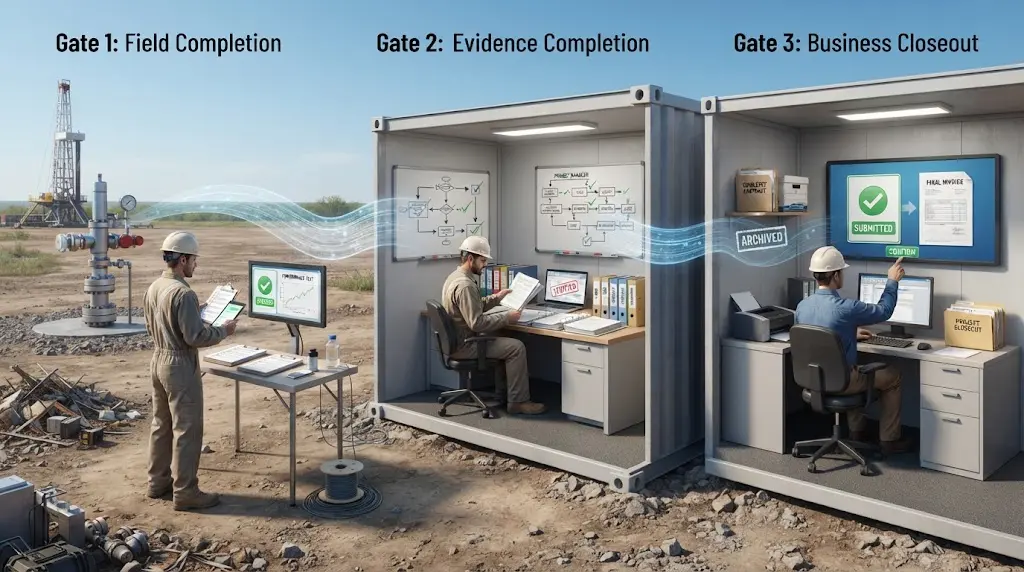
This structure matters because each gate has a different owner and a different kind of proof.
| Gate | The decision | Minimum proof | If it fails |
|---|---|---|---|
| Field complete | Can the crew release the site safely and honestly? | Field checklist, readings, photos, operating demonstration, and punch-list status | Keep a field item open and assign a person before demobilization. |
| Evidence complete | Could another qualified person reconstruct the well and system from the file? | Final well data, pump data, test records, photos, permits, filings, and indexed documents | Mark the file document-incomplete and do not rely on memory later. |
| Business complete | Are scope, money, handoff, warranty, and follow-up resolved? | Approved changes, invoice support, acceptance, warranty record, and CRM closeout | Use conditional closeout or keep the job open. |
The checklist below is a contractor operating framework. It is not a substitute for the permit, contract, state rule, local health requirement, manufacturer instruction, or engineer's specification controlling a particular project.
A well project is not closed because the rig is gone. It is closed when the field result, evidence, and business file agree.
The phrase "closeout" can cover different work. A domestic water well with a pump and pressure system needs a different packet from a monitoring well, geothermal loop, irrigation well, municipal production well, or mineral exploration hole. Start by writing the project type at the top of the checklist and list which trades and permits were in scope.
At minimum, identify:
- The well type and intended use.
- The physical address, parcel, coordinates, and well or permit number.
- The contracting party and the owner or agency receiving the records.
- The work included, excluded, and changed.
- Whether drilling, completion, development, testing, pump installation, electrical work, water treatment, sampling, restoration, or abandonment was included.
- The authority that receives the completion report, if one is required.
- The person responsible for final field inspection and the person responsible for office closeout.
That first line prevents a common error: treating a pump installation closeout as if it were the same as a new well construction closeout. It also prevents the office from assuming that the driller, pump installer, sampler, and permit holder are all the same party.
When is the project open, conditionally complete, or closed?
Use explicit status labels instead of a single checkbox. A status label tells the office whether it can invoice, the service team whether the record is trustworthy, and the owner whether something is still expected.
| Status | Use it when | What the office may do | What still has to happen |
|---|---|---|---|
| Open | Field work, a safety item, a material test, a required filing, or a contract deliverable is unresolved. | Schedule the next action and communicate the blocker. | Resolve the blocker and attach proof. |
| Field complete | The installed work is safe and functional enough for the agreed field release, but documents or external results are still pending. | Start office review and prepare the packet. | Finish the evidence and commercial gates. |
| Conditional closeout | The contractor's work is complete, but a named third party or external event is pending, such as an agency receipt or laboratory result. | Invoice only according to the contract and local law, with the exception documented. | Track the dependency to a named date and deliver the result when received. |
| Closed | All three gates pass and no critical exception remains. | Archive the file, trigger the agreed follow-up, and report the job closed. | Reopen only for a warranty, correction, or new scope. |
Conditional closeout is useful, but it is not a way to hide missing work. The exception must name the dependency, the responsible party, the evidence expected, the due date, the owner communication, and whether it affects payment or warranty. If no one can answer those questions, the project is still open.
The contract controls whether an invoice can be issued before every closeout document is complete. Some public project specifications explicitly connect closeout submittals, final inspection, final payment, final cleaning, and demobilization. The City of Vacaville's public Wells 18, 19, and 20 project manual, for example, lists testing and system demonstration, an initial punch list, closeout submittals, final application for payment, final cleaning, and site demobilization in its closeout meeting agenda. Treat that as a project-specific example of a formal closeout sequence, not a national rule. City of Vacaville project manual
How should the office start closeout before the rig leaves?
Start the closeout review on the final field day, not when the invoice is due. The person who watched the work happen can resolve an unclear depth, missing serial number, or unlabelled photograph in minutes. The same question asked two weeks later may require a return visit.
Use this seven-step field-release procedure:
- Freeze the scope. Read the proposal, work order, approved changes, permit, and current field notes together. Mark what was completed, changed, deferred, or excluded.
- Record the actual result. Capture the final depth, construction intervals, water levels, yield or test data, pump setting, equipment details, and any other values required by the permit, contract, or applicable form. Use the required units and identify the measurement date and reference point.
- Walk the site. Check the wellhead, cap or seal, pad, drainage, exposed piping, electrical or control work, access, cleanup, cuttings, debris, and disturbed ground against the scope and local requirements.
- Demonstrate the system. Run the pump or other installed equipment within the agreed test procedure. Record what was tested, the conditions, the readings, and any limitation that prevents a full test.
- Photograph the evidence. Take wide site photographs and close photographs of the wellhead, cap, seal, identification, control equipment, pressure system, visible piping, restoration, and any exception. Tie photographs to a date and job identifier.
- Open the exception log. Do not put a vague note such as "follow up later." Name the item, severity, owner, due date, evidence, and effect on status or payment.
- Hold the release conversation. The field lead and office owner confirm the status label, the next action, and who speaks with the customer or agency.
The office should have a single closeout folder or job record. Avoid one set of photos on a phone, another set of test readings in a text message, and the permit receipt in a personal email account. The storage system can be paper, a field-management platform, or a structured drive. The control is the index and the naming convention.
The closeout file starts with the same scope discipline used at proposal time. If the front-end scope is vague, the final packet will be vague too. Use Well Contractor Proposal Cover Letter Template as a related way to make scope, assumptions, exclusions, and the next action explicit before the crew mobilizes.
Suggested file naming pattern:
[job-id]_[well-or-site]_[document-type]_[date]_[version]
For example, use a generic pattern such as JOB-1234_WELL-A_pump-test_2026-08-20_v1.pdf. The exact job ID is yours. The useful part is consistency, not the software.
What must be checked in the field before demobilization?
The field checklist should test the actual deliverable, not just whether the crew performed an activity. A checkbox that says "pump installed" is weaker than a record that says what pump was installed, where it was set, what the system did during the test, and which document proves it.
Well construction and completion
Record the final construction information required by the project and jurisdiction. Depending on well type and scope, that can include:
- Well identification and location.
- Date drilling started and finished.
- Drilling method.
- Total depth and depth reference.
- Borehole diameter where required.
- Casing material, diameter, weight or thickness if required, and installed lengths.
- Liner, screen, filter pack, formation stabilizer, grout, seal, or other completion materials and intervals where applicable.
- Water-bearing zones and lithology or formation log information.
- Static water level, measurement date, and reference point.
- Yield or production result, test rate, test duration, drawdown, and recovery where measured.
- Development method, duration, discharge destination, and observations where required.
- Disinfection method and record, where in scope.
- Wellhead elevation or finished-grade relationship where the governing form or specification requires it.
Pennsylvania's official water-well data page is a useful example of the type of information a completion record may require. It says the report should include an accurate location, complete construction information, as much detail as possible about the rocks encountered, and groundwater information such as yield, water-bearing zones, and water levels. Those are Pennsylvania instructions, but they are a strong prompt for the fields your own state or contract may require. Pennsylvania Department of Conservation and Natural Resources
Washington's Department of Ecology describes its well report as a record of location, ownership, construction details, and lithology, completed and signed by the individual who constructs the well. That is another reason to assign the field record to a named qualified person instead of asking the office to reconstruct it from a daily log. Washington State Department of Ecology
Pump, controls, and pressure system
If pump work was included, record the installed system rather than only the quoted system. The closeout record should make it possible to identify the equipment and understand how it was matched to the well and service conditions.
Capture, as applicable:
- Pump type, manufacturer, model, serial number, horsepower, voltage, phase, and rated capacity.
- Pump installation date and setting depth.
- Drop pipe or column information.
- Cable type, size, length, splice or connection details, and conduit information when required by the project.
- Pitless adapter, well seal, cap, vent, and sanitary-seal information.
- Control box, variable-frequency drive, pressure switch, sensors, overload settings, disconnect, and alarm details.
- Pressure tank manufacturer, model, size, pre-charge or set-point information where relevant.
- Pressure cut-in, cut-out, and observed operating pressure when that is part of the scope.
- Water treatment equipment or bypass position if installed.
- Product manuals, warranty documents, and serial-number photographs.
WellOwner.org's finished-well checklist tells owners to obtain pump motor and pump-end information, ratings and serial numbers, warranty information, discharge-pipe and cable characteristics, pressure-system paperwork, and a demonstration of function. The contractor-facing lesson is simple: make these items part of the handoff packet before the owner has to ask for them. WellOwner.org finished-well checklist
Site, safety, and restoration
The well record does not prove that the property was left in the agreed condition. Add a site-release block with:
- Wellhead, cap, seal, or enclosure installed and visibly secure.
- Finished grade, pad, drainage, and access checked against the scope and applicable requirement.
- Exposed lines, conduits, and controls protected and identified.
- Cuttings, drilling fluids, waste, pallets, trash, and temporary materials handled under the contract and applicable rules.
- Fencing, gates, landscaping, pavement, or agricultural access restored where included.
- No open excavation, unmarked hazard, trip hazard, or unsecured equipment left by the contractor.
- Final wide-angle photographs taken from consistent reference points.
- Owner or representative shown the operating area and any access or shutoff points within the agreed scope.
Do not treat a photograph of a clean truck as proof of site restoration. Photograph the wellhead, the ground around it, the access route, and any restored or excluded area.
Field closeout table
Use this as a starting point, then add fields from the work order, permit, specification, and local authority.
| Field check | Evidence to attach | Owner | Status |
|---|---|---|---|
| Scope and approved changes reconciled | Signed scope review and change log | Project lead | Open / pass |
| Final well depth and construction recorded | Field log, final record, measurement reference | Driller or qualified supervisor | Open / pass |
| Water level and yield or test data recorded | Test sheet with dates and units | Test lead | Open / pass / N/A |
| Development and disinfection recorded | Procedure, readings, discharge notes | Driller or pump lead | Open / pass / N/A |
| Pump and controls identified | Serial-number photos, equipment sheet | Pump installer | Open / pass / N/A |
| System demonstrated | Commissioning sheet and readings | Pump lead | Open / pass / N/A |
| Wellhead and visible components checked | Closeout photos | Field lead | Open / pass |
| Site restored and waste handled | Photos, disposal or haul record if required | Site lead | Open / pass |
| Owner or representative walked through result | Sign-off, email, or meeting note | Project lead | Open / pass |
| Exceptions assigned | Exception log with due dates | Office owner | Open / pass |
The status column should not be a free-form paragraph. Use a controlled value and put the explanation in the attached record or exception log.
The strongest field closeout record pairs every important number with a date, unit, reference point, person, and source document.
What should be in the closeout packet?
Build the packet as an indexed set of records, not as a single overloaded PDF. A small contractor may combine sections, but the office should be able to identify where each class of evidence lives.
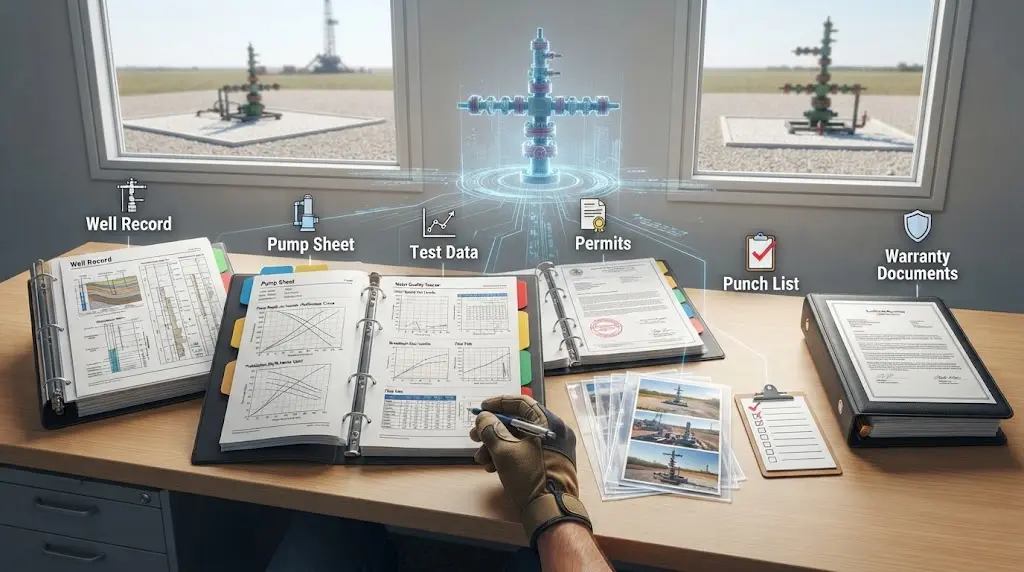
The following index works for many well and pump projects. Mark each row included, not applicable, pending, or not in contract.
| Packet section | What belongs there | Why the contractor keeps it |
|---|---|---|
| 1. Cover and index | Job ID, address, well ID, project type, completion status, document list, contacts | Gives the office and owner one map of the file. |
| 2. Scope and changes | Signed proposal or work order, permits, approved change orders, exclusions, field directives | Shows what was promised and what changed. |
| 3. Well construction record | Completion report or well log, final depth, casing, screen, grout, seal, geology, water zones | Describes what was built and supports future service. |
| 4. Development and yield | Development notes, pumping test, static level, drawdown, recovery, discharge notes | Separates tested performance from an estimate or observation. |
| 5. Pump and controls | Equipment sheet, serials, setting, wiring or control data, pressure components, manuals | Lets service staff identify the installed system. |
| 6. Water quality and disinfection | Disinfection record, sample information, chain of custody, lab report, owner notice | Shows what was done and what result was actually received. |
| 7. Site and restoration | Final photos, restoration record, waste or disposal records, exclusions | Records the visible condition at release. |
| 8. Inspections and approvals | Inspection notes, agency receipts, permit closeout, acceptance record | Proves the required outside steps were addressed. |
| 9. Punch list and exceptions | Open items, owners, due dates, severity, evidence, closure dates | Prevents a verbal promise from disappearing. |
| 10. Handoff and warranty | Owner handoff, operating contacts, manuals, warranty, maintenance notes, limitations | Gives the recipient a usable record and clear next step. |
| 11. Commercial closeout | Final quantities, approved changes, invoice support, retainage or release documents where applicable | Connects completed scope to the amount billed. |
| 12. Internal learning | Actual duration, delays, rework, material issues, callbacks, lessons learned | Improves estimating, dispatch, training, and future proposals. |
The packet should distinguish actual, tested, estimated, and not measured. Those labels prevent an estimate from being repeated later as a guaranteed yield or a tested pump capacity.
For example, a well log may say the well is expected to produce a certain amount based on drilling observations, while a later pump test measures a different rate under a specific test setup. Put both in the file, name the difference, and state which value the contract or agency recognizes. Do not silently replace one with the other.
A practical packet cover sheet
The cover sheet can contain the following fields:
Job ID:
Project type:
Well or site ID:
Physical address:
Coordinates or location reference:
Owner or contracting party:
Permit number:
Drilling contractor:
Pump contractor:
Field completion date:
Evidence packet target date:
Required agency or local filing:
Current status: Open / Field complete / Conditional closeout / Closed
Critical exception:
Next action:
Responsible person:
Customer or agency notified on:
Final invoice status:
Warranty record location:
Keep the cover sheet short. Its job is to tell the next person what the file is and whether it is safe to rely on, not to replace the records behind it.
How should the file distinguish a well report from an owner handoff?
A regulatory completion report and an owner handoff packet overlap, but they are not the same thing. The agency form may not include the product manual, final photos, warranty contact, pressure-system explanation, site exclusions, or the approved change order. The owner handoff may include those items but still fail to satisfy the official report format.
Treat the official filing and the customer packet as two linked outputs. Put the agency receipt or submission confirmation in the project file and provide the owner the copy required by the governing rule or contract. New York's Water Well Contractor Program, for example, says the contractor must complete a Water Well Completion Report and submit it to the Department and the well owner. NYSDEC Water Well Contractor Program
What must be filed, and how do state rules vary?
There is no single US closeout deadline or universal completion form. The contractor should verify the permit, well type, authority, filing method, signer, deadline, required fields, owner-copy rule, and any local inspection before the job is marked closed.
Use this filing decision table for every job:
| Question | Record the answer |
|---|---|
| Which state, county, city, or other authority controls? | Authority name and web page or permit clause |
| What kind of well or work is this? | New well, alteration, pump installation, repair, monitoring, geothermal, irrigation, public supply, abandonment, or other |
| What form or portal is required? | Form name, version, portal, and access date |
| Who must sign or submit? | Driller, pump installer, owner, engineer, permit holder, or other |
| What is the trigger date? | Completion of drilling, completion of construction, pump installation, inspection, or another defined event |
| What is the deadline? | Exact date calculated from the trigger and rule |
| What fields and attachments are required? | Checklist copied from the current instruction |
| Who gets a copy? | Owner, agency, local health department, engineer, or contract administrator |
| What proves submission? | Receipt, confirmation number, email, stamped copy, or portal screenshot |
| What remains pending? | Exception log entry with owner and date |
The table is deliberately procedural. A deadline copied from a neighboring state is worse than no deadline because it creates false confidence.
Examples of state-specific reporting rules
These examples show why the office should build a job-specific filing line:
- Pennsylvania: The Department of Conservation and Natural Resources says water well drillers are required by law to submit construction details to the state and provide the same information to owners. It says the completion report should include location, construction, drilling geology, and groundwater information. PA DCNR water well data
- New York: NYSDEC says a water well contractor must notify DEC before drilling and file a completion report upon completion, with a copy provided to the owner. The program also points to state standards covering location, construction, well yield, pumps, flowing wells, separation standards, and decommissioning. NYSDEC contractor program
- Washington: The Department of Ecology says well reports must be submitted within 30 days following completion of the well and describes the record as covering location, ownership, construction, and lithology. That is a Washington rule and should not be copied into another state's checklist. Washington well report viewer
- California: California DWR says California Water Code Section 13751 requires covered completion reports within 60 days of the completion of the work. The type of work covered by that statement includes constructing, altering, or destroying specified wells. California DWR completion reports
- Virginia: Virginia's administrative code provides an example requiring a uniform completion report within 30 days of completion of construction, alteration, abandonment, or deepening of a private well, with a statement signed by the water well systems provider. Virginia Administrative Code
- Arizona pump installation: Arizona publishes a separate Pump Installation Completion Report resource. Its form includes pump type, rated capacity, static level, pumping level, drawdown, test pumping rate, and test duration. That illustrates why a pump installation may need its own closeout record even when the well construction record already exists. Arizona DWR pump installation report
Do not turn those examples into a 30-day national rule. Use them to train the office to ask the right questions. The current permit and authority instructions control.
State examples belong in the filing decision table, not in a contractor's memory. Record the source and access date with the job.
What if the agency portal is down or the form is not ready?
Treat a portal problem as an exception, not as permission to forget the filing. Save the attempted submission time, error message, form version, contact attempt, and interim instruction. Notify the owner or contract administrator if the delay affects their records or a contractual milestone. Follow the authority's published alternative method, and attach the eventual receipt to the packet.
Do not claim that an email, screenshot, or draft form is a completed filing unless the authority accepts it as such. The closeout status should say "agency submission pending" or "agency receipt pending" and identify the person watching it.
How should a contractor verify well and pump performance?
Record the test method and conditions before interpreting the result. A yield number without a test rate, duration, water-level reference, discharge method, or recovery observation is difficult to compare and easy to overstate.
Well performance record
For a production or water-supply well, the performance section may include:
- Static water level before pumping, with the measurement date and reference point.
- Pumping water level or maximum drawdown, with the same reference system.
- Pumping rate and how flow was measured.
- Start time, stop time, total duration, and any interruptions.
- Discharge location and whether discharged water could recirculate toward the well.
- Recovery measurements and recovery time where required or measured.
- Water clarity, sand production, turbidity, temperature, or field observations when included in the procedure.
- Test-pump type, capacity, setting, column, and measuring equipment where a test pump was used.
- Calibration or equipment identification when required by the contract or standard.
- The person conducting the test and the person reviewing the result.
The official New York completion form shows how specific this record can become. It includes static level before the test, maximum drawdown, recovery time, drilling dates, pump information, hydraulic development, pressure, water used, and water returned. The form is New York-specific, but it is a useful prompt for designing a complete internal test sheet. NYSDEC Water Well Completion Report PDF
Arizona's official pump-installation form similarly separates static water level, pumping water level, drawdown, test pumping rate, and duration. Use the exact fields required by the local form or contract, and keep the internal record detailed enough to explain how the reported result was produced. Arizona DWR Pump Installation Completion Report
Pump commissioning record
The pump section should answer five questions:
- What equipment was installed?
- Where was it installed?
- What controls and protection were connected?
- What happened when the system ran under the agreed test conditions?
- What limitations, alarms, or owner instructions remain?
Record the actual installed model and serial numbers. Attach a clear photograph. If the pump was selected or adjusted after the original proposal, link the change record. If the test used a temporary pump, label it as a test pump and do not let the result be read as the performance of the permanent system.
The office should also capture the operating limits that matter to service staff. Examples include pressure switch settings, tank pre-charge or set point where documented, control-box information, alarm condition, disconnect location, and any manufacturer-specific reset or maintenance instruction. Do not invent a setting after the job. If it was not measured or is not part of the scope, mark it "not measured" or "not in contract."
How should the contractor handle a failed or incomplete test?
Do not convert an interrupted test into a passing test. Record the start and stop times, the reason for interruption, the measurements obtained, the conditions that prevented completion, and the next decision.
Possible next decisions include:
- Repeat the test after the system recovers.
- Correct a wiring, control, leak, pressure, discharge, or equipment problem.
- Obtain written direction from the engineer, owner, or contract administrator.
- Close the field work conditionally while keeping the performance item open.
- Stop and escalate if the result suggests an unsafe or nonconforming condition.
The closeout packet should make the limitation visible. A short honest record is more useful than a clean-looking form with an unexplained gap.
How should water quality and disinfection be closed?
Treat disinfection, sampling, and laboratory results as separate records with their own dates. A statement that the well was "clean" is not a substitute for a disinfection record or laboratory report when those items are required.
The exact treatment and sampling requirement depends on the well's use, the contract, the state or local authority, and the contamination risk. For private well water, CDC says to use a state-certified laboratory and recommends at least annual testing for total coliform bacteria, nitrates, total dissolved solids, and pH. That is federal public-health guidance for private well owners, not a universal project acceptance panel. CDC guidelines for testing well water
The contractor's closeout record should identify:
- Who performed or supervised disinfection.
- Date, method, products, concentration or amount where required, and contact or flushing information.
- Which parts of the system were included or bypassed.
- Where disinfectant water was discharged and whether the procedure required a specific disposal method.
- Sample location, date and time, collector, laboratory, requested analyses, and chain-of-custody record.
- Laboratory certification or other qualification required by the authority.
- Result status, report date, and who reviewed it.
- Customer or agency notice if the result is pending, unsatisfactory, or requires follow-up.
CDC's emergency disinfection guidance says to contact local or state authorities for specific advice, use a contractor where safety concerns exist, wait at least 7 to 10 days after disinfection before testing in that emergency context, and test again if bacteria are detected. The page is written for emergency conditions, so do not blindly copy its timing into a routine new-well contract. Use the applicable local procedure and record which instruction controls. CDC well disinfection guidance
If the laboratory result will arrive after field demobilization, keep the job in conditional closeout. The exception should include the sample date, lab, requested test, expected result date, result recipient, and a communication record. When the result arrives, attach it, record the review, update the owner, and close the exception.
When the result is unsatisfactory, do not close the item by adding a note that the owner was informed. The correct next step may require resampling, additional disinfection, a technical investigation, treatment, or authority direction. The closeout status should reflect the actual state of the work.
How should the site and owner handoff be completed?
The handoff is complete when the recipient has the records, knows what is still pending, can identify who to call, and can distinguish installed scope from excluded or future work.

Use a handoff meeting or structured call for projects with a pump, controls, water testing, multiple trades, public funding, or unresolved external records. For a small job, a signed form or clear email may be enough if it identifies the documents delivered and the remaining actions.
The owner-facing handoff packet
Give the owner or contract administrator the records required by the contract and governing authority. A useful packet may include:
- Completion report, well log, or other official well record.
- Final construction summary with actual depth, casing, screen, grout or seal, and relevant geology.
- Development, yield, pump-test, and recovery records where in scope.
- Pump, motor, control, pressure, and visible-system details.
- Equipment manuals, serial numbers, warranties, and supplier contacts.
- Disinfection record, sample chain of custody, and laboratory results when available.
- Permit, inspection, agency receipt, or approval record.
- Site photographs and restoration notes.
- Operating demonstration record and practical limitations.
- Open exception list with owner, due date, and next communication.
- Contractor contact and warranty process.
WellOwner.org says, in its finished-well checklist, “The contractor is required to deliver a copy of the record to the owner.” WellOwner.org finished-well checklist The quote is directed at owners, but it gives the contractor a clear standard: the well record should be delivered, not merely stored in the contractor's office.
Do not give the owner a folder full of unlabeled images and call it a record. Use a document index and explain which files are official, which are test results, which are product documents, and which are contractor observations.
An owner handoff is a deliverable, not a link to an internal folder.
How should the contractor record acceptance?
Acceptance should identify the scope accepted, the date, the representative, and the exceptions. Avoid a blanket sentence such as "customer satisfied" if a permit receipt, lab report, or repair is still pending.
An acceptance record can say:
The field work listed in the attached scope was reviewed on [date].
The system demonstration covered [scope and test conditions].
The following documents were delivered: [index or file link].
The following exceptions remain: [exception IDs, owners, due dates].
Acceptance status: field accepted / conditional closeout / closed.
Representative and role: [name and role].
The representative's signature does not waive a requirement unless the contract and law allow that result. It simply records what was reviewed and what remains visible.
How should commercial closeout connect to the field record?
Commercial closeout should reconcile the invoice to the actual completed scope, approved changes, quantities, exclusions, and unresolved items. The office should not make billing decisions from a technician's memory or from a total typed into a text message.
Review these items:
- Original proposal, work order, purchase order, or subcontract.
- Approved change orders and field directives.
- Actual quantities or units that affect the invoice.
- Standby, extra footage, difficult ground, materials, trucking, disposal, testing, pump installation, electrical, restoration, or other billable items if included in the terms.
- Credits for omitted scope.
- Retainage, release forms, lien waivers, or other contract documents where applicable.
- Supplier invoices, equipment serials, and warranty registrations where they support the scope.
- Tax, permit, inspection, or laboratory charges when the agreement assigns them.
- Punch-list items that affect final payment under the contract.
- Customer acceptance and final handoff date.
The closeout packet should include an invoice-support page that points to the evidence for each material line. It does not need to expose internal margin or confidential supplier terms to the customer. It does need to let the office answer, "What does this line represent, and where is the proof?"
What if the scope changed in the field?
Link the change to the reason, authorization, work performed, materials used, and price or time effect. If the change was directed verbally, record who directed it and when, then obtain the written confirmation required by the contract as soon as possible.
Do not bury a material scope change in the final invoice. It creates a closeout dispute even when the field work was sound. A one-page change log is often enough:
| Change ID | Original scope | Actual change | Authorized by | Date | Cost or time effect | Evidence | Status |
|---|---|---|---|---|---|---|---|
| CO-01 | [scope] | [change] | [person or contract reference] | [date] | [amount or days] | [photo, note, directive] | Approved / pending |
Use placeholders until the actual values are known. Never backfill invented quantities or costs just to make the table look complete.
How should warranty information be handled?
A warranty record should state what product or workmanship it covers, the start or delivery date, the provider, the claim route, exclusions that were supplied with the product or contract, and the documents needed for a claim. Attach the actual manufacturer or contract warranty. Do not promise a duration or response time that is not in the governing terms.
Link the warranty record to the installed serial number. If the pump was replaced or a component was changed, update the record. If the owner declined an item, record the exclusion and any effect on warranty only when the governing terms state one.
The same record helps the service team later. A future pump technician should not have to ask which motor, cable, pressure tank, or control was installed when the answer could have been captured at closeout.
How should the exception log work?
The exception log is the control that keeps conditional closeout honest. Every unresolved item gets one row, one owner, one next action, and one evidence requirement.
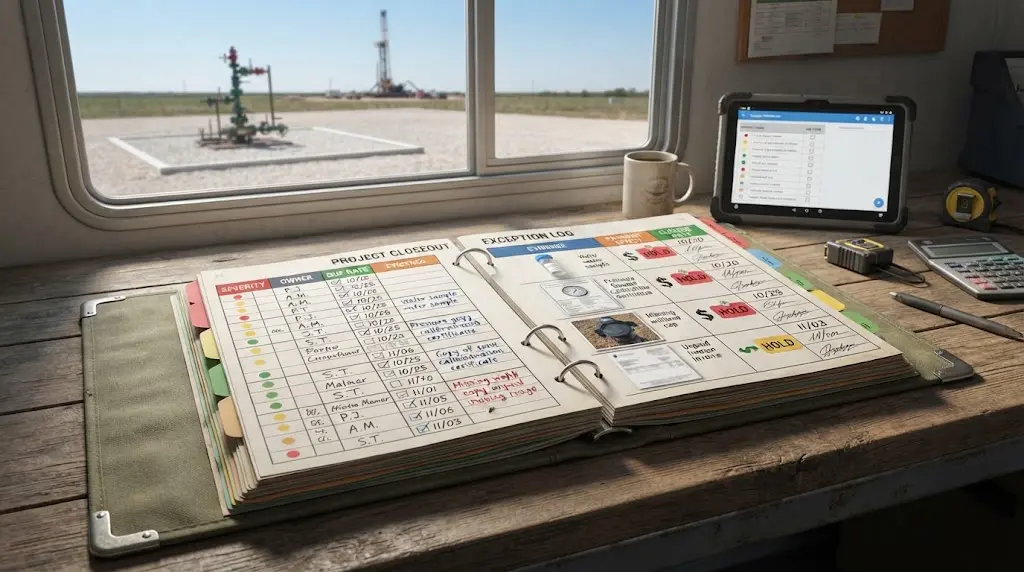
Use these columns:
| Column | What to write |
|---|---|
| ID | Short unique number, such as EX-01. |
| Category | Safety, technical, document, filing, laboratory, site, commercial, warranty, or customer. |
| Description | One observable unresolved item. |
| Severity | Critical, material, or routine based on your internal rule. |
| Blocking gate | Field, evidence, business, or none. |
| Owner | One named person or outside party. |
| Evidence needed | Receipt, reading, photo, lab report, approval, repair record, or other proof. |
| Due date | The actual next date, not "soon." |
| Customer or agency notice | Date and communication record. |
| Payment effect | Hold, partial, contract-dependent, or none. |
| Next action | The next physical or administrative action. |
| Closure date | Date proof was reviewed and the item was closed. |
Severity needs a definition. A critical item can affect safety, regulatory compliance, water quality, structural or equipment integrity, or the ability to operate the system. A material item can affect a contractual deliverable, performance record, final payment, warranty, or owner use. A routine item may be a labeling, formatting, or non-blocking cleanup task.
Do not use the log to make a critical safety or compliance issue look like a routine document delay. If the item is not safe to leave, the field gate has failed regardless of how neat the report looks.
Conditional closeout is a status with a deadline, not a polite synonym for unfinished.
When can a conditional closeout become a closed job?
Close a conditional item only when the specified evidence is received, reviewed by the assigned person, and delivered or stored as promised. Change the status, record the date, and note any follow-up that remains outside the original project.
For example, "lab report pending" becomes closed only after the report is received, the result is reviewed by the person responsible under the project, the required recipient is notified, and any corrective action is either completed or moved into a new documented scope. The exception should not vanish just because an email with the attachment arrived.
Which closeout mistakes create the most risk?
The recurring mistakes are ordinary. They happen when the team assumes that someone else captured the record, that the state form is the whole packet, or that a customer question can be answered later.
Mistake 1: Closing from the rig departure date
Rig departure may be the trigger for a state filing in one jurisdiction, while pump installation, final inspection, or another event controls a different record. Record the actual trigger for each obligation. Do not use one date for every document.
Mistake 2: Using an estimated yield as a tested result
A drilling observation, air-lift estimate, short test, and formal pumping test are not interchangeable. Label the method and condition. If the contract promises a test, attach the test sheet. If no test occurred, say so.
Mistake 3: Waiting for the office to ask for serial numbers
Serial numbers are easiest to capture when the equipment is visible. A service call months later is the wrong time to discover that the label is hidden, the model changed, or the installer cannot remember which component went to which well.
Mistake 4: Treating the state report as the owner packet
An official report may not include operating contacts, manuals, photos, warranty instructions, or a clear explanation of pending items. Deliver the official record and the practical handoff.
Mistake 5: Filing the report but not saving the receipt
A completed form in the office folder is not the same as proof of submission. Save the receipt, confirmation, stamped copy, or other accepted evidence. If the authority does not issue a receipt, record the submission method and date and follow the applicable instruction.
Mistake 6: Letting a verbal punch list survive outside the file
If a customer says, "Come back and label that control," create an exception. The customer should not have to repeat the promise to a new office employee.
Mistake 7: Mixing jobs in the photo library
Use the job ID, well ID, date, and subject in the filename or field-management record. A photo without context can support the wrong well.
Mistake 8: Marking the job closed when payment is disputed
Technical completion and commercial completion can have different statuses. Keep the technical record accurate, identify the commercial issue, and follow the contract. Do not change technical facts to make billing easier.
Mistake 9: Ignoring the next service handoff
A completed installation creates a future service record. If the owner agreed to a maintenance visit, warranty check, or follow-up test, record the date or trigger. Do not sell a future service that the crew cannot deliver or that was never agreed.
When should a contractor not use this generic checklist as-is?
Do not use a generic checklist without project-specific additions for public water systems, municipal or industrial wells, monitoring or remediation wells, geothermal work, abandoned or failed wells, work governed by an engineer's specification, funded public construction, or jobs with separate electrical, treatment, or environmental permits.
For those jobs, make the governing permit, specification, contract, and authority form the top layer. Then use this checklist to make sure the office also closes the packet, handoff, exceptions, billing, warranty, and internal record.
How can closeout become an operating asset for the company?
Closeout becomes valuable when the same record serves the owner, office, field service team, estimator, and manager. That requires a small amount of structured data, not a long postmortem nobody reads.
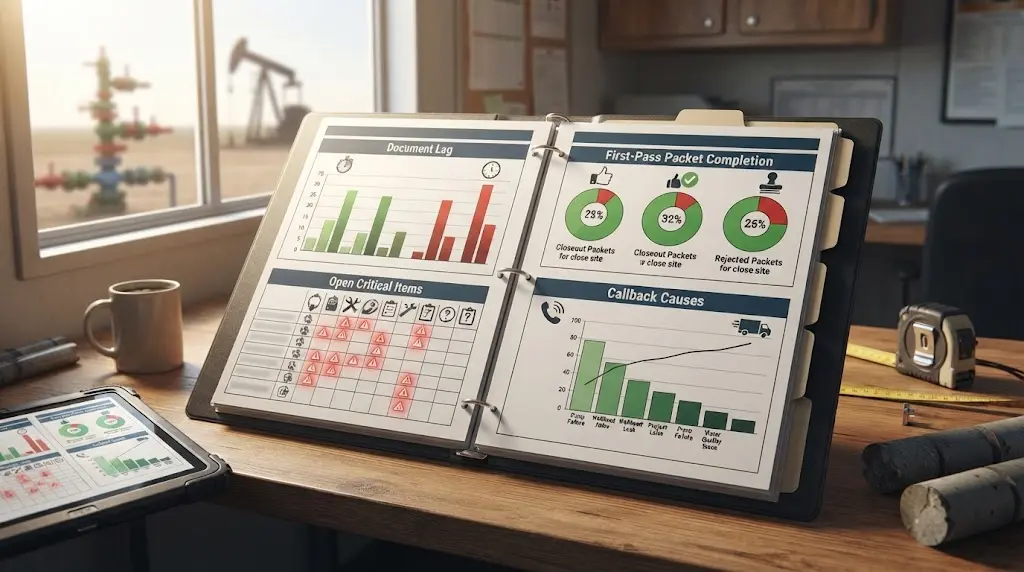
Track four internal measures:
- Document lag: calendar days from field completion to a complete evidence packet.
- First-pass packet completion: jobs whose packet passes the office review without a request for missing core documents, divided by jobs reviewed.
- Open critical exceptions: count and age of unresolved safety, compliance, water-quality, or major performance items.
- Callback cause: number of follow-ups caused by missing records, unclear handoff, installation issue, customer education gap, warranty question, or new scope.
These are management measures, not industry benchmarks. Establish your baseline from your own jobs, then set a practical next target. A contractor with five jobs should not pretend to have a statistically meaningful benchmark. The value is seeing whether the process is improving.
What should the lessons-learned review capture?
Ask questions that change the next estimate or field procedure:
- Which scope item was unclear at the proposal stage?
- Which material, measurement, or photo was hardest to capture?
- Which change was discovered too late?
- Which test was interrupted and why?
- Which document did the office have to chase?
- Which customer question was not answered at handoff?
- Which delay was caused by the contractor, owner, supplier, agency, weather, access, or another dependency?
- Which exception repeated across jobs?
- What one field form, photo prompt, label, or training change would prevent it?
Do not turn lessons learned into blame. The purpose is to improve the system. If the same missing serial number appears three times, change the field form. If the same change-order dispute appears on several jobs, revise the proposal and approval process. If customers keep calling because they cannot find the shutoff, make the handoff demonstration and photo mandatory.
How does closeout support future service and marketing?
The closeout record can support future service when the customer has agreed to the relevant follow-up and the company handles the information responsibly. Record the installed system, warranty timing, maintenance recommendation, and next contact trigger. A pump company can use that record to offer a defined maintenance plan or inspection when appropriate. See How to Sell Well Pump Maintenance Plans for the separate offer and follow-up decision.
Closeout can also produce legitimate proof for proposals: a documented process, clear handoff, test records, and organized project files. Do not turn an internal checklist into a claim that every job achieved a particular yield, duration, or customer result. Use actual permissioned evidence only.
The company-growth connection is practical. If completed jobs, territories, services, and customer follow-up are recorded cleanly, the owner has better information when deciding whether to add demand, hire, expand a service line, or repair an operational bottleneck. Well Drilling Contractor Capacity Planning covers that broader capacity decision.
What should the office use as the master checklist?
Copy this into the job system and adapt it to the project. Every row should have a status, an owner, and linked proof. Use N/A only when the project record explains why the item does not apply.
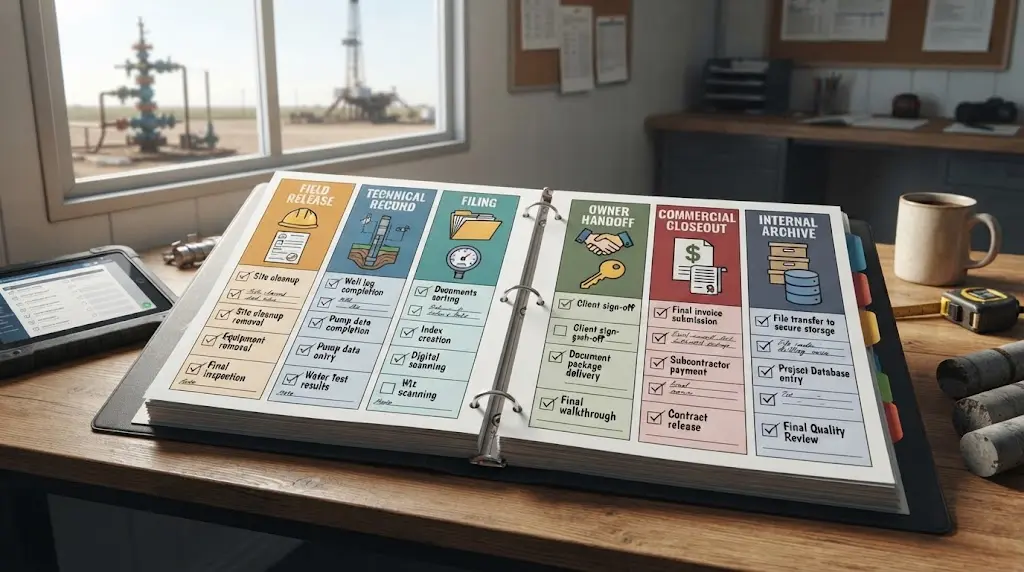
Gate 1: Field complete
- Scope, exclusions, and approved changes reviewed against the actual work.
- Well or site ID and location verified.
- Final depth and construction observations recorded with units and reference points.
- Casing, screen, liner, filter pack, grout, seal, and other completion details recorded where applicable.
- Lithology, water-bearing zones, and field observations recorded where required.
- Static water level recorded with date and reference point.
- Yield or pumping test recorded with method, rate, duration, drawdown, and recovery where applicable.
- Development record completed where applicable.
- Disinfection record completed where applicable.
- Pump type, model, serial, setting, and rated capacity captured where pump work is in scope.
- Cable, drop pipe, controls, pressure system, visible connections, and manuals captured where applicable.
- System demonstrated under the agreed test conditions.
- Wellhead, cap, seal, pad, drainage, controls, and visible piping checked.
- Site cleanup, restoration, access, and waste handling checked.
- Final photos taken and linked to the job.
- Every unresolved item entered in the exception log.
- Field lead assigned the initial status and office review date.
Gate 2: Evidence complete
- Closeout packet cover sheet and index completed.
- Final well log or completion report prepared in the required format.
- Pump installation or system record prepared when separate reporting applies.
- Test sheets reviewed for units, dates, methods, and signatures.
- Water-quality sample, chain of custody, and lab status attached when in scope.
- Required agency, permit, health, inspection, or contract records identified.
- Filing deadline and responsible signer recorded.
- Submission receipt or accepted proof saved.
- Owner copy prepared or delivered as required.
- Product serials, manuals, warranties, and supplier information indexed.
- Site photos and restoration record indexed.
- Open exceptions have owners, due dates, evidence, and payment effects.
- Actual, tested, estimated, and not-measured values are labeled.
- Office reviewer confirms that the file can be understood without asking the field lead to reconstruct it.
Gate 3: Business complete
- Customer or contract administrator received the agreed handoff packet.
- Acceptance record identifies scope accepted and exceptions remaining.
- Change-order log is approved or clearly pending under the contract.
- Quantities, credits, extra work, and invoice support reconciled.
- Retainage, release, lien, or other contract closeout documents handled where applicable.
- Warranty record linked to the installed equipment or workmanship scope.
- Any agreed maintenance, inspection, or follow-up is scheduled or explicitly declined.
- CRM, accounting, and field system records agree on status and key identifiers.
- Lessons-learned note captures one useful operational change or states that none was found.
- Final status is open, field complete, conditional closeout, or closed.
- If closed, no critical exception remains.
- If conditional, the next review date is on the calendar.
The closeout review question
Before marking the job closed, ask:
If the original field lead left the company tomorrow, could the office, service team, customer, and authority still understand what was built, what was tested, what was filed, what was promised, and what remains?
If the answer is no, the file is not evidence-complete. If the answer is yes but a named laboratory or agency result is pending, use conditional closeout. If the answer is yes and the commercial terms are resolved, close the job.
Brictale helps well drilling and pump companies examine where qualified demand, booked work, territory coverage, and customer follow-up are breaking down. Once the closeout record is accurate, a free territory audit can show whether the market around those completed jobs is creating enough qualified calls to support the company's next operating decision.