Referrals are valuable only when they arrive with enough context to become work. A list of names is not a program. It is a new queue for your office to clean up.
For a well drilling or pump company, the useful version is narrower: a small set of trusted partners, a clear handoff, a qualification rule, a payout trigger, and a record of what happened after the call.
A referral program is a sales process with a partner on the front end, not a jar of names.
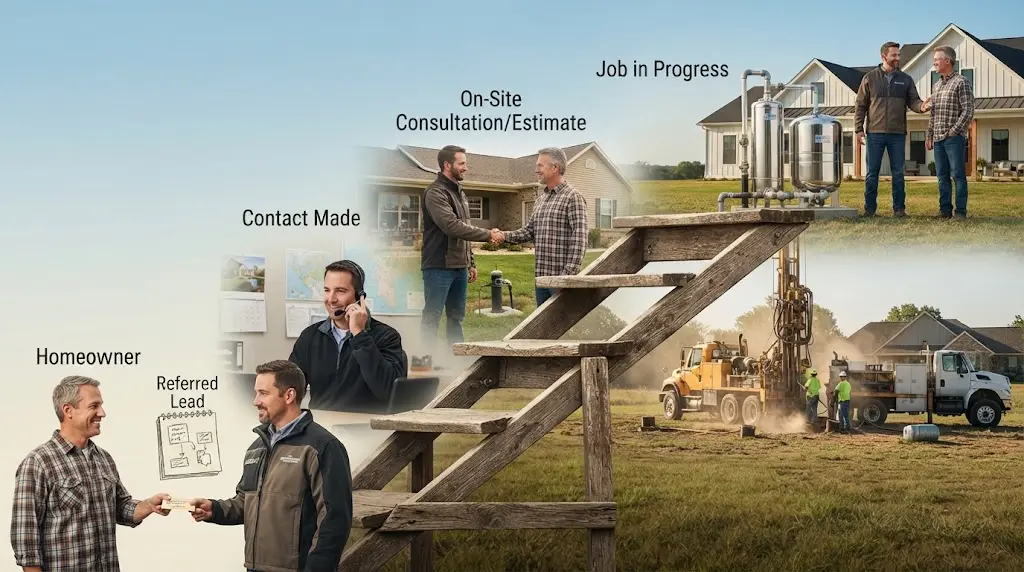
What should a well contractor referral program accomplish?
A good program should produce qualified conversations in the services and territories your company can actually handle. It should make the partner comfortable sending the opportunity, make the customer understand who will call, and make the owner able to trace the result to a booked or completed job.
The U.S. Small Business Administration recommends actively asking for referrals, building referral activity into follow-up, and partnering with complementary businesses rather than waiting for word of mouth to appear by itself. That is the basic idea. A well contractor needs the operating detail that general small-business advice leaves out: what counts, who gets paid, and how the office handles the lead.
The program has four jobs:
- Create a trusted path into a relevant customer or property problem.
- Filter the opportunity before it consumes dispatch, estimating, or service time.
- Give the company and partner a fair, written way to recognize the referral.
- Show whether the source produces completed work at an acceptable gross-profit level.
If it cannot do those four things, it is networking. Networking can still be useful. It just should not be reported as a lead channel.
The owner’s starting question
Do not begin with, “What reward should we offer?” Begin with, “Which job do we want more of, and who sees that need before we do?”
The answer might be:
- pump repair calls inside a tight service radius;
- pump replacement work from plumbers or electricians who find a failed system;
- new residential well opportunities from builders, excavators, or land professionals;
- commercial or agricultural work from engineers, site contractors, or property managers;
- water testing or treatment conversations that need a pump or well-system partner;
- overflow work from another licensed contractor whose territory or capacity does not fit the request.
Each job type needs different partners, questions, scheduling expectations, and economics. One generic “refer anyone who needs a well” offer is easy to announce and hard to manage.
Should you use customer referrals, partner referrals, or both?
Use both only when you can keep the source and the offer distinct. Past customers can introduce friends, neighbors, builders, or property owners. Business partners can identify a need during their own work. The two channels should not share one vague reward rule.
| Referral source | What the person usually knows | Best use | Main risk | First measurement |
|---|---|---|---|---|
| Past customer | Your communication, workmanship, and whether you kept promises | Introductions to similar property owners or repeat work | Asking for a referral before the job experience is complete | Referred inquiries that reach a real conversation |
| Builder or excavator | Project timing, site access, land constraints, and construction sequence | New well work, pump installation, coordination-sensitive jobs | Sending a job before scope or territory is clear | Qualified opportunities by project stage |
| Septic or water-treatment company | Water, property, and system symptoms | Pump, testing, treatment, or related service fit | Blurred scope and unclear responsibility | Accepted opportunities by service line |
| Plumber or electrician | Active service problem and urgency | Pump repair, controls, pressure, or replacement conversations | Emergency handoff confusion | Response time and booked service calls |
| Real estate or property professional | Transaction timing and property context | Inspections, testing, well condition, or pre-closing needs | Privacy, disclosure, and compensation issues | Completed opportunities with clear consent and source |
| Another well or pump company | Technical fit and overflow capacity | Out-of-area, out-of-scope, or overflow work | Territory conflict and customer ownership disputes | Accepted handoffs and dispute rate |
| Existing commercial customer | Operational context and vendor network | Commercial, agricultural, or multi-site work | Long sales cycles and procurement rules | Qualified bids or scheduled site reviews |
The table is a starting point, not a claim that every company in a category is a good partner. EPA guidance tells well owners to consider local requirements, bonding, insurance, licensing and certification where required. Those same trust markers matter when you decide who should represent your company in a warm handoff. EPA’s private-well guidance also points readers toward state agencies and professionals because proper construction depends on local conditions.
Customer referral program
A customer program is usually easier to explain. After a completed job and a normal follow-up, you can ask whether the customer knows someone who needs the same kind of service. The customer does not need a portal or a complex code. A simple introduction with the person’s permission can be enough.
The important sequence is:
- Finish the work and close open service issues.
- Ask for honest feedback without tying it to a reward.
- Ask whether the customer knows someone who needs a service you perform.
- Get permission for the referred person to be contacted.
- Record the source before the new inquiry enters the normal pipeline.
Do not treat a customer referral as permission to send marketing to everyone in the customer’s address book. The customer should make the introduction or confirm that the prospect expects contact.
Business partner program
A partner program needs more structure because the partner is making a business recommendation. The partner needs to know your service area, response expectation, job types, exclusions, and what happens after the handoff. You need to know whether the partner is licensed or insured where its own work requires it, whether it communicates accurately, and whether its incentive could create a conflict.
The partner should not have to guess what to send. Give the partner a one-page handoff brief with:
- the services you want;
- the counties, ZIP codes, or travel limits you serve;
- the minimum information needed for an initial review;
- the phone number or form to use;
- your business-hours and emergency response expectations;
- what you do not handle;
- what the customer should expect next;
- the source label or partner ID;
- how referral status will be confirmed;
- the plain-language reward rule, if there is one.
The simpler the handoff, the more likely the partner is to use it correctly.
Which partner types are worth recruiting first?
Recruit partners by customer overlap and timing, not by how many contacts they claim to have. The best partner often sees a narrow problem at the exact moment when the customer needs a specialist.
Start with adjacent field businesses
For pump repair and replacement, plumbers, electricians, septic companies, water-treatment providers, irrigation companies, and property maintenance firms may encounter a water-system issue before a well contractor does. For new drilling, builders, excavators, land developers, site contractors, surveyors, and real estate professionals may know the project exists before the owner searches.
These categories are suggestions, not a universal list. Your service mix determines the useful overlap. If your company does only commercial drilling, a residential referral offer will create noise. If your crews are booked for months, a referral program aimed at emergency pump repair may damage trust unless the partner knows who is covering the overflow.
Use the five-question partner screen
Before inviting a business into the program, ask:
- Does the partner see the right problem? A partner who never encounters well or pump decisions cannot produce a useful stream.
- Does the partner serve the same territory? A technically good referral outside your travel range is still a poor referral.
- Does the partner know when to hand off? The trigger should be concrete, such as a failed pump, a new build needing a well, or a water-system issue outside the partner’s scope.
- Can the partner describe the situation accurately? A warm introduction with no context is not much warmer than a web form.
- Can both companies serve the customer without conflict? The handoff should not create a dispute about scope, ownership, warranties, or who promised what.
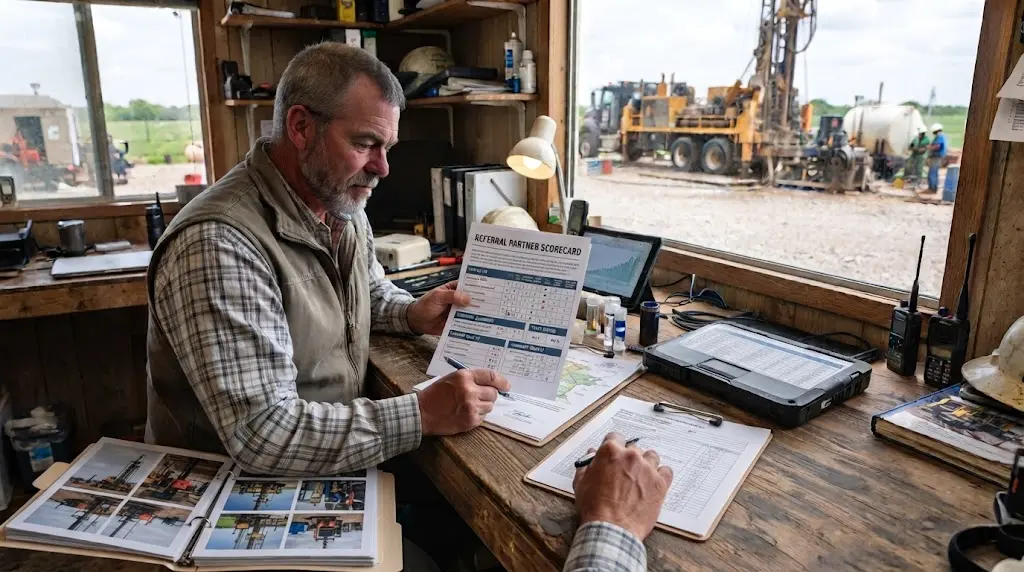
Score each answer from 0 to 2. A score of 8 to 10 is a reasonable pilot candidate. A score of 5 to 7 needs a tighter service definition or a test before a formal arrangement. A score below 5 is a networking contact, not a referral partner yet.
That score is Brictale’s decision aid, not an industry benchmark. Keep the scoring sheet so you can explain why a partner was invited, paused, or declined.
What counts as a qualified referral?
A qualified referral has enough information and fit for the company to take a sensible next step. It does not need a full scope, a budget, or a guaranteed sale. It does need more than a name and a phone number.
Use a five-stage ladder so the office, field team, and partner use the same words.
| Stage | Definition | What the company should do | Does it normally trigger payout? |
|---|---|---|---|
| 1. Referred name | A person or business was mentioned, but no permission or context is recorded | Verify the introduction and avoid treating it as a lead | No |
| 2. Reachable inquiry | The person expects contact and the basic contact details work | Respond, confirm the need, and check territory | Usually no |
| 3. Service-fit opportunity | The need matches a service, territory, and capacity rule | Route to service manager, estimator, or dispatcher | Sometimes, only if agreed |
| 4. Booked opportunity | A qualifying estimate, service call, site visit, or bid conversation is scheduled | Confirm the appointment and track attendance | Possible trigger |
| 5. Completed paid job | The company performed or collected for the agreed work | Reconcile revenue, gross-profit proxy, and payout | Strongest trigger |
The ladder solves a common argument. The partner may say, “I sent you three referrals.” The owner can answer, “We received three referred names, two reachable inquiries, one service-fit opportunity, and one booked appointment.” Those are different business events.
Do not pay for a raw name when your business value appears only after fit, booking, or completed work.
Minimum qualification fields
For a residential or small commercial referral, aim to capture:
- the customer or business name;
- the best phone and email, with permission to contact;
- the property address or service location;
- the requested service;
- whether the need is emergency, scheduled, bid, inspection, or maintenance;
- what the partner observed or what the customer said;
- the expected timing;
- any known access, safety, permit, or site constraint;
- the partner ID and date of referral;
- whether the customer has already contacted your company.
Do not ask a plumber to diagnose a groundwater problem. Ask the plumber to state what happened, what the customer asked for, and why a well or pump specialist is needed. The company can do the technical qualification.
Qualification questions for the office
When the referral arrives, the first response should be short and useful:
- “I understand you were connected with us by [partner]. Is it okay for us to discuss the request?”
- “What happened, and what service are you looking for?”
- “Where is the work located?”
- “Is this an emergency, a planned project, or an estimate?”
- “Has another contractor already diagnosed or worked on the system?”
- “What timing are you working with?”
- “What is the best next step: a service appointment, site visit, estimate conversation, or a request for more information?”
These questions are not a technical diagnosis. They are a routing check. For a deeper lead-screening process, use Brictale’s well drilling lead qualification guide. That page covers the dispatch decision itself. This referral page adds the source, partner, and payout layer before and after that decision.
Qualification exclusions
Write exclusions down before the first referral. Common examples include:
- a location outside the company’s service territory;
- a service the company does not perform;
- an existing open opportunity already in the CRM;
- a customer who did not consent to contact;
- a request that conflicts with a warranty, contract, or exclusive territory;
- a job below the company’s minimum scope, if one exists;
- a site that cannot be reached safely or legally;
- a project that requires a license, certification, or capability the company does not have;
- a referral submitted after the partner knew the company could not accept the work.
The exclusion rule is not a way to avoid paying. It is a way to stop two parties from using different definitions of success.
How should the handoff work from partner to office?
The best handoff is a three-party introduction: the partner identifies the need, the customer knows who will respond, and your office receives enough context to take the next step.
Use a warm introduction when possible
The partner can call, text, or email the customer while introducing your company, then include your office. The exact channel depends on consent, the relationship, and your compliance process. A forwarded contact with no context should be treated as an unverified referral until the customer confirms the introduction.
The handoff message can be plain:
“I’m connecting you with [Company]. They handle [service] in [area]. I’ve told them you’re looking for help with [short description]. Is it okay for me to include your phone number so they can follow up?”
The customer can then reply or speak with the company directly. The partner should not promise a price, arrival time, water yield, repair outcome, or project result that your company has not approved.
Give the partner two paths
Offer one path for urgent issues and one for planned work. A pump failure may need a phone call during business hours. A new well project may need a form with property, timing, and bid context. Do not make the partner choose among six forms.
The office must also know what happens after submission:
- who owns the first response;
- how quickly the partner gets an acknowledgment;
- when the opportunity becomes accepted, rejected, or needs more information;
- whether the company will contact the customer or ask the partner to stay involved;
- when referral status is updated;
- who handles a duplicate or disputed source.
If the partner sends a referral and hears nothing, the program feels broken even when the sales team eventually contacts the customer. The response process is part of the product.
Use a one-page handoff brief
Keep the brief short enough to print or save on a phone. It should contain:
We want: the exact service categories and project types.
We serve: the territory, travel boundaries, and any capacity limits.
Please send: the customer’s name, contact permission, property location, service need, timing, and your observation.
Do not promise: price, availability, technical outcome, license approval, or guaranteed yield.
We will: acknowledge the referral, make the next contact, and report the status under the agreed rules.
Use this source label: the partner ID or dedicated intake option.
This is a useful place to connect the referral program to your larger lead process. Brictale’s well drilling lead generation system covers the broader channel mix and follow-up architecture. A referral program should feed that system with a clean source label instead of creating a separate unmanaged inbox.

When should you pay the referrer?
Pay when the business event you value has happened, and define the event before the first referral. An owner who says “we’ll work something out” is inviting a dispute.
| Trigger | Good fit | Advantage | Risk | Rule to write down |
|---|---|---|---|---|
| No cash, reciprocal help | Trusted peer with similar customer value | Simple and relationship-led | Hard to value and easy to forget | What counts as a reciprocal introduction and how it is recorded |
| Customer benefit | Consumer-facing customer program | The reward helps the new customer experience | Can be confused with review incentives | Reward the introduction or completed transaction, never review sentiment |
| Accepted service-fit opportunity | High-volume partner with strong qualification | Faster recognition for useful work | You pay before revenue is collected | Define acceptance, exclusions, and what happens if the job is cancelled |
| Booked appointment or site visit | Service businesses with measurable scheduling | Ties reward to a real calendar event | No-show and reschedule disputes | Define a valid booking and attendance rule |
| Completed paid job | Most owner-controlled partner program | Aligns payout with collected business | Slower feedback and reconciliation | Define completion, collection, refunds, duplicates, and payout date |
| Percentage of job value | Large jobs with contract review | Scales with the work | Margin, licensing, disclosure, and calculation risk | Obtain legal and tax review before use |
For many small contractors, a fixed event-based reward is easier to understand than a percentage of job value. That is a recommendation, not a universal rule. The right structure depends on service margins, state rules, contract terms, customer expectations, and the partner’s role.
A conservative default
Start with a payout tied to a completed paid job or a clearly defined booked appointment. Use a small pilot, reconcile every record, and delay any expansion until both sides understand the edge cases.
If your company cannot know whether a job was paid, whether a lead was already open, or whether a customer came from a partner, do not launch a paid program yet. Better attribution is more valuable than a clever reward.
Define the payout edge cases
Your written rule should address:
- Duplicate referrals. The first documented source wins, or the companies split recognition under a defined rule.
- Existing opportunities. An existing customer or open estimate is excluded unless the partner created a new, agreed scope.
- Out-of-area work. Decide whether the referral is rejected, routed to a partner, or eligible only if the company accepts the travel.
- Cancelled jobs. A cancelled appointment should not be treated like a completed paid job.
- Refunds and chargebacks. State whether payout is delayed until the refund window or reversed if the underlying payment is reversed.
- Shared ownership. If two partners make the introduction, use a documented split rule rather than negotiating after the sale.
- Company capacity. If you decline a service-fit referral because the crews are full, state whether it is still eligible for recognition or whether the partner should have a different routing path.
- Partner termination. Define what happens to referrals received before the relationship ended.
The point is not to make a twelve-page contract. It is to remove the five arguments most likely to appear in the first month.
The fairest payout rule is the one both sides can verify from the same record.
What should the referral agreement include?
Use a plain-language agreement, even if the first pilot is with a friendly local business. Friendliness does not solve duplicate leads, customer consent, tax records, or a disagreement about what was promised.
The agreement should identify:
- the legal business names and contact people;
- the covered services and service territory;
- what a referral is and what it is not;
- the required customer permission or introduction process;
- the source ID and how referrals are submitted;
- the company’s response and status-update expectation;
- the payout trigger and payout timing;
- the duplicate, existing-customer, cancellation, refund, and out-of-area rules;
- whether either company can refer the other’s work and under what terms;
- what the partner may and may not say about price, availability, technical results, licenses, or warranties;
- privacy and record-handling expectations;
- any disclosure required when the partner is compensated for a public recommendation;
- term, termination, and unresolved-payout handling;
- a statement that each party remains responsible for its own licensing, insurance, tax, advertising, and legal obligations.
Keep technical promises with the contractor
The National Ground Water Association’s public guide tells prospective well owners to consider licensing, certification, well logs, equipment, insurance, applicable health and safety codes, reputation, and a written contract. Those details belong in the company’s own qualification and sales process, not in a partner’s improvised promise.
Your partner can say, “This company handles pump replacement in that area.” The partner should not say, “They can be there in two hours,” “the well will produce a specific yield,” or “the repair will cost a certain amount” unless your company has supplied and approved that language.
When is a partner recommendation an endorsement?
The Federal Trade Commission says that if a connection between an endorser and a marketer could affect how people evaluate the endorsement, the connection should be disclosed. The FTC also says compensated promotion should be disclosed. That matters when a partner publishes a public post, newsletter, video, directory listing, or social recommendation and receives a benefit for promoting your company.
The safest operational rule is simple: if a partner is being paid for a public recommendation, disclose the business relationship in clear language near the recommendation. Do not ask a partner to present a paid placement as an independent, unpaid opinion. Get current legal advice for the specific medium and arrangement.
How should you keep referral rewards separate from Google reviews?
Keep the two programs completely separate. A referral reward pays for an introduction or agreed business event. A review request asks for honest feedback from a real customer. Do not make one conditional on the other.
Google’s Business Profile guidance says, “Reviews and other user contributions to Google Maps must reflect a genuine experience.” It also says offering free or discounted goods or services in exchange for posting, changing, or removing a review is prohibited. Google’s review guidance is the controlling source for that platform policy, not a marketing blog.
The prohibited combinations are easy to recognize:
- “Refer a friend and get a reward if you leave us five stars.”
- “Get a discount for posting a review after your referral pays.”
- “We will pay you for a positive Google review and another amount for a referral.”
- “Send only customers who promise to review us.”
- “Change your review to five stars and we will release the reward.”
A customer can refer someone and later leave an honest review. The company must not tie those acts together or tell the customer what sentiment to express.
The clean workflow is:
- Ask for honest feedback through the normal customer follow-up.
- Separately ask whether the customer knows someone who needs a relevant service.
- Record the referral source and consent independently from the review request.
- Pay or recognize the referral under its own rule.
That separation protects the review channel and makes the referral data easier to trust.

What should the referral tracking record contain?
Use one source of truth. A CRM is useful, but a well-maintained spreadsheet can run a pilot if every row has an owner and a next action. The system matters less than the discipline.
Required fields
Create a referral record with these fields:
| Field group | Fields to record | Why it matters |
|---|---|---|
| Source | Partner ID, partner name, referral date, submission channel | Proves who sent the opportunity and when |
| Permission | How the customer was introduced, consent or confirmation status | Prevents blind outreach and unclear handoffs |
| Customer | Name, phone, email, property or service address | Lets the office identify the opportunity |
| Need | Service requested, urgency, project type, partner observation | Routes the opportunity correctly |
| Territory | County, ZIP, travel zone, commercial or residential | Stops avoidable out-of-area work |
| Response | First-response date, owner, contact status, response time | Shows whether the office acted |
| Qualification | Service fit, capacity fit, existing opportunity, accepted or rejected reason | Separates useful referrals from noise |
| Sales or service | Appointment, estimate, site visit, bid, no-show, reschedule | Captures the next business event |
| Outcome | Completed, lost, cancelled, declined, duplicate, customer unreachable | Explains what happened |
| Economics | Collected revenue, job-cost proxy, payout due, payout paid | Supports channel comparison |
| Follow-up | Partner status update, dispute, next action, close date | Keeps the relationship healthy |

Do not collect details you will not use. The point is not to build a second estimating system. The point is to connect the handoff to the job outcome.
Use a partner ID everywhere
Names are unreliable. Companies merge, people change roles, and a partner may have multiple locations. Assign a simple ID such as P-014 and put it in the CRM source field, intake form, email subject, or phone note.
If you use a dedicated phone number or form, keep the partner ID in the tracking record, not just in a campaign name that no one reviews. A referral source should remain visible after the first call, the estimate, and the completed job.
Track source at the first conversation
Ask “How did you hear about us?” but do not rely on memory alone. The intake record should already show the partner source, and the office can confirm it with the customer.
If the customer says, “My plumber told me to call,” record the plumber’s name and the source confidence. If the customer says, “I found you online after my plumber mentioned you,” you can record the partner as an influence and organic search as the immediate source. Both facts can matter, but they are not the same attribution.
Work with assisted referrals
Not every referral is a direct handoff. A builder may mention your company at the start of a project, while the owner searches for you weeks later. A property manager may include your name in a vendor list, and the tenant may call after a separate incident.
Use two fields:
- Primary source: the source that directly generated the call, form, or message.
- Influence source: a partner or person who introduced the company earlier.
Do not use assisted attribution to pay twice. Use it to learn which relationships create demand even when the last click or last caller is something else.
For broader call attribution, connect this system to Brictale’s well drilling call tracking checklist. The referral program needs partner attribution, while call tracking helps verify whether the call became a qualified conversation and what happened after it.
How do you judge referral-program economics without inventing a payout?
Use your own collected revenue, job-cost records, response data, and payout ledger. Do not borrow a generic “referral conversion rate” from another service business and pretend it predicts your territory.
Use the booked-job equation
At the channel level:
Referral contribution
= collected revenue from referral jobs
- direct job costs
- referral payouts
- incremental sales and dispatch cost
- refunds, credits, and dispute cost
You can also use a contribution-per-completed-job view:
Contribution per completed referral job
= collected revenue
- direct job costs
- payout
- incremental cost to handle the referral
The exact cost categories depend on your accounting system. Keep the formula consistent across channels.
Use a break-even payout ceiling
Let:
C= expected contribution before the referral payout;H= incremental handling cost for calls, estimates, and dispatch;R= reserve for refunds, cancellations, or disputes;P= referral payout.
Then the program is contribution-positive when:
P < C - H - R
This is not a promise that every job will be profitable. It is a ceiling for testing a payout rule. Use conservative historical numbers from your own service line. For new drilling, pump repair, replacement, and commercial work, keep separate records because their sales cycles and cost structures are different.
Use a qualified-call funnel
Track the count at each stage:
referred names
→ reachable inquiries
→ service-fit opportunities
→ booked appointments or estimates
→ completed paid jobs
→ collected revenue and contribution
The useful rates are your own:
reach rate = reachable inquiries / referred names
fit rate = service-fit opportunities / reachable inquiries
booking rate = booked opportunities / service-fit opportunities
completion rate = completed paid jobs / booked opportunities
If the denominator is tiny, describe the result as an observation, not a benchmark. A partner who sends two excellent pump replacement opportunities may be more valuable than a partner who sends twenty vague names.
Worked example without fake prices
Suppose a company reviews one partner after a pilot period. The owner records the number of referrals, the number that reached a real conversation, the number that fit the service and territory, the number booked, and the number completed. The owner then adds collected revenue, direct job costs, handling cost, and actual payout from the ledger.
The decision is not “did the partner send a lot?” It is:
- Did the partner send the service the company wanted?
- Were the referrals inside the territory?
- Did the customer expect the call?
- How much office time did qualification require?
- Did the opportunity book?
- Did the job complete and collect?
- Was the contribution positive after payout and handling cost?
- Did the partner follow the handoff and promise rules?
That is enough to choose expand, fix, pause, or reject without inventing an industry average.

What compliance checks belong in the program?
The owner should treat compliance as part of the design, not as a note at the bottom of a partner agreement. The exact rules vary by activity, state, channel, and relationship. The framework below identifies where to slow down and get current advice.
Check the partner’s own licensing and insurance context
EPA recommends checking whether well drillers and pump-well installers are bonded and insured and whether they are licensed and certified where required. NGWA’s contractor guide similarly points to licensing, certification, equipment, insurance, applicable codes, reputation, and written contracts.
This does not mean every referral partner must hold a well license. It means the partner should be credible for the work it performs and should not make your company look like an unqualified substitute. A septic company, electrician, plumber, builder, or real estate professional has a different role and different requirements. Screen the partner within its own scope.
Check public compensation disclosures
If a partner publishes a recommendation and receives money, credits, discounts, or another benefit, review whether the relationship is a material connection that needs clear disclosure. The FTC’s public guidance applies to advertising and endorsements across media, including online and social channels.
A private, one-to-one introduction between businesses is not automatically the same as a public endorsement. Do not assume the reverse either. Public pages, newsletters, videos, and social posts can change the consumer’s understanding of why the recommendation was made.
Check email forwarding and referral campaigns
If the program asks customers or partners to forward commercial email, pay attention to who initiated the message and who receives the benefit. The FTC’s CAN-SPAM guidance says a seller that pays or gives a benefit for forwarding a message, generating traffic, or making a referral may have compliance obligations.
Keep the program simple. Prefer a customer or partner making a direct introduction with permission over an automated “send this promotion to ten friends” loop. If you use email at scale, have the person responsible for compliance review the sender, content, opt-out, and recordkeeping requirements.
Check calls, texts, and automated follow-up
A referred phone number is not a blank check for automated marketing. The FTC’s telemarketing guidance covers do-not-call protections, prerecorded calls, opt-out procedures, and recordkeeping. State rules may add requirements.
For a referral workflow:
- Ask whether the customer expects contact.
- Record how the introduction happened.
- Use a human first response for the pilot unless your compliance process supports automation.
- Honor a request not to call or text again.
- Do not assume the partner’s consent covers every message your company might send.
- Review automated calls, texts, and marketing sequences before launch.
The goal is a clean customer experience as well as legal caution. A referred prospect who says, “I never gave you permission to contact me,” is not a qualified referral.
Check tax records before the first payment
Referral compensation may create recordkeeping and reporting obligations. The IRS instructions for Forms 1099-MISC and 1099-NEC list “fee-splitting or referral fees” among examples of payments to be reported in the relevant circumstances. Collect the information your tax adviser says you need, keep the agreement and payout record, and confirm the current treatment for the recipient and payment structure.
This article does not give tax advice. Do not decide that a partner is “just a friend” or that a small payment is automatically exempt. Ask a qualified tax professional before paying a recurring or material amount.

How do you launch a referral program in 30 days?
Run a controlled pilot with a small number of partners and one or two service categories. The objective is to learn whether the handoff works, not to announce a nationwide program.
Days 1 to 3: choose the job and constraint
Write down:
- the service you want more of;
- the territory you can serve;
- the job type you can accept now;
- the minimum information needed to qualify it;
- the person who owns first response;
- the payout event you can verify;
- the reports you will review;
- the jobs or circumstances you will exclude.
If you cannot answer those questions, the program is premature. Fix capacity, service-area clarity, or intake ownership first.
Days 4 to 7: build the partner list
List businesses you already know, businesses that have worked near your customers, and businesses that appear in the same projects. Do not scrape a large directory and send a generic message.
For each candidate, record:
- business and contact person;
- service category;
- territory;
- customer overlap;
- likely referral trigger;
- trust and qualification observations;
- possible conflict or scope issue;
- score from the five-question screen;
- next conversation.
Start with a short list that you can actually support. A program with three responsive partners is more informative than one with fifty names and no status updates.
Days 8 to 12: write the handoff and agreement
Create the one-page handoff brief and a plain-language agreement. Test both with someone who does not work in your office. If the person cannot tell what to send, where to send it, or when a payout occurs, simplify the document.
Have a lawyer or other qualified adviser review the arrangement when compensation, regulated work, public endorsements, shared customers, or state-specific rules create uncertainty.
Days 13 to 16: make intake and attribution work
Add the partner ID to your CRM, spreadsheet, call note, or form. Create the statuses:
received
awaiting permission
contacted
qualified
rejected
booked
completed
lost
payout pending
payout paid
Assign an owner for every record. Build a daily check for referrals with no first response and a weekly check for referrals with no next action.
Days 17 to 23: run the pilot
Invite the first partners with a direct conversation. Explain the job type, territory, handoff, status updates, and payout event. Ask the partner to send only opportunities that match the brief.
When the first referral arrives, notify the partner that it was received. Do not wait until the job closes to communicate. The partner is testing your reliability too.
Days 24 to 30: review the funnel
Review each partner’s records:
- total referred names;
- reachable inquiries;
- service-fit opportunities;
- booked appointments or estimates;
- completed paid jobs;
- collected revenue;
- direct job costs;
- handling cost;
- payout due and paid;
- response time;
- duplicate, out-of-area, no-show, and dispute reasons.
Then choose one action:
| Decision | Use it when | Next action |
|---|---|---|
| Expand | Fit, booking, completion, and contribution are healthy | Add a similar partner or service, one change at a time |
| Fix | The partner is promising but handoff, qualification, or response is weak | Rewrite the brief, retrain, and run another controlled test |
| Pause | The opportunity exists but the company lacks capacity or attribution | Stop new referrals until the constraint is fixed |
| Reject | The partner sends poor-fit work, makes bad promises, or creates repeat disputes | Close the arrangement and document the reason |
Do not expand because one referral became a good job. One job is evidence that the path can work, not proof that the system is ready to scale.
What mistakes make contractor referral programs fail?
Most failures are operating failures, not creative failures. The reward is rarely the only problem.
Mistake 1: Paying for volume instead of fit
If the partner earns credit for every name, the program teaches the partner to send every name. The office then pays in time, not just money. Use the qualified referral ladder and make the value event clear.
Mistake 2: Recruiting competitors without territory rules
Another well or pump company may be a strong overflow partner. It may also be a direct competitor. Define service areas, job types, customer ownership, and what happens when both companies receive the same request.
Mistake 3: Asking partners to explain technical outcomes
Partners should identify the need and make the connection. They should not promise water yield, repair results, arrival times, pricing, or permits they do not control. Give them approved language.
Mistake 4: Mixing referrals with reviews
This creates a policy risk and weakens the trust of both channels. Pay for the agreed referral event. Ask for an honest review separately and without a condition. Google’s review guidance is clear on incentivized review content.
Mistake 5: Having no source field
If the office waits until the end of the month to ask where a job came from, the answer will be incomplete. Capture partner ID at intake and preserve it through closeout.
Mistake 6: Paying before checking duplicates
A partner may refer a current customer who already has an open estimate. This is not necessarily bad, but it needs a rule. Search the CRM before accepting the referral as new.
Mistake 7: Launching when the office cannot respond
A slow response damages the company’s reputation with the partner and the referred customer. If your crews are full or your phone is routinely missed, solve that constraint before adding another source.
Mistake 8: Making the agreement vague to preserve flexibility
Vague rules feel friendly before the first dispute. After the first dispute, they feel arbitrary. Write the few rules that matter and update them after the pilot.
Mistake 9: Expanding before reviewing job economics
A partner can create good-looking activity that costs more to handle than it contributes. Review collected revenue, direct job cost, handling, payout, and dispute cost together.
Mistake 10: Turning the program into a mass promotion
A well contractor referral program should feel like a trusted routing system. A generic coupon blast can attract the wrong service, wrong territory, or wrong expectation. Start with relationships where context already exists.
When should you not launch a referral program?
Do not launch yet if the company cannot reliably answer, qualify, schedule, serve, or reconcile the opportunity. More demand will expose those gaps faster.
Pause the idea when:
- the company misses a material share of inbound calls and has no recovery process;
- no one owns referral intake during business hours;
- the service territory is changing or unclear;
- the company cannot tell which jobs are profitable by service line;
- a partner would have to promise availability the company cannot guarantee;
- the program depends on incentivized reviews;
- the owner has not checked tax, licensing, disclosure, email, phone, or state-law questions relevant to the arrangement;
- the company is at capacity and has no overflow routing;
- the CRM or spreadsheet cannot preserve the referral source;
- the proposed payout is based on a competitor’s number instead of the company’s own contribution.
Sometimes the right move is a referral-ready operating layer without a paid referral program. You can still give trusted partners a clear handoff brief, respond quickly, report the outcome, and revisit compensation after you have evidence.
A referral program cannot repair a company that cannot keep the promise made after the introduction.
How should you improve the program after the pilot?
Review the program monthly at first. Use a short meeting with the owner, dispatcher or office lead, and whoever owns sales or estimating.
Ask these questions:
- Which partners sent service-fit opportunities?
- Which partners sent the service we actually wanted?
- How many referrals arrived with customer permission and useful context?
- Where did the handoff fail?
- Which leads were already in the system?
- What did the company decline, and why?
- How many booked opportunities became completed paid jobs?
- What was collected after direct cost, handling, payout, and credits?
- Did a partner make a promise the company could not support?
- Is the program creating better work, or just more administrative work?
Change one element at a time. If you change the partner list, reward, service category, territory, intake process, and follow-up sequence all at once, you will not know what improved.
Build a partner feedback loop
Tell the partner what happened at the level the agreement allows. “Received,” “outside territory,” “appointment booked,” or “job completed” may be enough. Do not share private customer details that the partner does not need.
Ask the partner two questions after each meaningful outcome:
- Did the customer understand what would happen next?
- Was the handoff easy enough to repeat?
The partner sees friction your CRM may not show. A form can be technically complete and still too slow to use from a jobsite.
Turn the best partners into a service map
After several review cycles, group partners by:
- service type;
- territory;
- customer type;
- urgency;
- job value or contribution band;
- handoff quality;
- completion quality;
- capacity fit.
This can reveal that one partner is strong for pump emergencies, another for planned well work, and another for commercial bids. A single program-wide payout may be less useful than clear lanes.
What should a well contractor do next?
Start with one job type, one territory, and a short list of partners who already encounter the problem you solve. Write the qualification rule before you announce the reward. Record the source before the first call. Pay only when the agreed business event is verifiable, and keep the referral offer separate from review incentives.
If the pilot produces qualified calls but your company cannot see where the territory is weak, where competitors are more visible, or which service pages support the handoff, Brictale’s free territory audit is the practical next step. It can show the gaps that sit around the referral channel, including local visibility, service coverage, conversion friction, and tracking. Use that evidence to decide whether the next investment is more partners, better follow-up, or a stronger way for customers to find and call you directly.