What to Do If You Find an Abandoned Well on Your Property
A safe US homeowner decision path for an unknown well opening: isolate it, preserve evidence, find the governing program, and choose the right next step.
The short answer
Keep people, pets, and livestock away; do not enter, open, fill, or pump the feature. Photograph it from a safe distance, search the applicable state and county well records, and ask the state well or local environmental-health authority whether it is in use, abandoned, repairable, eligible for standby, or required to be sealed. Closure rules and disclosure duties vary by state.What to do if you find an abandoned well on your property
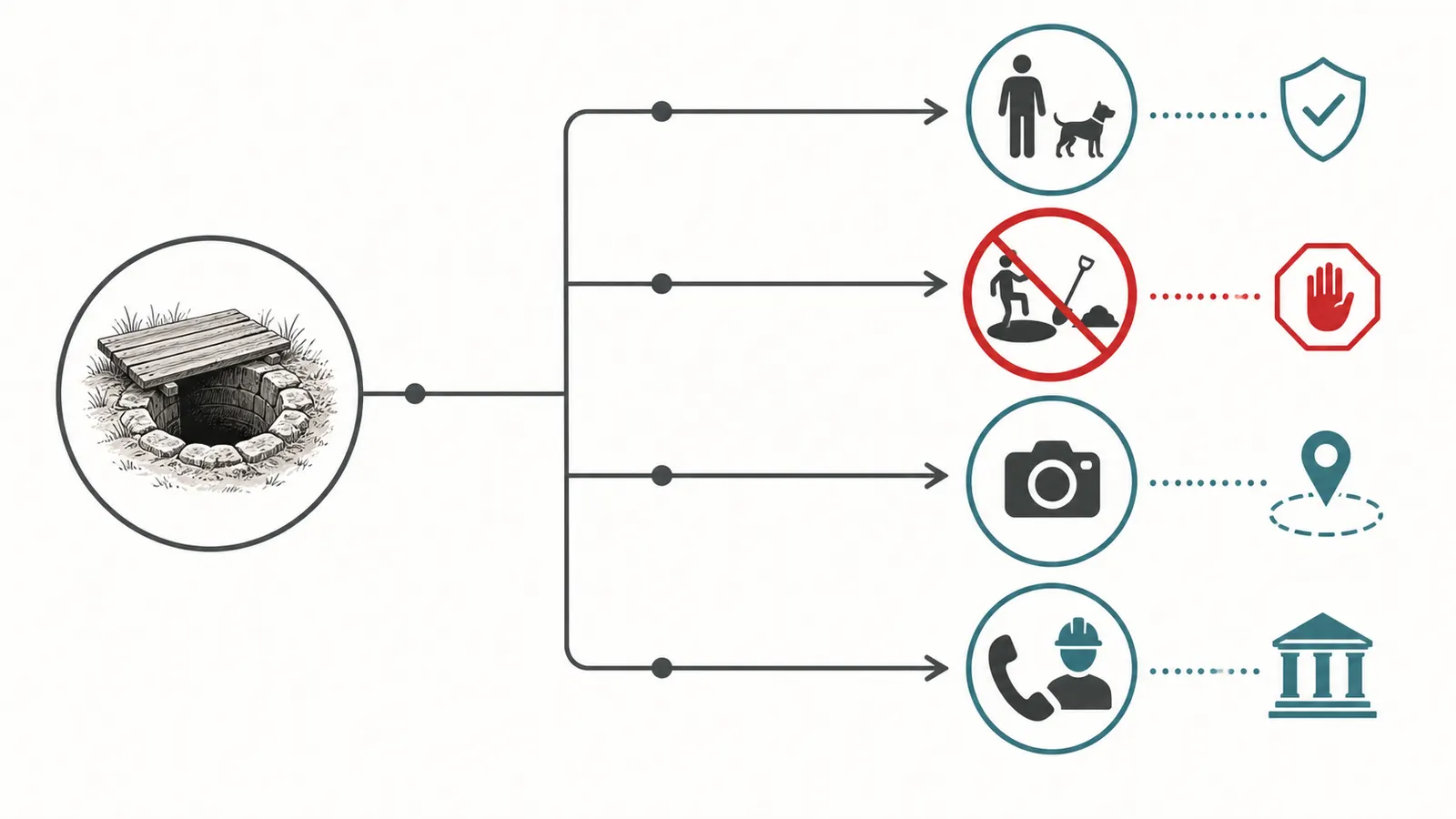
If you find an opening, casing, pit, depression, or old pump that may be a well, treat it as an unknown hazard first—not as a weekend filling project. Keep children, visitors, pets, livestock, and vehicles away. Do not enter the opening or a pit, open a control box, test live wiring, pull a pump, lower anything into the well, or pour in soil, trash, gravel, or concrete. Photograph and locate the feature from a safe position, then ask the applicable state well program or local environmental-health office how it is classified and what work is allowed.
The correct outcome may be professional evaluation, repair and return to service, a legally recognized standby or maintenance status, or permanent sealing and documentation. Those choices are not interchangeable, and the governing rule is not national. The US Environmental Protection Agency’s state private-well program directory says most states have zero or limited regulation of private drinking-water wells and routes owners to state resources. That is why the first useful question is not “How do I plug it?” but “Which authority and record system governs this property?”
1. Make the opening safe before you investigate
Your first job is to prevent a fall and prevent an improvised action from making the record or hazard worse.
Use a no-entry perimeter
Stay back far enough that a damaged cover, soft soil, concealed void, or overgrown edge cannot give way under you. Keep people and animals away with a temporary barrier or warning markers placed on stable ground, not across the opening. Do not use a sheet of plywood, a loose board, a pallet, a tarp, or a lightweight cover as a load-bearing fix. You are marking a hazard, not making it safe for someone to walk over.
If the opening is immediately adjacent to a path, driveway, play area, livestock enclosure, or work zone, use a more conservative perimeter and arrange professional help promptly. Do not move a vehicle, mower, trailer, or materials near it to “protect” it. Weight and vibration can destabilize an old structure.
Treat pits and vaults as confined spaces
An old well may be in a basement, under porch steps, inside a pump house, under a hatch, or within a concrete or brick vault. A cover being present does not establish that the space is safe. The Snohomish County Health Department’s well guidance warns that well pits and other enclosed spaces can contain low oxygen, toxic gases, or explosive conditions, and says not to enter them. It also warns about electric shock where equipment in a flooded pit may still be live.
That means:
- Do not climb into a pit, vault, crawlspace, well house, or basement opening to inspect it.
- Do not lean your head over the opening to smell, listen, or look for water.
- Do not lower a person, child, pet, rope, ladder, camera, or gas detector unless a qualified professional has planned and controlled the entry.
- Do not open an energized control panel or touch wires, pump controls, or submerged equipment.
- Do not test live wiring. Shutoff and verification of electrical equipment belong to a qualified person when the condition is uncertain.
If someone has fallen in, do not climb in after them. Call 911, keep others back, and tell responders that a well, pit, or possible confined space is involved. If there is a fuel, chemical, sewage, or electrical concern, describe that too.
The safe first-response checklist
Use this sequence before you search, measure, or call:
| Sequence | Homeowner action | What it establishes | What it does not establish |
|---|---|---|---|
| 1 | Keep people, animals, and equipment away | There is a controlled hazard zone | That the opening is a well |
| 2 | Place visible warnings or a temporary barrier on stable ground | Others can recognize the hazard | That the barrier can support weight |
| 3 | Photograph from outside the perimeter | The starting condition is preserved | The depth, construction, or legal status |
| 4 | Record the location relative to fixed features | A professional can find it again | That a map point is exact |
| 5 | Contact the governing program or local health office | The correct process can be identified | That any contractor’s proposed method is approved |
2. Identify what you found without opening it
“Abandoned well” is a legal or program term in some places, but an owner may initially have only an unknown feature. A pipe sticking out of the ground could be a well casing, a utility, a drain, or an old irrigation component. A depression could be a collapsed well, a buried structure, settlement, or something unrelated. Use observations to build a question for the authority; do not use them to declare the answer.
Safe observations from the surface
From a stable position outside the perimeter, note:
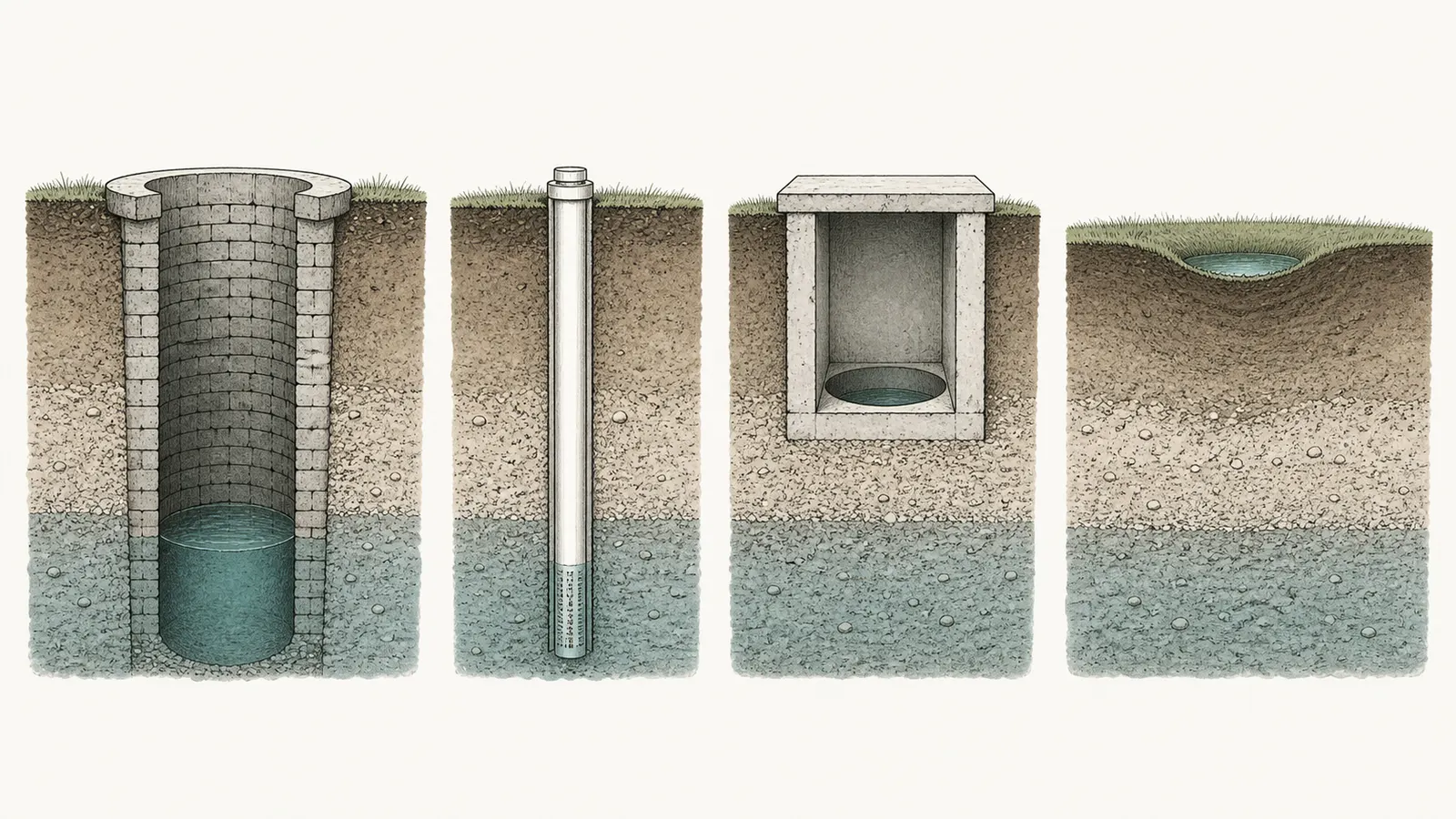
- whether the feature is a narrow casing, a wide opening, a concrete or brick-lined structure, a tile, a vault, or only a depression;
- visible material such as steel, PVC, concrete, brick, wood, or masonry;
- whether a cap, cover, hatch, pump, pipe, pressure tank, wiring, or plumbing is visible;
- whether water, sediment, vegetation, standing water, erosion, or fresh collapse is visible without looking over the edge;
- whether the feature is in a basement, under a porch, in a pump house, beside a cistern or windmill, near surface water, or close to a septic system;
- approximate dimensions only if they can be taken without approaching an unstable edge; and
- the date you found it and any recent change such as a broken cover, sinking soil, flooding, or construction disturbance.
Washington’s Department of Ecology lists pipes, old well houses, lawn depressions, concrete vaults, pits, tile, and old plywood as possible clues. Snohomish County describes dug wells as wider structures that may be lined with concrete tile and drilled wells as narrower casings, but those descriptions are recognition aids, not a homeowner test for legal status. A visual match can support a records search; it cannot prove that the feature is safe, usable, properly capped, or legally sealed.
What you should not infer
Do not infer any of the following from a cap, a dry appearance, a full-looking surface, or a missing record:
- A cap means the well is sealed. Minnesota specifically says a well described as “capped,” “plugged,” “filled,” or “abandoned” is not necessarily the same as a legally sealed well with a sealing record.
- No water at the surface means no fall or contamination hazard. The shaft, casing, or void may still be open below grade.
- A map with no well means there is no well. Snohomish County notes that older wells may not have been recorded, and Washington’s well-report viewer warns that reported locations may not be exact.
- The feature is legally abandoned because it has not been used for years. Texas defines abandonment around nonuse, while another state may use different terms, exceptions, deadlines, or status categories.
- The current owner created the problem. Ownership, transfer, and liability rules are jurisdiction-specific; your immediate responsibility is to control the hazard and obtain the governing record.
- A contractor’s generic “plugging” price or method applies to your site. Depth, diameter, geology, obstructions, access, casing, water conditions, and the state-approved method can change the scope.
3. Build the record-and-evidence packet
The most useful thing a homeowner can prepare is a small, factual packet that lets an agency or qualified well professional identify the feature without guessing. Do not disturb the feature to make the packet more complete.
Record the location two ways
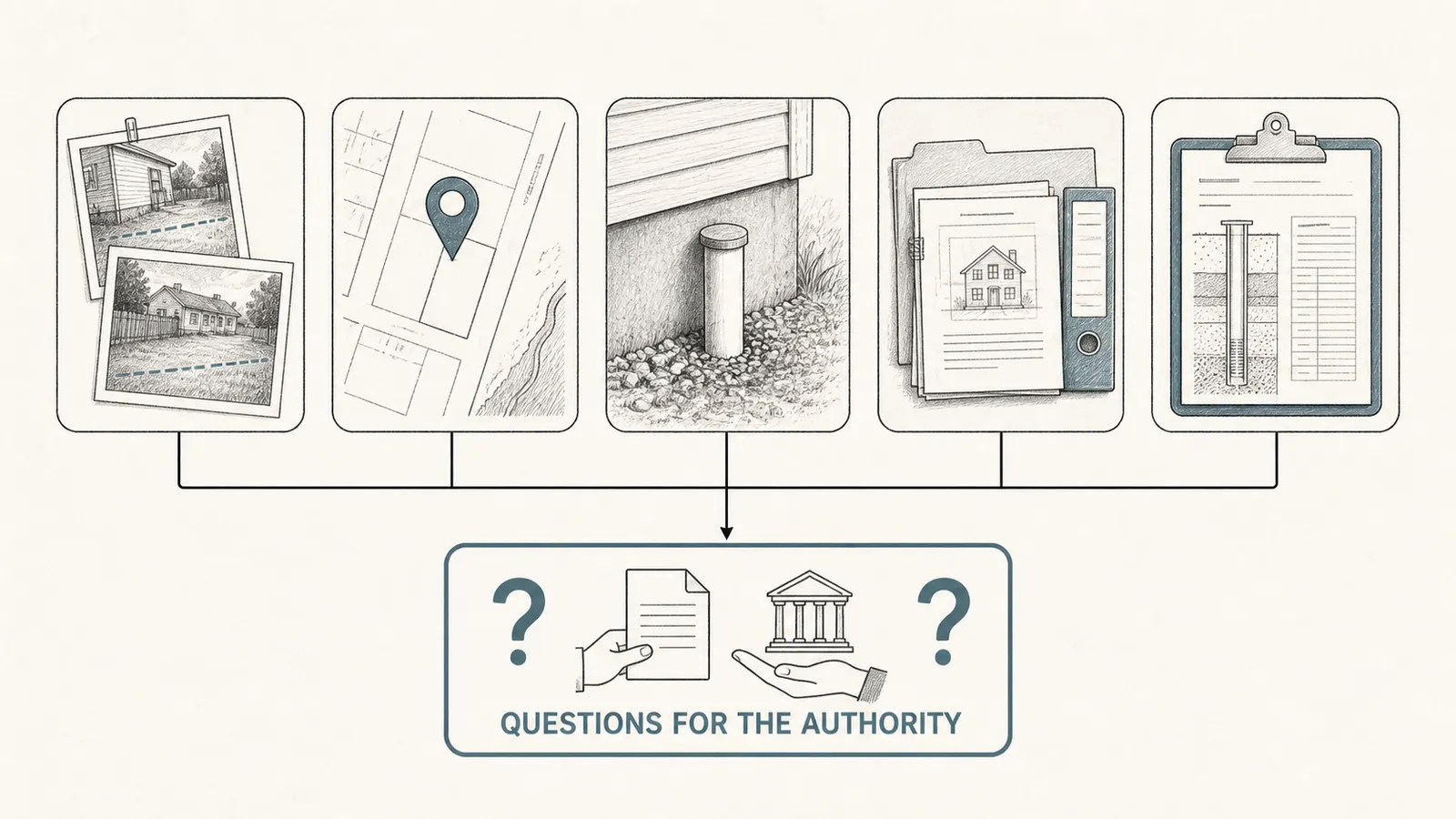
Use a phone photo showing the feature in relation to a house corner, fence, driveway, tree, shed, or other fixed landmark. Also make a simple sketch with north or a clear orientation, approximate distance to the house, septic system if known, property lines, surface-water features, and any other well or pump equipment. If your phone provides a location pin, save it, but label it “approximate.”
This matters because official well maps can have location uncertainty. Washington’s well-report search tool supports map and text searches but explicitly says reported locations may not represent the exact well location. A record that is nearby is a lead to investigate, not proof that it describes the opening you found.
Collect the history that is safe to obtain
Ask the seller, prior owner, neighbors, farm manager, well contractor, or property manager what the feature was used for. Search your closing file, inspection report, title documents, old surveys, permits, invoices, water-quality results, pump-service records, and photographs. Look for words such as “well,” “irrigation,” “cistern,” “bored,” “dug,” “drilled,” “test boring,” “monitoring,” “plugged,” “sealed,” “decommissioned,” or “abandoned.”
If you know an approximate drill year, a prior owner, a well depth, or a driller, write those facts down separately from assumptions. Texas’s official well-report search procedure starts with the approximate drill date and owner name and identifies depth and driller as helpful additional information. It also explains that reports from different periods may be held in different systems. Other states may use a different combination of address, parcel number, county, owner, or well-log number.
Search in the right order
- Start with the state environmental, natural-resources, health, water, or well-construction agency. Use the EPA state program directory if you do not know the correct agency.
- Search the state’s well-record database or report viewer using the property address, parcel number, current owner, former owner, approximate drill year, and county. Try alternate spellings and nearby addresses.
- Ask the county environmental-health office, building or permitting office, recorder, assessor, or planning office whether it keeps well permits, closure records, septic records, historic parcel files, or transfer forms. County systems differ; the absence of an online record is not a clearance.
- In states with groundwater-conservation districts, water-management areas, or delegated county programs, check whether the property falls inside one and whether that local body has separate registration, closure, inspection, or assistance requirements. Texas, for example, directs owners to determine whether a groundwater conservation district has jurisdiction and whether it offers plugging assistance.
- Save the record number, document title, date retrieved, source URL, and a PDF or screenshot where permitted. Keep a copy with the property file.
Ask the authority precise questions
Give the office your address, parcel or tax ID, photographs, location sketch, visible dimensions, known history, and any matching record. Ask:
- Is this agency the authority for this type of well and this property?
- What local definition or status categories apply: in use, not in use, abandoned, deteriorated, standby, maintenance, capped, sealed, or decommissioned?
- Is a field evaluation, permit, notice, inspection, licensed contractor, or completion record required before work?
- Can the well be repaired or returned to service, and what evidence is required to establish that it is sanitary and structurally sound?
- Is a standby or maintenance status available, for how long, and what maintenance or renewal duties follow?
- What closure method and materials are approved for this construction, depth, diameter, geology, and water condition?
- How is the closure recorded, and what document proves completion for a future owner or property transfer?
- Are there grants, cost-share programs, or district programs, and must approval happen before work begins?
Ask for the answer in writing or save the agency’s published instruction. A phone answer that omits the parcel, well type, or current rule is not a closure record.
What to hand over
Put the packet in one folder with a plain-language cover note. Include the property address and parcel number, the date found, a one-sentence description of the feature, the safe-distance photos, the location sketch, and a list of facts that are known versus guessed. Add the names of prior owners or contractors only when you can identify the source. Keep a short log of every call or email: date, office, person, question, answer, and requested follow-up. If a record appears to match, save the record number and note the facts that match and the facts that do not. This makes uncertainty visible instead of silently converting it into a conclusion.
4. Identify the rule-set that governs your property
The safest national rule is to expect variation. The practical sequence—control the hazard, preserve evidence, identify the record, consult the authority, then select work—travels well. The definition of abandonment, who may perform closure, whether an owner may do any part of it, what a cap means, whether standby is allowed, the notice period, the filing document, and the transfer disclosure can all change by state or local program.
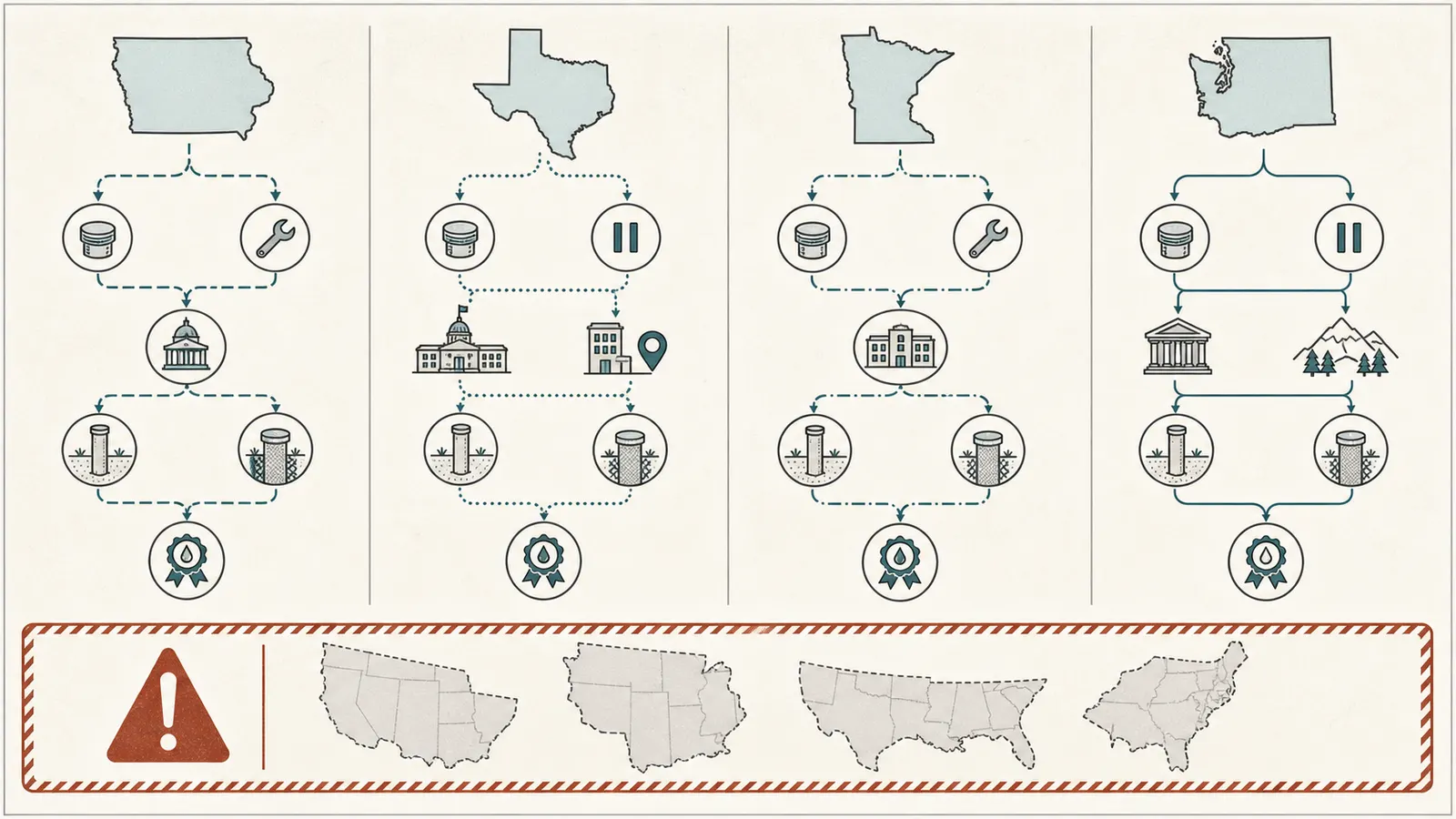
Four official examples of why the state matters
| Location | What the official source says | The decision lesson |
|---|---|---|
| Iowa | An Iowa DNR abandoned-well page says an abandoned well may be unused or so deteriorated that use is unsafe or impractical. It lists plugging, renovation or rehabilitation, and standby, with specific required work and records. | “Not using it” does not automatically tell you which outcome is required or available. |
| Texas | The Texas Water Development Board FAQ says a well is considered abandoned when no longer used and directs owners to TDLR, TCEQ guidance, groundwater conservation districts, and well-report systems. | The responsible contact may be state licensing, environmental, or district-level depending on the question. |
| Minnesota | The Minnesota Department of Health distinguishes “not in use,” “sealed,” and “capped” statuses. A maintenance permit may be available only for a structurally sound, sanitary well in a safe location. | A surface cap or a seller’s label is not the same as a legal closure record. |
| Washington | The owner must work with a licensed well driller to decommission an abandoned well, with notice and state-specific steps. | A homeowner must not import another state’s DIY allowance or closure method. |
These are examples, not a 50-state summary. Iowa’s choices, Texas’s liability language, Minnesota’s permit and disclosure terms, and Washington’s licensed-driller requirement should be read only within those states. Use the EPA state directory to locate the applicable program, then read the current rule or instruction for your property.
Use the state’s language when you call
Say “I found an opening that may be an old water well” if that is all you know. Then describe the evidence. Do not lead with “I have an abandoned well” unless an official record or qualified evaluation supports that status. This small distinction reduces the chance that a program routes you to the wrong form or assumes facts about the construction.
Also separate three questions that are often mixed together:
- Is it physically a well? This is an identification question.
- Is it safe and sanitary to keep or use? This is a technical evaluation question.
- What status or closure does the law recognize? This is a jurisdiction and recordkeeping question.
A water sample alone cannot answer all three. A clean sample does not prove that the casing, cap, annular seal, pump, electrical system, or legal status is acceptable. A record alone does not prove current condition. A contractor’s opinion alone may not satisfy the agency’s filing requirement.
5. Choose the right path: evaluate, repair, standby, or seal
Do not decide from the word “abandoned” alone. Choose the path only after the authority and qualified professional have enough information about construction, condition, intended use, and the required record.
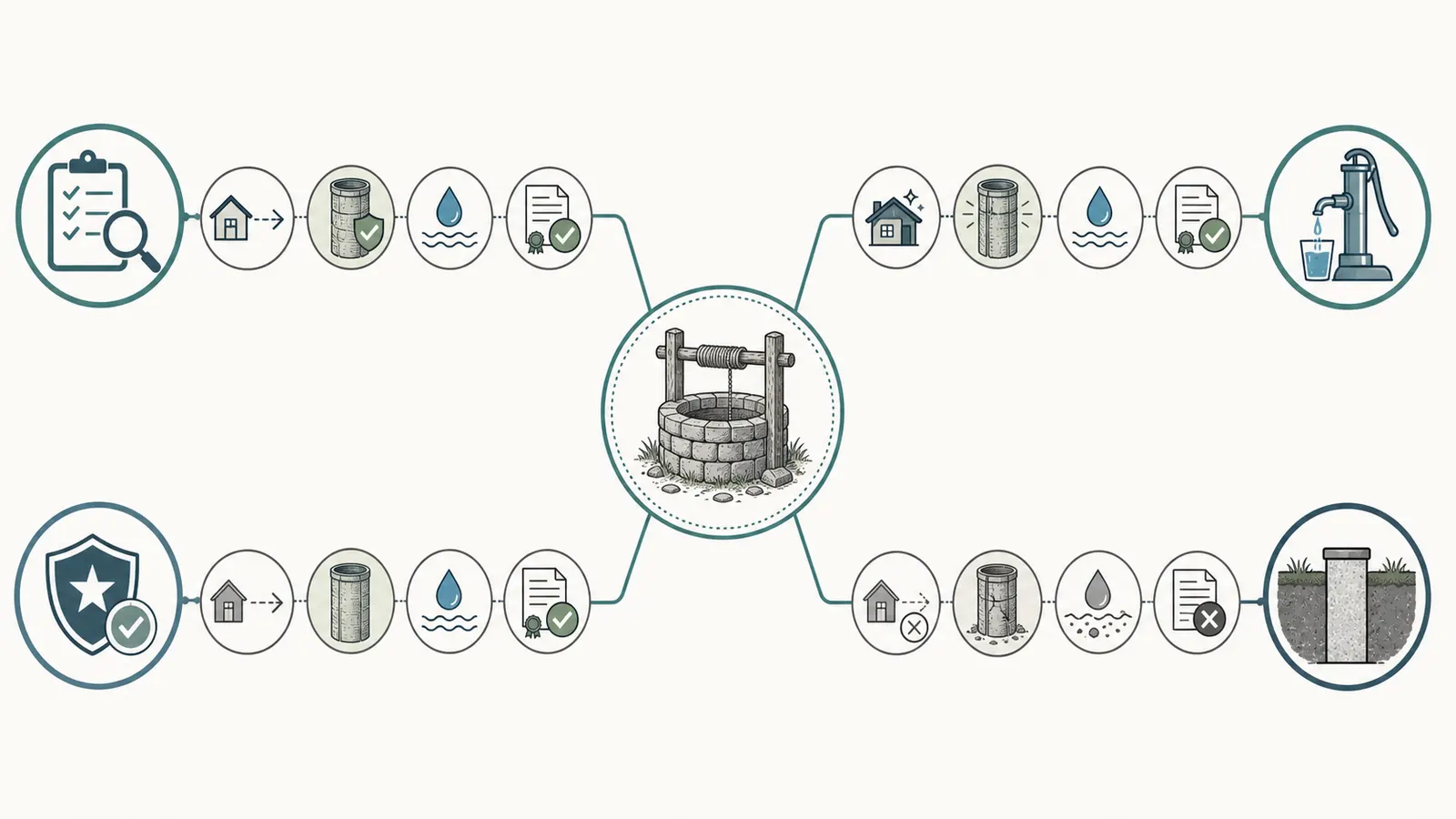
Path A: Preserve and evaluate
Choose evaluation first when the feature is unidentified, the record is missing, the opening is unstable, or you may want to use the water. The professional may need to identify the well type, casing, depth, obstructions, pump arrangement, sanitary protection, location relative to contamination sources, and condition of the wellhead. The work plan and any testing should be defined by the professional and applicable program.
Bring the evidence packet and ask for a written scope that distinguishes observations from assumptions. Ask what the professional can determine without entering a pit or disturbing the well and what agency notification or permit is needed before any intrusive work.
Path B: Repair and return to service
Repair is a possible outcome only when the state recognizes it and the well can meet the applicable construction, sanitary, water-quality, and operational requirements. Iowa describes renovation or rehabilitation as work that can improve casing, the wellhead, or the well area and increase groundwater protection. That does not mean every old well is economical, safe, or legally eligible to return to service.
If you are considering this path, ask for:
- the intended use: drinking, irrigation, livestock, fire protection, or another purpose;
- the condition and protection requirements for that use;
- any water-quality testing or yield information the authority requires;
- pump, pressure, electrical, and plumbing work by the appropriate qualified professionals; and
- the final record showing what was repaired, by whom, under which permit or standard, and what remains the owner’s maintenance duty.
Do not reconnect an old pump, energize a control box, or drink from the source because water appears clear. Treat unknown water as nonpotable until the applicable evaluation and testing are complete.
Path C: Standby or maintenance status
Standby can make sense when you genuinely expect future use and the program allows a well to remain inactive under defined conditions. Iowa says a standby well must be in good overall condition, sanitary, free of defects that risk groundwater, and protected with the pump removed and an airtight cap. Minnesota describes a maintenance permit for a structurally sound well in a safe, sanitary location and says it may require annual renewal.
Those examples show why “leave it for later” is not a universal option. Ask what the status is called locally, whether a permit or renewal fee applies, whether the pump must be removed, what cap or surface protection is required, who inspects it, and when it must be repaired or sealed. If you do not need the water and cannot maintain the status, permanent closure may be the more defensible path.
Path D: Permanently seal or decommission
Sealing or decommissioning is the usual decision when the well is unwanted, unsafe, deteriorated, or not economically useful, or when the authority requires closure. It is not the same as dropping dirt into the opening or putting a cap on top. Iowa describes plugging as removal of pumping equipment and obstructions followed by approved layers of fill and sealing materials and specific surface work. Minnesota says a legally sealed well has an official sealing record and is not defined merely by a cap.
Washington requires a licensed well driller to decommission an abandoned well and says the owner cannot legally do the work themselves there. The Washington Department of Ecology’s current instructions also show why a quote cannot be generalized: depth, diameter, geologic conditions, access, and special equipment affect the work.
For any closure proposal, confirm in writing:
- who is legally allowed to perform the work;
- whether a notice, permit, inspection, or preapproval is required;
- how the pump, casing, debris, and other obstructions will be handled;
- what approved materials and placement method apply to this well;
- how the surface will be restored and marked or mapped;
- what contamination, artesian, or cross-connection concerns must be addressed;
- which agency receives the completion report; and
- what record you will receive for your property file.
6. Plan professional work and preserve proof
The homeowner’s role is to control access, assemble evidence, choose the governing program, and verify documentation. Hazardous or regulated work belongs to the appropriate licensed or qualified professionals.
What not to do yourself
Unless the specific authority and a qualified professional have clearly established that a narrow action is safe and allowed, do not:
- enter a well, pit, vault, pump house, crawlspace, or other enclosed well area;
- open an energized electrical control, test live wiring, or handle submerged electrical equipment;
- open the well or remove a well cap;
- pull a pump or cut casing;
- lower a tool, camera, rope, or person into the opening;
- manipulate pressurized equipment, including plumbing, pressure tanks, or pump controls;
- pour in concrete, expanding foam, bentonite, gravel, trash, chemicals, or soil;
- bury the feature so a future owner cannot find it; or
- sign a form saying a well is sealed, plugged, or abandoned when you have not verified what that term means in your jurisdiction.
The distinction is important: a homeowner may be allowed to observe, photograph, mark, and call, while the same homeowner may be prohibited from decommissioning or may create liability by doing so incorrectly. Iowa’s page even separates owner-performed plugging conditions from contractor work, while Washington prohibits owners from legally decommissioning wells themselves. That is a state-rule difference, not a contradiction.
Compare quotes by scope, not just total price
If professional work is required, request an itemized scope. Compare whether each quote includes record search, site visit, agency notification, permit or notice fees, locating or exposing the well, pump removal, obstruction removal, sealing materials, surface restoration, inspection, and filing of the completion record. Ask how unknown depth, casing, access, or groundwater conditions would change the price.
Do not use a low quote as evidence that the work is simple. Washington specifically identifies depth, diameter, geology, and special equipment as cost drivers. A quote that excludes the agency record, inspection, or completion filing may leave you with a physically altered opening but no proof of recognized closure.
Keep a durable closure file
Save the before photographs, map or sketch, records search results, agency correspondence, contractor license or certification details, estimate, permit or notice, invoices, test results, photos during and after work, inspection outcome, and final plugging, sealing, or decommissioning record. Note the date, address, parcel number, well identifier, and name of each person or office involved.
If the professional says the feature is not a well, ask what written basis supports that conclusion and whether the agency wants the finding recorded anyway. If the well cannot be located, ask whether a “lost” or buried well has a specific local process. Minnesota, for example, says a maintenance permit will not be approved for a well that is completely buried or “lost.” That does not make Minnesota’s rule universal; it shows why an unresolved opening should remain an open record question.
7. Protect the property record and future owner
An old well is not only a water-system decision. It can affect future maintenance, environmental risk, lending, and property-transfer paperwork. The exact legal duty depends on the state and transaction, so preserve evidence even if you are not selling soon.
The Iowa DNR property guidance says water-supply wells, including abandoned and plugged wells, must be accurately disclosed on its Groundwater Hazard Statement when a property is sold or transferred. The Minnesota Department of Health transfer guidance requires well disclosure at specified points in a property transfer and distinguishes the status terms that appear in those documents. These are examples of why the final record matters; they are not a national disclosure rule.
Before listing, refinancing, subdividing, or signing a purchase agreement, ask the applicable state agency, county office, title professional, or real-estate attorney:
- whether all known wells must be disclosed, including sealed or plugged wells;
- which document or form is current;
- whether a completion or sealing record is required before the transaction;
- whether an unresolved or “not in use” well must be repaired, maintained, or sealed;
- whether a well on a neighboring parcel, shared well, or easement changes the analysis; and
- what the buyer or lender will likely need to see.
Do not promise that an old well is “gone” because the surface has been landscaped. A future owner needs the location, status, work record, and any remaining maintenance or monitoring duty. Keep a durable marker or map reference if the local program requires one, and tell future owners or their representatives where the record is stored.
The decision in one line
If you find a possible abandoned well: isolate it, do not enter or alter it, document what is visible, search the governing records, ask the state or county authority how the status is defined, and select evaluation, repair, standby, or sealing only through the process that applies to your property. That sequence protects people first, preserves groundwater and evidence, and keeps a state-specific problem from being mistaken for a generic DIY repair.
Sources and scope
Evidence behind this page
- Abandoned Wells & Well Plugging
Iowa DNR describes groundwater contamination and fall hazards from abandoned wells; the safety and contamination mechanisms are cited as general risk context, while Iowa legal duties remain Iowa-specific.
- Maintaining Your Well
Snohomish County Health Department, Washington, lists these hazards and tells readers not to enter enclosed spaces; it is safety guidance, not a national well-closure rule.
- Private Drinking Water Well Programs in Your State
EPA says most states have zero or limited private-well regulation and provides state-program links; this supports the article’s jurisdiction-first workflow, not a claim that every state uses the same process.
- Abandoned Wells & Well Plugging
The options and conditions are Iowa-specific examples of how a state may distinguish repair, standby, and closure; they are not presented as a national entitlement or rule.
- General Groundwater and Private Water Well FAQ
All definitions, liability language, and referral pathways in this claim are Texas-specific and are used only as an example of state variation.
- Locating a Water Well Report
Texas record-search procedure; the article generalizes only the practical idea of collecting identifying facts before asking the applicable state or county office.
- What You Should Know About Wells at Property Transfer
Minnesota definitions, permit conditions, and disclosure requirements; no Minnesota term is treated as a national definition.
- Abandoned wells
Washington-specific legal, administrative, and cost-driver information; the article uses it to show why the governing state program must be identified before work.
- Well Report Search Options
The viewer and its location disclaimer are Washington-specific; the older-record warning comes from the Snohomish County source cited in the article.
- Abandoned Wells & Well Plugging
Iowa-specific property-transfer disclosure information; the article separately cites Minnesota for Minnesota’s transfer requirements and presents both as examples, not a national disclosure rule.