What to Do If Your Private Well Cap Is Buried
A safe homeowner decision path for a buried private-well cap: records, surface checks, stop-use triggers, professional repair, and post-repair testing.
The short answer
Do not dig up or open a buried well cap as a DIY repair. Start with the well log and a surface-only inspection. If the casing is below grade, the cap or seal is damaged, water is pooling or flooding, or the well location is uncertain, contact your local well authority and a qualified well contractor. After any opening or repair, follow local disinfection guidance and use a state-certified laboratory for testing before treating the water as safe.What to Do If Your Private Well Cap Is Buried
Do not treat a buried private-well cap as a landscaping problem until you know what is buried, whether the casing is still intact, and whether the well is protected from surface water. A cap hidden by loose mulch may be a minor access issue. A casing that ends below grade, a well completed in a pit, a damaged seal, or standing water around the wellhead can be a sanitary defect or a safety hazard.
Your safest first move is records plus a surface-only inspection. Find the well completion report or well log, identify the well location without opening or excavating the well, and contact the local health or well-permitting authority and a qualified drinking-water well professional when the casing, cap, seal, drainage, or well location is uncertain. If flooding or suspected contamination is involved, stop using the water for drinking and cooking until the appropriate inspection, disinfection, flushing, and testing steps are complete.
The safe answer in one minute
Use this sequence:
- Find the record before the shovel. Look for the well log or completion report, permit, closing file, pump invoice, prior inspection, and water-test results. The University of Maryland Extension identifies the well log as the first place to learn what was installed and notes that the visible homeowner components are at the wellhead. Understanding and Maintaining Private Wells
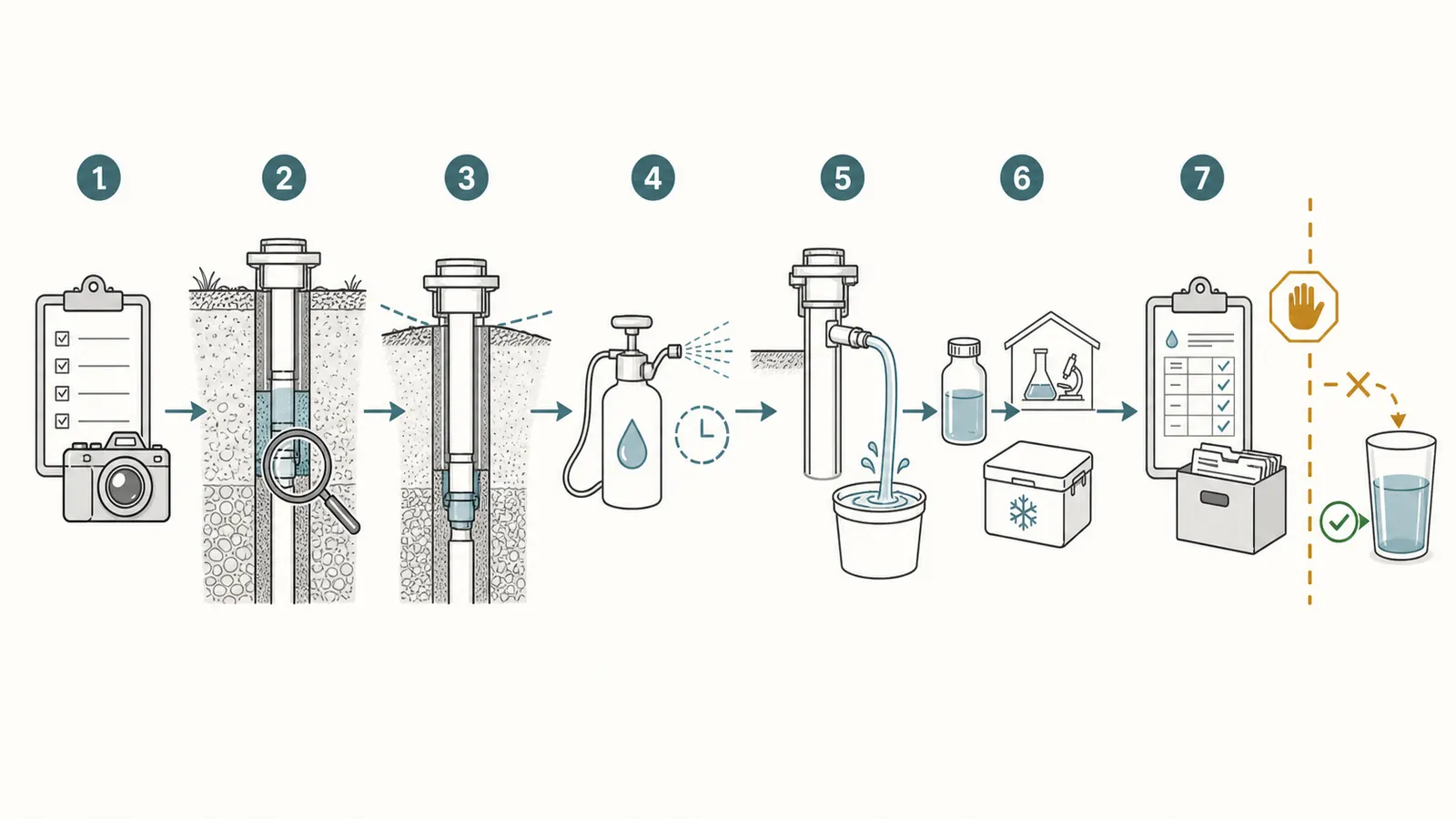
- Observe without disturbing the well. From dry, stable ground, photograph the area, note pooling or runoff, identify visible casing or a cap, and record whether landscaping or soil has been raised around it. Do not remove the cap, pry a seal, dig to expose the casing, pull a pump, or touch electrical controls.
- Separate “covered” from “below grade.” A cap just under loose mulch is different from a casing that was cut off below ground or a wellhead in a pit. You cannot reliably make that distinction from a small depression or a metal lid alone.
- Escalate the right trigger. A missing or damaged cap, buried casing, standing water, floodwater, chemical smell, open hole, electrical damage, or uncertain well location calls for a qualified well or pump contractor and local authority. Do not assume a replacement cap alone fixes the sanitary or code issue.
- Close the loop with evidence. After an opening, excavation, repair, or disinfection, ask for a written record of what was found and changed. Test through a state-certified laboratory before treating a suspected-contamination event as resolved.
The reason for this caution is functional, not cosmetic. EPA explains that casing and grout help keep dirt and excess water out of the well, while the cap keeps debris, insects, and small animals out. A buried or disturbed wellhead can therefore affect the barrier system, not just access to a lid. EPA's well-component explanation
Start with records and a surface-only check
Gather the record set
Before anyone excavates, assemble whatever exists:
- the well log, completion report, permit, or drilling report;
- the year the well was installed, if known;
- the well type, casing material and diameter, total depth, static water level, pump type, and pump-setting depth;
- the location sketch, survey, or directions from the driller;
- prior casing, cap, pitless-adapter, pump, or electrical work;
- previous laboratory results and any well-disinfection record; and
- photos from before the landscaping changed.
Do not assume a record will show the well as a precise dot beside the house. Indiana DNR, for example, says that well records rarely show the well's location relative to buildings and that some older Indiana wells were completed in a pit or covered with dirt. It recommends professional locating help when the well cannot be found reliably. That is Indiana-specific guidance, but it illustrates why a homeowner should not infer a location from the pipe entering the basement or from a guessed distance to the house. Indiana DNR's well-location FAQ
If you cannot find the record, ask the county or state well program where completion reports are kept. Ask whether the property has permits or reports under a prior owner's name, and ask what contractor credentials or permits apply before work starts. EPA directs owners to their state water-well licensing agency, local health department, or a local water-system professional for construction information because proper construction depends on local geology and groundwater conditions. EPA's private-well guidance
What you can observe safely
The homeowner evidence-gathering boundary is deliberately narrow. From stable ground, without opening anything, you may:
- photograph the entire area from several angles;
- note whether the cap, casing, vent, protective cover, or pitless-adapter riser is visible;
- note mulch, soil, paving, landscape edging, or a structure that may have been added later;
- look for standing water, erosion, septic or drain discharge, chemical containers, animal waste, or a grade that directs runoff toward the well;
- note obvious cracks, dents, missing fasteners, a loose cover, exposed wires, or a damaged protective post; and
- record whether the pump or nearby electrical equipment is wet, flooded, or physically damaged.
If a cap is already fully visible, you can photograph it and, while standing on dry ground, measure the exposed distance from finished grade to the top of the casing or riser without removing the cap. Do not reach into a hole, stand on the cover, scrape around the casing, or place a probe under the lid. If the cap is not visible, do not turn this into a digging project. A locator or well professional can identify the well and plan excavation around buried services and the well system.
The grade matters because surface water should drain away from the wellhead. Maryland Extension tells owners to check the well log, inspect the visible casing and cover, and make sure the ground slopes away from the wellhead. University of Maryland Extension's inspection guidance
Actions that are not homeowner observations
For a high-safety water system, the following are professional tasks:
- opening the well cap, sanitary seal, or well cover;
- digging down to expose a buried casing or grout annulus;
- opening an electrical control box, energized disconnect, or pump wiring;
- testing live wiring or resetting equipment that has been wet;
- pulling a pump, drop pipe, or pitless-adapter components;
- entering a well pit, vault, excavation, or other confined space; and
- manipulating a pressurized water line, pressure tank, or pitless-adapter connection.
Do not open energized controls or test live wiring. Do not open the well, pull the pump, enter a well pit, or manipulate pressurized equipment as part of this diagnosis. CDC specifically warns about electrical shock around flooded well equipment and says not to enter a well pit because gases and vapors can accumulate. CDC emergency well-disinfection safety guidance
Decide which buried-wellhead situation you have
The table below is a triage tool, not a substitute for an inspection. “No obvious problem” means only that your surface observations found no obvious problem; it does not prove the seal, grout, casing, or water is sanitary.
| What you can establish without opening the well | What it may mean | Safest next step | What not to infer |
|---|---|---|---|
| The cap is visible after landscaping was changed; casing is intact; no pooling or flood history is evident | The cap may be obscured by landscaping rather than structurally buried | Keep the area accessible and arrange a professional or local-code check if grade has been raised or the cap cannot be inspected fully | A visible lid proves the annular grout and seal are sound |
| The cap is not visible and the well location is uncertain | The well may be under soil, a pit, a landscape feature, or a different point than the record suggests | Use the well record and a qualified locator or well contractor; keep heavy equipment away until the well is identified | A pipe, basement line, or old photo proves the well location |
| The casing or riser is visibly below finished grade, or the well appears to be in a pit | Surface water can reach a below-grade wellhead, and access may be hazardous; the correction is jurisdiction-specific | Do not excavate or open it; ask the local well authority what code or permit applies and have a qualified contractor expose and assess it | A taller replacement cap alone corrects the casing, drainage, grout, or pit condition |
| The cap is cracked, loose, missing, corroded through, or visibly damaged | The barrier against debris, insects, animals, and surface contamination may be compromised | Keep children and animals away, contact a qualified professional, and ask the health authority whether to use alternate water pending testing | The water is safe because it still looks, tastes, or smells normal |
| Water is ponding at the well, the area flooded, or the pump/electrical equipment is wet | Floodwater or runoff may have entered the well area; electrical shock is also possible | Stay away from flooded equipment; do not drink or wash from a suspected flooded well; call a well/pump professional and local health department | Boiling or shock chlorination makes fuel or chemical contamination safe |
| Water has a fuel, solvent, pesticide, or other chemical odor, or nearby land disturbance may have introduced chemicals | The concern may be chemical rather than bacterial | Use bottled or another known-safe source and contact the health or environmental department for a contaminant-specific plan | Boiling or ordinary disinfection removes all chemical contamination |
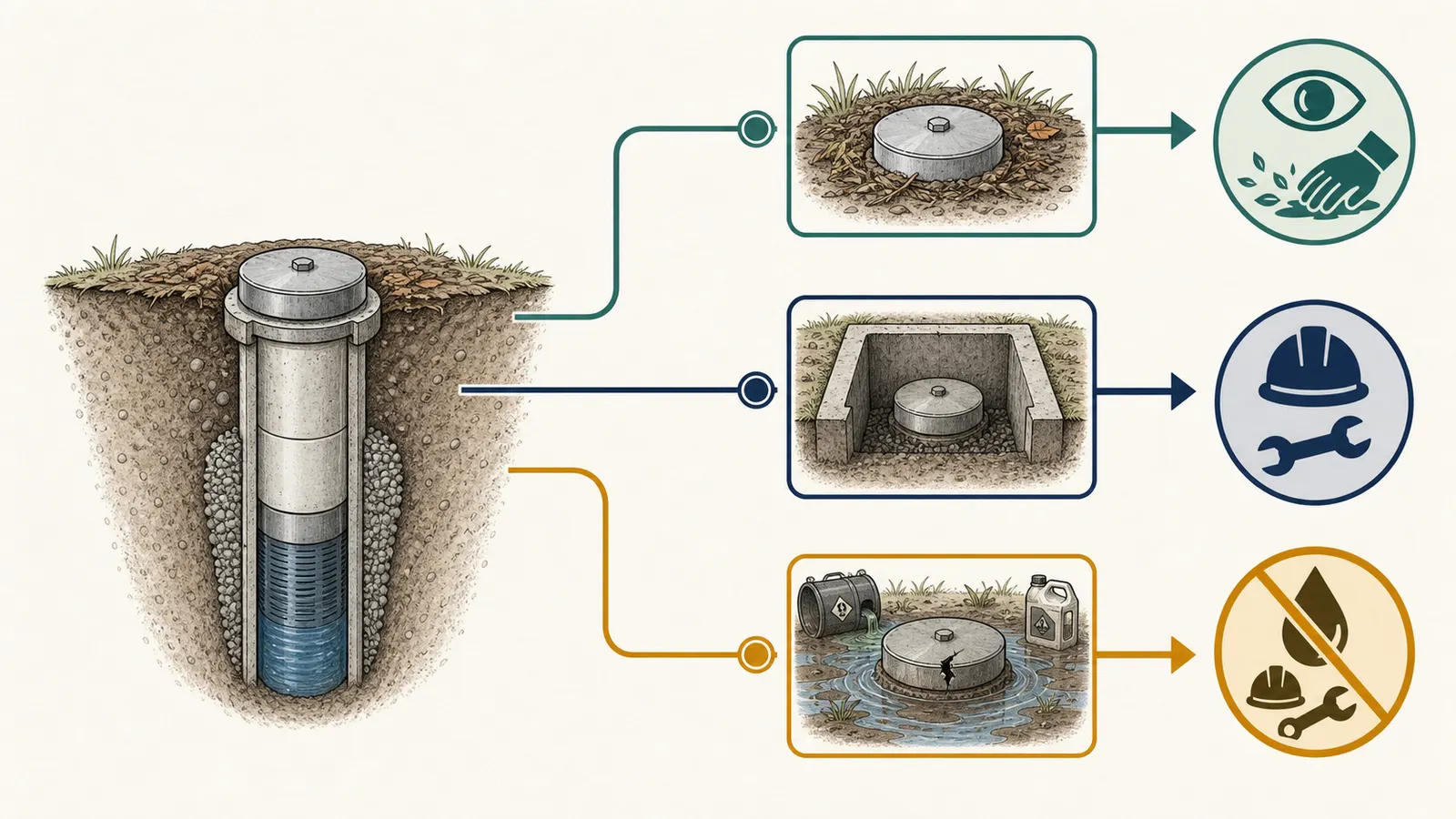
The central fork is whether the wellhead is merely hard to see or is physically completed below the protective grade. A record or professional excavation may be needed to answer that. Indiana's recommended standards are one example: they call for the casing to project at least 12 inches above finished grade and at least 24 inches above the highest flood level of record, and say casing should not be cut off below ground except to install a pitless adapter. Those are Indiana standards, not a nationwide measurement. Indiana's recommended private-well standards
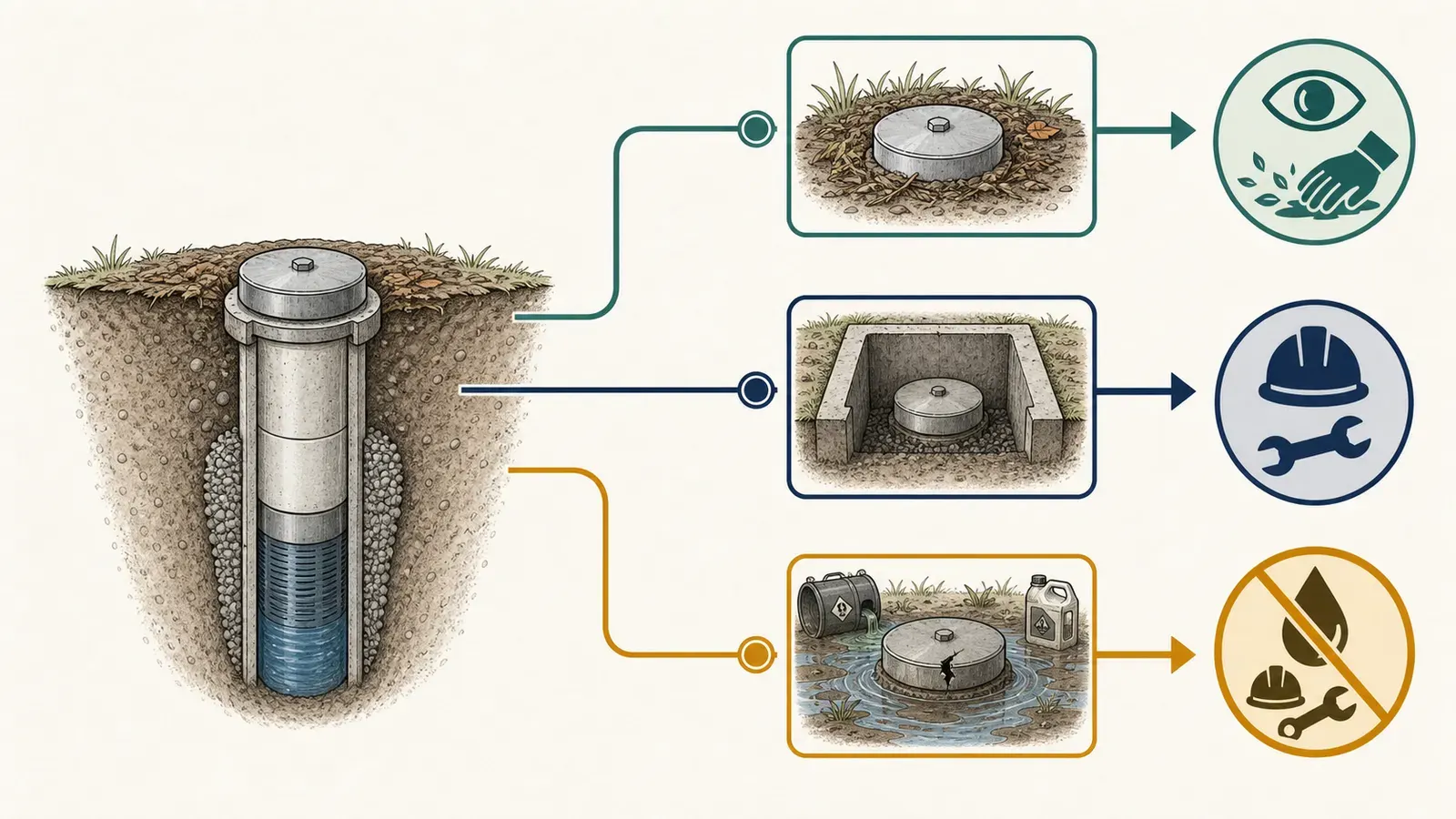
Know when to stop using the water and call now
A buried cap is not automatically an emergency. Stop and escalate when the condition suggests actual entry of surface water, a damaged barrier, electrical danger, or a chemical release.
Use an alternate source for suspected contamination
If the well has been flooded, if floodwater or sewage may have reached the wellhead, or if the water has a fuel or chemical smell, do not use it for drinking or cooking while you wait for instructions. EPA's flood guidance says not to drink or wash from a flooded well and to get help from a well or pump contractor to clean and disinfect it before turning on the pump. CDC likewise says that after extensive flooding or suspected contamination, bottled water is safest until the water is known to be safe. EPA's flood-response steps and CDC's emergency guidance
For a suspected chemical release, do not rely on boiling or disinfection. CDC says water contaminated with fuel or toxic chemicals will not be made safe by boiling or disinfection. Call the local health or environmental department and describe the chemical odor, nearby tanks, spills, pesticide use, fire, flood, or earthwork. CDC's chemical-contamination warning
If the only evidence is that intact-looking mulch hides a cap and there is no pooling, flooding, damage, or water-quality change, this is not the same stop-use trigger. Still, do not open the well to satisfy curiosity, and do not treat normal-looking water as proof that the buried configuration is acceptable.
Call before work when the hazard is physical or electrical
Call promptly when you see an open hole, a pit, unstable soil, wet electrical equipment, exposed conductors, a missing cap, a broken casing, or a well location that cannot be established. Keep people and pets away. Do not operate the pump or controls if equipment is wet or flood-damaged. The contractor may need a qualified electrician as well as a well or pump professional before power is restored. CDC's repair and power precautions
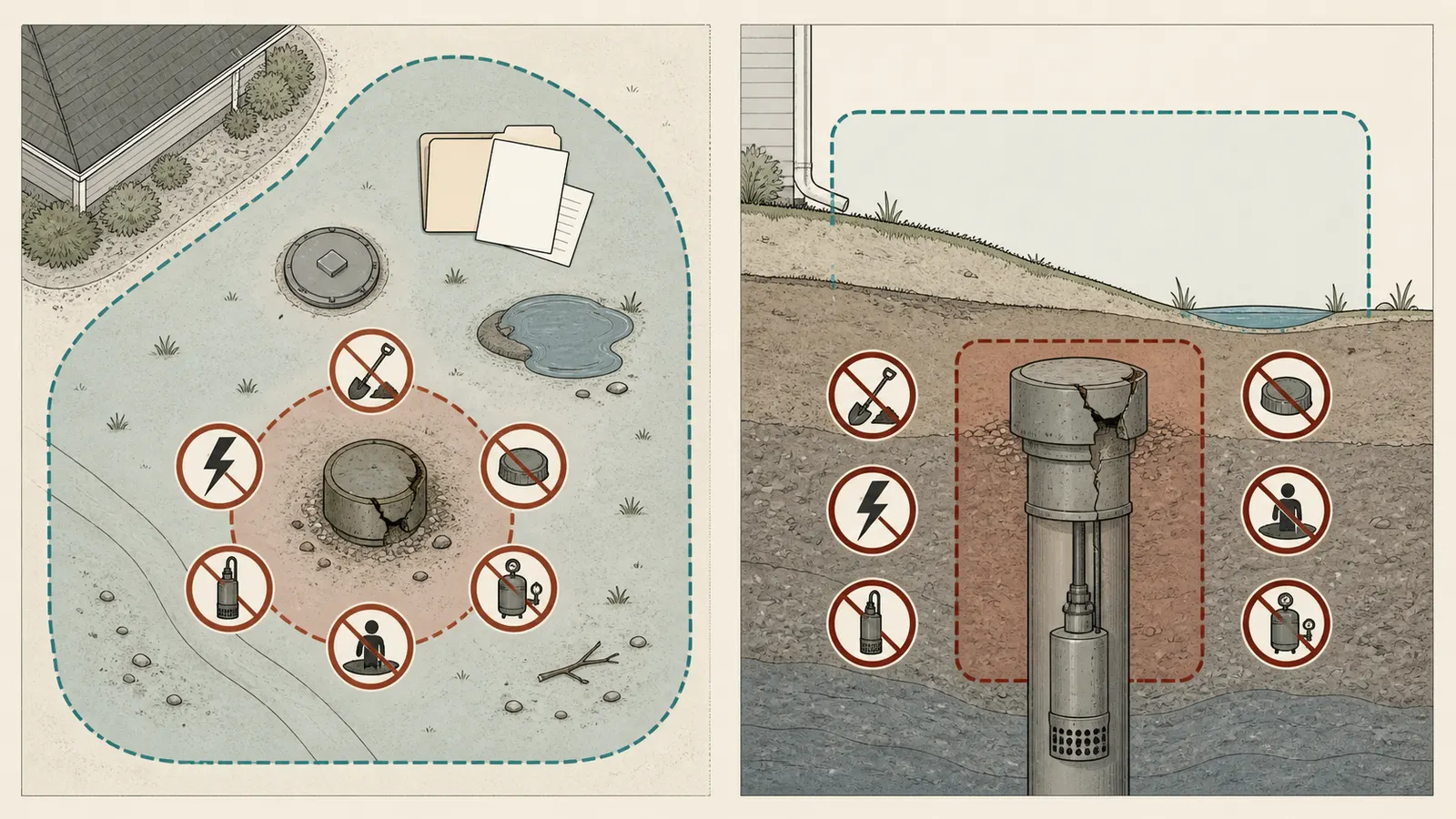
Ask the right local questions
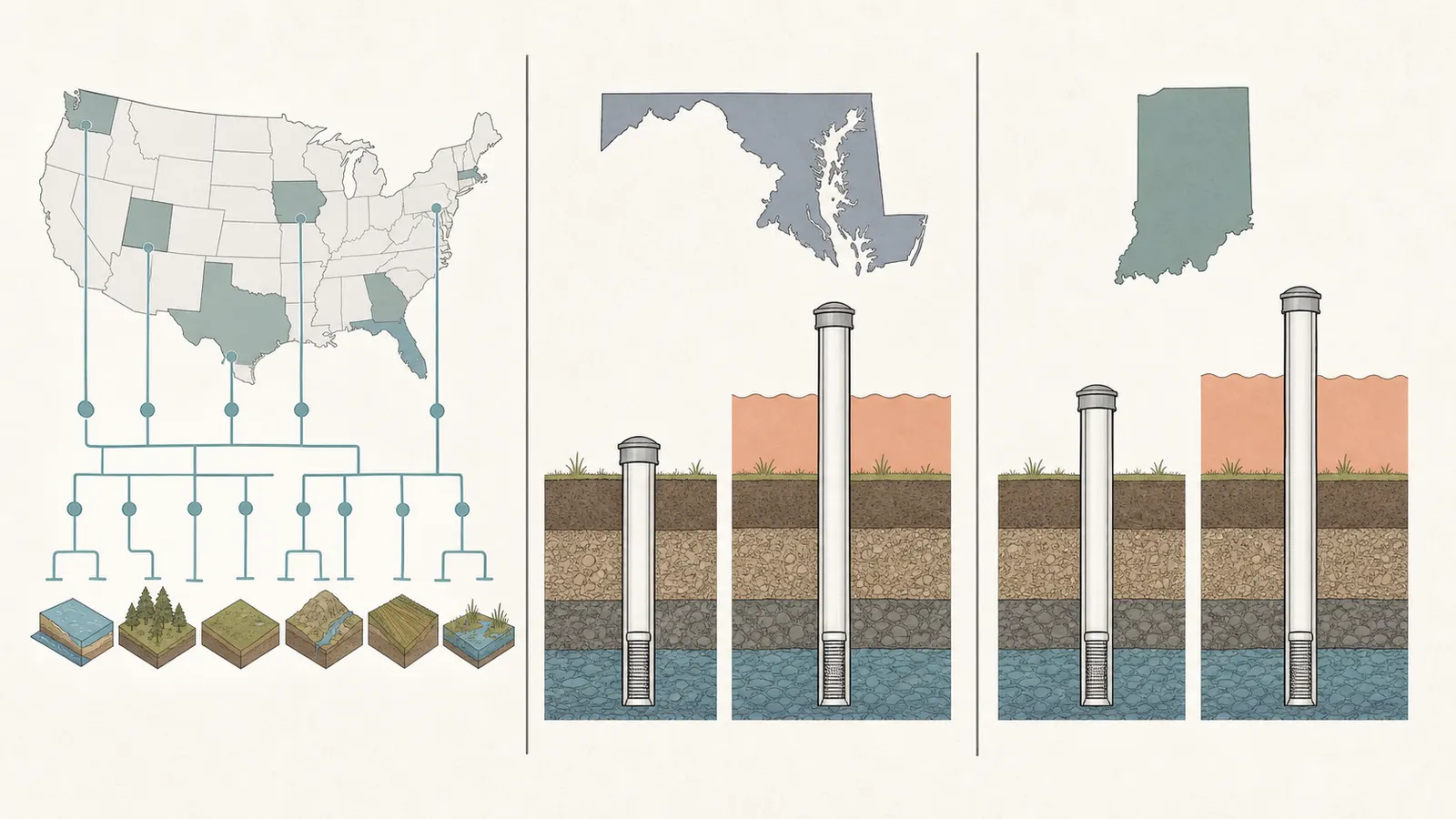
The U.S. has no single homeowner rule that resolves every buried wellhead. EPA says states and local governing agencies may set minimum casing requirements, and construction depends on local geology and groundwater conditions. EPA's well-component guidance
Ask the relevant county or state office:
- Is a buried or below-grade wellhead allowed for this existing well, or must the casing or pitless adapter be raised?
- Does exposing or opening the cap require a permit, inspection, licensed contractor, or notification?
- What height, flood-elevation, drainage, cap, vent, and sanitary-seal requirements apply at this address?
- Does a repair trigger current standards, even if the well is old?
- What disinfection and laboratory sampling are required after the work?
The details really can differ. Maryland Extension gives a general educational example of 8 inches above grade, or 24 inches in flood zones, while Indiana's recommended standards use 12 inches and 24 inches above the highest flood level. These figures should be read as source-specific examples, not as a national answer. Maryland Extension's well anatomy table and Indiana's recommended standards
One local example shows why the question should be asked before the seal is disturbed: an Ogle County, Illinois, public-health handout says that if a buried well's seal is broken, the well must be brought up to current code, and it directs owners to the county health department about permits, fees, and requirements. That is an Ogle County instruction, not a national rule, but it is a useful warning against opening first and asking later. Ogle County's chlorination and well handout
What a qualified professional should inspect and correct
When you schedule the visit, describe the condition as “wellhead location or cap buried” and send the records and photos in advance. Ask whether the company handles drinking-water well construction and wellhead work, and ask for the license, registration, insurance, or certification required in your jurisdiction. EPA recommends checking that water-well drillers and pump installers are bonded and insured and licensed or certified when the state requires it. EPA's contractor guidance
The inspection scope
The professional should identify the well and document, as applicable:
- Well identity and construction. Match the location to the record; confirm well type, casing material, diameter, depth, pump setting, pitless adapter, and any legacy pit or buried completion.
- Casing and terminal condition. Determine whether the casing is continuous and structurally sound to the finished termination, whether it ends below grade, and whether any opening other than a properly installed pitless adapter exists.
- Cap or sanitary seal. Record whether the cover is secure, vermin-resistant, vented as required, cracked, corroded, missing fasteners, or incompatible with the casing.
- Annular seal and drainage. Inspect the accessible grout or seal condition, the surface seal, soil settlement, erosion, and whether the finished surface directs water away from the well.
- Flood and contamination exposure. Note flood elevation, standing water, septic or drain pathways, fuels, pesticides, animal waste, recent grading, and nearby construction.
- Pump and electrical safety. Check whether the pump, wiring, controls, conduit, and pressure equipment are dry and serviceable. Any live electrical testing or wet-equipment restoration belongs to qualified personnel.
The goal is not merely to make a lid visible. The casing and grout are part of the contamination barrier, and the cap is part of the well's sanitary closure. Indiana's standards describe the annular seal as protection against contaminants entering the aquifer and require a watertight pitless-adapter connection where that configuration is used. Indiana's casing, sealing, and pitless-adapter standards
The correction may be more than excavation
Depending on the findings and local requirements, the work might be limited to removing landscape material and restoring drainage, or it might require a casing extension, pitless-adapter correction, replacement sanitary cap, grout or surface-seal repair, abandonment of a damaged legacy pit, electrical repair, or a larger well rehabilitation. A professional should explain which problem was actually found and which requirement or engineering reason supports the proposed work.
Do not accept an unexplained “bring it up” quote that does not identify the existing casing, seal, pump connection, and drainage. Conversely, do not assume that a buried well is automatically abandoned or that a visible cap is automatically compliant. The record, the exposed construction, and the applicable local rule control.
Request a before-and-after record
Ask for:
- dated before-work and after-work photographs;
- the exposed casing or riser height measured from the finished grade, if the jurisdiction uses a height requirement;
- the cap, seal, grout, pitless-adapter, drainage, and flood-exposure findings;
- the permit, inspection, or authority reference, if applicable;
- the parts and materials installed, including cap or seal type and casing-extension material;
- the pump, electrical, or pressure-equipment work performed by each qualified trade;
- the disinfection product and procedure, if disinfection was performed;
- flushing completion and the date and point of water sampling; and
- the laboratory report and the professional's interpretation of any failed result.
This record protects you later if the well is sold, repaired again, or questioned after a water-quality event. It also lets a laboratory result be interpreted alongside what physically changed.
Disinfection and testing after opening or repair
Do not make up a bleach dose, contact time, flushing duration, or test date for a buried-cap repair. The correct protocol depends on the well construction, the work performed, the equipment, the local authority, and the contaminant concern.
When disinfection is considered
If the well was opened, the seal was disturbed, the casing was exposed, the pump or plumbing was repaired, or floodwater may have entered, ask the local health department and the well professional whether disinfection is required and who should perform it. CDC says wells should be disinfected by a well or pump contractor after an emergency because of safety concerns. The Ogle County handout likewise recommends a certified, qualified professional for chlorination and warns that breaking the seal of a buried well may trigger current-code work locally. CDC emergency disinfection guidance and Ogle County's local handout
Do not open the cap to pour in bleach. Do not open energized controls, test live wiring, pull the pump, enter a pit, or handle chlorine without the training and controls appropriate to the job. Chlorine can injure eyes and skin, and a disinfection procedure can affect softeners, filters, septic systems, plumbing, and the pump system. If a professional gives you a written homeowner step, follow that specific local protocol; otherwise, leave the work to the qualified contractor.
What to request from the laboratory
For routine private-well surveillance, CDC recommends annual testing for total coliform bacteria, nitrates, total dissolved solids, and pH, with additional contaminants selected based on local conditions. It also says to test after replacing or repairing any part of the well system and to use a state-certified laboratory. CDC's well-testing guidelines
After a repair, ask the local health department or laboratory whether the required sample is a compliance sample, a post-disinfection bacterial sample, or both. At minimum, the professional handoff should state:
- the sample date and the sampling point;
- whether the well had been disinfected and fully flushed;
- the laboratory's certification status;
- total coliform and E. coli or fecal-coliform results when bacterial contamination is the concern;
- nitrate, pH, and total dissolved solids results when the routine panel is due; and
- additional tests selected for local geology, nearby septic systems, agriculture, fuels, industry, floodwater, or the specific work performed.
For an emergency disinfection protocol, CDC says to wait at least 7 to 10 days after disinfection so chlorine can be flushed, then sample for total coliform and either E. coli or fecal coliform. It also recommends follow-up testing in the next 2 to 4 weeks and again in 3 to 4 months, with further health-department help if bacteria persist. That timing belongs to the cited emergency guidance; it is not a universal waiting period for every routine cap replacement. CDC's post-disinfection sampling instructions
If any bacterial result is positive, do not turn a single result into reassurance or panic. Contact the local health department and the well professional, review whether the sample was collected correctly, identify whether the wellhead or nearby surface conditions remain vulnerable, and follow the recommended repeat-disinfection and retesting plan. If a chemical result is elevated, use the health department's contaminant-specific advice; bacterial disinfection does not solve every chemical problem.
Keep a homeowner decision record
The following checklist is designed to be copied into your maintenance file or sent to a well professional. It is a homeowner handoff record, not an official inspection, legal certificate, laboratory form, or code-compliance document.
Before the visit
- Well log, completion report, permit, or county-record search attached.
- Installation year and prior repair history recorded, if known.
- Well location shown on a sketch or marked only from safe surface observations.
- Photos show the full well area, drainage direction, landscaping, and any visible cap or casing.
- Pooling, erosion, flooding, septic proximity, chemicals, animal waste, or recent grading noted.
- Water-quality changes and the dates they began recorded.
- Children, pets, and heavy equipment kept away from the suspected well area.
Questions for the professional and local authority
- Who is authorized to locate, expose, open, repair, disinfect, or test this well in this jurisdiction?
- Is the current condition a covered cap, a below-grade casing, a pit, a pitless-adapter issue, or an abandoned/unknown well?
- What current height, flood, drainage, cap, seal, vent, access, and permit requirements apply?
- Does opening the well trigger an upgrade, inspection, or code-compliance review?
- What will be photographed and measured before backfill or landscaping is restored?
- What disinfection and flushing protocol applies to this construction and repair?
- Which state-certified laboratory and test panel should be used, and when should the sample be collected?
Closeout evidence
- Before-and-after photographs received.
- Casing or riser, cap, seal, grout, pitless adapter, and grade findings recorded.
- Work scope, parts, materials, contractor credentials, and permit or inspection reference saved.
- Disinfection and flushing record saved, if performed.
- Laboratory report saved with sample date, sampling point, and certification information.
- Any failed result has a written next step from the health department or qualified professional.
- Finished grade drains away from the wellhead and the well remains accessible for future inspection.
The decision to carry forward
If the cap is only hidden by loose landscaping, the answer may be a documented access and drainage correction. If the casing is below grade or in a pit, the answer is a professional exposure and jurisdiction-specific correction. If the cap or seal is damaged, water is pooling or flooding, the well location is uncertain, or chemicals may be involved, treat it as a potential sanitary or safety event and escalate before opening the well.
The one conclusion that does not change by state is the order of operations: identify the well, preserve the seal, avoid electrical and confined-space hazards, verify local requirements, document the physical repair, and test through the appropriate certified laboratory before declaring the water safe.
Sources and scope
Evidence behind this page
- Learn About Private Water Wells
National EPA homeowner explanation of common private-well components; it does not set a single national casing-height rule.
- Learn About Private Water Wells
National EPA guidance on why construction and professional requirements must be checked locally.
- Understanding and Maintaining Private Wells
University of Maryland Extension homeowner guidance; the records and inspection advice is general, while its numeric casing examples are not a national code.
- Understanding and Maintaining Private Wells
Maryland Extension's general educational example; not a nationwide rule and not a substitute for the owner's state or local requirements.
- Recommended Standards For Private Water Wells
Indiana Department of Health recommended standards; an Indiana example of jurisdictional requirements, not a national rule.
- Recommended Standards For Private Water Wells
Indiana recommended standards used here for the kinds of records and access a professional may need; record availability and requirements vary by state.
- Water Availability Use/Rights Frequently Asked Questions
Indiana DNR location guidance; used as an example of legacy conditions and locating limits, not as a national history of well construction.
- Protect Your Home's Water
National EPA testing and flood-response guidance for private wells.
- Guidelines for Testing Well Water
National CDC guidance for private-well testing; the additional contaminant panel depends on location and local risk.
- How to Disinfect Wells After an Emergency
CDC emergency and flood-related safety guidance; the stop-use triggers here are tied to flooding or suspected contamination, not to every cap hidden by landscaping.
- How to Disinfect Wells After an Emergency
CDC post-disinfection emergency protocol; not a universal waiting period for every non-emergency cap or casing repair.
- Chlorination Process and Well Diagram
Ogle County, Illinois local public-health handout; its code, permit, fee, and procedure statements are local and must not be generalized nationally.