What Does a Private Well Flow Test Actually Measure?
A homeowner worksheet separates faucet flow, pump and pressure-system observations, and formal well-yield evidence before you make a water-supply decision.
The short answer
A typical 30-minute hose-bib flow check measures water delivered at that outlet under that day's pump, pressure, plumbing, and stored-water conditions. It does not prove sustainable aquifer yield or recovery. A defensible capacity conclusion requires documented static level, drawdown, pumping rate, duration, discharge, and recovery—usually through a licensed well professional and state-specific method.What Does a Private Well Flow Test Actually Measure?
A typical private-well flow check measures water delivered at a particular outlet under that day's conditions. It is a snapshot of fixture flow, pressure-system behavior, pump operation, and water already stored in the well and pressure tank. It does not, by itself, prove how quickly the aquifer will replace the water being withdrawn or whether the well can sustain that rate through a dry period.
The Water Systems Council describes a common flow test as pumping from an outside hose bib for 30 minutes and recording flow at intervals. The same guide says that this test may reflect adequate storage in the well on the day of testing and does not represent actual recovery. A stronger sustainable-supply conclusion requires a documented pumping rate, static level, drawdown, and recovery observation under a method accepted where the well is located. Water Systems Council’s guide to evaluating water wells makes that distinction explicit.
Use the worksheet below to classify the result before you rely on it:
| Evidence you have | What it can reasonably tell you | What it cannot prove |
|---|---|---|
| Gallons per minute at a hose bib or fixture | How much water reached that outlet under the recorded conditions | Sustainable aquifer recharge, long-term capacity, or drinking-water safety |
| Flow plus pressure, pump cycling, cut-in/cut-out, and run-time observations | Whether the pump-and-pressure system behaved consistently during the observation and whether a distribution restriction may be involved | That the aquifer will recover at the same rate |
| A formal test with documented static level, constant pumping rate, drawdown, discharge, and recovery | Evidence about the tested rate under the test method, conditions, and jurisdiction | A permanent guarantee under every season, demand pattern, or future groundwater condition |
If a report gives only “8 GPM” or “passed a 30-minute flow test,” classify it as a fixture/distribution proxy unless it also documents the well measurements and formal test scope. Do not convert that number into a long-term well-capacity guarantee.
1. Separate the three questions hidden inside “flow”
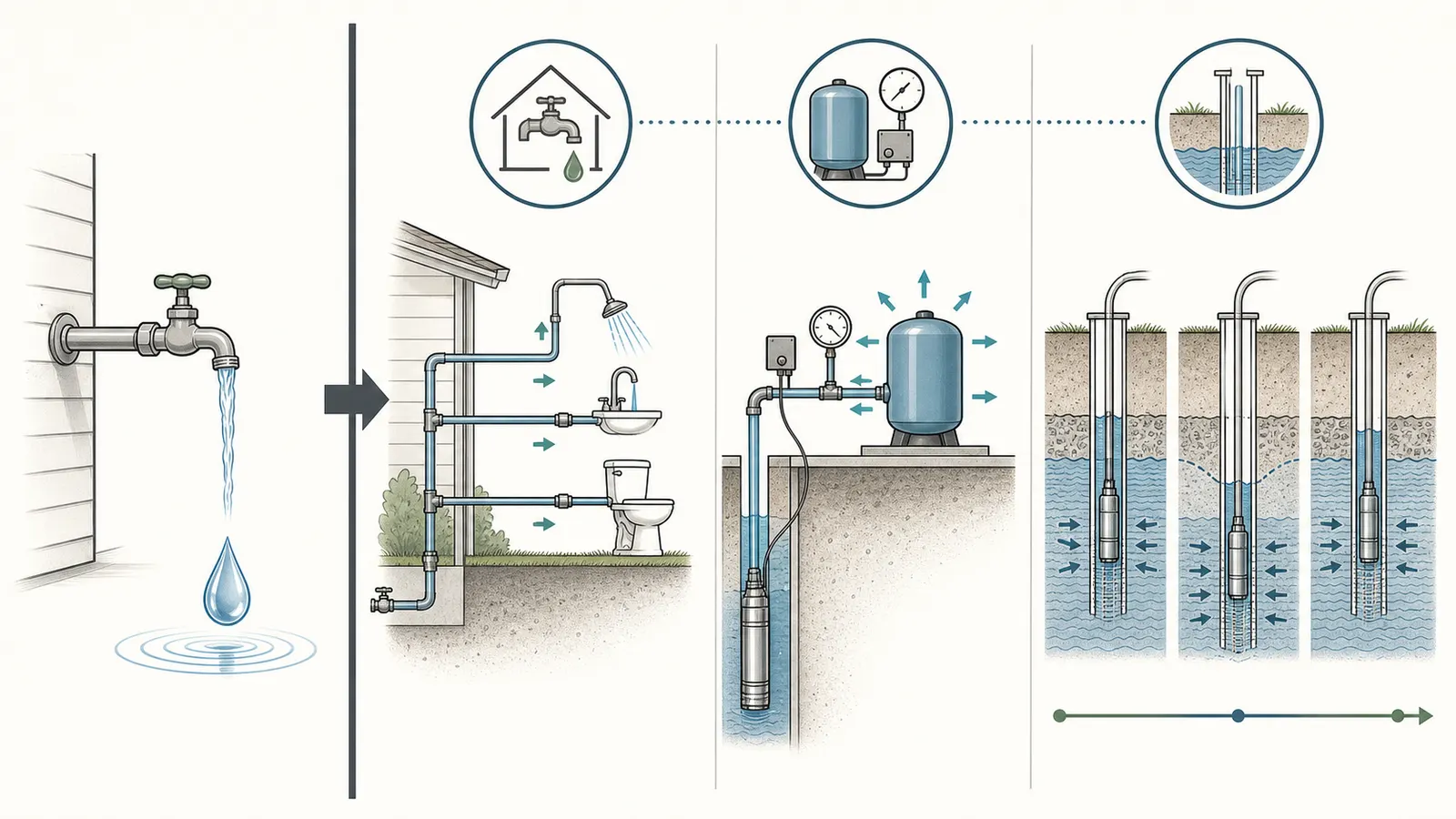
“How many gallons per minute does the well produce?” sounds like one question, but a homeowner may be asking three different things:
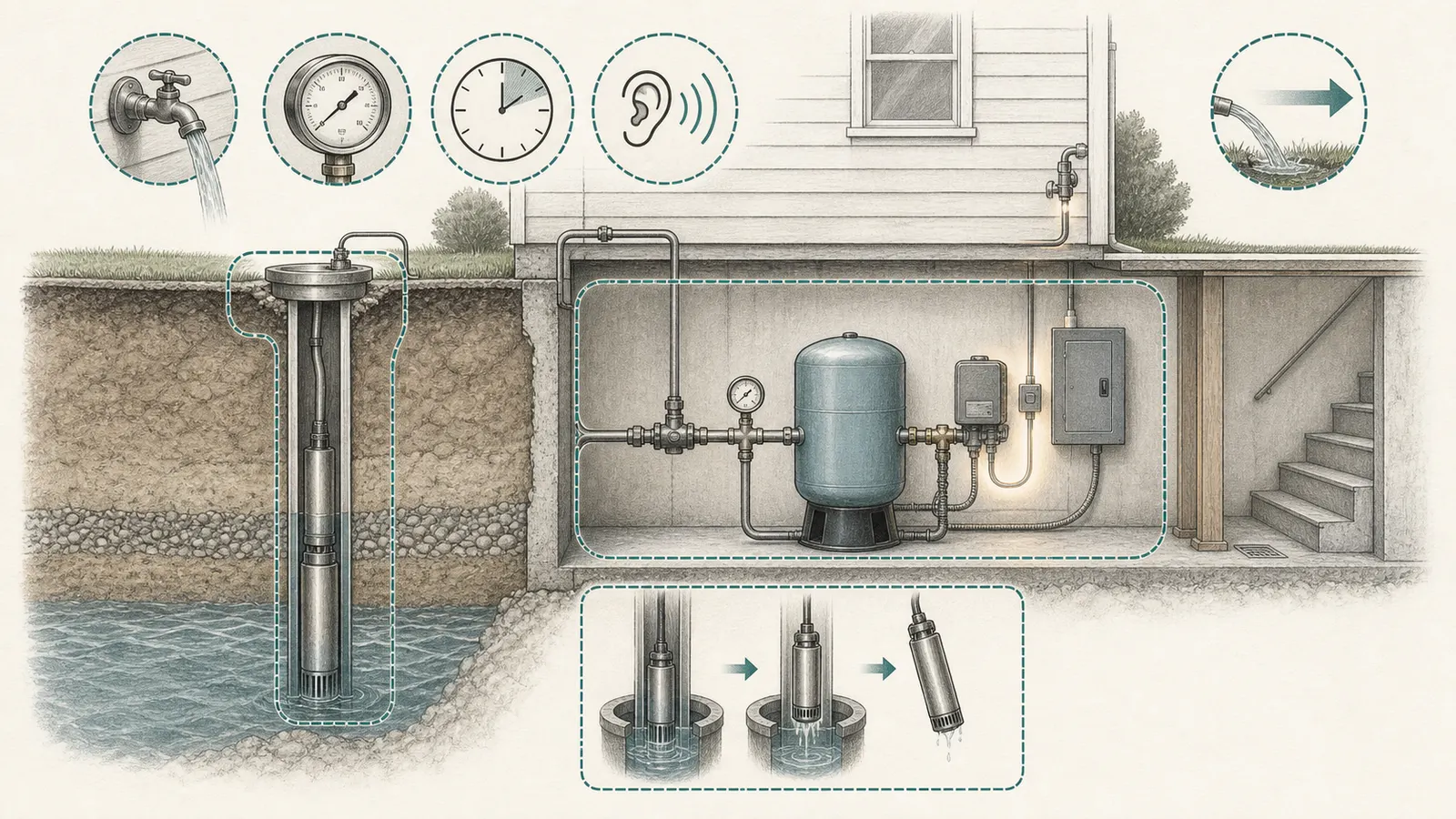
- What came out of this outlet? This is a fixture or distribution question. The hose bib, aerator, backflow device, treatment equipment, pipe size, valves, and elevation can affect the number before it tells you much about the aquifer.
- Did the pump and pressure system keep the house supplied? This is a system-performance question. You want the pressure readings, pump cycling, tank behavior, and the conditions under which the water was delivered.
- Can the groundwater source replenish the withdrawal over time? This is a well-yield question. It requires water-level observations during pumping and after shutoff, not only a container at the end of a hose.
The distinction matters in a home purchase, a low-pressure complaint, and a drought concern. A low hose-bib flow can be caused by a restriction or a pump problem. A strong hose-bib flow can be supported by stored water that later takes a long time to recover. A pressure tank can also make a low-yield well appear adequate for a short demand peak because the tank supplies part of the water while the pump is off. None of those observations should be mislabeled as aquifer yield.
Wisconsin’s Department of Natural Resources uses a similar separation in its property-transfer guidance: a licensed professional may evaluate the well and pressure system, while the inspection does not include the home’s plumbing distribution system or electrical-code requirements. That page also notes that household size, high-use fixtures, sprinklers, well type, and groundwater-level changes can affect performance. The licensing statement and inspection rules are Wisconsin-specific, but the measurement boundary is useful nationwide. Wisconsin DNR’s property-transfer well inspection guidance is the source for that distinction.
The result label to use
Write one of these labels beside the reported number:
- Outlet-flow proxy: The number was measured at a faucet or hose bib, but no water level or formal well-yield record accompanies it.
- Pump-and-pressure observation: The report also records pressure, cut-in/cut-out, pump starts, cycling, tank behavior, or run time, but still does not document drawdown and recovery.
- Formal-yield evidence: The report identifies the well, pumping rate, test duration, static level, drawdown, recovery, discharge conditions, test method, tester, and applicable state or local requirements.
- Unclassifiable: The report supplies a number without a location, units, duration, or test conditions.
The last label is not a failure finding. It is a record-quality finding: ask for the missing facts before drawing a capacity conclusion.
2. What a 30-minute hose-bib test actually measures
In the common format described by the Water Systems Council, water is discharged from an outside hose bib for 30 minutes, with the flow noted every 10 minutes. The preferred location is a hose bib on the house because it is intended to give a better assessment of what is available inside the home. That is a practical screening observation, not a universal regulatory protocol. State agencies, lenders, contracts, and local professionals may require different methods or thresholds.
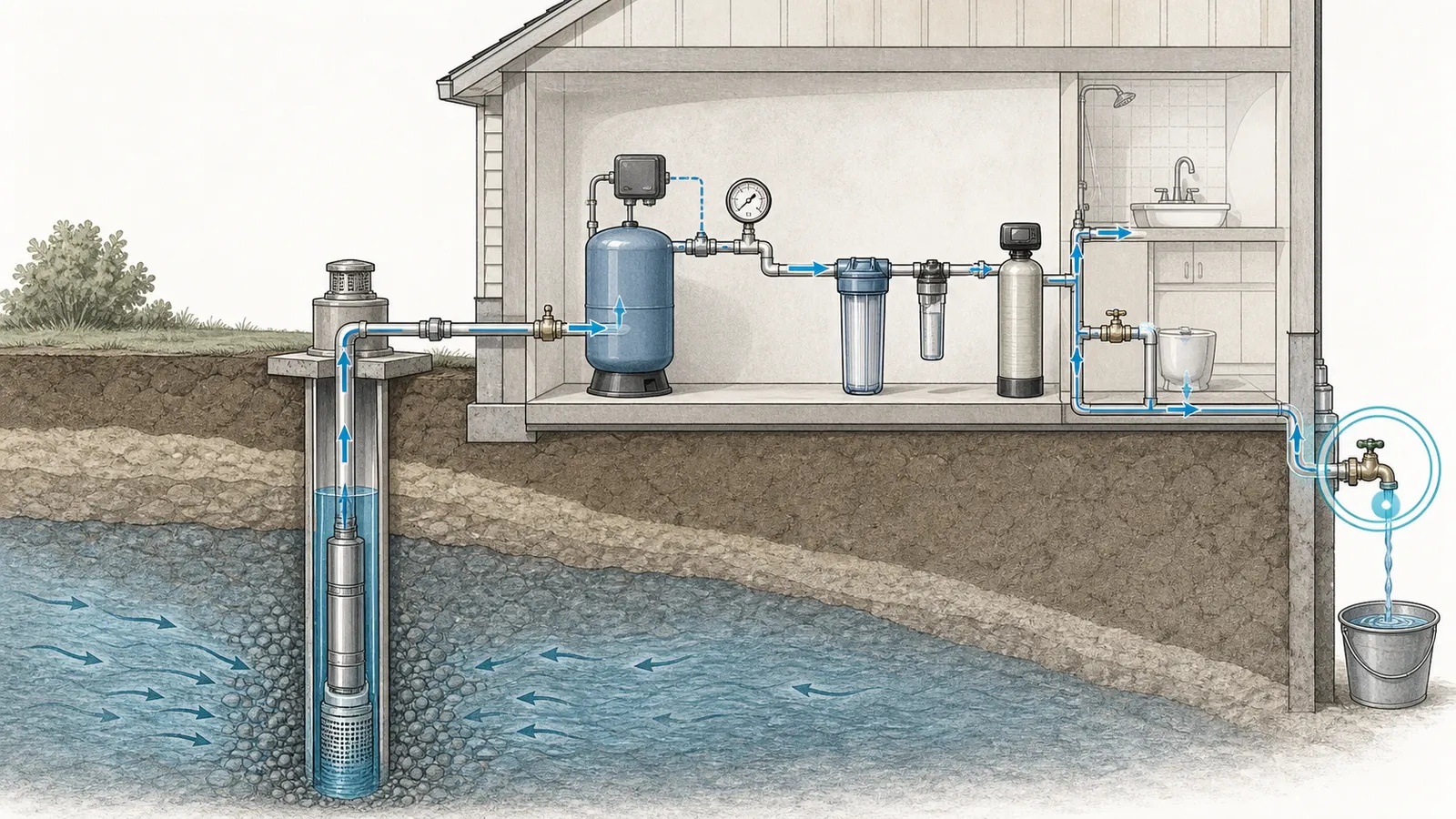
At the instant the hose is opened, the water at the outlet may be supplied by more than one source:
- water already in the pressure tank;
- water already standing in the well above the pump intake;
- water being delivered by the pump at that operating pressure; and
- water entering the well from the surrounding formation while pumping continues.
The bucket or flow meter sees the combined delivery at the chosen outlet. It does not identify the share contributed by storage versus ongoing recharge. If the test ends before the water level meaningfully responds, the reported GPM can look stable while the well’s recovery behavior remains unknown.
The outlet also sits downstream of the pressure system and the home’s distribution path. The Water Systems Council lists pump sizing, backflow prevention at the fixture, and small plumbing lines as possible reasons for a low observed flow rate. Treatment equipment, clogged filters, partially closed valves, a restrictive hose or nozzle, and elevation can be additional property-specific explanations that must be investigated rather than assumed. A low outlet number is therefore a prompt to locate the restriction, not proof that the aquifer is low-yield.
Record the location precisely. “Outside faucet” is not enough if the property has several hose bibs. Note whether the outlet is before or after treatment equipment, whether a hose or nozzle was attached, whether other fixtures were open, and whether the measurement was taken at the wellhead, pressure tank, house entry, or a remote fixture. A number without a location is not reproducible.
How to use the interval readings
Suppose a report records 7.2, 6.8, and 6.5 GPM at 10-minute intervals. The pattern may show that the outlet delivered roughly the same flow during that half-hour. It does not tell you that the well produces 6.5 GPM indefinitely. It also does not tell you whether the pump was running continuously, cycling, or drawing down a stored volume.
If the flow falls sharply, record what changed at the same time:
- Did pressure drop toward cut-in?
- Did the pump start, stop, or run continuously?
- Did the stream weaken while the gauge stayed high?
- Did the pressure oscillate or fail to rebuild?
- Did sediment, air, or discoloration appear?
- Did a filter, treatment device, or valve sit upstream of the outlet?
These observations help separate a fixture restriction, pressure-system behavior, and possible supply limitation. They still do not replace water-level measurements in the well.
3. Complete the evidence worksheet before interpreting GPM
Use one row for each test or report. If a field is absent, write not reported rather than filling it with an assumption.
| Field | Record exactly | Why it matters |
|---|---|---|
| Property and well identity | Address, well number or construction-report number, shared or individual well | Prevents a result from being attached to the wrong well or a shared system |
| Test date and time | Start, stop, time zone if relevant | Connects the result to season, recent rainfall, drought, and household demand |
| Test location | Well discharge, pressure-tank outlet, house hose bib, fixture; before/after treatment | Separates well delivery from distribution and treatment restrictions |
| Measurement method | Calibrated meter, timed container, inline gauge, other | Makes the precision and repeatability visible |
| Flow observations | GPM or gallons and time at each interval | Shows stability, decline, cycling, and whether units were confused |
| Pressure | Gauge reading at start, during discharge, cut-in, and cut-out if observed | Links outlet flow to pressure-system behavior |
| Pump behavior | Starts, stops, continuous run, short cycling, unusual noise | Helps identify pump or controls behavior without diagnosing it remotely |
| Pressure tank | Size, type if known, pressure range, observed cycle time | Identifies stored-water contribution and the system’s operating band |
| Static water level | Measurement method and depth before pumping or after full recovery | Establishes the baseline for drawdown |
| Pumping water level | Depth and time during pumping; lowest or stabilized level if recorded | Shows the water-level response to the stated withdrawal rate |
| Pumping rate and duration | Constant or changing rate, start/stop times | Defines the stress applied to the well |
| Recovery | Water level and times after shutoff; endpoint or reason observation stopped | Tests how the well returns toward its starting condition |
| Discharge conditions | Where water was sent, slope, distance from well, drainage, recirculation risk | Water flowing back toward the well can distort the test and damage the site |
| Demand context | Other fixtures, sprinklers, appliances, occupants using water | Separates a single-outlet check from peak household demand |
| Season and recent conditions | Rainfall, drought, freezing, flood, recent service or drilling | Explains why a snapshot may not represent another period |
| Tester and authority | Name, license where applicable, method, report, state or local requirement | Establishes who made the conclusion and what standard was used |
The Water Systems Council’s own inspection checklist asks for flow-test GPM and whether a more extensive test is needed. It also records pressure cut-in, cut-out, differential, and the time for the pump to go from cut-in to cut-out with no water running in the house. Those fields are useful observations, but their presence does not turn a pressure-system check into a formal aquifer-yield test. The Water Systems Council inspection guide identifies them as separate parts of an evaluation.
The minimum record for a homeowner decision
For a quick screening conclusion, insist on at least:
- the exact outlet and whether treatment equipment was upstream;
- the unit and measurement method;
- start and stop times and interval readings;
- pressure at the relevant moments;
- pump starts, stops, and whether the pump ran continuously;
- the date, season, recent water use, and recent weather; and
- a statement that says whether the number is a flow observation or a formal yield result.
For a sustainable-supply conclusion, add the well’s static level, pumping level or drawdown, constant pumping rate, test duration, recovery observations, and discharge arrangement. If those fields are absent, the honest conclusion is “capacity not established by this report.”
4. Read the number with a bounded calculation
A flow result is useful for describing observed delivery and for comparing it with a stated demand, but the calculation must keep its assumptions visible.
Convert the reported flow into the water observed during the test
If flow is approximately constant, the discharged volume is:
observed gallons = flow in GPM × test minutes
For example, a steady 6 GPM reading over 30 minutes corresponds to:
6 GPM × 30 minutes = 180 gallons observed at the outlet
That is a statement about the outlet during the test. It is not a statement that the aquifer replenished 180 gallons, or that the well can supply 6 GPM continuously. If the flow changed, calculate each interval separately and add the intervals; do not multiply the first or final reading across the whole test.
Compare with demand without calling it yield
If a home’s estimated simultaneous demand is 9 GPM and the outlet test shows 6 GPM, the observation suggests that the system did not deliver that requested flow at that outlet under those conditions. Possible explanations include the outlet, pressure system, pump, stored water, or well supply. The number alone does not tell you which explanation is correct.
If a home’s estimated simultaneous demand is 4 GPM and the outlet test shows 6 GPM, the observation suggests that the outlet delivered more than that stated demand during the test. It still does not prove that the well will maintain 6 GPM during a drought, after a long shower, while irrigation runs, or after a change in groundwater level.
The Water Systems Council notes that planned use matters and that a low-producing well may be made more reliable with proper storage equipment. That is a system-design question, not permission to relabel a stored-water or pressure-tank performance observation as aquifer yield. A professional must evaluate whether the well, pump, storage, controls, and demand are compatible.
Keep thresholds local and purpose-specific
You may see a lender, agency, or transaction form specify a minimum GPM. The Water Systems Council guide gives HUD’s existing-well flow requirement as an example of a program-specific requirement. Do not turn that example into a national rule, and do not assume that meeting a financing threshold proves long-term supply or water quality. Ask which program, jurisdiction, and test method the threshold belongs to.
The separate water-quality question is essential. EPA recommends that private-well owners use certified laboratories for drinking-water testing and describes health-related contaminants and testing conditions separately from well performance. A strong flow result does not establish that the water is safe to drink; a weak flow result does not identify a contaminant. EPA’s private-well testing guidance is the appropriate boundary for that issue.
5. What formal yield evidence adds
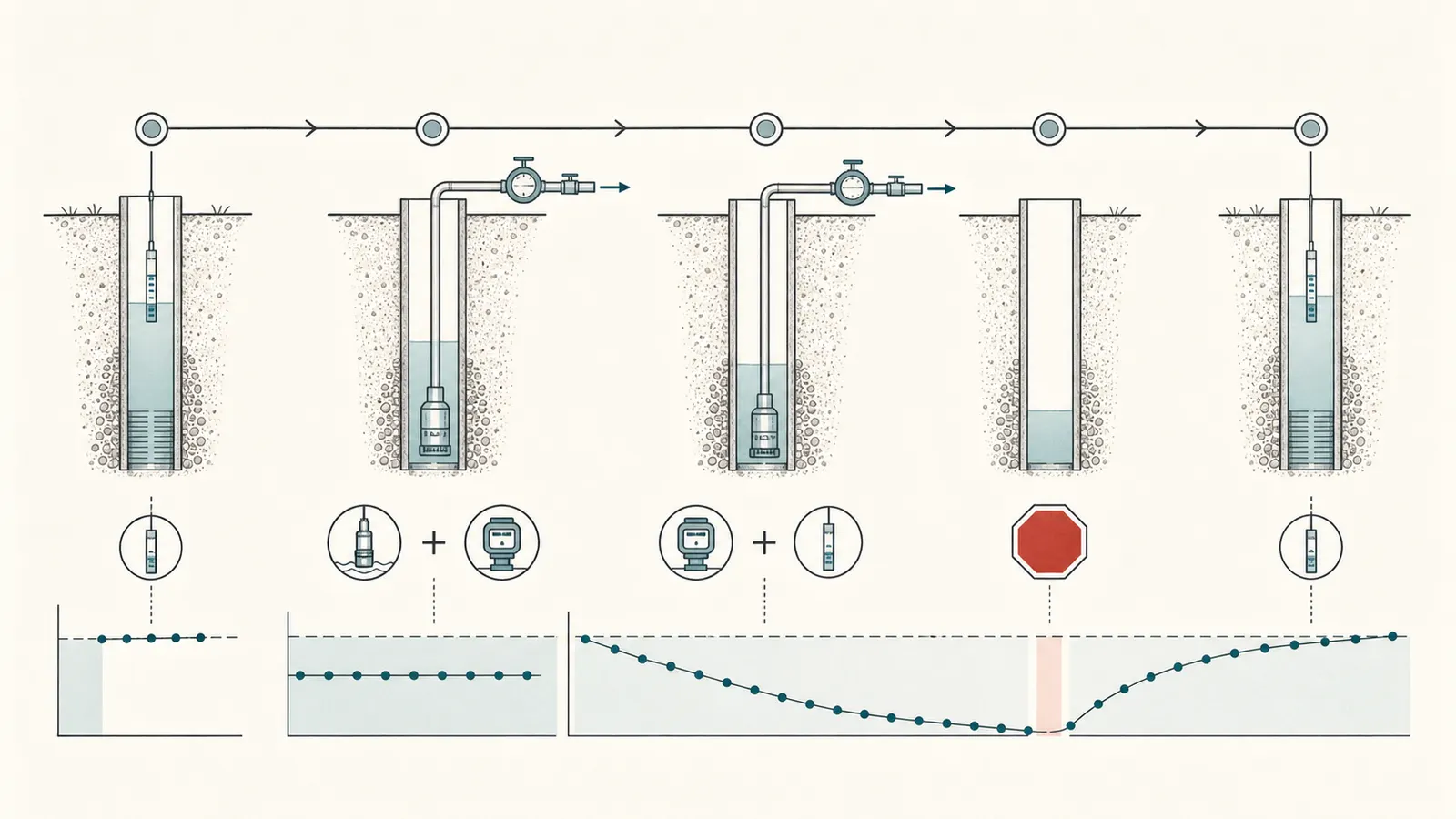
A formal yield test changes the question from “what came out of this outlet?” to “what happened to the water level while a defined withdrawal was applied, and how did the well recover afterward?” The test design, duration, measurement points, discharge route, licensing, and state requirements matter.
New York’s Appendix 5-B is a useful regulatory example. It defines well yield as a sustainable quantity that may flow from or be pumped continuously from a well. It requires a yield test to run long enough to quantify yield and calls for water-level and flow observations before pumping, at the end of withdrawal, and periodically during drawdown and recovery. New York State’s well standard applies in New York; it is not a nationwide test prescription.
The same New York standard’s example calls for at least four hours of stabilized drawdown at a constant flow rate and recovery observation to at least 90 percent of the initial water level or for 24 hours, whichever comes first. It says that if the level does not recover to 90 percent after 24 hours, the tested rate may not be sustainable for an extended period. Those are New York requirements and examples, not numbers to paste into another state’s report.
The evidence a professional should identify includes:
- Static level: the water level before pumping or after the well has recovered, with the reference point and measurement method.
- Pumping rate: the withdrawal rate, whether it stayed constant, and how it was measured.
- Drawdown: the change from static level as pumping continues, including the time series and any stabilized level.
- Duration: how long pumping continued and why that duration was selected.
- Recovery: water levels after shutoff, the observation interval, and the endpoint or stopping reason.
- Discharge: where the pumped water went and how the setup avoided returning water to the tested aquifer near the well.
- Interpretation: the tested rate, limits, seasonal assumptions, and whether the result is adequate for the intended household use.
Do not treat the phrase “yield test” as sufficient by itself. Ask to see the report’s actual measurements. A document can use the word yield while supplying only a hose-bib number.
Why recovery matters
Drawdown tells you how the water level responded while the well was being stressed. Recovery tells you how it returned after the stress stopped. A test that reports only the flow at the outlet has no direct evidence of either response. Without recovery observations, you cannot tell from that report whether the tested pumping rate left the well close to its starting condition or whether the water level continued to lag.
Recovery is also not a lifetime guarantee. Groundwater levels can change with rainfall, drought, nearby pumping, seasonal demand, and the physical condition of the well. Wisconsin DNR specifically cautions that no one can predict when groundwater levels will drop or when a pump or pressure tank will fail. Use a formal result as evidence under stated conditions, not as an unqualified promise about every future use.
6. Use this decision surface on an existing report
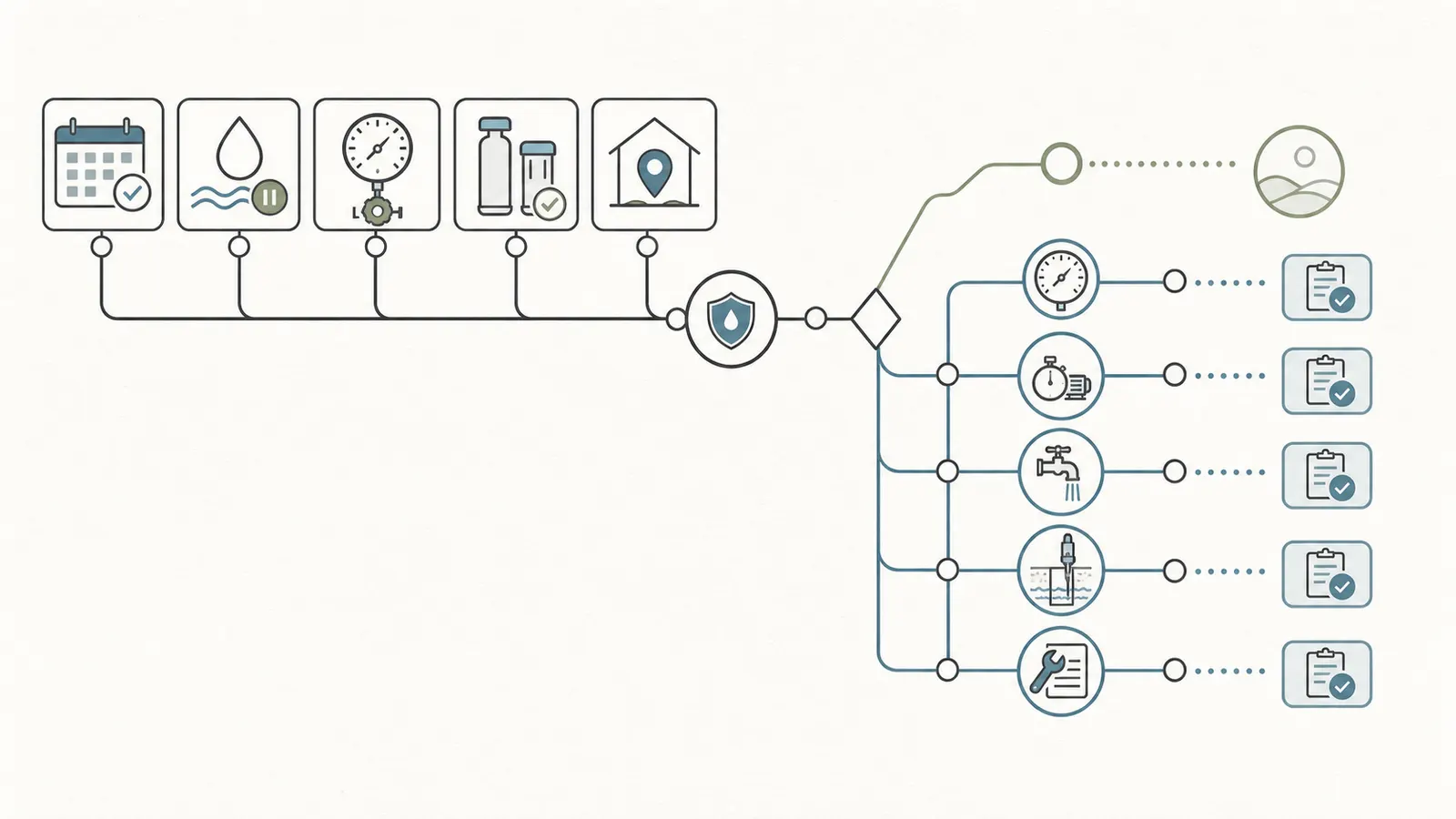
Start at the left side of the matrix and stop at the first row that matches the evidence you actually have.
| Report contains | Classification | Homeowner conclusion | Next action |
|---|---|---|---|
| One GPM number, no location, duration, or method | Unclassifiable | The result cannot be independently interpreted | Request the complete test record before relying on it |
| Outlet, method, duration, and interval GPM; no water levels | Outlet-flow proxy | Delivery was observed at that point on that date | Check pressure, pump cycling, restrictions, and well records; do not claim sustainable yield |
| Outlet GPM plus pressure and pump/tank behavior; no drawdown or recovery | Pump-and-pressure observation | The system’s surface behavior was observed | Have a licensed well professional evaluate whether the well-yield question remains open |
| Static level and pumping rate but no recovery record | Incomplete yield evidence | Drawdown may be described, but replenishment evidence is incomplete | Request recovery data or a follow-up test under the applicable method |
| Constant pumping rate, duration, drawdown, recovery, discharge, tester, and method documented | Formal-yield evidence | The report supports a bounded conclusion about the tested rate and conditions | Compare the tested conclusion with household demand, season, records, and local requirements |
| Formal yield result plus water-quality lab report | Two separate evidence tracks | Quantity and quality have both been investigated, within their scopes | Confirm sampling date, certified lab, contaminants, and any local or transaction requirements |
Red flags in a report’s wording
Ask for clarification if you see any of these statements without supporting measurements:
- “The well produces 10 GPM” when the number came from a hose bib.
- “Passed” without naming the threshold, program, location, or test duration.
- “Good recovery” without initial level, post-shutoff levels, times, and endpoint.
- “Low yield” when the outlet was after a filter, treatment unit, restrictive valve, or small line and no well measurement was taken.
- “Safe water” based only on clear appearance or strong pressure.
- “Meets code” when the report does not identify the state, local authority, code edition, or licensed professional responsible for that conclusion.
These are not proof that the well is defective. They are signals that the conclusion is broader than the evidence shown.
7. Take the safe next step and brief the professional well
Homeowners can safely document visible and ordinary-use observations: the test location, time, weather, fixture configuration, bucket or meter reading, gauge reading from a normal viewing position, pump starts and stops that occur during ordinary operation, unusual sounds, and where discharge water was directed. Keep the well log, construction report, maintenance records, prior water-quality reports, pump and pressure-tank information, and the household’s intended demand together.
Do not open energized controls, test live wiring, open the well, remove a well cap, pull a pump, enter a confined space, disconnect pressurized fittings, adjust a pressure switch, change tank precharge, manipulate a relief valve, or redirect a high-volume discharge toward the well. A pressure gauge reading or visible observation is not authorization to service the equipment. Electrical work, well access, pump removal, pressure-equipment service, and formal yield testing belong to a qualified, appropriately licensed professional under the applicable local rules.
The Water Systems Council’s guide says detailed inspection of well components should be performed by a licensed well contractor and recommends contacting one when a more extensive yield test is needed. Wisconsin DNR likewise says that compensated statements about well or pressure-system capacity and performance at property transfer must be made by the license class required by Wisconsin law. Your state may use a different license or terminology, so verify the local program before hiring or relying on a report.
A precise follow-up request
Send this request to the seller, inspector, lender, or well professional when the report does not support a sustainable-supply claim:
Please provide the complete well-flow or yield-test record for the well serving [property/address], including the well identifier, test date and season, outlet or discharge location, measurement method, flow readings and units at each interval, pressure readings, pump starts/stops or continuous-run observations, pressure-tank and control details if observed, static water level, pumping water level or drawdown, pumping rate and duration, recovery readings and times, discharge location and whether return flow toward the well was avoided, tester name and license where applicable, the test method, and the state or local requirement being applied. If the existing record is only an outlet-flow check, please state that the result does not establish sustainable well yield and advise whether a licensed formal yield test is appropriate for the intended household use.
That wording keeps the request focused. It does not demand a particular state’s duration or threshold, and it does not tell a professional how to perform a regulated test. It asks for the facts needed to decide whether the existing evidence answers the homeowner’s actual question.
Bottom line
A private-well flow test is only as strong as the question it was designed to answer. A hose-bib number can tell you what that outlet delivered on that day. Pressure and cycling observations can tell you more about the pump-and-storage system. Sustainable aquifer yield requires a separate evidence trail: static level, controlled pumping, drawdown, recovery, discharge conditions, and a report bounded by the applicable state or local method.
Until those layers are separated, the safest homeowner conclusion is: observed flow recorded; long-term well capacity not established.
Sources and scope
Evidence behind this page
- Water Systems Council — Guide to Evaluating Water Wells
The guide's homeowner and home-inspector flow-test description; the 30-minute format is guidance in this publication, not a nationwide legal test protocol.
- Water Systems Council — Guide to Evaluating Water Wells
The guide's flow-and-yield section; this supports the article's central boundary between a same-day flow snapshot and sustainable-yield evidence.
- Water Systems Council — Guide to Evaluating Water Wells
The guide's explanation of low flow during the hose-bib test; it supports troubleshooting branches but does not diagnose a particular property.
- Water Systems Council — Guide to Evaluating Water Wells
The guide's yield-definition discussion; it is general educational guidance and does not replace the well program or licensing rules where the property is located.
- New York State Department of Health — Appendix 5-B Standards for Water Wells
New York's drinking-water well standard; it is a state-specific regulatory example used to show what formal yield evidence contains, not a national rule.
- New York State Department of Health — Appendix 5-B Standards for Water Wells
New York's standard well-yield-test example in Section 5-B.4(b); the duration and recovery thresholds must not be presented as requirements in another state without checking that jurisdiction.
- Wisconsin Department of Natural Resources — Property Transfer Well Inspections
Wisconsin property-transfer inspections; the licensing rule is local to Wisconsin and is included to reinforce the need to check the applicable state program.
- Wisconsin Department of Natural Resources — Property Transfer Well Inspections
Wisconsin's property-transfer inspection description; the article uses the separation as a decision framework, not as a nationwide inspection checklist or code determination.
- U.S. Environmental Protection Agency — Private Drinking Water Wells and Protect Your Home's Water
EPA guidance on private-well drinking-water responsibility and testing; it supports the article's explicit separation of quantity/performance evidence from water-quality evidence.
- Water Systems Council — Guide to Evaluating Water Wells
The guide's pressure-tank and pressure-switch observations; the timing ranges are guidance in that publication and are not a universal pass/fail standard for every controller or system type.