Nearby Well Contamination: What Changes Your Testing Priority
Use your neighbor’s well result, distance, well depth, groundwater direction, and nearby sources to choose a safe next water-testing step.
The short answer
Yes—treat a nearby positive result as a reason to test your own well, but do not copy the neighbor's risk. Repeat the same contaminant through a state-certified drinking-water lab, add annual baseline indicators, and use your local health department to adjust for geology, well depth, groundwater direction, septic, land use, and household vulnerability.The short answer
Yes: a nearby private well with a confirmed water-quality problem is a reason to test your own well. It is not proof that your well has the same contamination. Start by obtaining the neighbor's actual report or the official notice, identify the contaminant and date, and ask your local or state health department how the result changes your panel. CDC lists being notified of well-water problems in the area as a reason to test outside the routine schedule, and EPA says to test immediately when there are known groundwater or drinking-water problems in the area. (CDC guidelines for testing well water, EPA private-well testing guidance)
For most homeowners, the safe default is: repeat the reported contaminant in your own sample, add the normal annual baseline, and use distance, well depth, construction, groundwater direction, nearby sources, and household vulnerability to decide how quickly to act. A clean neighbor result does not clear your well. Wells can draw from different screened intervals, flow paths, or local geologic pockets, and private-well owners are responsible for monitoring their own supply. (USGS domestic private-supply well overview, EPA private-well contaminants and impacts)
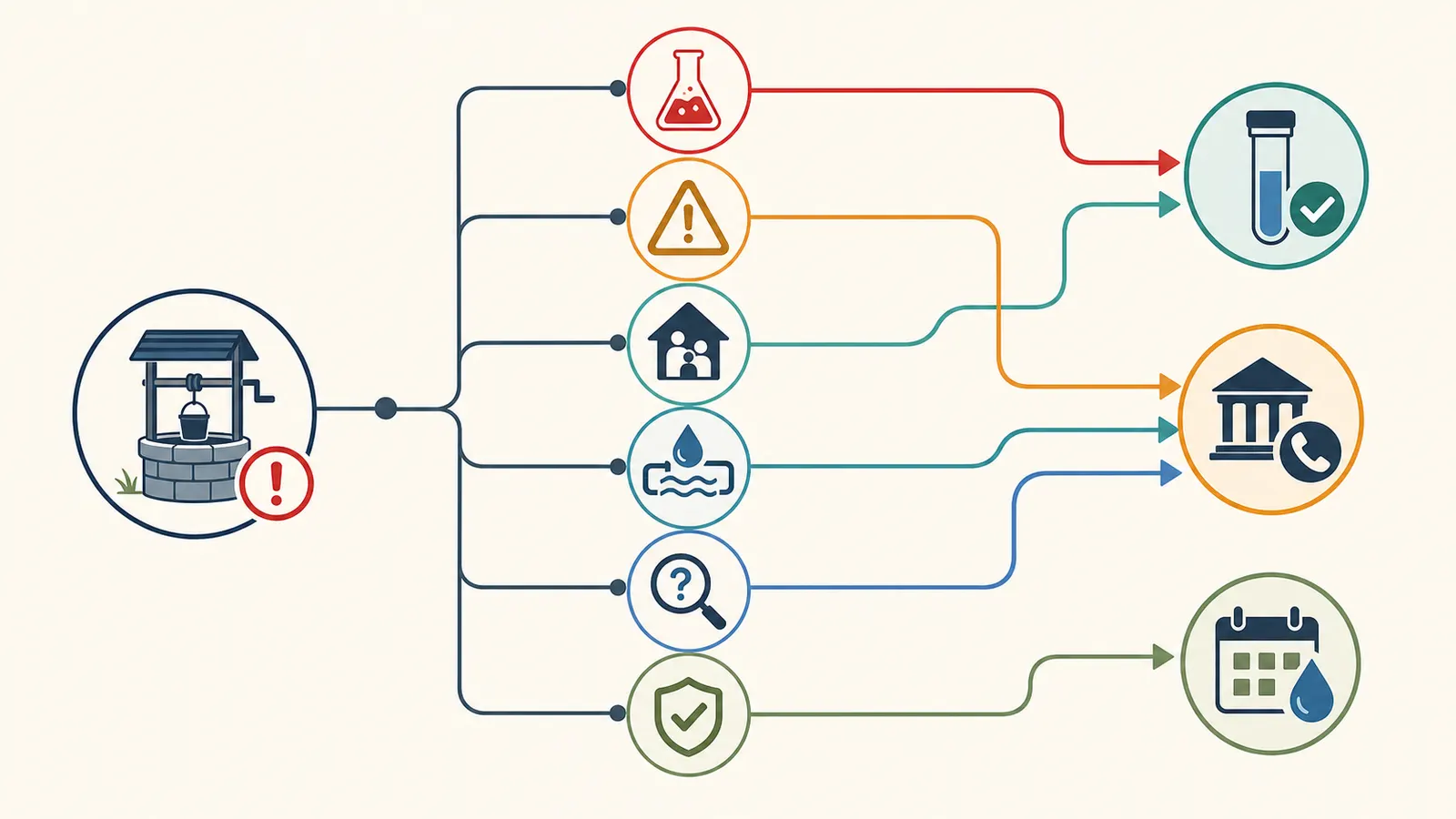
Choose the right lane: test now, call first, or establish a baseline
Use this routing table as a starting point, not as a substitute for an official advisory or a site-specific sampling plan.
| Situation | Best next action | What to arrange |
|---|---|---|
| The neighbor's report is verified; the contaminant is known; or an official notice identifies a groundwater or drinking-water problem | Test your well promptly | Repeat the same analyte or method, add the annual baseline, and use a state-certified drinking-water laboratory |
| The result is unknown, the report is only a rumor, a spill or sewage event may be involved, or the household includes an infant, pregnant person, nursing person, or older adult | Contact the health department first, then follow its sampling advice | Ask whether an advisory, alternate water source, special bottle, rapid turnaround, or tailored panel is needed |
| The neighbor's result is old or cannot be verified, there are no shared-source clues, and your well has no recent change | Establish or update a routine baseline | Test total coliform, nitrate, total dissolved solids, and pH at least annually, then add local-risk analytes |
“Test promptly” does not mean there is one universal number of hours or days for every contaminant. It means do not wait for your next annual date when a credible area problem, nearby land disturbance, flooding, changed water quality, or other trigger is present. EPA also notes that households with small children, elderly adults, or pregnancy or nursing may need more frequent testing. (EPA's testing and vulnerability guidance)
If your own result later shows harmful germs or chemicals, follow the health department's instructions about a safe drinking-water source and use. CDC advises contacting the local health or environmental department to understand what to do next; EPA advises contacting public health officials and re-testing your own well to confirm an exceedance before selecting treatment. Do not install treatment solely because a neighbor's result sounds alarming, and do not treat a neighbor's clean result as a safety certificate for your house.
Verify what the neighbor's positive result actually means
Before ordering a broad panel, record the facts that make the result interpretable. A phrase such as “the well tested positive” is not enough. “Positive” could mean a presence/absence bacteria result, a concentration above a health benchmark, an aesthetic issue, a screening result that needs confirmation, or a result from water after treatment. Those conditions lead to different next questions.
Ask for or write down:
- The exact contaminant or analyte, including whether it was total coliform, E. coli, nitrate, arsenic, a named VOC, lead, a pesticide, or something else.
- The result, unit, reporting limit, qualifier, and any comparison value shown on the report.
- The sample date, sample tap, and whether the sample was untreated well water or collected after a filter, softener, or other treatment.
- The laboratory name and whether it was certified for that drinking-water analysis in the state.
- The neighbor's well depth, construction type, casing or screened interval if known, and approximate distance from your well.
- Any official notice, repeat test, treatment, flood, spill, septic failure, construction, or land-use change connected to the result.
Do not pressure a neighbor to share private health or property information. A redacted report, the contaminant name and date, or a health-department notice may be enough to ask a useful question. If the only information is hearsay, tell the health department exactly what is known and unknown rather than presenting the rumor as a confirmed exceedance.
The best available neighbor-targeting research is narrower than the headline question. A New Jersey pilot offered arsenic testing to households within 500 feet and between 500 and 1,000 feet of known high-arsenic wells; proximity and the neighboring concentration helped predict observed arsenic exceedance in that local setting. The authors also emphasize that neighboring wells are not consistently safe or unsafe and that each well must be tested. Treat 500 feet as a study boundary, not a national cutoff for arsenic or any other contaminant. (peer-reviewed New Jersey arsenic proximity study)
Repeat the reported contaminant, then add the right baseline
CDC's annual baseline is total coliform bacteria, nitrate, total dissolved solids, and pH, with additional germs and chemicals chosen for local conditions. Use the laboratory's current instructions because different analytes may require different bottles, preservation, sample taps, or delivery times. (CDC annual well-testing guidance, EPA's private-well protection guide)
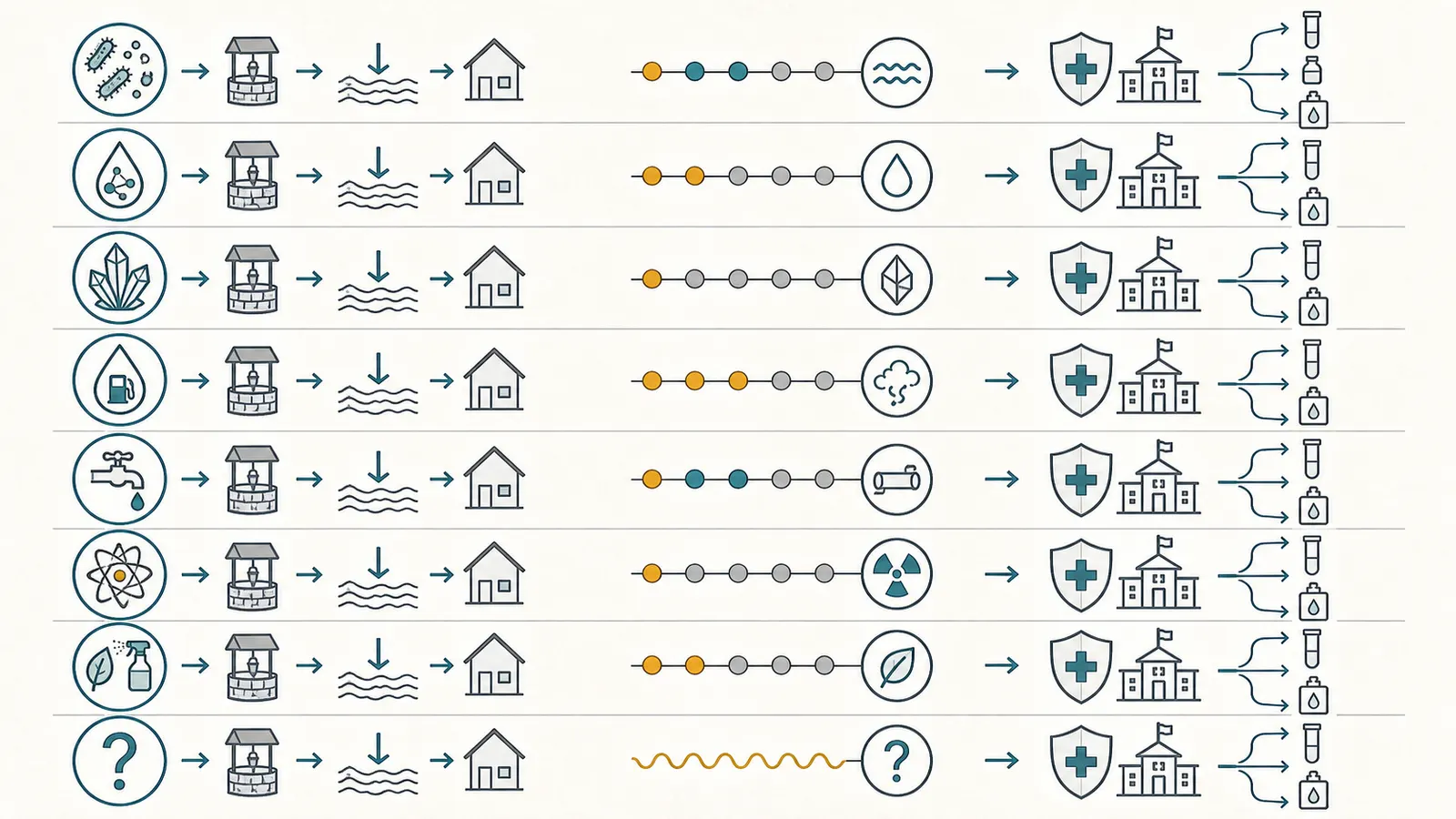
| Neighbor's reported finding | First test to repeat in your well | Baseline and follow-up question |
|---|---|---|
| Total coliform, fecal coliform, or E. coli | Ask the certified lab for the same indicator and method; do not silently substitute one bacteria test for another | Add the annual baseline. Ask the health department about sewage, flooding, well-cap or casing defects, and whether the result requires immediate use precautions |
| Nitrate or nitrite | Repeat the named analyte; ask whether both nitrate and nitrite are appropriate for the local program | Add the annual baseline. Ask about septic systems, wastewater, animal waste, fertilizer, runoff, and infant exposure; EPA identifies infants as especially vulnerable to high nitrate/nitrite |
| Arsenic | Repeat arsenic using the lab's specified method and reporting limit | Add the annual baseline. Ask whether local geology or the same aquifer unit makes arsenic a known concern; do not generalize the New Jersey proximity study to your area |
| VOC or fuel-related chemical | Repeat the named chemical or the state-approved VOC method/panel rather than ordering a generic “chemical test” | Add the annual baseline. Ask about fuel tanks, gas stations, spills, dry cleaners, industrial activity, and the correct sample handling |
| Lead or copper | Repeat the named metal with the laboratory's specified tap, flushing, and preservation instructions | Add the annual baseline. Ask whether the concern is household plumbing or a well-source issue; pH and corrosion questions may matter, but they do not replace the requested metal test |
| Pesticide, radionuclide, fluoride, or another specific chemical | Repeat the exact analyte if it is known | Add the annual baseline and ask the health department for the local panel, because geology, agriculture, industry, and waste sites change the relevant list |
| “Contamination” with no analyte or an unavailable report | Do not guess at a universal panel | Call the health department first, describe the location and possible source, and ask what sample and timing would answer the question |
EPA's contaminant guide links microorganisms with sewage and animal waste, nitrate and nitrite with fertilizer, sewage, animal waste, groundwater movement, and runoff, metals with natural deposits and industrial or household sources, and organic chemicals with products, spills, waste disposal, agriculture, and industry. These pairings help you formulate questions; they do not prove that one nearby activity caused the neighbor's result. (EPA potential well-water contaminants and impacts)
Do not expand the panel just because a long list feels safer. A focused analyte, a valid sample, and a clear interpretation plan are more useful than an expensive collection of tests that the lab cannot collect or the health department cannot interpret in context.
Use distance, depth, and groundwater direction as risk clues
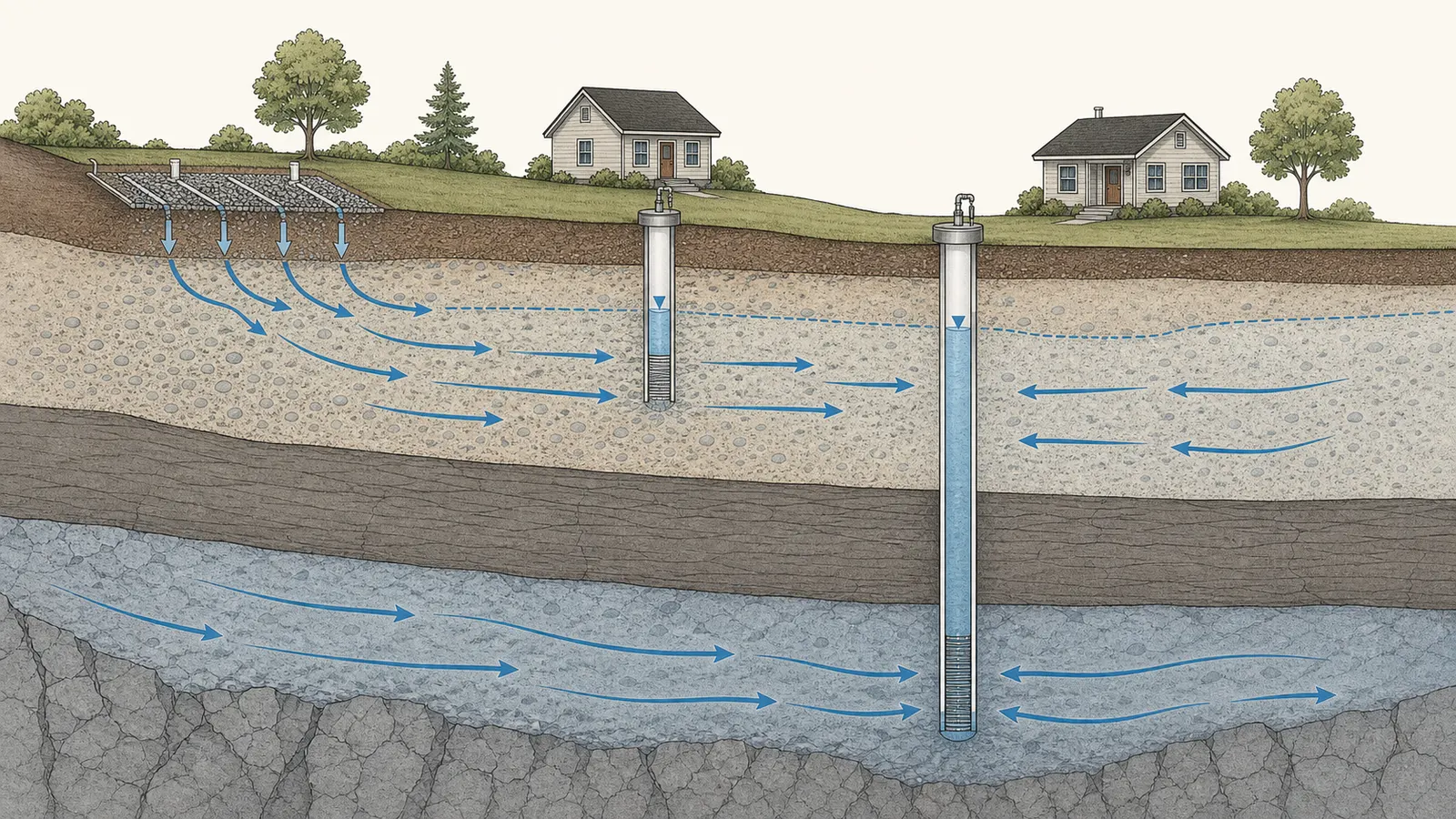
Straight-line distance is useful for finding what to investigate, but it is not a contamination map. Two wells on adjacent lots may draw different water. A shallow dug or driven well may sample a different part of the groundwater system than a deeper drilled well. Casing, screen or open-hole interval, bedrock, clay layers, well elevation, pumping history, and local groundwater movement can all change whether the same source reaches both wells. USGS describes dug and driven wells as generally shallow and drilled wells as potentially much deeper, with construction details affecting the water sampled. (USGS domestic private-supply well overview)
For your worksheet, record these comparisons:
- Approximate map distance between wells, plus whether the wells are uphill or downhill in the surface landscape.
- Total depth, casing depth, screened interval or open-hole section, and well type for each well if records are available.
- Whether a septic tank or drainfield, manure area, fertilizer storage, fuel tank, dump, landfill, road-salt area, industrial site, or construction zone lies between or upgradient of the wells.
- Any known groundwater-flow direction, aquifer name, bedrock or clay layer, or local wellhead-protection information.
- Whether either well has a cracked cap, damaged casing, poor surface drainage, recent repair, or treatment that changes the sampled water.
Do not infer groundwater direction from property boundaries or the nearest visible slope. Ask the local health department, environmental agency, well program, or a qualified hydrogeologist which records or maps can answer it. If the neighbor's result is arsenic, local geology may matter more than a generic distance rule. If it is bacteria or nitrate, a nearby septic or wastewater pathway may be the more important question.
EPA's septic guidance gives a practical example of why these details matter: risk is lower with more separation, a deeper well in bedrock or below a defined silt or clay layer, and regular septic service; risk is higher for a shallow well in permeable soil, a well downgradient of a septic system, dense septic development, or poor well or septic construction. These are directional risk factors, not proof that your well is safe or contaminated. (EPA septic systems and drinking water)
Check nearby sources and household vulnerability
Walk the property only to observe and record; do not open a well, enter a pit, disturb a septic system, or handle damaged electrical equipment. Mark possible sources on a sketch or map and note whether they are new, failing, or in the likely groundwater path.
Use this source checklist:
- Septic tanks and drainfields, sewage backups, surfacing effluent, shared septic density, or a recent pumping or repair problem.
- Farms, animal areas, manure storage, fertilizer application, pesticide use, or irrigation.
- Fuel-oil tanks, gasoline or diesel storage, gas stations, pipelines, solvents, dry cleaners, paint or metal businesses, and industrial sites.
- Landfills, junkyards, waste-transfer areas, abandoned wells, road-salt storage, mining, construction, grading, flooding, or storm-water changes.
- Well-cap, casing, surface-seal, drainage, or plumbing changes that could allow surface water or household materials to affect your sample.
EPA's source table specifically lists agriculture, commercial and industrial operations, septic tanks and leach fields, fuel storage, landfills, sewer lines, storm-water systems, and illegal dumping among possible contaminant sources. Use that list to decide what to disclose to the health department and which analyte questions to ask; do not use it to assign blame or diagnose a plume from a map alone. (EPA potential well-water contaminants and impacts)
Record who uses the water. Pregnancy, nursing, infants, and young children deserve particular attention because EPA identifies these households as potentially needing more frequent testing, and EPA identifies high nitrate/nitrite as especially serious for infants. Older adults or anyone with a health condition may also need individualized advice from a clinician or health department. A vulnerable household is a reason to call earlier; it is not a reason to choose an unsupported test panel or make a medical diagnosis from a neighbor's report. (EPA's testing and vulnerability guidance, EPA potential well-water contaminants and impacts)
Collect a sample that can answer the question
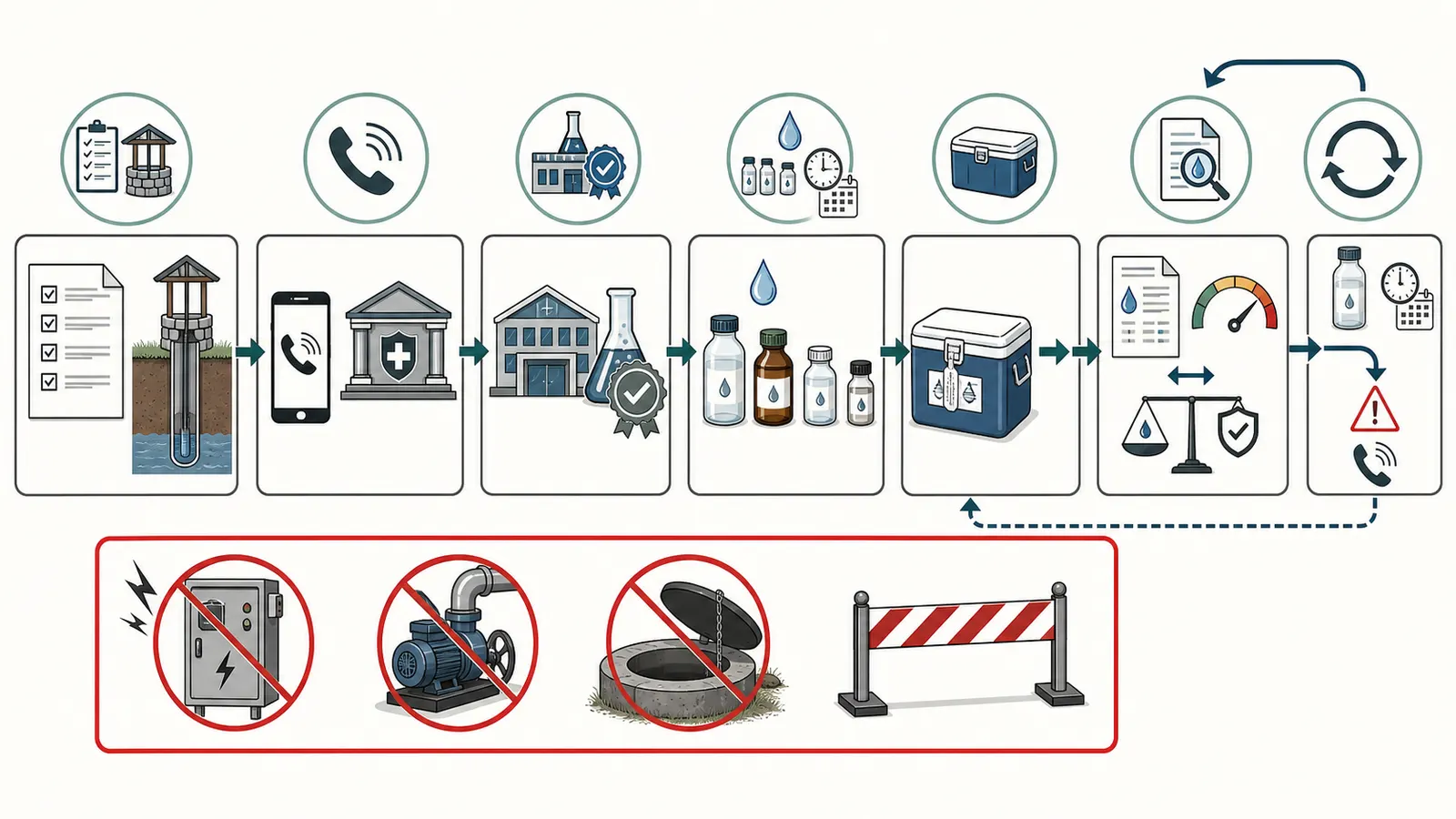
Call the laboratory before collecting water. Tell it that the sample is prompted by a neighbor's reported result, name the exact analyte if known, and describe your well and any treatment. EPA's household-well sampling guide says to obtain the laboratory's bottles and instructions, follow its storage and delivery timing, and recognize that instructions differ by substance. (EPA household-well sampling guide)
Use a laboratory certified for the relevant drinking-water analysis in your state. Certification is not a generic quality label for every test a lab offers, so confirm that it covers the analyte and method you need. EPA directs private-well owners to a state program or certified drinking-water laboratory for this purpose. (EPA certified drinking-water laboratory directory)
Before sampling, write down the lab's answers to these questions:
- Which exact analyte, method, bottle, preservative, and reporting limit will be used?
- Which faucet or sample point answers the question: untreated source water, a household tap, or both?
- Should the tap be flushed, left stagnant, or prepared in another way?
- How must the sample be cooled, protected, shipped, or delivered, and by what deadline?
- Does the lab need a chain-of-custody form, field blank, duplicate, or special collection by a sampler?
- Who will compare the result with the applicable state or health benchmark and explain the next step?
Do not rinse a sterile bacteria bottle, use a random mail-order bottle, collect only after a filter when the question concerns the well, or change treatment settings to make the result look better. The correct sample point depends on the analyte and the decision. Do not open electrical controls, pull a pump, open a pressurized well component, enter a well pit, or perform disinfection or treatment work just to collect a sample. If the well or surrounding area is damaged, flooded, electrically unsafe, or affected by suspected fuel or sewage, contact the local health or environmental authority and a qualified professional.
Read your result and close the loop
When your report arrives, keep the complete document and compare only like with like: analyte, unit, sample point, method, reporting limit, and comparison value. “Not detected” means below that method's reporting capability; it does not prove that a contaminant is impossible. A result without a unit or sample context is not ready for a health conclusion.
If your result is above a health benchmark, shows harmful germs, or is otherwise flagged as a concern:
- Contact the local health or environmental department and ask what water uses are safe while the result is reviewed.
- Follow any instruction to use bottled or another safe source; do not choose treatment from a neighbor's result or from a salesperson's generic recommendation.
- Ask whether and how to re-test. EPA recommends re-testing a homeowner's own well to confirm presence and concentration when its sample exceeds a health standard.
- Preserve the original report, sampling record, treatment status, recent weather, repairs, and any corrective action.
- Use a qualified water professional for well, plumbing, septic, electrical, or treatment work that is outside ordinary observation and lab sampling.
If your result is clean, keep the date and method in your well record and continue the annual baseline. A clean sample answers only the analytes and sample conditions tested on that date. It does not erase a future spill, flood, septic failure, construction event, plumbing change, or local advisory. CDC and EPA both identify those events as reasons to test outside the routine schedule. (CDC guidelines for testing well water, EPA private-well testing guidance)
The homeowner's decision record can be short:
| Field | Record |
|---|---|
| Neighbor result and date | ______________________________ |
| Exact contaminant, result, unit, and report source | ______________________________ |
| Distance; each well's depth and construction | ______________________________ |
| Groundwater, septic, land-use, or geology clues | ______________________________ |
| Household vulnerability or official advisory | ______________________________ |
| Lab, method, sample point, and collection date | ______________________________ |
| Result interpretation and health-department contact | ______________________________ |
| Next test, safe-water instruction, or professional action | ______________________________ |
The defensible conclusion is neither “my neighbor is contaminated, so mine is” nor “my neighbor tested clean, so mine is safe.” It is: the neighbor's result changes the reason to test; the contaminant and local conditions determine the scope; and your own correctly collected result determines the next household decision.
Safety boundary: Do not drink, cook with, or otherwise use your own water contrary to an official advisory or health-department instruction. If your own testing identifies harmful germs or chemicals, contact the local health or environmental department before deciding how to use, treat, dispose of, or return the water to service. Do not open a well, enter a well pit, handle damaged wiring, alter controls, or perform treatment or disinfection work beyond your training and local requirements. A neighbor's report is a reason to obtain qualified guidance and a valid sample; it is not permission to perform hazardous well work.
Sources and scope
Evidence behind this page
- Guidelines for Testing Well Water
National CDC guidance for private well owners; the additional-contaminant recommendation depends on location and local conditions.
- Guidelines for Testing Well Water
National CDC testing triggers; it does not create a universal response time or contaminant panel for every state.
- Protect Your Home's Water
EPA national private-well guidance; local health departments may set more specific advice.
- Protect Your Home's Water
EPA screening guidance for choosing questions and possible analytes; it is not a substitute for a state or site-specific sampling plan.
- Septic Systems and Drinking Water
EPA's stated risk factors for septic systems and drinking-water wells; these are not universal numeric setbacks or proof of contamination.
- Potential Well Water Contaminants and Their Impacts
EPA national description of private-well responsibility and common contaminant sources; state requirements can differ.
- Protect Your Home's Water
EPA follow-up guidance after the homeowner's own result, not a directive to treat based only on a neighbor's result.
- Contact Information for Certification Programs and Certified Laboratories for Drinking Water
National EPA laboratory-certification directory; availability and analyte certification must be checked in the homeowner's state.
- Domestic (Private) Supply Wells
USGS national well-type and groundwater-quality context; depth alone does not establish safety.
- Domestic (Private) Supply Wells
USGS study summary; the statistic is not a prediction for an individual household or a neighbor pair.
- Improve Private Well Testing Outreach Efficiency by Targeting Households Based on Proximity to a High Arsenic Well
Peer-reviewed pilot in northern New Jersey focused on arsenic and local geology; it does not establish a national distance cutoff or apply automatically to other contaminants.
- Drinking Water From Household Wells
EPA homeowner sampling guide; the laboratory's current instructions control for the selected analyte.