Can I Drill a Private Well If Public Water Is Available?
A homeowner decision path for checking local well permission, permits, public-water connection rules, water rights, septic setbacks, and safe system separation.
The short answer
Sometimes, but there is no nationwide yes-or-no rule. Confirm four separate decisions for the address: whether a new well is allowed, what notice or construction permit is required, whether the utility or municipality requires connection, and how the private system must be isolated from public water. Get written answers before drilling.Can I Drill a Private Well If Public Water Is Available?
Sometimes. Public water being available at a property does not produce one nationwide yes-or-no answer. Before any site work, resolve four separate questions for the exact address:
- Is a new well allowed here?
- What construction permit, notice, well log, inspection, or completion record is required?
- Must the home connect to public water, even if a well is allowed or an existing well is present?
- How must the private and public plumbing be kept separate?
Those answers can come from different authorities. A state well agency may handle drilling notices or construction standards; a county health department may handle the permit and septic review; a groundwater district may regulate production; a municipality or utility may control connection; and a water-rights agency may decide whether the intended use is legally available. The US EPA’s state-program directory is the right national starting point because the agency says most states have zero or limited regulation of private drinking-water wells and routes owners to state programs rather than offering one national rule. Start with EPA’s private-well state program directory, then identify the local offices below.
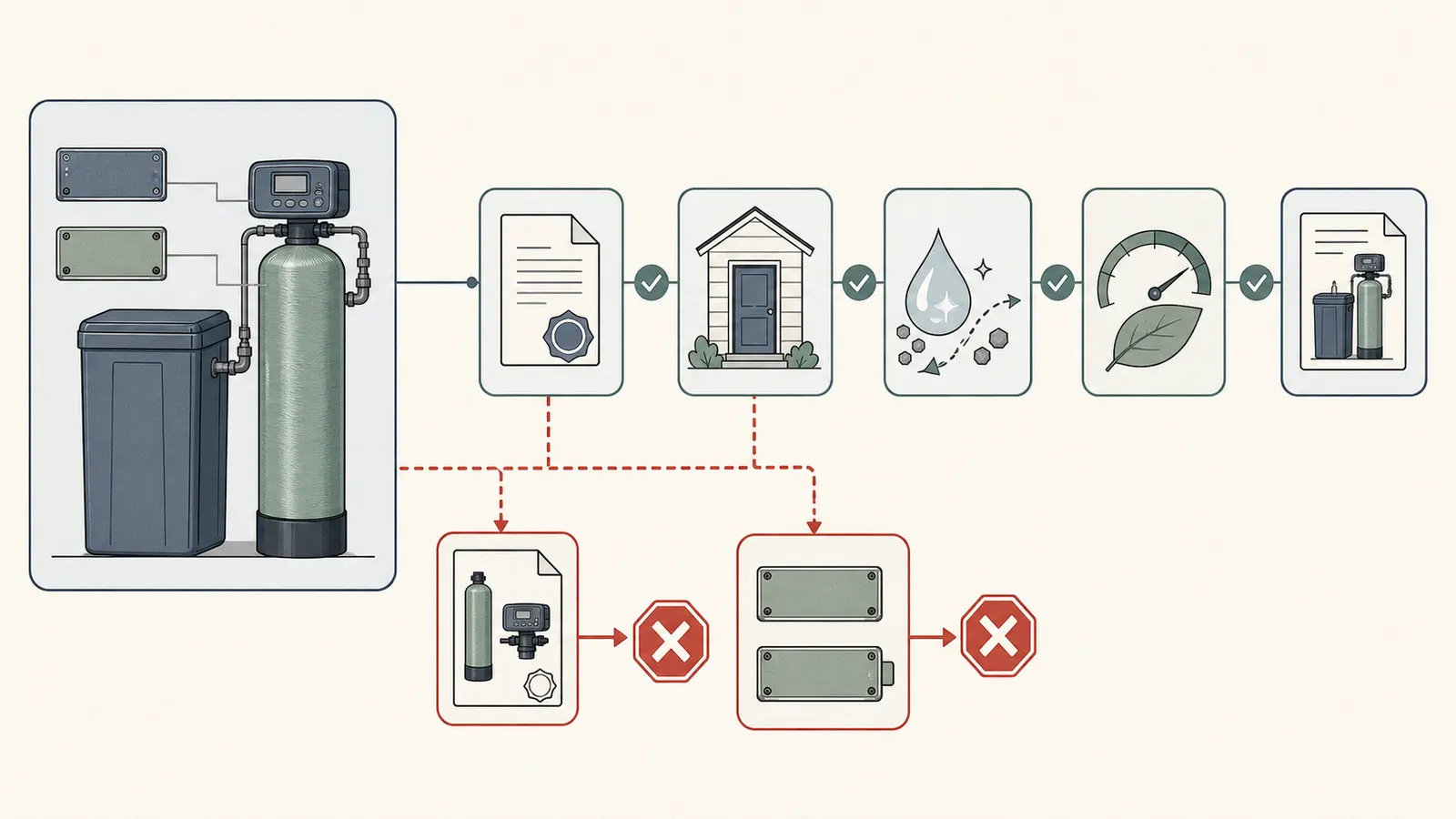
Do not treat a driller’s availability, a state notice, a well-construction permit, a water-right filing, or an old well record as proof that the home may use the well. Ask for written, address-specific answers before signing a drilling contract.
1. Turn the address into an authority map
The first task is not choosing a drill location. It is identifying every jurisdiction that can say “yes,” “no,” or “not yet.” A street address can sit outside a city but inside a county health district, groundwater conservation district, water-service territory, or special management area. A parcel can have a public main at the road but a different utility boundary. A property can also have septic constraints that make an apparently open portion of the lot unusable for a well.
Record this information before calling anyone:
| Address fact | Why it changes the answer | Who to verify with | What to keep |
|---|---|---|---|
| State and county | Establishes the state program and county health or environmental authority | State well agency; county health department | Program link, phone number, date checked |
| City, town, township, or unincorporated status | Local ordinances can prohibit new wells, restrict use, or require connection | Municipality or building/public-works office | Ordinance or written staff answer |
| Public-water provider and service boundary | “A main is nearby” is not the same as service availability or a connection order | Utility engineering or customer-connections office | Service-availability letter, map, fees, deadline |
| Groundwater district or management area, if any | District rules may control permits, spacing, production, registration, or reporting | District office or state groundwater map | District name, rule link, permit answer |
| Septic authority and system layout | Well placement may be constrained by the tank, drainfield, reserve area, or contamination sources | County onsite-wastewater or health office | Approved septic plan and proposed well site |
| Proposed use | Household drinking water, irrigation, livestock, geothermal, and commercial uses may be treated differently | State water-rights or groundwater office and local authority | Written use classification and limits |
| Existing well status | Keeping, transferring, converting, or abandoning a well can follow different rules than drilling a new one | Well agency, utility, and municipality | Well permit, log, testing, operation or abandonment record |
Use EPA’s directory to find the state starting point, but do not stop there. The directory itself links to non-federal state sites; it does not decide whether a parcel is within a city, utility, county delegation, or groundwater-district boundary. Ask the state program which local agency has delegated authority if the website is unclear.
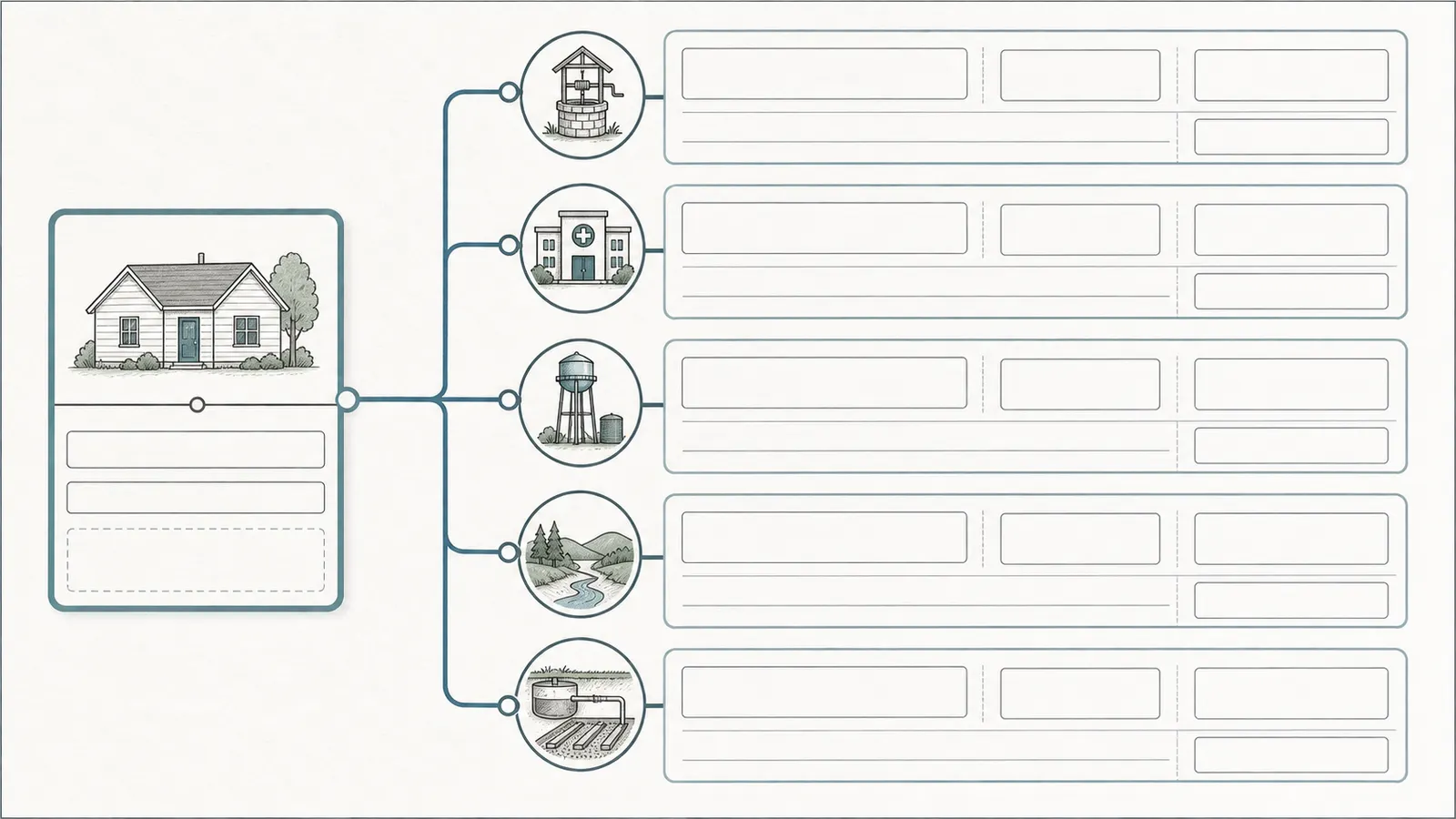
The minimum call list
For a proposed household well, contact these offices in this order:
- State well or groundwater program: Ask whether the state requires a license, construction notice, well report, water-right authorization, or use registration, and whether a county or district administers any part of the process.
- County or local health department: Ask who issues the well-construction permit, whether the office reviews the proposed location against septic and contamination sources, and what inspection or water-sample steps follow construction.
- Municipality or public-water utility: Ask whether the parcel is required to connect, whether an existing well may remain, whether outdoor-only use is allowed, and what isolation or backflow-control details the utility requires.
- Groundwater district, if present: Ask about well spacing, production limits, exemptions, registration, metering, reporting, and whether the intended use requires a district permit.
- Septic or onsite-wastewater authority: Ask for the approved septic layout and the well-to-tank, well-to-drainfield, reserve-area, property-line, and contamination-source setbacks that apply to this parcel.
If an office says “the driller handles it,” ask which document the driller will file, with whom, and when you will receive a copy. Responsibility for filing does not turn a notice into permission, and a verbal handoff can leave the homeowner without a record.
2. Check whether a new well is allowed at this address
“Can I drill?” is a permission question, not a construction question. The answer can be affected by a municipal connection ordinance, a groundwater district, a water-rights closure, a local well-density rule, a septic layout, a protected area, a subdivision covenant, or a public utility’s service conditions.
Texas is a useful example of why the answer cannot be generalized. The Texas Water Development Board says there is no statewide regulation against drilling a water well on a property simply because the property is connected to a water utility. The same answer immediately adds that local restrictions, a homeowner association, disconnection costs, utility coordination, and possible Public Utility Commission involvement may still matter, and that a public supply and private system may not be cross-connected. Read the Texas FAQ at the connected-home question. That is a Texas answer, not a US rule.
A different jurisdiction can reverse the practical outcome. Madison, Wisconsin, says a habitable building with access to municipal water must connect to the municipal system, and that wells used or maintained in the city must be permitted through Madison Water Utility. Its page describes limited treatment of some existing wells and connection deadlines after sale, transfer, annexation, or a later main extension. See Madison’s water-service connection requirement. Madison’s ordinance cannot be applied to another city, but it is strong evidence that “public water is available” can be a direct connection trigger in a particular municipality.
Washington provides another boundary. Its Department of Ecology tells applicants to check the local permitting agency before filing a notice because some areas may require additional fees or connection to a public water supplier. Washington’s well guidance makes that local check explicit.
For your address, treat any of these outcomes as possible until the authority answers:
- Allowed after local review: You may still need a permit, notice, licensed driller, water-use authorization, septic approval, and completion record.
- Allowed only for a limited use: The well may be restricted to irrigation, livestock, emergency supply, or another non-potable use. Do not assume a line labeled “irrigation” is permitted to supply a sink, shower, or hose bib connected to the home’s potable plumbing.
- Allowed only if public service is not available: A new main, service boundary, or connection offer can change the result.
- Allowed as an existing well but not as a new well: A grandfathered, permitted, or outdoor-use well may have a different status from new drilling.
- Not allowed or not economically practical: The authority may require public connection, prohibit a new well, require abandonment, or impose connection fees that change the project decision.
Do not infer permission from a neighbor’s well. Neighboring parcels may have different dates, permits, municipal boundaries, septic plans, water-service distances, or grandfathered rights.
3. Separate the construction permit, notice, water right, and completion record
A homeowner can have four different paperwork problems:
| Document or decision | What it usually answers | What it does not prove |
|---|---|---|
| Construction permit | Whether the proposed well may be constructed under that jurisdiction’s siting and construction process | That groundwater may be legally withdrawn or that public connection is optional |
| Notice of intent | That the agency was notified before a specified activity | That the agency approved the well or authorized water use |
| Water right, allocation, or groundwater-district authorization | Whether and how the intended quantity or purpose of groundwater may be withdrawn | That the well has been built correctly or connected to the home |
| Well log, completion report, or well report | What was drilled and installed, and when the record was filed | That current water quality is safe or that a later owner may use it without new conditions |
| Utility connection or exemption letter | Whether the parcel must connect, may retain a well, or may use it for a limited purpose | That the private plumbing may be tied into public plumbing |
Washington’s official page is unusually direct: a notice of intent is not a permit, certificate, claim, or water-right application, and filing it does not approve or authorize use of the water. The state says a notice is generally due 72 hours before drilling, and it separately tells owners to check water availability and whether a water right is needed. Use Washington’s notice and water-right guidance as a model for the distinction. Washington also gives thresholds of more than 5,000 gallons per day or irrigation of more than one-half acre for when a water-right application is needed before drilling. Those thresholds are Washington-specific; do not carry them into another state.
Iowa illustrates the opposite kind of process. Iowa says private well construction permits are required for all private water-supply wells, with county health departments generally issuing them. The county reviews the application, may refer a contamination concern to the state, issues or denies the permit in writing, and requires the owner to have the permit before proceeding. Iowa’s private-well permit process is here. Iowa also describes site visits before, during, and after construction and a household water sample 10 to 30 days after construction. Those are Iowa requirements, not a national checklist, but they show why the homeowner should ask about inspection and sampling before the rig arrives.
For your packet, save the exact document name, issuing office, parcel or address, date, expiration, conditions, and whether it covers construction, withdrawal, connection, or operation. If the document is a portal confirmation, save a PDF or screenshot with the confirmation number and the final submitted site plan.
The well report is part of the property record
Ask the driller and agency how the final record will be filed and how you will obtain it. Texas, for example, says registered drillers and landowners who drill their own wells must submit a State of Texas Water Well Report for a new well, while groundwater conservation districts can impose additional rules. Texas explains the report and district layer in its groundwater FAQ. In a future sale, a well report can help establish what was actually built, but it is not a current water-quality test or a guarantee of production.
4. Determine whether public connection is mandatory
Public-water availability has at least three meanings, and they are not interchangeable:
- A public main is physically nearby.
- The utility says the parcel is inside its service area and can receive service.
- The municipality or utility requires the building to connect by a deadline.
Ask the public-water provider to answer in writing:
- Is the parcel inside the current service boundary?
- Is a water main abutting the parcel, across the road, or only planned?
- Is a service connection available now, or would an extension be needed?
- Is connection mandatory for a new residence, a sale or transfer, a new well, or a change in use?
- May an existing well remain, and if so, for drinking water, irrigation, fire protection, or outdoor use only?
- Must the well be abandoned, physically disconnected, permitted, tested, inspected, or fitted with a utility-approved backflow assembly?
- What are the connection fee, meter, tap, road-opening, or extension requirements?
- What event starts the deadline: permit issuance, occupancy, sale, annexation, main extension, or something else?
Do not assume a utility’s customer-service representative can interpret an ordinance. Ask for the utility engineering or cross-connection-control contact and the ordinance or written policy governing your parcel. If an answer is conditional, write down the condition.
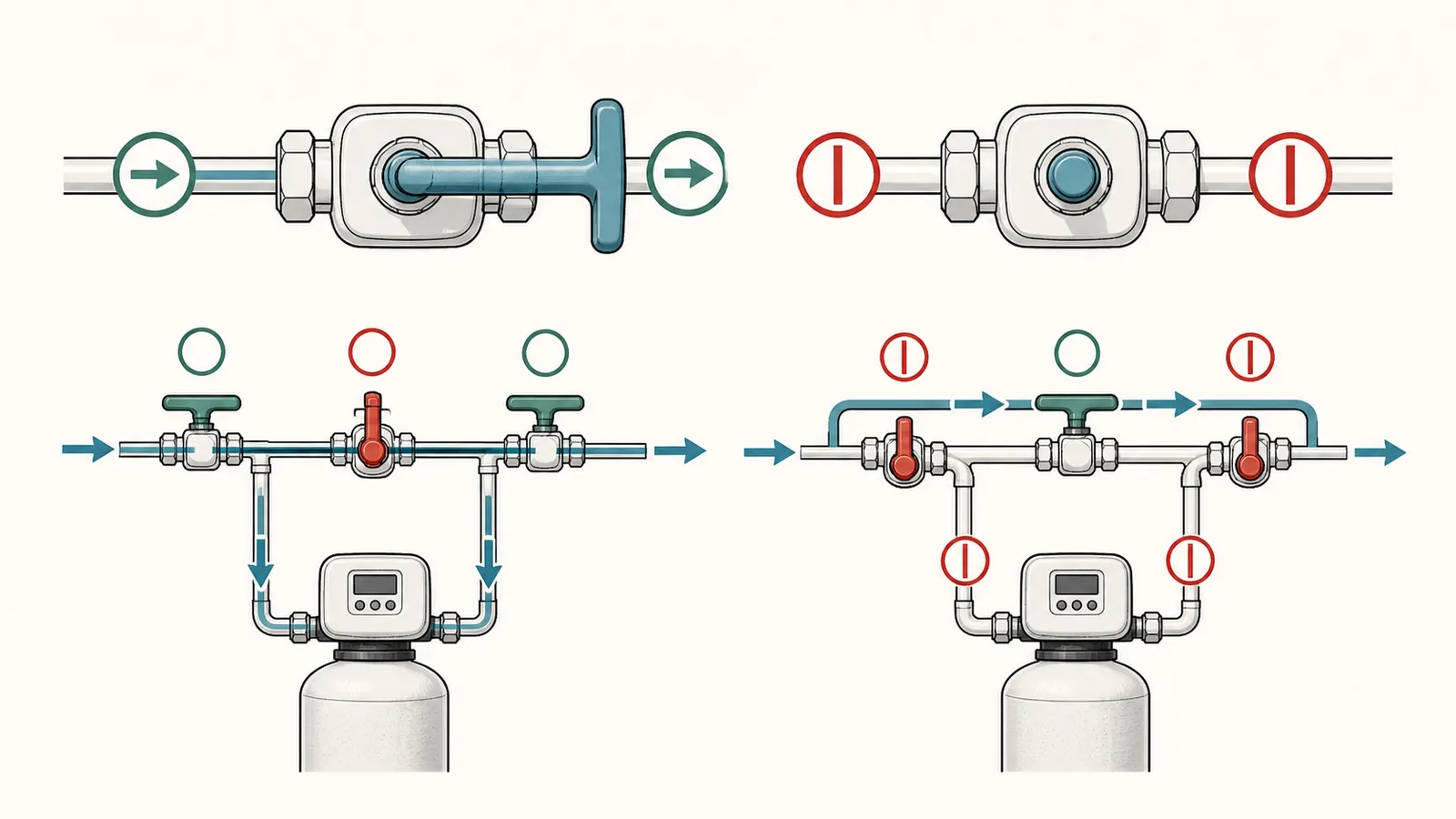
The Madison example shows why this matters: the city ties connection to habitable use and access to municipal water, while also setting different treatment for existing wells and properties annexed or attached later. A homeowner in another municipality may face no such rule, a stricter rule, or a different timeline. A county-rural address may be governed by a utility district or county service area rather than a city.
New well versus existing well
Do not ask only “Can I have a well?” Ask the right version of the question:
| Situation | Questions to ask |
|---|---|
| No well exists; public water is available | Is new drilling allowed? Is public connection required before occupancy or as a condition of the well? |
| An existing well is present and the house uses public water | May the well remain? Must it be abandoned, permitted, tested, or limited to outdoor use? |
| Buying a property with an existing well | Is the well permit transferable? Does sale trigger connection, inspection, testing, or abandonment? |
| Public water becomes available later | Does a new main extension start a connection deadline? Can the well remain as a separate non-potable source? |
| A well will serve only irrigation | Is the irrigation source exempt, separately metered, or subject to backflow and labeling rules? |
An old well is not automatically legal because it predates public service. Conversely, an existing permitted well may have protections or conditions that a new well would not receive. Treat the existing well’s records as a separate research branch.
5. Plan the site with septic, contamination, and water-use limits in view
A well can be legally drillable but physically unsuitable on the lot. Before a driller marks a point, place the proposed well, house, septic tank, drainfield, reserve area, property lines, road, fuel tanks, livestock areas, chemical storage, drainage paths, and any abandoned wells on one plan.
EPA says local health departments may impose septic placement requirements and minimum setbacks and recommends contacting the local permitting authority about onsite wastewater components. EPA’s septic FAQ explains why the local authority controls this part of the plan. Do not use an internet “typical setback” as approval. The controlling distance can depend on soil, well construction, septic type, lot size, groundwater conditions, surface water, and local code.
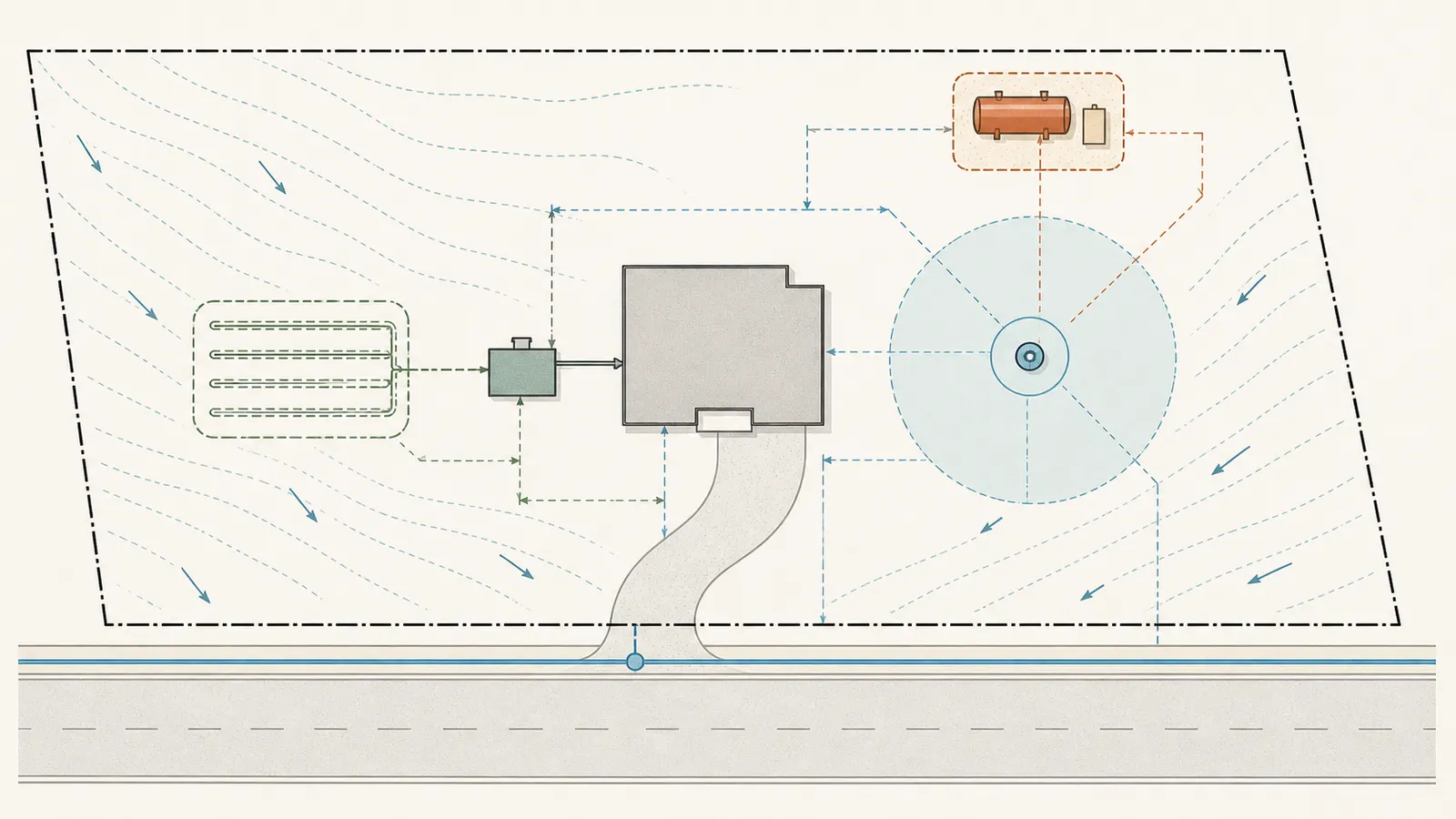
There are useful state examples, but they must stay bounded. Texas technical guidance lists 50 feet from a septic tank and 100 feet from drain fields or spray areas when minimum well-construction specifications are met. Read the Texas drilling and pump-installing guidance. That does not make 50 and 100 feet a national answer; it tells a Texas homeowner what to verify against the applicable rules and site conditions.
The same caution applies to water quantity. A well that can supply a house is not automatically authorized for lawn irrigation, livestock, a pool fill, a second dwelling, a short-term rental, or commercial use. Record the intended use and estimated peak and daily demand. Ask whether the authority regulates:
- domestic use per residence or per connection;
- irrigation area or seasonal volume;
- multiple residences or accessory dwelling units;
- livestock or agricultural use;
- commercial or rental occupancy;
- water hauling, storage, or resale;
- groundwater conservation, spacing, metering, or drought restrictions.
Washington’s 5,000-gallon-per-day and one-half-acre irrigation thresholds show why purpose and quantity belong in the first call, not after drilling. They are not a national exemption.
Use the septic layout as a hard input
If the approved septic plan is missing, pause the well decision. Ask the onsite-wastewater office or a qualified septic professional to locate the tank, distribution box, drainfield, reserve area, repair area, and any required replacement area. A proposed well location that appears open on a real-estate listing may be reserved for septic expansion or may sit downhill from a contamination source.
Do not excavate, probe, or expose a septic tank, drainfield, well casing, or buried service without confirming location and utility markings. A safe site plan is more valuable than a guessed measurement.
6. Keep public and private systems isolated
If the well is allowed and public connection is also required or retained, the systems must be treated as separate sources unless the authority has approved a specific arrangement. A well pump feeding a pressure tank does not make the water public-water compliant, and a shutoff valve does not by itself make a cross-connection safe.
EPA defines a cross-connection as an actual or potential connection between potable water and nonpotable plumbing and warns that backflow through one can create a serious public-health hazard. See EPA’s cross-connection and backflow fact sheet. Texas’s homeowner FAQ states that no cross-connection between a public drinking-water supply and private water system is permitted in Texas. In another jurisdiction, the exact rule and approved backflow device may differ, but the safe planning boundary is the same: never improvise a tie-in between the systems.
Before a plumber or well contractor changes piping, obtain the utility’s written answer to these questions:
- Must the private well be completely disconnected from all potable house plumbing?
- Is a separate outdoor or irrigation distribution system allowed?
- Does the utility require an air gap, approved backflow preventer, inspection, testing, annual certification, or labeling?
- Where must the public service shutoff, meter, and backflow assembly be located?
- Must the private source be capped, locked, abandoned, or identified at fixtures?
- Who is allowed to make and inspect the change?
A “dual-source” plan should show independent pipes, valves, and fixtures, with no bypass that can connect the private source to public water. If the utility requires a backflow assembly, the utility—not a generic online diagram—controls the approved type, installation, testing, and maintenance.
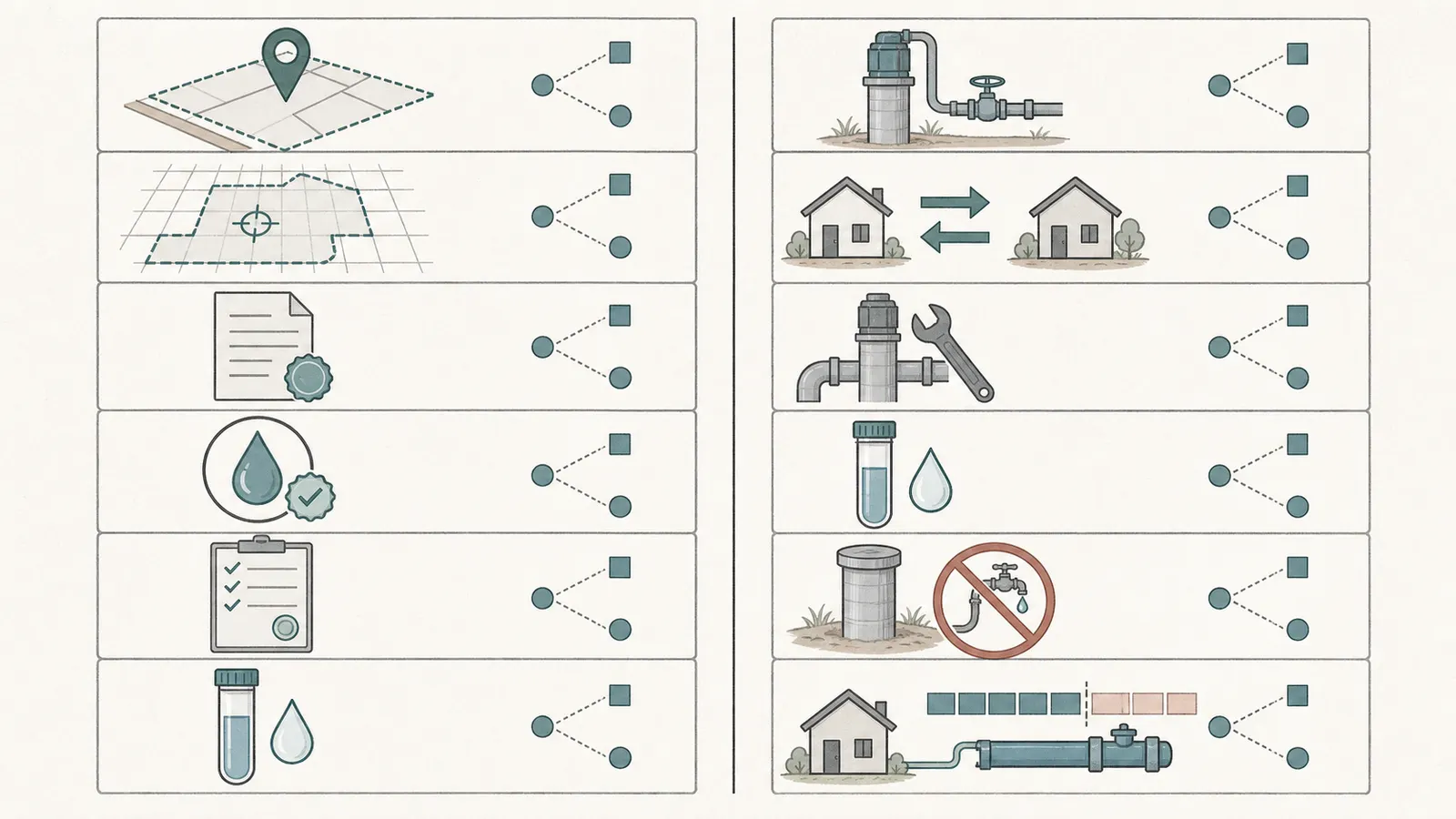
Safety boundary for homeowners
This decision surface is for records, questions, and visual site planning. Do not open energized pump controls, test live wiring, open a well casing or wellhead, pull a submersible pump, enter a well pit or other confined space, or manipulate pressurized equipment. Do not remove a pressure-tank component, disconnect a pressurized line, or defeat a backflow device to “see which source is feeding the house.” Assign electrical, well-entry, pump-pulling, pressure-system, plumbing tie-in, and backflow work to qualified professionals who can follow the authority’s requirements.
If there is an unexpected pressure change, contaminated water, damaged wellhead, exposed wiring, flooding, or a suspected cross-connection, stop using the affected source as drinking water, keep people away from the hazard, and call the utility, health department, or qualified professional. CDC says private-well owners are responsible for the safety of their water because public-water rules do not monitor private wells; it recommends annual testing for total coliform bacteria, nitrates, total dissolved solids, and pH through a state-certified laboratory, with additional local tests as appropriate. Use CDC’s well-water testing guidance.
7. Complete this pre-drilling decision worksheet
Fill this out from official answers, not estimates from a driller or neighbor. The goal is a documented next action, not a nationwide legal conclusion.
Address and system facts
- Property address and parcel number: ______________________________
- State and county: ______________________________________________
- City, town, township, or unincorporated area: ______________________
- Proposed use: ☐ household drinking water ☐ irrigation ☐ livestock ☐ other: __________
- New well or existing well? _______________________________________
- Public-water provider and customer-service territory: _______________
- Main location or written service-availability result: ______________
- Septic tank, drainfield, reserve area, and repair area located? ☐ yes ☐ no
- Other wells, abandoned wells, fuel, chemicals, livestock, surface water, or waste sources mapped? ☐ yes ☐ no
Four decision gates
| Gate | Official answer or document | Status |
|---|---|---|
| New well allowed at this parcel? | Office, contact, date, rule or letter: __________________ | ☐ yes ☐ no ☐ conditional ☐ unknown |
| Construction permit or notice required? | Document name, number, issuer, expiration: __________________ | ☐ complete ☐ pending ☐ not required ☐ unknown |
| Water withdrawal or district authorization required? | Use, quantity, district, permit or exemption: ________________ | ☐ complete ☐ pending ☐ not required ☐ unknown |
| Public connection mandatory? | Utility/municipality answer, deadline, existing-well treatment: ___ | ☐ yes ☐ no ☐ conditional ☐ unknown |
| Private/public isolation approved? | Plumbing plan, backflow or air-gap requirement, inspector: ______ | ☐ complete ☐ pending ☐ unknown |
Site and completion records
- Septic authority and approved plan number: ________________________
- Required well-to-septic and other setbacks: ________________________
- Proposed well location reviewed by the authority? ☐ yes ☐ no
- Licensed or certified driller identified and license checked? ☐ yes ☐ no
- Well construction report or completion record recipient: ____________
- Initial water-quality tests and sampling timing: ____________________
- Annual testing contact and state-certified laboratory: ______________
- Utility inspection or cross-connection certification required? ☐ yes ☐ no
- Final packet stored with property records and sent to insurer/lender if requested? ☐ yes ☐ no
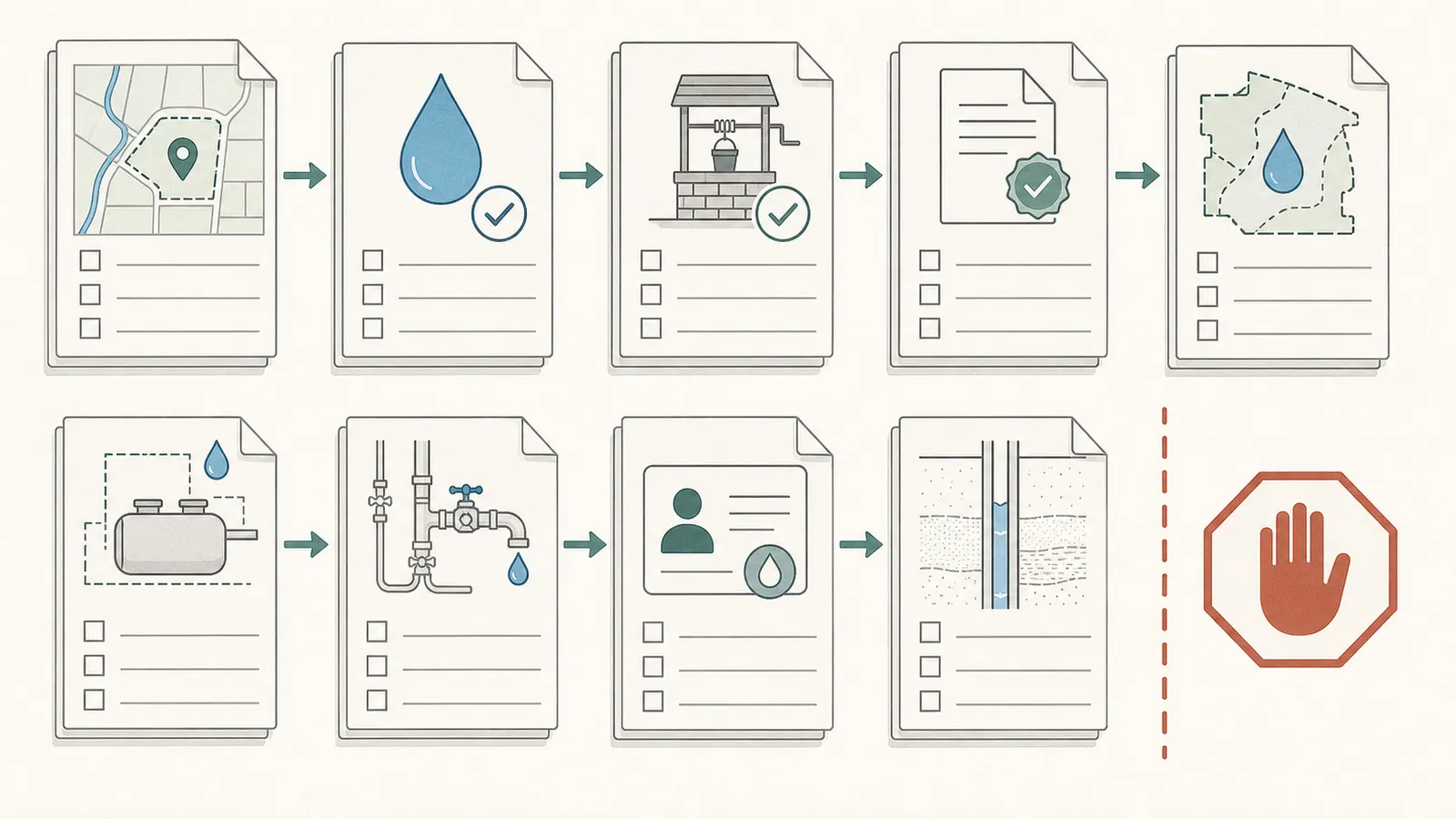
Stop conditions
Stop before drilling if any of these is true:
- the state or local authority has not confirmed whether a new well is allowed;
- a required permit or notice is missing, expired, or addressed to the wrong parcel;
- the utility has not answered whether public connection is mandatory;
- the proposed well point has not been checked against the approved septic layout and contamination sources;
- the intended use or quantity has not been checked for a water-right or groundwater-district limit;
- the plumbing plan shows any direct, bypass, or undocumented connection between private and public water;
- the driller cannot explain who files the well report and what completion documents you will receive.
The safest next step is to send the completed worksheet, parcel map, septic plan, and proposed use to the state program, county or local health office, groundwater district if applicable, and public-water utility. Ask each to answer only the part within its authority, then keep the responses together. That packet gives the driller and plumber a defensible starting point and prevents a construction permit, notice, or old well record from being mistaken for permission to use the well.
Sources and scope
Evidence behind this page
- Private Drinking Water Well Programs in Your State
National routing source; establishes why the homeowner must identify the state program and should not infer a uniform US rule.
- General Groundwater and Private Water Well Frequently Asked Questions
Texas-specific example only; not a nationwide permission rule.
- General Groundwater and Private Water Well Frequently Asked Questions
Texas-specific example of a groundwater-district and completion-record layer.
- Wells
Washington-specific example showing why construction notice, water-use authorization, and public connection must be separated.
- Wells
Washington-specific thresholds; never generalize them to another state.
- Private Well Construction Permits
Iowa-specific example of a construction-permit requirement and county role.
- Private Well Construction Permits
Iowa-specific example of inspection and post-construction documentation.
- Water Service Connection Requirement
Municipal example only; Madison's ordinance cannot be applied to another city or county.
- Protecting Water Quality Through Cross-Connection Control and Backflow Prevention
General public-water safety principle; local utility rules determine the approved protection and inspection requirements.
- Guidelines for Testing Well Water
National public-health guidance for private-well ownership; local health departments may add tests or different schedules.
- Frequent Questions on Septic Systems
National routing guidance; exact well-to-septic distances are jurisdiction-specific.
- Well Drilling and Pump Installing Technical Guidance
Texas-specific siting example; it is not a national setback standard and local rules may be more restrictive.