Why Is My Water Softener Salt Turning to Mush? A Safe Diagnostic
Separate bottom salt mushing from a salt bridge, normal brine, or a failed brine draw—and choose the safest cleanup or service next step.
The short answer
Salt mushing is fine, wet salt sludge collecting at the bottom of the brine tank. It is different from a hard bridge across the top. Stop adding salt, document the tank condition, and follow the model manual for a bypassed tank cleanout if the sludge is blocking salt contact. Then run one documented regeneration and observe whether brine is drawn. If water does not drop, the unit leaks, or valve work is required, stop and request service.Why Is My Water Softener Salt Turning to Mush?
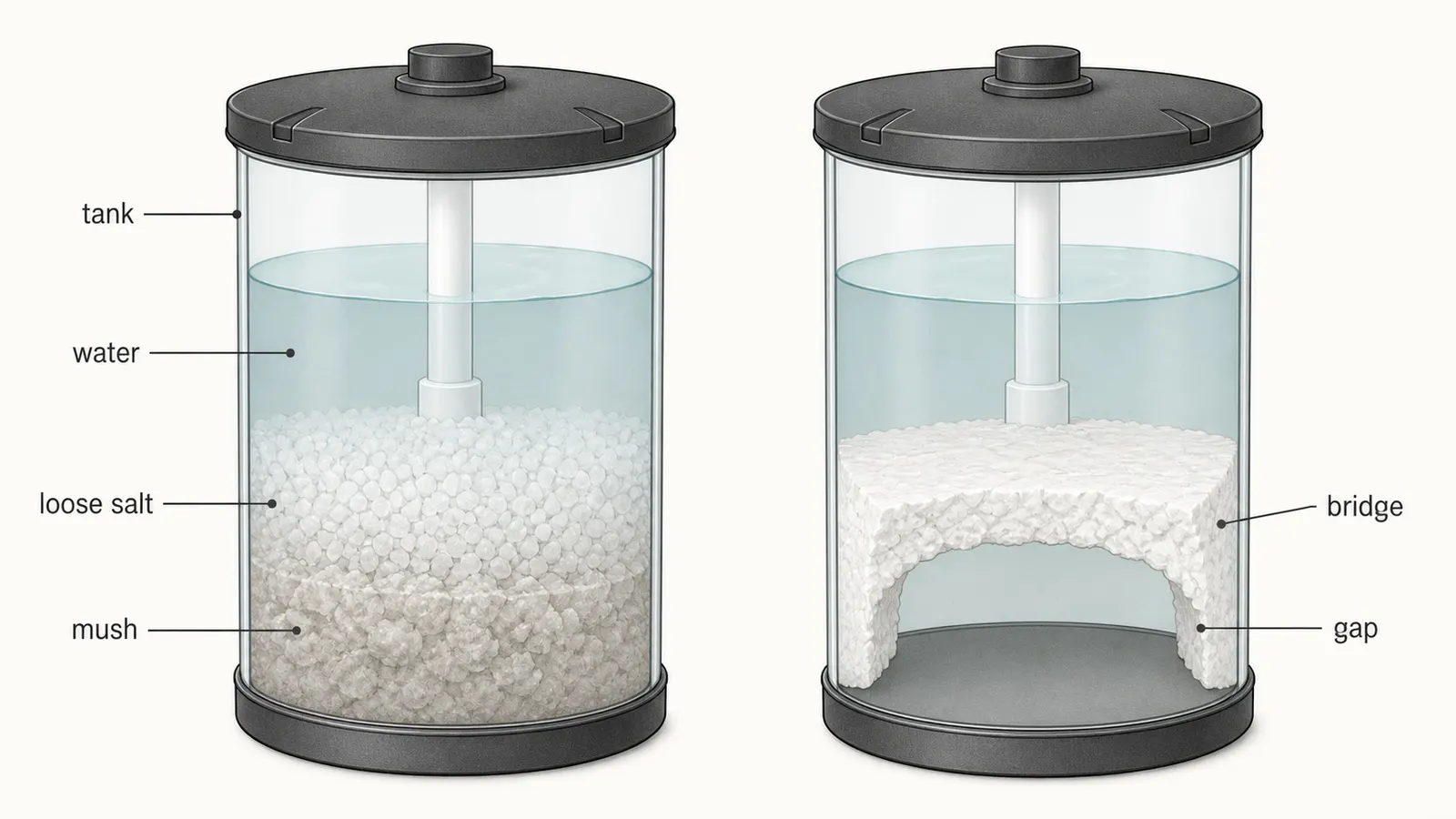
If the salt has become fine, wet sludge at the bottom of the brine tank, you are probably seeing salt mushing. That is different from a hard salt bridge higher in the tank. A bridge can look like a full tank while leaving an empty gap beneath it; mushing is the loose, wet accumulation at the bottom. Do not keep adding salt until you identify which condition you have. Record the tank, use the installed model’s manual to decide whether a bypassed tank cleanout is allowed, then run one documented regeneration and observe whether the brine level drops. If the unit leaks, the water level remains high, or the next step involves a float, brine line, nozzle, venturi, valve head, drain fitting, wiring, or energized control, stop and request service.
This is a moderate-safety appliance diagnosis. Keep the work to external observation and the open salt-storage area. Do not open an energized control, test live wiring, open a well, pull a pump, enter a confined space, disconnect a brine or drain line, remove a pressurized fitting, or manipulate a control valve head. Bypass only as the owner’s manual shows, and do not assume that a similar-looking handle has the same position or meaning on another brand.
Start with the physical distinction
The word “mush” is useful only if it describes what is actually in the tank. Cargill’s water-softener salt FAQ gives the most direct distinction: a bridge is a solid mass at the water level, while mushing is fine salt lying at the bottom. Cargill’s recommended response also differs: break up the bridge carefully; for mushing, remove the usable pellets, scoop out the mushed salt, and reload the usable pellets. That is why swinging a tool through every hard-looking patch is a poor first move.
The decision table
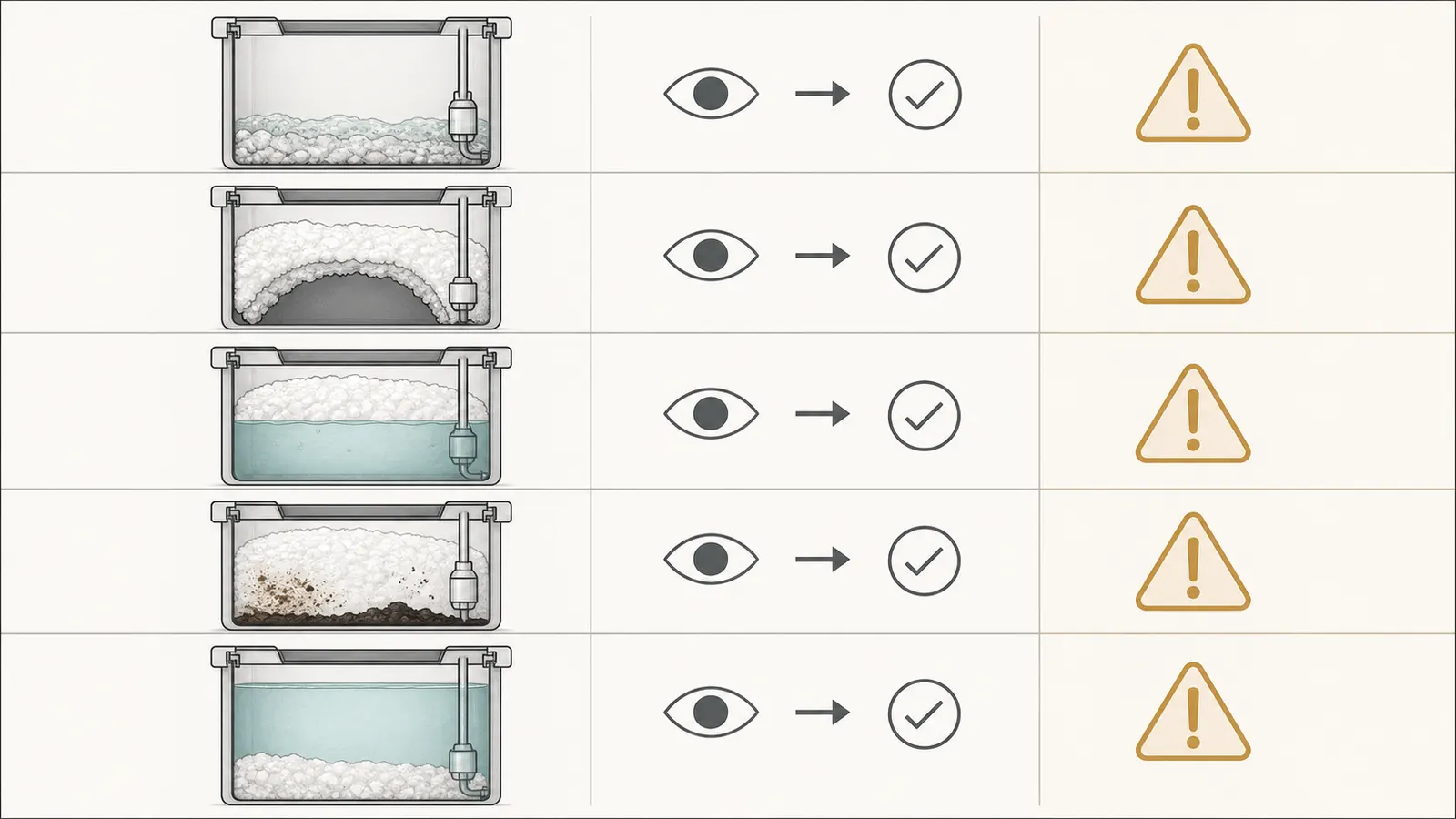
| What you observe with the lid open | What it most closely means | What it does not prove | Safest next check |
|---|---|---|---|
| Fine, wet, grainy or paste-like salt settled at the bottom; upper salt is loose or sinking into it | Salt mushing or accumulated dissolved/insoluble material | It does not prove the control valve is defective or that the resin is spent | Photograph and describe it; check the manual for a bypassed brine-tank cleanout; do not add more salt first |
| A hard crust or solid layer stops a blunt probe above the expected bottom; the tank looks fuller than the usable salt beneath it | Salt bridge | It does not prove there is no salt or that the brine line is blocked | Use the manual’s gentle bridge check with a blunt rigid tool; never use a sharp tool or strike the tank wall |
| Salt is loose and in contact with water at the bottom, without a hard gap | Brine formation may be normal | It does not prove the unit will draw brine or that the resin will soften correctly | Record the level, then verify one regeneration and test hardness consistently |
| Brown or black sediment or an oily-looking film | Water-insoluble material from salt or the supply is possible | It does not prove the residue is harmless, sanitary, or the only fault | Photograph it; check salt type and manual; clean only within the manual’s boundary, and service if the material returns or water quality is uncertain |
| Water is unusually high, rising, leaking, or not dropping after a cycle | Fill, float, drain, brine-draw, or control problem is possible | It does not prove mushing caused the high water | Stop before disconnecting anything; request a qualified diagnosis |
| The salt level is unchanged but the home has used little water | Normal low demand is possible | It does not prove the softener is working | Compare the display history and a repeatable hardness test, not salt level alone |
The last two rows matter because Cargill says insoluble material from salt or the water supply can accumulate as brown or black sludge, while the EPA WaterSense explanation of cation-exchange softeners explains that brine is part of a regeneration process. A visual residue is evidence about the brine tank; it is not a diagnosis of the resin tank, control valve, or household water quality.
Rule out normal brine and look-alikes
Normal brine is wet by design
A salt-based softener needs a brine tank because regeneration uses salt solution to recharge the resin. Virginia Cooperative Extension describes the brine tank as the place where sodium pellets are maintained and the brine solution is stored for periodic resin regeneration in a household water-treatment overview. EPA describes the same cation-exchange process: calcium and magnesium are exchanged on resin, then brine is used to regenerate it.
So a wet bottom, by itself, is not “water damage” and is not proof of mush. The useful question is whether salt is loose and contacting the water in the arrangement described by the manual, or whether a layer of mush, crust, or insoluble residue is preventing the intended brine cycle. Do not scoop out normal liquid merely because the tank is wet. Do not taste the water, and do not use appearance as a potability test.
A bridge is a top or middle obstruction
GE describes a bridge as a fused salt layer that can leave a tank looking half-full or fuller while a mixture of salt water and empty space sits beneath it. Its homeowner check uses a broom handle marked against the tank height, inserted gently through the salt; GE warns not to bang on the tank because the tank may crack. The GE bridge instructions are a useful example, but the exact fill levels and tool-mark method belong to that guidance and your own manual—not to every softener.
The Whirlpool manual makes the mechanism explicit: a bridge leaves an empty space between salt and water, so salt cannot dissolve into brine and hard water may result. Its routine-maintenance section says to use a broom handle or similar tool gently, not a sharp or pointed object, and not to pound on the tank wall. If a blunt probe encounters a rigid shelf before reaching the expected lower area, treat that as a bridge branch, not mushing.
Sludge is not automatically a failed softener
Fine salt at the bottom can be a product or water-quality issue, but it can also coexist with another fault. Cargill says water-insoluble matter from salt or the water supply may accumulate and appear brown, black, or oily, usually from natural mineral inclusions in salt. That wording supports a possibility, not a guarantee. A smell, unusual color in the home’s water, repeated residue, or uncertainty about contamination is a reason to stop using the water-treatment system for diagnosis and consult the manufacturer or a qualified professional.
Likewise, do not jump from “mush” to “replace the resin.” Resin replacement is a later conclusion after salt, brine formation, and basic mechanical operation have been assessed. If the softener is not drawing brine, the problem may be upstream of the resin: the Whirlpool manual lists a dirty or plugged nozzle and venturi, an incorrectly seated gasket, leaking valve seals, a restricted drain, or an obstruction in the brine valve or tubing. Those are service branches, not invitations to open the valve head.
Capture a baseline before cleanup
The best cleanup is the one you can evaluate afterward. Before moving salt, make a dated record. This takes less time than repeating an uncertain regeneration and gives a service professional something better than “it looked mushy.”
Homeowner record
- Equipment: brand, model, serial number if visible, and whether the system has a separate brine tank.
- Salt: sodium chloride or potassium chloride; pellet, nugget, coarse solar, crystal, or unknown; brand if visible.
- Tank condition: loose salt depth, water level relative to the salt, location of mush, color or oil-like appearance, bridge location, and whether the brinewell cover is present.
- Controls: display time, error code, recharge indicator, power status, and the date of the last known regeneration.
- Plumbing: bypass label and current position, visible leaks, and whether the drain hose is visibly kinked or disconnected. Do not move a drain hose just to test it.
- Water result: hardness test at one consistent softened cold-water tap, with units, test method, date, and time. If safely available, record an untreated reference tap separately.
- Demand: recent vacancy, guests, laundry, leaks, irrigation, or other unusual water use.
The purpose of this record is to separate “salt did not move” from “the home’s water became hard.” EPA notes that regeneration demand depends on the softener’s capacity, incoming hardness, and how much water the home uses. A demand-initiated unit can legitimately use salt at a different rate after a change in occupancy or water use. Culligan likewise explains that salt use depends on regeneration frequency and the brine-tank arrangement in its consumer guide. An unchanged salt line is therefore a clue, not a failure code.
Use hardness as the outcome check
A home test is more informative when it is repeatable. Choose one softened cold-water tap downstream of the softener. Follow the test kit’s instructions, flush the tap the same way each time, record the units, and use the same tap for the post-regeneration sample. Do not compare a strip from the kitchen to a sample from a faucet that may be upstream of the unit, and do not compare gpg with mg/L without converting or keeping the units explicit.
The result is not a laboratory certification of drinking-water safety. It is a before-and-after operating check. If a qualified water professional later tests the system, your consistent samples help them understand when the change occurred.
Check the outside controls in a safe order
This sequence is deliberately narrow. It is meant to identify whether a cleanup and a documented regeneration are reasonable next steps, not to repair a control valve.
1. Confirm the equipment uses salt
A salt-based cation-exchange softener normally has a brine tank, salt, a mineral or resin tank, a control valve, and a drain. A salt-free conditioner may have no salt tank and no salt regeneration. EPA’s WaterSense guide separates traditional cation-exchange softeners from salt-free scale-reduction devices and their certification scopes. If the label says conditioner, scale reduction, cartridge filter, or another non-softener treatment, stop adding salt and identify the model first.
2. Confirm power and the display from the outside
Look for a normal display, a flashing clock, an error code, or no display. Check only that the intended plug and outlet are dry and intact. Do not open the control cover or test live voltage. The Whirlpool manual uses model-specific diagnostics and electrical components; another brand may use a different sequence or may not expose the same information.
If the outlet is wet, hot, damaged, sparking, or repeatedly trips a protective device, leave it alone and call an electrician or qualified service provider. An unpowered controller can explain a missed regeneration, but it does not make energized troubleshooting safe for a homeowner.
3. Confirm the labeled bypass position
A bypass is useful for authorized maintenance because it isolates the softener while leaving the home’s water service available on many installations. But “bypass” means untreated water may be reaching the home, and the handle orientation is not universal. Read the label and manual. If the position is unclear, photograph it and leave it unchanged for the service professional rather than cycling a stiff handle.
4. Look for a bridge before treating the tank as mush
Use the installed manual’s procedure. If it permits a blunt probe, press gently and vertically through loose salt. Do not use a screwdriver, knife, rod with a sharp end, or any tool that could puncture the plastic brine tank. Do not hammer the outside wall. GE allows warm water for a difficult bridge in its instructions; the Whirlpool manual also describes a gentle broom-handle method. Do not pour hot water into a tank unless your exact manual says to, and never use boiling water.
If the obstruction breaks and loose salt falls into contact with the water, stop and record that fact. Do not assume the bridge was the only problem. A regeneration and hardness retest still determine whether the unit recovered.
If it is mushing, clean only the homeowner-safe zone
Mushing is the branch where a tank cleanout can make sense, but the boundary matters. The safe zone is the accessible salt-storage area and only the components your model manual explicitly identifies as homeowner-maintainable. The unsafe zone includes the control valve head, pressurized fittings, brine tubing, float or brine valve internals, nozzle and venturi, electrical compartment, and drain connections.
Decide whether a cleanout is justified
Cargill says a brine-tank cleanout is not always necessary when the salt is low in insoluble matter, but buildup should be cleaned if it is present and could cause malfunction. EPA recommends cleaning the brine tank once per year as part of water-softener maintenance. Read together, those sources support a conditional decision: visible bottom buildup that is interfering with salt contact or brine formation is a reasonable cleanout trigger, while a clean tank does not need to be emptied simply because the water is wet.
Before you start, confirm all of the following:
- the unit is a salt-based softener;
- the owner’s manual allows homeowner brine-tank cleaning;
- you know how to place the unit in the manual’s maintenance or bypass condition;
- no leak, crack, electrical hazard, or unknown residue is present;
- you can remove salt without disconnecting tubing or opening the valve;
- you can dispose of salt and brine in a way permitted for your property and local system.
If any answer is no, stop and request service. Do not improvise a siphon, detach the brine line, or carry a full tank. Salt and water are heavy; a plastic brine tank can be damaged by lifting, tipping, or levering against its fittings.
What the cleanout should accomplish
The goal is not to make the tank look new. The goal is to remove the bottom mush and obvious loose buildup that prevents the intended salt-water contact, then return the system to the manual’s specified salt and water arrangement. Cargill’s mushing instruction is to remove good pellets, scoop out the mushed salt, and reload the good pellets. Do not mix old mush back into new salt merely because it is wet.
Use only the salt type allowed by the manual. EPA says to use sodium or potassium pellets made for softeners and avoid rock, road, and table salt. GE warns against rock, block, and granulated ice-cream-making salt because of dirt and sediment. Whirlpool gives a model-specific preference for nugget, pellet, or coarse solar salt with less than 1% impurities and says humid areas may require lower storage levels and more frequent refills. Those recommendations are compatible in direction but not a substitute for the installed manual.
Do not pour brine onto a lawn or garden as a disposal shortcut. Cargill warns that direct sodium- or potassium-chloride brine discharge can harm grass. Your property’s sewer, septic, and local requirements may impose additional limits; confirm them rather than assuming a national rule.
Run one documented regeneration check
After a bridge is cleared or a permitted tank cleanout is complete, do one regeneration using the exact owner-manual command. Do not start repeated cycles hoping that extra salt or water will cure an unknown obstruction. Repeated regeneration can waste salt and water, and it can make the record harder to interpret.
Observe from the brinewell, not the valve head
The Whirlpool manual provides a useful model-specific pattern: its regeneration check observes fill water entering the brine tank, then observes a noticeable liquid-level drop during brine draw, which may take 15 to 20 minutes. It also says to check the water level after recharge and call for service if the level does not drop. Use that as the kind of observation to look for, not as a universal button sequence or universal timing.
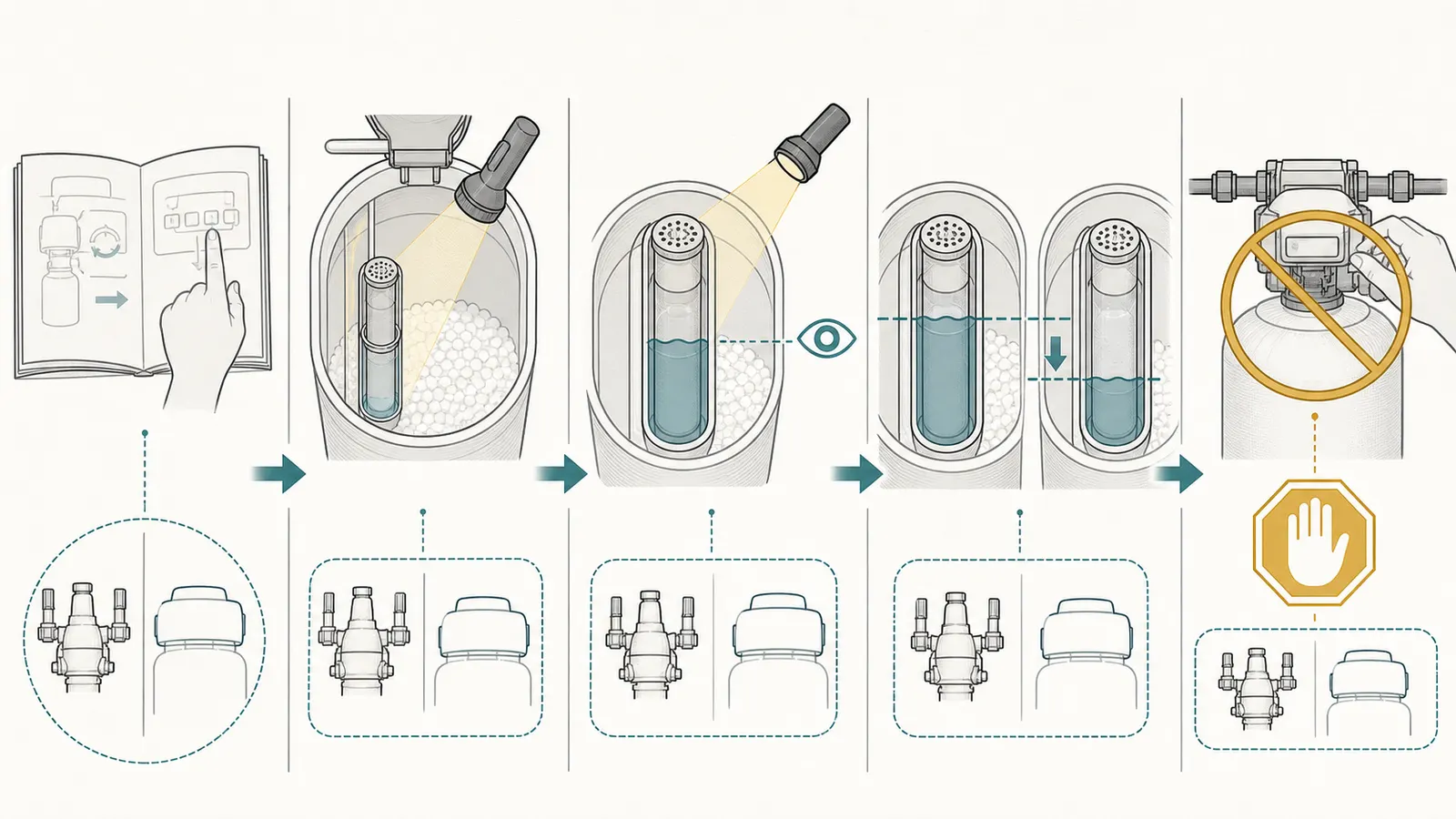
Your observation should answer three questions:
- Did the control initiate the cycle? Record the display state and the start time.
- Did the brine tank fill or otherwise change as the manual describes? Observe from the safe opening above the brinewell; do not touch tubing or the float.
- Did the liquid level drop during brine draw and return to the expected state? Use the manual’s expected sequence. If the water stays high, rises, leaks, or does not drop, stop.
If the level drops, that supports a functioning brine-draw event, but it does not prove that every grain of hardness has been removed or that the resin is healthy. Take the same hardness sample at the same softened cold-water tap after the manual’s cycle is complete and the water has returned to service.
Interpret the outcome
| Regeneration observation | Same-tap hardness result | Best interpretation | Next action |
|---|---|---|---|
| Liquid level drops as the manual describes | Hardness improves toward the expected softened result | Mushing or bridging may have blocked brine formation, and the cleanup likely restored the cycle | Keep the record, use the correct salt, and monitor salt level and hardness |
| Liquid level does not drop | Hardness remains high or is unknown | Brine draw is not verified; a nozzle, venturi, gasket, drain, brine line, float, or valve issue is possible | Stop before disassembly and request service |
| Tank fills abnormally, overflows, leaks, or stays high | Any result | Fill, float, drain, or control problem needs attention | Bypass only if the manual directs it; stop and request service |
| Liquid level drops | Hardness remains high | Brine moved, but the system may have a programming, capacity, hardness-setting, resin, bypass, or water-quality issue | Verify model settings and bypass externally; arrange professional diagnosis if the result repeats |
| Display is blank or error-coded | Any result | The regeneration record is not reliable | Do not test live wiring; use the manual’s service path or a qualified technician |
The Whirlpool troubleshooting list is helpful here because it separates “does not draw brine” from “salt is mushy.” It names the nozzle and venturi, gasket seating, valve seals, drain restriction, and brine-line obstruction as possible causes. Those components are inside the service boundary for this page. A homeowner may document the symptom; a qualified professional should decide which component to open, clean, replace, or test.
Choose observe, clean-and-retest, or service
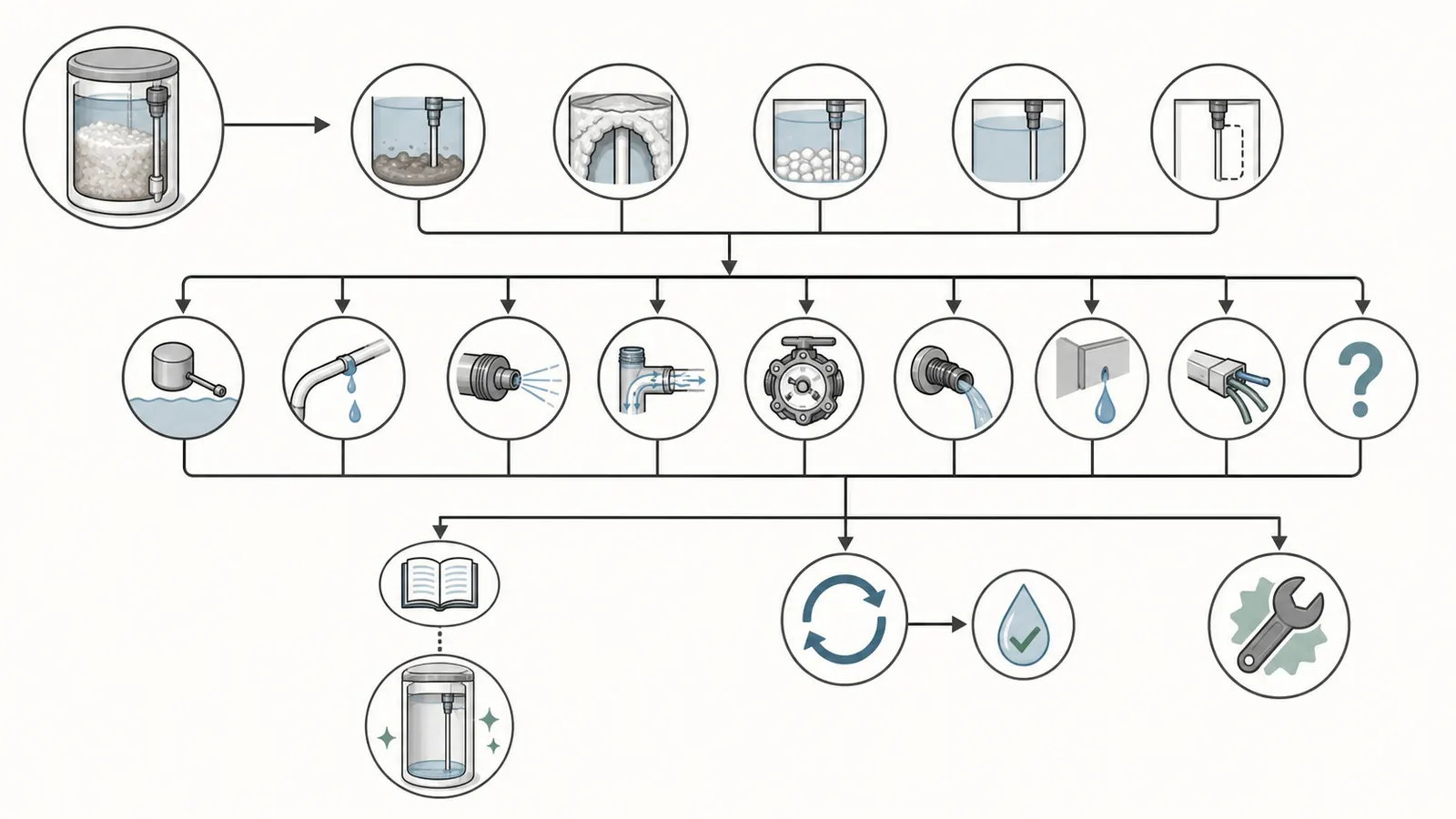
Use the smallest branch that matches the evidence.
Continue observing when
- the equipment is confirmed as a salt-based softener;
- the tank contains loose salt in contact with water;
- there is no bridge, unusual residue, leak, or high water level;
- the display and bypass are normal;
- the unit completes its documented regeneration;
- the liquid level changes as the manual describes; and
- repeatable hardness results remain consistent with the home’s expected softened water.
Do not force a refill schedule from a single observation. EPA advises checking salt periodically and programming regeneration from hardness, flow, and capacity rather than treating a calendar interval as universal. Keep the salt above the water level and follow the manual’s maximum fill guidance; overfilling increases the chance of bridging in some conditions.
Clean and retest when
- bottom mush or visible buildup is confirmed;
- the model manual permits homeowner tank cleaning;
- the tank and fittings are intact and dry outside the tank;
- you can keep the work inside the salt-storage area; and
- you can complete one controlled regeneration and hardness retest afterward.
The cleanout is successful only if the observable result improves: salt remains loose, the tank’s expected water level returns, brine draw is observed, and the same-tap hardness result moves in the expected direction. A clean-looking tank with no brine draw is not a successful repair.
Request service when
- water does not enter or leave the brine tank as the manual describes;
- water remains high, overflows, or leaks;
- the brinewell float or valve appears stuck;
- the brine or drain line must be disconnected;
- the nozzle, venturi, control valve, seals, gasket, or drain restriction is suspected;
- the display, adapter, wiring, or outlet is damaged or unreliable;
- the same hardness result remains high after a verified brine draw;
- the residue is recurring, foul-smelling, or associated with a water-quality concern; or
- you cannot identify the model or the manual’s maintenance boundary.
This is also the point where replacement should not be the default. A failed brine draw can often be a serviceable component issue, while recurring sludge can point to salt quality or incoming-water sediment. Ask the professional to document the observed tank condition, brine-draw result, hardness results, bypass position, model settings, and the reason a repair or replacement is being proposed.
Prevent the next recurrence
Once the system is operating, use a light record rather than a guess. EPA recommends periodic salt checks, annual brine-tank cleaning, professional service once per year, and bypass during water-intensive activities that do not need softened water. The installed manual may call for a different interval or a manufacturer-specific cleanser; follow that document where it is more specific.
A practical maintenance schedule
| When | Record or inspect | Stop condition |
|---|---|---|
| Every 2–4 weeks until you know the pattern | Salt level, salt type, bridge signs, display time, leaks, and hardness symptom | Salt is fusing, mush is returning quickly, water is high, or the display is abnormal |
| Every 4–6 weeks after the pattern is known, unless the manual says otherwise | Salt level and whether the expected amount is being consumed | Salt level does not change despite normal demand, or hard water returns |
| After adding salt or clearing a bridge | Date, approximate amount, tank condition, and next regeneration | You cannot confirm salt contact or the unit will not regenerate |
| After a permitted tank cleanout | Before/after photos, regeneration start and end, brine-level observation, same-tap hardness | No level drop, leak, overflow, error, or unchanged high hardness |
| Annually | Manual-recommended tank cleaning and professional service | Any component must be opened, pressure released, or wiring tested |
Whirlpool notes that humidity and salt type can contribute to bridging, and recommends lower salt storage with more frequent refills in humid areas for its product family. That does not mean every homeowner should keep a half-empty tank; it means storage level and salt choice are maintenance variables to record against the installed manual. If the same mush returns after correct salt, a permitted cleanout, and a verified brine draw, bring the full record to a water-treatment professional rather than adding more salt or replacing the softener by guesswork.
The decision is simple once the physical evidence is kept separate: bottom mush points first to a tank cleanout decision; a hard shelf points to a bridge check; normal salt-contacting brine points to regeneration and hardness verification; high water or absent brine draw points to service. That separation protects the tank, avoids breaking the wrong obstruction, and gives the next professional a repairable record instead of a symptom alone.
Sources and scope
Evidence behind this page
- Water softener salt FAQ
Cargill's consumer-facing salt FAQ explicitly distinguishes a bridge from bottom mushing and advises removing good pellets, scooping out mushed salt, and reloading good pellets for mushing.
- Water softener salt FAQ
Cargill's answer about brown, black, or oily-looking material in the salt-holding tank; it describes a possible source and does not certify every residue as harmless.
- Water softener salt FAQ
Cargill's conditional cleanout guidance for brine-tank buildup; the page does not replace the installed model manual.
- Home Maintenance
US EPA WaterSense homeowner maintenance recommendation; it does not replace a model-specific manual or establish local disposal rules.
- Water Softener - Checking Salt Storage Level / Adding Salt
GE Appliances' homeowner instructions for checking and loosening a salt bridge, including a model-specific one-gallon warm-water suggestion and the warning not to bang the tank.
- Whirlpool Water Softener Installation and Owner's Manual (WHESCS)
Whirlpool WHESCS manual, routine-maintenance section; salt type and fill guidance are specific to that manual's product family and must not be generalized to every softener.
- Cation Exchange Water Softeners
US EPA WaterSense explanation of the ion-exchange process, brine regeneration, and water and salt use.
- Soften Water Without Wasting It: Guide to Selecting and Maintaining a Water-Efficient Water Softener
EPA WaterSense consumer guide, including hardness, capacity, salt levels, bridging, and regeneration scheduling; it is not a universal programming prescription.
- Home Maintenance
US EPA WaterSense homeowner maintenance recommendations for water softeners; the page does not set local plumbing or discharge requirements.
- Water Softener - Checking Salt Storage Level / Adding Salt
GE homeowner salt-selection instructions; exact salt compatibility remains model-specific.
- Soften Water Without Wasting It: Guide to Selecting and Maintaining a Water-Efficient Water Softener
EPA WaterSense consumer guide's salt-product maintenance guidance; exact compatibility remains model-specific.
- Whirlpool Water Softener Installation and Owner's Manual (WHESCS)
Whirlpool WHESCS manual's cleaning and troubleshooting sections; component names and access steps are model-specific and are used here to define the service boundary, not to authorize generic disassembly.
- Whirlpool Water Softener Installation and Owner's Manual (WHESCS)
Whirlpool WHESCS model-family diagnostic sequence; the timing and control-button commands are not universal and must be replaced by the installed manual's instructions.
- Whirlpool Water Softener Installation and Owner's Manual (WHESCS)
Whirlpool WHESCS routine-maintenance instructions explaining the bridge mechanism and associated causes.
- Virginia Household Water Quality Program: Household Water Treatment
Virginia Cooperative Extension explanation of residential cation-exchange softeners, hardness, brine tanks, and regeneration; it is educational and not a model-specific service manual.
- When to put salt in water softener systems
Culligan consumer explanation of salt levels, bridging, salt forms, and regeneration; it is secondary manufacturer guidance and not a universal diagnostic procedure.