Water Softener Resin or Whole Unit? A Test-First Homeowner Decision
Test hardness, brine draw, bypass, pressure drop, media loss, and tank condition before choosing resin replacement, valve repair, or a new softener.
The short answer
Do not decide from age alone. Check salt and bypass, run a complete manufacturer-approved regeneration, then compare raw and outlet hardness. Confirm brine draw and look for media loss, pressure drop, leaks, and control faults. Good post-regeneration softening with a sound tank points away from replacement; failed brine draw points to valve service; failed softening with a serviceable tank can justify a rebed. Replace the whole unit when tank, valve, fit, or parts make a rebed poor value.Should I Replace My Water Softener Resin or the Whole Unit?
Start with the water, not the calendar. A softener that is not producing soft water may have spent or fouled resin, but it may also be bypassed, unable to make brine, mis-programmed, unable to advance through regeneration, or restricted by media migration. The clean decision sequence is:
- Record the model, valve, tank, service history, raw-water hardness, and symptoms.
- Check salt condition and confirm the bypass is in service.
- Run one complete, manufacturer-approved regeneration.
- Test raw inlet water and outlet water after regeneration using the same units.
- Observe whether the unit actually draws brine, without opening the control or disconnecting a line.
- Check for downstream resin beads, a repeatable pressure change, leaks, tank damage, and unavailable controls.
- Compare three written scopes: resin-only, valve repair, and full replacement.
If brine draw fails, a resin replacement is premature. If brine draw works but outlet hardness stays close to inlet hardness, resin condition becomes more plausible—provided the bypass, settings, flow, and tank are sound. If the tank is damaged, media is escaping, the valve is obsolete, or the quote requires several aging components at once, replacement may be the better foundation. Neither a “50 percent” rule nor a generic age rule can substitute for these observations.
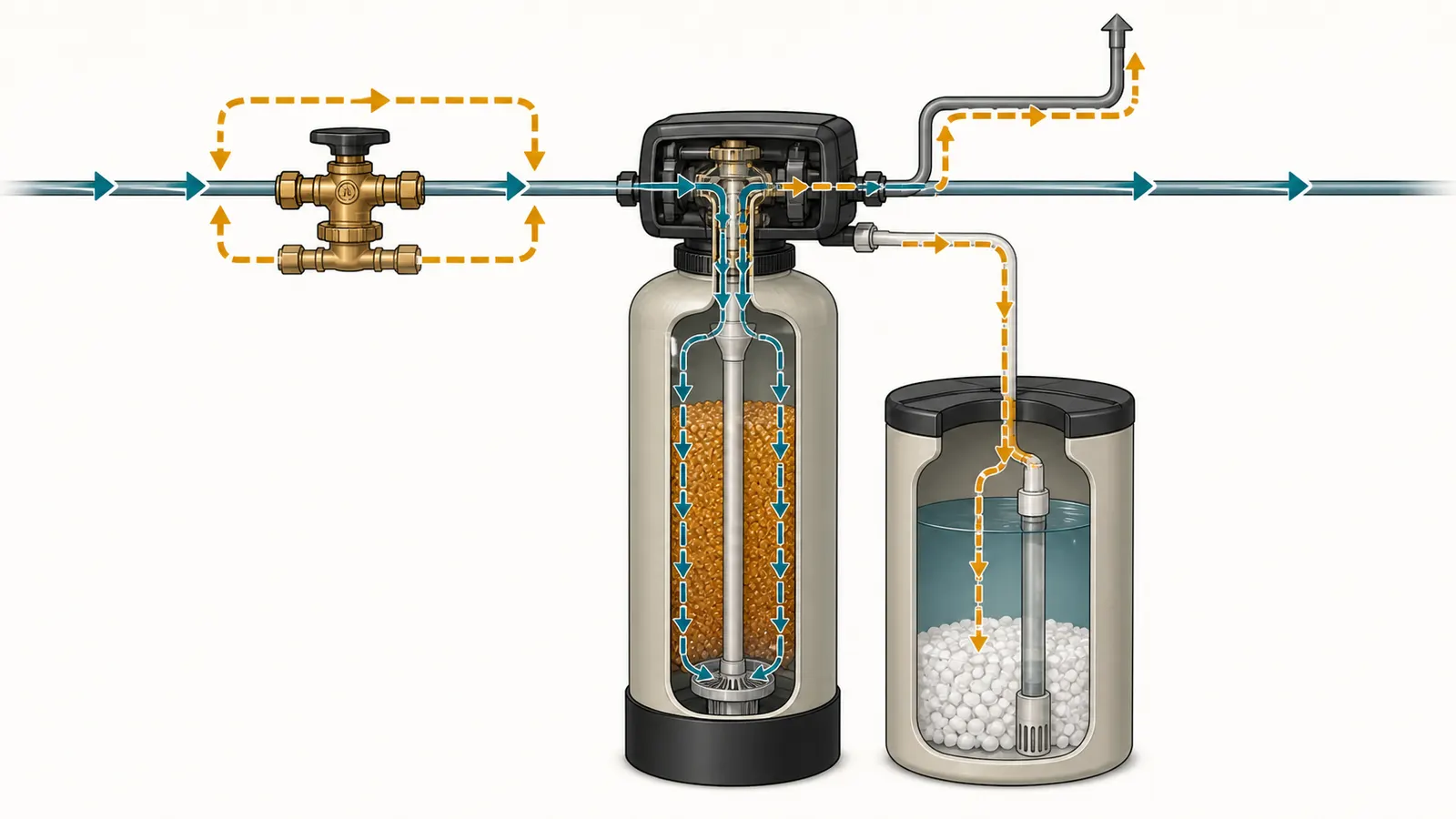
The decision surface: what each result actually tells you
The table below is a triage surface, not a universal repair code. “Pass” means the observation is consistent with normal operation for the installed model; use the owner’s manual for the model’s names and sequence. “Fail” means the observation is abnormal or cannot be confirmed. A failed observation identifies the next question; it does not automatically identify the part to buy.
| Evidence you record | What it supports | What it does not prove | Safest next step |
|---|---|---|---|
| Outlet hardness is materially lower than inlet hardness after a complete regeneration | The bed is exchanging hardness at that moment | That the unit is correctly sized, will last, or is free of a future valve problem | Keep the unit in service; investigate settings, capacity, flow, or intermittent symptoms before replacing resin |
| Outlet hardness remains close to inlet hardness after regeneration | A regeneration, bypass, setting, valve, or resin problem remains | That the resin is spent | Repeat only the checks allowed by the manual; have a softener technician test valve operation and brine flow |
| Brine-tank liquid level visibly falls during the brine-draw portion | The injector/valve path is drawing brine in that observed cycle | That the dose, injector rate, rinse, or capacity is correct | Continue to hardness, pressure, media, and tank checks |
| Brine draw cannot be seen or the level does not fall | Brine formation or delivery may be failing | Which component failed; a salt bridge can mimic a valve fault | Confirm salt condition and bypass; request a documented brine-draw test before a rebed |
| Bypass is in bypass or a mixing/blending setting is open | Untreated or partly blended water may be reaching the house | That resin or valve is bad | Restore only the clearly marked operating position; test again |
| Beads repeatedly appear at a toilet, faucet aerator, or other outlet | Media may be migrating out of the tank | That all resin is exhausted or the tank alone is the cause | Put the softener in the manufacturer-approved safe state and arrange professional inspection |
| A repeatable pressure difference appears across the unit at the same flow | A restriction or media/tank/valve issue may be affecting flow | A single hose-bib pressure reading proves a softener restriction | Use existing test points or have a professional measure differential pressure |
| Tank is cracked, bulging, leaking, badly corroded, or cannot safely support the valve | Reusing the pressure vessel is questionable | That a new valve alone will solve the system | Treat whole-unit or tank-and-valve replacement as the comparison baseline |
| Control will not retain time/settings, advance, meter, or stop a continuous drain | Valve, motor, sensor, controller, or power issue is plausible | That the resin is bad | Quote a model-specific valve/control repair and compare parts availability |
This order matters because resin is not the only component that determines softening. EPA’s WaterSense guide discusses hardness in units such as grains per gallon, milligrams per liter, and parts per million, but it does not set a universal pass/fail outlet-hardness threshold for every model. EPA’s WaterSense softener guide is therefore a context source, not a diagnosis. A water test can tell you that water is hard; it cannot, by itself, tell you that the resin bed is the failed part.
1. Record the system before touching anything
Take photographs of labels and write down the following. This record is more useful than “the softener is old” when you ask for a quote.
Identify the assembly
- Manufacturer, model, serial number, and installation date if known.
- Control-valve brand and model, including any valve or controller code separate from the cabinet brand.
- Resin-tank dimensions or the rated resin volume, if stated on the label or original paperwork.
- Brine-tank type, salt type, drain arrangement, and whether there is a separate prefilter, iron filter, sediment filter, or mixing/blending valve.
- Where the inlet, outlet, bypass, brine line, and drain line are located. Do not disconnect any of them.
The tank and valve are a system, not interchangeable labels. Pentair’s Fleck manual ties capacity and regeneration configuration to resin volume, tank size, resin specification, inlet hardness, salt dosage, and flow requirements. Pentair’s sizing and programming sections are specific to the Fleck 3150 NXT/NXT2 configuration, but they show why a quote that says only “replace the resin” is incomplete: the replacement bed must work with the tank, distributor, injector, drain-control flow, and programmed capacity.
Capture the symptom without interpreting it
Record dates and locations, not conclusions:
- Is hardness present at every cold fixture or only hot water?
- Did the change begin after a power outage, salt delivery, plumbing work, filter change, well work, or a change in iron, odor, color, or sediment?
- Is the salt level falling between regenerations? Is there a crust or a soft, wet mass?
- Is there a continuous trickle to the drain, a leak, low pressure, or beads in a toilet tank or aerator?
- Does the controller show a regeneration, error, low salt, or flow-meter warning?
Do not treat a soap feel, a shower sensation, or one stained fixture as a hardness measurement. Hardness symptoms can remain after a repair because scale is already present in plumbing and appliances. Conversely, a clean-looking fixture does not prove the outlet is soft.
Collect the water-quality context
Use a recent utility water-quality report where available, or obtain an independent test. For private wells, EPA recommends certified drinking-water laboratories and lists hardness for scaly residues and iron or manganese when a softener is being considered for those constituents. Record hardness in the reported units, plus iron, manganese, pH, turbidity, and any other result that has changed since the softener was installed. A softener is not a general-purpose treatment for every contaminant.
2. Run the safe homeowner test sequence
Only perform the external observations below. Use the installed owner’s manual for button names, valve positions, regeneration steps, and any chemical-cleaning instructions. Do not borrow a cycle time from another brand. Pentair documents five regeneration functions for one Fleck configuration—backwash, brine draw and slow rinse, rapid rinse, brine-tank refill, and an optional pause/delay—but other models can differ. Pentair’s regeneration description is a model reference, not a universal timer.
Check salt and bridging first
With the lid closed or opened only as the owner’s manual permits, look for an obvious salt bridge or mush. A bridge can leave salt above an empty space, so a full-looking tank does not guarantee brine. Cargill describes bridging and mushing as conditions that can reduce or eliminate brine formation and recommends resolving those basic salt issues before treating the resin as failed. Cargill’s water-softener salt FAQ also says to follow the softener manufacturer’s instructions for salt and water level.
If your manual permits homeowner bridge removal, use only the external method it describes. EPA’s maintenance guidance mentions breaking up a salt bridge with a rigid tool; do not stab downward into hidden equipment, pry against the tank, or use a metal rod near wiring or the brine well. If the salt is mushing, the tank is contaminated, the float is stuck, or the water level is abnormal, stop and document it for service. Do not add a cleaner, bleach, acid, or a different salt product just to see what happens.
Confirm the bypass position
Read the markings on the installed bypass. In normal service, water should be routed through the softener; in bypass, the unit is isolated and the house receives untreated water. Pentair describes the bypass function as isolating the softener for unconditioned water and maintenance. EPA also advises returning the bypass to its prior position after outdoor or other water-intensive use. EPA’s home-maintenance guidance is clear on that operational consequence.
Do not force a stiff handle, use pliers on plastic fittings, or guess at an unlabeled position. If the valve has a mixing or blending control, record its setting. A unit can be regenerating correctly while a bypass or blend path sends hard water around some or all of the resin.
Run one complete regeneration
Before starting, photograph the controller display and note the salt level, bypass position, and any error. Start a manual regeneration only if the owner’s manual identifies that as a normal user operation. Keep people and stored items clear of wet floors and the drain discharge. Do not drink from a line that the manual says is temporarily out of service, and do not interrupt the cycle unless the manual tells you how.
Wait for the complete cycle, including its final return to service. “The display advanced” is not the same as “the bed regenerated.” The purpose of brine draw is to send regenerant through the resin and remove exchanged hardness ions to the drain; the rinse then removes residual brine and settles the bed. Pentair’s regeneration-process sheet describes those functions in sequence.
Observe brine draw without opening the system
If the brine tank has a safe viewing point, observe the liquid level during the period the manual identifies as brine draw. Record:
- whether water is visibly moving toward the drain;
- whether the brine-tank liquid level falls during draw;
- whether the level later returns during the refill portion;
- whether the controller pauses, stalls, or reports an error.
Do not remove the brine line, open a fitting, reach into the brine well, insert a tube, or put your face near the drain. Do not infer a successful draw from salt consumption alone; salt can dissolve or compact without a correct valve cycle. A level that does not fall may reflect a bridge, clogged injector, blocked brine line, air-check issue, insufficient inlet pressure, or a control problem. It is a reason to diagnose the brine path, not a reason to order resin.
Test raw and softened water after the cycle
Use a hardness kit that reports a numeric result, or use a certified laboratory when the result will determine a major purchase. Test two cold-water samples with the same kit and units:
- Raw/inlet sample: a source that is upstream of the softener, if one is safely available, or the current water-quality report/lab result. Label the date and source.
- Outlet sample: a cold tap downstream of the softener after the complete cycle has returned to service. Follow the kit’s flushing and sampling instructions exactly.
Record the actual result, not just “soft” or “hard.” If you cannot access a true inlet sample, do not call a downstream result the raw hardness. If you have a bypassed hose bib or an outdoor branch, it may not represent the same path. The comparison is strongest when inlet and outlet samples are taken under comparable conditions and the unit is confirmed in service.
Use the result as a comparison, not a universal threshold. If outlet hardness is substantially lower than inlet hardness, the resin is performing an exchange function at the time of the test. That points away from an immediate resin replacement, even if the unit is old. If outlet hardness is near the inlet result after a verified complete regeneration, the unit still has a problem—but the result cannot distinguish a failed draw, bypass, wrong hardness setting, undersizing, valve sequencing fault, or exhausted/fouled resin by itself.
3. Read the branches: resin, brine/valve, or something upstream
When the evidence points first to salt, settings, or valve work
Prioritize service or a settings correction when any of these are true:
- the bypass is not fully in service or a blend path is open;
- the salt is bridged or mushed;
- brine draw cannot be confirmed;
- the drain runs continuously or the control does not complete its sequence;
- the controller lost time or hardness/capacity settings after a power event;
- the meter, motor, sensor, or controller does not respond as the manual describes;
- the unit softens immediately after a technician forces a proper cycle, then fails again;
- the incoming hardness, iron, manganese, pH, or sediment has changed.
EPA recommends programming regeneration from incoming hardness or flow rather than a fixed schedule. Its WaterSense home-maintenance guidance also recommends professional annual service. Pentair’s manual shows that hardness and capacity are controller inputs in metered configurations and that wear can be affected by raw-water quality and regeneration frequency. Pentair’s maintenance and programming guidance supports bringing those records to the technician.
What not to infer: hard water after a failed regeneration is not proof of spent resin. Resin cannot be judged fairly if the salt solution never reached it, if the valve remained in bypass, or if the controller is using the wrong hardness or capacity.
When the evidence points toward fouled or spent resin
Resin becomes a reasonable work-scope candidate only after the basic path is credible:
- the bypass is in the service position;
- salt is available and not bridged or mushed;
- a complete regeneration occurred;
- brine draw was observed or professionally confirmed;
- the hardness setting and capacity are plausible for the documented inlet water;
- no obvious continuous drain or control failure explains the result;
- the outlet still tests close to inlet hardness;
- the pressure behavior and tank condition do not indicate a broader failure.
At that point, ask whether the problem may be fouling rather than irreversible resin exhaustion. GE says resin in its softeners is designed to last the life of the appliance but may need cleaning when iron is high, while Cargill says ion-exchange resin life can vary with usage. GE’s resin guidance is specific to GE products and its cleaner instructions; do not apply its chemical method to another model without that model’s approval. Cargill’s resin-life guidance is likewise context, not a cutoff.
If a qualified technician confirms the resin is fouled or exhausted, ask for a written rebed scope that addresses the pressure vessel, riser/distributor, valve interface, bypass, drain path, brine system, proposed media, and post-work verification. These details are not universal homeowner steps: tank internals, bed volume, media specification, valve programming, and rinse requirements depend on the installed model and the technician’s service procedure. Ask the technician to state what will be reused, what will be replaced, which model documentation governs, and how outlet hardness and leaks will be checked after the work. Do not open the tank or attempt to pour in media yourself.
When the evidence points to media migration or pressure restriction
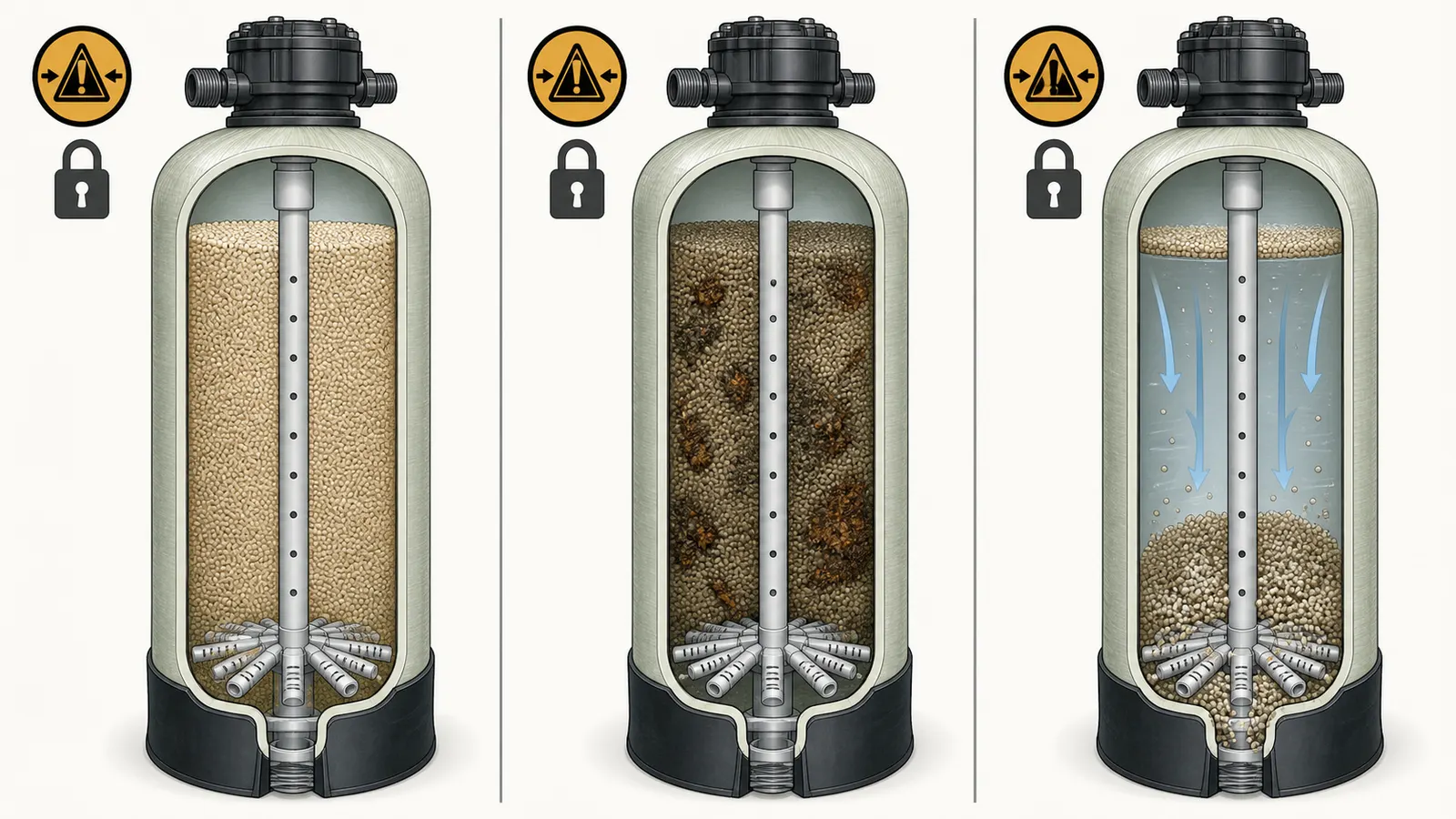
Rheem identifies pressure drop and resin appearing in plumbing as possible signs associated with expired resin, and it identifies oxidation and expansion as possible aging mechanisms. Rheem’s expired-resin guidance makes these useful clues. They are not a complete diagnosis.
Treat a few isolated tan or amber beads as evidence to investigate, not as proof that the entire bed is gone. Record where they appeared, how often, and whether they return after the unit is placed in the manufacturer-approved safe state. Recurring beads, a large amount of media, damaged fixture screens, or an unexplained pressure change justify professional inspection before continued use.
For pressure, the useful quantity is a differential under comparable flow:
pressure drop across softener = upstream pressure − downstream pressure
A single pressure gauge on a hose bibb measures service pressure at that location; it does not isolate the softener. Do not create a new pressure-tap point or loosen a pressurized connection to take a reading. If the installation already has accessible gauges or test ports, record upstream and downstream pressures at the same flow and time. Otherwise, ask the technician to measure the differential and state the flow rate, valve position, and whether the unit was in service or bypass. NSF/ANSI 44 includes pressure drop, structural integrity, and softening capacity within its certification scope, but NSF’s summary does not supply a universal homeowner pass/fail number for every model.
4. Compare the three work scopes
Do not compare a one-line “new softener” quote with a one-line “resin replacement” quote. They may include different assumptions. Use the following scope matrix when requesting written proposals.
| Scope | Evidence that should be present | Scope items the quote must identify | Questions that change the decision |
|---|---|---|---|
| Resin-only rebed | Verified brine draw, correct service/bypass position, failed outlet hardness after regeneration, sound tank and valve, no unexplained media loss or restriction | State the tank, riser/distributor, valve interface, bypass, brine system, drain path, proposed media, any internals, and the post-work test; do not assume any item is reusable | Is the tank structurally sound? Is the riser/distributor intact? Is the valve compatible with the proposed bed? What media volume and specification are proposed? What outlet-hardness test is included? |
| Valve/control repair | Brine draw fails, control stalls, drain runs continuously, meter/sensor or settings fail, or bypass does not operate correctly | State the exact failed or suspected part, valve revision, parts availability, labor, and verification steps; do not bundle an unexplained rebed into valve work | Is the proposed part compatible with the exact valve revision? Will the technician verify brine draw and outlet hardness after repair? |
| Whole-unit replacement | Tank leak/crack/bulge, repeated media migration, severe restriction, obsolete or unsupported valve, multiple failed assemblies, poor fit, or a replacement quote that solves documented capacity/flow issues | State the proposed tank, bed, valve, brine system, connection hardware, retained plumbing, removal, and post-installation tests; do not assume “whole unit” includes every site change | What is the rated capacity at the stated salt dose? What are inlet hardness, peak flow, drain, and electrical requirements? Is the model certified to NSF/ANSI 44? Are local restrictions and septic implications checked? |
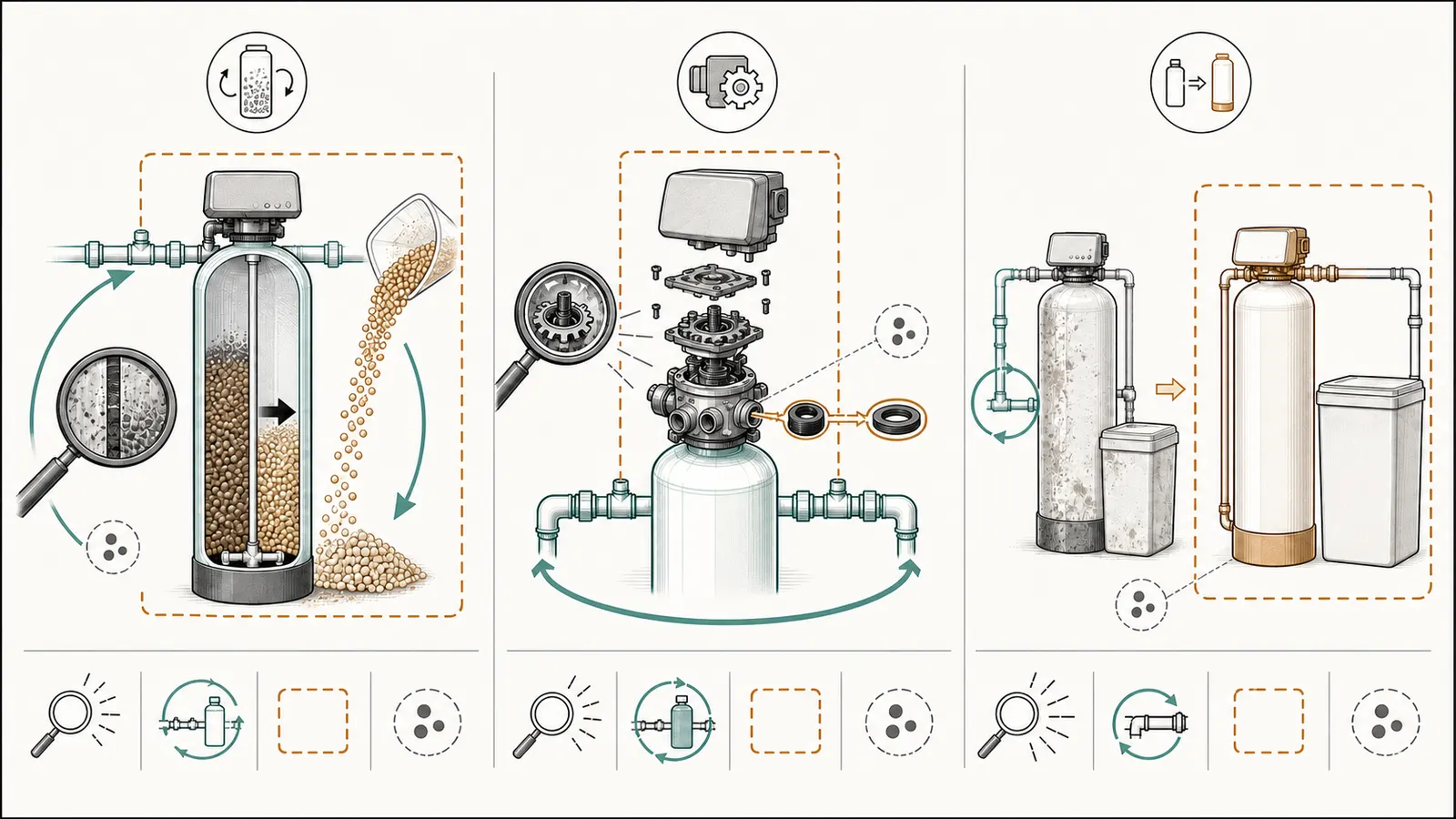
“Resin-only” should not mean “ignore the valve.” Ask whether the technician will inspect the riser tube, upper distributor, injector, drain-flow control, brine-line connection, bypass, and valve-to-tank interface. “Whole unit” should not mean “install a larger box.” Ask the installer to show how the proposed size follows from the measured hardness, household use, peak flow, and any iron or manganese load. Pentair warns that sizing from nominal rather than peak flow can cause hardness leakage at peak demand in the specific systems it documents. Pentair’s sizing section is the reason to demand those inputs, not a reason to copy its tables to another brand.
5. Use tank, control, history, and water inputs together
Tank condition is the hard stop
A pressure vessel that leaks, bulges, cracks, or has a damaged valve connection is not a good platform for a new bed. Do not sand, patch, drill, strap, rotate, or open the tank. A resin tank can look fine externally and still require an internal inspection by someone qualified to depressurize and service it. The whole-unit comparison becomes stronger when a rebed would leave a known tank or distributor problem in place.
Control condition determines whether the new resin can be used
Even good resin will fail to deliver if the controller cannot meter water, retain time, open the correct cycle, draw brine, refill the brine tank, or stop drain flow. Ask for the exact failure observed and the model-specific replacement part number. Pentair’s maintenance schedule separately identifies seals, spacers, pistons, motors, gearing, meters, electronics, transformers, and bypass components; its maintenance tables make clear that “the valve” is not one undifferentiated part.
An old unit with a sound tank and a supported valve may still be a good rebed candidate. An equally old unit with an unsupported controller, leaking bypass, damaged tank threads, and poor access may not be. That is why age belongs in the history column, not at the top of the decision tree. Cargill’s resin-life statement and Rheem’s appliance-life/resin observations point in different directions because they discuss different parts and conditions; neither creates a national replacement age.
Water chemistry can make a new bed fail early
If iron, manganese, turbidity, oxidized material, or chlorine exposure changed, a “new resin” quote without a water-quality explanation may simply reset the same failure. UGA Cooperative Extension notes that turbid water and iron or bacterial slimes can clog a softener, and that oxidized iron or manganese can foul a softener; it points to filtration or other treatment matched to the water condition rather than treating every failure as a resin-life problem. UGA’s water-quality and treatment guidance is educational guidance, not a model-specific service procedure. For a private well, use a certified laboratory and discuss the results with a water-treatment professional rather than guessing at a cleaner or pretreatment filter.
Local and household constraints belong in the replacement decision
EPA notes that some jurisdictions limit softener installation or use, and that onsite septic owners should check with the septic-system manufacturer or a local service provider. The EPA WaterSense guide also recommends considering NSF/ANSI 44 certification. These are not blanket national rules. Write down your state, municipality, water utility, and septic context before approving a replacement. A certified model still has to fit the household’s hardness, flow, drain, electrical supply, space, and maintenance ability.
6. Make quotes comparable with a simple worksheet
Ask every provider to fill the same fields. You can copy this into a note or spreadsheet.
Observed condition
- Raw/inlet hardness: ____ units ____ date ____ source ____
- Outlet hardness after complete regeneration: ____ units ____ date ____ tap ____
- Brine draw: confirmed / not confirmed / not visible; observation: ____
- Bypass: service / bypass / unclear; blend setting: ____
- Media observed downstream: none / isolated / recurring / significant; location: ____
- Pressure evidence: upstream ____ / downstream ____ at flow ____; or “not measured”
- Tank leaks, cracks, bulges, corrosion, or damaged connection: ____
- Controller, meter, drain, and error behavior: ____
Existing system
- Brand/model/serial: ____
- Valve model/revision: ____
- Tank size or resin volume: ____
- Installation date or best-supported age: ____
- Last service, rebed, valve repair, or water-quality change: ____
- Inlet hardness, iron, manganese, pH, turbidity: ____
Quote fields
- Resin-only scope and resin specification/volume: ____
- Valve repair scope and exact parts: ____
- Whole-unit model, rated capacity, salt dose, and flow rating: ____
- Labor, removal, disposal, plumbing changes, drain/electrical work: ____
- Warranty for labor, tank, valve, and resin: ____
- Post-work test included: hardness / brine draw / leak check / pressure / other ____
- Local approval or restriction checked by homeowner: yes / no / not applicable
If you have numbers, calculate the repair share for context:
repair share = written repair or rebed quote ÷ written installed replacement quote × 100
This is a comparison aid, not a rule. A lower repair share is not automatically better if the tank is failing, parts are unavailable, the water chemistry is unresolved, or the proposed repair has no verification step. A higher repair share can still be rational when the tank is sound, the valve is supported, the bed specification is clear, and replacement would add plumbing or local-compliance work. Do not let a quote hide exclusions by calling them “standard installation.”
For replacement proposals, request the performance basis, not just a grain number. EPA explains that system size depends on hardness and household water use, and that demand-initiated regeneration can reduce unnecessary salt and water use. EPA’s replacement guidance recommends reviewing typical water consumption and choosing efficient, certified equipment where appropriate. Your actual selection must still follow the model’s instructions and local conditions.
Operation belongs in the comparison too. EPA says a typical softener may use about 20 to 70 gallons of water per regeneration, while larger systems can use more; the actual amount depends on the model, hardness, household use, capacity, and regeneration design. That EPA range is not a forecast for your home, but it is a reason to ask for the replacement model’s documented regeneration behavior rather than comparing purchase prices alone.
7. Safety limits and the professional handoff
The external checks in this page are deliberately limited. Do not open an energized control, test live wiring, remove a cover while power is connected, loosen a brine or drain fitting, disconnect a pressurized hose, unscrew a control valve from the tank, or attempt to pull the resin. Do not open a well, pull a well pump, enter a confined space, or manipulate a pressure tank or other pressurized equipment as part of this diagnosis. Do not enter a tank or crawl into a pit. Assign electrical, pressurized-tank, valve-internal, well, pump, and confined-space work to a qualified professional.
Hardness is not a drinking-water safety test
Hardness, iron, manganese, pH, turbidity, odor, and color checks help explain softener performance; they do not establish that water is safe to drink. A softener is not a general-purpose contaminant treatment, and a “good” post-regeneration hardness result does not clear a private well or a suspected chemical or microbial problem. EPA’s private-well guidance says to use a certified drinking-water laboratory, contact the public-health department when a result exceeds a health standard, and recognize that an alternate water source may be needed depending on the contaminant and concentration. EPA’s private-well testing and treatment guidance supports that boundary.
If you suspect microbial or chemical contamination, if a health-related result exceeds the applicable standard, or if the well has been flooded or its water changes suddenly, stop using the water for drinking, cooking, ice, brushing teeth, and baby formula until the health department, water utility, or a qualified well professional gives you a safe-use instruction. Use bottled or otherwise confirmed-safe alternate water, arrange the appropriate certified testing, and do not try to solve the concern with a softener rebed, salt change, or unapproved chemical cleaner. This page’s hardness comparison cannot authorize drinking the water.
Pentair’s installer manual states that qualified personnel should perform internal technical actions and requires power disconnection, inlet shutoff, and pressure relief before internal access. Pentair’s safety instructions are a conservative boundary for this homeowner decision surface. Your installed product manual and local requirements control.
Put the unit in bypass only when the installed markings and manual make the action clear. If a leak is active, the drain will not stop, water pressure changes sharply, electrical parts are wet, or resin is entering fixtures, close the nearest safe shutoff if you know it and can do so without reaching through water or touching wiring; otherwise call for service. Do not use a bypass handle to mask a leak or leave an unexplained condition running unattended.
Bring the professional one packet: photos of every label, the raw and outlet hardness readings, the complete-regeneration date, brine-draw observation, bypass and blend positions, media photographs, pressure readings or the fact that pressure was not measured, water-quality report, service history, and the three requested quote scopes. Ask the professional to return the same packet with the observed failure, the part or material that failed, the proposed scope, the verification test, and any unresolved uncertainty.
The decision is complete when the evidence and scope agree:
- Choose resin-only work when the regeneration path is confirmed, the outlet still fails, the tank and valve are sound and compatible, and the rebed includes a defined post-work test.
- Choose valve/control repair when brine draw, sequencing, bypass, metering, drain control, or settings are the demonstrated failure and the tank/bed remain suitable.
- Choose whole-unit replacement when the tank or media path is compromised, the valve and parts situation is poor, multiple major components are failing, the system is a poor fit, or a replacement quote is the only scope that resolves the documented water-quality and flow requirements.
- Pause the purchase when no one has documented the inlet/outlet comparison, regeneration, brine draw, or exact failure. A recommendation without those inputs is an opinion about the appliance, not a diagnosis of it.
Sources and scope
Evidence behind this page
- Soften Water Without Wasting It: Guide to Selecting and Maintaining a Water-Efficient Water Softener
The units and treatment-context claim applies to the EPA WaterSense guide; it does not set a universal pass/fail outlet-hardness threshold for every softener.
- Soften Water Without Wasting It: Guide to Selecting and Maintaining a Water-Efficient Water Softener
The water-use range is a typical range from EPA, not a prediction for a specific model.
- Home Maintenance
These are EPA WaterSense maintenance recommendations; they do not replace the model owner's manual or local requirements.
- Soften Water Without Wasting It: Guide to Selecting and Maintaining a Water-Efficient Water Softener
The jurisdiction statement is intentionally local and conditional; this page does not infer a national restriction.
- Installer Manual — Fleck 3150-NXT/NXT2
This is specific to the Fleck 3150 NXT/NXT2 configurations described in the manual. Other valves can use different labels, order, timing, or plumbing.
- The Regeneration Process
This is Pentair's general overview; exact cycle labels, order, and timings remain model-specific.
- Installer Manual — Fleck 3150-NXT/NXT2
The functional description supports checking bypass position, but the homeowner should follow the installed valve's markings and manual.
- Installer Manual — Fleck 3150-NXT/NXT2
This safety instruction is from a commercial Fleck manual and is used here as a conservative boundary for pressurized valve and tank service, not as a substitute for the installed unit's instructions.
- Installer Manual — Fleck 3150-NXT/NXT2
The sizing and programming details are model/configuration-specific; this supports collecting inputs, not recalculating a replacement from a generic tank label.
- Installer Manual — Fleck 3150-NXT/NXT2
This supports including service history, water chemistry, and control condition in the comparison; the table is not a universal service interval for every brand.
- Frequently asked questions — water softener salt
Cargill's troubleshooting guidance is about its salt FAQ and general salt-use context; it does not diagnose a particular valve or set an age cutoff.
- Frequently asked questions — water softener salt
The range is Cargill's experience statement and is explicitly conditional on usage and troubleshooting; it does not establish a universal resin life.
- Old or Expired Resin
Rheem's observations support treating media loss and pressure change as clues; neither symptom alone proves that resin is the only failed component.
- Water Softener — Resin Beads
This is GE's guidance for its appliances and iron-fouling context; it does not authorize using a cleaner in another brand or prove that cleaning will restore a particular bed.
- NSF/ANSI 44 Technical Requirements
NSF's summary describes the standard's scope; it is not a claim that every certified model will fit a particular home's hardness, flow, or local requirements.
- Protect Your Home's Water
This guidance is for private-well water testing; municipal customers should also consider current utility water-quality information and local testing options.
- Water Quality and Common Treatments for Private Drinking Water Systems
This is UGA extension guidance about private drinking-water treatment and softener fouling, not a model-specific service procedure or a universal resin-replacement rule.