How to Test Your Water Softener’s Actual Capacity
Measure the grains your installed softener removes at its real salt setting, report hardness leakage, and separate a field estimate from a lab rating.
The short answer
After complete regeneration, record paired raw/treated hardness at each meter reading and define confirmed breakthrough as the first nonzero treated result followed by a second qualifying result at least 5 gallons later. Let removalᵢ = rawᵢ − treatedᵢ and Δgallonsᵢ be each interval; estimate delivered grains as Σ[(removalᵢ₋₁ + removalᵢ) ÷ 2 × Δgallonsᵢ]. Report first-crossing and confirmed-breakthrough totals separately, then compare with matching programmed settings, not a lab rating.How to Test Your Water Softener’s Actual Capacity
The useful homeowner result is not the largest grain number printed on a tank label. It is the amount of hardness your installed unit removes between a known post-regeneration meter reading and a stated endpoint, at the salt setting and water conditions you actually use.
Use the confirmed-breakthrough field estimate, with one paired raw/treated hardness result at each logged meter reading:
Rᵢ = Hᵢₙ,ᵢ − Hₒᵤₜ,ᵢ
delivered grains through reading k ≈ Σᵢ₌₁ᵏ [((Rᵢ₋₁ + Rᵢ) ÷ 2) × (Gᵢ − Gᵢ₋₁)]
This interval-aligned sum uses the removal measured at each end of each gallon interval. It does not apply the endpoint hardness to every gallon. Report the same sum through the first observed crossing as Cₓ, and through the later confirming sample as Cₑ; the latter is the primary “confirmed breakthrough” result. Both are household field estimates, not laboratory capacity ratings.
Record the softener’s model, programmed hardness, salt dose or salt level, reserve setting, meter reading immediately after a complete regeneration, and meter reading at the endpoint. Test raw and treated water with the same hardness method. If the controller regenerates before hardness leakage appears, report capacity to programmed regeneration; do not label it resin exhaustion. If treated hardness is high immediately after regeneration, stop calculating and investigate routing, bypass, regeneration, brine, or settings first.
This is a repeatable household diagnostic, not a certification test. A rating under NSF/ANSI 44 is established through specified requirements and testing, including softening capacity and brine-system accuracy. Your result describes this installation under this run’s conditions.
1. What capacity means—and what it does not mean
Water-softener capacity is the amount of hardness removed between regenerations. Pentair’s water-treatment glossary defines capacity as the quantity removed between servicing under standard test conditions and says ion-exchange capacity is expressed in grains of hardness removal and related to pounds of salt used. Chem-Aqua likewise describes capacity in either grains or gallons and says it matters for sizing, configuration, and troubleshooting in Technical Bulletin 4-019.
Those definitions contain three different numbers that homeowners often collapse into one:
| Number | What it describes | How to use it in this test |
|---|---|---|
| Rated or laboratory capacity | A performance claim under stated test conditions, model configuration, salt dose, flow, pressure, water chemistry, and endpoint | Use it as a reference only after matching the exact model, resin size, and salt dose |
| Programmed capacity | The controller’s working value after its hardness, salt, reserve, meter, and calendar settings are applied | Record it as the expectation the installed control is acting on |
| Delivered household capacity | The hardness removed by this installed unit over the gallons you log until your selected endpoint or automatic regeneration | Calculate it from paired hardness readings and meter gallons |
The difference matters. A manufacturer’s table can show several capacities for one system at different salt doses. For example, the cited Pentair manual lists different grain values at low, medium, and high salt settings, and says its rated efficiency is valid only at the referenced salt dosage. The same manual says its efficiency comes from an NSF/ANSI 44 laboratory test, represents maximum possible efficiency, and is typically lower in operation because hardness, water use, and contaminants vary.
That is why a 40,000-grain label is not a promise that your home will receive 40,000 grains of removal before the control regenerates. EPA’s 2026 homeowner guide explains that softeners are sized by grain capacity per cycle and that both incoming hardness and household water use affect the required size. EPA also distinguishes time-initiated systems from demand-initiated regeneration, which uses a meter or hardness sensor to trigger regeneration after demand.
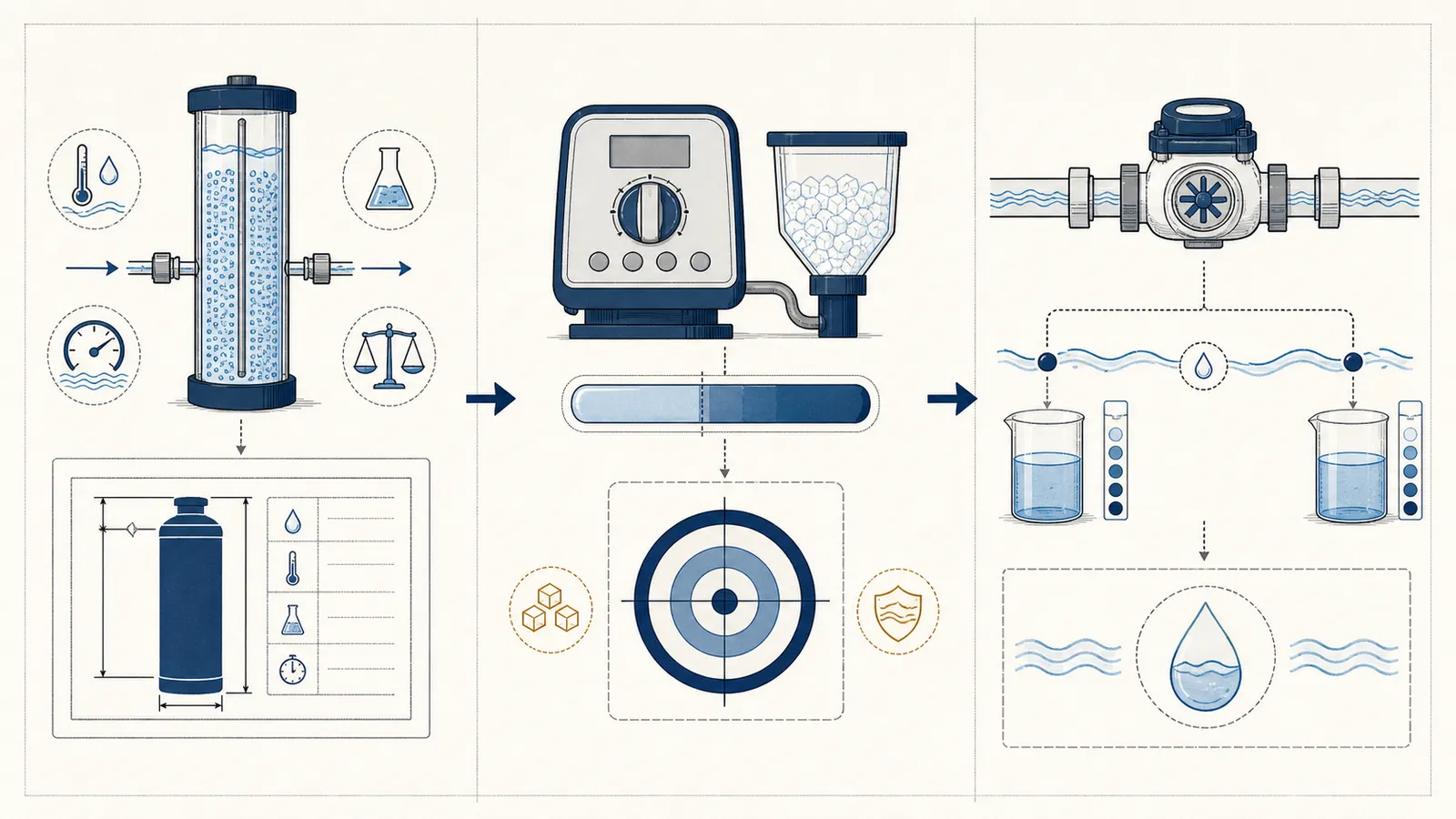
The test below measures performance at the conditions you document. It cannot establish the resin’s original laboratory capacity, certify the unit, prove a health-protection claim, or identify an internal failed component without additional inspection.
2. Decide which endpoint you can safely observe
“Breakthrough” means hardness has appeared in the treated water. Pentair defines breakthrough as the appearance in the effluent of the material the conditioner is meant to remove, with hardness in a softener as the example. The word does not supply a universal homeowner threshold. Test kits have different scales and resolution, and some systems intentionally blend a small amount of hard water or regenerate before exhaustion.
For a bounded household estimate, write down one of these endpoints before starting:
- Field breakthrough endpoint. Mark
Gₓat the first treated-water sample at or above the first nonzero increment on your hardness kit. Then take a second paired sample atGₑ, at least 5 gallons later, and require it to meet the same increment. If your kit resolves 1 grain per gallon (gpg), you may write “1 gpg, confirmed twice.” If it resolves only 0, 5, 10, and 25 gpg, write the actual first nonzero increment instead. This is Brictale’s repeatability rule for a field estimate, not an NSF acceptance limit. - Automatic-regeneration endpoint. If the controller regenerates before you observe the field breakthrough rule, use the meter reading immediately before that regeneration and label the result “capacity to programmed regeneration.” This is the unit’s delivered operating cycle, not proof that the resin bed was exhausted.
- Manufacturer endpoint. If the exact manual or performance data sheet defines a comparable endpoint, you may use it, but quote the model-specific wording in your log. Do not substitute a different manufacturer’s threshold.
Use the confirmed reading Gₑ for the primary result, labeled capacity through confirmed breakthrough. Also retain the cumulative sum through Gₓ, labeled capacity through first observed crossing. The interval from Gₓ to Gₑ is part of the confirmed-breakthrough total: include its gallons and use the paired readings at both ends in the interval sum. Do not silently treat those gallons as zero-hardness water or multiply the later endpoint value across the whole cycle. Because the actual crossing can occur between samples, the first-crossing result is bounded by the cumulative estimate through the last sample below the threshold and the cumulative estimate through Gₓ; the log should show both readings and their meter gap.
If a blended-water valve is intentionally open, the treated sample may never be zero. The University of Minnesota Water Resources Center notes that a blending valve can intentionally raise hardness from zero to roughly 2 gpg for feel. Record that condition and use the measured treated hardness in the formula; do not call the blended result a failure. If the blend setting is unknown or changes during the run, the comparison is not clean enough for a capacity conclusion.
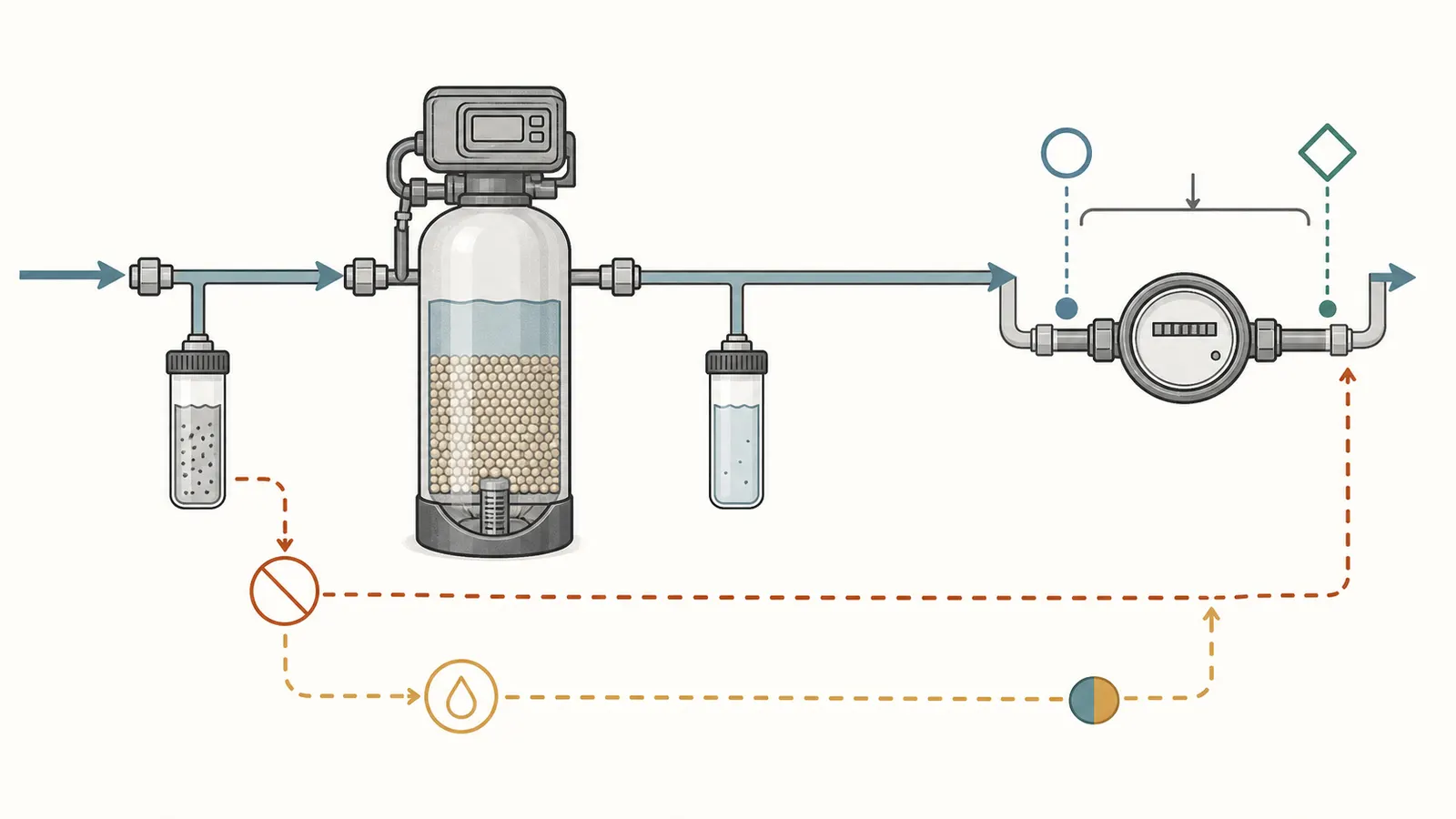
3. Gather the inputs before you regenerate
The quality of the answer depends more on the inputs and sampling location than on complicated arithmetic.
The minimum record
Create one line for each item below. Photograph the data plate and controller screen if that is safe and possible without removing a cover.
| Input | What to record | Why it matters |
|---|---|---|
| Exact model and resin volume | Model number, tank size, resin volume if documented | Capacity tables are model- and media-specific |
| Raw hardness | gpg, or ppm/mg/L as CaCO₃ | This is the hardness load entering the resin |
| Treated hardness | Same units and same kit as raw | This measures hardness leakage, not just whether water feels slippery |
| Salt dose | Pounds per regeneration, pounds per cubic foot, or exact manufacturer low/medium/high setting | Capacity changes with regenerant dose; do not guess pounds from salt-tank height |
| Hardness setting | Controller value and units | A wrong setting changes the controller’s gallon calculation |
| Reserve and calendar override | Percent, gallons, days, or “off,” if shown | The system may regenerate before breakthrough |
| Meter start and endpoint | Softener meter or whole-house meter readings | The difference supplies gallons treated |
| Flow conditions | Normal household use, unusual high flow, well pressure symptoms, outdoor bypass use | Test conditions affect what the installed system delivers |
If the controller shows only “low,” “medium,” or “high,” transcribe that exact label and find its pounds-per-regeneration value in the exact manual. The Pentair manual, for example, gives separate capacity and salt values for its system sizes and settings; that table is not a basis for filling in an unknown brand’s dose.
If hardness is reported in ppm or mg/L as calcium carbonate, divide by 17.1 to convert to gpg, following the conversion used in the Chem-Aqua capacity bulletin. Keep the original value in your log so someone can check the conversion. If the report does not state its hardness basis, ask the lab or water utility before treating the number as gpg.
Use a valid hardness measurement
Use a hardness strip or titration kit that reports hardness, and follow that kit’s timing, sample volume, and color or endpoint instructions. Rheem’s current homeowner testing guidance says to verify that the faucet is supplied through the softener and to test raw and treated water. It also warns that a TDS meter is not a valid hardness test: softening exchanges calcium and magnesium for sodium or potassium, so total dissolved solids may remain similar.
Use cold water unless the exact equipment manual says otherwise. The cited Pentair system is designed for cold water, and a hot-water sample can include water that has been stored in the water heater rather than representing the current pass through the softener. Choose a treated faucet whose flow path you have verified. Do not assume every outdoor hose bib is softened; EPA advises bypassing outdoor uses where possible, and many installations deliberately branch outdoor water around the softener.
For the raw sample, use a verified upstream tap, a documented raw-water outlet, or another sampling point that is actually before the resin. If no accessible raw point exists, use a recent utility or laboratory result only if it matches the same source and the date is defensible; otherwise the test is incomplete. Never loosen fittings or open a pressurized line to create a sample point.
4. Run the field test without changing the system’s story
The objective is to observe the unit at the setting it normally uses. Do not change the salt level, hardness setting, reserve, bypass, flow meter, or blend valve halfway through the run. A one-time test after changing settings can be useful, but it is a different test and must be labeled as such.
Step 1: establish a clean starting point
Confirm that the unit has completed a normal regeneration according to its manual. Record the date and time, the controller status, salt setting, hardness setting, reserve, and the softener meter reading. Call this reading G₀.
Do not interrupt a cycle, remove the valve cover, or use an installer menu simply to make the numbers look better. If the display says regeneration is incomplete, treat the test as a regeneration problem, not as a capacity result. If the unit has no usable meter, you can still compare raw and treated hardness, but you cannot defensibly calculate grains removed from household gallons.
Step 2: take paired baseline samples
At roughly the same time, collect a raw sample and a treated sample. Use the same kit, sample temperature, container type, and reading method. Record:
Hᵢₙ,0: raw hardness in gpg;Hₒᵤₜ,0: treated hardness in gpg;- whether a blend valve, bypass, filter, or unusual flow path is present; and
- the meter reading and date/time.
The first treated reading is a routing check. If Hₒᵤₜ,0 is close to Hᵢₙ,0, do not proceed as if the resin has no capacity. Check whether the faucet is upstream, a bypass is open, the unit is still in regeneration, or the sample was collected before the line cleared. If the treated result is only slightly above zero, record it as leakage rather than rounding it to “soft.”
Step 3: use ordinary demand and log the meter
Use the home normally, but note unusual events. Do not add a deliberate irrigation cycle, pool fill, or long hose draw unless that is the service pattern you are trying to test. If outdoor water bypasses the unit, those gallons should not be counted as softened gallons. If the whole-house meter is the only meter, keep all bypassed uses out of the interval or use the softener’s own meter.
If the programmed capacity is known, take an additional paired sample around 25%, 50%, 75%, and 90% of the expected gallons. After 75%, sample more often as the endpoint approaches. If the expected capacity is unknown, use a daily or every-few-uses log and make the sampling interval explicit. Record a meter reading with every pair:
| Reading | Meter | Gallons since G₀ | Raw hardness | Treated hardness | Notes |
|---|---|---|---|---|---|
| Start | G₀ | 0 | Hᵢₙ,0 | Hₒᵤₜ,0 | Complete regeneration |
| Check 1 | G₁ | G₁ − G₀ | Hᵢₙ,1 | Hₒᵤₜ,1 | Normal use or unusual event |
| Check 2 | G₂ | G₂ − G₀ | Hᵢₙ,2 | Hₒᵤₜ,2 | Same test method |
| First crossing / endpoint | Gₓ / Gₑ | Gₓ − G₀ / Gₑ − G₀ | Hᵢₙ,ₓ / Hᵢₙ,ₑ | Hₒᵤₜ,ₓ / Hₒᵤₜ,ₑ | First nonzero sample / confirmation at least 5 gallons later |
Do not interpret one strip that looks darker after a faucet sat idle as proof of breakthrough. Repeat the sample using the same flushing and timing procedure. Also record raw hardness at each interval if the water source is a private well, seasonal, or known to vary. A single raw hardness value multiplied by all gallons can materially overstate or understate capacity when the incoming load changes.
Step 4: stop at the endpoint you declared
For the field breakthrough rule, take the first nonzero treated sample at Gₓ, then take the confirming paired sample at Gₑ after at least 5 gallons. Stop at Gₑ; the confirmed-breakthrough result includes the Gₓ-to-Gₑ gallons as their own interval. If the unit automatically starts regeneration first, capture the last stable meter reading, label it automatic regeneration, and do not continue drawing water just to force leakage. In that case there is no confirmed-breakthrough result for this run; report only capacity to programmed regeneration.
The endpoint is intentionally conservative. It makes the result repeatable for the same kit without pretending that 1 gpg is a universal certification threshold. A product may be designed to regenerate with reserve remaining; that behavior can be appropriate. Your report should say whether the result is “through first observed crossing,” “through confirmed breakthrough,” or “to programmed regeneration.” “Through confirmed breakthrough” means the cumulative removal estimate includes the post-crossing confirmation interval; it is not a claim that every grain of resin capacity was exhausted.
5. Calculate delivered grains and hardness leakage
Interval-aligned calculation
Use the top-level interval sum whenever you have more than one paired sample. Define Rᵢ = Hᵢₙ,ᵢ − Hₒᵤₜ,ᵢ and ΔGᵢ = Gᵢ − Gᵢ₋₁. For each interval, estimate removed grains as the average of the removal at its two readings multiplied by that interval’s gallons:
interval grainsᵢ ≈ ((Rᵢ₋₁ + Rᵢ) ÷ 2) × ΔGᵢ
Then add the intervals from G₀ through the endpoint you are reporting. If conditions are genuinely stable, this collapses to the familiar shortcut R × total gallons; that shortcut is acceptable only when the paired readings support the stability assumption. Do not use the treated-hardness value at Gₓ or Gₑ for every gallon if earlier treated readings differ.
Example using invented arithmetic only: suppose the paired readings are G₀ = 12,450, G₁ = 12,950, Gₓ = 13,600, and Gₑ = 13,620 gallons. If R₀ = 18, R₁ = 18, Rₓ = 17, and Rₑ = 17 gpg, then the first-crossing estimate is 18 × 500 + ((18 + 17) ÷ 2 × 650) = 20,375 grains. The confirmed-breakthrough estimate adds the 20-gallon confirmation interval: 20,375 + 17 × 20 = 20,715 grains. The 20 gallons are included using their paired readings; the 1 gpg endpoint value was not applied to all 1,170 gallons. These numbers are illustrative only.
If samples are sparse, state that this is an interval approximation. The true first crossing occurred somewhere after the last below-threshold sample and by Gₓ; show the two cumulative estimates as a bounded range rather than claiming a precise crossing gallon.
Report the leakage separately:
hardness leakage (%) = Hₒᵤₜ ÷ Hᵢₙ × 100
For any sample, leakage is Hₒᵤₜ,ᵢ ÷ Hᵢₙ,ᵢ × 100; report the first-crossing and confirming leakage separately when they differ. A softener can still remove most of the hardness while delivering nonzero hardness. “It tested soft” is not enough information for a capacity comparison.
If the treated reading is greater than the raw reading, do not report negative capacity. Flag the interval as invalid and retest paired samples. Common explanations include different sample sources, a changing raw supply, test-kit error, or a sample affected by stored water. If raw hardness is zero or nearly zero, a leakage percentage is not meaningful; report the two readings and the grain calculation only if the difference is reliable.
Variable-hardness calculation
When raw hardness changes, keep using the interval sum rather than one baseline number. The midpoint removal ((Rᵢ₋₁ + Rᵢ) ÷ 2) is a bounded approximation between the two paired samples, not a claim that hardness changed linearly. If you cannot defend that interpolation—for example, an abrupt source change or an unlogged high-flow event—show a low/high scenario using the two endpoint removals and explain the uncertainty. Write the raw and treated values beside each interval so a reviewer can see which assumption drives the result.
Do not convert a capacity in grains to a gallon number without stating the hardness used. The reverse calculation is:
gallons at a stated endpoint = delivered grains ÷ (raw hardness − treated hardness)
That gallon figure changes when hardness changes. Chem-Aqua’s technical bulletin demonstrates the same dependency: after converting hardness to gpg, capacity in grains is divided by hardness to express capacity in gallons, and a safety factor may be applied for a design calculation. Its example and safety factor are not a replacement for your meter-based observation.
Compare like with like
Compare your field estimate only with a manufacturer value that matches:
- the exact model and resin volume;
- the same salt dose or a documented equivalent;
- the same basis for treated hardness and endpoint;
- the same service or capacity flow assumptions; and
- whether the published number includes reserve or is a maximum laboratory rating.
The cited Pentair data sheet says its capacity testing used a defined pressure, pH, and a flow rate equal to 50% of rated service flow. Household demand will not hold those conditions constant. A comparison that ignores flow, salt dose, reserve, or endpoint can make a healthy unit look weak or a weak unit look acceptable.
Do not calculate salt efficiency unless the salt dose is known in pounds. If you can document it, use:
field salt efficiency = delivered grains ÷ pounds of salt used for that regeneration
If the controller offers only a label such as “medium,” report the label and the model manual’s corresponding dose; if no mapping exists, leave salt efficiency uncalculated. Salt remaining in the brine tank is not the same as salt consumed by one regeneration.
6. Interpret the pattern before blaming the resin
The pattern of hardness over the cycle is more useful than one final number.
| Observed pattern | First interpretation | Safest next check | Do not infer |
|---|---|---|---|
| Treated hardness is high immediately after regeneration | Sampling or flow-path problem is possible; incomplete regeneration is also possible | Verify faucet routing, bypass position, cycle completion, salt present, and controller settings from the outside | Do not declare the resin exhausted from the first sample |
| Treated hardness starts low and rises at the declared endpoint | The unit is showing a normal breakthrough pattern under this run | Compare delivered grains with the matching programmed and published basis | Do not call the result a certification test |
| Controller regenerates while treated hardness remains below endpoint | The control is using reserve, calendar, prediction, or another trigger | Record “to programmed regeneration” and compare its settings with actual household demand | Do not claim the resin bed’s maximum capacity was measured |
| Delivered grains are far below the matching programmed value, but treated hardness is low until late in the cycle | Settings, raw hardness, flow, contaminants, resin condition, or an undersized system may be involved | Repeat with stable sampling, check documented hardness and salt dose, then seek model-specific service | Do not jump directly to replacement |
| Delivered grains are low and treated hardness is high from the first post-regeneration sample | Regeneration, brine draw, salt supply, bypass, leak, or sample routing deserves priority | Use the manual’s external troubleshooting steps and provide the log to a qualified technician | Do not “fix” it by adding arbitrary salt or opening the valve |
| Raw hardness changes materially between samples | The load calculation is unstable | Use interval arithmetic or repeat across another cycle | Do not multiply the final raw value by all gallons |
| TDS is almost unchanged between raw and treated samples | That is compatible with ion exchange and does not measure hardness performance | Use a hardness kit or laboratory test | Do not use TDS as a capacity result |
| Scale remains on an old fixture even though treated hardness is low | Existing deposits, other water chemistry, or an unsoftened branch may be involved | Test the actual branch and consider the wider water analysis | Do not infer current resin failure from old scale alone |
For troubleshooting causes, the Pentair manual lists bypass position, incomplete or failed regeneration, incorrect settings, no salt, flow-meter trouble, declining exchange capacity, and internal leaks among possible causes. The University of Minnesota overview adds important field context: iron and manganese can reduce efficiency, degraded resin can reduce capacity, a blend valve may intentionally leave hardness in the water, and both undersizing and oversizing can create efficiency problems.
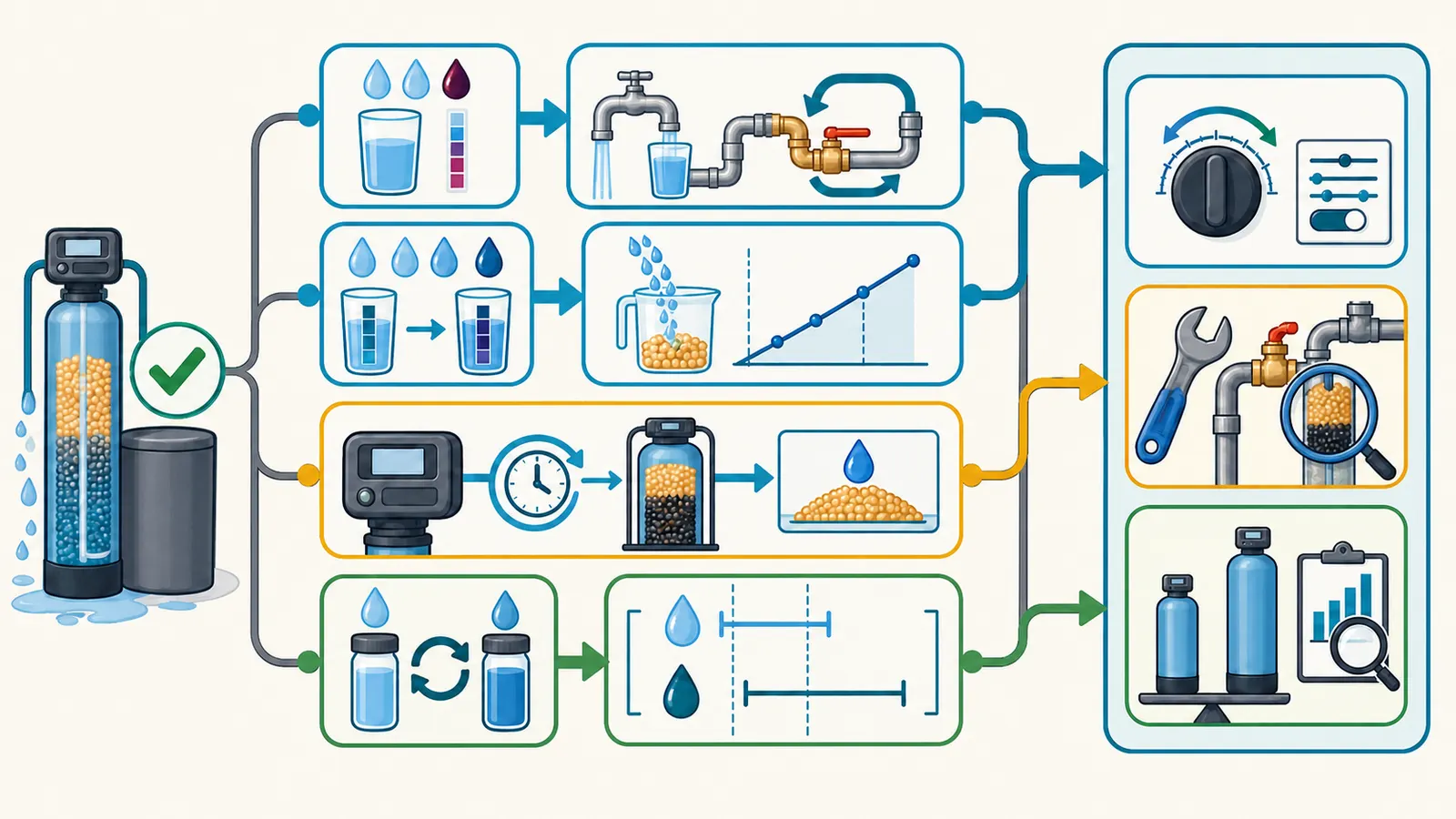
That makes the decision order practical:
- Confirm the measurement. Same source, same kit, same units, complete regeneration, valid meter interval.
- Confirm the setting. Exact raw hardness, salt dose, reserve, calendar override, and bypass state.
- Check water chemistry. Iron, manganese, sediment, chlorine, or other source changes may matter; do not assume the softener is designed to remove every contaminant.
- Repeat the cycle if the result is consequential. One field run can be distorted by a test error or abnormal household demand.
- Escalate with evidence. Ask for a model-specific capacity interpretation or service diagnosis using the log, not a visual opinion alone.

7. Know the limits and prepare the professional handoff
This test can answer: “How many hardness grains did this installed system remove over this logged interval at this documented setting and endpoint?” It cannot answer, by itself:
- whether the unit is certified under NSF/ANSI 44;
- whether the resin bed has a particular remaining service life;
- whether a control valve, injector, brine line, flow meter, riser, or seal is internally damaged;
- whether the water is safe to drink or free of contaminants other than measured hardness;
- whether a larger softener will be more economical; or
- whether local plumbing, wastewater, septic, or water-quality requirements permit a change.
EPA notes that cation-exchange softeners discharge salt to wastewater, that some jurisdictions restrict them, and that septic-system compatibility should be checked with the system manufacturer or a local service provider. This page does not turn those national cautions into a local code rule.
For a service call or replacement decision, bring:
- a photograph of the model and data plate;
- the exact manual or performance data sheet;
- the raw and treated hardness reports, including units and kit type;
- meter start and endpoint readings with dates and times;
- salt level or pounds per regeneration, with the source of that number;
- hardness, reserve, calendar, and bypass settings;
- notes about well pressure, unusual flow, outdoor branches, blend valves, iron, manganese, sediment, or chlorine; and
- the result label: “through first observed crossing,” “through confirmed breakthrough,” or “to programmed regeneration.”
Moderate-safety boundary: keep this as an observation and logging task. Do not open an energized control, test live wiring, remove a valve cover, pull a pump, open a well, enter a confined space, disconnect pressurized tubing, or manipulate a pressurized component to create a sample point. Do not force a regeneration cycle or change an installer setting unless the exact homeowner manual clearly permits that action and you can perform it without opening or servicing the equipment. Assign electrical, pressure, internal valve, resin-bed, well, and plumbing work to a qualified professional.
The best result is often not a single number. It is a number with a trail: raw hardness, treated hardness, salt dose, meter gallons, endpoint, conditions, and a clear statement of what the field estimate does not prove. That trail lets you distinguish an incorrect setting or regeneration problem from a system that is genuinely delivering less than the household needs before you pay for resin replacement or a new softener.
Sources and scope
Evidence behind this page
- NSF/ANSI 44 Technical Requirements
NSF's summary of the residential cation-exchange standard; it describes certification scope, not a homeowner field-test protocol or a universal pass/fail endpoint.
- Pentair Water Treatment Glossary
Pentair glossary terminology; it supports the distinction between a defined capacity number and a homeowner's installed-unit field estimate.
- Pentair Water Treatment Glossary
Pentair glossary definitions; they are used here as terminology, not as a claim that every softener should break through at the same hardness value.
- Pentair Whole House Water Softening System Installation and Service Manual
Pentair 1.0, 1.5, and 2.0 cubic-foot system family; the exact table values and operating limits must not be generalized to another model.
- Pentair Whole House Water Softening System Installation and Service Manual
Manufacturer instructions for the cited Pentair system; a different controller may expose different settings or test intervals.
- Technical Bulletin 4-019: How to Calculate Softener Capacity
Chem-Aqua technical bulletin for ion-exchange softeners; its example resin capacities and safety factor are not a universal rating for an installed residential unit.
- How to Test for Hard or Soft Water
Rheem homeowner guidance updated February 19, 2026; strip timing is kit-specific and the article does not define a capacity endpoint.
- Soften Water Without Wasting It: Guide to Selecting and Maintaining a Water-Efficient Water Softener
U.S. EPA national consumer guidance published in 2026; it supports sizing and control logic context, not a model-specific capacity value.
- Soften Water Without Wasting It: Guide to Selecting and Maintaining a Water-Efficient Water Softener
EPA national guide; local rules and septic-system constraints are jurisdiction- and system-specific and are not inferred here.
- Residential softening
University of Minnesota residential softening overview; its treatment and maintenance guidance is contextual and does not diagnose an unidentified unit.
- Pentair Whole House Water Softening System Installation and Service Manual
Pentair troubleshooting for the cited valve/system family; it supports diagnostic branches, not a remote diagnosis or permission to service pressurized or energized components.