Is Your Water Softener Metered or Timer-Based? A Homeowner Evidence Path
Identify an inherited water softener's trigger from its model, control head, meter evidence, manual, and operating record before changing settings or replacing it.
The short answer
Find the model and control-head markings first. Call a unit demand-initiated (metered) only when the exact model manual identifies a meter or flow input and the installed configuration matches it; a gallons/capacity field is supporting evidence, not proof. A clock display or 2 a.m. setting alone proves neither. Then log hardness, capacity, salt dose, regeneration dates, and household use before comparing repair, reprogramming, or replacement.Is Your Water Softener Metered or Timer-Based? A Homeowner Evidence Path
Short answer: identify the brand, model, and control-head marking first, then use that exact manual to confirm whether regeneration is time-clock initiated or demand-initiated (metered). A day wheel or 2 a.m. setting is not enough: a metered unit may use a clock only to choose when a meter-triggered regeneration will run. Look for documented flow-meter or gallons-remaining evidence, record the programmed hardness, capacity, salt dose, and regeneration dates, and treat the result as an operating baseline—not a guaranteed savings percentage.
Start with the model, not the clock display
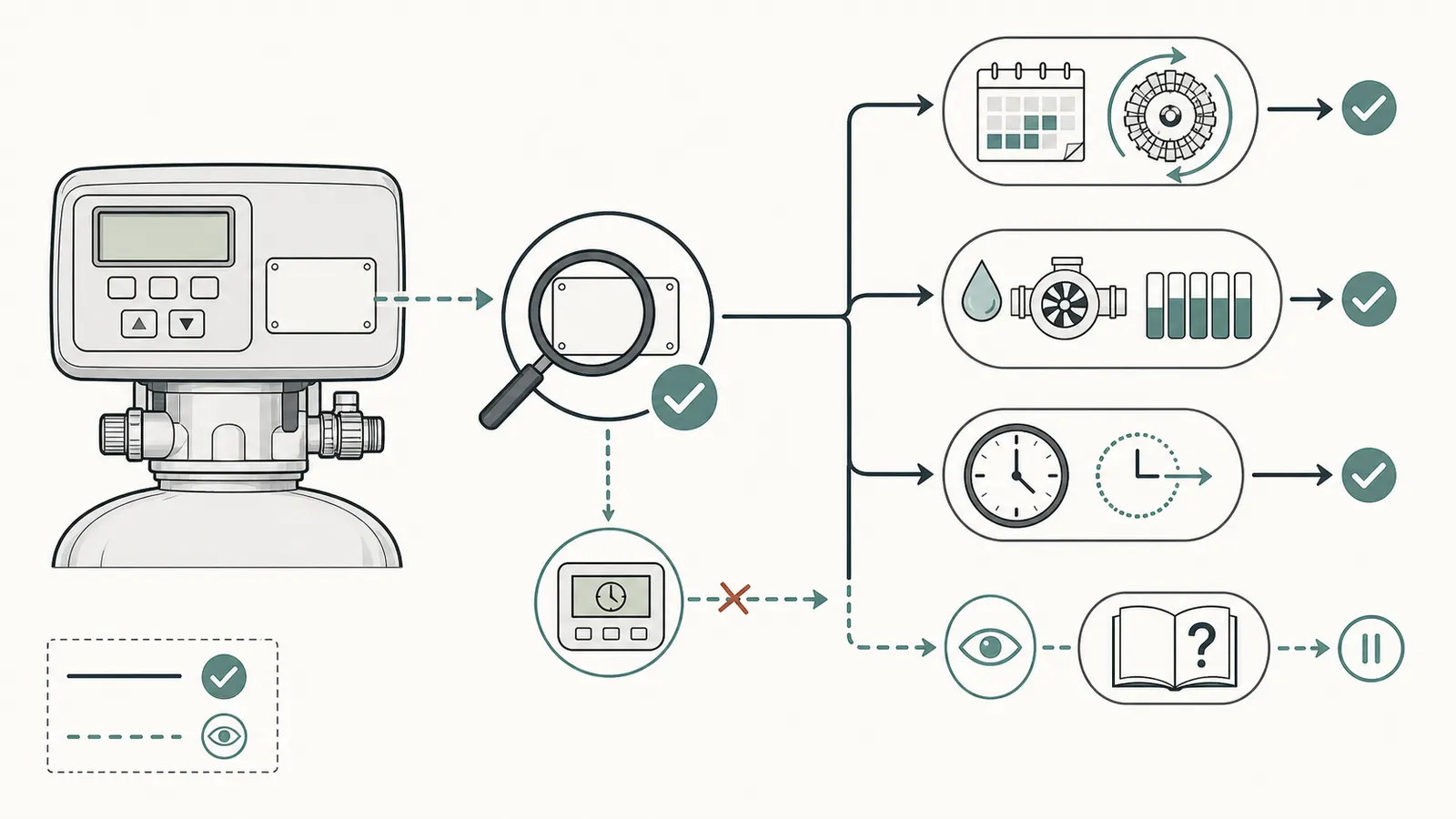
An inherited softener is easiest to misidentify when you begin with the time shown on its face. Start with the evidence that can be matched to a manufacturer document.
With the system in its normal service state, record what you can read without removing covers or touching controls:
- brand name on the cabinet, tank label, or control head;
- complete model number, serial number, and any control-family marking;
- the visible controller type: electromechanical dial, electronic display, or another layout;
- labels for hardness, capacity, salt dose, gallons, meter, days, or regeneration;
- any accessible meter or cable between the control head and the water line;
- the brine tank, resin tank, bypass position, drain line, and power connection as visible installation context.
Take clear photographs of labels and the front of the control head, but do not photograph exposed wiring by opening a cover. If the model plate is unreadable, record partial characters exactly as seen rather than filling in a likely model from memory. A partial model plus the control-head marking is more useful than a guessed model with a confident conclusion.
The model-first approach matters because a water softener is not identified by its tank shape alone. A single tank can be paired with different control valves, and similar-looking controllers can be sold in both clock and meter configurations. The NSF/ANSI 44 technical overview describes the certification scope for residential cation-exchange softeners, but certification scope does not tell you how an inherited control is programmed. The NSF residential-softener listing is useful only after you have the exact model or product family; a listing is not proof of the settings or condition of the unit in your basement.
Use this first-pass record before opening a manual:
| Field | What to write down | What it can establish |
|---|---|---|
| Brand and model | Exact visible text, including suffixes | Which manual and parts family to search |
| Control-head marking | Front label, series, or valve name | Which control configuration may be installed |
| Visible trigger clues | Day tabs, meter cable, gallons field, capacity wheel | A hypothesis to confirm, not a final answer |
| Clock or regeneration time | Displayed time and any scheduled start | A schedule clue only |
| Manual found | URL, revision/date, and matching model | Stronger evidence of the controller type |
| Confidence | Confirmed / likely / unresolved | Whether a service call should verify the identification |
Do not infer “metered” from the word “efficient,” from a seller’s claim, from a digital screen, or from the fact that the unit regenerates at night. The trigger is the event that tells the control to regenerate. The clock may be only the timekeeper for that event.
Use the control head to classify the trigger
The useful distinction is between a time-clock trigger and a demand-initiated trigger. The University of Minnesota’s residential-softening comparison describes older time-clock systems as regenerating on a preset time and day, while demand-initiated regeneration is based on the measured amount of water used. Those definitions describe the categories; they do not identify every manufacturer’s faceplate.
Evidence that points toward a time-clock control
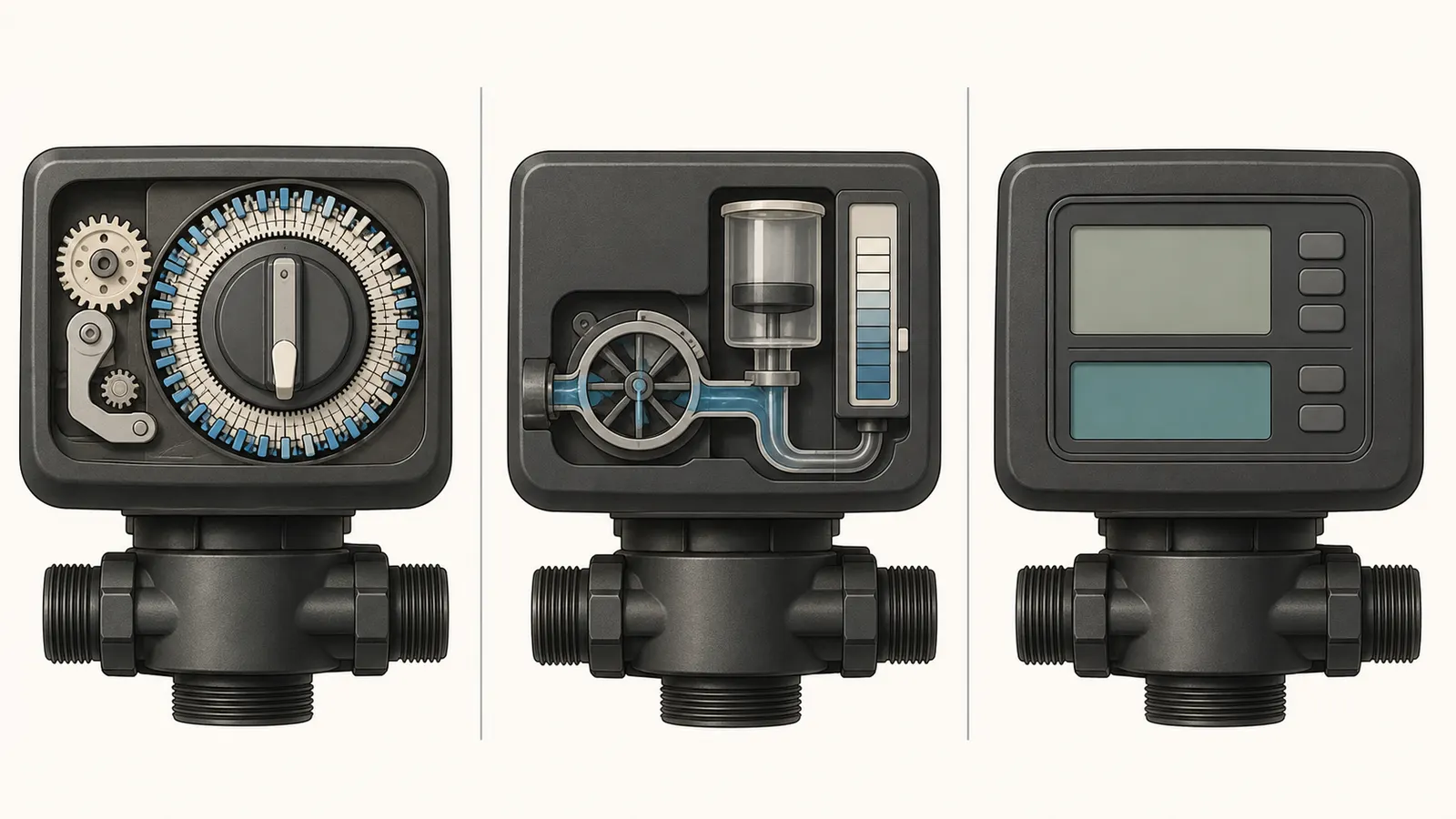
A compatible electromechanical controller may show a skipper wheel, day tabs, or a calendar-like schedule. In the Fleck 5600 service manual, the time-clock setup uses a skipper wheel whose tabs represent days and whose fingers create the regeneration schedule. If your exact controller has the same model and the manual describes that arrangement as the time-clock configuration, the evidence is strong.
For a time-clock unit, a regeneration date can often be predicted from the programmed days even if the household used very little water. That observation supports a calendar trigger, but do not test it by forcing a regeneration or changing the schedule simply to see what happens. Record the setting and let the manual or a qualified service person interpret the control.
Evidence that points toward a metered or demand-initiated control
A mechanical paddle or turbine meter, meter cable, electronic flow input, or a display that reports gallons remaining can support a metered hypothesis. The Fleck manual’s job specification sheet separates “Time Clock” from “Meter Initiated,” lists several meter types, and separately records immediate or delayed regeneration. Its metered operating section describes a program wheel that uses time and hardness information, monitors system needs, and displays a gallons-remaining concept on the compatible control.
That is useful evidence, not a universal visual rule. A controller may have a cable or a meter housing that is not connected, a display that shows capacity without measuring actual flow, or a meter that is inaccurate. The control-head label and exact manual still control the conclusion.
Evidence that remains unresolved
Treat the classification as unresolved when:
- the model number is incomplete or the manual describes multiple control options;
- the face shows a clock but no clearly identified trigger field;
- the manual is for a similar-looking valve rather than the installed model;
- a meter is visible but the manual does not say whether the installed configuration uses it;
- the gallons or capacity display is frozen, blank, or inconsistent with household use;
- the unit regenerates at a regular time but you cannot establish whether water use set the event.
“Unresolved” is a useful answer. It tells you what evidence is missing and prevents a replacement or reprogramming decision from resting on a visual guess.
Confirm the classification in the exact manual
Search by the full model and control-head marking, then compare the manual’s diagrams and setup fields with your photographs. Prefer the manufacturer’s current owner or service manual, and save the PDF or URL with the date you checked it. If the model has several revisions, use the one whose part numbers, faceplate, meter option, and electrical configuration match the installed unit.
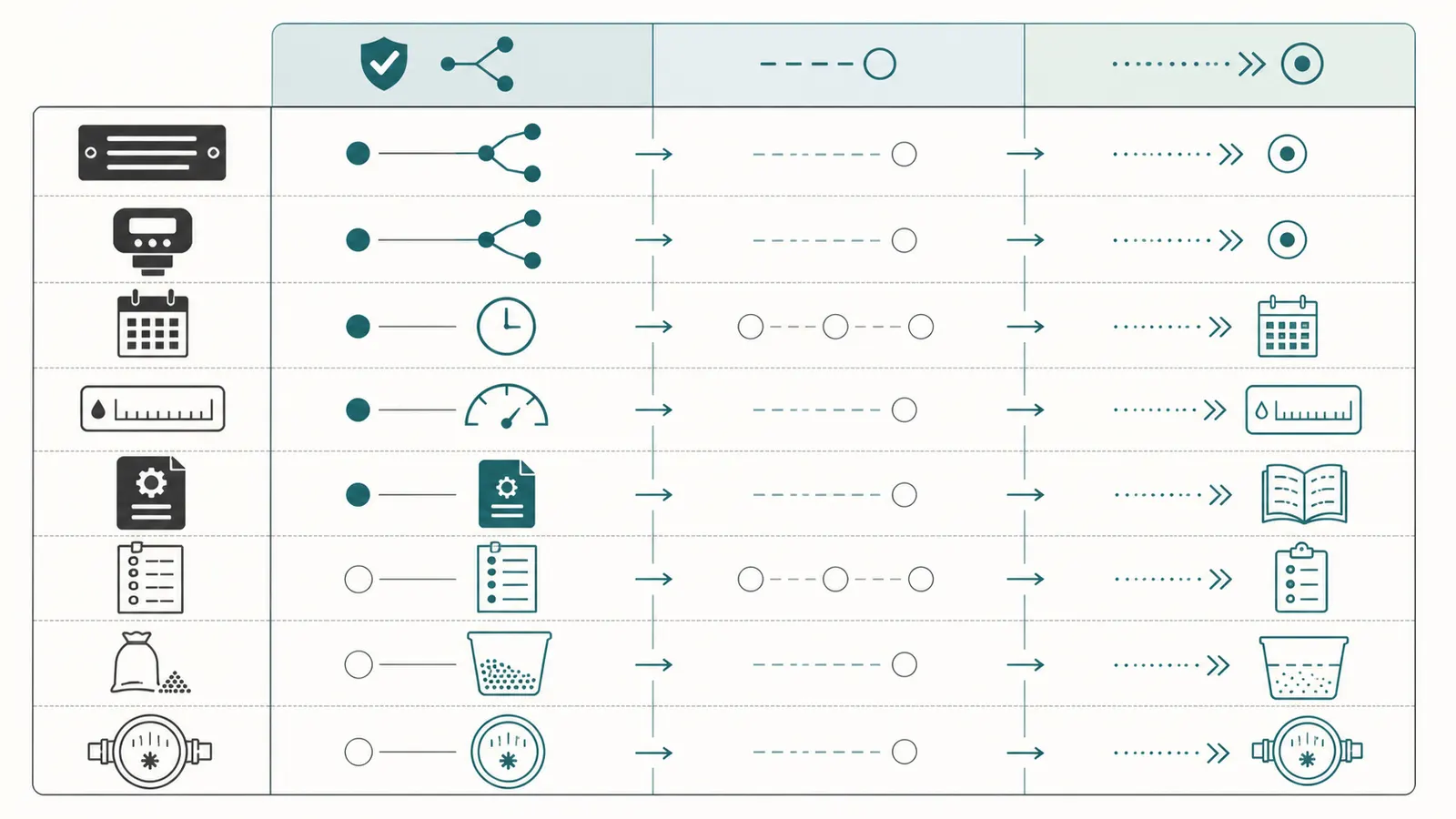
For a practical manual cross-check, look for these phrases or equivalent fields:
| Manual evidence | What it answers | What it does not answer |
|---|---|---|
| Time clock / meter initiated | Which trigger configurations the family supports | Which one is installed unless the model configuration matches |
| Meter size or meter type | How flow is sensed in that configuration | Whether the meter is working now |
| Program wheel, capacity, or gallons remaining | How the control represents available capacity | Whether the programmed value is correct for this home |
| Immediate or delayed regeneration | What happens after the trigger | Whether the trigger was calendar or water use |
| Hardness, capacity, and salt setting | The inputs used for programming | Whether the homeowner’s water test or settings are accurate |
| Troubleshooting: meter output or wheel movement | Possible evidence of flow-sensing failure | Permission for a homeowner to open or repair the control |
The Fleck manual’s specification sheet is a good example of the record you want: it keeps model number, hardness, capacity, salt setting, timer type, meter size, and regeneration mode in separate fields. Do not generalize its exact wheel, reserve, or meter behavior to another brand. Use it as a model-first method.
If the manual says the family supports both clock and meter versions, find the configuration code, parts list, or manual section that distinguishes them. A control head with a 24-hour gear may still be the metered version; a clock gear can maintain the time at which a regeneration occurs without deciding whether regeneration is needed. Ask the manufacturer or a qualified water-treatment professional to identify the configuration when the manual’s drawings do not match the installed hardware.
Separate the trigger from the regeneration schedule
This is the most common source of a wrong answer. A timer can schedule the event while another input triggers it.
For example, Whirlpool’s FAQ says its softeners use demand-initiated regeneration, while also saying they are pre-programmed to regenerate at 2:00 a.m. and can be reprogrammed to another time. The clock time therefore does not prove a time-clock softener. It shows when a triggered regeneration is allowed to run.
Use three separate questions:
- What starts regeneration? A calendar/day schedule, measured water use, a capacity calculation, or an unresolved condition?
- When does regeneration run? Immediately after the trigger, at the next permitted time, or after a delay?
- What settings affect the trigger? Hardness, capacity, household use, reserve, salt dose, and any meter or sensor input documented by the exact manual.
An electronic display that shows the time and a regeneration time answers only the second question. A “recharge tonight” message may reflect a calculated demand event that is being delayed until the programmed hour. A manual regeneration button proves that the valve can be commanded manually; it does not prove the automatic trigger.
When observing the unit, do not create unusual water use or manually start a cycle just to force a conclusion. Instead, note the normal regeneration date and time, the displayed gallons or capacity before the event when available, and what the manual says that field means. If the unit has no user-visible gallons field, record that absence as “not shown,” not as “timer-based.”

Build an operating record before judging efficiency
Once the model-first classification is confirmed, create a record that separates manufacturer specifications from what the installed unit actually does. This is the step that turns an unknown appliance into a defensible operating-cost baseline.
Record these fields for each observation:
| Category | Record | Source of the value |
|---|---|---|
| Identity | Brand, model, serial, control-head marking | Accessible label or photograph |
| Trigger | Time clock / meter initiated / unresolved | Exact manual and matching configuration |
| Regeneration behavior | Immediate or delayed; date and start time | Manual plus homeowner observation |
| Water inputs | Hardness value, unit, test date, iron if documented | Water report or test record; do not guess |
| Program | Capacity, reserve, hardness setting, salt dose | Display, setting sheet, or manual record |
| Meter evidence | Meter type, gallons remaining, gallons used, or not shown | Display/manual/qualified service record |
| Household load | Occupants, unusual guests, leaks, irrigation or bypassed uses | Homeowner log and plumbing context |
| Costs | Salt price per pound; water and sewer rate | Current local bills or published rates |
For a simple monthly estimate, keep the units explicit:
monthly salt cost = pounds of salt per regeneration × regenerations per month × local salt price per pound
monthly regeneration-water cost = gallons used per regeneration × regenerations per month × local water-and-sewer rate per gallon
If the utility bills by hundreds or thousands of gallons, convert the tariff before multiplying. If sewer charges do not apply to the regeneration discharge, use the applicable water-only rate and note the assumption. If the unit’s regeneration volume is unknown, leave the field blank; do not substitute a generic number from another model.
Use a log such as this for a controlled baseline:
| Date | Time | Displayed gallons/capacity | Regeneration occurred? | Salt added or dose | Household note |
|---|---|---|---|---|---|
| ______ | ______ | ______ | yes / no | ______ lb | ______ |
| ______ | ______ | ______ | yes / no | ______ lb | ______ |
| ______ | ______ | ______ | yes / no | ______ lb | ______ |
| ______ | ______ | ______ | yes / no | ______ lb | ______ |
The EPA WaterSense treatment guide recommends considering demand initiation, water consumption per 1,000 grains removed, and salt efficiency when minimizing resource use. It also warns that systems should be matched to water use and not oversized. Those are selection and programming principles, not a promise that every metered installation will reduce a particular household bill.
The University of Minnesota comparison reports broad comparison ranges of 26–60% less salt and 25–40% less water for demand-initiated systems than time-clock systems, while noting that performance varies by manufacturer, unit, and application. Treat those figures as context for why the trigger matters, not as your unit’s expected savings. A wrong hardness setting, oversized capacity, excessive reserve, leaking plumbing, incorrect salt dose, or inaccurate meter can erase the expected benefit.
Interpret hard water, frequent cycles, and missing meter evidence
The trigger identification and the performance diagnosis are related but not identical. A unit can be genuinely metered and still deliver hard water or regenerate too often. Use the symptom pattern to choose the next evidence, not to declare a failed part remotely.
| Observation | What it may support | What not to infer | Next safe step |
|---|---|---|---|
| Regeneration follows programmed days with little water use | A time-clock hypothesis, if the manual matches | That every clock-faced unit is timer-based | Verify the exact configuration in the manual |
| Gallons/capacity changes when household water is used | A metered hypothesis | That the meter is calibrated or connected correctly | Photograph the display and ask for model-specific verification |
| Unit regenerates at 2 a.m. | A delayed schedule | That the trigger is a clock | Check the manual’s trigger and delay descriptions |
| Hardness appears after a cycle or before expected regeneration | Reserve, capacity, hardness setting, bypass, or meter issue may be involved | That replacement is required | Test or document water quality and provide the log to a professional |
| Regeneration is much more frequent than expected | High use, wrong settings, a leak, or control issue may be involved | That demand initiation is saving resources | Check household-use notes, salt dose, and accessible plumbing for leaks |
| No gallons field is visible | The interface may not expose meter data | That the unit is timer-based | Use the manual and control configuration, not the display absence |
| Drain flow continues outside a normal cycle | A valve or control problem may be present | That the meter alone caused it | Stop experimenting and arrange qualified service |
The Fleck manual illustrates this branching: its troubleshooting section associates hard water with exceeded reserve capacity, a program wheel not rotating with meter output, or a meter that is not measuring flow. It separately lists timer, valve, and continuous-drain problems. That model-specific troubleshooting logic shows why one symptom should not be turned into one diagnosis.
If you have a private well or a water-quality concern, keep the trigger question separate from drinking-water safety. EPA says well homes should periodically use a state-certified laboratory, and a softener’s hardness operation does not establish that other contaminants are absent. If taste, odor, color, or a laboratory result has changed, use the appropriate water-testing or public-health guidance rather than treating a control-head classification as a water-safety answer.
Choose reprogram, repair, or replacement investigation
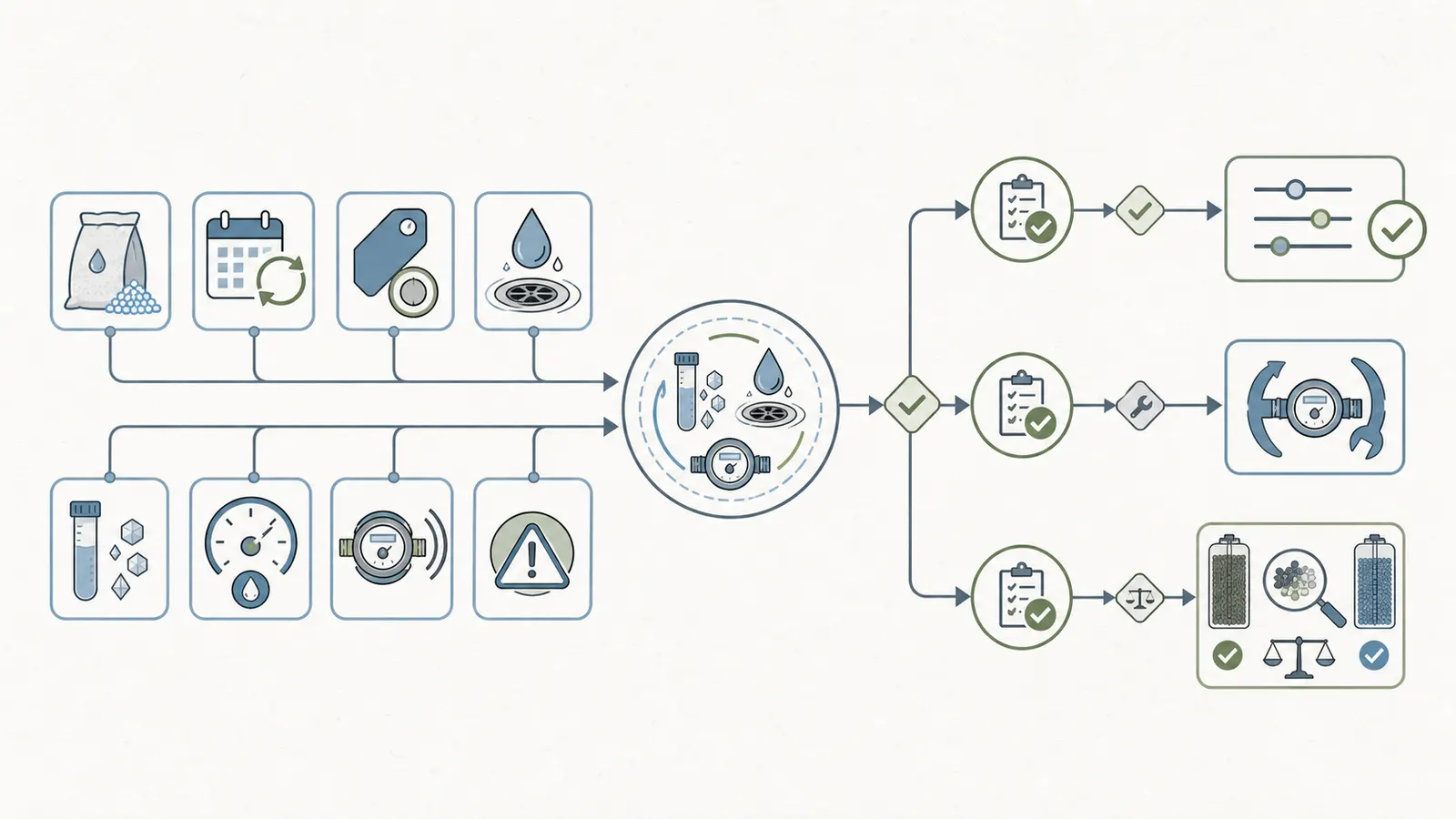
After the manual check and operating log, make the smallest decision supported by the evidence.
Reprogramming is worth investigating when settings are the problem
Reprogramming may be appropriate when the exact manual is known, the meter/control configuration is verified, and the recorded hardness, capacity, salt dose, household use, or regeneration time does not match the installation. Obtain the correct water-hardness value and use the manual’s units. Do not copy a hardness number from a neighbor, a generic internet table, or an old estimate. If iron or another load affects the model’s capacity calculation, use it only when the water test and manual say it belongs in the setting.
The goal is not to make the unit regenerate as rarely as possible. A capacity setting that is too aggressive can allow hardness breakthrough; a reserve setting that is too large can cause unnecessary regeneration. Record the old setting before any qualified person changes it, then record the new setting and the date so the next operating period can be compared.
Repair is worth investigating when the evidence points to the control or meter
Arrange qualified service when the manual’s symptoms match a meter that is not registering flow, a program wheel that does not respond to meter output, unexplained continuous drain flow, a stuck cycle, a leak, or a control that loses settings. Provide the model, photographs, manual revision, observed display behavior, regeneration log, water-hardness result, and salt history. Ask the professional to state whether the trigger is verified, whether the meter is connected and functioning, and what setting or part is implicated before authorizing replacement.
Replacement is an investigation, not the conclusion
Do not replace a unit solely because it regenerates at night, has a mechanical clock, or is older. Compare the documented condition, parts availability, resin or media condition if professionally assessed, water and salt use, local discharge constraints, and the cost of correcting the existing installation. The EPA guide notes that local jurisdictions may restrict salt-discharge softeners, and that certification and performance data should be checked for the selected model. Before installing, replacing, or changing a salt-discharge unit for continued use, check the applicable city, county, state, or water-authority code; if you cannot verify the requirement, stop and route the question to a qualified local water-treatment or plumbing professional. The NSF listing can support model-level certification research, but it does not prove the installed unit’s current programming or field efficiency.
Keep this safety boundary: a homeowner may read labels, photograph accessible controls, record a display, observe a normal drain event from a safe location, check salt as the manual permits, and organize records. Do not open energized control covers, test live wiring, loosen pressurized fittings, manipulate a bypass or valve you do not understand, open a well, pull a pump, or enter a tank, pit, or other confined space. Assign electrical, pressurized-water, plumbing alterations, control-head disassembly, and uncertain service to a qualified professional.
The final answer should fit in one sentence and one evidence table: “This unit is [confirmed/likely/unresolved] [time-clock/meter initiated] because [model/manual evidence], with [schedule or meter evidence] observed in the home.” Keep the operating baseline beside it. That record is more useful than the generic claim that metered is better because it shows what is verified, what is measured, what remains uncertain, and whether the next dollar belongs to a setting correction, a control or meter repair, or a carefully scoped replacement comparison.
Sources and scope
Evidence behind this page
- EPA WaterSense — Guide to Selecting Water Treatment Systems
EPA consumer guidance published November 2024; it supports feature-level interpretation and selection, not a guaranteed saving for an installed unit.
- EPA WaterSense — Guide to Selecting Water Treatment Systems
The cited efficiency threshold is a voluntary NSF/ANSI 44 rating reference; it is not a field measurement or a national operating requirement.
- NSF — NSF/ANSI 44 Technical Requirements
NSF's March 8, 2025 standard overview; it defines certification scope and does not identify the trigger or prove how an installed controller is programmed.
- NSF International — Residential Water Softeners, Standard 044 Listings
NSF's listing and footnotes apply to listed models and their certified claims; a listing is not proof that an inherited unit has the same settings, condition, or current performance.
- University of Minnesota Water Resources Center — Residential Softening
University of Minnesota comparison guidance; it describes common system categories and notes that features vary by manufacturer, unit, and application.
- University of Minnesota Water Resources Center — Residential Softening
The ranges are the university page's comparison figures, not a promise for a particular home; programming, hardness, capacity, usage, leaks, and hardware condition must be checked in the field.
- University of Minnesota Water Resources Center — Residential Softening
General residential comparison guidance; the exact maintenance schedule belongs to the installed manufacturer's manual.
- Pentair Fleck 5600 Service Manual
This is a model-specific manufacturer manual; its fields show how to document one control family and must not be generalized to every brand or controller.
- Pentair Fleck 5600 Service Manual
The operating description and 75-gallons-per-person reserve example apply to the cited Fleck 5600 metered configuration, not to an unknown installed softener.
- Pentair Fleck 5600 Service Manual
Manufacturer troubleshooting for Fleck 5600 controls; homeowner observations can justify escalation but do not authorize opening the control or replacing parts.
- Whirlpool Water Solutions — Hard Water & Water Softening System FAQs
This is a Whirlpool product-family statement and an illustration of the distinction between trigger and scheduled regeneration time; it is not a claim about every Whirlpool model or other brands.
- Whirlpool Water Solutions — Hard Water & Water Softening System FAQs
Manufacturer FAQ explanation; the exact capacity and programming rules belong to the model manual and certified performance data.