Salt-Free Water Conditioner vs. Water Softener: Choose by Outcome
Compare hardness removal with scale reduction, then match your water test, household result, salt and drain constraints, and certification claim.
The short answer
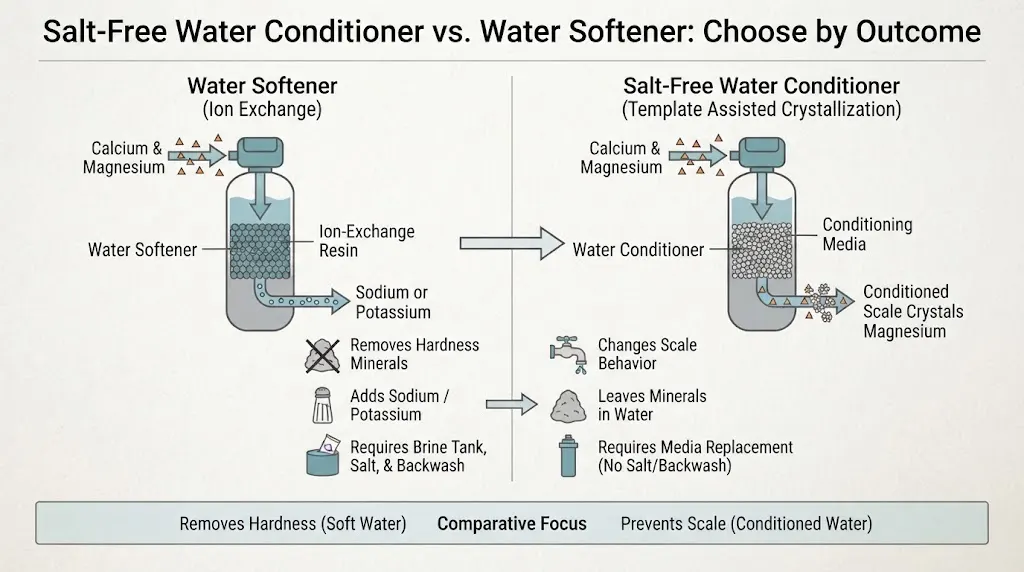
A salt-based ion-exchange softener removes calcium and magnesium, so it is the choice for measurable hardness reduction, soap performance, and soft-water results. A salt-free conditioner generally leaves hardness in the water and aims to reduce scale formation, with less salt handling and regeneration waste. Test your water first, define the result you need, then verify the exact model’s NSF/ANSI 44 or IAPMO/ANSI Z601 claim before buying.Salt-Free Water Conditioner vs. Water Softener: Choose by Outcome
Short answer: buy an ion-exchange water softener when you need calcium and magnesium removed from the water. That is the path to measurable hardness reduction, more predictable soap behavior, and actual soft water. Consider a salt-free conditioner when your goal is narrower: reduce visible scale on plumbing or a water heater while leaving most hardness minerals in the water and avoiding a brine tank and regeneration discharge. The product name is not the decision. Your water test, desired household result, operating constraints, and exact certified claim are.
The decision in one table
The words “softener,” “conditioner,” and “salt-free softener” are used loosely in product listings. Start with the treatment action, not the label.
| Homeowner outcome or constraint | Ion-exchange water softener | Salt-free water conditioner | What to verify before purchase |
|---|---|---|---|
| Remove calcium and magnesium from the water | Yes, by exchanging them for sodium or potassium ions | Generally no; most salt-free technologies leave most hardness minerals in the water | A current hardness result before and after treatment, if removal is your requirement |
| Reduce the hardness number | Yes, when correctly sized, regenerated, and maintained | Do not assume it will; scale reduction is not the same claim as hardness reduction | The performance claim and test method, not “salt-free softener” wording |
| Improve soap lather, rinsing, and hard-water feel | Usually the stronger fit because hardness is reduced | Not the right default if soft-water feel or soap performance is the main objective | Your actual priority and a representative water test |
| Reduce scale on fixtures or a water heater | Yes, as a consequence of removing hardness | This is the intended outcome, but product performance varies with water quality and use | A scale-reduction claim and the exact model’s certification |
| Add sodium or potassium | Yes: the exchange replaces calcium and magnesium with sodium or potassium | Not from an ion-exchange brine process; do not infer that the device treats every other contaminant | The regenerant, treated-water plan, and any health or dietary advice you have received |
| Salt handling | Requires a brine tank and salt or potassium chloride pellets | Usually no salt tank; some designs may use electricity or other media | The installation manual and maintenance schedule |
| Regeneration water and drain discharge | Yes; regeneration sends wastewater to a drain | Typically designed to avoid regeneration water waste, but verify the manual | Drain route, local requirements, and actual product instructions |
| Septic or local salt-discharge concern | Requires a property-specific compatibility and restriction check | May avoid the salt-discharge issue, but does not automatically solve other water problems | Local authority, septic manufacturer or service provider, and product documentation |
| Treat unrelated contaminants | No, not unless a separate, specific claim says so | No, not unless a separate, specific claim says so | NSF says certification is claim-specific, not a promise to reduce all contaminants |
EPA describes cation exchange as the process that removes the hardness minerals and replaces them with sodium or potassium. The University of Nebraska–Lincoln likewise cautions that most non-chemical alternatives do not remove most hardness minerals. That is the line between “soft water” and “scale control,” even when a sales page uses both phrases. (EPA WaterSense softener guide; UNL Water’s explanation of salt-free alternatives)
First prove what your water is doing
Hard water is primarily a calcium-and-magnesium condition. EPA reports hardness in milligrams per liter, parts per million, or grains per gallon. Its consumer guide says water above 120 mg/L, or 7 gpg, is generally considered hard and that softeners are often recommended above 180 mg/L, or 10 gpg. Those are useful screening points, not a command to install equipment. (EPA WaterSense softener guide)
Record the result, not just the symptom
Before comparing equipment, assemble one small water file:
- Write down the source: municipal supply or private well; if municipal, save the current utility water-quality report.
- Record the hardness value, unit, test date, and whether it is reported as calcium carbonate. Do not compare “ppm,” “mg/L,” and “gpg” as if the numbers were interchangeable.
- If the water is from a well, ask the laboratory or water professional which sample point and test panel are appropriate. Hardness is not a substitute for a drinking-water safety panel.
- Record any iron or manganese result, because a salt-free scale device is not a general treatment for those minerals. UNL specifically identifies ion exchange when actual hardness removal or low concentrations of iron and manganese are desired. (UNL Water’s explanation of salt-free alternatives)
- Note the household result you actually want: fewer spots, less scale, easier soap rinsing, less salt handling, a lower hardness number, or some combination.
White crust on a faucet, a chalky ring in a kettle, soap scum, and a slippery or sticky feel are clues. They are not a complete diagnosis. A scale deposit does not tell you that a device will remove hardness, and a clean-looking shower does not prove that the water is soft. Test the water and inspect the claim.
A simple load calculation for sizing conversations
If a softener is under consideration, calculate a rough hardness load before you let a salesperson pick a grain capacity:
daily hardness load = hardness in gpg × gallons per day sent through the softener
Illustration, not a product recommendation: a home with 10 gpg hardness and 240 gallons per day of treated use has a rough load of 2,400 grains per day. A nominal 32,000-grain unit would divide to about 13.3 days before regeneration under that simplified assumption. Real selection must account for the manufacturer’s usable capacity at a selected salt setting, reserve, actual use, iron or manganese, peak flow, and which lines will bypass treatment. EPA says capacity is measured in grains per cycle and that both hardness and household use determine size; it also warns that oversizing can waste water. (EPA WaterSense softener guide)
The calculation is valuable because it exposes missing inputs. If a quote contains only “32,000 grains” but no hardness basis, salt setting, water-use assumption, flow rating, or regeneration volume, you do not yet have a comparable offer.
Choose a softener when you need removed hardness
An ion-exchange softener has a clear job. Hard water enters a resin tank. Calcium and magnesium bind to the resin, while sodium or potassium ions are released into the treated water. EPA describes the result as softened water because the calcium and magnesium have been removed. NSF describes NSF/ANSI 44 as the certification standard for residential cation-exchange softeners regenerated with sodium or potassium chloride. (EPA WaterSense softener guide; NSF/ANSI 44 technical requirements)
This is the better fit when the household’s success test is one of these:
- the hardness number must materially decrease;
- soap needs to lather and rinse more predictably;
- laundry, dishes, and bathing are being affected by hard-water residue;
- scale reduction is needed throughout the home and you accept salt, water, and maintenance duties;
- a professional has identified hardness removal as the treatment objective.
The trade is not hidden in the chemistry. The resin eventually fills with hardness ions and must regenerate. Regeneration rinses the resin and restores its sodium or potassium supply. EPA reports a typical water use of 20 to 70 gallons per regeneration cycle, with some larger systems using up to 200 gallons. The actual frequency depends on incoming hardness, household water use, capacity, and regeneration design. (EPA WaterSense softener guide)
That means “salt-based” is not automatically wasteful and “salt-free” is not automatically better. A correctly sized, demand-initiated softener can avoid unnecessary regeneration. A poorly configured or oversized unit can regenerate too often, waste salt and water, and leave the owner with a misleadingly large capacity number.
What a softener does not promise
Softening is not disinfection, filtration for every contaminant, or a cure for a bad well. NSF says the standard numbers are not rankings and that certification does not mean a system reduces all possible contaminants. Verify each contaminant claim separately; a hardness claim is not an arsenic, nitrate, bacteria, sediment, taste, or odor claim. (NSF standards for water treatment systems)
If your water file contains several concerns, treat them as separate decisions. A whole-house softener may sit beside a sediment filter, iron treatment, carbon filter, ultraviolet system, or point-of-use treatment, but those are not interchangeable modules. The correct combination depends on the test results and the manufacturer’s compatibility instructions.
Choose a salt-free conditioner when scale reduction is enough
A salt-free conditioner is a reasonable candidate when your desired outcome is narrower than soft water: less visible scale on a water heater, fixtures, or shower surfaces, with no brine tank and no routine salt loading. EPA describes salt-free conditioners as conditioning hardness ions through electricity or another method to reduce scale buildup without added chemicals or water waste, and points homeowners to IAPMO/ANSI Z601 for scale-reduction devices. (EPA WaterSense softener guide)
The word “condition” matters. The University of Nebraska–Lincoln says these emerging technologies generally do not remove most hardness minerals. It discusses several categories, including template-assisted crystallization, electrically induced precipitation, electrochemical systems, and magnetic treatment. UNL also calls magnetic treatment controversial and unproven, and warns that variable water quality and use patterns make results difficult to predict across homes. (UNL Water’s explanation of salt-free alternatives)
Use a conditioner as the leading option when all of these are true:
- your main complaint is scale, not soap performance or the hardness number;
- you accept that calcium and magnesium will remain in the water;
- avoiding salt handling and regeneration discharge matters more than a soft-water result;
- the product makes a precise scale-reduction claim for the water conditions you have;
- the exact model—not merely the product category—can be checked against the relevant certification or test information.
Do not select a conditioner as a shortcut around a requirement for actual removal. If the brief says “reduce hardness,” “remove calcium,” “reduce iron,” or “make the water behave like softened water,” pause and ask whether a scale device can demonstrate that result. In general, it cannot be assumed from the word “conditioner.”
What a conditioner does not promise
It does not promise lower total hardness merely because scale is less visible. It does not make water safe to drink if a separate contaminant is present. It does not establish that every fixture, water heater, or household will see the same result. It may also leave the owner with hard-water soap behavior even if a heater has less scale. Those are not defects in a scale-reduction product; they are different treatment objectives.
Check the operating burden before you buy
The best choice is partly a maintenance decision. Put the recurring work beside the desired result.
| Operating question | Softener | Conditioner |
|---|---|---|
| What must be replenished? | Sodium or potassium chloride pellets in a brine tank | Media or other components according to the manual; no salt assumption |
| What must be discharged? | Regeneration wastewater to a suitable drain route | Usually no regeneration discharge; verify the exact design |
| What must be monitored? | Salt level, regeneration behavior, leaks, bypass position, and settings | Flow path, media life, power if applicable, leaks, and the product’s scale-performance conditions |
| What happens if neglected? | Hardness breakthrough, wasted water or salt, or continuous drain flow can occur | Scale control can be lost or the device can operate outside its tested conditions |
| What should be documented? | Capacity, salt setting, water use, regeneration interval, service, and test results | Media replacement, operating conditions, service, and scale observations |
For a softener, EPA recommends checking salt every 4 to 6 weeks, using pellets made for softeners, cleaning resin beads annually according to the owner’s manual, and cleaning the brine tank as needed at least every few years. EPA also says a continuous trickle or flow to the drain can indicate a broken valve or other malfunction. (EPA WaterSense softener guide)
Drain and wastewater constraints deserve a decision before purchase. EPA warns that salt discharge can affect local water quality or septic-system efficacy, says some jurisdictions prohibit these systems, and recommends checking local restrictions plus the septic manufacturer or service provider. That is property-specific guidance, not a national ban. Record the authority you checked, the date, and any condition attached to installation. (EPA WaterSense softener guide)
If outdoor water is being treated unnecessarily, EPA recommends placing the softener after the branch to exterior hose bibbs or irrigation where possible and using the bypass for lawn watering, car washing, or pool filling. This can reduce salt, water, and energy use, but the bypass must be returned to its normal position afterward. (EPA WaterSense softener guide)
Verify the claim, certification, and installation fit
Treat a product page as a lead sheet, not as the evidence. Ask for the owner’s manual, performance data, model identifier, certification listing, installation requirements, and warranty exclusions before you compare price.
For an ion-exchange softener
Check for NSF/ANSI 44 certification for the exact model or product family and identify the listed claim. NSF says the scope includes hardness reduction, material safety, structural integrity, pressure drop, capacity, rinse effectiveness, brine-system accuracy, and the accuracy of information supplied to end users. (NSF/ANSI 44 technical requirements)
Ask for:
- rated capacity at the proposed salt setting, not just the largest headline grain number;
- salt efficiency and water used per regeneration;
- demand-initiated regeneration details and meter location;
- minimum and peak flow information for the home;
- inlet-water limits, including hardness, iron, manganese, pH, and sediment if the manual specifies them;
- the required drain route, electrical supply, clearances, bypass, and service access;
- whether the drinking-water plan should account for added sodium or potassium.
EPA’s guide gives useful efficiency screens: 5 gallons of water or less per 1,000 grains removed and salt efficiency greater than 3,350 grains exchanged per pound of salt, with those values verifiable through the voluntary efficiency rating under NSF/ANSI 44. Use them to compare like with like; do not turn them into a promise of a particular monthly bill. (EPA WaterSense softener guide)
For a salt-free conditioner
Ask what “scale reduction” means in the documentation. Is the claim about a tank-type water heater, a tankless heater, a fixture surface, or a specific laboratory protocol? Ask whether the exact product meets requirements of IAPMO/ANSI Z601, as EPA recommends for scale-reduction devices. Do not treat a logo, a dealer’s phrase, or a generic “tested” statement as the same thing as a current certification listing. (EPA WaterSense softener guide)
Also ask what remains untreated. A conditioner that reduces scale does not necessarily lower hardness, iron, manganese, sodium, nitrate, bacteria, or sediment. If the manual does not state a claim, do not infer one. NSF’s guidance is the right discipline here: verify the applicable standard and the specific contaminant or performance claim. (NSF standards for water treatment systems)
Installation and safety boundary
Safe homeowner work is limited to reading the documentation, recording the water result, visually checking accessible connections for leaks, observing a drain for an unexplained continuous flow, and maintaining salt or media exactly as the manual allows. Before any service, follow the manufacturer’s shutoff and pressure-relief instructions.
Do not open energized control covers, test live wiring, open a well, pull a pump, enter a tank, pit, or other confined space, or loosen or manipulate pressurized equipment. Do not bypass a safety or backflow device because a product installation is inconvenient. Assign electrical changes, new drain or water-line work, pressure-system work, well work, and any uncertain service task to a qualified professional. The professional should confirm the actual plumbing layout, drain route, electrical requirements, water chemistry, and local requirements before installation.
Make the purchase decision from a one-page brief
Bring this completed brief to a water-treatment professional or use it to compare written proposals:
| Field | Your record |
|---|---|
| Water source | Municipal / private well |
| Hardness result and unit | __________________ |
| Test date and laboratory or report | __________________ |
| Iron, manganese, or other relevant results | __________________ |
| Main outcome | Lower hardness / soap performance / scale control / lower salt and water use |
| Water to be treated | Indoor only / whole house / water heater branch / other |
| Estimated indoor use | __________________ gallons per day |
| Outdoor or irrigation branch | Separate / shared / unknown |
| Septic system | Yes / no / unknown; confirmation source and date: __________ |
| Local restriction checked | Authority, answer, and date: __________________ |
| Candidate model and exact claim | __________________ |
| Certification or listing checked | Standard, model, claim, and date: ______________ |
| Proposed maintenance | Salt or media, service interval, cleaning, leak checks |
| Open questions | __________________ |
Use the outcome to select the branch:
- If you need the hardness number lower, start with an ion-exchange softener comparison.
- If you need easier soap behavior or a soft-water feel, do not let a scale-only claim substitute for hardness removal.
- If scale is the only problem and salt, brine discharge, or regeneration water is unacceptable, investigate a conditioner with a precise, independently supported scale-reduction claim.
- If the water test shows more than hardness, pause the comparison and build a treatment train around the actual contaminants.
- If the property uses a septic system or lies in an area with restrictions, obtain property-specific confirmation before buying an ion-exchange unit.
- If the product cannot supply a manual, exact model claim, certification evidence, or installation requirements, treat the missing information as a buying risk.
The cleanest decision is not “salt or salt-free.” It is “removal or scale reduction, and which operating burden fits the home?” Once that is written down, the marketing vocabulary becomes much less powerful—and the equipment choice becomes much easier to defend.
Sources and scope
Evidence behind this page
- Soften Water Without Wasting It: Guide to Selecting and Maintaining a Water-Efficient Water Softener
EPA WaterSense consumer guide; thresholds are guidance, not a universal purchase mandate or local code rule.
- Soften Water Without Wasting It: Guide to Selecting and Maintaining a Water-Efficient Water Softener
EPA description of residential cation-exchange softening; it does not establish performance for a particular model.
- Salt-Free Water "Softener" Alternatives
UNL Water educational guidance about categories of salt-free alternatives; individual products and technologies can differ.
- Soften Water Without Wasting It: Guide to Selecting and Maintaining a Water-Efficient Water Softener
EPA WaterSense guide; the statement describes the intended distinction and does not guarantee every product’s result.
- Soften Water Without Wasting It: Guide to Selecting and Maintaining a Water-Efficient Water Softener
EPA range for typical residential systems; not a quote for a particular installation.
- Soften Water Without Wasting It: Guide to Selecting and Maintaining a Water-Efficient Water Softener
EPA selection guidance for residential softeners; final sizing must use the manufacturer’s rated conditions and the home’s measured use.
- Soften Water Without Wasting It: Guide to Selecting and Maintaining a Water-Efficient Water Softener
EPA WaterSense guide; criteria are efficiency-screening values, not a guarantee of household operating cost.
- Soften Water Without Wasting It: Guide to Selecting and Maintaining a Water-Efficient Water Softener
EPA national consumer guidance; restrictions and septic compatibility must be confirmed for the actual property.
- NSF/ANSI 44 Technical Requirements
NSF description of the standard’s certification scope; verify the exact model and claim in the current listing.
- NSF Standards for Water Treatment Systems
NSF consumer explanation of certification limits; applies to treatment claims generally.
- Soften Water Without Wasting It: Guide to Selecting and Maintaining a Water-Efficient Water Softener
EPA consumer maintenance guidance; manufacturer instructions control for the installed model.
- Soften Water Without Wasting It: Guide to Selecting and Maintaining a Water-Efficient Water Softener
EPA installation and operation guidance; actual plumbing layout and local requirements require professional review.