Does a Water Softener Drain Need an Air Gap?
See whether your softener valve drain has a real air gap, which receptors can work, how overflow and filter drains differ, and what local code and the model manual require.
The short answer
Usually, yes: the softener's pressurized regeneration drain should discharge indirectly through a visible air gap into an approved receptor. Do not insert the hose into a sewer or drain throat, or submerge it in a tub or standpipe. The exact gap, receptor, drain material, and permit rules vary by model and jurisdiction; verify both before approving the route.Does a Water Softener Drain Need an Air Gap?
Usually, yes. The softener control valve's regeneration drain should discharge indirectly through a visible air gap into an approved receptor. Do not insert the hose into a sewer opening or floor-drain throat, or submerge it in a laundry tub or standpipe. The exact gap, receptor, drain material, permit, and backflow requirements vary by softener model and jurisdiction: Whirlpool illustrates a 1-1/2-inch gap for its manual, Illinois specifies at least twice the pipe diameter and not less than 2 inches for pressure-type treatment units, and San José publishes a 1-inch local requirement. Check the exact manual and local rule before approving the route.
This is the homeowner decision surface:
- Pass: the valve drain ends above the receptor's flood-level rim, the open-air separation is visible and meets the applicable rule, the hose is secured, and the receptor and drain material are approved for that installation.
- Revise: the hose is submerged, the gap is an unverified dimension, the receptor is only assumed to be acceptable, the valve drain is joined to the brine-tank overflow, or a companion filter drain is tied in without a model-specific plan.
- Escalate: the route requires new sanitary-sewer work, a permit, a concealed receptor, a long or elevated drain run, a backflow device, or any work on pressurized or energized equipment.
1. What an air gap actually means
An air gap is not simply “some space near a drain.” In the Illinois Plumbing Code definition, an air gap in a drainage system is an indirect arrangement in which a pipe discharges above the flood-level rim of the receiving fixture, receptacle, or interceptor, with unobstructed air between the outlet and the rim. The physical point is that the drain hose does not create a continuous water path from the wastewater system back toward the treatment equipment.
That is why a hose pushed into a floor drain, sewer cleanout, sink, bucket, or standpipe is not an air gap. Even if the hose is not touching the bottom, the opening can still be below the receptor's flood level. If wastewater rises, the hose end can become submerged. The configuration has changed from an open indirect discharge to a potentially connected path.
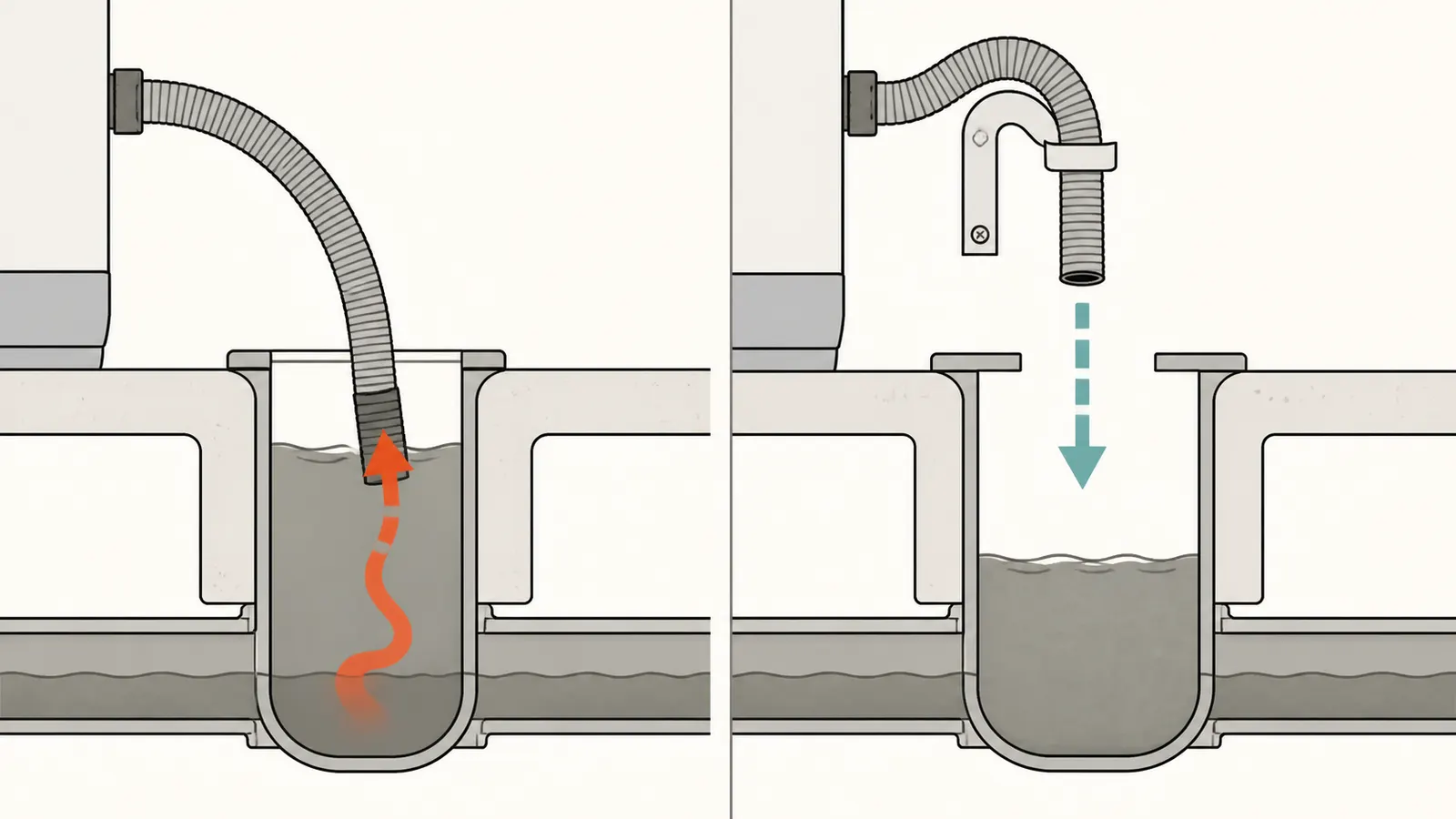
An air-gap device can be a listed fitting or receptor arrangement designed to preserve the open separation while making the hose easier to secure. It is not automatically acceptable just because it is sold as an air-gap product. The device, receiving drain, pipe size, and installation still need to satisfy the local code and the softener manual. Pentair's whole-house softener manual shows both a standard air-gap arrangement and purchasable air-gap devices, while Whirlpool illustrates hose discharge above a floor drain, laundry tub, and standpipe.
Do not resolve conflicting numbers by averaging them. A 1-inch municipal requirement, a 1-1/2-inch manufacturer instruction, and an Illinois 2-inch minimum are not three ways to calculate one national answer. They are rules or instructions with different scopes. The applicable jurisdiction and exact model determine which requirement governs; a professional can identify whether the route also needs a listed device, trapped and vented receptor, backflow assembly, or permit.
2. Identify which softener drain you are looking at
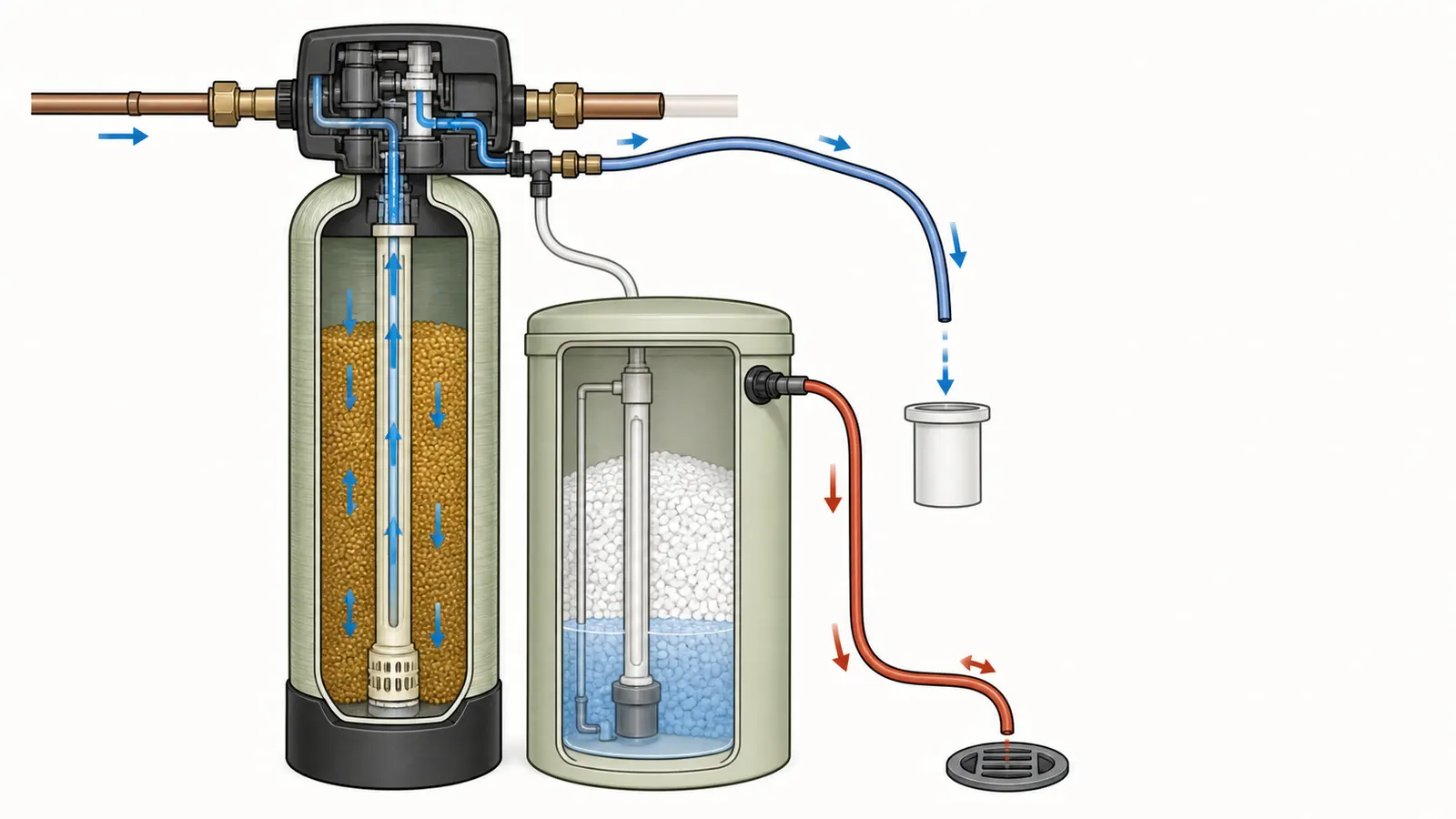
The most common installation-review mistake is treating every hose near the softener as “the drain.” A typical salt-based softener can have at least two distinct water paths, and a nearby backwashing filter can add a third.
| Hose or path | What it does | How it behaves | Review question |
|---|---|---|---|
| Control-valve drain | Carries backwash, brine discharge, and rinse water during a regeneration cycle | Pressurized or flow-controlled discharge; the route must handle the model's drain flow | Does it discharge above the receptor through the required air gap, and is the hose secured? |
| Brine-tank overflow | Provides a gravity escape if the salt-storage tank overfills | Gravity drain; the termination cannot be treated as the valve's regeneration drain | Is it separate from the valve drain, routed downhill as required, and terminated at an approved point? |
| Filter backwash drain | Carries discharge from a carbon, sediment, iron, or other backwashing filter | May flow at a different rate and during a different cycle | Does the filter have its own line, or does the proposed tie-in follow both manufacturers' instructions? |
Whirlpool's manual is unusually useful for this distinction. It routes the valve drain hose to the floor drain and separately routes the salt-storage-tank overflow hose to a point no higher than the overflow fitting because that line is a gravity drain. It then states: do not connect the valve drain tubing to the overflow hose. See the Whirlpool installation and operation manual, especially its valve-drain and overflow sections.
The overflow line is not a substitute for an air-gapped valve drain. If a quote says “both softener drains to the same hose,” stop and ask the installer to identify which line is being described. If the answer is unclear, the scope is not ready for approval.
Likewise, a drain hose that looks dry during normal service has not passed the review. The valve drain may flow only during regeneration. An installer should be able to explain when the valve drains, how the cycle will be checked, and how the receptor will contain the discharge without flooding.
3. Compare the possible receptors
The receptor is the thing receiving the valve-drain discharge. A practical route can be a floor drain, standpipe, laundry or utility tub, listed air-gap device, or another receptor named by the model manual and local code. Pentair lists a floor drain, sewer trap, utility sink, vent stack, or dry well as possible locations depending on local plumbing codes; its manual also advises avoiding drain lines over 25 feet. That is a product manual's site-selection guidance, not permission to use any convenient opening in every home.
| Proposed receptor | What can make it workable | What to verify before approval | Immediate red flag |
|---|---|---|---|
| Floor drain | Hose is supported above the flood-level rim and the drain can accept the discharge | Required gap, trap/vent arrangement, drain capacity, and whether the local rule permits this receptor | Hose inserted into the drain throat or a gap hidden below the grate |
| Laundry or utility tub | Hose discharges into the basin with open air and is secured against movement | Whether the tub is an approved receptor for this indirect waste and whether another fixture's discharge can flood it | Hose tied below the tub rim or lying in standing water |
| Standpipe | The hose ends above the standpipe's receiving rim or a listed device preserves the separation | Standpipe diameter, height, trap and vent, gap dimension, and local approval | Hose pushed down the pipe as if it were a washing-machine drain |
| Listed air-gap device | Device is designed and listed for the application and creates a visible indirect discharge | Listing, connection sizes, receptor, installation orientation, and manual/code approval | “Air-gap” is used as a product name but the outlet is still submerged |
| Direct sewer or cleanout connection | Only if the local rule and approved device specifically permit the indirect arrangement | Permit, approved device, air-gap geometry, sanitary-sewer connection, and service access | Hose hard-connected directly to the sewer with no visible separation |
| Dry well or exterior disposal | The exact manual and local authority allow it and the site can handle the water | Local wastewater and environmental rules, nuisance or freezing risk, and equipment warranty | Installer says exterior discharge is always allowed |
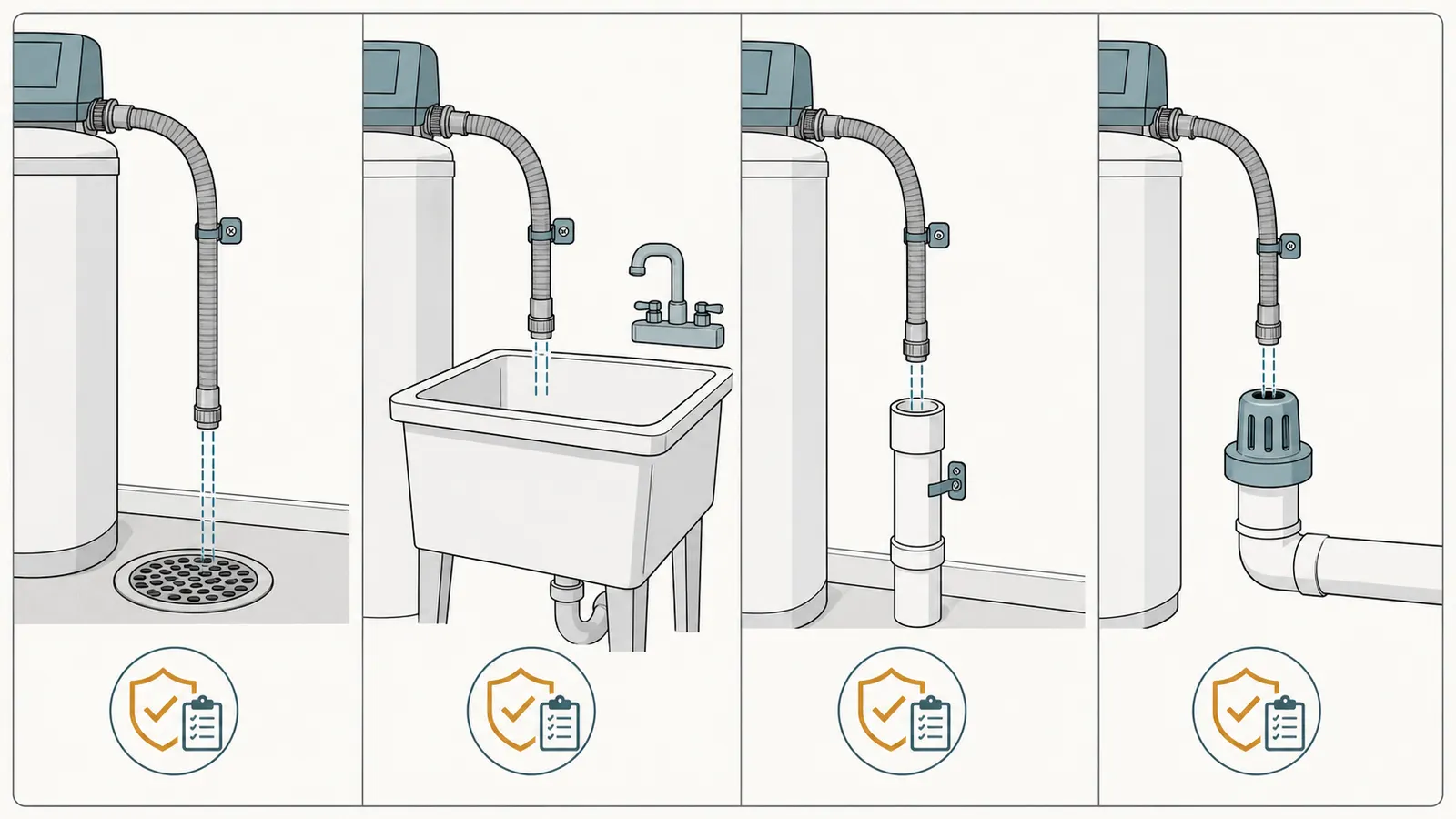
The word “acceptable” is conditional. Whirlpool says a floor drain is preferred and a laundry tub or standpipe are other options, but it also says all plumbing must follow national, state, and local codes. San José takes a more specific local position: its residential appliance-installation guidance says a new softener requires a plumbing permit, must discharge to the sanitary sewer with a minimum 1-inch air gap, and must have two separate drain tubes. That page is strong evidence for a San José homeowner and no evidence that a dry well, exterior discharge, or one-inch gap is acceptable in every city.
Published code vocabulary can be narrower than everyday plumbing language. For example, the Minnesota Plumbing Code's indirect-waste provisions use terms such as air gap or air break, trapped and vented receptor, and restrictions on indirect-waste receptors. Those sections are not a softener-specific nationwide rule; they show why the local review must identify the applicable receptor provision instead of assuming that any sink, floor drain, or open pipe is approved.
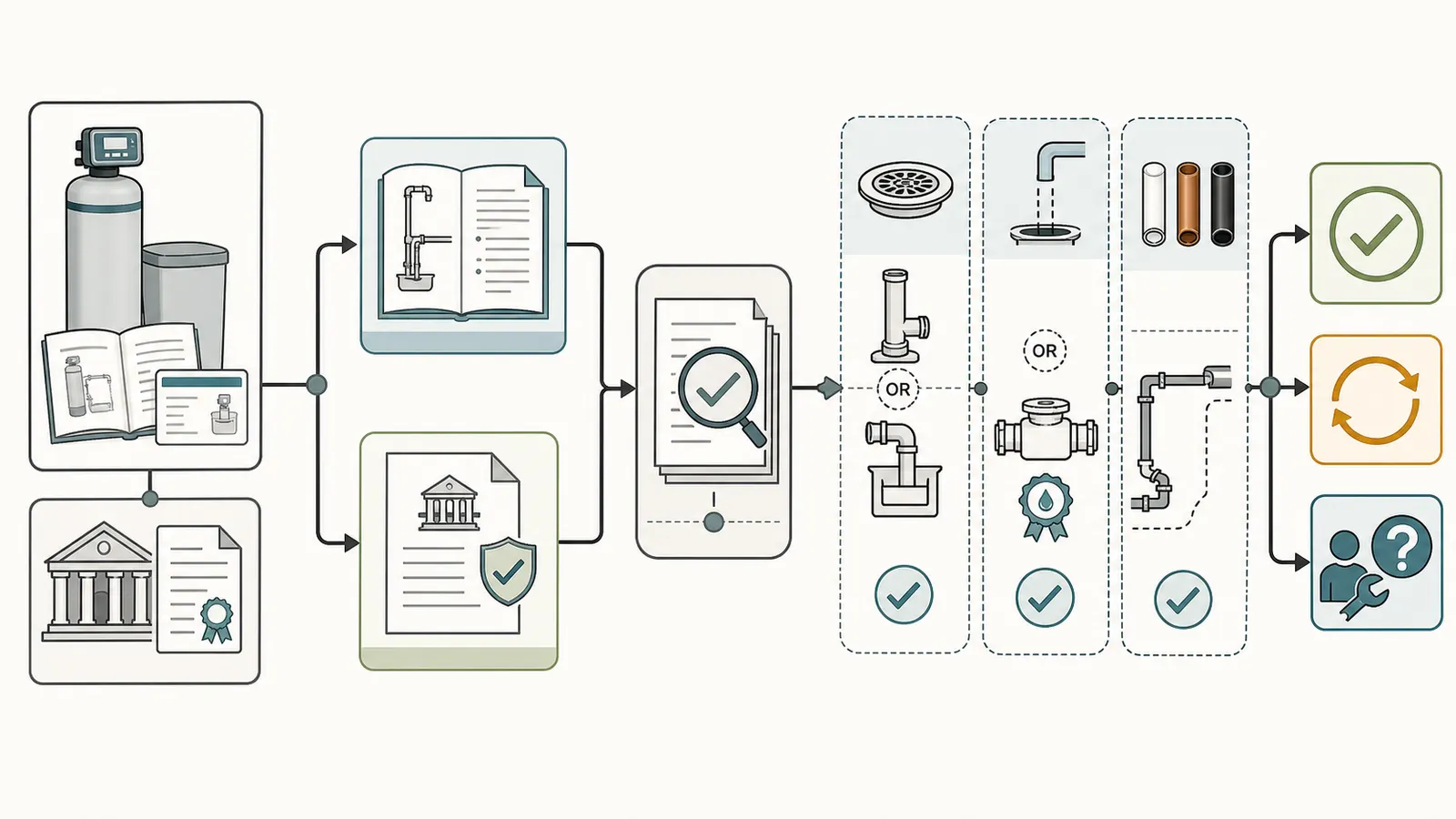
4. Run the exact manual and local-code gate
Use this order when a contractor, retailer, or previous owner gives you a drain recommendation.
Gate A: identify the exact equipment
Photograph the softener control label, model number, serial number, valve head, bypass, brine tank, drain connection, and any nearby filter label. Record whether the valve is electronic or mechanical and whether the drain line is flexible tubing, rigid pipe, or a listed device. A generic label such as “water conditioner” is not enough to select a gap dimension or drain fitting.
The manual may control details such as drain-tube inside diameter, maximum route length, maximum elevation, hose securing method, drain-flow control, regeneration flow, or a required air-gap accessory. Pentair's cited manual calls for 1/2-inch inside-diameter flexible drain tubing for its system and says rigid pipe or PEX may be used if local code requires it. Whirlpool says flexible drain hose is not permitted in all localities. Those statements belong to those products; they are not a universal material specification.
Gate B: identify the jurisdiction and project type
Write down the city, state, whether the property is a single-family home or another occupancy, and whether the work is a new installation, relocation, or replacement that changes plumbing. Look for the local plumbing department's water-softener or water-treatment guidance, permit page, cross-connection program, and current adopted plumbing code. If the page is silent, ask the authority having jurisdiction or a licensed plumber to identify the applicable section in writing.
The Illinois rule for pressure-type water-treatment units requires a vertical air gap at least twice the drain-pipe diameter and not less than 2 inches. The rule also distinguishes venturi-based softeners from units using check valves or stopped inlet flow when discussing inlet backflow protection. This is a useful example of why the valve's operating design can affect the code review, but it is Illinois law—not a national dimension.
Gate C: compare the required geometry
Measure only what is safely visible: the vertical distance from the valve-drain outlet to the receiving flood-level rim, the hose's inside diameter if the manual calls for it, and the route's approximate length and elevation. Do not push a ruler into a drain, move a pressurized fitting, remove a cover, or loosen a hose clamp. Photograph the measurement with the receptor and hose support in the same frame.
Then compare the result with the exact manual and local rule. Whirlpool's manual shows a 1-1/2-inch air gap. San José publishes 1 inch for its residential softener guidance. Illinois publishes a calculation and floor minimum. If the installer says a device replaces a measured open gap, request the device's listing and installation instructions, not just a verbal assurance.
Gate D: check the point of discharge
An air gap does not make an otherwise prohibited receptor acceptable. Ask where the receptor ultimately drains, whether it is trapped and vented as required, whether it is sized for the discharge, and whether the discharge can create a nuisance, freeze, or flood an occupied space. A hose ending over a decorative basin that can overflow onto finished flooring may pass the visual gap check and still fail the practical installation check.
5. Use the route-check workflow
Use this compact worksheet before approving an installation or quote.
Homeowner observation checklist
- Exact softener model and jurisdiction recorded.
- Valve drain identified separately from brine-tank overflow.
- Any companion backwashing filter drain identified.
- Receptor named: floor drain, standpipe, tub, listed device, sewer connection, dry well, or other.
- Valve-drain outlet is visibly above the receptor flood-level rim.
- Required gap dimension or listed-device requirement is written down with its source.
- Hose is secured against whipping, kinking, or falling into the receptor.
- Drain material and hose inside diameter match the model manual and local rule.
- Route length, elevation, and capacity are reviewed against the manual.
- Overflow line is separate and follows its gravity-drain instructions.
- Filter drain is separate unless both manuals and the local rule support the proposed tie-in.
- Permit and inspection requirement is answered for this address.
- Quote names the exact receptor, gap, device, materials, and startup test.
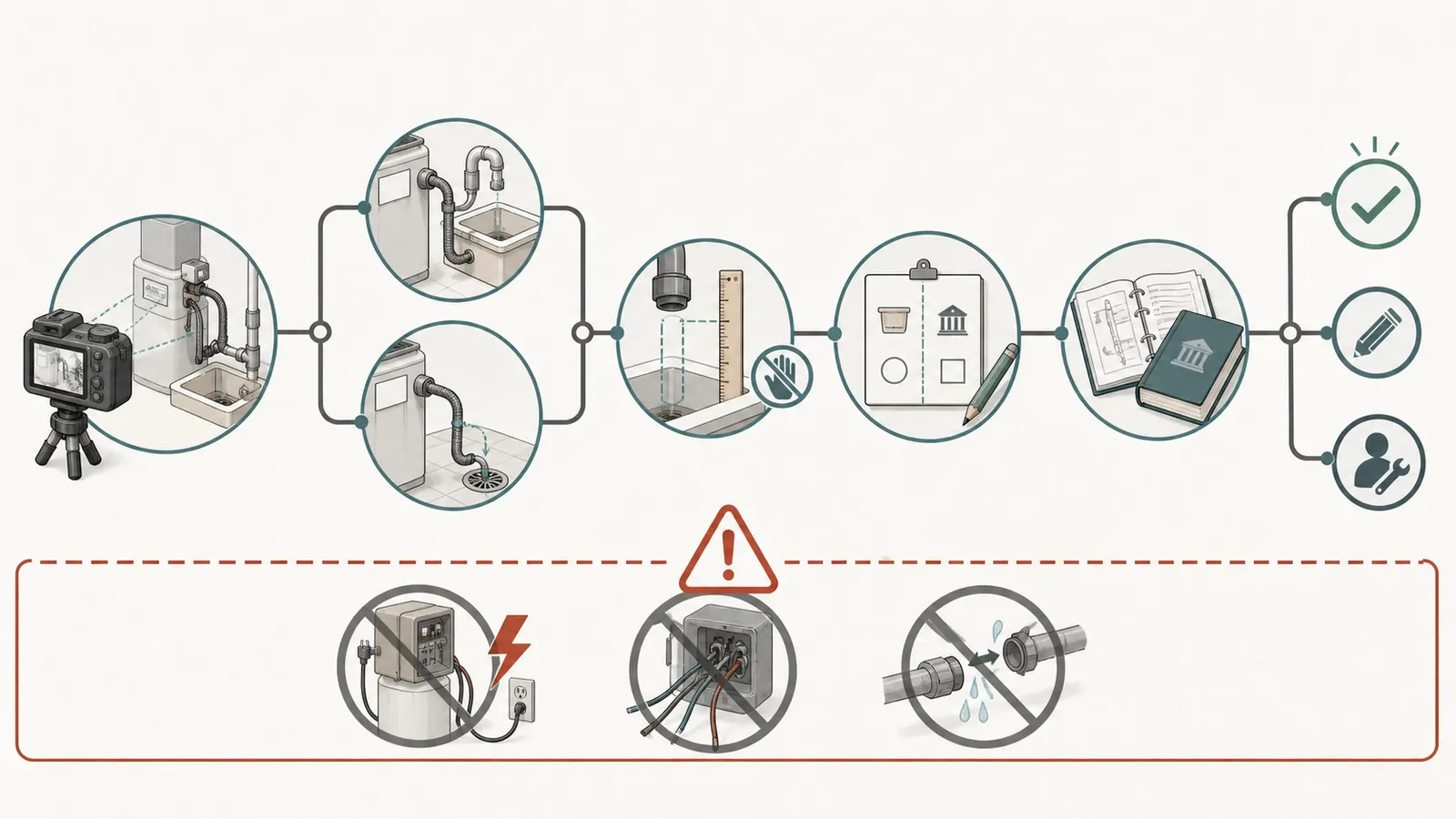
Interpret the checklist conservatively. A blank is not a “probably yes.” It is an unresolved item. A photograph can show that the hose is above the drain today, but it cannot prove the gap remains compliant if the hose is unsecured, the receptor grate is replaced, or a future service person pushes the hose down the opening. The finished scope should make the correct position durable and obvious.
The Minnesota Department of Health cross-connection factsheet illustrates the homeowner-relevant difference: it shows direct sewer plumbing, floor-drain discharge without an air gap, and sink discharge without an air gap as unprotected arrangements, while showing the air-gapped versions as protected. It is educational guidance, not a substitute for your local code, but the diagrams capture the visual test well.
6. Review a companion filter without creating a backfeed path
A carbon, sediment, iron, or other backwashing filter beside the softener changes the decision. The filter may discharge while the softener is in service, may have a different flow rate, and may create pressure or backfeed conditions in a shared line. Pentair specifically says the preferred approach for its filter-and-softener setup is a separate drain line from each unit all the way to the termination point. If circumstances require a tie, its manual shows two model-specific approaches: tee the lines together before the air gap, or install a light-spring check valve on the softener side.
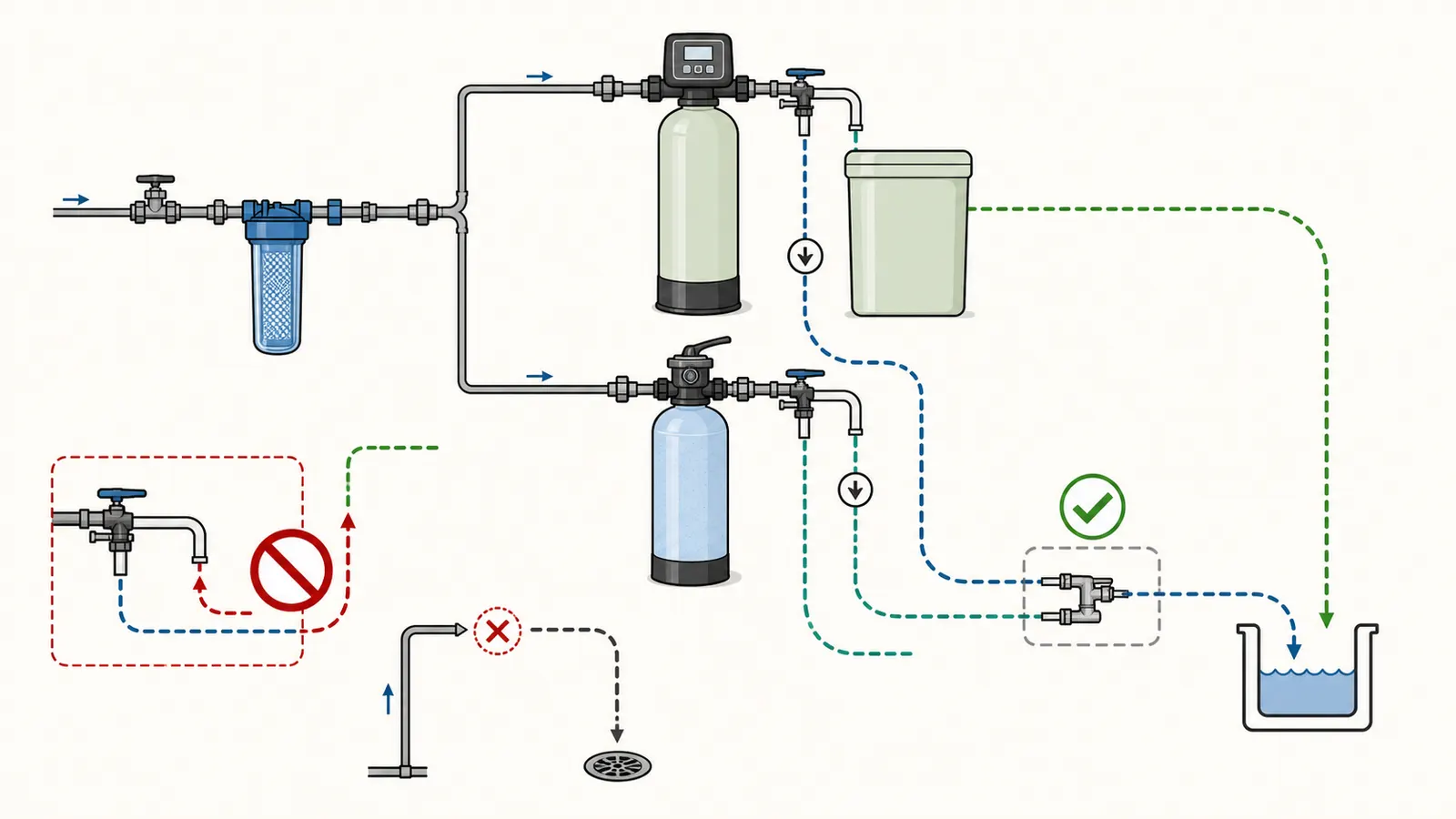
Treat that as a design review, not a universal recipe. Before accepting a shared line, ask for:
- The exact model manuals for both pieces of equipment.
- The drain-flow rate and cycle timing for each unit.
- The location of the tee relative to the final air gap.
- The reason a check valve is needed, its exact specification, and its service access.
- Confirmation that either unit cannot discharge through the other unit, overflow the brine tank, or force wastewater out of the receptor.
- A test plan that observes each unit's cycle separately.
Do not confuse the filter's backwash drain with the softener's brine-tank overflow. The overflow remains a separate gravity safeguard. A proposed line that combines valve drain, filter drain, and overflow should be treated as incomplete until a qualified installer documents the arrangement against the exact manuals and local rule.
7. Decide whether to approve, revise, or escalate
| What you can prove | Decision | What the quote should say |
|---|---|---|
| Exact model manual and local rule agree; gap is visible and measured or a listed device is documented; receptor is approved; hoses are secured and separate | Approve the drain scope | Model, receptor, gap or device, materials, support, permit, and post-install cycle check |
| Air gap is present but dimension, receptor, material, or permit is unknown | Hold for documentation | Identify the governing local section and exact manual page before work starts |
| Hose is submerged, hard-connected, loose, or routed into the brine overflow | Request a revised route | Separate valve drain and overflow; show the open discharge and approved receptor |
| Softener and filter share a line without a tee/check-valve design and dual-cycle test | Request a revised scope | Separate lines preferred; any tie-in must cite both manuals and show backfeed protection |
| Route requires concealed sewer work, new venting, exterior disposal, a backflow assembly, or a permit | Use a qualified professional | Professional to identify code path, obtain permit where required, and document inspection |
| Installer proposes a universal number or says “that is how we always do it” | Do not approve on that statement | Require exact model, jurisdiction, source, and measured installation detail |
The best quote is specific enough that another professional could inspect it without guessing. A useful scope sentence would identify the valve drain as a separate regeneration discharge, name the receiving receptor, state the applicable air-gap dimension or listed device, specify the hose or rigid-pipe material, identify the brine overflow separately, and state whether a companion filter is included. “Connect softener to drain” is not enough.
8. Safety boundary and final acceptance
Safe homeowner work is observation and documentation: read labels, photograph the route, note the receptor, watch for visible leaks, and measure an exposed gap without touching equipment. Follow the exact owner manual for any external control action only when it is clearly designed for homeowner use and the system is not leaking or behaving abnormally.
Do not perform work that requires opening an energized control head, testing live wiring, removing electrical covers, disconnecting pressurized plumbing, loosening a drain fitting under pressure, manipulating a stuck valve, adding chemicals, opening a well, pulling a pump, entering a confined space, or climbing into a tank or pit. Do not assume that turning a bypass handle makes every component safe to disconnect. Assign electrical diagnosis, pressurized disconnection, internal valve service, well or pump work, concealed drainage, and code-sensitive plumbing to a qualified professional. If there is an active leak, overflow, electrical odor, unexpected discharge, or water-quality concern, stop the observation and use the appropriate shutoff or emergency service path without taking apart the system.
Before accepting the completed work, ask the installer to demonstrate or document:
- Valve drain discharges at the specified air gap or listed device.
- Hose remains secured and cannot fall into the receptor.
- Receptor and final drain accept the discharge without splash, backup, or floor flooding.
- Brine-tank overflow is a separate gravity line and is not connected to the valve drain.
- Companion filter drain, if present, follows the documented separate or approved shared route.
- A regeneration or backwash cycle was checked by the professional without leaks or abnormal flow.
- Permit or inspection status is recorded where required.
- Exact manual, local rule, device listing, and any changed fittings are left with the homeowner.
The practical answer to “does a water softener drain need an air gap?” is therefore yes in the normal homeowner installation review, unless the applicable code and exact equipment documentation establish another approved protection method. A submerged hose is not a shortcut version of an air gap. The decision is complete only when the valve drain, overflow, receptor, dimension, local rule, and post-install test all match the documented scope.
Sources and scope
Evidence behind this page
- Pentair — Whole House Water Softening System Installation and Service Manual
Pentair's whole-house softener manual; its air-gap language, tubing size, illustrations, and receptor examples are manufacturer guidance for that product family and do not establish a nationwide dimension or approval.
- Pentair — Whole House Water Softening System Installation and Service Manual
Pentair site-selection guidance for the cited whole-house system; the listed receptors and 25-foot preference are not a national rule and do not override the exact model manual or authority having jurisdiction.
- Pentair — Whole House Water Softening System Installation and Service Manual
Pentair's special-attention guidance for its filter-and-softener arrangement; it is not permission to combine every manufacturer's drains or to omit the final air-gap requirement.
- Whirlpool Water Softeners — Installation and Operation Manual 7392319
Whirlpool's cited installation manual; the 1-1/2-inch value is model-family guidance and must not be generalized to all softeners or jurisdictions.
- Whirlpool Water Softeners — Installation and Operation Manual 7392319
Whirlpool's component-routing instructions; exact hose sizes, elevations, and termination requirements remain model- and code-dependent.
- Illinois Plumbing Code — Section 890.760 Pressure Type Water Treatment Units
Illinois state code text for pressure-type water-treatment units; this is jurisdiction-specific and does not establish the rule in another state or city.
- Illinois Plumbing Code — Section 890.120 Definitions
Illinois plumbing-code definition used to explain the physical concept; other jurisdictions may use related terms or different dimensions.
- City of San José — Appliance Installations
San José residential guidance referencing the California Plumbing Code; the permit, sanitary-sewer, 1-inch, and two-tube requirements are local and must not be presented as nationwide rules.
- Minnesota Department of Health — Cross-Connections and Water Softeners
Minnesota Department of Health cross-connection education reviewed July 25, 2023; it is educational guidance and does not provide a universal gap dimension or replace local plumbing code.
- Minnesota Rules Chapter 4714 — Plumbing Code
Minnesota code provisions cited for terminology and local-code variation; the displayed sections are not a softener-specific national rule and must not be transferred to another jurisdiction.