Do You Need a Pressure Regulator for a Water Softener on a Private Well?
Use your well pressure-tank gauge and the exact softener manual to decide whether you need no regulator, a unit-protection regulator, or professional diagnosis.
The short answer
A private well does not automatically require a pressure regulator for a softener. Record the pressure-tank gauge through a complete pump cycle, including the highest observed reading, then compare it with your exact softener manual. If the high reading exceeds the unit’s inlet limit, a regulator upstream of that unit may be required. If pressure keeps rising, the switch or relief protection needs professional diagnosis; a regulator is not a repair.Observation flow
What is the system doing?
Choose the closest visible pattern. Stop immediately for sparking, hot wiring, uncontrolled pressure, or a damaged tank.
Do You Need a Pressure Regulator for a Water Softener on a Private Well?
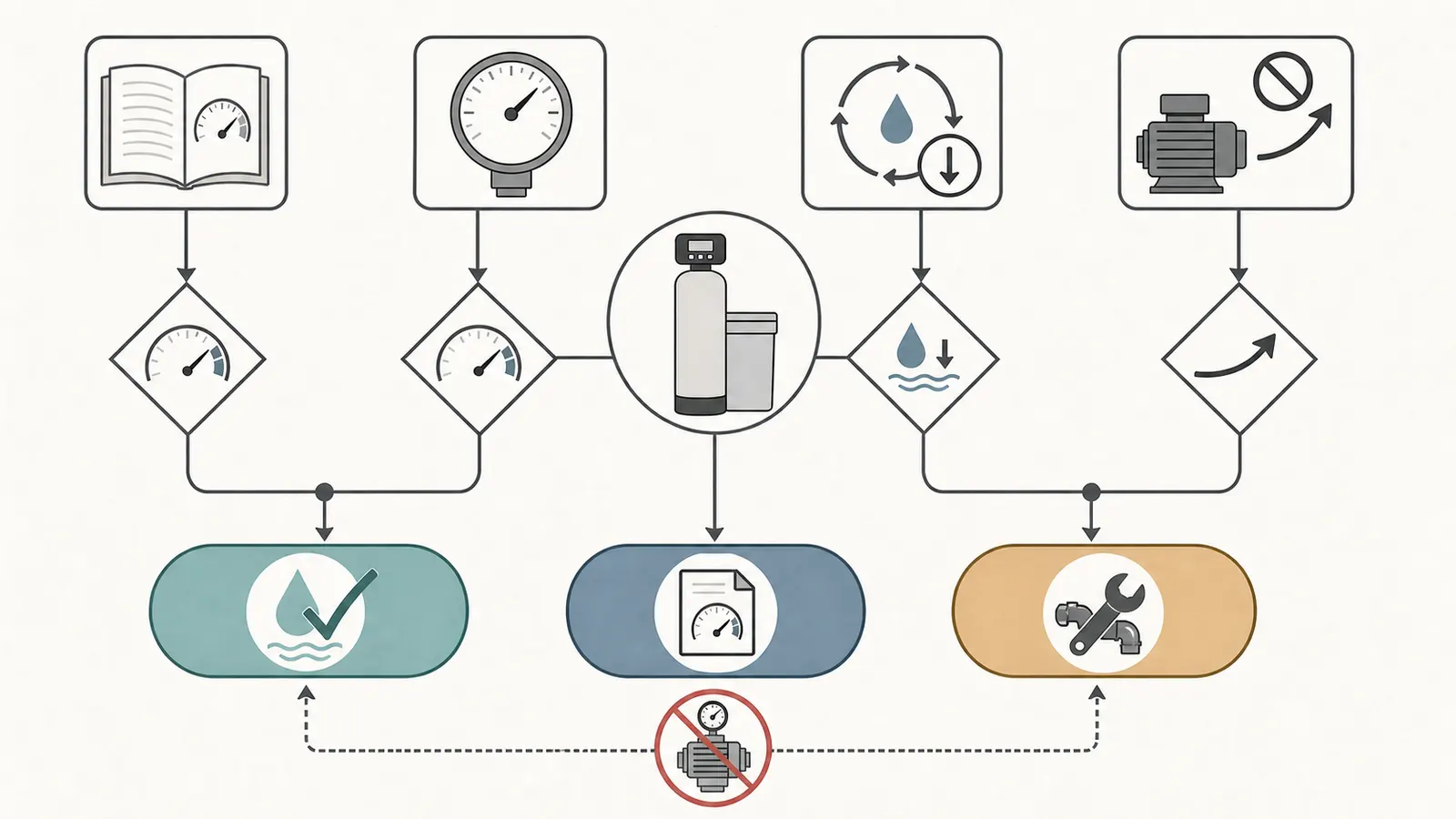
Usually, no—not simply because the home uses a private well. The decision turns on two different questions: what pressure the softener actually sees, and what the exact softener manual allows. Record the pressure-tank gauge through a full pump cycle and note the highest observed pressure. Then compare that evidence with the model-specific inlet-pressure limit and minimum regeneration requirement. The result should be one of three outcomes: no regulator indicated by the available evidence, a regulator required upstream of this softener, or a broader well-pressure fault that needs professional diagnosis.
A pressure regulator can protect a treatment unit from excessive inlet pressure. It cannot repair a pressure switch that fails to stop the pump, replace a missing or failed relief valve, increase a low-yield well’s flow, or make a softener regenerate correctly when the pressure drop through the system is too large.
What the well gauge can—and cannot—tell you
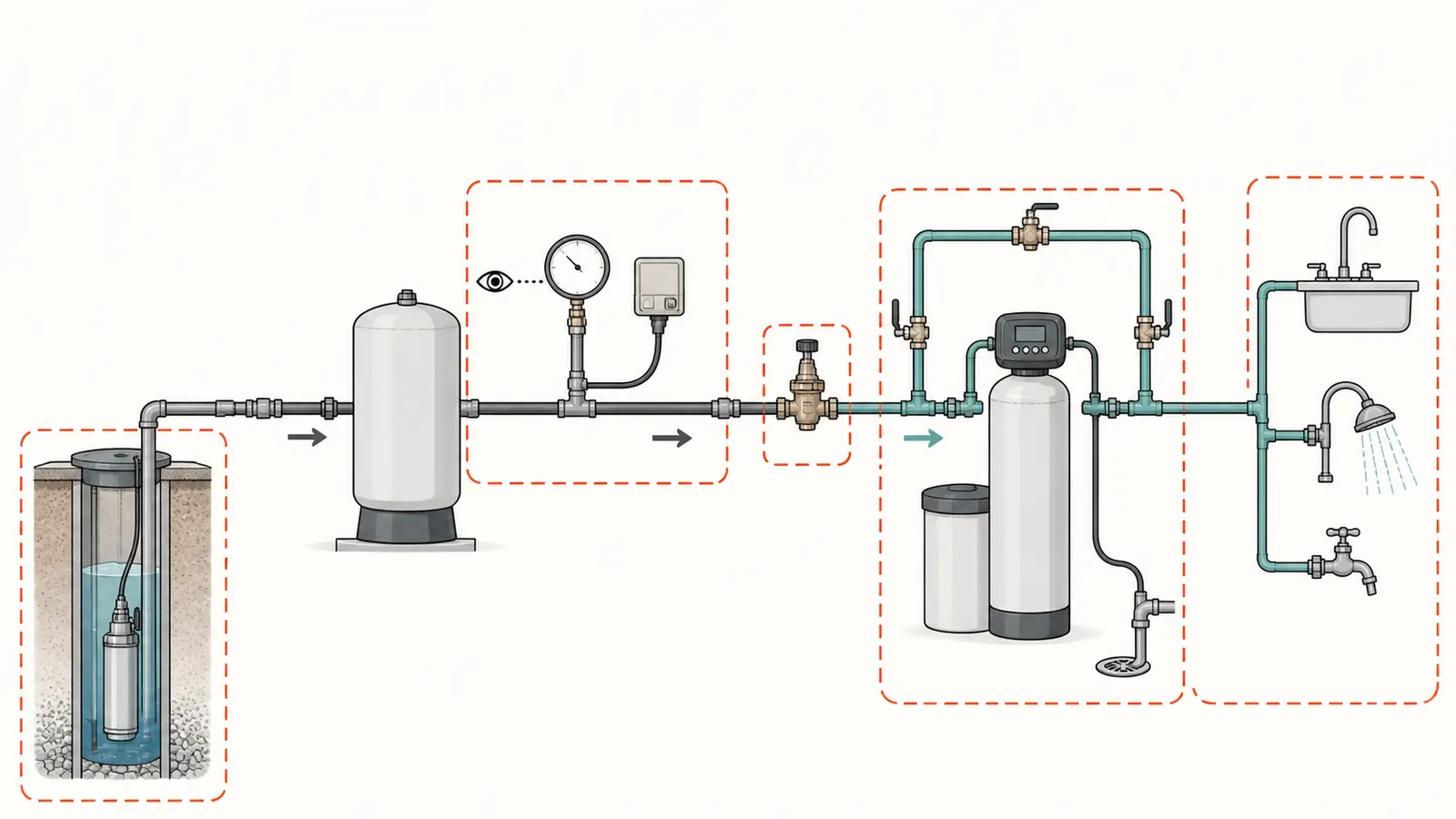
The gauge beside the pressure tank is useful because it records the pressure in the well system at that point. It does not automatically prove the pressure at the softener inlet, at a distant fixture, or during the softener’s most demanding regeneration step. Pipe size, filters, valves, elevation, simultaneous water use, and the softener’s own internal pressure drop can all change what the treatment valve receives.
Think of the gauge as a record of the source-side pressure cycle, not as a universal “safe for every appliance” number.
The familiar 40/60 cycle is an example, not a rule
Many well systems are discussed as 40/60 systems: the pump starts around 40 psi and stops around 60 psi. Penn State Extension uses a 40 psi pump shutoff and 20 psi pump-start example when explaining pressure-tank operation, but presents it as an example of how a pressure tank and switch work—not as a required setting for every well. Penn State Extension describes the pressure-tank cycle as a system arrangement that maintains pressure in the pipeline.
Amtrol’s support table likewise lists several possible combinations, including 20/40, 30/50, 40/60, 50/70, and 60/80 psi. Its table pairs a 40/60 switch with a 38 psi tank precharge, because the stated precharge relationship is 2 psi below pump cut-in. Amtrol’s well-tank support guidance is useful for interpreting a known tank-and-switch setup, but it does not turn 40/60 into a national standard or a softener specification.
That distinction matters. A softener manual may allow a maximum inlet pressure higher than the pump’s cut-out, yet still require enough pressure and flow during regeneration. Another model may have a different maximum, a different minimum, or a minimum dynamic pressure measured at a particular injector flow. You need the manual for the actual control valve or assembled system.
Three pressure terms to keep separate
Use these terms consistently in your notes:
| Term | What it means | Why it matters to the decision |
|---|---|---|
| Static or resting pressure | A gauge reading with no meaningful fixture flow | Useful for seeing the tank’s cycle state, but it does not show pressure under softener demand. |
| Dynamic pressure | Pressure while water is flowing at a stated flow rate | This may be the deciding evidence for regeneration, drain flow, or a pressure drop through treatment equipment. |
| Maximum observed pressure | The highest reading you actually recorded during the observation period | This is the number to compare with the manual’s maximum inlet pressure; do not replace it with the nominal switch label. |
The word “maximum” is especially important. A pressure switch marked 40/60 is not evidence that the system can never exceed 60 psi. The gauge could be inaccurate, the switch could be misadjusted or malfunctioning, the pump could fail to shut off, or a pressure increase could occur in a closed section. A regulator decision made from the label alone is incomplete.
The three-outcome decision path
Use this path before buying a regulator or changing a pump setting.
| Evidence you have | Decision | Safest next step |
|---|---|---|
| Highest observed softener-inlet pressure is below the exact manual’s maximum; regeneration has adequate flow and no high-pressure symptoms are present | No regulator indicated by the available evidence | Keep the record with the softener manual and recheck after plumbing or pump changes. |
| Highest pressure at the softener inlet is at or above the exact manual’s stated maximum, or the manual explicitly requires regulation above a specified value | Regulator required to protect this treatment unit | Have the regulator correctly selected, placed upstream of the softener, and verified under flow by a qualified installer. |
| Pressure rises beyond the expected cycle, does not stop at pump cut-out, fluctuates rapidly, the relief valve discharges, or the unit still lacks regeneration flow | Broader high-pressure or well-system fault | Stop treating this as a softener-accessory purchase. Call a qualified well or plumbing professional to evaluate the switch, tank, relief protection, pump, piping, and flow. |
This is a compatibility decision, not a remote diagnosis. “No regulator indicated” means the evidence you collected does not show that this softener requires one. It does not certify the whole plumbing system, pressure tank, pump, or local-code compliance.
A regulator for the softener is not automatically a regulator for the house
If the only confirmed problem is that the softener’s inlet limit is lower than the well system’s observed pressure, the equipment manual may call for a regulator immediately upstream of the treatment unit. Pentair’s whole-house softener manual says well-water treatment equipment should be installed following the pressure tank, and instructs the installer to install a pressure regulator on the unit inlet if that system’s pressure exceeds 120 psi. See Pentair’s well-placement and pressure instructions.
That is a unit-protection instruction for a particular Pentair system. It is not the same as deciding that the home’s entire distribution system has acceptable pressure. If the pressure at the tank is already abnormally high, a downstream regulator may shield the softener while leaving the upstream fault unresolved. If the whole house is exposed to high pressure, the broader plumbing protection question deserves its own evaluation.
EPA’s WaterSense service-pressure sheet says high pressure can damage plumbing, fixtures, and appliances, increase water consumption, and increase the risk of leaks or premature equipment failure. It says most U.S. plumbing codes require pressure-regulating valves on domestic systems where supplied pressure exceeds 80 psi, while also directing readers to consult local plumbing codes. Read the EPA WaterSense service-pressure guidance. Treat that 80 psi reference as code-oriented general guidance, not as a substitute for your jurisdiction’s adopted code or your softener manual.
How to measure the pressure evidence safely
You can usually observe an installed gauge without opening the pressure switch, tank, well, or pump controls. If there is no usable gauge, ask a qualified professional to install or verify one rather than opening energized equipment to reach a connection.
Prepare the record
Write down:
- the softener manufacturer, exact model, valve or control-head model, and manual revision date;
- where the gauge is located relative to the pressure tank, treatment equipment, filters, and any bypass;
- the gauge’s current reading before you begin;
- the pump cut-in and cut-out readings if they can be observed without removing a cover;
- any leaks, relief-valve discharge, rapid cycling, surging, poor flow, or regeneration error;
- whether the softener is in service, bypass, or an active regeneration cycle.
Photograph the model plate and plumbing layout. Do not photograph inside an energized control box. Do not infer the model from the tank color, resin tank shape, or a dealer’s description.
EPA’s verification procedure for service pressure uses a gauge at a hose bibb, a washing-machine cold-water connection, or a first-floor cold-water faucet, with the water fully open. EPA’s gauge-location instructions are useful for a home-pressure check, but a remote fixture reading can differ from the softener inlet. If your question is specifically whether the treatment valve is protected, the most useful evidence is a verified gauge at or immediately upstream of that valve, collected by someone qualified to install it safely.
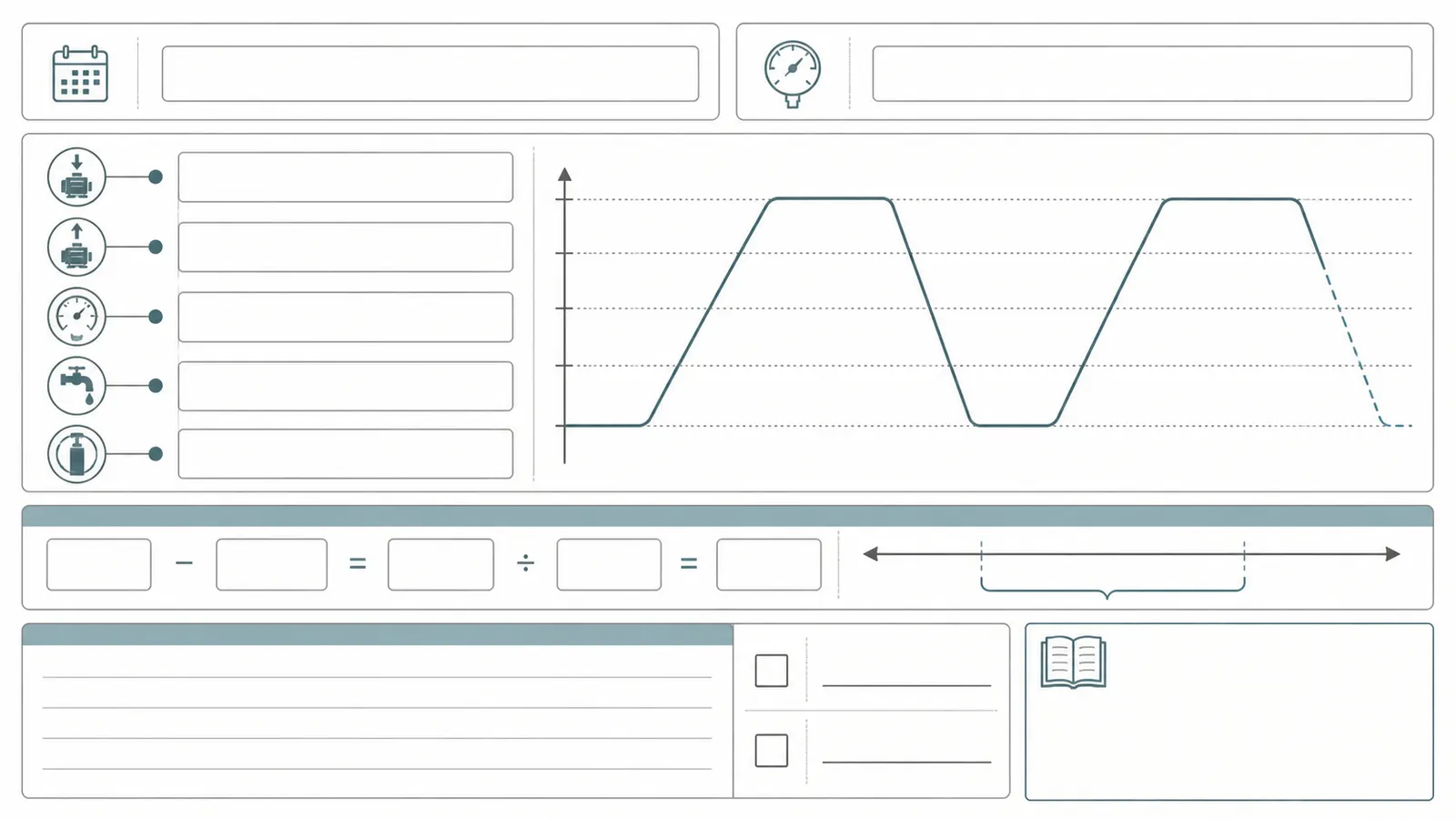
Observe at least one complete ordinary cycle
From a safe distance, observe the gauge as normal household water is used and the pump starts and stops. Record:
| Observation | Record | Do not infer |
|---|---|---|
| Lowest ordinary reading | ____ psi | Do not assume this is the softener’s dynamic regeneration pressure. |
| Pump start or cut-in | ____ psi | Do not change the switch because the reading differs from a label. |
| Pump stop or cut-out | ____ psi | Do not assume the pump always stops at the nominal setting. |
| Highest observed reading | ____ psi | Do not assume this is the maximum possible pressure if the gauge may be inaccurate or the cycle is abnormal. |
| Pressure with one cold fixture open | ____ psi | Record the fixture and approximate flow condition; a partly open tap is not a standardized test. |
| Pressure during regeneration, if the manual permits observation | ____ psi | Do not force a regeneration or open a valve to create a test if you are not instructed and qualified to do so. |
For an illustrative 40/60 system, the ordinary range is approximately 20 psi from low to high. That 20 psi range is calculated as:
observed range = highest observed pressure − lowest observed pressure
60 psi − 40 psi = 20 psi
The calculation describes the observed cycle. It does not establish that the tank precharge is correct, that the switch is healthy, or that the softener has enough dynamic pressure at its injector. It also does not establish that 60 psi is the true maximum if the pump continues running or pressure continues rising.
Check the gauge before trusting a close call
If your highest reading is close to the manual limit, treat the result as uncertain until the gauge is verified. Older well-system gauges can be inaccurate; the current Autotrol Performa 255 Easy-iQ installer manual specifically tells private-well installers to check minimum pressure with an accurate gauge. The Autotrol manual’s private-well pressure section also separates static pressure from dynamic pressure at the injector.
Do not solve gauge uncertainty by adjusting the pressure switch. Ask for a pressure test with a known-good gauge, and give the professional the exact softener model and your observations.
Compare the readings with the exact softener manual
Locate the installation manual, not only the marketing page. Search it for “water pressure,” “inlet pressure,” “minimum pressure,” “regeneration,” “injector,” “drain flow,” “pressure drop,” and “pressure regulator.” Record the page and the exact wording in your worksheet.
Manufacturer limits are not interchangeable
The following examples show why a model-specific lookup is necessary:
| Manufacturer and equipment document | Pressure information stated in the document | How to use it |
|---|---|---|
| Pentair whole-house softening system | 20–120 psi operating range; gauge the pressure; if it exceeds 120 psi, install a regulator on the unit inlet; 60 psi is identified as optimum for that system | Compare the verified high reading with 120 psi for that Pentair system. |
| Autotrol Performa 255 Easy-iQ | On a private well, static pressure below 29 psi may cause low flow or inadequate regeneration depending on pressure drop; the manual states a 14.5 psi dynamic minimum at the injector under a 5.28 gpm condition and a 120 psi maximum inlet pressure | Do not treat 29 psi as a universal minimum. The dynamic condition and valve model matter. |
| Fleck 5600SXT Upflow | At least 20 psi is required for the regeneration valve to operate effectively; water pressure is not to exceed 125 psi | Compare only if this is the actual valve or the manufacturer confirms applicability. |
Pentair’s whole-house manual, the current Autotrol manual, and the Fleck service manual are three manufacturer documents, not one universal specification. A 40/60 well cycle sits comfortably below the maximum values in these examples, but that observation alone does not settle a different model’s requirements or prove adequate regeneration flow.
Compare high pressure and low flow separately
A regulator is relevant to excessive pressure. It is not a cure for low dynamic pressure. These are separate branches:
- If the high reading exceeds the exact manual’s maximum, regulation may be required to protect the unit.
- If pressure drops too far while the unit is drawing or regenerating, a regulator could make the low-flow problem worse.
- If the pressure is within the manual’s range but the drain flow is weak, investigate clogged screens, a restrictive filter, undersized piping, a partially closed valve, excessive elevation, pump capacity, or a softener-specific service problem with a professional.
- If pressure rises abnormally after the pump should stop, investigate the well system before placing a regulator downstream.
The Autotrol manual’s language is a useful warning: it gives a private-well static-pressure concern and a separate dynamic-pressure condition at the injector. That is why a single resting gauge number cannot answer every regeneration question.
Do not confuse a warranty or unit limit with a whole-house limit
The softener’s maximum inlet pressure protects that model’s valve, tank, seals, and warranty conditions. It does not necessarily state the safe operating limit for every pipe, fixture, pressure tank, or appliance in the house. Conversely, an EPA or local-code pressure threshold for domestic plumbing does not replace the softener’s own minimum regeneration requirement.
Keep two lines in your notes:
- “Treatment unit limit: ____ psi maximum; ____ psi minimum or dynamic requirement.”
- “Whole-house pressure evidence and local-code question: ____ psi; professional/code review needed? yes/no.”
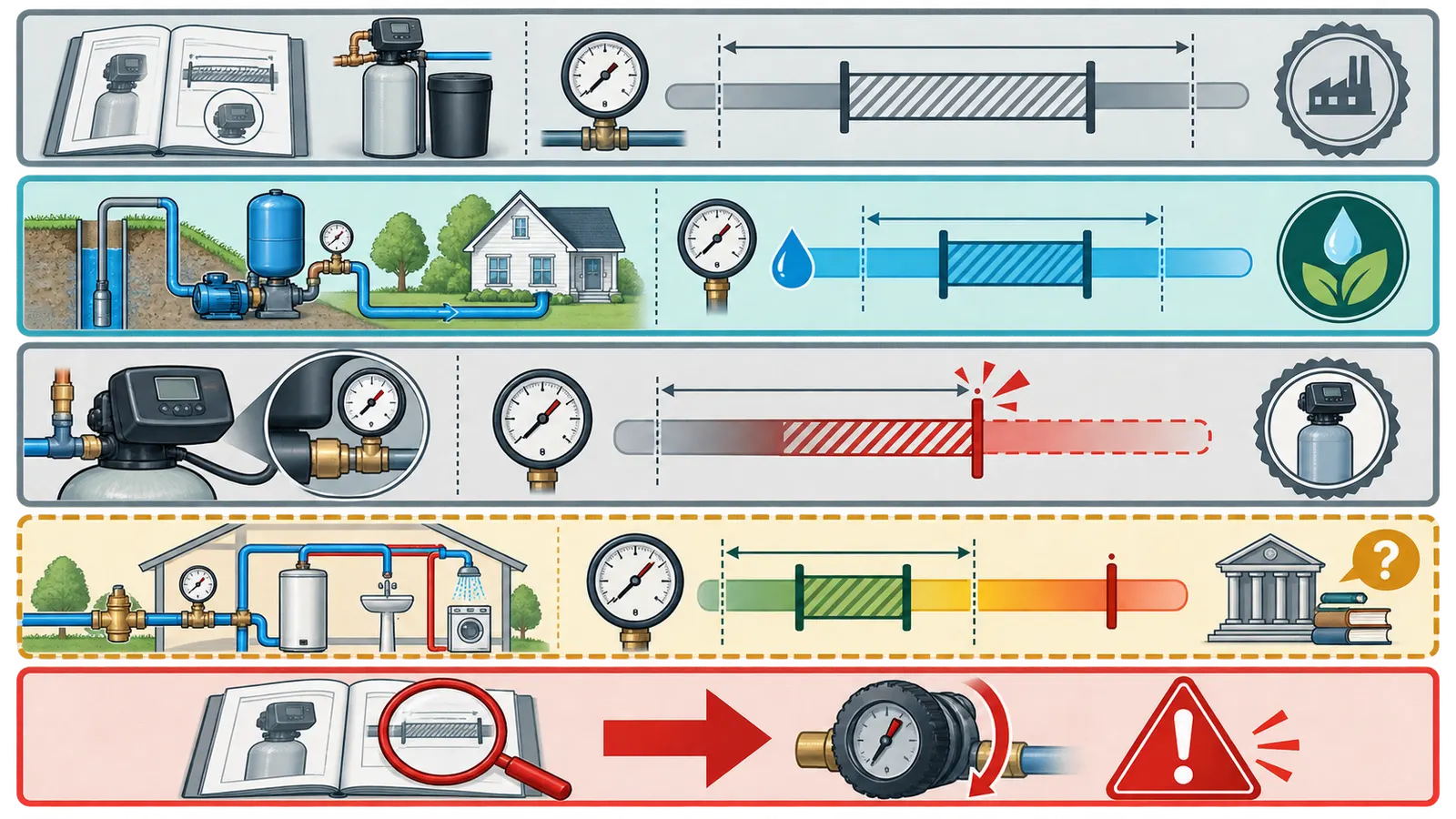
This separation prevents a common error: installing a regulator because a generic article mentions 80 psi, then setting it so low that the softener cannot meet its regeneration flow requirement—or deciding that a 120 psi softener limit makes a whole house at 100 psi acceptable.
If a regulator is indicated, decide what it should protect
If the evidence shows that the exact softener’s inlet pressure can exceed its maximum, the manual may call for a regulator upstream of the softener. “Upstream” means before water enters the treatment valve, not merely somewhere convenient downstream of it. The pressure tank and well controls remain part of the source system; the softener’s bypass, inlet, outlet, and drain must still be installed according to the manual and local requirements.
Placement is a system decision
Ask the installer to identify on the written scope:
- the pressure measured before the regulator;
- the target pressure after the regulator;
- the regulator’s rated flow range and pressure range;
- how the regulator will be isolated, serviced, and verified;
- whether a gauge will be installed on the protected side;
- whether the whole-house plumbing remains exposed to the upstream pressure;
- how regeneration and drain flow will be checked after installation;
- whether local code requires thermal-expansion control or other protection.
EPA says a direct-acting PRV should have a minimum flow between 10% and 15% of maximum desired flow and should be selected by its rated operating range, not by pipe size alone. See EPA’s regulator-selection guidance. That is a general selection principle, not enough information to size your specific regulator. The installer needs the softener’s service and regeneration flow, well pump capacity, simultaneous household demand, pipe size, and the pressure before and after the regulator.
Do not assume a smaller regulator is safer because it lowers pressure more. A restrictive or poorly sized device can create a pressure drop during regeneration. Conversely, a regulator selected only by nominal pipe diameter may not control pressure properly at the actual flow.
Protect regeneration flow
Regeneration may use a drain flow, injector, brine draw, rinse, and refill sequence. The exact sequence and pressure requirement depend on the valve. A regulator setting that looks comfortable during a quiet shower can still starve the injector or drain during a treatment cycle.
After installation, the professional should verify the softener’s required service and regeneration behavior using the manual’s procedure. A homeowner can record the symptoms—slow drain flow, failure to draw brine, an error code, hard water after regeneration, or a pressure collapse—but should not defeat a bypass, disconnect a pressurized line, or open a control to investigate.
When a regulator is the wrong first move
Certain observations point away from a simple unit-protection regulator and toward a well-system fault.
| Observation | What it may indicate | What a regulator cannot do |
|---|---|---|
| Pump keeps running and pressure continues to climb | Pressure switch, pump-control, shutoff, or system fault | It cannot make a failed switch stop the pump. |
| Relief valve discharges | Excessive pressure or a protection event | It cannot replace the relief valve or explain why it opened. |
| Very rapid pump cycling | Tank issue, switch issue, loss of air charge, undersizing, or changing demand | It cannot correct cycling or protect a compromised tank. |
| Pressure is low only when water flows | Pump capacity, restriction, clogged filter, elevation, or pressure drop | It may reduce pressure further. |
| Softener regenerates poorly despite acceptable static pressure | Insufficient dynamic pressure, injector or screen issue, drain restriction, programming, or installation problem | It cannot guarantee regeneration flow. |
| Pressure is high throughout the house | Whole-house pressure-protection issue | A regulator only at the softener leaves other equipment exposed. |
Amtrol’s residential tank instructions make the safety boundary explicit: pressurized tanks can rupture or explode if operated improperly; relief protection is required, and only qualified professionals should check, adjust, or recharge precharge on tanks in service. The manual warns against adding pressure when there is corrosion, damage, loss of air, or reduced pump cycle time. Read the Amtrol Well-X-Trol safety instructions.
For that reason, do not remove the pressure-switch cover, manipulate live wiring, change switch settings, add air to a used tank, test a relief valve by forcing it open, or open a pressurized connection as part of this decision. Opening or loosening pressurized equipment is prohibited for this homeowner check. Do not open the well, pull the pump, or enter a well pit or other confined space. Those actions belong to a qualified well or plumbing professional. If you see a leak, corrosion, a damaged tank, active relief discharge, or pressure that does not stop where expected, keep people away from the equipment and arrange service.
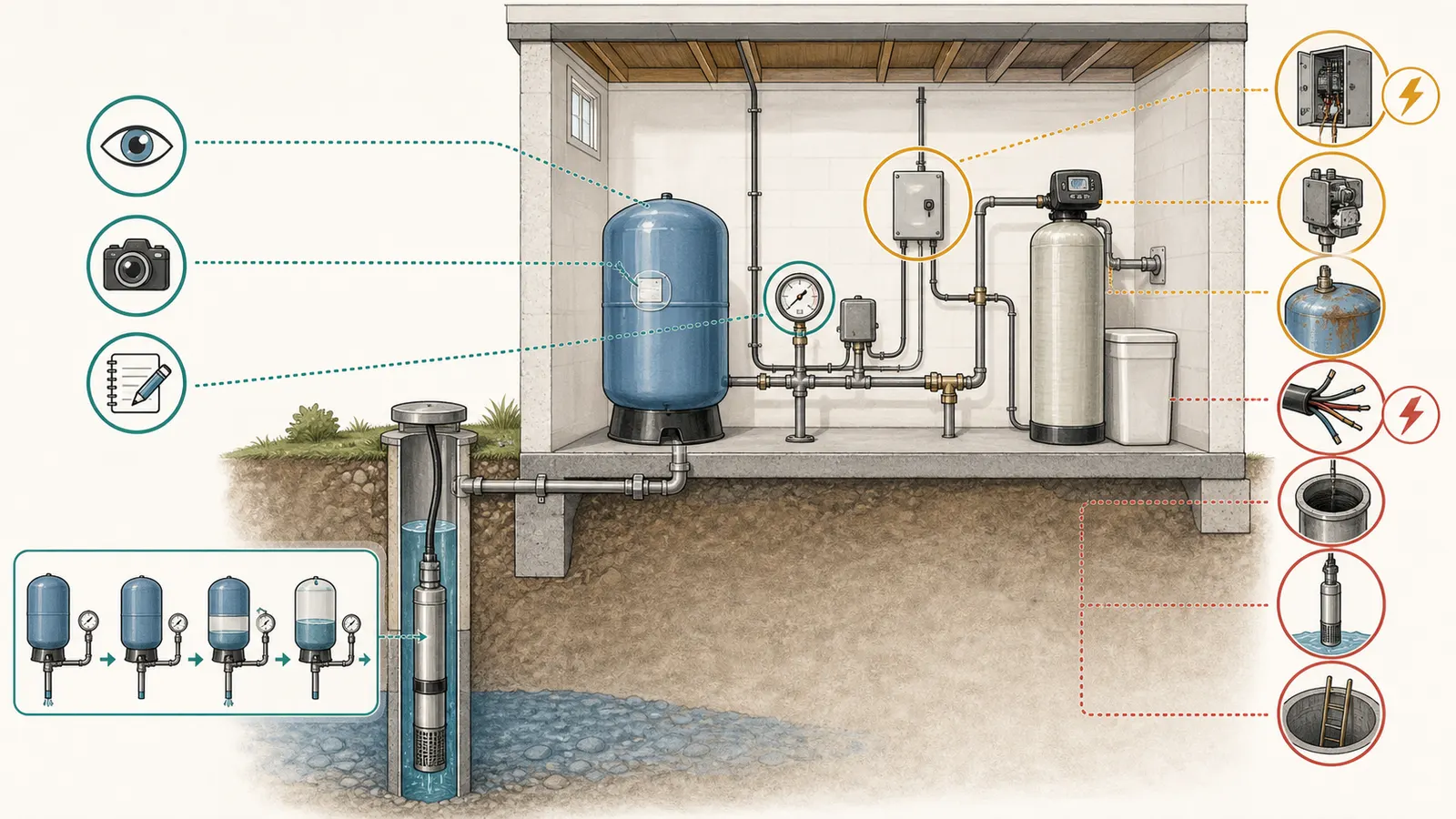
The homeowner hand-off record
The most useful result of this decision surface is a concise record that another person can verify. Fill in what you can observe safely and leave service fields for the professional.
Pressure-and-specification worksheet
| Field | Your record |
|---|---|
| Well and pressure-tank gauge location | ______________________________ |
| Gauge appears readable / gauge verification needed | ______________________________ |
| Well tank manufacturer and model, if visible | ______________________________ |
| Pressure switch label, without opening the cover | ______________________________ |
| Softener manufacturer | ______________________________ |
| Softener model and control-valve model | ______________________________ |
| Exact manual URL or document name | ______________________________ |
| Manual maximum inlet pressure | ______________________________ |
| Manual minimum or dynamic regeneration requirement | ______________________________ |
| Lowest observed ordinary gauge reading | ______________________________ psi |
| Pump cut-in observed from gauge | ______________________________ psi |
| Pump cut-out observed from gauge | ______________________________ psi |
| Highest observed reading | ______________________________ psi |
| Reading with one named cold fixture open | ______________________________ psi |
| Pressure or flow symptom during regeneration | ______________________________ |
| Relief-valve discharge, leak, corrosion, or rapid cycling | ______________________________ |
| Regulator currently present? Location? | ______________________________ |
Calculate the observed range only after you have both endpoints:
observed pressure range = highest observed reading − lowest observed reading
Then write the comparison in one sentence: “The highest verified reading at __________ was ______ psi; the exact manual allows ______ psi maximum. The low-flow or regeneration evidence is __________. Decision: no regulator indicated / regulator upstream of unit requires professional installation / broader fault requires diagnosis.”
What to bring to a professional
Bring the manual, model photographs, pressure record, gauge location, dates and times, and a description of any simultaneous water use. If the water-quality question is also part of the purchase, bring a certified laboratory report rather than a sales demonstration. Penn State Extension recommends testing private-well water through a state-certified laboratory before buying treatment equipment, consulting an unbiased expert, understanding maintenance, and getting warranties or agreements in writing. Penn State’s treatment-equipment buying guidance is a useful companion to this pressure decision.
Ask the professional to answer these specific questions in writing:
- Is the gauge accurate, and where was the pressure measured?
- What are the actual pump cut-in and cut-out pressures?
- Does pressure continue to rise after cut-out?
- Is the relief valve present, correctly rated, and discharging?
- Is the pressure tank showing signs of corrosion, lost precharge, rapid cycling, or other damage?
- What pressure does the softener see during service and regeneration?
- Does the exact manual require a regulator, and where does it specify placement?
- Does the proposed regulator maintain the manufacturer’s required regeneration flow?
- Is the recommendation for the softener only or for the whole house?
- What local-code or thermal-expansion questions must be addressed?
Maintenance after the decision
Record the final regulator setting, both-side gauge readings if available, the date of installation, and the softener manual revision. Keep the regulator, bypass, pressure tank, and relief-valve locations accessible. Recheck the record after a pump replacement, pressure-switch service, tank replacement, new filtration stage, major plumbing change, or a change in regeneration behavior.
Do not use a new regulator to mask worsening pressure symptoms. A regulator that has become noisy, unstable, clogged, or unable to hold its downstream setting needs service. A softener that begins to regenerate poorly needs its flow path and source pressure evaluated, not merely a lower regulator setting. A pressure tank that begins rapid cycling, leaks, corrodes, or loses pressure needs professional attention.
The practical answer is therefore conditional but clear: a private well does not by itself create a regulator requirement. Measure the actual cycle, verify the gauge when the result is close, compare the highest inlet pressure and the regeneration minimum with the exact softener manual, and keep unit protection separate from whole-house pressure safety. If the evidence crosses the unit’s maximum, protect the softener with a correctly selected upstream regulator. If the pressure behavior is abnormal, stop at the record and send the well system—not just the softener—to a qualified professional.
Sources and scope
Evidence behind this page
- Pentair Whole House Water Softening System Installation and Service Manual
Pentair whole-house softening system installation guidance; this is a manufacturer-specific placement instruction, not a universal plumbing rule.
- Pentair Whole House Water Softening System Installation and Service Manual
Specific Pentair whole-house softening system manual, pages 4 and 6; do not transfer these values to an unidentified model.
- Autotrol Performa 255 Easy-iQ Installer Manual
Autotrol Performa 255 Easy-iQ valve installation manual, section 5.3.2; minimums depend on this valve and stated flow condition.
- Fleck 5600SXT Upflow Service Manual
Fleck 5600SXT Upflow service manual; values are model-specific and illustrate why the exact manual controls the decision.
- WaterSense Labeled Homes Technical Sheet: Service Water Pressure
EPA WaterSense technical guidance for labeled homes and service-water pressure; the 80 psi statement is not a substitute for the applicable state or local code or a softener manual.
- WaterSense Labeled Homes Technical Sheet: Service Water Pressure
EPA WaterSense verification and PRV selection guidance; it is not a sizing recommendation for an individual softener without system data.
- Amtrol Well Tank Support
Amtrol Well-X-Trol support guidance; pressure-switch settings vary by system and the table is not permission for an unqualified adjustment.
- Well-X-Trol Residential Pre-Pressurized Well Tanks Installation & Operation Instructions
Amtrol Well-X-Trol residential tank safety instructions; tank model and local requirements still govern.
- Tips for Buying Water Treatment Equipment
Penn State Extension consumer guidance for private water systems, updated July 1, 2026; it is not a pressure-regulator installation standard.
- Using Low-Yielding Wells
Penn State Extension explanation and example for low-yielding well systems; the example is not a required setting for every well.