Why Does My Well Pump Keep Losing Prime?
A homeowner decision surface for recurring well-pump prime loss: identify pump type, separate symptoms, log evidence, and know when to stop.
The short answer
Recurring prime loss is a symptom, not a part diagnosis. Identify an above-ground jet/centrifugal pump versus a submersible; make only de-energized observations, allow one manual-approved reprime, and log pressure hold/time to reprime. Stop repeated running and call a qualified professional if it will not stay primed. Prime loss does not establish drinking-water safety: if contamination is suspected, stop drinking or cooking with the water, use a safe source, and contact the local health department.Why Does My Well Pump Keep Losing Prime?
If a well pump repeatedly loses prime, treat it as a recurring water-path problem until a qualified professional proves otherwise. On an above-ground jet or centrifugal pump, the leading evidence categories are air entering the suction side, water draining back through a foot or check valve, excessive suction lift, or a pumping water level that falls below the intake. A pump that primes once and then loses water is a different branch from a pump that never primes. Neither pattern identifies a failed part by itself.
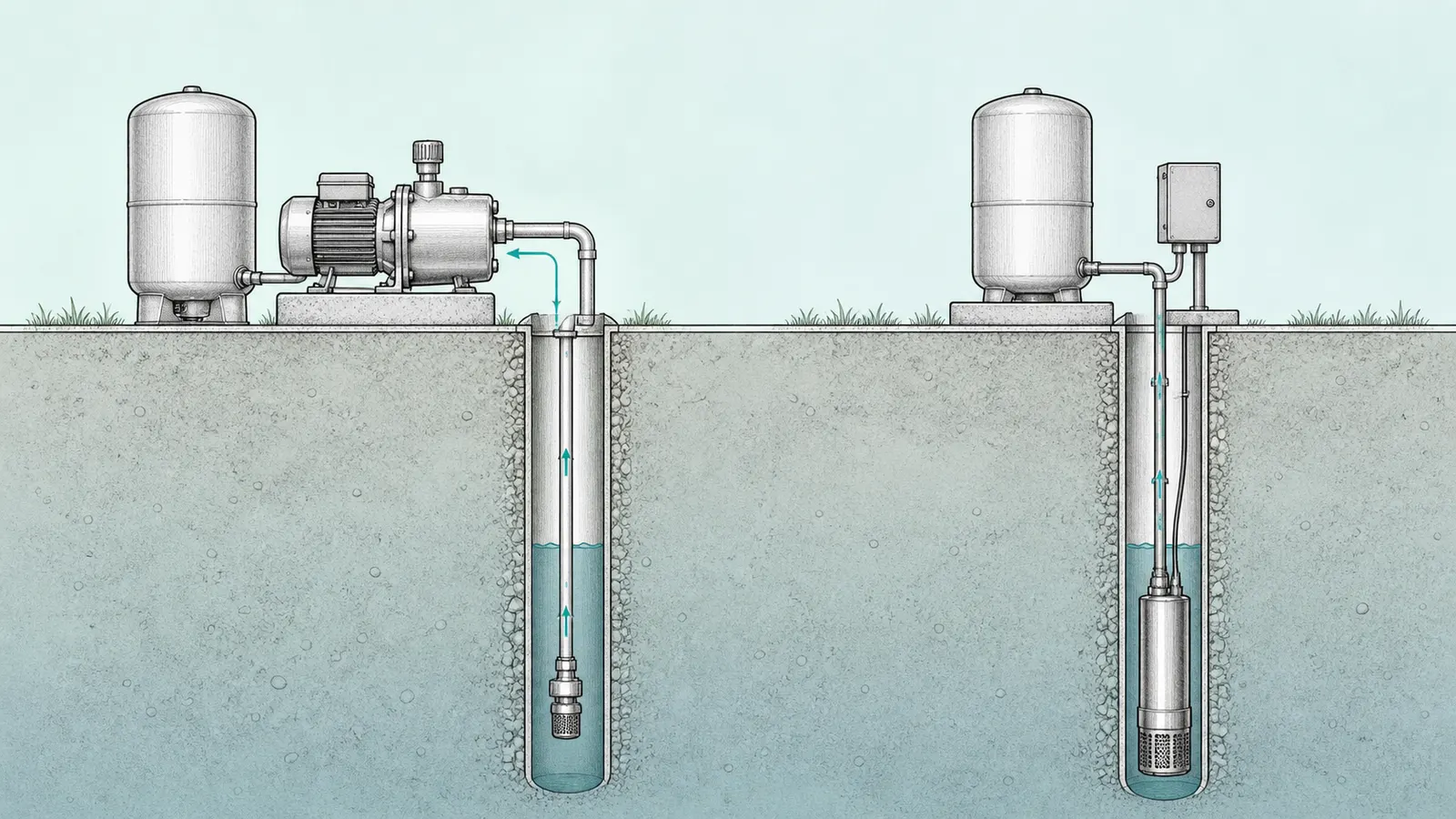
First identify the pump arrangement. If the pump is above ground and has a visible motor, pump casing, suction pipe, and often a priming plug, this guide's reprime boundary may apply—but only through the exact manual for that pump. If the pump is down inside the well casing, it is a submersible arrangement: there is no homeowner “reprime” at the surface. Do not open the well, pull the pump, test live wiring, or keep running a pump that is not delivering water.
1. Identify the pump before interpreting “prime”
The phrase “lost prime” is precise for some above-ground suction systems and imprecise for many submersible systems. Start with what you can see without removing covers or touching controls.
| What you can safely observe | Likely arrangement | What “prime” means here | Boundary for the homeowner |
|---|---|---|---|
| Motor and pump casing are above ground; a suction line runs toward the well; a priming plug or fill opening is visible | Above-ground jet or centrifugal pump | The pump casing and suction line need to remain water-filled so the pump can draw water | Use only the exact manufacturer's reprime procedure, with power off for service and no dry running |
| Only a pressure tank, gauge, switch, and buried piping are visible; the pump motor is not at the surface | Submersible pump | “Lost prime” is often shorthand for no water, low pressure, rapid cycling, or a failed delivery system | Do not open the well, expose wiring, lower tools, or pull the pump; gather observations for a qualified well/pump professional |
| A surface booster or centrifugal pump is installed after a storage tank or cistern | Surface centrifugal or booster arrangement | Prime depends on the source, suction piping, and pump design—not necessarily the well itself | Use the pump's manual and identify the source tank, valves, and protection before drawing conclusions |
EPA's private-well component guidance describes jet pumps as above-ground pumps commonly used for shallow wells of about 25 feet or less and submersible pumps as units placed inside the well casing, commonly for deep private wells. Those are useful orientation clues, not a universal depth rule. UF/IFAS explains that practical suction lift is much less than the theoretical atmospheric limit and is affected by friction and the water conditions at the pump; it also describes submersible pumps as operating below the water surface.
Do not use the well's depth alone to identify the pump. A drilled well can have an above-ground pump in some installations, and a shallow source can use equipment that is not a standard shallow-well jet pump. Look for the equipment arrangement and model label from a dry location. If the label is missing, photograph it without opening an electrical cover and give the photo to the professional.
2. Separate the symptom into one of four paths
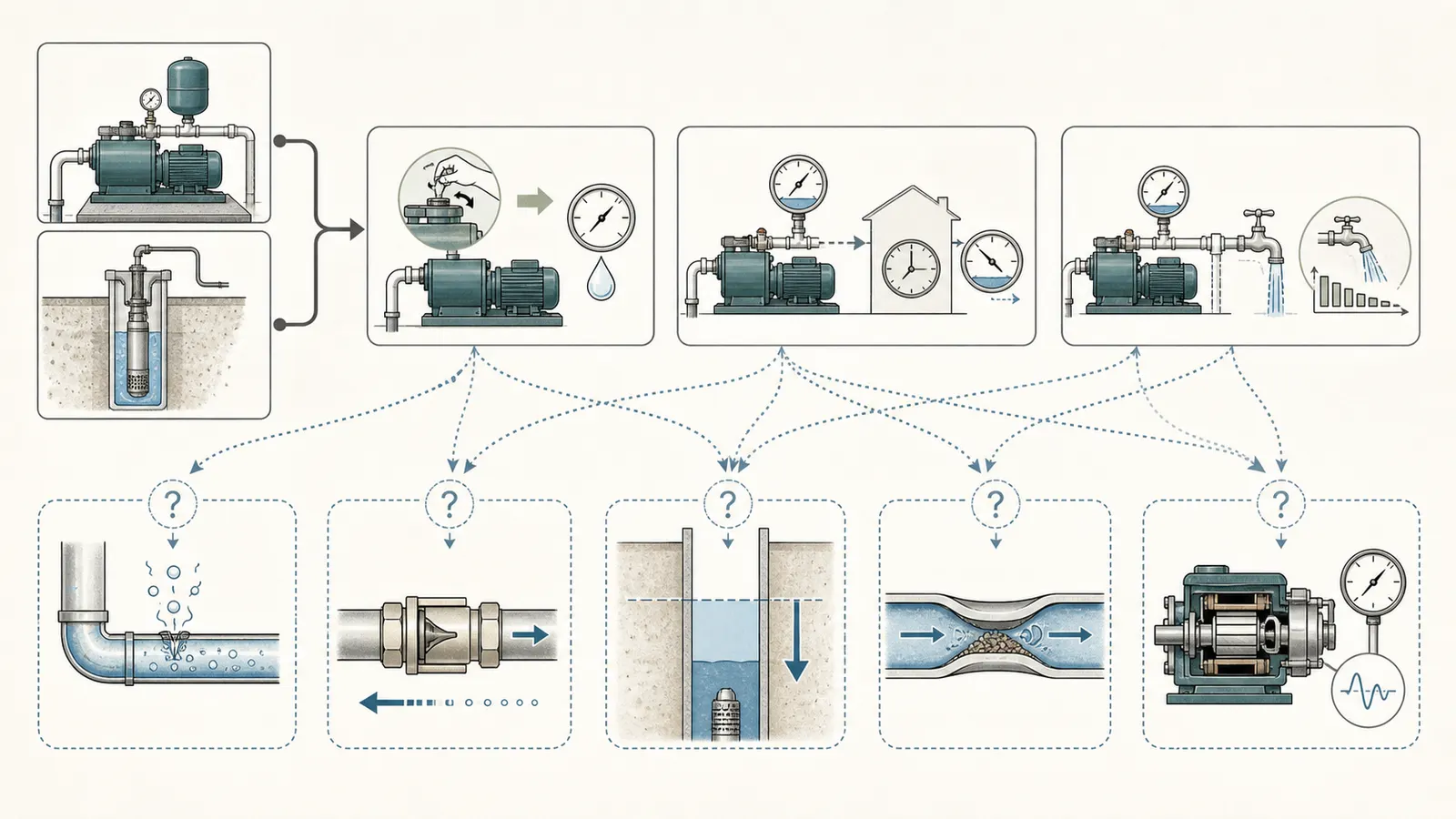
The first decision is not “which part should I replace?” It is “what happens, and when?” Record the sequence after ordinary water use. Do not deliberately run the pump dry to reproduce a fault.
| Symptom sequence | Evidence categories to keep open | What the observation can support | What it cannot prove |
|---|---|---|---|
| Pump never delivers water after a single, manual-approved reprime | Incomplete prime, suction-side air entry, excessive lift, plugged valve or line, source-water issue, pump or control issue | The system is not establishing or maintaining the required water path | It cannot identify a bad foot valve, leak, impeller, motor, or well level without further professional testing |
| Pump primes, supplies water, then loses pressure while sitting with no water use | Water draining back, a suction-side leak, a downstream leak, pressure-control behavior, or an unrecorded use event | The system's pressure or retained water state changes at rest | It does not prove the pressure tank caused the problem or that the foot valve is the failed part |
| Pump primes, then loses water or pressure while running | Air entry under suction, excessive lift, intake submergence or drawdown, restriction, or pump performance issue | The symptom is load- or time-dependent and may track the pumping water level | It does not prove the well is dry, the pump is undersized, or a particular valve is bad |
| Pump runs but pressure is low or water delivery is weak without a clear loss of prime | Plugged suction or discharge components, pump wear, wrong rotation or voltage, excessive head, restriction, or an open-use leak | The motor is operating but hydraulic delivery is not meeting demand | It does not prove the pressure tank needs replacement |
The manufacturer manuals support this separation. Red Lion's RJS-PREM troubleshooting table lists suction-line air leaks, a well that draws down too far, and a faulty foot valve under “pump loses prime,” while listing excessive suction lift and plugged components for other delivery problems. Pentair Myers lists air in the suction piping, excessive total suction lift, and insufficient submergence or pumping water level for a pump that loses prime after starting. These are candidate causes from manufacturer troubleshooting tables, not a remote diagnosis.
The “after sitting” clue
If the pump works normally immediately after a qualified reprime but is empty or ineffective after several hours, record that interval. A retention problem is a reasonable category to discuss because the suction system must stay water-filled, but the interval does not name the failed component. The cause could involve a valve, a joint, a fitting, a crack, a drain-back path, or another part of the installation.
The “while running” clue
If the pump starts with water and then fades while a faucet or appliance is drawing, record how long it takes and whether stopping water use allows recovery. That pattern keeps drawdown, suction lift, air entry under load, restriction, and pump performance in the discussion. USGS says a well is considered dry when water drops below the pump intake, and that the level can return as recharge increases. A low pumping level is therefore plausible in some cases, especially after high demand or low recharge, but a homeowner should not infer it from a pressure gauge alone.
3. Make only de-energized, visible observations
The useful homeowner check is an evidence pass, not a repair attempt. It should be possible to complete it without opening an electrical enclosure, removing a pressure-tank cover, disconnecting piping, opening the well, or placing hands near a moving or energized part.
Before touching the system
Write down the pump model if it is visible from outside the equipment. Note whether the area is dry, whether a leak is actively spraying, whether the pump is running, and whether the pressure gauge is readable. If water is near electrical equipment, the floor is flooded, or the pump may restart automatically, stay clear and call for qualified help. Do not reach through water to operate a disconnect.
If the installation is dry and the disconnect can be operated from a safe standing position, follow the equipment's shutdown instruction. Do not assume that a wall switch alone makes an electrical enclosure safe. Red Lion's manual says electrical connections require a licensed electrician and that power must be disconnected before servicing. The Pentair Myers manual likewise says not to work on the pump or switch while power is on and warns that some motors can restart unexpectedly.
Visible checks that preserve evidence
- Look, do not dismantle: note water on the floor, a damp pump casing, a wet threaded joint, corrosion trails, or a discharge leak. A dry exterior does not rule out an air leak on the suction side.
- Read the existing gauge without tapping it, removing it, or adjusting the switch. Record the pressure and whether the pump is on or off.
- Note the last normal use, the first failed use, and whether the problem follows a shower, laundry load, irrigation, a power interruption, or a long period without water use.
- Check ordinary fixtures only: record whether all fixtures are affected or one branch is affected. Do not remove aerators, open buried valves, or disconnect filters to create a test.
- Photograph the pump label, gauge, visible piping, and any leak from a dry, safe position. Do not photograph inside a control box or well casing.
- Gather the installation manual, repair invoices, pump age, prior well work, pressure-tank model, and any professional measurements of static or pumping water level.
The EPA explains that a well cap helps keep debris, insects, and small animals out of the well and that local agencies and water-system professionals can advise on well construction. That is why the well cap is not an observation port for this homeowner workflow. Do not open it to “see if there is water,” lower a tape, or pour anything into the well.
4. Use a pressure-hold and time-to-reprime log
A short record can make the professional visit more efficient and can prevent an expensive guess. It is not a pressure test, a valve test, a proof of a leaking pipe, or a reason to replace the pressure tank.
Use the existing gauge only. Do not adjust the pressure switch, change the tank air charge, loosen a plug, relieve pressure through an unknown fitting, or open a tank or control enclosure. Record units exactly as displayed. If the gauge is fogged, stuck, cracked, or unreadable, write “unreadable” rather than tapping or replacing it.
Pressure-hold observation
- Record the date, time, pump type, gauge reading, and whether the system has just completed a normal cycle.
- Stop ordinary water use. Do not create a special high-demand event. Make a note of any toilet, softener, refrigerator, irrigation controller, or appliance that might use water automatically.
- From a safe location, record the gauge at 5, 15, and 30 minutes if the system remains stable. If the pump starts unexpectedly, record the time and stop the observation; do not hold a switch or close a valve to force a result.
- Note whether pressure falls, whether the pump cycles, whether a fixture is using water, and whether the visible pump or piping changes.
- If the gauge falls to zero, the pump runs without producing water, or the system becomes noisy or hot, stop the pump from a safe location if possible and call a professional. Do not keep cycling it to collect a cleaner graph.
A pressure decline with no intended water use says that the system is not holding the same pressure state. It can be useful evidence for a leak, drain-back, valve issue, gauge issue, or pressure-control issue, but it cannot locate the cause. A stable gauge does not prove that the pump will maintain prime under flow. Those limits matter: a pressure tank can be involved in cycling or pressure behavior without being the reason an above-ground pump lost its water column.
Time-to-reprime observation
Only record this after a qualified professional or the exact equipment manual has established that a homeowner reprime is allowed. Write down:
- the time the pump was switched on after the approved fill or reprime;
- the time until continuous water flow or normal pressure returned;
- whether the pump stopped, sounded different, or required another fill;
- how many cycles the model's manual permits or describes;
- whether the same pattern returned after sitting for a known interval; and
- the water-use context and weather or high-demand conditions.
Do not invent a pass/fail threshold. Priming time depends on the pump, suction-line length, source arrangement, and manual procedure. Red Lion's manual gives a model-specific cycle procedure and says to shut the pump off if it does not draw water within eight tries. That eight-try limit is not a universal residential rule. Use the exact manual for the exact model; if the manual is unavailable or the setup is uncertain, stop before priming.
5. Keep the reprime boundary narrow
Repriming is a one-time recovery step only when all of these conditions are met:
- the equipment is clearly an above-ground pump whose manual permits homeowner priming;
- the pump model and procedure are known;
- the area is dry, stable, and accessible without standing in water;
- the pump is not showing a damaged cord, exposed wiring, overheating, burning smell, seized motor, or active spray;
- you can follow the manual's fill amount, plug sequence, valve position, and run limits exactly; and
- you will stop if water does not arrive within the manual's limit or the pump sounds abnormal.
The manual wins over generic advice. Red Lion instructs that its pump should not be run before priming because the seal and impeller could be damaged; its procedure fills the casing, uses a nearby tap to observe flow, and says to shut the pump off after eight unsuccessful tries. Pentair's Quick Prime manual likewise says the pump must be filled with water before initial operation to protect the mechanical shaft seal and says not to run the pump dry.
Do not generalize one manual's gallon quantity, cycle count, valve arrangement, or automatic-reprime feature to another pump. Do not add water through an opening that is not identified in the manual. Do not run with a discharge completely closed. Do not loosen a plug on a pressurized system: Pentair warns that internal pressure must be relieved before work and that a closed discharge can create superheated water and burn risk.
If the pump primes and immediately loses prime again, the reprime has established a recurring symptom—not a successful repair. Do not keep repeating it. Repeated dry or near-dry operation can damage pump components, and it removes the clean timing evidence a professional needs.
6. Interpret the log without naming a part
Use the log to sort the next professional question, not to order a replacement component.
| Recorded pattern | Most useful question for the professional | Avoid this inference |
|---|---|---|
| Pressure falls while no water is intentionally used, then pump cycles | “Can you isolate a household leak, drain-back path, valve issue, gauge issue, or pressure-control issue without assuming the tank is bad?” | “The pressure tank must be failed.” |
| Pump loses prime after sitting but works briefly after an approved reprime | “Can you check the suction-side integrity and water-retention arrangement for this model?” | “The foot valve is definitely bad.” |
| Pump loses water only during a long draw or irrigation event | “Can you compare pump demand with pumping water level, suction lift, source capacity, and restrictions?” | “The well is permanently dry.” |
| Pump never draws water after one approved attempt | “Can you verify the model's prime path, suction piping, valves, source water, pump condition, and controls?” | “The pump motor needs replacement.” |
| Only one fixture is affected while other fixtures work normally | “Can you check the local branch or treatment equipment without disturbing the well system?” | “The well pump has lost prime.” |
| Submersible system has low pressure or no water but no visible surface pump | “Can you diagnose the surface controls, pressure behavior, well conditions, and pump electrically and hydraulically?” | “I can reprime it through the pressure tank.” |
This is also where the pressure tank should be kept in its proper place. A tank can influence how often the pump starts and how pressure behaves, but the symptom “loses prime” does not by itself show that the tank bladder, air charge, or tank size caused the prime loss. Do not adjust the tank charge or replace the tank solely because the gauge moved during the hold observation. Ask the professional to explain which measurement separates a tank problem from a suction, valve, well-level, or pump problem.
Do not turn a low-water hypothesis into a well-entry project
USGS's explanation is useful for the decision boundary: water can fall below a pump intake and later recover as recharge increases. It does not authorize a homeowner to open the well or measure the water level. A professional can compare well construction records, pump setting, historical yield, static water level, pumping level, recent rainfall, and household demand using appropriate equipment.
7. Stop conditions and professional handoff
Stop using the pump and arrange qualified help when any of the following occurs:
- the pump runs without delivering water, needs repeated reprime, or reaches the manual's failed-attempt limit;
- the pump becomes hot, noisy, vibrates unusually, smells burned, or trips a breaker or overload;
- water is spraying, the pump area is flooded, or electrical equipment is wet;
- pressure behaves erratically, exceeds the rating of a component, or a relief device operates;
- the well may be drawing down during use, especially after drought, high demand, or a change in well output;
- the pump is submersible or the equipment identity is uncertain;
- service would require opening an energized control, testing live wiring, opening a pressure tank or switch, disconnecting pressurized plumbing, opening the well cap, pulling a pump, entering a pit or confined space, or handling disinfectants and treatment chemicals.
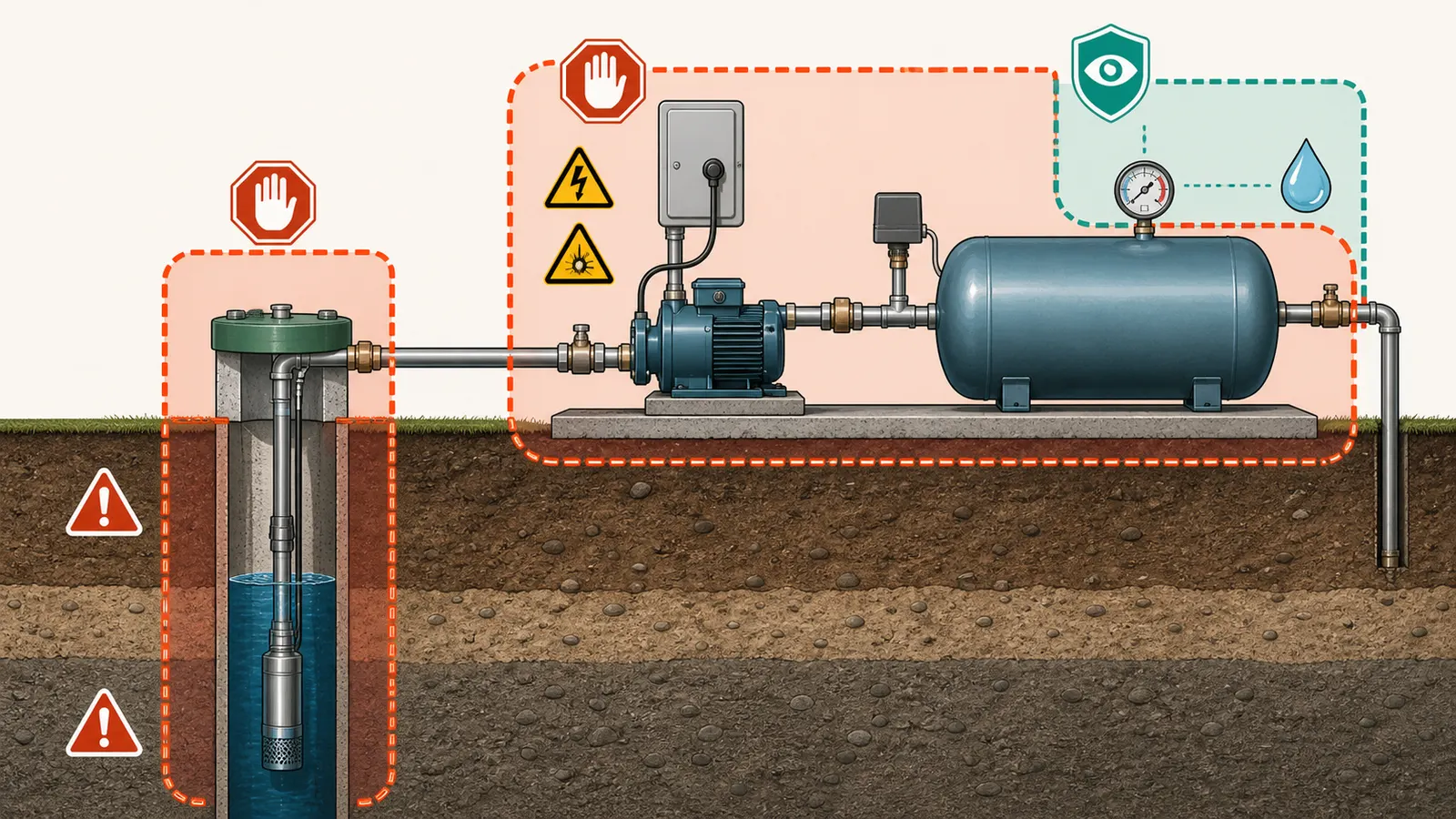
For high-safety reasons, this guide explicitly stops before electrical diagnosis, well entry, pump removal, pressure-equipment adjustment, and chemical treatment. Red Lion requires licensed electrical work for its pump's wiring and says to disconnect power before servicing. EPA directs owners toward state agencies, local health departments, and water-system professionals for well information, noting that licensing and certification requirements vary by state. Use a qualified well or pump professional familiar with private-well systems; use a licensed electrician for electrical work where required.
Prime loss is not a water-safety test
Pressure, flow, a successful reprime, or clear-looking water can describe the hydraulic symptom without establishing that the water is safe to drink. If contamination is suspected because of floodwater or runoff, sewage, a fuel or chemical odor, or an unexpected color, taste, or odor, stop using the water for drinking and cooking and switch to bottled water or another known-safe source. If chemical contamination is possible, do not use the water for any purpose until the responsible authority gives specific advice. CDC says to contact the local health department when contamination is suspected, then treat and test the water before using it again. A qualified well professional can inspect the well and pump system; neither a prime-loss log nor a pump that runs normally can replace water-quality testing.
Bring the professional a compact evidence packet:
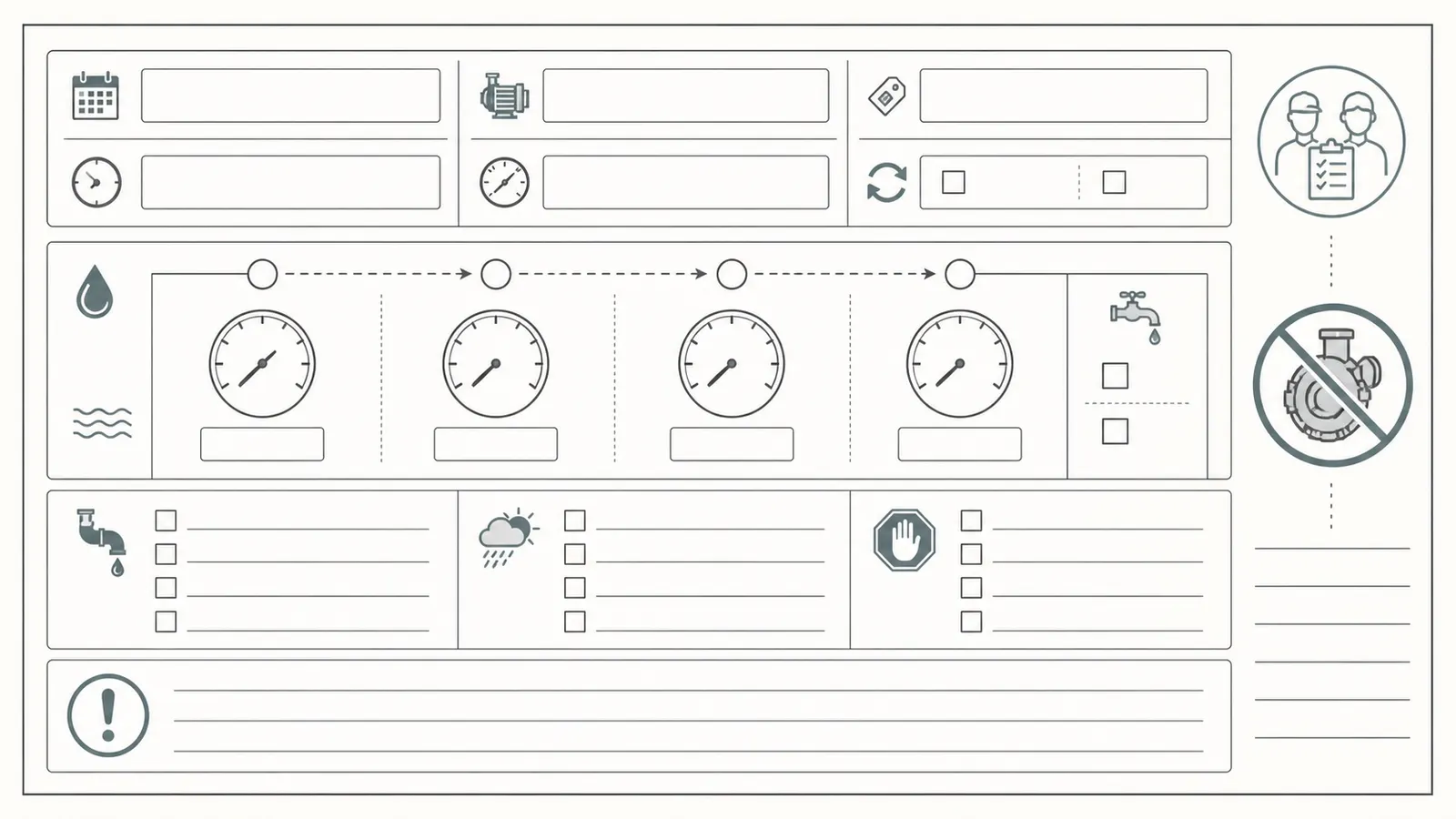
- pump type, model, horsepower, and a photo of the external label;
- whether it primes once, never primes, loses prime while sitting, or loses it while running;
- pressure-hold readings with times and any unexpected cycles;
- time-to-reprime records only for a manual-approved procedure;
- visible leak photos and the exact fixture or use pattern;
- the last known normal date and any outage, repair, freeze, flood, drought, irrigation, or high-demand event;
- pressure-tank model, installation date, and prior service records;
- well construction records and any prior static or pumping water-level measurements; and
- the exact symptom after a safe shutdown, without repeatedly restarting the pump.
The homeowner decision surface is therefore: identify the pump arrangement, distinguish never-primes from primes-then-loses-water, make only safe visible observations, log pressure hold and time to reprime without claiming a part-level result, allow at most the exact manual-approved reprime, and stop when the pattern recurs. That boundary preserves the pump, the evidence, and the household's next professional decision.
Sources and scope
Evidence behind this page
- U.S. EPA — Learn About Private Water Wells
EPA's component descriptions for private drinking-water wells; the approximate depth and common-use descriptions are orientation clues, not a universal pump-selection rule.
- UF/IFAS Extension — Pumps for Florida Irrigation and Drainage Systems
University of Florida agricultural and irrigation extension guidance, reviewed 2024; its numerical lift discussion is not a rating for every residential pump or geography.
- Red Lion — RJS-PREM Series Shallow Well Jet Pump Manual
A manufacturer installation manual for the named Red Lion shallow-well jet-pump series; do not generalize its pipe sizes, depth, or valve arrangement to another model without that model's manual.
- Red Lion — RJS-PREM Series Shallow Well Jet Pump Manual
Manufacturer troubleshooting for the named shallow-well jet-pump series; these are candidate causes, not a homeowner diagnosis or proof that a particular part failed.
- Red Lion — RJS-PREM Series Shallow Well Jet Pump Manual
A model-specific manufacturer procedure; Brictale uses it to define a one-manual-approved reprime boundary and does not apply the eight-try number to other pumps.
- Pentair Myers — Quick Prime Centrifugal Pump Installation and Service Manual
Manufacturer safety and priming instructions for the Myers Quick Prime centrifugal-pump series; exact procedures, pressure ratings, and controls remain model-specific.
- Pentair Myers — Quick Prime Centrifugal Pump Installation and Service Manual
Manufacturer troubleshooting for the named centrifugal-pump series; it supports candidate categories and does not turn a gauge observation into a part-level diagnosis.
- U.S. Geological Survey — What Determines If a Well Will Go Dry?
USGS groundwater explanation; it supports escalation for possible drawdown but does not provide a homeowner method for measuring a particular well's pumping level.
- U.S. EPA — Learn About Private Water Wells
EPA private-well component and professional-selection guidance; licensing and certification requirements vary by state and local jurisdiction.
- CDC — Guidelines for Treating Well Water
CDC private-well treatment and emergency guidance; a pressure or prime-loss observation is hydraulic evidence and cannot establish drinking-water safety or rule out contamination.