Why Does My Well Pump Bang When It Shuts Off?
Use the sound's exact timing to separate check-valve water hammer from cycling, pressure-tank, and mechanical pump trouble—and know when to stop use.
The short answer
A bang exactly as a well pump stops is often a check-valve slam: reverse flow stops suddenly and creates water hammer. If the noise repeats with rapid cycling, pressure swings, leaks, or a failing tank, the pressure system may be involved. A violent, new, worsening, or multi-hit bang can damage piping or equipment; stop discretionary use, avoid opening controls, and arrange qualified service.Why Does My Well Pump Bang When It Shuts Off?
Short answer: a bang that occurs exactly as a well pump stops is often a hydraulic event: water reverses briefly, a check valve closes, and the sudden stop creates water hammer. A bang that starts or ends a rapid sequence of pump cycles points more toward pressure-tank, leak, control, or flow problems. A noise that continues while the pump runs points toward a mechanical or installation issue. A violent, new, worsening, or multi-hit bang can damage piping, fittings, the pump, or the motor. Stop discretionary water use, do not open the controls or pressurized equipment, and arrange qualified service when the pattern is severe or changing.
This is a homeowner decision surface, not a pump-repair procedure. You can safely observe timing, listen from a dry accessible location, read an already-visible gauge, and record labels and symptoms. Do not open an energized control box, test live wiring, change pressure-switch settings, add air to a tank, open a pressurized fitting, pull a pump, open a well, or enter a well pit or other confined space. Assign electrical, pressure-vessel, well, drop-pipe, check-valve, and pump work to a qualified professional.
Legal and professional boundary: licensing, permits, isolation procedures, and well, plumbing, or electrical requirements vary by state and locality. This article does not determine whether a repair or system modification is legally permitted. Before any repair or modification, check with the applicable local or state health/environmental authority and use the appropriately licensed or certified well, pump, plumbing, or electrical professional where your jurisdiction requires one. Follow that professional's isolation instructions for the specific installation. EPA's state program directory and private-well protection guidance are starting points, not substitutes for local requirements.
1. Start with the exact moment of the sound
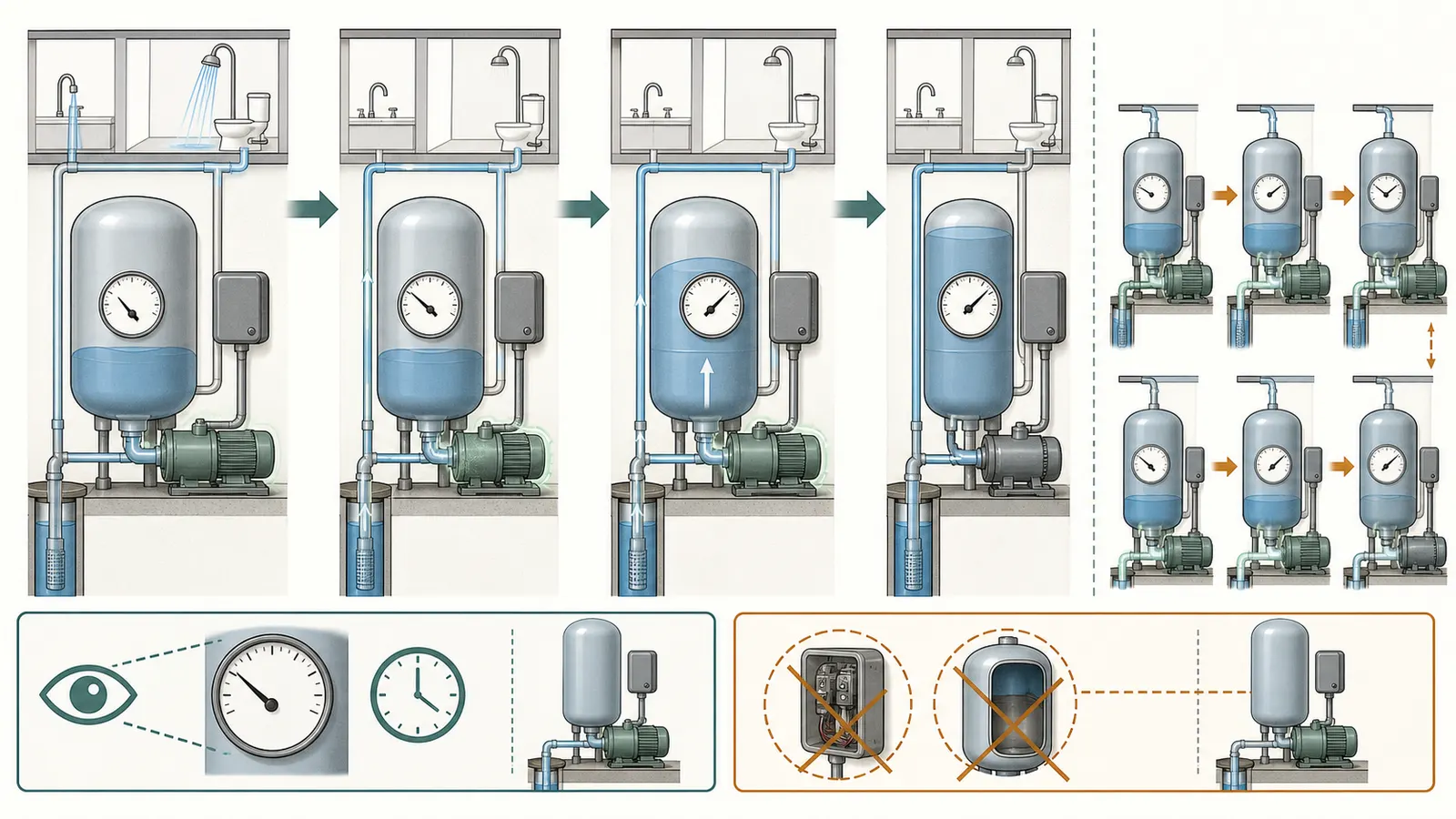
The useful question is not simply “does the pump make a bang?” It is: what event is happening at the instant of the bang? A pressure-switch system normally has distinct events: household water use lowers pressure, the pump starts, the pump runs while the tank refills, and the pump stops at the upper setting. Pentair’s controller manual describes the lower pressure setting as the point where the pump starts and the upper pressure setting as the point where it stops. Those terms are defined in its troubleshooting manual; your actual settings may be different and are not a reason to adjust anything yourself.
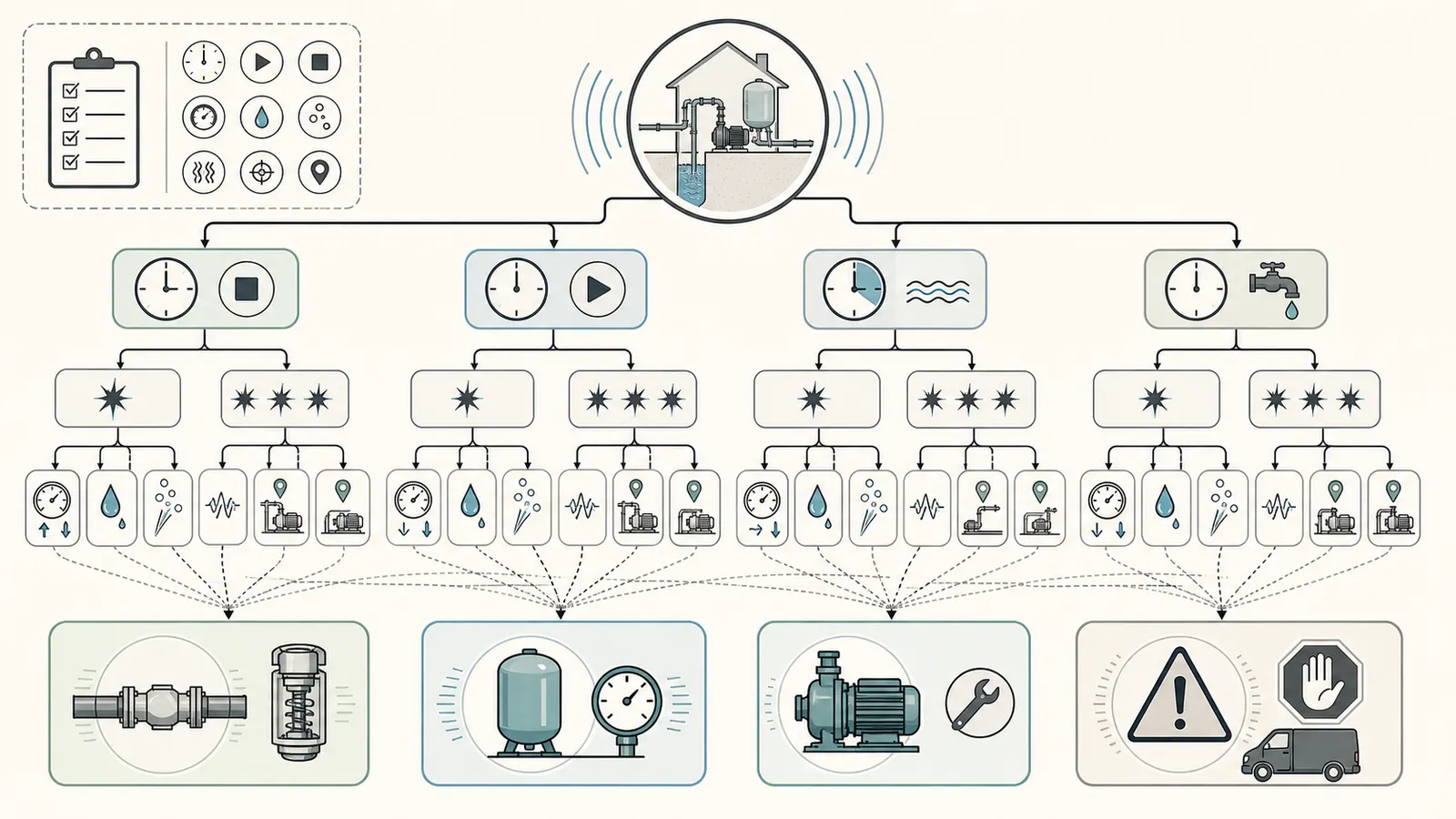
Use the following first pass. It is a sorting tool, not a sound-only diagnosis.
| When you hear it | Pattern that matters | Leading direction | Safest next move |
|---|---|---|---|
| Exactly as the pump stops | One heavy thud or one to several quick hits; often felt in nearby piping | Check-valve slam and water hammer caused by sudden flow reversal or stopping | Stop repeated testing. If new, violent, or worsening, schedule prompt well-pump service. |
| At pump start | Bang begins when the motor starts, sometimes after a pause or water draw | Startup hydraulic shock, a valve or pipe movement, or a control/mechanical event | Record whether it occurs only after a long idle. Have the installer inspect the check-valve and piping arrangement. |
| During the run | Grinding, squealing, rattling, humming, or vibration continues while water is being pumped | Mechanical pump/motor, cavitation, debris, loose mounting, or a flow-condition problem | Stop if severe, water delivery changes, or the pump overheats or trips; arrange qualified diagnosis. |
| After a faucet, toilet, appliance, or irrigation valve closes | Sound tracks a house fixture rather than the pump stop | House-side water hammer or a fast-closing valve | Stop the fixture test and have the plumbing and well professional consider the whole system. |
| In a repeating start-stop sequence | Pump starts and stops unusually often, pressure swings, or water use is low | Short cycling from tank, pressure-switch, leak, flow, or control trouble | Limit discretionary use and schedule service; do not keep cycling the pump to reproduce it. |
| Several minutes after shutdown | Sound is delayed, intermittent, or associated with pressure loss | Possible leak, reverse flow, thermal or fixture event, or a separate noise | Record the delay and whether a faucet or appliance was active; service is needed if pressure falls. |
The timing distinction matters because ordinary motor noise and hydraulic shock are produced by different events. A motor can hum or vibrate while energized. Water hammer is a pressure surge caused by a rapid change in flow velocity. Grundfos describes the phenomenon in those terms, while the engineering explanation from Water Well Journal describes a check valve closing when flow stops or reverses and the resulting pressure wave moving through the piping. Read the engineering discussion.
Do not infer that every shutdown bang is a failed pump. The sound may originate in the drop pipe, check valve, tank tee, house piping, a treatment device, or a fixture. Conversely, do not infer that the pump is healthy because it still delivers water. A system can continue to supply water while a valve slams, a tank loses useful air cushion, or a pipe support is being shocked.
2. Understand the shutdown mechanism without taking anything apart
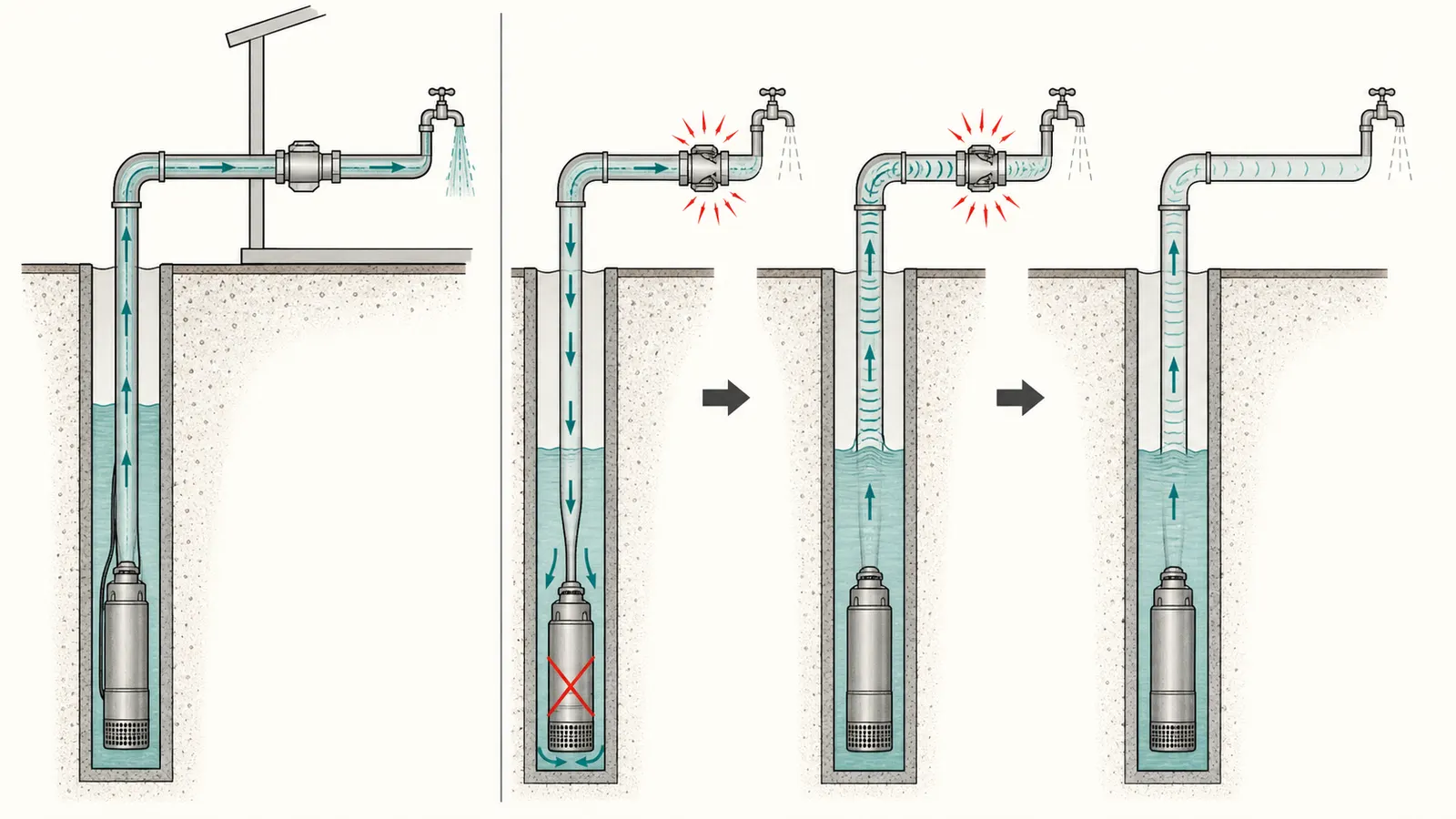
In a typical submersible-well arrangement, the pump pushes water upward through a drop or discharge pipe. During operation, water has momentum. When the pump stops, the water column can try to move back toward the well. A check valve is intended to permit flow in the desired direction and limit reverse flow. If reverse-moving water meets a valve that closes abruptly, its motion is converted into a pressure wave. That wave can travel through the drop pipe and house piping, where it may be heard as a bang or a fast series of knocks.
Grundfos gives a homeowner-relevant description of this sequence: the submersible pump shuts off, water flows back down, the non-return valve slams shut, and the pressure surge bounces between boundaries before diminishing. It says the sound may be one or a few quick hammers and warns that pressure surges can burst pipelines or joints or damage the pump and motor. See the manufacturer explanation.
The Water Well Journal engineering article adds an important diagnostic nuance: check valves are not supposed to be dismissed as devices that inevitably slam. Its discussion identifies sizing, selection, wear, excessive velocity, sand, and extreme cycling as factors that can make slamming more likely. It also describes how reverse flow can create a pressure or shock wave that oscillates until friction and pipe-wall effects dissipate it. That is an engineering account, not a diagnosis of your installation.
This explains why exact timing is so valuable. If the pump is quiet while running, then stops and the bang occurs immediately, the event is compatible with a flow-stop problem. If the sound is a steady growl while the motor runs, the shutdown moment is probably incidental. If the sound occurs after a faucet closes while the pump continues to run, house-side water hammer becomes more plausible. These are working directions for a professional, not permissions to replace a valve or alter a setting.
A shutdown bang can also be made worse by the system around the valve. The cited Pentair Defender manual lists a check valve between the tank and controller, treatment installed between controller and tank, no tank, a waterlogged tank, and an undersized tank among possible water-hammer causes for that controller installation. It separately lists a waterlogged tank as a possible short-cycle cause. Use that table only within its product and installation scope. The practical takeaway is not “replace the tank”; it is “do not isolate the pump from its tank, treatment, and check-valve arrangement when describing the symptom.”
Jet-pump systems have different component locations, but the same one-way principle appears in homeowner guidance. The Minnesota Department of Health’s well-owner handbook describes a foot valve as a check valve that allows flow while a jet pump runs and closes when the pump shuts off. The handbook’s component description is general homeowner education; the exact valve arrangement depends on the pump and well design.
3. Use the decision matrix before you test anything
Record the pattern in the table below. Put a question mark beside anything you cannot observe safely. “Unknown” is more useful than a guess because it tells the professional which event needs to be reproduced or measured with proper instruments.
| Observation | Fits shutdown water hammer/check-valve slam? | Fits tank/cycling trouble? | Fits mechanical pump noise? | What to record |
|---|---|---|---|---|
| Bang occurs within a moment of pump stop | Strongly compatible | Possible contributor | Less typical if pump is otherwise quiet | Stop timing, number of hits, location |
| One to three quick hits that fade | Compatible with a pressure wave | Possible if tank or valve condition changes the event | Less typical | Whether each hit is immediate and diminishing |
| Pump starts again soon after stopping | Not enough by itself | Strong clue | Possible secondary effect | Start-to-stop and stop-to-start intervals |
| Pressure gauge swings or falls while no water is being used | Not enough by itself | Leak, tank, check-valve, or control direction | Not primary | Gauge value and time, without touching controls |
| Bang occurs while motor is running | Less typical | Possible flow problem | Stronger direction | Whether sound is hum, grind, rattle, squeal, or vibration |
| Water spurts or air appears at a faucet | Can coexist with reverse-flow or pressure trouble | Can follow pressure loss | Can follow pump/control failure | First-flow behavior and whether it stabilizes |
| Visible pipe movement, leak, wet electrical equipment, or damage | Risk escalation | Risk escalation | Risk escalation | Stop discretionary use; do not approach unsafe equipment |
| Sound began after pump, tank, valve, treatment, or piping work | Installation/compatibility direction | Installation direction | Installation direction | Date, invoice, model, and what changed |
The matrix deliberately avoids a “listen once and replace X” answer. Sound travels through water-filled piping and building framing. A bang heard at a basement wall may be generated above, below, or inside a well component. A professional may need to compare pressure readings, pump current, flow, valve behavior, and the installation layout. Those are service measurements, not homeowner requirements.
What a tank can and cannot explain
A pressure tank stores water and air under pressure and gives the pump a pressure range in which it does not need to run continuously. Connecticut’s Department of Public Health explains that hydropneumatic tanks provide pressurized water, prevent a pump from starting at every slight demand, and minimize pressure surges. Its page is written for small community public-water systems, so its maintenance and inspection statements are not a residential schedule; the tank-function explanation is still useful.
A waterlogged tank is listed by Pentair as a possible short-cycle cause, and its product troubleshooting table lists several tank, treatment, and check-valve arrangements among possible water-hammer causes. Connecticut DPH says hydropneumatic tanks deliver water within a predetermined pressure range and minimize pressure surges. Those sources do not establish that a failing or waterlogged tank is causing pressure swings or a changed shutdown event in your home. If rapid cycling or a pressure change accompanies the bang, include the tank and controls in the service scope. If it is an isolated immediate thud with stable cycles, the valve and hydraulic behavior deserve equal attention. Pentair's table is product-specific, and Connecticut DPH's tank page is written for small community public-water systems rather than a residential inspection schedule.
Do not remove a tank valve cap, add compressed air, depressurize the vessel, or loosen a fitting as a “quick check.” Pressurized vessels and connected piping can release energy. Connecticut DPH warns that aging, corroded, cracked, or damaged hydropneumatic vessels can fail catastrophically and advises regular preventive maintenance and scheduled inspections for the public systems within its scope. Use that warning as a reason to stay outside the pressure-vessel work boundary.
4. Make a safe observation record
The best homeowner contribution is a short, repeatable event log that does not create a new hazard. You do not need to make the pump bang on demand. If the event happens during normal water use, one brief observation is enough; repeated flushing, irrigation, or appliance tests can stress a marginal system and will not identify the failing component.
Observation procedure
Choose a safe position. Stay on a dry floor and away from wet electrical equipment, open pits, exposed wiring, moving machinery, and the well opening. Listen from a doorway or other accessible location if the pump equipment is in a utility room.
Write the event trigger. Note whether the pump was already running, whether a faucet or appliance was using water, and whether the sound happened at startup, during operation, at shutdown, or after a fixture closed.
Count the pattern once. Record “one bang,” “two quick hits,” “several diminishing hits,” or “continuous vibration.” Do not stand beside the equipment waiting for another event if the bang is violent or the area is wet.
Read only what is already visible. If a pressure gauge can be read without removing a cover or touching a control, record the approximate indication and time before and after the event. If it is fogged, stuck, unlit, or hard to read, record “unknown.” Do not treat a gauge as a laboratory instrument or proof of tank precharge.
Observe one ordinary fixture briefly, only if there is no stop-use condition. Note whether the initial stream is steady, weak, air-filled, or spurting. Close it normally. Do not remove aerators, disconnect hoses, open drain valves, or use a fixture to force a long pump run.
Look from a distance for consequences. Record only visible, accessible clues: water on the floor, a new leak, pipe movement, a pressure loss, a tripped control indication, a burning smell, or unusual water appearance. Do not touch, wipe, reset, or energize damaged equipment.
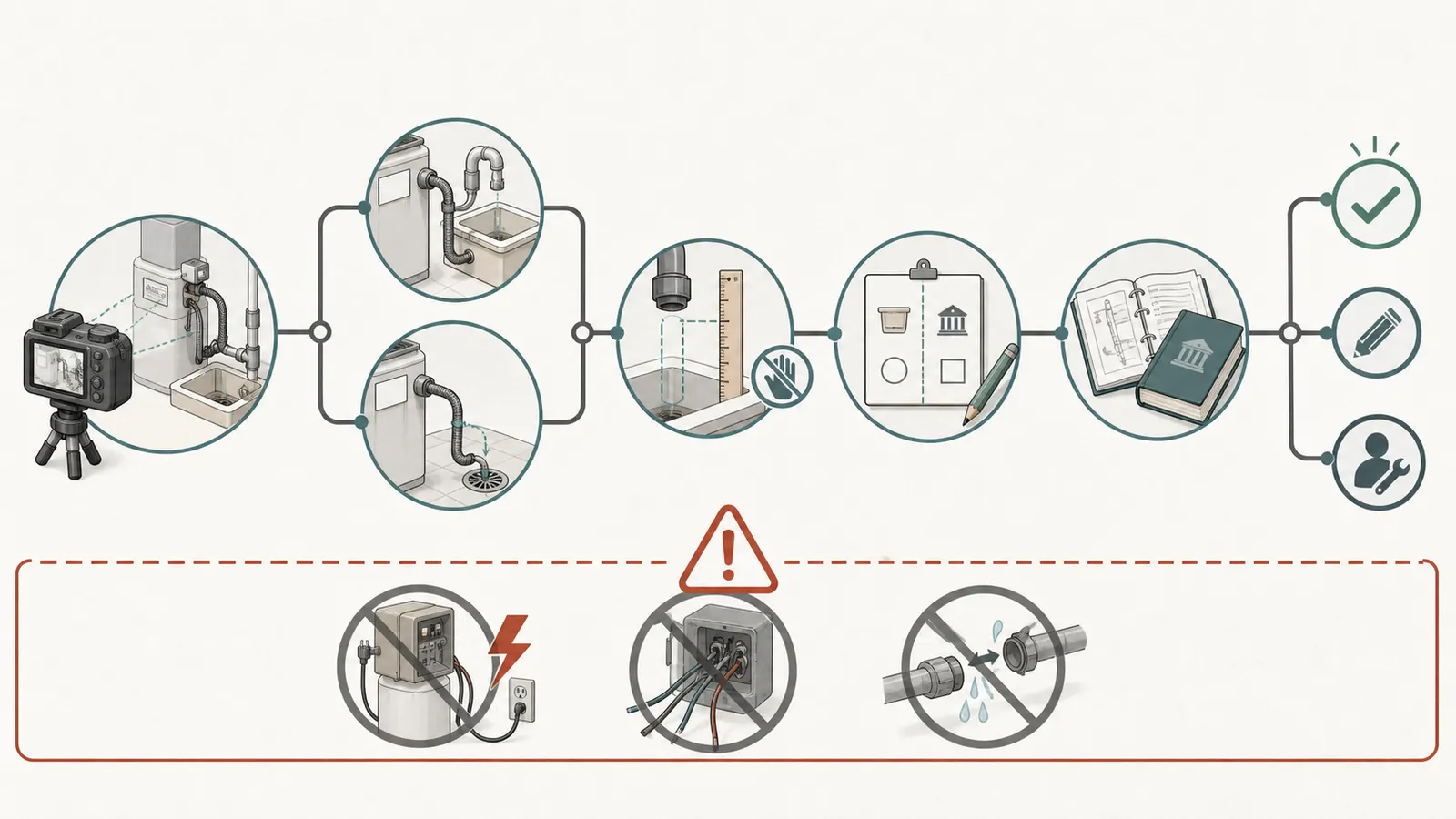
Photograph labels, not hazards. Capture the pump, tank, controller, pressure-switch, and treatment model labels if they are visible from a safe position. Photograph the piping layout from outside the hazard area. Do not remove covers or insulation to find a model number.
Stop the observation. Put the system back into ordinary use only if there was no violent or worsening event, no visible leak or damage, and no pressure-loss concern. Otherwise limit water use and arrange service.
The compact log to give a professional
| Field | Entry to make |
|---|---|
| Date and time | When the noise occurred; outage or recent work if relevant |
| Trigger | Faucet, toilet, appliance, irrigation, automatic demand, or unknown |
| Pump event | Start, run, stop, or unknown |
| Sound timing | Immediate, delayed, or unrelated to pump event |
| Number of hits | One, several quick hits, repeated bangs, or continuous noise |
| Sound location | Tank area, wellhead, exposed house piping, wall, or unknown |
| Gauge | Visible reading and time, or “not visible/unknown” |
| Cycle behavior | Normal-looking, repeated start-stop, continuous run, or unknown |
| Water behavior | Steady, air, spurting, weak, no flow, color/odor change |
| Visible clues | Leak, pipe movement, wet or damaged equipment, none seen |
| Recent change | Pump, check valve, tank, treatment, piping, electrical, or no change |
| Labels and records | Model photos, installation date, prior repairs, service history |
The record is not an inspection certificate and does not establish that a component is safe. Its purpose is to preserve the event without inviting unsafe access. EPA recommends that private-well owners keep accurate maintenance records and use qualified well professionals for construction and modification work. See EPA’s private-well protection guidance.
Water-quality boundary: a noise diagnosis cannot clear the water
Color, odor, taste, air, or spurting water may be a pressure or equipment clue, but a suspected water-quality or contamination change is not resolved by identifying water hammer. Treat it as a separate safety issue—especially after flooding, pressure loss, or opening, repairing, or modifying the well system. Stop using the water for drinking and cooking until the applicable local or state health/environmental authority gives instructions. Use that authority's jurisdiction-specific alternate-water guidance; do not assume that boiling, chlorination, filtration, or bottled water is the correct response for every contaminant or event.
Contact the local or state health department or environmental agency, a certified drinking-water laboratory, and the appropriately qualified well or pump professional as directed. EPA says to test promptly after a change in water quality, flooding, or well-system repair, to use a certified laboratory, and—after a suspected flood—not to drink or wash from the well until the relevant guidance is followed. Read EPA’s testing and disaster guidance. The sound log can document the timing; it cannot establish that the water is safe.
5. Decide whether the system can remain in discretionary use
Use the most protective branch that matches what you observed.
A single, unchanged, mild thud with stable service
If the sound is old, unchanged, happens only once at pump shutdown, there is no rapid cycling, no pressure loss, no leak, no pipe movement, and no unusual water behavior, the immediate decision may be to avoid deliberate testing and schedule the issue at the next qualified service visit. “Mild” is not a technical measurement; it means there is no sign of worsening or damage and the event is not startlingly violent relative to its established pattern.
Write down the history and ask the professional to inspect the check-valve arrangement, pump and drop-pipe installation, pressure tank, pressure switch, treatment equipment, and house-side piping as a system. Do not accept a diagnosis based only on the sound if the professional has not asked when it occurs.
A new, recurring, or louder bang with pressure or cycling changes
Limit discretionary use: no irrigation, long showers, repeated fixture cycling, or appliance runs intended to test the system. Keep only necessary water use until a well/pump professional can assess it. Arrange service soon, especially when the bang began after a repair, pump replacement, tank work, treatment installation, or piping change.
The service request should say: “The bang occurs [at startup / during run / exactly at shutdown / after fixture closure], happens [number] times, and is accompanied by [cycle or pressure behavior].” Include model labels and the event log. That language makes a hydraulic inspection more likely than an automatic motor replacement.
A violent or worsening bang, multiple hard hits, visible pipe movement, leak, or pressure loss
Stop discretionary use and arrange prompt qualified service. If a pipe is visibly moving, a fitting is leaking, water is spraying, the pressure is gone, or the sound is rapidly escalating, do not remain beside the equipment to listen. If safe from a dry location, stop using water and follow the professional’s or local utility’s instructions about isolating the system. Do not shut or open an unfamiliar valve in a wet or energized area.
The reason for this boundary is physical, not dramatic language. Grundfos warns that pressure surges can break joints, burst pipelines, and damage a pump or motor. Water Well Journal likewise describes check-valve slamming as capable of producing conditions from rattling pipes to damaged equipment and burst pipes. Grundfos’ warning and the engineering discussion support treating a violent shutdown bang as a service issue rather than an entertaining sound test.
Electrical, flood, tank, or well danger
Leave the area and call the appropriate qualified help if controls, wiring, pump equipment, or the pressure vessel are wet, burned, melted, exposed, corroded, leaking, or physically damaged. Do not test for voltage, remove a control cover, reset a breaker while standing in water, or energize a flooded pump. EPA specifically advises staying away from a flooded well pump because of electric-shock risk and using an experienced well contractor for inspection and testing after flooding. Read the EPA guidance.
The correct professional may be a well/pump contractor, licensed plumber, qualified electrician, or a combination. A pressure-vessel issue is not made safe by adding air. A check-valve issue is not made safe by repeatedly starting the pump. A pump that trips or loses pressure is not made safe by bypassing a control. Keep the system de-energized or otherwise isolated only as directed by a qualified person familiar with the installation.
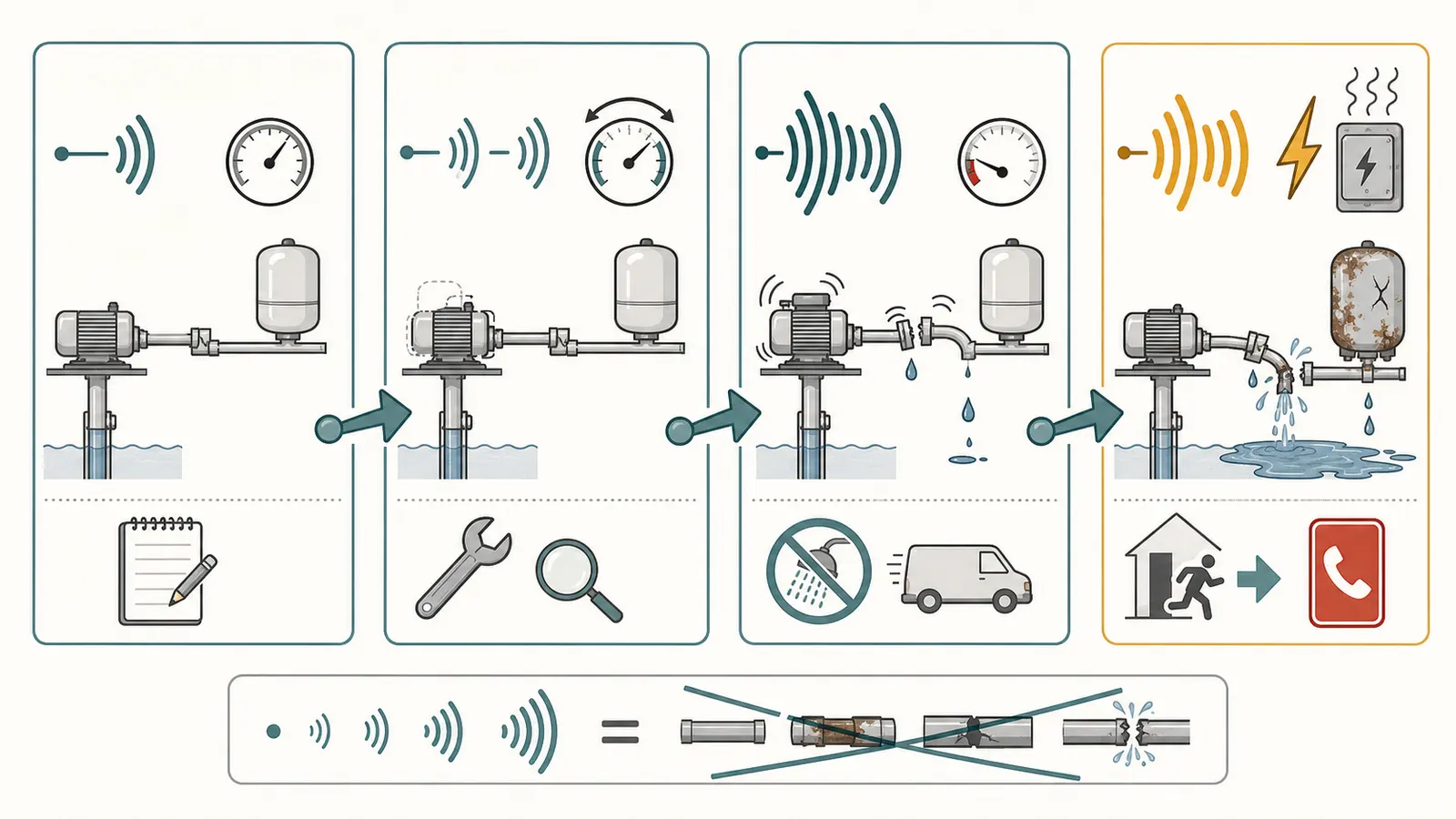
6. Separate the repair paths a professional should evaluate
The homeowner does not need to select a part, but understanding the possible paths helps you assess whether the service scope fits the evidence.
Check valve and reverse-flow path
This path is most consistent with an immediate shutdown bang, a short cluster of diminishing hits, and little or no motor noise while running. The professional may inspect check-valve placement, condition, sizing, orientation, reverse flow, sand or debris, pipe supports, and the well-pump installation. The Berkeley/Pentair submersible turbine manual warns that backspin and hydraulic shock can severely damage a pump and motor and calls for at least one discharge-pipe check valve for that equipment. Its distances and requirements are model-specific.
This is also why a check valve belongs in the inspection scope even when the pump still runs. The Minnesota Department of Health’s sanitary-survey information lists a missing check valve and a check valve stuck open among pump-facility deficiencies to identify during a water-system inspection. That list is public-water-system inspection guidance, not a homeowner self-test.
Do not copy a distance from that manual into a residential system. Grundfos’ example about a non-return valve more than 30 feet above the water level is also installation-specific. These sources establish why location and reverse flow matter, not a universal homeowner correction.
Pressure tank, switch, leak, and cycling path
This path rises when the pump starts and stops repeatedly, pressure falls when no water is being used, the tank has a history of poor performance, or the bang changed after pressure-system work. A professional may verify tank condition, switch settings, pressure gauge accuracy, leaks, flow rate, treatment isolation, and whether the pump is correctly matched to the system. Pentair’s troubleshooting table explicitly links a waterlogged tank to short cycling and lists several tank, treatment, and check-valve arrangements among possible water-hammer causes for its controller. The table should be read as a troubleshooting list, not a part-ordering instruction.
Short cycling can itself shorten equipment life because the motor is asked to start repeatedly. But a homeowner should not “fix” it by turning a pressure screw or changing precharge without the exact instructions, a depressurized and verified system, and the required competence. Pressure tanks are connected to stored energy and, in some systems, hazardous electrical controls.
Mechanical pump, motor, flow, and installation path
This path rises when the noise continues while running, changes with flow, is accompanied by vibration, sand, reduced delivery, overheating, trips, or unusual current behavior, or began after work near the pump. Possible causes include wear, debris, cavitation, poor operating conditions, damaged bearings, loose piping, or motor/control faults. A Berkeley manual cautions against operating outside the pump’s pressure and flow range and says not to operate with a discharge valve closed. Those limits belong to the specified pump model.
If the pump runs continuously, loses prime or pressure, delivers sand, or repeatedly trips, stop treating the symptom as a noise-only nuisance. The professional needs the pump model, well depth and construction records if available, recent service history, observed cycle behavior, and any water-quality change.
House-side piping and fast-closing fixtures
If the sound occurs when a toilet fill valve, washing machine, dishwasher, irrigation valve, or faucet closes, the source may be in household piping rather than the well pump. The pump may happen to stop at the same time because the pressure tank reaches its upper setting, which creates a misleading correlation. Note which fixture was active and whether the sound happens when the pump remains running. A plumber or well professional can then assess the fixture, pipe supports, valves, and pressure system together.
7. Prepare the service handoff and prevent a repeat
Before calling, gather the event log, photos of visible labels, the well and pump installation date if known, the pressure-tank model and size if visible, the pump model, recent invoices, any treatment equipment between the tank and fixtures, and the exact wording of the symptom. Ask the professional to document:
- where the sound is generated or transmitted;
- whether the event is hydraulic shock, mechanical noise, pressure cycling, or unresolved;
- whether the check-valve arrangement is correct for this pump and well;
- whether pressure and flow are within the pump’s model-specific operating range;
- whether the tank, gauge, switch, treatment, and piping are functioning as a coordinated system;
- what evidence supports any recommendation to replace a tank, valve, pump, controller, or pipe; and
- what use limit applies before the repair is complete.
Do not let a generic statement such as “all well pumps do that” close the investigation if the bang is new, worsening, or damaging. The evidence says that a shutdown pressure wave can be serious, while a tank or cycling problem can change the conditions that make the wave audible. The right service scope follows the event pattern.
For ongoing care, keep a simple record of pump and tank service, check-valve or piping changes, unusual water events, and any recurring pressure behavior. EPA recommends accurate private-well maintenance records and qualified well professionals for construction and modification work. See EPA’s private-well protection guidance.
The homeowner’s final decision can be simple:
- Immediate shutdown event, stable system, unchanged mild pattern: do not reproduce it; log it and schedule informed service.
- New or repeated event with cycling, pressure loss, leaks, or water changes: limit use and arrange prompt qualified inspection.
- Violent or worsening bang, visible movement or damage, flooded or energized hazard: leave the hazard area, stop discretionary use, and obtain qualified help.
That timing-and-pattern record is enough to move the problem forward without guessing at a valve, opening a tank, or turning a warning sound into a preventable failure.
Sources and scope
Evidence behind this page
- Grundfos — What does water hammering mean, and what causes it?
Grundfos explanation for well and submersible-pump installations; its 30-foot check-valve placement examples are manufacturer guidance, not a universal residential rule.
- Water Well Journal — Engineering of Water Systems: Part 17(d), Mechanical Design, Valves, Part 4
Engineering discussion by a PE/CPI published by Water Well Journal; it supports the hydraulic mechanism and risk framing, not a diagnosis of any specific home.
- Connecticut Department of Public Health — Hydropneumatic Tank Assessment
Connecticut DPH guidance for small community public water systems, not a residential inspection schedule or nationwide tank-life rule; used here to explain tank function and why pressurized tank hazards must not be improvised around.
- Pentair — Pentek Defender CSC-Link Manual
Pentair troubleshooting for the Pentek Defender controller; listed causes are product/system troubleshooting possibilities, not proof that any one cause is present in a homeowner's installation.
- Pentair — Pentek Defender CSC-Link Manual
Terminology and controller settings in the cited Pentair manual; actual settings vary by system and must not be adjusted from this article.
- Minnesota Department of Health — Well Owner's Handbook: A Consumer's Guide to Water Wells in Minnesota
Minnesota homeowner education about private-well components; the component descriptions are general, while Minnesota construction and licensing requirements remain state-specific.
- Pentair Berkeley — TMH Series Submersible Turbine Manual
Berkeley TMH submersible turbine equipment manual; installation distances and operating limits are model-specific and are not homeowner adjustment instructions.
- U.S. EPA — Protect Your Home's Water
EPA private-well protection and flood guidance; it supports the recordkeeping and professional-boundary language, not a universal pump-repair procedure.
- Minnesota Department of Health — Sanitary Survey Information for Public Water Systems
Minnesota public-water-system sanitary-survey information; it supports the professional inspection branch and is not a homeowner self-test or a diagnosis.
- U.S. EPA — Protect Your Home's Water
EPA private-well testing and disaster guidance; it supports separating water-quality decisions from a pump-noise diagnosis, while the applicable alternate-water and treatment instructions remain jurisdiction- and contaminant-specific.
- U.S. EPA — Private Drinking Water Well Programs in Your State
EPA's nationwide directory and private-well guidance support checking applicable state and local authority requirements and using the credentialed professional required by that jurisdiction; they do not determine legal permission for a particular repair.