Should I File an Insurance Claim for a Well Pump Failure?
A policy-specific worksheet for deciding whether to claim a well-pump failure, comparing cause, coverage, deductible, evidence, and claims-history questions.
The short answer
File or call for a coverage review when a covered event may have caused sudden pump damage or when the failure also damaged the house. Pay out of pocket is often more rational when the technician finds ordinary wear, a dry or low-yield well, or a repair total near or below the deductible. Preserve the pump, controls, photos, report, and receipts first; your policy and insurer decide coverage.Should I File an Insurance Claim for a Well Pump Failure?
Start with the cause, not the invoice. A failed well pump is worth reporting for a coverage review when a covered event may have caused sudden physical damage, when an equipment-breakdown endorsement may apply, or when the failure also damaged the house. Paying out of pocket is often more rational when a qualified technician finds ordinary wear, a dry or low-yield well, or a repair total close to or below the deductible. That is a screening decision, not a coverage ruling: your policy, endorsements, exclusions, limits, deductible, and insurer control the result. NAIC describes a homeowners policy as a legal contract and directs policyholders to read it and contact the agent or company with questions. NAIC's consumer guide makes the same boundary important here.
Use this order:
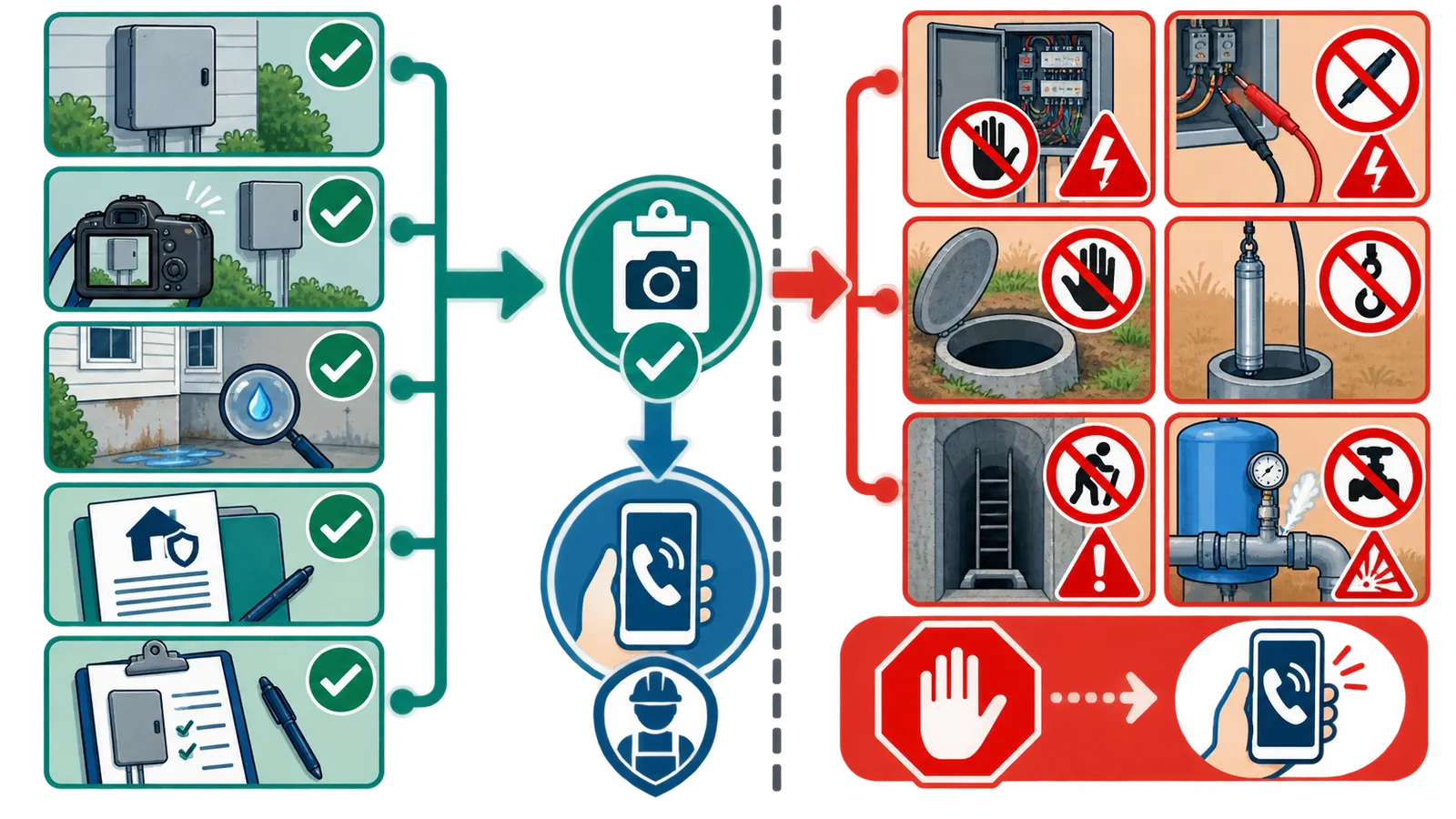
- Make the system safe and preserve the cause-of-loss evidence.
- Get the technician's written finding: pump, control, wiring, well yield, pressure tank, or another component.
- Put the failure into the right coverage lane.
- Compare the plausible covered amount with the applicable deductible and any ACV depreciation or sublimit.
- Ask the insurer how a claim or claim inquiry is recorded and how it could affect renewal in your state and rating plan.
Contamination boundary: stop using the water. If contamination is suspected because of an unusual color, odor, taste, flood, sewage, fuel, chemical exposure, or another warning sign, do not drink or use the well water, and do not try to diagnose or treat it from this article. Use bottled or another known-safe source. Contact your local health department and a qualified well-water professional for appropriate testing and next steps; CDC says suspected contamination requires a safe alternate source and health-department guidance, and directs homeowners to a well-water contractor for treatment decisions. CDC's well-water treatment guidance also says chemical contamination must not be boiled or treated as though a generic home remedy makes it safe.
Do not attempt opening energized controls, testing live wiring, opening a well, pulling a submersible pump, entering a confined space, or manipulating pressurized equipment to improve your evidence. Pentair's submersible-pump manual warns that hazardous voltage may be present and says power must be disconnected before work around the control box, pipes, cable, pump, or motor. The manufacturer's safety instructions are equipment-specific, but the stop-and-call boundary is appropriate for a high-risk homeowner decision.
1. The fast claim-or-pay screen
The most useful first question is not “Is a well pump covered?” It is: “What caused this failure, and which part of the loss am I asking the policy to pay for?” A single visit can reveal several different losses:
| What failed or was damaged | Evidence to request | Coverage question to ask | First decision signal |
|---|---|---|---|
| Submersible or jet pump | Written diagnosis, model, age, failed part, photos before removal | Is the pump covered under the base policy, an equipment-breakdown endorsement, or neither? | Sudden mechanical or electrical breakdown points to an endorsement question; a worn component points to exclusions and maintenance wording. |
| Control box, pressure switch, or pump circuit | Technician's electrical diagnosis and photos; do not test it yourself | Is electrical damage from the event covered? Is there a separate equipment-breakdown or power-surge provision? | A documented external event may matter; a tripped control with no established cause is not proof of a covered event. |
| Well yield or water level | Static water-level and recovery findings from the well contractor | Does the policy address the resulting property damage, and does it exclude depletion, drought, or maintenance conditions? | A low or dry well is a water-supply condition to document, not automatically a pump failure claim. |
| Buried wiring or water line | Location, length, photos, and written estimate; avoid digging without utility checks | Is the affected item part of the insured property, and is the cause covered? | The pump invoice alone does not answer whether buried components or excavation are included. |
| Interior or structural water damage | Photos, moisture or material scope from the appropriate professional, receipts | Is resultant damage covered separately from the failed pump? What limits and deductible apply? | House damage can change the economics even when the pump itself is excluded. |
NAIC's homeowners shopping guide lists a water well pump as an example of equipment-breakdown coverage and lists equipment breakdown as an optional coverage to ask about. That is a useful search term for your declarations page and endorsements, not proof that your policy pays. Read the NAIC coverage worksheet.
As a practical screen, lean toward a prompt claim or coverage call when any of these are true:
- A dated lightning, fire, wind, freeze, utility, or other event may have caused physical damage, and the policy lists that peril or does not exclude it for the affected property.
- The declarations page or endorsement schedule names equipment breakdown, home systems, mechanical breakdown, or similar language.
- The technician finds sudden electrical, mechanical, or pressure-system failure and the endorsement wording appears to match it.
- Water escaped or accumulated and damaged floors, walls, cabinetry, insulation, or other insured property.
- The estimated covered loss is materially larger than the deductible after subtracting work that the policy is unlikely to cover.
Lean toward documenting and paying out of pocket, or at least obtaining a coverage discussion before opening a formal claim, when:
- The technician finds age-related wear, corrosion, a worn seal, a failed bearing, routine maintenance, or a component that simply reached the end of its service life.
- The well is low, dry, or unable to recover at the required rate, and no separate insured event caused physical damage.
- The likely covered amount is at or below the deductible.
- You cannot yet separate pump replacement from noncovered well work, excavation, upgrades, water treatment, or a larger redesign.
This is not a universal “never claim a small loss” rule. A formal claim can be appropriate even when the first estimate is uncertain, especially if there is active property damage or a reporting deadline in your policy. The point is to make the call with a documented cause and a realistic payment range.
2. Establish what actually failed
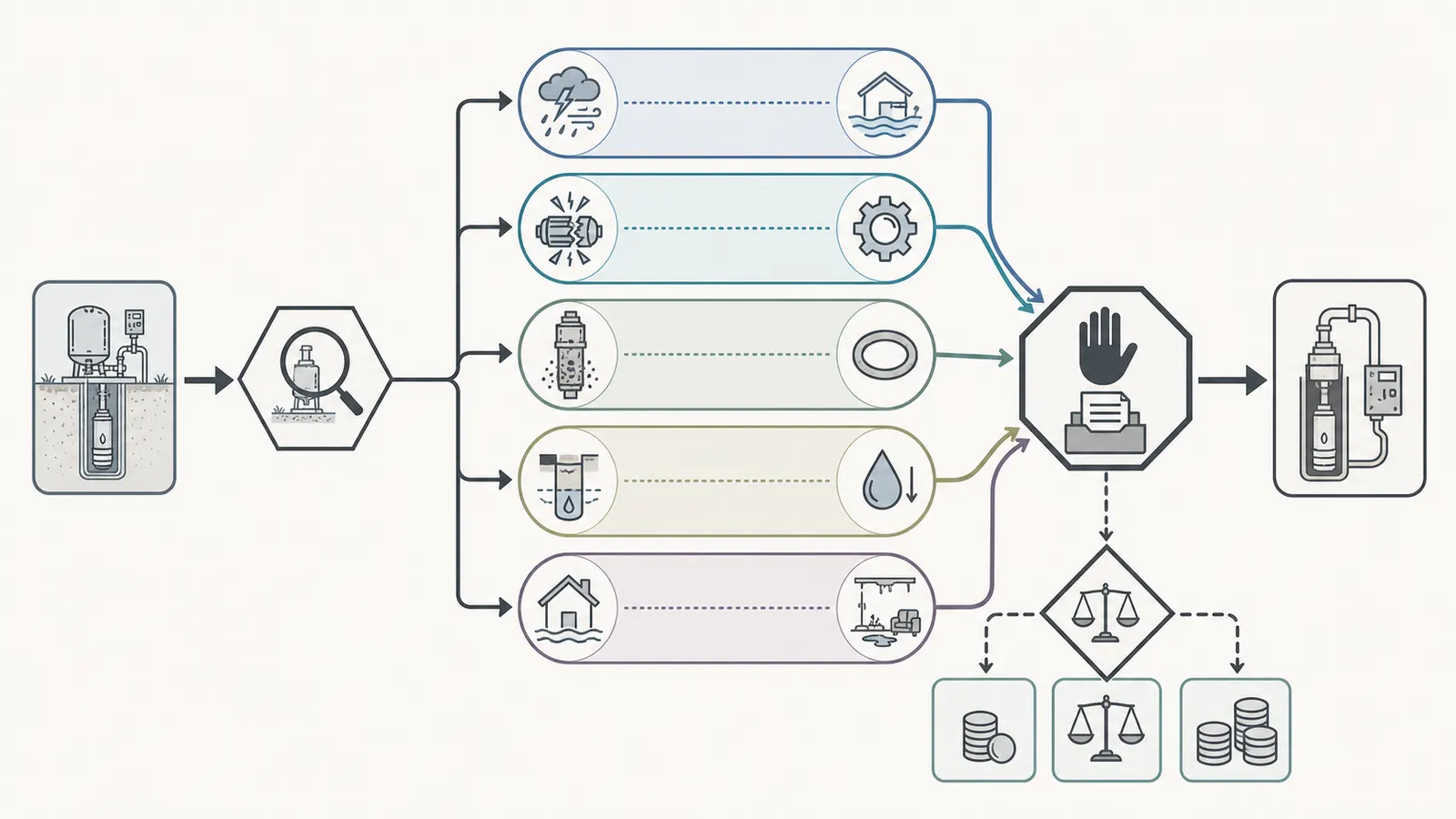
“No water” is a symptom, not a diagnosis. The Water Systems Council says a no-water condition can be caused by a low or dry well, loss of electricity or a blown fuse, a pressure tank, or pump wiring; it also says the only sure way to tell whether the well has run dry is to measure the water level, which can be complicated and should be handled by a licensed well contractor. Its wellcare guidance gives you the exact reason to keep “pump failure” and “water-supply failure” as separate records.
Ask the service professional for a short written report that answers:
- What symptom was observed: no water, low pressure, rapid cycling, breaker trip, humming, leaking, or another condition?
- What was tested, and what was not tested?
- Is the pump motor, pump end, control box, pressure switch, pressure tank, buried wiring, buried line, well yield, or another component the confirmed failure point?
- What is the most likely cause: sudden electrical event, lightning, freeze, blockage, dry running, corrosion, wear, installation issue, or undetermined?
- What evidence supports that conclusion: a failed component, burn marks, fault history, measured water level, pressure behavior, or visual damage?
- What must be removed or disturbed to restore water, and what can be retained for inspection?
- Is the recommended replacement like-for-like, or does it include an upgrade, resizing, new controls, treatment, storage, or well work?
The phrase “failed pump” may describe the visible end point even when the original cause was a low-yield well, a control failure, or a line problem. Do not infer pump damage from a dry-well symptom alone: the Water Systems Council identifies a low or dry well as one possible cause of no water and warns that adding outside water can damage the borehole and pump. Its wellcare guidance supports documenting the water-level finding without turning it into a pump diagnosis. Record the professional's words exactly and keep “confirmed,” “likely,” and “not determined” distinct. An insurer can evaluate the cause, but neither a homeowner nor an invoice should be expected to turn a symptom into a forensic conclusion.
Safe homeowner observations are limited to recording the failure date and time, noting whether weather or a utility event happened, photographing visible conditions without opening equipment, identifying whether water reached the house, and reading the policy. Do not remove a control-box cover, probe terminals, reset unknown equipment repeatedly, or turn a failed system back on to create a test. If water is near electrical equipment, keep clear and call a qualified professional.
3. Match the cause to the coverage lane
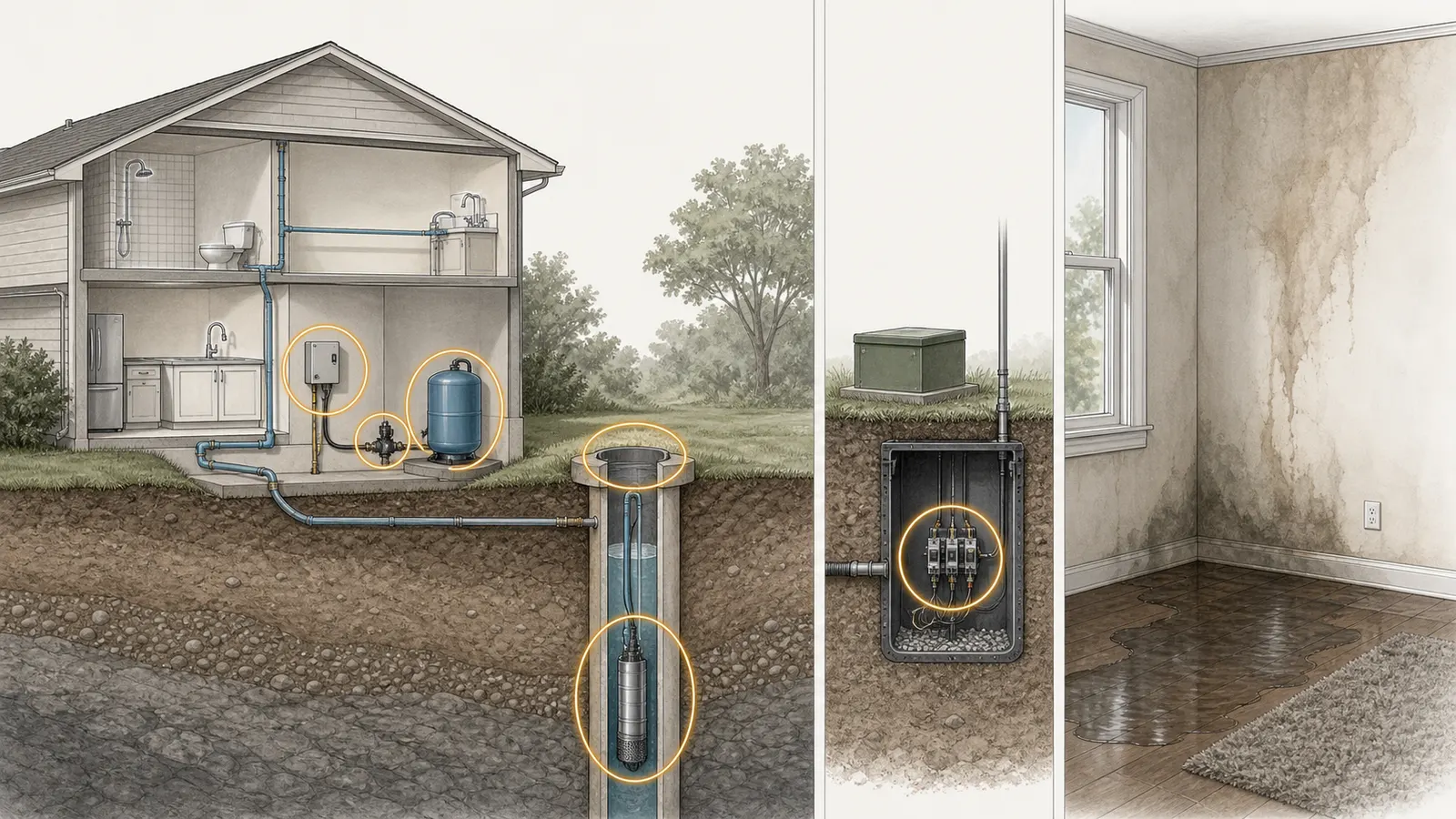
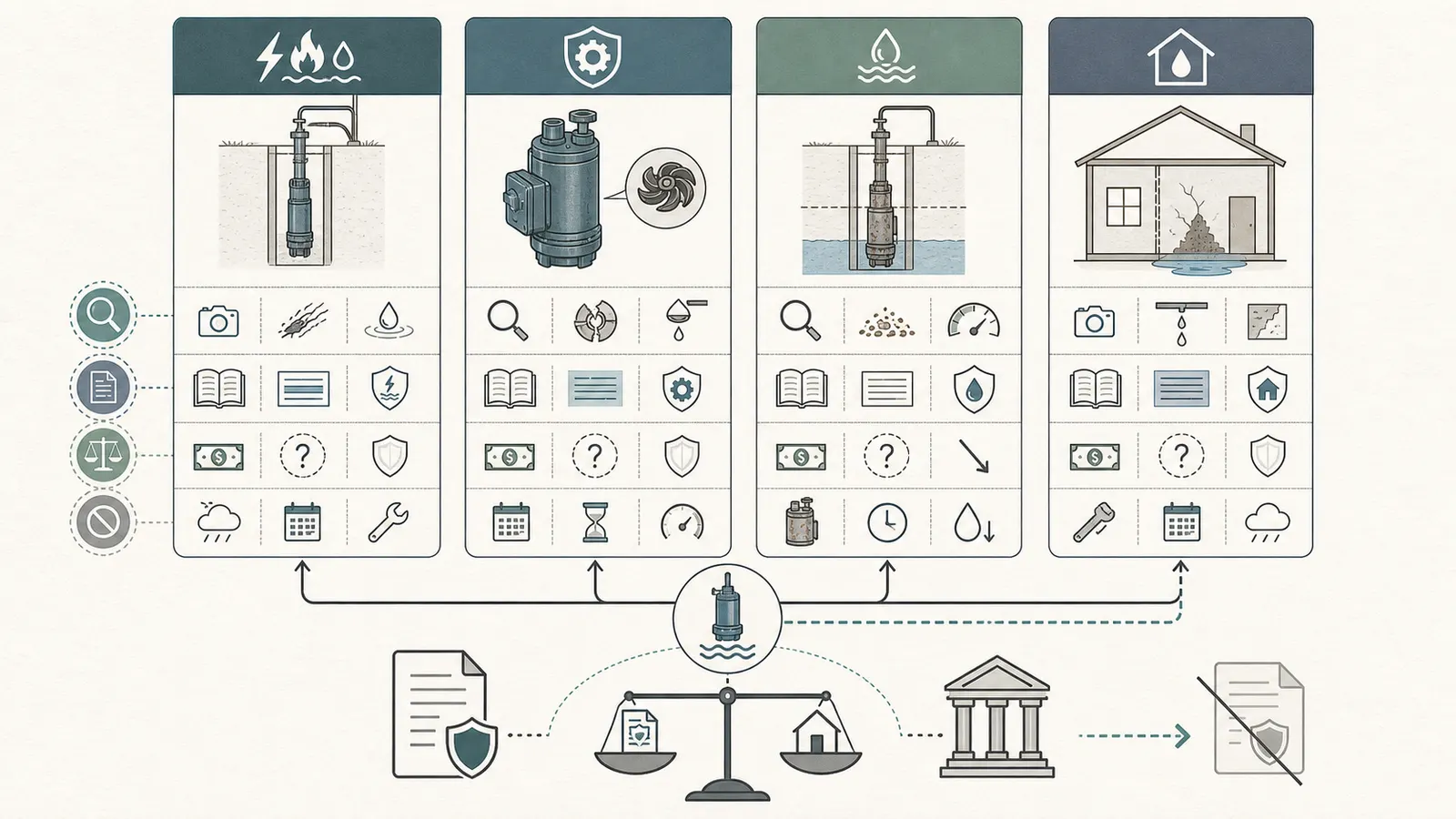
There are four lanes to keep separate. They can overlap, and one incident can generate more than one claim question.
Covered-peril damage
Insurance language starts with the peril—the cause of loss. NAIC explains that basic and broad forms cover listed causes, while special-form coverage generally covers the home against causes except those specifically excluded; the exact policy wording matters. NAIC's policy-form explanation is a consumer overview, not a substitute for your form.
For a well system, ask whether a listed or non-excluded event caused physical damage to an insured component. Examples that may require a policy question include lightning, fire, a frozen pipe, a falling object, or a documented electrical event. Do not convert an event into coverage just because it happened near the failure. “The power went out and the pump later stopped” is a timeline. It is not yet proof of a covered surge, lightning strike, or physical damage.
Bring the event date, utility or weather record if relevant, technician observations, photographs, and any failed part to the conversation. Ask the adjuster to identify the policy provision that supports or excludes the affected item, not only to quote a general answer about “water systems.”
Equipment-breakdown endorsement
Equipment breakdown is the most direct coverage lane for a pump that fails internally rather than because of an external peril. NAIC's guide uses a water well pump as an example. The Hanover gives a concrete insurer example: its endorsement describes physical loss or damage from mechanical, electrical, and pressure-system breakdown and includes well pumps in its equipment list. The Hanover's product page also shows why you must not generalize from a public example: its deductible, limits, and additional coverages belong to that offering.
Look for your own endorsement's definitions of “breakdown,” “equipment,” “covered property,” “failure,” “wear and tear,” “corrosion,” “maintenance,” “power surge,” “pollutant,” and “resulting damage.” Check whether the pump is treated as dwelling equipment, other property, or excluded below a stated location or depth. Check the limit, deductible, waiting period if any, service-call treatment, temporary-repair rules, and whether parts, labor, excavation, haul-out, water testing, or code-related work are handled separately.
Do not treat an equipment-breakdown endorsement like a warranty. The public Hanover explanation itself contrasts breakdown coverage with warranties. Your policy may cover a sudden breakdown without covering deterioration, a pre-existing condition, or an upgrade chosen during replacement. The technician's report should say what broke, rather than only recommending a new pump.
Ordinary wear, maintenance, corrosion, or a dry well
The difficult lane is the common one: an old pump stops, the well has low recovery, or the system has corrosion and no identifiable external event. The correct insurance answer depends on the policy, but these facts do not automatically become covered physical damage. Ask whether the policy excludes wear and tear, deterioration, rust, settling, mechanical breakdown, water depletion, or maintenance conditions, and whether the endorsement changes that result.
If the well is dry or low-yield, record the water-level and recovery findings, household demand, and date. Do not pour water into the well. Water Systems Council warns that adding outside water can damage the borehole and pump and can contaminate the well. Its low-yield well guidance says to contact a licensed well contractor to determine current water level and recovery rate.
This lane may still produce a legitimate insurance question if a covered event damaged the pump while the well was stressed, or if the dry condition caused covered property damage. But do not ask an insurer to treat a water-supply limitation as a pump diagnosis. Preserve the distinction because it affects both the claim and the repair: replacing a pump without understanding low water can repeat the failure.
Damage to the house or other property
The pump and the house are separate line items. A failed pump can leave a home without water, but a different event can cause water to escape from a broken line, failed pressure component, or plumbing connection and damage interior materials. Ask about each affected property item, its cause, and its coverage—not just “is the pump covered?”
List the location and type of damage: wet drywall, flooring, cabinets, insulation, stored property, electrical components, mold concerns, or structural materials. Photograph before cleanup where safe. If emergency work is needed to prevent more damage, ask the insurer what mitigation is authorized and keep itemized receipts. Do not wait to prevent active damage merely to stage a perfect claim, but do document what changed and why.
The California Department of Insurance says its claims guide is for California consumers and advises reporting a property loss, confirming the deductible, and asking whether estimates are required. The guide's claims section is useful for the workflow, but its deadlines and remedies should not be generalized to another state.
4. Compare the dollars before deciding
The useful calculation is not the replacement invoice. It is a staged comparison that keeps the total estimate, excluded work, policy sublimit, deductible, and ACV depreciation separate. Do not subtract noncovered work twice, and do not treat a sublimit as an amount to subtract: it is a cap on the covered scope.
Gross scope = every itemized repair, replacement, access, mitigation, and resulting-damage cost in the estimate before coverage decisions.
Noncovered scope = the portion identified as wear, dry- or low-yield-well work, maintenance, upgrades, excluded property, or another item the policy does not cover.
Candidate covered scope = max(0, gross scope − noncovered scope).
Capped covered scope = min(candidate covered scope, applicable policy sublimit). If no sublimit applies, use the candidate covered scope.
Screening payment = max(0, capped covered scope − applicable deductible − ACV depreciation, if the settlement is on an ACV basis).
Use ranges when the cause or scope is uncertain. For example:
| Line item | Low estimate | High estimate | Coverage status to verify |
|---|---|---|---|
| Pump repair or like-for-like replacement | $_____ | $_____ | Pump, labor, haul-out, and access |
| Control, pressure switch, or wiring | $_____ | $_____ | Cause and insured-property definition |
| Buried line or excavation | $_____ | $_____ | Location, cause, access, and exclusions |
| Resulting interior damage | $_____ | $_____ | Sudden damage, materials, mitigation |
| Water testing, well diagnosis, or well work | $_____ | $_____ | Often a separate question; do not assume |
| Upgrade or redesign chosen by homeowner | $_____ | $_____ | Usually compare like-for-like versus upgrade |
| Emergency water, temporary lodging, or other costs | $_____ | $_____ | Ask about applicable additional coverage |
Then calculate three numbers:
- Gross scope: add every relevant estimate row, including pump work, resulting damage, mitigation, access, and separate well or upgrade work, before deciding coverage.
- Noncovered scope: identify excluded or maintenance work once, then subtract it once from gross scope to get candidate covered scope; do not subtract it again later.
- Capped covered scope: apply the applicable sublimit with
min(candidate covered scope, sublimit); the sublimit caps the covered amount and is not an additional deduction. - Likely payment screen: subtract the applicable deductible from capped covered scope, then subtract ACV depreciation if applicable. Use zero as the floor; the insurer's adjustment controls.
- Your cash exposure: noncovered scope plus the deductible, plus any gap between the approved scope and the replacement or upgrade selected.
NAIC defines a deductible as the amount paid before the policy pays and explains that ACV reflects age and wear, while RCV concerns like kind and quality replacement subject to policy limits and terms. Use the NAIC definitions, then verify your declarations page and form. A public insurer page may show a $500 equipment-breakdown deductible or a particular limit, but you cannot use that figure for another insurer.
Example: suppose the gross scope is $12,200: a $3,200 like-for-like pump replacement, $9,000 of resulting interior damage, and no other work. If $2,000 is identified as noncovered wear or an upgrade, the candidate covered scope is $10,200. With a $7,500 policy sublimit, the capped covered scope is $7,500; with a $2,500 deductible and $1,000 of ACV depreciation, the screening payment is $4,000. The $2,000 noncovered scope is not deducted again. If no sublimit applied, the same inputs would produce a $6,700 screening payment. Ask the insurer to confirm each figure and whether the deductible applies once or separately to different coverages.
Do not use the calculation to predict a settlement. It is a comparison tool for deciding what to ask and whether the likely benefit is large enough to justify a formal claim review. If a line item could fall into more than one coverage lane, leave it as “unresolved” rather than placing it in both gross covered scope and noncovered scope.
5. Preserve the cause-of-loss record before replacement
The most valuable evidence can disappear when a pump is pulled, a control is discarded, a line is dug up, or a wet wall is opened. Before authorizing non-emergency replacement, create one dated folder containing:
- declarations page, full policy form, endorsements, exclusions, limits, and deductible schedule;
- failure date and time, last-known-normal date, weather, lightning, utility outage, freeze, construction, or other relevant event;
- photos and video of the pressure tank area, controls from the outside, visible leaks, standing water, damaged finishes, and the wellhead without opening or disturbing it;
- technician name, license or company details where applicable, visit date, written diagnosis, measurements, parts removed, and exact cause wording;
- model, horsepower, installation date if known, maintenance records, prior repair invoices, warranty information, and serial number;
- estimates separated into repair, replacement, access, excavation, well work, upgrade, emergency mitigation, and house restoration;
- receipts for reasonable emergency steps, temporary water, drying, cleanup, or other expenses, with an explanation of why each was necessary;
- copies of every insurer call note, claim number, email, request for proof of loss, adjuster scope, estimate, reservation of rights, or denial.
The California Department of Insurance says an adjuster's scope should include the degree of damage, quality of materials and workmanship, and measurements needed to calculate quantities. It also advises not throwing away damaged items until the adjuster says to do so. See the documentation guidance. Those are California consumer instructions, but preserving a removed pump or failed control for inspection is a sensible evidence practice anywhere when it can be done safely.
Ask the contractor to photograph the failed component before disposal and label it with the date, address, equipment location, and service ticket. Do not ask a professional to preserve something unsafe or contaminated; ask the insurer how it wants the item handled. If a part must be discarded to restore water, record who authorized disposal and why.
6. Ask the insurer questions that produce a usable answer
A vague phone answer such as “well pumps are covered” is not enough. Use the following script and write down the representative's name, date, claim or inquiry number, and the policy provision discussed:
- “Is my pump listed or included under the base policy, an equipment-breakdown endorsement, or another coverage?”
- “Which cause-of-loss wording applies to the technician's finding: covered peril, mechanical or electrical breakdown, wear, corrosion, low water, or undetermined?”
- “Is the pump itself treated differently from the control box, pressure switch, buried cable, buried water line, excavation, or pressure tank?”
- “If the pump is excluded, could resulting interior water damage be evaluated separately? What facts and photos do you need?”
- “What deductible applies to each part of the loss? Is it a flat dollar deductible, percentage deductible, equipment-breakdown deductible, or more than one?”
- “Is settlement based on ACV, RCV, functional replacement cost, or a stated limit for this item? What must I do to receive withheld depreciation, if applicable?”
- “May I authorize emergency mitigation or a temporary pump before inspection? Do you need photographs, a written estimate, or an adjuster visit first?”
- “Should I keep the failed pump, motor, control, or other parts? If not, how should disposal be documented?”
- “If I report this as a claim, a notice of loss, or a coverage question, how is it recorded? What is the expected effect on renewal or premium under my policy and state?”
- “If you deny coverage, will you provide the reasons and policy provisions in writing, and what review or appeal path is available?”
The last question matters because claims handling varies by state. The California guide says a denial there must be in writing with reasons and describes a state assistance process, but that is not a national promise. Use your state insurance department for local rights and deadlines.
Claims history deserves a precise, non-alarmist question. NAIC says insurers may use claims history in pricing or renewal and recommends asking how submitting a claim will affect the premium. NAIC's consumer guide does not say every claim raises every premium. Factors can include state rules, insurer rating plans, claim type, frequency, severity, prior losses, and whether the event is recorded as a claim or inquiry. Do not make the decision on an internet promise that “one claim always raises rates” or “a denied claim never counts.” Ask your insurer and read your state guidance.
7. Make the repair decision without destroying your options
If there is no active property damage and the pump is plainly at the end of its service life, get a written cash estimate, compare it with the deductible, and ask whether the insurer wants notice even if you do not intend to pursue payment. If the loss may be covered or the house is damaged, notify the insurer promptly enough to comply with the policy and request inspection instructions before non-emergency replacement.
When water service is urgent, separate restoration from evidence. A contractor may install a temporary or like-for-like solution while preserving the old component, photographs, and report. Confirm in writing what was approved, what remains disputed, and whether the work is emergency mitigation, repair, replacement, or an upgrade. Do not let a rushed invoice combine a pump replacement with well deepening, treatment equipment, pressure-tank resizing, generator work, or cosmetic improvements.
If the insurer says the pump is excluded, ask whether the decision addresses the pump only or every part of the loss. If it says the cause is wear, ask whether the resulting water damage is being evaluated separately. If it says there is no physical damage, provide the technician's findings and ask what additional evidence would change the determination. If the answer remains unclear, request the denial or coverage position in writing and contact your state insurance department or a qualified insurance professional. Do not sign a release or accept a check described as full settlement until you understand what it covers; the California guide specifically warns consumers to understand whether an initial settlement is full or partial. Review the state guide's settlement section.
The safest conclusion is often a documented decision, not a confident prediction:
Claim or coverage review: cause may be covered, endorsement appears applicable, house damage is material, or the likely covered amount is well above the deductible. Preserve parts and get insurer instructions.
Pay and document: technician finds ordinary wear or low/dry well, no separate property damage exists, and the repair is near the deductible. Keep the diagnosis and ask whether notice is required.
Pause and investigate: the system has no confirmed failure point, the estimate mixes covered and noncovered work, or a replacement would erase the evidence. Get the written diagnosis and coverage position first, unless emergency mitigation is needed.
Reusable record
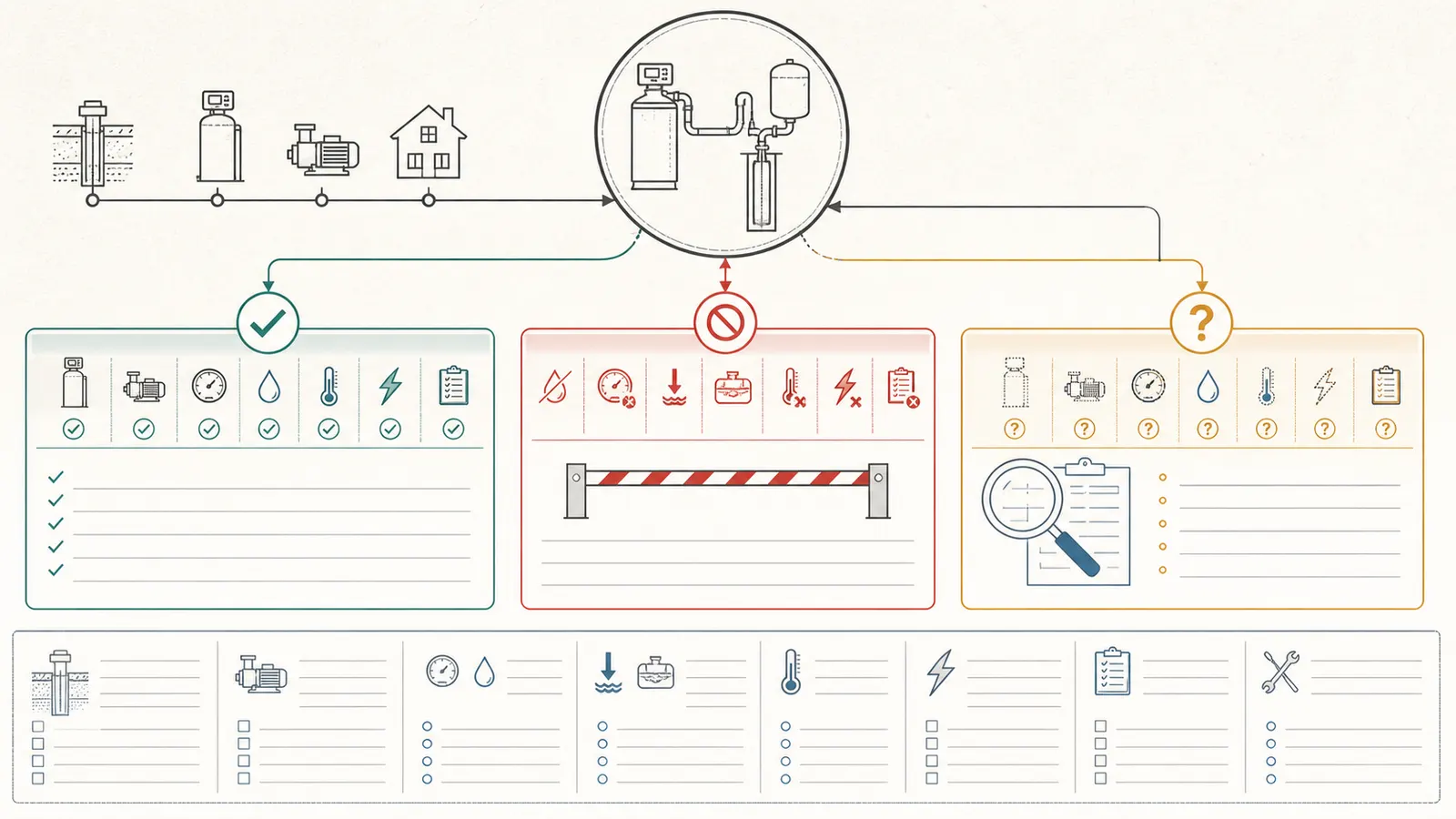
Use the sections and tables in this article to capture the policy form, endorsements, deductibles, failure timeline, professional findings, evidence, estimates, insurer answers, and final claim-or-pay choice. It is a homeowner record, not an insurance form, engineering report, inspection, or legal advice.
Sources and scope
Evidence behind this page
- A Shopping Tool for Homeowners Insurance
NAIC consumer shopping guide; it explains a coverage category and example, not the terms, limits, exclusions, or deductible in any particular homeowner's policy.
- A Shopping Tool for Homeowners Insurance
General consumer explanation of common policy forms; it does not classify a particular pump failure or state-specific policy form.
- A Shopping Tool for Homeowners Insurance
General consumer definitions; the worksheet uses them for questions and a comparison calculation, not as a prediction of settlement.
- A Consumer's Guide to Home Insurance
NAIC national consumer guide; state rules, insurer rating plans, claim type, loss history, and renewal circumstances can differ.
- A Consumer's Guide to Home Insurance
General consumer guidance; it supports the article's repeated boundary that the policy and insurer control the claim outcome.
- Equipment breakdown | The Hanover Insurance Group
One insurer's product page; it is an illustration of possible endorsement structure, not a national coverage promise or the reader's policy.
- Residential Property Claims Guide
California Department of Insurance consumer guide; the article uses it as a claims-process example and does not generalize California deadlines or remedies nationally.
- Residential Property Claims Guide
California claims guidance; preservation and documentation are presented as practical evidence steps, while state-specific claim rules remain local.
- wellcare — What to Do If Your Well Runs Dry
Water Systems Council homeowner information sheet; it supports diagnostic branching and professional escalation, not an insurance coverage classification.
- Water Delivery and Low-Yielding Wells
Water Systems Council guidance for low-yielding private wells; it supports the safety and diagnostic boundary and does not determine insurance coverage.
- Guidelines for Treating Well Water
CDC consumer guidance for suspected microbial or chemical contamination; it supports a stop-use and professional-testing boundary, not remote diagnosis or a treatment recommendation for this particular well.
- Pentair 4-inch Submersible Pumps Installation and Operation Manual
Manufacturer manual for specified Pentair 4-inch submersible pumps; used here for the safety boundary, not as a universal installation specification for every well system.