Private Well Pump Performance Baseline Worksheet
A homeowner-safe, condition-controlled worksheet for comparing well pressure, pump run time, faucet flow, water levels, and service findings.
The short answer
Record the same conditions each time: date, recent water use, pressure-switch range, treatment status, and measurement location. Owners can observe pressure, run time, and repeatable faucet flow. A qualified well professional must handle water-level, yield, amp-load, grounding, line-voltage, tank, switch, well-opening, and pump work. A changed trend is evidence to investigate—not proof of a failed pump.Private Well Pump Performance Baseline Worksheet
Use a private-well pump baseline to answer one narrow question: under repeatable conditions, is this water system behaving differently from its own earlier record? It is not a remote pump diagnosis and it is not a homeowner yield test.
Record the same date context, recent water use, pressure-switch range, treatment status, pressure-gauge location, and faucet-flow location each time. A homeowner can usually observe the exterior, read an existing gauge, time a normal pump cycle, and record a repeatable faucet-flow proxy. A qualified well professional should measure static and pumping water levels, well yield, amp load, grounding, line voltage, tank condition, pressure-switch contacts, and any condition that requires opening the well or an energized control. A changed trend is a reason to obtain professional diagnosis—not proof that the pump has failed.
This separation matters because “pump performance” is a system outcome. Reduced water at a faucet can involve the well, water level, screen or formation, pump, tank, switch, power supply, plumbing, treatment equipment, or a change in household demand. Penn State Extension lists several possible causes of declining well performance, including lowered water level, mineral deposits, biofouling, sediment plugging, corrosion, and pump damage. A single low reading cannot distinguish those causes. (Penn State Extension, “Water Well Maintenance and Rehabilitation”)
1. Know what this baseline can and cannot establish
The baseline is a controlled history, not a pass/fail inspection. It helps you show a professional what changed, when it changed, and whether the change repeats. It can also expose a bad comparison: for example, a flow reading taken after a filter was changed, or a run-time reading taken while a toilet was filling.
The record has five evidence lanes:
| Lane | What it can establish | What it cannot establish by itself | Safest owner action |
|---|---|---|---|
| Pressure | What the existing gauge showed when the pump started and stopped; whether the observed range is changing | That the gauge is accurate, the switch is correctly set, or the pump is healthy | Observe without opening the control or adjusting the switch |
| Pump run time | Elapsed time from observed pump start to observed stop under a stated household condition | Pump capacity, motor health, well yield, or a universal acceptable time | Time a normal cycle with no other water use |
| Faucet flow | A repeatable point-of-use flow proxy at a named faucet or hose bib | Well yield, pump curve, or flow available elsewhere in the house | Use the same outlet, container, treatment status, and method |
| Water level and drawdown | When measured professionally, the relationship between static level, pumping level, and a stated pumping condition | A cause without system context, well construction data, and professional interpretation | Leave well access and level measurement to a professional |
| Service findings | What a professional measured or repaired on a dated visit | A guarantee that the next symptom has the same cause | Attach the report and invoice to the baseline |
The National Ground Water Association’s annual checkup guidance puts flow testing, water level before and during pumping when possible, motor amp load, grounding, line voltage, pressure-tank, and pressure-switch checks in the professional checkup scope. That is why those fields belong in the worksheet but are marked professional-only. A homeowner record should preserve the information, not invite a homeowner to reproduce hazardous testing.
The worksheet also does not replace water-quality testing. CDC says private-well owners are responsible for the safety of their tap water and recommends an annual well check that includes water testing and checking the well for mechanical problems and cleanliness. (CDC, “Well Water Safety”) A stable pressure trend does not prove that water is microbiologically or chemically safe.
2. Fix the comparison conditions before you measure
Numbers are only comparable when the conditions around them are comparable. The first page of the record therefore captures the test context before any reading is taken. This is the most important part of the protocol: a carefully measured number under a changed condition can be less useful than a rougher number under the same condition as last time.
Date, time, and recent use
Record the local date and time. Note whether the household recently used a shower, bath, washing machine, dishwasher, irrigation system, hose, or water-softener regeneration. For a simple cycle observation, pause other water use and record how long the pause was. The pause does not need to be a universal number; the point is to document whether the pressure tank started full, partly depleted, or under active demand.
If you cannot pause use because a household member needs water, mark the test as “active demand” and describe it. Do not compare that record directly with a quiet-house record without labeling the difference.
Pressure-switch setting and system type
Record the pressure-switch setting from an existing label, prior service record, or professional report if known. Do not remove a cover to look for it. On a typical single-speed system, the lower value is the cut-in pressure and the higher value is the cut-out pressure. The difference is the operating differential. The Water Systems Council’s home-inspector guide describes observing the pressure when the pump comes on and goes off to identify those limits. (Water Systems Council, “Guide to Evaluating Water Wells”)
Do not assume every well uses the common 30/50 or 40/60 pattern. Record what your gauge and service records show. If the home has a constant-pressure or variable-speed system, label it. The Water Systems Council specifically notes that special circumstances apply to constant-pressure systems; a fixed cut-in-to-cut-out cycle may not describe their normal operation. (Water Systems Council, “Guide to Evaluating Water Wells”)
Treatment status and measurement location
Write down whether a softener, iron filter, sediment filter, ultraviolet unit, cartridge filter, or other treatment equipment was operating. Record whether the flow observation is before treatment, after treatment, or unknown. A clogged filter or a treatment unit in regeneration can change flow or pressure without a change in the well pump.
Name the exact pressure-gauge location: for example, “gauge on pressure tank tee in basement” or “gauge near well equipment.” Name the exact flow location: “garage hose bib before treatment” or “laundry sink after treatment.” Do not move the gauge or bypass treatment just to make a test easier. If a professional changes the measurement point, start a new comparison series and record the change.
Recent service and environmental context
Record pump, tank, switch, plumbing, treatment, electrical, wellhead, or water-quality work since the last entry. Add unusual conditions: a power outage, flooding, wildfire smoke or damage, drought, unusually high occupancy, irrigation demand, or a suspected leak.
The Water Systems Council recommends keeping the well permit or completion report, basic well data, pump and tank information, water-test results, and maintenance record because those records help a future contractor inspect or repair the system. (Water Systems Council, “Well Owner’s Manual”) A baseline becomes much more valuable when it can be read alongside the well log and service history.
3. Make the homeowner-safe observations
Only perform this section if the area is dry, stable, accessible, and free of obvious hazards. Stop if you see exposed or damaged wiring, water near electrical equipment, a burning smell, a tripped breaker, damaged equipment, an unsecured well cap, or a condition that makes you unsure where to stand. Do not open the well, remove a cap or seal, open an electrical control box, touch wiring, pull a pump, enter a pit, or enter any confined space.
Exterior condition check
From the outside, observe the wellhead, casing, cap, conduit, ground, and visible plumbing. Look for a cracked or loose cap, a gap around the casing, standing water, erosion, contamination sources, corrosion, damaged conduit, visible leaks, or vegetation and debris interfering with access. Do not take a visual check as permission to repair or manipulate anything.
Clemson Extension describes periodic wellhead observation, including cap and casing condition, insulated and corrosion-free visible electrical wires, and ground sloping away from the wellhead. (Clemson Cooperative Extension, “Residential Drinking Water Well: Well Components”) If the cap, conduit, casing, or area around the well looks compromised, call a water-well professional and, when appropriate, the local health department. Do not open the well to investigate.
Existing-gauge pressure
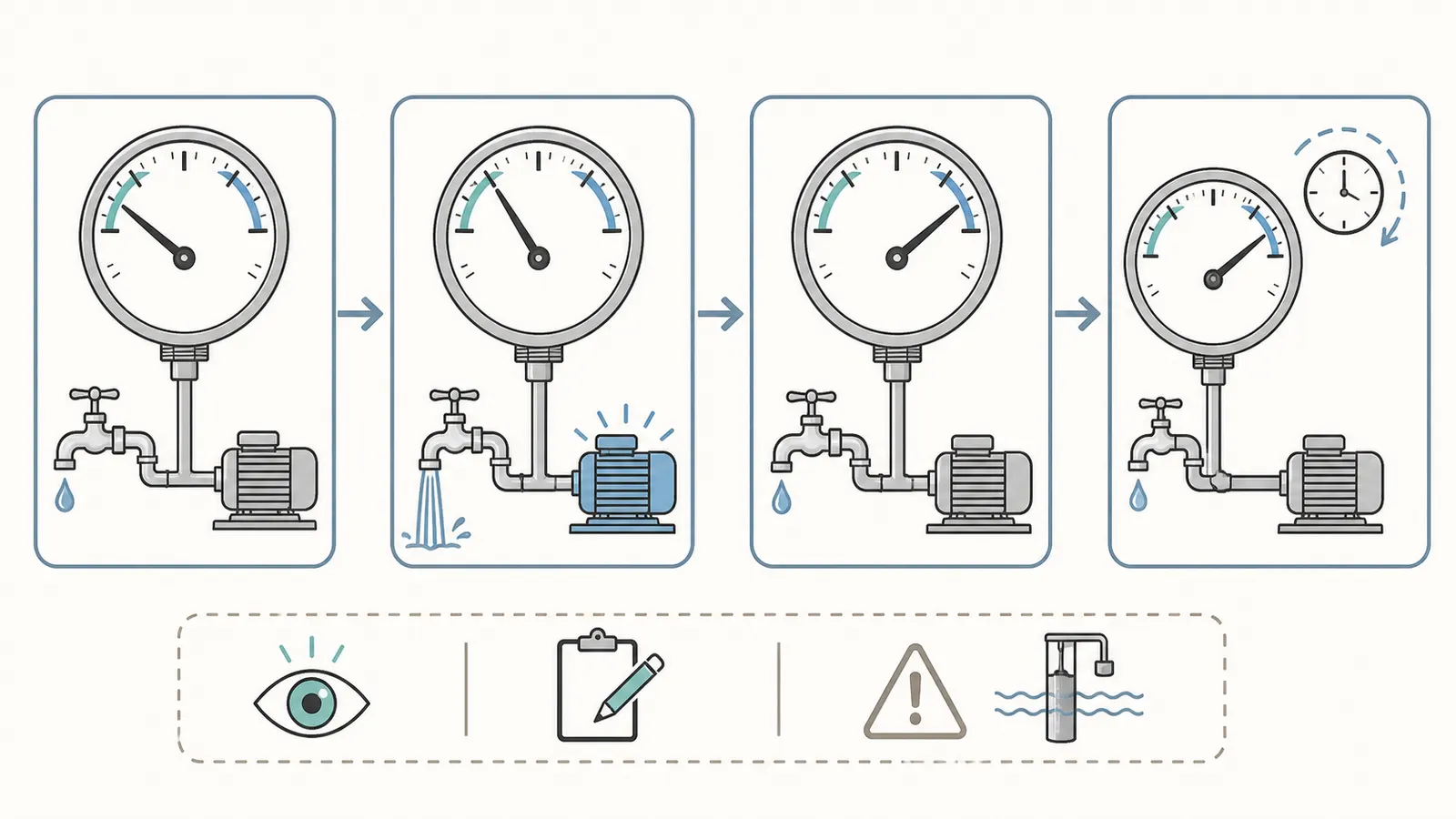
Use the gauge that is already installed and visible. Record its resting pressure before opening water, the pressure at which the pump appears to start, and the pressure at which it appears to stop. If the needle sticks, does not move, moves erratically, or is hard to read, record “gauge questionable” rather than replacing it or interpreting the number as precise.
For a basic observation, open a nearby normal-use faucet just enough to let the pressure fall while you watch the gauge from a safe position. Note the pressure when the pump starts. Close the faucet and note the pressure when the pump stops. If the pump does not start, do not open a control cover or manipulate the pressure switch. Record the symptom and call a professional.
The purpose is to capture the system’s observed operating range, not to prove that the switch is correctly adjusted. Clemson notes that common pressure settings vary and that a gauge that does not move or is significantly out of range may need attention. (Clemson Cooperative Extension, “Residential Drinking Water Well: Well Components”) Treat that as a prompt for service, not as a universal national threshold.
Pump run time
For a common single-speed system, start a timer when the pump starts after the pressure falls to the observed cut-in and stop it when the pump stops at the observed cut-out. Keep all other household water use off during the timing. Record seconds or minutes, not “short” or “long.” If the pump cycles before reaching the observed stop pressure, record the behavior and stop the test.
The Water Systems Council describes timing the rise from cut-in to cut-out with no water running in the house. It also explains that tank size, tank precharge, and pump affect the time, and points unusually short or long timing toward further licensed-contractor investigation. (Water Systems Council, “Guide to Evaluating Water Wells”) Do not copy a timing threshold from another house or treat it as proof of a bad pump. A constant-pressure system needs its own manufacturer or professional interpretation.
Repeatable faucet-flow proxy
This is a point-of-use observation, not a well-yield test. Use the same faucet or hose bib, the same container, the same treatment status, and the same valve position each time. Confirm that the container is stable and that the discharge will not create a slip hazard or damage the area. Do not use a fixture with an aerator or restriction unless you can leave it unchanged for every record.
Measure the container volume and the fill time. Convert it using:
flow proxy in gallons per minute = gallons collected × 60 ÷ seconds to collect
Example: if the same container holds 2.0 gallons and takes 24 seconds to fill, the point-of-use flow proxy is 2.0 × 60 ÷ 24 = 5.0 gallons per minute. Write the container volume, seconds, outlet, treatment status, and whether the valve was fully open. The arithmetic is repeatable; the result is not the well’s tested yield.
If the flow pulses, changes during the fill, or falls while the pump runs, record that pattern rather than averaging it away. If the water is discolored, has an unusual odor or taste, or the flow change followed flooding, a spill, a fire, or a wellhead breach, stop treating this as a pump-only question. CDC and the Water Systems Council both direct private-well owners toward water-quality and professional guidance when water changes or contamination may be involved. (CDC, “Well Water Safety”; Water Systems Council, “Well Owner’s Manual”)
4. Put hazardous and diagnostic measurements in the professional section
The worksheet intentionally has blank fields for measurements a professional may provide. This gives a technician a compact history without turning the homeowner into an electrician, well driller, or pump installer.
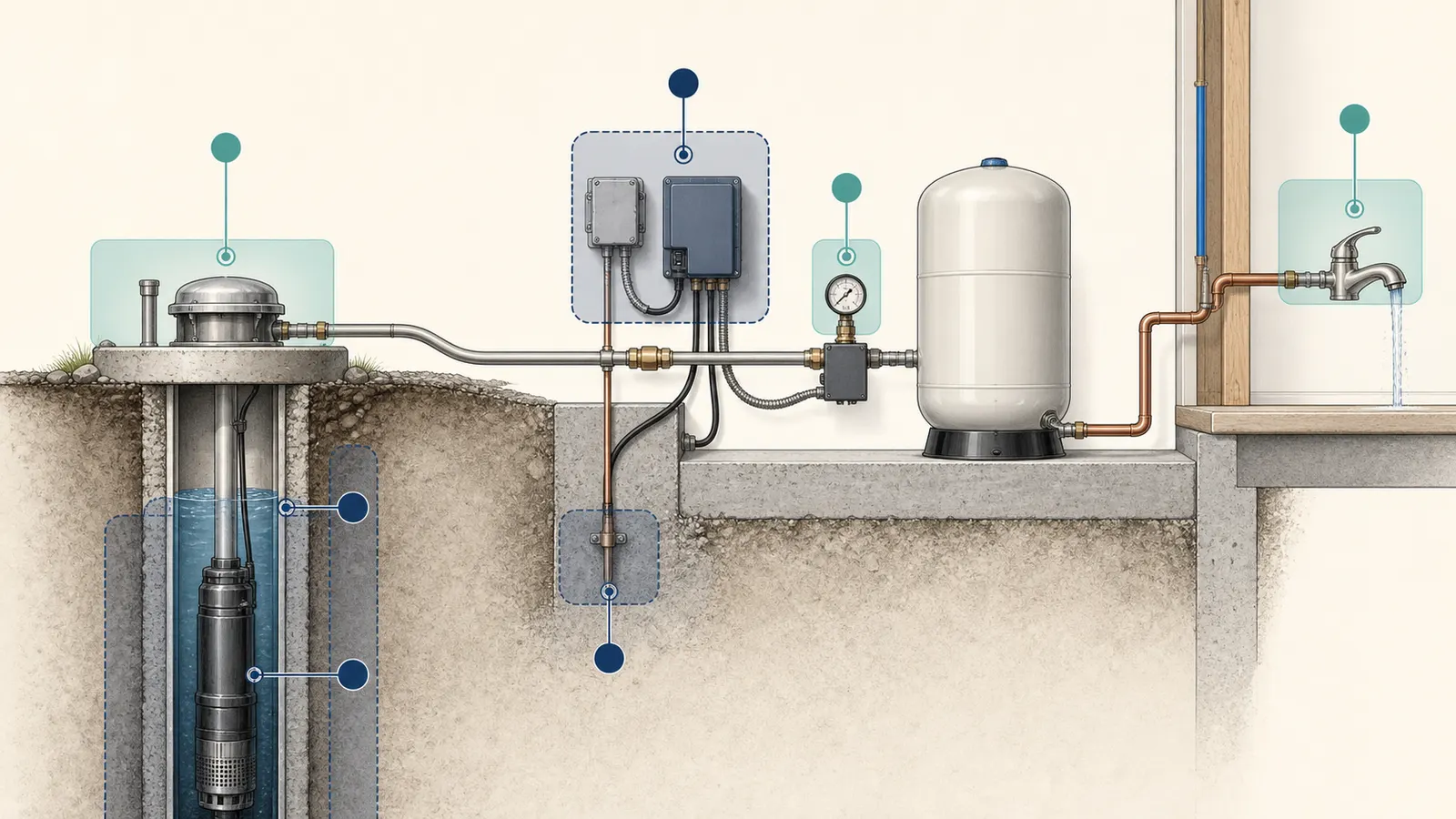
Water level, drawdown, and well yield
Static water level is the water level before pumping under a stated condition. Pumping water level is the level while pumping at a stated rate and duration. Drawdown is the difference between those levels. A professional may also perform or report a well-yield or flow test. The result is meaningful only with the measurement location, rate, duration, water-level condition, and method recorded.
The University of Arizona’s private-well maintenance record places static water level, flow rate, pressure-pump-on and pump-off readings, and run time together, while keeping observations and corrections in the same service record. It also includes amp, resistance, and voltage fields under an in-well check. (University of Arizona Cooperative Extension, “Private Well Installation & Maintenance Record”) Brictale uses that structure but labels the electrical and well-access fields as professional-only.
Do not open the well to lower a tape, probe a casing, inspect a pump, or take a water level. Do not infer that a lower water level means the pump failed, or that a normal water level proves the pump is healthy. Water level, aquifer conditions, well construction, pump setting, demand, and plumbing all belong in the professional interpretation.
Electrical and control findings
Ask the professional to record amp load, line voltage, grounding, insulation or resistance findings, control-box condition, pressure-switch contacts, and any fault or alarm code. These are useful because a motor or power-supply problem can present as weak delivery, intermittent operation, nuisance tripping, or long run time. They are not homeowner readings.
Do not remove a control-box cover, probe terminals, measure live voltage, clamp a conductor, reset a questionable overload repeatedly, or assume that turning off one switch makes a system safe. The CDC’s private-well wildfire guidance explicitly says to turn off power before inspecting after damage; that emergency instruction does not convert energized testing into a homeowner task. A qualified professional should establish the safe isolation procedure and verify the system before testing.
Tank, switch, and gauge findings
A pressure tank stores usable water and helps control pump cycling. The Water Systems Council guide describes checking for corrosion and leaks at the tank and fittings, observing the pressure gauge and switch, and distinguishing cut-in, cut-out, and differential. (Water Systems Council, “Guide to Evaluating Water Wells”)
The owner’s record should therefore capture visible leaks, corrosion, gauge behavior, observed start and stop pressure, and cycling. A professional report can add tank condition, precharge verification, switch-contact condition, gauge accuracy, and any adjustment. Do not press a tank valve, drain a tank, loosen fittings, adjust the switch, or change a precharge based on an internet rule. A tank is pressurized equipment, and the correct procedure depends on the tank, switch setting, plumbing, pump, and manufacturer instructions.
Treatment equipment and household demand
Ask the professional or treatment provider to record filter condition, differential pressure if the equipment provides it, regeneration timing, bypass state, and service history. A flow change after treatment can be a treatment-side restriction rather than a well-side decline.
Record changes in the household too: a new bathroom, irrigation, livestock use, guests, a home business, a leak, or a new appliance. The Water Systems Council explains that pump sizing depends on static water level, well yield, working pressure, and household needs, and that normal peak demand matters. (Water Systems Council, “Guide to Evaluating Water Wells”) A larger demand can make a previously adequate system appear to have changed even when the pump has not.
5. Complete one controlled record from start to finish
Use the printable sheet as one dated record, not a collection of unlabelled numbers. The order below keeps conditions visible.
Step 1: identify the system
Write the property or well ID, date, time, pump and tank information if known, pressure-switch range if documented, and any recent service. If you do not know a field, write “unknown.” Unknown is better evidence than a guess. Attach a copy of the well completion report, prior service report, or equipment label photograph only if it was taken from a safe exterior position and does not reveal sensitive household information you do not want stored.
Step 2: lock the conditions
Record recent water use, weather or drought context, treatment status, and exact gauge and faucet locations. State whether the house was quiet or under active demand. If a treatment unit was regenerating, if irrigation was on, or if a leak was suspected, mark the record as non-comparable to a quiet-house baseline.
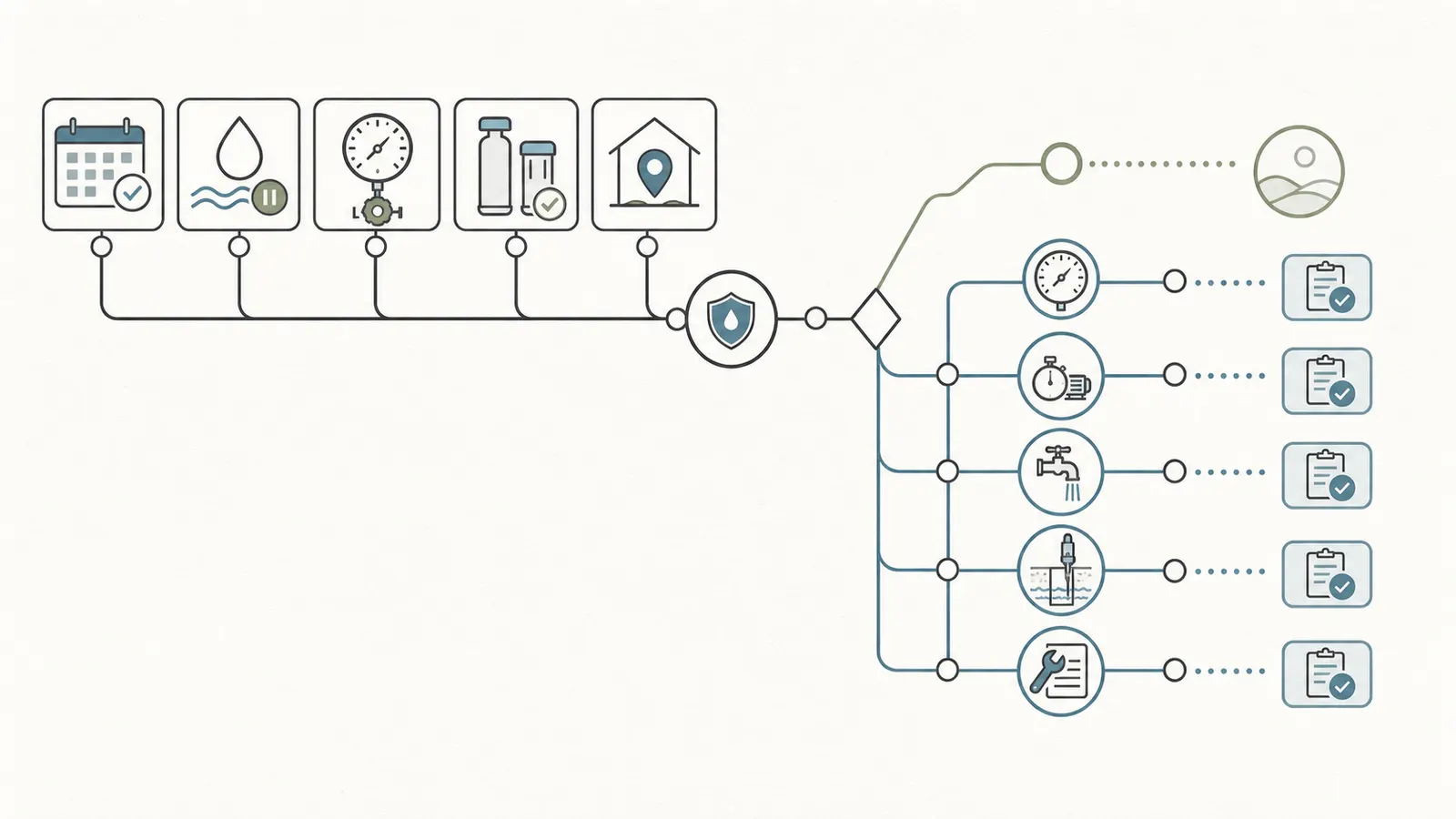
Step 3: observe pressure and run time
Read the existing gauge at rest. Observe pump start and stop without opening any cover. Time one start-to-stop cycle with other water use off. If the pump cycles, stalls, fails to stop, runs continuously, or causes a breaker or alarm event, stop recording and describe the sequence. Do not repeat a hazardous or damaging condition to get a cleaner number.
Step 4: measure the same faucet flow proxy
Use the same container and outlet. Record gallons and seconds, then calculate gallons × 60 ÷ seconds. If the outlet has changed, the filter has changed, or the treatment status differs, do not place the number in the same trend line without a note.
Step 5: record professional findings separately
Copy the professional’s static water level, pumping water level, drawdown, tested flow or yield, amp load, voltage, grounding, tank, switch, pump, and service findings exactly as reported. Preserve the date, method, rate, duration, and report or invoice number. Do not fill a professional-only blank with “not tested” and then interpret it as normal.
Step 6: state what changed and what did not
Use plain language: “Faucet flow proxy decreased from 5.0 to 3.8 gpm at the same garage hose bib, after the sediment filter, with no recent household use. Treatment cartridge was replaced after the second reading.” That statement is more useful than “pump weak.” It tells the professional which observation came first and which confounder changed afterward.
The University of Arizona record format includes a performance test, comments, and corrections-needed fields for exactly this kind of handoff. (University of Arizona Cooperative Extension, “Private Well Installation & Maintenance Record”)
6. Interpret trends without naming a failed pump
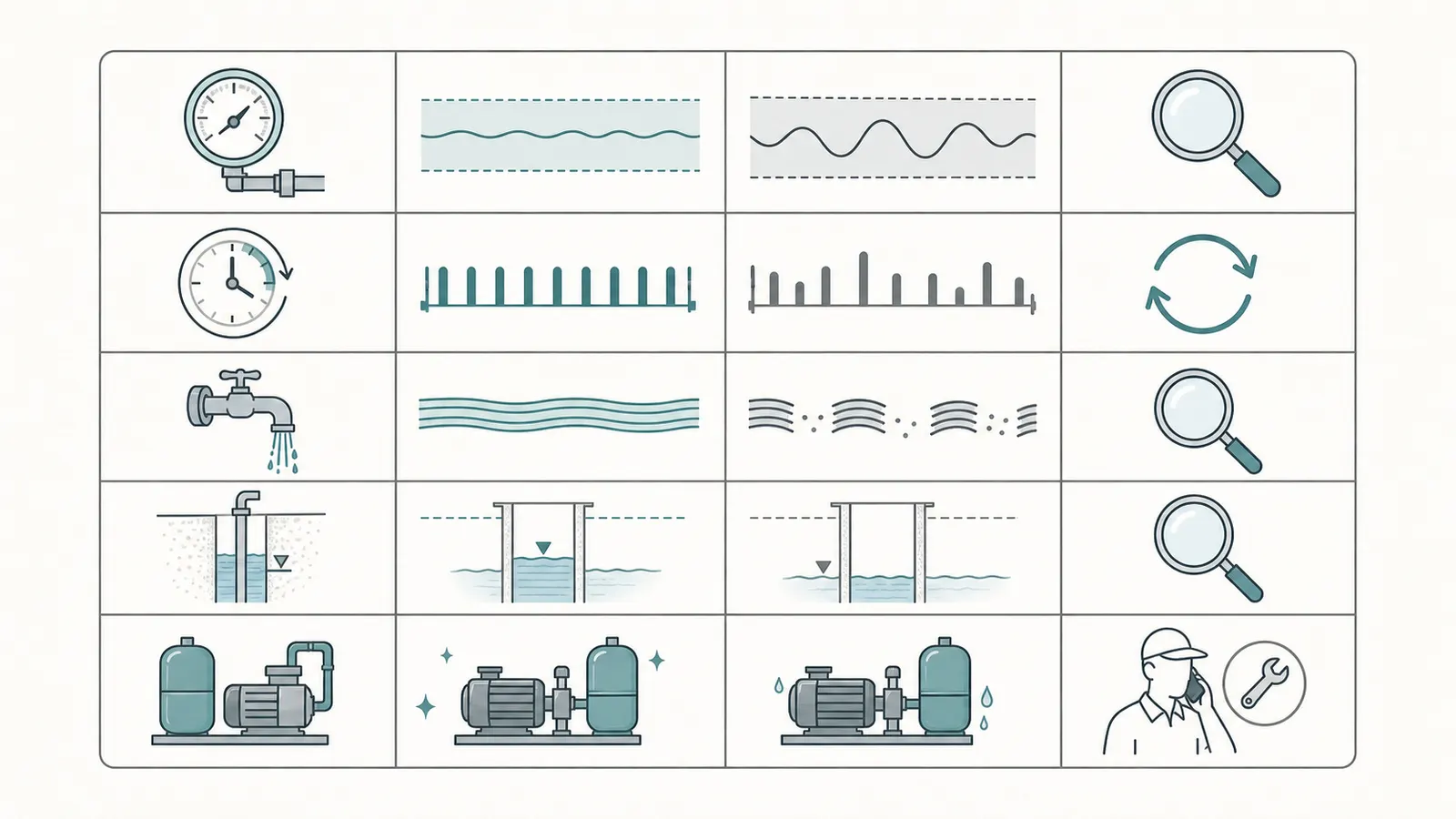
Compare records only after checking the conditions. The matrix below is a decision aid, not a diagnostic chart.
| Observed pattern | Plausible explanations to investigate | What not to infer | Next step |
|---|---|---|---|
| Pressure start/stop values changed | Gauge, switch, tank, demand, plumbing, or system change | The switch or pump is definitely bad | Repeat once under matched conditions if safe; request gauge, tank, and switch evaluation |
| Run time is longer with the same observed pressure range | More demand, lower flow, tank condition, pump, well, treatment restriction, leak, or power issue | The motor is failing | Check for household demand and visible leaks; provide the record to a professional |
| Run time is shorter and the pump cycles frequently | Tank or switch issue, small drawdown, leakage, control problem, or changed demand | A short cycle proves a bad tank | Stop repeated cycling tests and request professional diagnosis |
| Faucet-flow proxy is lower after treatment | Filter or treatment restriction, fixture restriction, plumbing, pressure, pump, or well | Well yield has fallen by the same percentage | Repeat at the same point and treatment status; service the treatment system according to its manual or call a professional |
| Faucet-flow proxy is lower before treatment too | Pressure, plumbing, pump, well, water level, or demand | Pump replacement is the only remedy | Request pressure, flow/yield, water-level, and equipment evaluation |
| Professional pumping level is deeper or drawdown is greater | Well yield, recharge, screen/formation condition, demand, pump rate, or drought | The pump alone caused the change | Ask the professional to compare rate, duration, static level, and prior well data |
| Visible wellhead, conduit, or cap concern | Physical damage, contamination pathway, corrosion, or unsafe electrical condition | A visual issue is cosmetic | Stop owner testing and contact a qualified well professional and relevant local authority |
| Water taste, odor, color, or clarity changed | Water-quality change, treatment issue, surface-water entry, or well-system breach | A pressure reading proves water is safe | Stop drinking-water assumptions and contact the health department, qualified professional, or accredited lab for guidance |
Penn State Extension notes that a loss of well performance can have several well-side and pump-side causes and that professional inspection is appropriate when performance is lost. (Penn State Extension, “Water Well Maintenance and Rehabilitation”) The Maryland Cooperative Extension well-owner guide likewise says frequent cycling can have more than one explanation and recommends a water-well professional or equipment manufacturer for accurate diagnosis. (University of Maryland Extension, “2021 Well Owners Guide”) The responsible conclusion is therefore “the trend changed; investigate,” not “the pump failed.”
When a changed trend deserves urgency
Contact a qualified professional promptly for no water, repeated loss of pressure, frequent cycling, a pump that will not stop, visible water near electrical equipment, a tripped breaker or control warning, exposed wiring, a damaged cap or casing, flooding, a suspected contamination event, or a water-quality change. The Maryland guide specifically directs owners to consult a professional when a well needs to be opened, when capacity or pressure is lost, when there is a wellhead concern, or when pump breakers or control indicators require attention. (University of Maryland Extension, “2021 Well Owners Guide”)
If water is unsafe or contamination is suspected, the response is not a pump baseline. Follow local health-department and laboratory guidance. EPA explains that private wells are not regulated by EPA and are not required to follow EPA drinking-water standards; owners therefore need to take steps to protect and monitor their own supply. State and local requirements can add obligations. (EPA, “Protect Your Private Well”)
7. Hand a professional a useful service record
Bring the completed baseline, earlier records, well completion report, pump and tank labels or manuals, water-test reports, treatment-service records, invoices, and a concise symptom timeline. The purpose is to reduce guesswork and keep the visit focused on the system’s actual history.
Ask the professional to answer these questions in the service report:
- Which measurement changed first: pressure, run time, faucet flow, water level, water quality, or electrical finding?
- Were the comparison conditions equivalent—same outlet, treatment status, water-use state, flow rate, pressure range, and test duration?
- Was the measured flow a faucet output, a pressure-tank drawdown observation, or a professional well-yield test?
- What were the static and pumping water levels, and at what date, rate, and duration were they measured?
- Were amp load, line voltage, grounding, insulation, control contacts, tank condition, gauge accuracy, and pressure-switch operation checked by a qualified person?
- Could the change be downstream of the well—in a filter, treatment unit, plumbing restriction, leak, fixture, or increased demand?
- What should the homeowner observe next, and what action should the homeowner not take?
The Water Systems Council’s records guidance says well records are useful to contractors and future owners, while the NGWA annual-checkup guidance describes the broader professional scope that a homeowner worksheet cannot replace. Keep the answer with the dated record.
The best baseline is not the one with the most numbers. It is the one that makes each number interpretable: same conditions where possible, differences clearly labeled, homeowner observations kept separate from professional measurements, and no claim stronger than the evidence. That turns a scattered symptom into a defensible service conversation while leaving diagnosis where it belongs—with a qualified well professional who can examine the complete system safely.
Sources and scope
Evidence behind this page
- Annual Water Well Inspection - Annual Checkup
Professional annual-checkup scope; not a homeowner instruction to test energized wiring or open a well.
- Well Owner's Manual
General private-well recordkeeping and service history.
- Wellcare Information for Home Inspectors: Guide to Evaluating Water Wells
Typical single-speed pressure-switch systems; constant-pressure systems require separate interpretation.
- Wellcare Information for Home Inspectors: Guide to Evaluating Water Wells
A screening observation for common systems; not a universal pass/fail threshold and not applicable without qualification to constant-pressure systems.
- Residential Drinking Water Well: Well Components
Exterior visual observation and existing-gauge observation; does not authorize opening controls or handling wiring.
- Private Well Installation & Maintenance Record
Record-field design; electrical fields are preserved as professional/service findings, not DIY instructions.
- Water Well Maintenance and Rehabilitation
General well-performance interpretation; local hydrogeology and system design affect diagnosis.
- Wellcare Information for Home Inspectors: Guide to Evaluating Water Wells
Professional evaluation of well yield, water level, and system capacity; not a homeowner well-opening procedure.
- Well Water Safety
Federal public-health guidance about private-well maintenance and water safety; it does not set a universal pump-performance threshold.
- Protect Your Private Well
Federal description of private-well responsibility; state and local requirements may add obligations.
- Water Well Maintenance and Rehabilitation
Pennsylvania Extension guidance offered as general maintenance context; local programs and requirements can differ.