Do I Need Dry-Run Protection for My Well Pump?
Use well behavior, pump records, pressure clues, and control features to decide whether dry-run protection is needed before buying a retrofit.
The short answer
Usually, dry-run protection is worth evaluating when a low-yield or seasonally declining well can drop below the pump intake. First rule out a fault and check whether protection is already built in. Motor-load, pressure-based, and level-sensing controls detect different conditions; a repeated trip or reset is a stop signal, not a diagnosis.A dry-run protector is worth evaluating if your well can temporarily produce less water than your pump can draw—especially when symptoms appear after long use, irrigation, drought, or a seasonal drop in groundwater. But do not buy a device just because the water stopped. First separate true drawdown from a pump, wiring, pressure-tank, check-valve, blockage, or well-structure fault. Then check whether your pump or control already includes protection.
For an ordinary US homeowner, the practical decision is:
- No evidence of low yield, and the system is stable: record the equipment and ask a well-pump professional whether protection adds value before retrofitting anything.
- Water loss follows sustained demand, the well recovers after resting, or the well is known to be low-yield: protection is a sensible risk-control conversation, subject to a model and wiring compatibility check.
- A protector, thermal overload, or control has tripped: stop treating the reset as a repair. Reduce demand, record the indication, and investigate the cause before another restart.
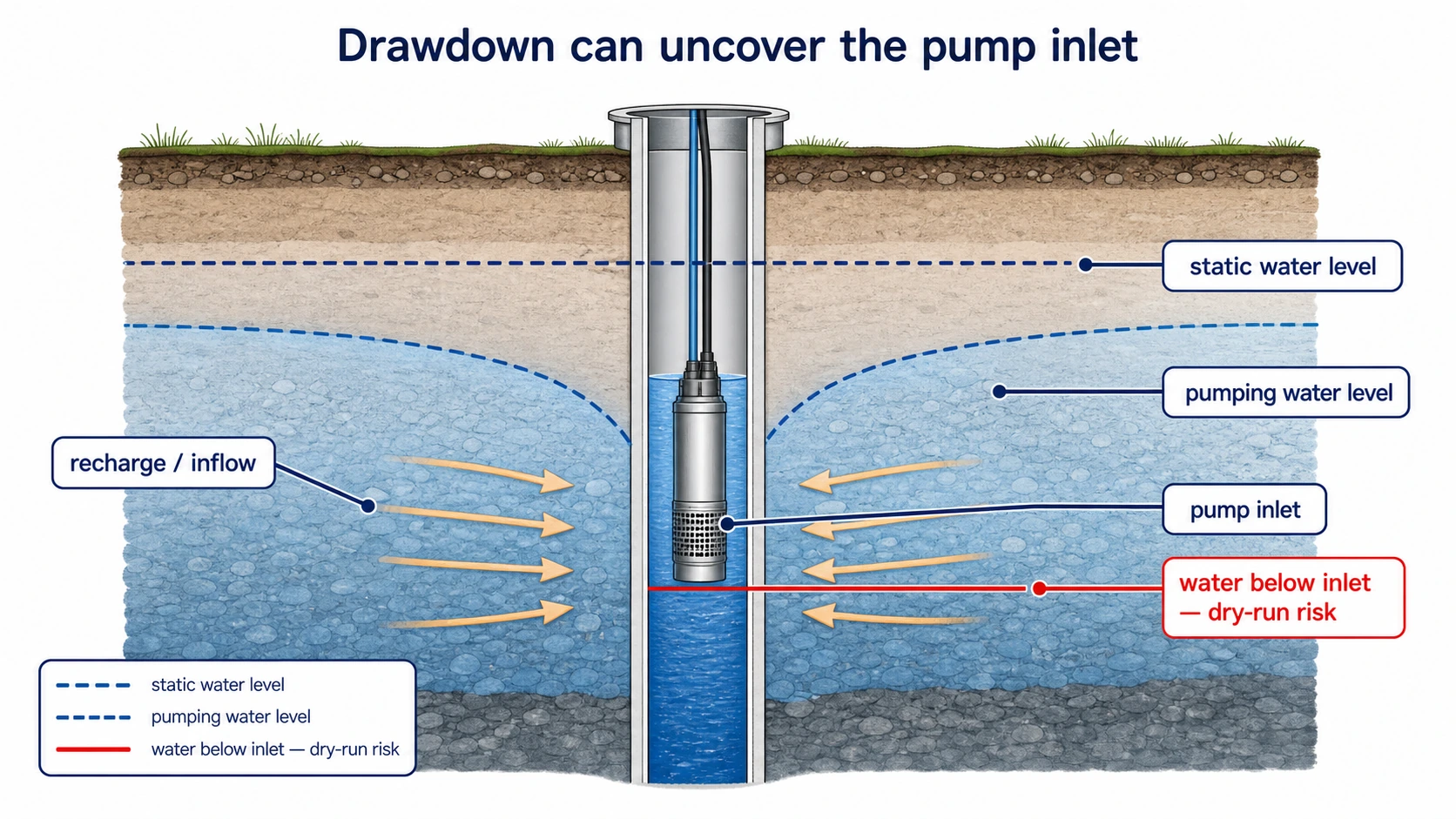
The term “dry well” is narrower than many homeowners expect. The U.S. Geological Survey explains that a well is dry for pumping purposes when the water level falls below the pump intake; water can still be present deeper in the well and may return as recharge improves. That is why this decision surface starts with well behavior and equipment records, not with a product name.
The decision in one minute
Dry-run protection is designed to stop or limit pump operation when a damaging condition is detected. It is not a way to create more groundwater, clear a clogged screen, repair a failed check valve, or make an undersized pump fit a changed well. Protection can reduce damage while the cause is being evaluated, but it can also trip during a fault that has nothing to do with low water.
Use this quick screen before you call about a retrofit. Treat it as observation of naturally occurring events only: do not create a high-demand event to see whether a suspected low-yield well will fail.
| What you observe | What it makes more plausible | What it does not prove | Safest next move |
|---|---|---|---|
| Flow becomes weak after a long shower, irrigation run, or several fixtures, then improves after a quiet period | Drawdown or a low-yield well | That the well is permanently dry, or that the pump is healthy | Stop the heavy demand; log time-to-symptom and recovery; arrange a well/pump assessment if it repeats |
| Weak or absent flow begins suddenly with no demand pattern | Electrical, control, pressure, check-valve, pump, blockage, or well fault | That a dry-run protector will fix it | Check only visible, non-hazardous clues; do not open the control; arrange service if the symptom persists |
| A fault light or low-pressure cutoff trips repeatedly | The device is detecting a condition in its sensing range | Which component failed, or that resetting is safe indefinitely | Leave it off and provide the light pattern, timing, and equipment records to a professional |
| The pump model or control documentation explicitly says dry-run or liquid-level protection is built in | A retrofit may be unnecessary | That the feature is enabled, correctly calibrated, or compatible with your well | Photograph labels and obtain the exact manual; have settings and operation verified |
| The well is documented as low-flow, shallow, drought-sensitive, or seasonally unreliable | Direct level or other dry-run protection may be valuable | That motor-load protection alone will catch every failure | Ask for a protection strategy matched to pump type, well behavior, and controls |
The strongest homeowner evidence is a repeatable relationship between demand, flow or pressure, and recovery. A pump that loses water only after extended use and recovers after resting may be experiencing drawdown. A pump that loses water at random, trips the breaker, runs hot, or never builds pressure needs a broader diagnosis.
First, separate low water from a pump or system fault
What a genuine drawdown pattern looks like
When a pump runs, it pulls water toward its inlet and lowers the nearby water level. Grundfos describes this as a cone-shaped drawdown zone; if the static level is already low or the pump can draw faster than the well yields, the water can fall below the inlet and the pump runs without the water that normally cools and lubricates it. Its explanation is specific to the SQ/SQE comparison, but the hydraulic pattern is useful for understanding why a well can contain water and still fail during sustained demand. See the Grundfos explanation of drawdown and dry-running behavior.
Look for a cluster of clues rather than one symptom:
- The problem appears after a predictable amount of use, such as irrigation, filling a tub, or several consecutive showers.
- The flow is initially normal, then falls away while the pump continues to run or the pressure declines.
- Water returns after a meaningful rest period, without a repair or control adjustment.
- The issue is worse during a dry season, drought, or period of unusually high demand.
- A well professional has prior records showing low yield, a low pumping level, or a pump set close to the normal pumping water level.
These clues increase the case for protection, but they do not identify the best protection method. A slow or intermittent well can also be affected by a clogged screen, mineral or sediment buildup, a collapsed casing, or a pump set or check-valve problem. Oregon’s water-resources guidance explicitly says a dry-well report can reflect a change in the well or groundwater supply, and it lists water-table decline, collapsed casing, clogged screen, sediment, and mineral deposits among possible causes. It recommends an assessment by a licensed pump installer or well driller when output falls, becomes intermittent, or appears dry. Read the Oregon owner guidance here.
Why “the pump is running” is not a complete test
A submersible pump may be energized while delivering little or no water. The Goulds/CentriPro troubleshooting table includes inadequate submergence, low voltage, faulty electrical connections, a pump bound by foreign matter, a damaged cable or splice, a faulty or incorrectly installed check valve, excessive air or gas, excessive lift, and pump wear among possible causes. That list is for the covered pump families, not a universal diagnostic, but it shows why a low-flow symptom cannot be relabeled as a dry well from the faucet alone. Review the manufacturer’s troubleshooting table.
Do not infer any of the following without an appropriate test:
- Brictale possibility—not an evidence-backed diagnosis: if no water appears at only one faucet, a local shutoff, clogged aerator, treatment device, filter, or frozen line could be the restriction. Compare another fixture before treating the symptom as a well-level clue.
- A running sound means water is moving. A pump can run with inadequate submergence, a blocked path, a failed check valve, or another fault.
- A low pressure-gauge reading identifies a low water table. It only reports system pressure at that gauge; it does not measure the water level in the well.
- A thermal reset means the pump needed a reset. It may mean the motor overheated, and automatic restart can repeat the damaging condition.
- One successful restart clears the issue. Intermittent faults are often the ones that return under demand.
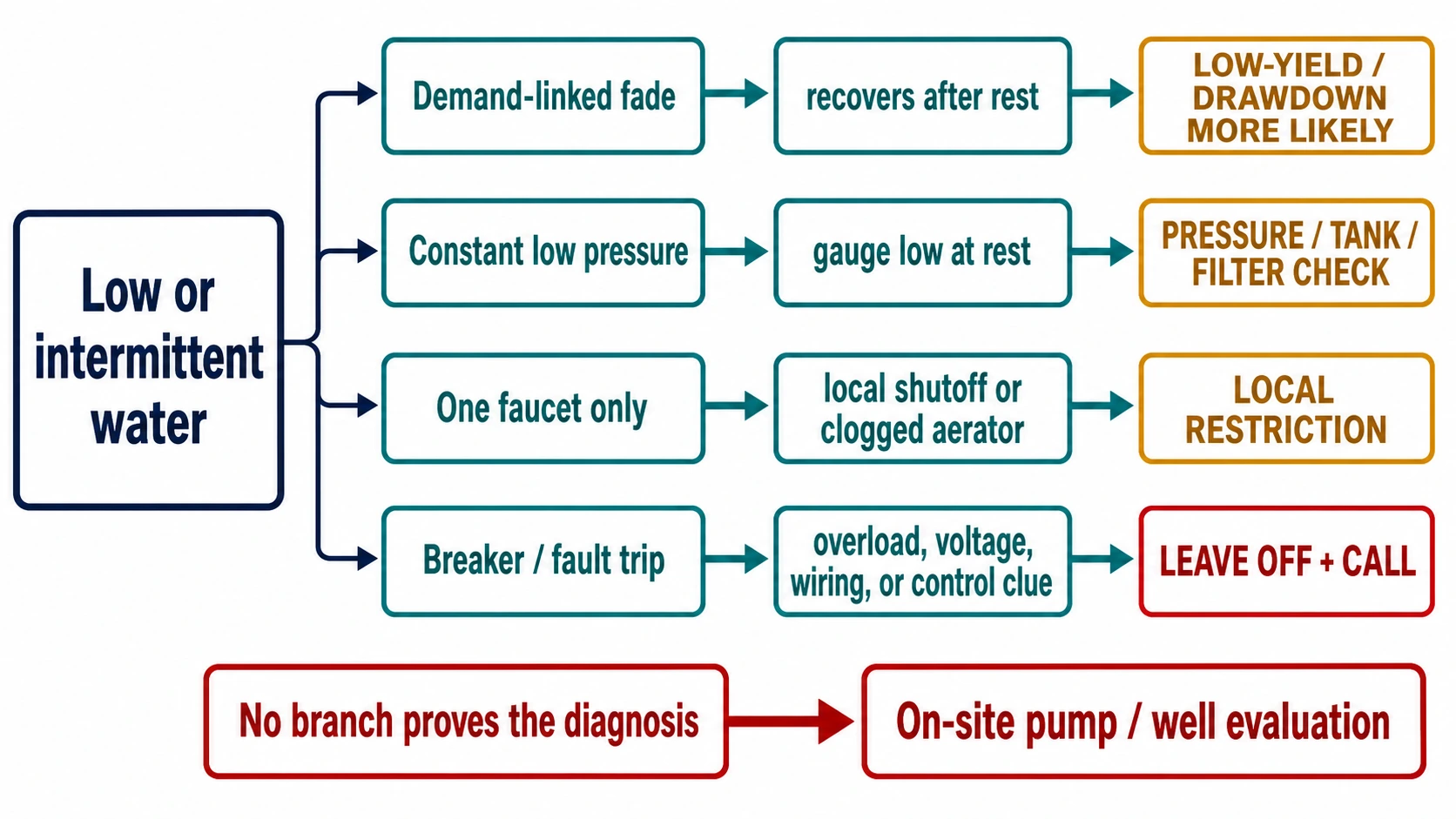
A practical diagnostic matrix
Use this as a record-taking aid, not as permission to open controls or pull equipment.
| Pattern | Observe without touching energized equipment | More useful question | Protection implication |
|---|---|---|---|
| Demand-linked fade | Start time, fixtures in use, approximate duration until flow changes, rest time until recovery | Does the well recover when demand stops? | Discuss low-yield protection; level sensing may offer a more direct signal if compatible |
| Constant low pressure | Gauge at rest and during one normal fixture, visible filter condition, whether all fixtures are affected | Is the pump reaching normal pressure, or is water restricted after the tank? | Pressure-based protection may not distinguish restriction from low well level |
| Pump will not start | Breaker position, visible control indication, whether neighbors have power, recent outage | Is there a protective trip or a supply/control fault? | Do not keep resetting; have electrical and pump controls checked |
| Pump starts and stops rapidly | Cycle timing, pressure rise/fall, visible leaks, recent tank or switch work | Is the tank, switch, leak, or check valve causing cycling? | Dry-run protection is not a substitute for correcting rapid cycling |
| Flow stops after a trip | Fault-light color or code, whether it is underload, overload, voltage, or pressure-related according to the manual | What signal did this exact device detect? | Record the event and follow the device manual; do not assume “dry well” |
Read your existing equipment record before buying
The most valuable pre-purchase information is usually already printed on a label, manual, or service record. The Goulds/CentriPro manual includes an owner-information block for pump and motor model and serial numbers, dealer, installation date, voltage, and amps. It also tells installers to match motor and pump horsepower, match supply voltage and phase, and record operating information. Use the model-specific manual as the primary record source.
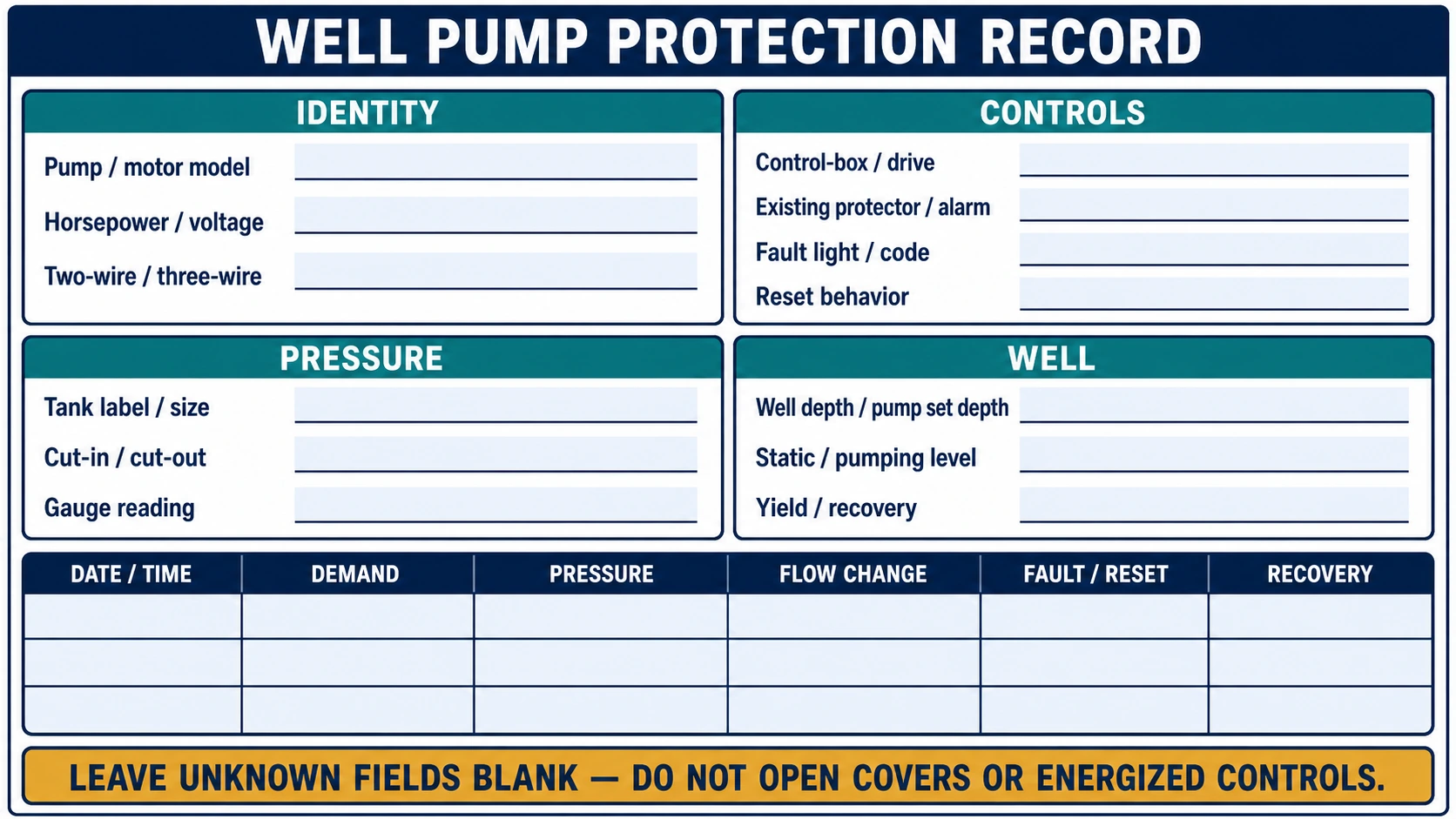
Record these facts
Write down or photograph the following without removing covers:
- Pump: manufacturer, model, horsepower, voltage, phase, two-wire or three-wire configuration, and serial number if visible.
- Motor and control: motor model, control-box model, starter or variable-frequency-drive model, and any protector name or model.
- Pressure system: pressure-tank label, pressure-switch cut-in and cut-out if clearly documented, gauge location, and whether the switch sits at the tank tee.
- Well facts: total well depth, pump set depth, static water level, pumping water level, reported yield, well-construction record, and date of the last service. Leave unknown fields blank.
- Observed behavior: date, time, demand in progress, pressure before and during the event, sound or vibration change, fault light, breaker status, and recovery time.
- Prior work: pump replacement, screen or casing work, filter change, pressure-tank work, wiring work, drought period, or a new irrigation load.
Do not copy a pressure setting from a neighbor’s system. In one Goulds/CentriPro installation example, the pressure switch is placed at the tank tee and within 4 feet of the tank to reduce switch chatter, and the tank pre-charge example is 2 psi below a 30/50 pressure setting. Those are equipment-specific instructions and examples, not a universal homeowner adjustment. See the manual’s pressure-tank and switch guidance.
Compatibility is not just a voltage question. Franklin describes Pumptec as monitoring motor load and power-line conditions, and its product family has different control-box relationships, sensitivity options, motor types, voltage ranges, and horsepower ranges. For example, its QD Pumptec is described as plugging into specified Franklin QD three-wire relay control boxes, while other Pumptec products have their own ranges and installation requirements. Check the exact Franklin product description, then the exact manual for the proposed device.
The same caution applies to level controls. Pentair’s 4-inch submersible manual describes liquid-level pump-down controls for low-flow wells, but also instructs that overload protection must not be removed or short-circuited. A level-control idea is therefore not a generic wire-and-float retrofit; it is a model-specific control arrangement that must preserve the pump’s required protection. See the Pentair manual’s liquid-level and overload guidance.
What to ask for in a quote
Ask the pump professional to state, in writing or on the work order:
- which exact failure the proposed device is intended to detect;
- whether it senses motor load, pressure, water level, flow, or a combination;
- the pump, motor, control-box, voltage, phase, and horsepower compatibility basis;
- whether the protection is already present and how its status is verified;
- what happens after a trip: manual reset, timed restart, lockout, or automatic restart;
- what conditions can cause nuisance trips or missed trips;
- where the device will be installed and what wiring or control changes are required;
- how settings will be selected and documented;
- what the homeowner should do when the device trips;
- what will be tested after installation, and what is outside the scope of that test.
If the answer is simply “it protects against dry running” with no discussion of your pump and control records, the decision is not yet specific enough to buy.
Which protection method matches the risk?
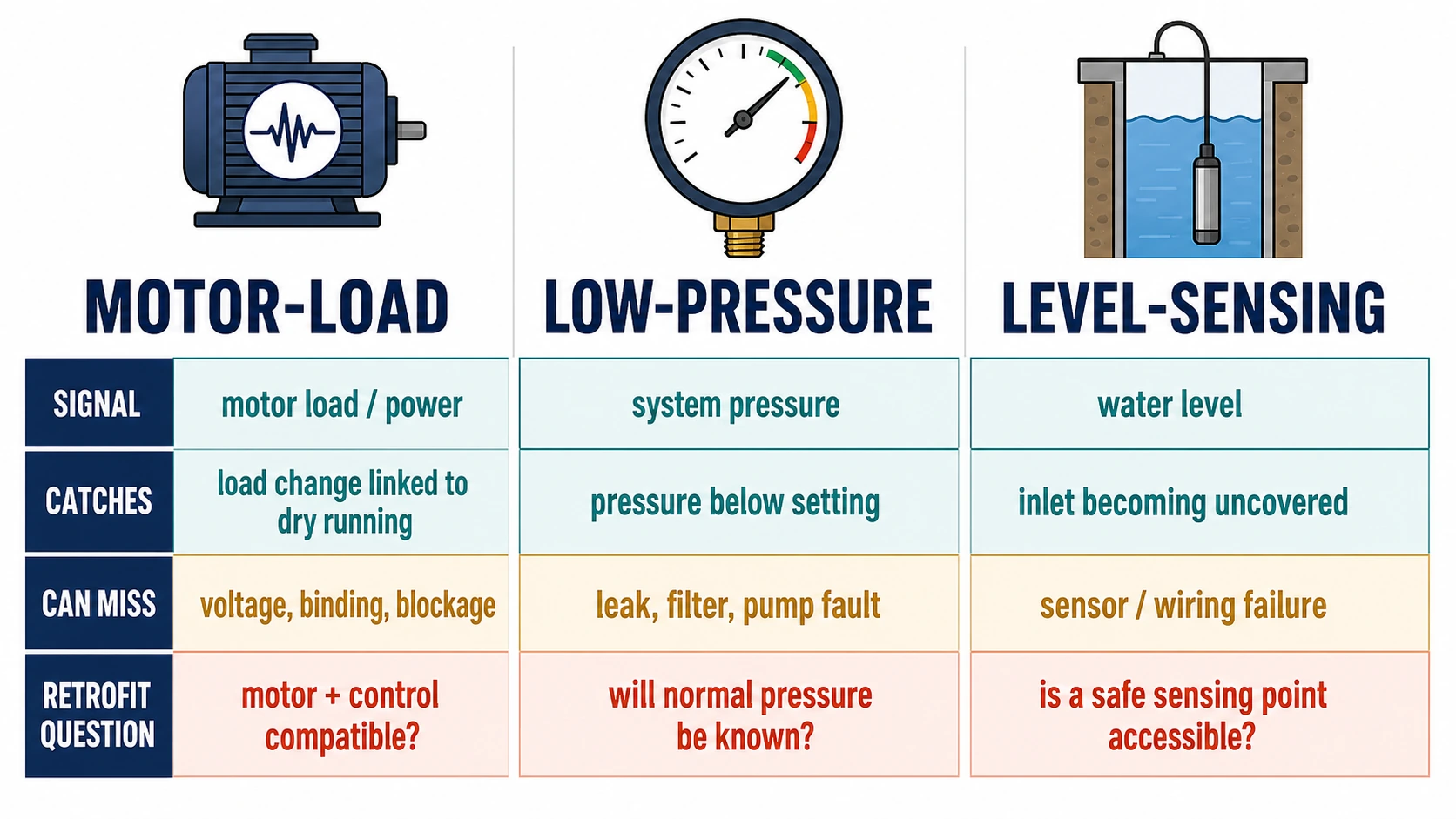
There is no universal best protector. The three common approaches below watch different signals. A professional may combine them, but more devices do not automatically mean more safety if they are mismatched or create confusing restart behavior.
| Approach | Signal watched | Strength for a homeowner decision | Blind spot or retrofit limit | Good record to bring |
|---|---|---|---|---|
| Motor-load / underload | Electrical load or power behavior of the motor | Can detect a rapid or sustained load change associated with dry-well or flow conditions; many products provide a fault light | The same load change can come from voltage, wiring, pump binding, flow restriction, wrong calibration, or other faults; model range matters | Motor model, voltage, phase, amps, control-box model, normal-load record if available |
| Low-pressure cutoff | Pressure in the delivery system | Can shut down when system pressure falls below a configured threshold; a manual-reset design can force an inspection before restart | Low pressure can be caused by a leak, blocked filter, check valve, pump problem, or high demand; a pressure gauge is not a well-level sensor | Pressure-switch model, cut-in/cut-out, tank label, gauge behavior, filter and valve status |
| Level sensing / pump-down | A water-level or low-level signal in the well or source | Most direct when the well’s risk is known to be the pump intake becoming uncovered | Probe, float, wiring, well access, corrosion, placement, and controller compatibility matter; a sensor cannot repair a collapsed casing or blocked screen | Well construction, pump setting, water-level history, control diagram, sensor location and model |
Motor-load protection is the clearest example of why the signal is not the diagnosis. Franklin says Pumptec monitors motor load and power-line conditions and interrupts power when the load drops quickly or below a preset level. That can be useful for dry-well conditions, but the same page also describes protection for waterlogged tanks and abnormal line voltage. A fault light narrows the field; it does not identify the failing part. See Franklin’s stated sensing scope.
Level sensing is attractive when a well is known to be low-flow because Pentair’s manual specifically identifies pump-down controls as a way to prevent a low-flow well from being pumped dry. It is still not a universal answer. The sensing point has to represent the pump’s safe operating condition, and the controller has to be compatible with the motor and existing controls. Do not accept a proposed probe or float based only on a generic product description. Use the equipment manual and installation diagram for the exact model.
Pressure-based protection can be useful where a pressure problem itself is the concern. Pentair’s product example shows the category: a low-pressure cutoff can remove power below a defined pressure and require manual reset, while the ordinary pressure switch still operates between its cut-in and cut-out settings. That specific product is discontinued, so treat it as an illustration of how the category behaves—not as a current product recommendation or a universal threshold. Read the discontinued example’s description and limits.
Why built-in protection changes the decision
Some pumps and drives include protection; other conventional pumps need added equipment. Grundfos describes dry-running protection as built into its SQ/SQE range and says conventional 4-inch pumps require extra equipment for dry-run protection. The same explanation says the SQ/SQE detects a drastic drop in motor power consumption when water falls below the inlet and can stop the motor before damage, with model-specific restart behavior. That is a manufacturer description of that range, not a rule for every pump that looks similar. Verify the exact model before assuming protection is present.
“Built in” can also mean different things in different records:
- thermal overload that protects against overheating but may restart after cooling;
- motor-load underload detection that trips on a load or power signature;
- pressure logic in a drive or control panel;
- a separate level input that must be wired and enabled;
- an alarm or notification that reports a problem without necessarily stopping the pump.
Ask which of those you have. Do not assume that a thermal protector is the same as a dry-run controller, and do not assume that a fault notification means the pump has been safely shut down.
A homeowner-safe check sequence
This sequence is designed to improve the next decision without asking you to perform electrical or well work. It deliberately stops at observation.
1. Protect the household first
Stop irrigation, hose use, repeated showers, and other nonessential demand. If the pump is audibly running without delivering water, or if a protector has tripped, use the house water sparingly until the system is evaluated. Do not force a restart just to see whether the symptom returns.
If you see a leak, water near electrical equipment, burning odor, smoke, a hot control enclosure, a repeatedly tripping breaker, or a damaged cable, leave the system off and arrange qualified service. Do not touch wet electrical equipment.
Dry-run symptoms are not a water-quality test
This remote screen cannot assess whether well water is safe to drink, and dry-run protection cannot detect or rule out contamination. If water is discolored, foul-smelling, has an unusual taste, or seems chemically unusual, stop using it for drinking and cooking. Use bottled water or another known-safe source, and arrange appropriate local water testing or professional advice; the CDC recommends testing when a private well’s color, taste, or smell changes and using a state-certified laboratory. See the CDC guidance for testing private-well water.
2. Observe only what is visible and ordinary
Without opening a control box, record:
- whether the breaker or disconnect appears on or off;
- pressure on an installed gauge, if it can be read without removing a cover;
- whether the gauge changes when one normal fixture is opened;
- whether flow is absent at every fixture or only one;
- visible filter pressure indicators or a clearly serviceable filter housing;
- fault-light color, flash count, text, or app message;
- whether the pump sound changes, stops, or cycles;
- the time from demand start to symptom and the time to recovery.
Do not interpret a breaker that is “on” as proof that the pump has safe power. Do not interpret a fault light without the device manual. Do not turn a pressure-switch adjustment screw, bypass a control, or remove a panel.
3. Document naturally occurring events only
Do not turn on fixtures, irrigation, or other loads to make a suspected low-yield well show the pattern. If an ordinary use already underway produces a symptom, stop that use at the first sign of trouble: flow falls, the pump appears to run without delivery, pressure collapses, or any protector trips. Do not wait for a complete loss of water. From a safe place and without touching controls, record the approximate time, the demand already in progress, a gauge reading if visible, the sound or flow change, the fault indication, and whether service later returns on its own. If no event is occurring, leave the system alone; do not create one for the log.
If there is no water, do not keep opening faucets to “help” the pump recover. If the system has a documented low-water alarm, follow the exact owner instructions. If it has no documented recovery procedure, leave it alone and call for service.
4. Compare the log with the equipment record
Compare only naturally occurring entries; never repeat a demand to test the pattern. The useful comparison is not “did it happen once?” It is:
same demand → same symptom → similar recovery
Repeated alignment makes a yield or drawdown problem more plausible. A symptom that does not track demand makes a control, electrical, pump, valve, blockage, or structural problem more plausible. Neither result is conclusive without well and equipment tests.
5. Arrange the right evaluation
For repeated low or intermittent output, ask for a well/pump evaluation that can distinguish water level, pump placement, well structure, and local groundwater conditions. Oregon’s owner guidance specifically directs owners with reduced or intermittent output to a licensed pump installer or well driller for that kind of assessment. Use the state guidance as a referral frame, while checking your own state’s requirements.
For a fault light, breaker trip, low-pressure cutoff, or suspected voltage problem, give the pump professional or qualified electrician the exact indication and the equipment record. The Goulds/CentriPro manual says wiring should be performed by qualified technicians, and its troubleshooting section requires power to be disconnected and locked out before service. Read the manufacturer safety instructions before discussing any electrical work.
What fault lights and resets can—and cannot—tell you
A reset is an event in the system’s story. It is not a diagnosis.
Underload or dry-run indication
If a motor-load protector reports underload or dry run, possible interpretations include low water, an uncovered inlet, a flow restriction, a calibration issue, or another condition that changed the motor’s load. Franklin’s description intentionally groups dry-well conditions, waterlogged tanks, and abnormal line voltage under its monitoring function. Treat the indication as “the device saw an abnormal signal,” then consult the exact manual and service provider. Franklin’s product page identifies the sensing logic and status lights.
Overload or thermal indication
An overload or thermal trip points toward heat, excessive load, binding, voltage, wiring, or other motor/control conditions. It should not be relabeled as dry run merely because the water is also weak. The Goulds/CentriPro troubleshooting table lists low voltage, faulty connections, a pump bound by foreign matter, inadequate submergence, and an inadequate power source among possible causes of a non-running motor. Use that list as a prompt for qualified diagnosis, not a homeowner test procedure.
Low-pressure cutoff
A low-pressure cutoff is watching pressure in the pressurized plumbing. If it trips, the system has crossed its configured pressure condition; it does not directly report the depth of water in the well. A blocked filter, closed valve, leak, failed pump, check-valve problem, or high demand can all affect pressure. That is why the device model, pressure settings, gauge behavior, and recent plumbing changes matter.
Automatic restart
Automatic restart is not automatically safe. Grundfos describes model-specific automatic resumption after a dry-run event, while the Goulds/CentriPro manual warns that thermal overload protection may allow an overheated pump to restart unexpectedly after cooling. Repeated starts can continue a damaging pattern or obscure the original failure. Read the relevant manufacturer restart description before assuming a timer is a cure.
Use this reset rule: one documented reset may be part of the exact owner procedure; repeated resets without a cause check are a stop condition. If the manual does not say that a homeowner should reset it, leave it off. Never defeat an overload, short a switch, bypass a level control, or substitute a control because the pump is inconveniently off. Pentair explicitly warns not to remove or short-circuit overload protection. See that warning in the Pentair manual.
Stop points: when to call a professional
Stop immediately and leave power off when
- a breaker trips again after one normal reset or will not hold;
- a protector trips repeatedly or the pump restarts unexpectedly;
- you smell burning, see smoke, melted insulation, scorching, or water inside an electrical enclosure;
- a control box, disconnect, pressure switch, or cable is wet or damaged;
- there is no water and the pump appears to keep running;
- a pressure vessel is leaking, corroded, bulging, or behaving abnormally;
- you do not know whether the system is energized;
- the system has an alarm you cannot interpret from its manual.
Arrange a qualified pump professional for well-level, pump-setting, pump-pull, casing, screen, check-valve, flow, or control diagnosis. Arrange a qualified electrician for supply voltage, wiring, disconnects, grounding, splices, or control-panel work. Depending on the equipment and jurisdiction, one professional may coordinate the other; do not assume one trade covers every part of the system.
Work that is outside this homeowner check
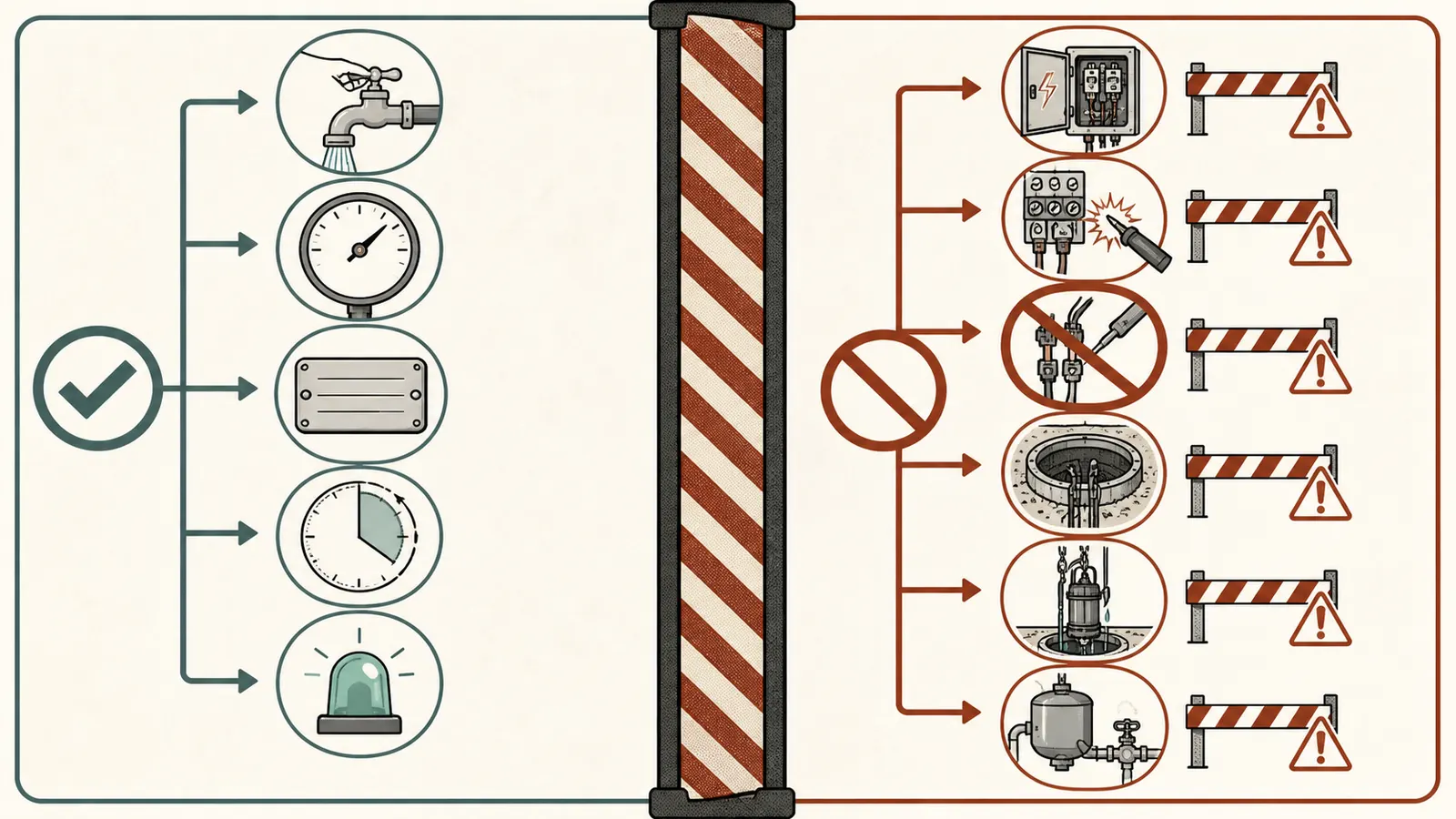
Do not open an energized control, pressure switch, starter, or drive. Do not test live wiring. Do not remove guards or covers to reach terminals. Do not open the well, pull a submersible pump, lower a probe, alter pump depth, change pressure-switch settings, modify tank pre-charge on a pressurized system, bypass a control, or enter a well pit or other confined space as part of this decision.
The Goulds/CentriPro manual states that electrical work must be performed by a qualified technician, that power must be disconnected before wiring, and that the pump, motor, and controls must be grounded in accordance with applicable electrical codes. It also warns against over-pressurizing the tank or system. Those are manufacturer safety instructions for the covered equipment; local requirements can add more limits. Read the manual’s safety instructions.
What to bring to the service visit
Bring the equipment record, photos of labels with serial numbers visible, the symptom log, the fault-light pattern, the pressure readings, and the time-to-recovery. Tell the professional whether the issue is new, seasonal, demand-linked, or associated with recent well, plumbing, electrical, or irrigation work. Ask for the diagnosis to be separated into:
- well supply: static level, pumping level, recovery, yield, and well condition;
- pump and hydraulics: pump model, setting, check valve, flow, head, and condition;
- pressure system: tank, switch, gauge, filters, leaks, and cycling;
- electrical and controls: supply, motor, control box, protection device, trips, calibration, and restart behavior;
- protection recommendation: what will be protected, what will still be unprotected, and how a trip should be handled.
That structure keeps a protection purchase from becoming a substitute for finding the failure.
Equipment record worksheet and next-action plan
Copy this table into your home records or print it. Leave unknown fields blank; an unknown is more useful than an invented value.
| Record | Your value | Why it matters |
|---|---|---|
| Pump manufacturer and model | Determines manual, curve, and compatibility | |
| Motor manufacturer and model | Determines voltage, phase, wire arrangement, and protection requirements | |
| Horsepower and voltage | Helps match a protector’s range | |
| Two-wire or three-wire | Affects the control-box and retrofit path | |
| Control-box, starter, or drive model | May already contain protection or require a specific accessory | |
| Existing protector or alarm model | Identifies the signal, settings, and reset behavior | |
| Pressure-tank label and size | Gives the service provider the tank basis | |
| Pressure switch cut-in / cut-out, if documented | Separates normal settings from abnormal pressure behavior | |
| Gauge location and readings | Shows where pressure is measured, not well depth | |
| Well depth and pump set depth | Helps assess sediment, submergence, and available drawdown | |
| Static and pumping water levels, if known | Connects symptoms to the well rather than guessing | |
| Reported well yield or recovery time | Helps judge whether demand exceeds supply | |
| Fault light, code, or app message | Records the device’s signal exactly | |
| Demand when symptom occurred | Tests whether the pattern is repeatable | |
| Time until flow fell | Provides a repeatable comparison | |
| Time until service recovered | Helps document recovery without claiming a diagnosis | |
| Recent changes or repairs | Identifies new loads, settings, restrictions, or wiring changes |
Your final decision statement
After filling the record, complete one of these sentences:
- “I have no repeatable low-yield pattern, and I have not confirmed existing protection. My next step is to ask for a compatibility review before buying.”
- “My flow loss follows sustained demand and recovers after rest, and the well has known low-yield or seasonal risk. My next step is a well/pump evaluation plus a protection recommendation.”
- “My device has tripped or the pump has stopped, but the cause is unknown. My next step is to leave it off, document the indication, and arrange service.”
- “My equipment record shows built-in protection, but I do not know its sensing range or restart behavior. My next step is to obtain the exact manual and have the feature verified.”
The best answer to “Do I need dry-run protection?” is therefore conditional. If a low-yield or drawdown event is credible and your existing system does not already protect the pump, protection may be a prudent addition. If the symptom is unexplained, diagnose first. And if a control has tripped repeatedly, the safest decision is to stop resetting it and arrange an on-site evaluation.
Sources and scope
Evidence behind this page
- U.S. Geological Survey — What determines if a well will go dry?
United States; general groundwater explanation. It does not diagnose a particular well or establish a national repair requirement.
- Oregon Water Resources Department — Report a Dry Well
Oregon state owner guidance used here for the listed causes and referral advice; it is not a nationwide code or licensing rule.
- Franklin Water — Pumptec Single-Phase Pump Protection
Franklin product-family description for specified single-phase applications; compatibility, calibration, and installation depend on the exact motor, control box, voltage, and model.
- Goulds Water Technology — 4-inch Submersible Pumps Installation, Operation and Maintenance Manual IM116R09
Manufacturer manual for the covered 4-inch submersible pump and motor families; recommendations are not universal for every well pump or control system.
- Goulds Water Technology — 4-inch Submersible Pumps Installation, Operation and Maintenance Manual IM116R09
Troubleshooting table in the manufacturer manual; use only as a model-specific differential, not as a remote diagnosis.
- Goulds Water Technology — 4-inch Submersible Pumps Installation, Operation and Maintenance Manual IM116R09
Safety and troubleshooting instructions for the covered pump systems; this is not a substitute for local electrical requirements or a qualified technician.
- Grundfos — SQ/SQE Protection Features: Dry-Running Protection
Grundfos educational material about the SQ/SQE range and a conventional 4-inch comparison; built-in behavior cannot be generalized to another pump model.
- Pentair — 4-inch Submersible Pumps Manual
Pentair manual guidance for the covered 4-inch submersible pump and control arrangements; exact level-control wiring and compatibility are model-specific.
- Goulds Water Technology — 4-inch Submersible Pumps Installation, Operation and Maintenance Manual IM116R09
Installation guidance and example from one manufacturer manual; do not apply the example settings to a different tank or pressure-switch specification without its instructions.
- Pentair Parts2O — 30/50 PSI Pressure Switch with Low Pressure Cut-Off
A discontinued Pentair product example used only to explain the category; it is not a recommendation or a current availability claim.
- CDC — Guidelines for Testing Well Water
General US guidance for private-well drinking-water testing; it does not diagnose a particular water-quality event or specify every contaminant test needed in every location.