Do I Need a Torque Arrestor for a Submersible Well Pump?
A source-linked homeowner buying guide for deciding whether a submersible-well-pump torque arrestor is required, optional, damaged, or worth checking during a pump pull.
The short answer
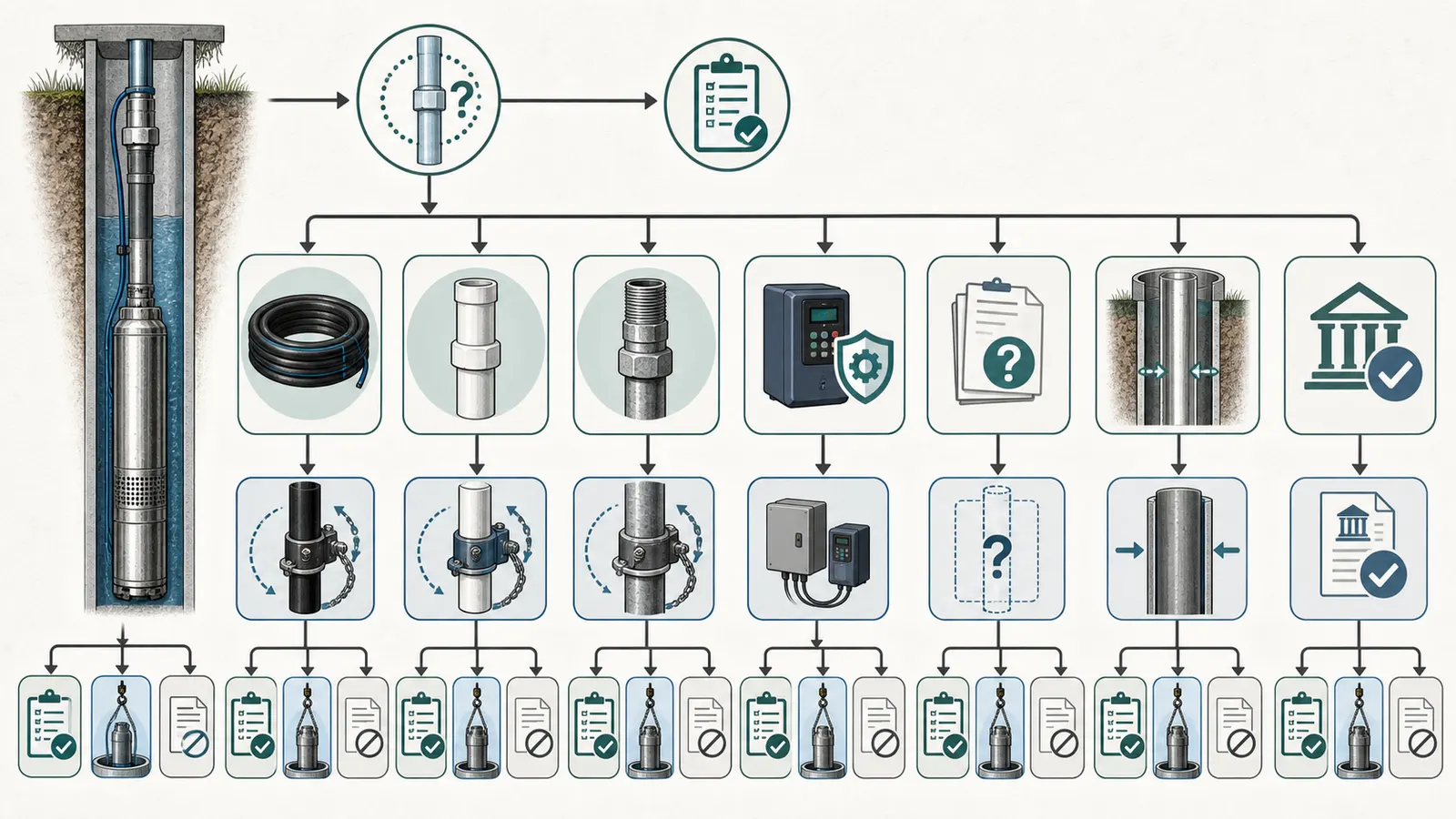
Usually, the drop-pipe material controls the first decision: flexible polyethylene and rigid PVC commonly need a torque arrestor, while threaded steel or galvanized pipe may not. But the pump manual, arrestor instructions, casing clearance, local rule, and installation record control the final answer. You cannot safely verify a buried arrestor without a pump pull; ask for an itemized inspection when the assembly is already being removed.Do I Need a Torque Arrestor for a Submersible Well Pump?
Short answer: maybe, and the drop-pipe material is the first useful clue. A torque arrestor is commonly expected on flexible polyethylene and rigid PVC drop pipe because a submersible motor can twist the pump-and-pipe assembly as it starts and stops; Zoeller requires one for rigid PVC or flexible plastic in the pump installations covered by its current manual. Threaded steel or galvanized pipe is a different case: it is rigid, but a pump manufacturer or local rule may still call for an arrestor as a centralizer, or may exempt steel. Franklin’s manual, for example, recommends galvanized pipe but separately calls for a torque arrestor just above the pump. The final decision depends on the exact pump manual, arrestor instructions, casing inside diameter, installation depth, local requirements, and the record of what was installed.
This is not a component you can reliably confirm by looking at the well cap. If the pump is already being pulled for service or replacement, ask the well professional to identify and photograph the drop-pipe material, casing clearance, arrestor, cable protection, and safety line before the assembly goes back in. If there is no planned pump pull, the prudent choice is to record the uncertainty and avoid a special pull solely to hunt for a part unless symptoms, a service decision, or a professional assessment justify it.
Safety boundary: do not open a well cap or seal, open an energized control box, test live wiring, disconnect pressurized piping, lower tools into the casing, pull a pump, enter a well pit or other confined space, or handle the pump cable, arrestor, or safety rope. A submersible pump is heavy, can start unexpectedly, and is connected to electricity and pressurized water. Goulds Water Technology says electrical work must be performed by qualified personnel and that applicable electrical and local requirements must be followed in its submersible-pump installation manual. Give the inspection and lifting work to a qualified well or pump professional.
1. Make the required-versus-optional decision
The useful homeowner decision is not “Does every submersible pump need a torque arrestor?” The evidence does not support that blanket rule. The useful decision is:
- Is the pump installed on flexible polyethylene, rigid PVC, threaded galvanized or steel pipe, or an unknown material?
- What does the exact pump manual require?
- What does the arrestor manufacturer require for casing size, pipe size, placement, and quantity?
- Is there a state, county, project, or installer specification that changes the baseline?
- Is the pump already being pulled, making inspection reasonably available?
Use this matrix as a first pass. “Likely” is a request-for-verification state, not permission to order a part by appearance.
| What is known | What the evidence generally supports | What it does not prove | Safest next action |
|---|---|---|---|
| Flexible polyethylene drop pipe | Treat a torque arrestor as a strong expectation; flexible pipe can move and contact the casing. Zoeller requires one for flexible plastic on the pump models covered by its manual. | It does not identify the correct arrestor, fit, number, or spacing. | Give the pump and pipe details to the professional; request inspection during the next pump pull or replacement. |
| Rigid PVC drop pipe | Treat an arrestor as commonly required by the applicable pump instructions because PVC can transmit movement and contact the casing. Zoeller expressly requires one for rigid PVC in its covered installations. | It does not establish that every PVC installation uses the same product or distance above the pump. | Verify the pump manual, casing ID, and arrestor instructions; do not buy from pipe material alone. |
| Threaded galvanized or steel drop pipe | A torque arrestor may be optional for pipe-flex control, but it may still be used as a pump centralizer or required by a local rule or pump maker. | “Steel means no arrestor” is not a safe universal conclusion. | Ask the professional to identify the manual and local rule that governs this installation. |
| Unknown pipe or unknown casing ID | The installation record is incomplete for a compatibility decision. | A visible pump model or well cap does not reveal buried pipe, casing clearance, or arrestor condition. | Mark the record “unknown”; request documentation at the next service event. |
| Soft-start, variable-speed, or unusual pump system | Starting behavior and accessory requirements can differ from a conventional fixed-speed residential pump. | A soft-start label alone proves neither that an arrestor is unnecessary nor that the existing part is compatible. | Use the exact system manual and installer record; have the professional reconcile any exception in writing. |
| A state or project rule is available | The rule or specification may require an arrestor, set exceptions, or prescribe quantity and cable protection. | A neighboring state’s rule is not your rule. | Check the applicable authority or project documents; keep the citation with the installation record. |
The strongest “request an inspection” branch is a flexible or PVC installation with no record of an arrestor, visible evidence of cable rubbing, repeated pump or pipe movement, a pump replacement already scheduled, or a quote that lists “torque arrestor” without saying what is being replaced. A steel-pipe installation with no symptoms and no planned pump pull is usually a record-review issue rather than a reason to create a separate excavation or pump-pull job.
This is a decision about installation scope, not a diagnosis from one symptom. Low pressure, a tripped control, noisy starts, or a failed motor can justify a pump professional’s investigation, but none of those symptoms alone identifies a missing arrestor. Conversely, a system that is currently delivering water does not document the condition of a buried rubber or polymer part. Keep the decision tied to the installation record and the next safe service opportunity.
2. Know what the part does—and what it cannot do
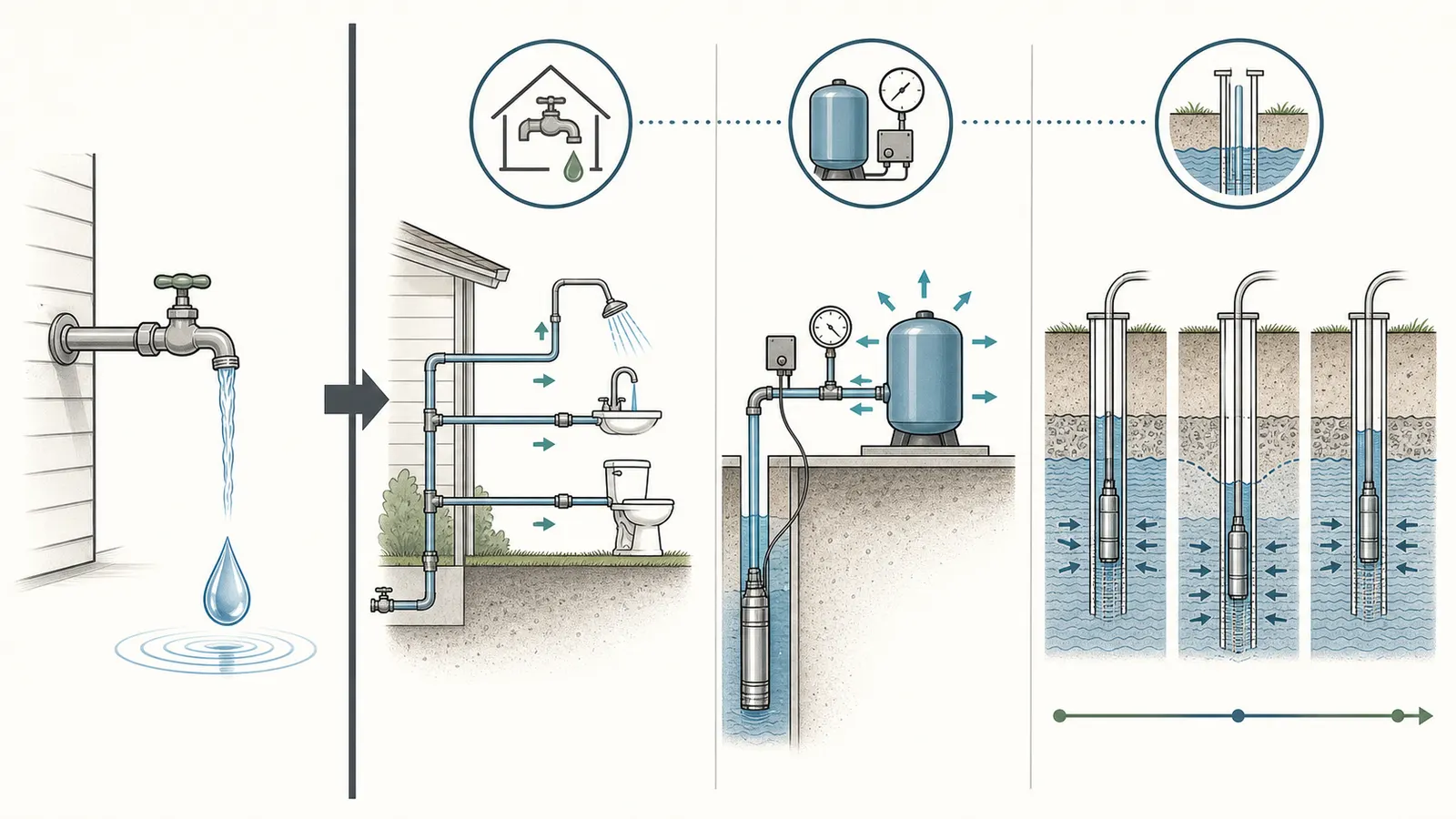
A torque arrestor is a friction-fit or expandable device attached to the drop pipe near the submersible pump. Its job is to keep the pump and pipe assembly centered and to resist movement caused by motor starting and stopping. Goulds Water Technology describes the function as absorbing thrust from motor start-ups and keeping the pump centered in the well; it also notes that different types are available in its residential water-systems technical manual.
The practical failure chain is easier to understand than the name:
- The motor starts or stops.
- The pump reacts against the drop pipe and can twist or move within the casing.
- A flexible pipe can flex, and the pump, pipe, or wire can approach the casing wall.
- Repeated contact can abrade cable insulation, pipe, clamps, or pump components.
- A correctly selected and fitted arrestor limits movement by bracing against the casing.
That description does not mean a missing arrestor automatically caused a pump failure. A pump can operate for years without an obvious symptom, and a rubbing cable can have several possible causes. It also does not mean installing an arrestor corrects an undersized or damaged drop pipe, a crooked casing, a bad splice, an unsuitable clamp, a failed check valve, a pump that is set incorrectly, or a wiring problem.
Three components are often blended together in a contractor conversation:
| Component | Primary job | Does it replace a torque arrestor? | Useful record field |
|---|---|---|---|
| Torque arrestor | Controls pump-and-pipe movement and helps center the assembly against the casing. | No. It is the movement-control part. | Brand/model, pipe size, casing ID, location, fit, condition. |
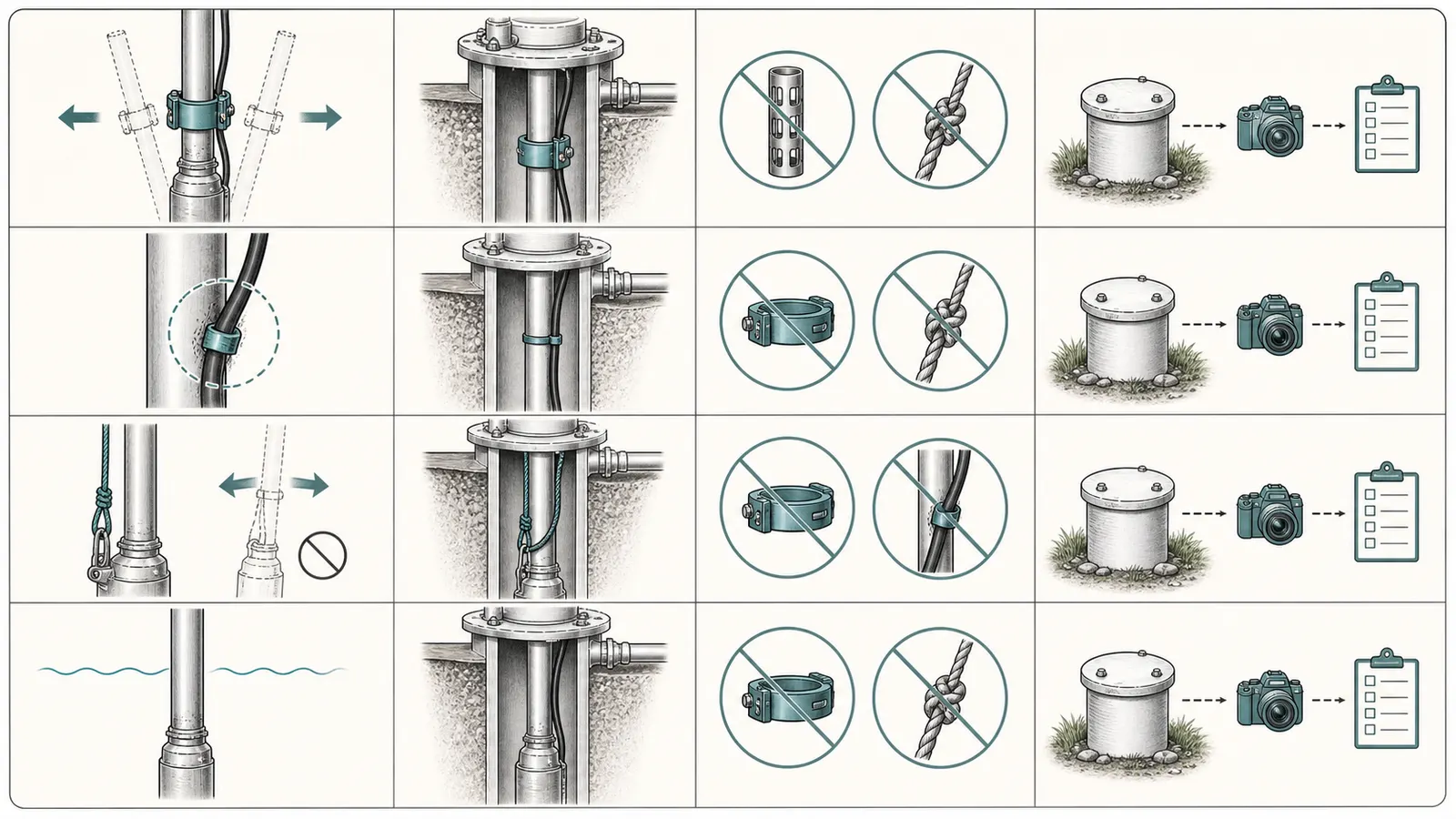
| Cable guard or cable tie | Keeps the submersible cable close to the drop pipe and reduces abrasion or tangling. | No. It protects the wire but does not establish the same pump-centering function. | Type, count, spacing, cable condition, clamp or tie method. |
| Safety rope or safety cable | Provides a backup for recovery if the drop pipe or fitting fails and may assist removal. | No. It is a retention or recovery line, not a friction-fit movement arrestor. | Material, attachment point, condition, securement at the wellhead. |
| Drop pipe | Supports the pump and carries pumped water to the wellhead. | No. Its rigidity and material change the arrestor decision, but do not answer it alone. | Material, nominal size, pressure rating, depth, fittings. |
Zoeller treats these as separate functions: it describes cable guards as protection against cable abrasion at the well sides and separately describes a safety rope as a means of helping remove the pump and preventing loss if a fitting loosens or pipe deteriorates. Its 2026 installation instructions also separately require a torque arrestor for the rigid-PVC or flexible-plastic installations covered by that manual. Boshart likewise warns that cable and safety rope routing around the arrestor matters because a shifted metal clamp could cut the pump cable and cause an electrical short in its accessory installation guidance.
So a quote saying “new cable guard installed” is not proof that a torque arrestor is present. A quote saying “safety rope replaced” is not proof that movement is controlled. Ask for each component by name.
3. Identify the buried installation from records and safe observations
The decision turns on facts that are often buried, missing, or recorded under vague labels. Start with the least invasive evidence:
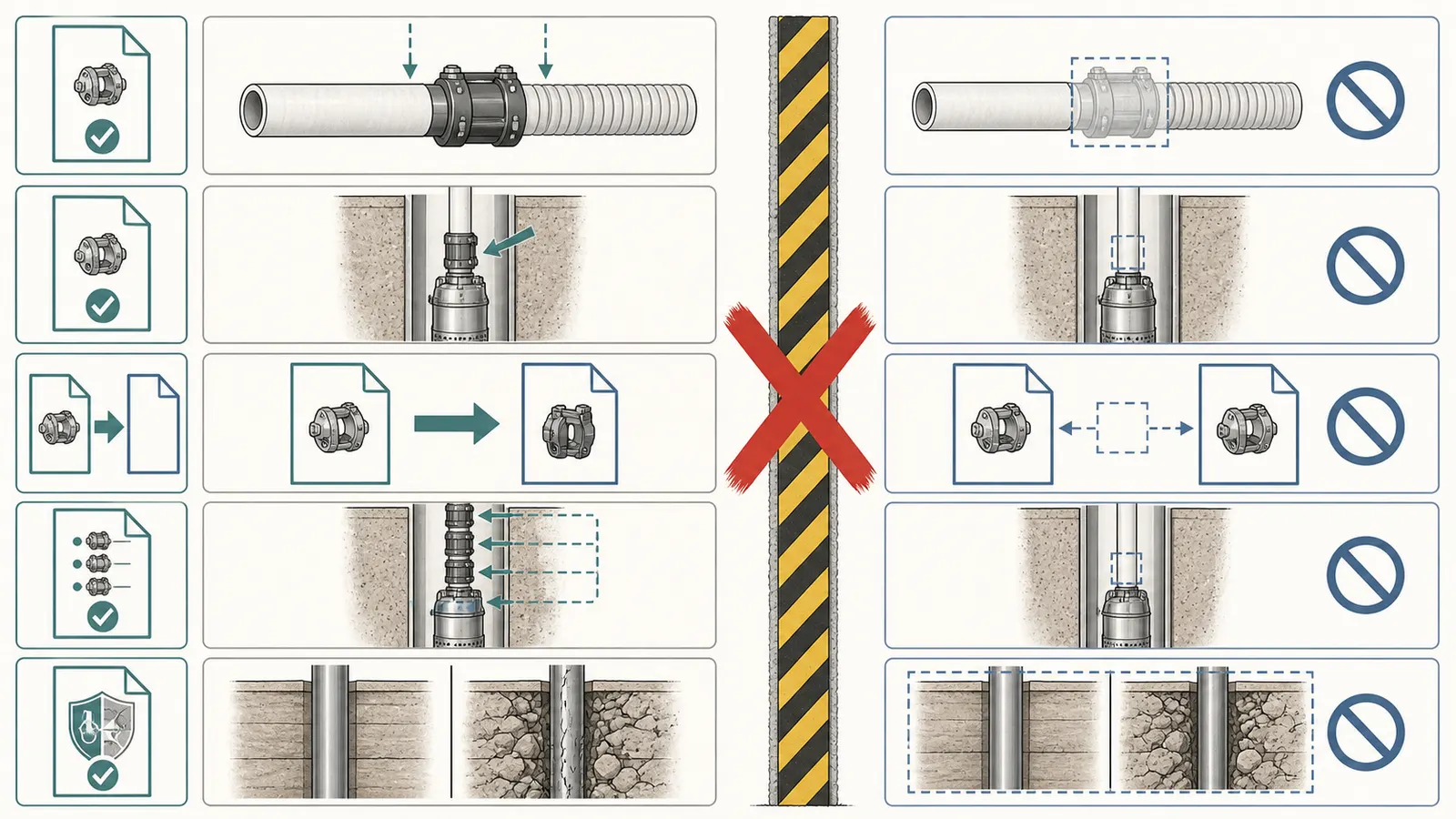
Pull the installation record before pulling the pump
Look for the well completion report, pump installation sheet, service invoice, pump replacement record, or photographs taken during the last pull. Useful fields include:
- pump manufacturer, model, horsepower, voltage, and motor type;
- pump setting depth and approximate static or pumping water level, if recorded;
- casing nominal size and actual or stated inside diameter;
- drop-pipe material, nominal size, pressure class, and connection style;
- torque-arrestor brand, model, location, and quantity;
- cable guard type and spacing;
- safety rope or cable material and attachment;
- pump cable, splice, check-valve, and clamp details; and
- installer, date, local permit, or applicable specification.
Do not infer the buried pipe from the horizontal service line at the pressure tank. The pipe from the pitless adapter to the house may be different from the vertical drop pipe in the casing. Do not infer casing inside diameter from the nominal casing label alone when a product’s fit depends on actual clearance. Do not infer arrestor condition from a line item that only says “pump accessories.”
Use the wellhead only for safe, external identification
From a safe location, you can photograph the wellhead, pitless-adapter cover, labels, visible service fittings, and any existing paperwork. You can record whether the system has a pressure gauge, whether a professional’s invoice names the drop pipe, and whether a recent quote calls for a pump pull. You can note symptoms such as a new electrical fault, unusual start-up noise, visible pressure loss, or a pump that trips a control.
Those observations are clues, not a buried inspection. A normal pressure gauge does not show whether a rubber arrestor has hardened, slipped, cracked, or lost casing contact. A quiet pump does not prove that cable insulation is intact. A well cap does not show whether the arrestor is 10 inches, 2 feet, or another distance above the pump. A pump model does not identify the accessory already installed.
If the record says “poly,” ask whether that means flexible polyethylene drop pipe or a different plastic component. If it says “PVC,” ask whether it is threaded rigid PVC drop pipe, a casing, or only the surface plumbing. If it says “steel,” ask whether it is galvanized, stainless, or another threaded material and whether a centralizer or arrestor was still used. Precision at this stage prevents buying the wrong part.
4. Reconcile manufacturer guidance instead of averaging it
The guidance looks inconsistent only if every sentence is treated as a universal rule. Read each one in its own scope.
Zoeller’s current manual is direct: for the covered pump installation, a torque arrestor is required when rigid PVC or flexible plastic pipe is used because starting torque can cause rubbing at the casing. It also gives an assembly sequence with the arrestor near the pump end. That is a strong material-based instruction for that manufacturer’s system.
Franklin’s owner’s manual recommends galvanized pipe for suspending submersible pumps, limits plastic to the plastic-pipe manufacturer’s depth and pressure recommendations, and calls for a torque arrestor just above the pump to prevent cable chafing when the pump and pipe twist during starting and stopping. Its diagram separately shows the safety cable and cable secured to the drop pipe. The cited Franklin manual therefore supports a strong arrestor expectation near the pump, but it does not turn galvanized pipe into a nationwide exemption.
Goulds takes a more conditional route in its pump installation instructions: if a torque arrestor is being used, install it according to the arrestor manufacturer’s instructions. The same manual says to protect the wires from chafing on the casing. That tells the installer where the compatibility and fit details live—the accessory instructions—not that the homeowner can select a generic arrestor from a photograph. See Goulds IM103R03.
Boshart’s instructions are product-specific and more detailed. For its accessory, the first arrestor is placed 18 inches to 2 feet above the pump and a second is described at 75- to 100-foot intervals. The fit should be snug against the casing, but not so tight that insertion becomes extremely difficult. That is useful when the installed product is known, but it must not be copied to another accessory without checking that product’s instructions. Boshart’s function page also shows that its listed models cover particular riser sizes and casing IDs; compatibility is not just “well pump plus arrestor.”
An educational plumbing text makes the material distinction explicit: plastic drop pipes should use an arrestor to control flexing and casing contact, while galvanized or stainless pipe usually does not require one for pipe flex because the pipe is rigid. It adds that a pump maker may still recommend one at the pump as a centralizer, and it directs the installer to the manufacturer for spacing, number, and attachment. The OpenTextBC explanation is independent context, not U.S. code.
The reconciliation is therefore:
- Flexible plastic creates the clearest movement-control case.
- Rigid PVC is still plastic and may be covered by a mandatory manufacturer instruction.
- Steel or galvanized pipe reduces pipe flex, but does not erase a manufacturer’s centralizer recommendation or a local rule.
- The exact pump and arrestor manuals control placement, fit, and number.
- A local rule or project specification can be more prescriptive than a general manufacturer explanation.
5. Check the local-rule branch without turning it into national code
Well construction and pump installation rules are not uniform across the United States. That matters because a homeowner may hear “required” in at least three different senses:
- required by the pump manufacturer’s instructions;
- required by the accessory manufacturer’s instructions; or
- required by a state, county, permit, public project, or installer specification.
New Hampshire provides a clear example of why the distinction matters. Its well rules require torque arrestors on submersible installations in wells 6 inches or larger, but state that they are not required when the pump is installed on steel pipe or when a caving condition exists; the rule adds a wire-protection alternative for the caving exception. That is a New Hampshire-specific rule, not a national standard.
An NRCS pumping-plant specification gives another scoped example: in the project type covered by that document, it calls for one torque arrestor on each length of plastic drop pipe. That does not tell a homeowner how many arrestors are needed in a residential well. It does show why a professional reviewing an engineered installation, public project, or agricultural system may cite a quantity that is different from a residential accessory page. The NRCS specification must be read within its project scope.
For a homeowner, the right question is not “What does the internet say is code?” It is “Which authority or document governs this well?” Ask the installer or local authority to identify the applicable rule if the answer affects a permit, warranty, repair approval, or replacement scope. Keep a copy or link with the property record. Never broaden a neighboring state’s exception or a public-project specification into a rule for your home.
6. Decide what can be verified without a pump pull
A torque arrestor sits below the wellhead, usually near the pump. The casing, drop pipe, cable, and arrestor are not safely inspectable from the surface without opening the well and handling the suspended assembly. For a homeowner, “verify” should mean verify from a document, photograph, or qualified professional’s report—not personally access the component.
| Question | Homeowner can safely document | What requires professional access or confirmation |
|---|---|---|
| What pump is installed? | Read a service record, invoice, label, or prior installation sheet. | Confirm the model if the label is buried or the record conflicts. |
| What is the casing size? | Record the casing ID if it appears on a well record or prior measurement. | Measure or confirm actual clearance at the wellhead or during a pump pull. |
| What is the drop-pipe material? | Use an installation record or an itemized professional invoice. | Identify buried pipe when records are absent or ambiguous. |
| Is an arrestor present? | Read a pull report or review a professional photograph taken during service. | Open the well, lower a camera, or pull the pump; do not do these yourself. |
| Is the fit still snug? | Review a professional inspection note or photograph with the casing and pipe context. | Assess rubber condition, clamp slip, cracking, compression, and actual casing contact. |
| Is the cable protected? | Ask for the cable-guard and cable-condition fields in the service report. | Inspect abrasion, clamp pressure, splice condition, and routing on the assembly. |
| Is the safety rope present? | Review the installation record or pull report. | Verify attachment, corrosion, fraying, tension, and wellhead securement. |
| Does the pump need an arrestor? | Compare the exact manuals, local rule, and known pipe/casing details. | Resolve an unknown buried installation, compatibility mismatch, or damage finding. |
Do not open the well “just to look.” Do not open a well seal, disconnect the pitless adapter, test pump wiring, manipulate a control box, or operate a lifting device. Do not assume a smartphone camera, fishing tool, magnet, or probe makes the inspection safe. A dropped object can contaminate the well, catch the cable, damage the pump, or create a recovery problem. The professional also needs to control electrical isolation, pressure, lifting, sanitation, and reassembly.
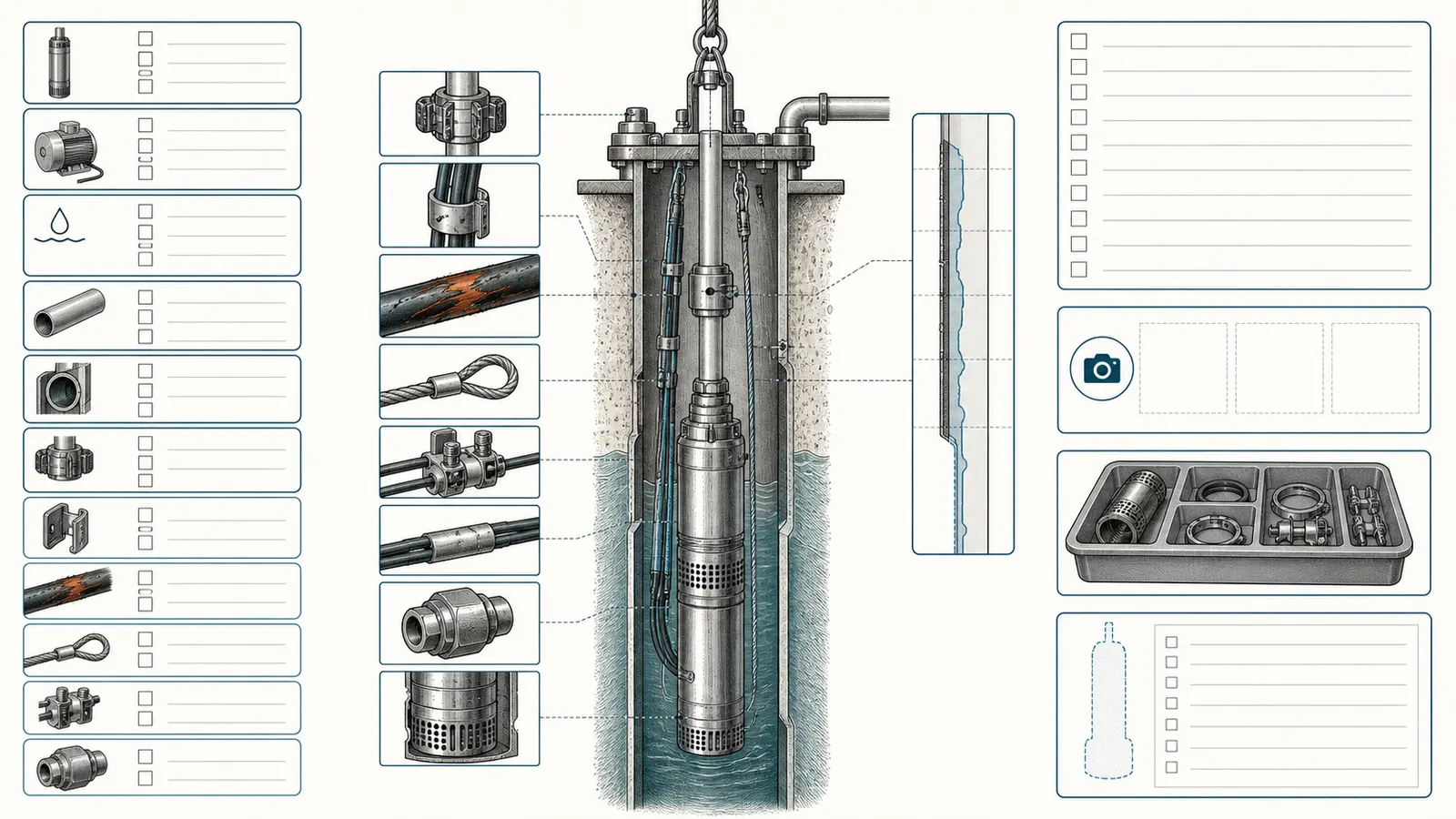
7. Use the next pump pull as the inspection opportunity
If the pump is already coming out for a failed motor, worn pump end, low production investigation, cable fault, or planned replacement, add the torque-arrestor inspection to the scope before work begins. The incremental documentation is usually more valuable than a vague promise that “all accessories will be reused.”
Ask the professional to record these fields:
Pump and well identity
- pump manufacturer, model, horsepower, voltage, motor type, and serial number if available;
- pump setting depth and the reason for the pull;
- casing nominal size and measured or documented inside diameter;
- well record, driller’s log, and any permit or local requirement;
- drop-pipe material, nominal size, connection type, and condition.
Arrestor and movement control
- arrestor brand, model, or a clear photograph with identifying features;
- location above the pump and number installed;
- whether the product fits the pipe size and casing ID;
- rubber or polymer condition: hardening, cracking, distortion, wear, or loss of compression;
- clamp condition, location, security, and any evidence of slipping;
- casing-contact evidence, including rub marks or debris, without claiming a cause that cannot be established; and
- whether the arrestor is being retained, replaced with the same model, or changed to another model with a compatibility reason.
Cable, pipe, and safety line
- cable guard or cable-tie type, spacing, and cable condition;
- abrasion, cuts, flattened areas, exposed conductor, or compromised insulation;
- splice type and condition, recorded by the professional;
- safety rope or cable type, attachment, securement, and condition;
- drop-pipe joints, clamps, fittings, and pressure-rating information; and
- check-valve location and condition if it is part of the service scope.
Reassembly and acceptance
- exact replacement part numbers and quantities;
- why each part was replaced rather than reused;
- whether the replacement matches the pump, pipe, casing, and local requirements;
- photographs before lowering and after assembly where safe and appropriate;
- electrical and plumbing checks performed by qualified personnel;
- observed start, stop, pressure, flow, and leak checks within the professional’s scope; and
- warranty, service date, and the updated installation record.
Interpret a finding without overclaiming
If the professional finds a split or hardened arrestor, ask whether the part still held the pump centered, whether the casing or cable shows compatible rubbing, and whether the condition changed the recommended scope. A damaged arrestor is evidence that the accessory needs attention; it is not automatically proof that it caused every pump problem. If the casing is out of round, the pump is oversized for the clearance, the cable guards are missing, or the drop pipe is damaged, replacing only the arrestor may leave the underlying compatibility problem unresolved.
If no arrestor is found, ask the professional to document the pipe material, pump model, casing ID, local requirement, and the manufacturer instruction used to decide whether to install one. “Not present” and “not required” are different findings. If a replacement is recommended, the line item should identify the compatible product, quantity, placement, cable-routing method, and whether the quote includes inspection of the cable and clamps. That is the level of detail a homeowner can compare later without pretending to evaluate the buried assembly personally.
The homeowner does not need the professional to claim that every pump failure was caused by a missing arrestor. The valuable outcome is narrower: the report should say what was present, what was damaged, what was compatible, what was replaced, and what remains unknown.
8. Choose the next action and preserve the record
Use this final decision sequence after reviewing the available documents:
- Known flexible polyethylene or rigid PVC, but no arrestor record: request that the professional verify the arrestor and cable protection at the next pump pull. If a pump pull is not otherwise planned, ask for a risk-based recommendation rather than automatically authorizing one.
- Known steel or galvanized pipe, no symptoms, no local-rule trigger, and no planned pull: record that the arrestor status is unknown, compare the exact pump manual, and avoid inventing a required replacement. A professional may still recommend a centralizer or arrestor based on pump model, casing clearance, or the installation history.
- Any material with cable abrasion, repeated movement, damaged clamps, unexplained electrical faults, or a failed buried component: treat it as a professional inspection and repair scope. Do not keep cycling a pump that is tripping, grinding, or showing signs of cable damage while waiting for a decision.
- Unknown material, casing ID, pump model, or local requirement: keep the decision open. The next useful action is record retrieval or professional confirmation, not a generic online purchase.
- Pump already being pulled: add an itemized inspection and photo record. Ask for a line-by-line quote for arrestor, cable guards, safety rope, cable or splice, drop pipe, check valve, and any replacement labor.
- A quote lists an arrestor without specifications: ask for brand or model, pipe-size range, casing-ID range, location, quantity, and the reason for replacement. “Torque arrestor” alone is not enough to verify compatibility.
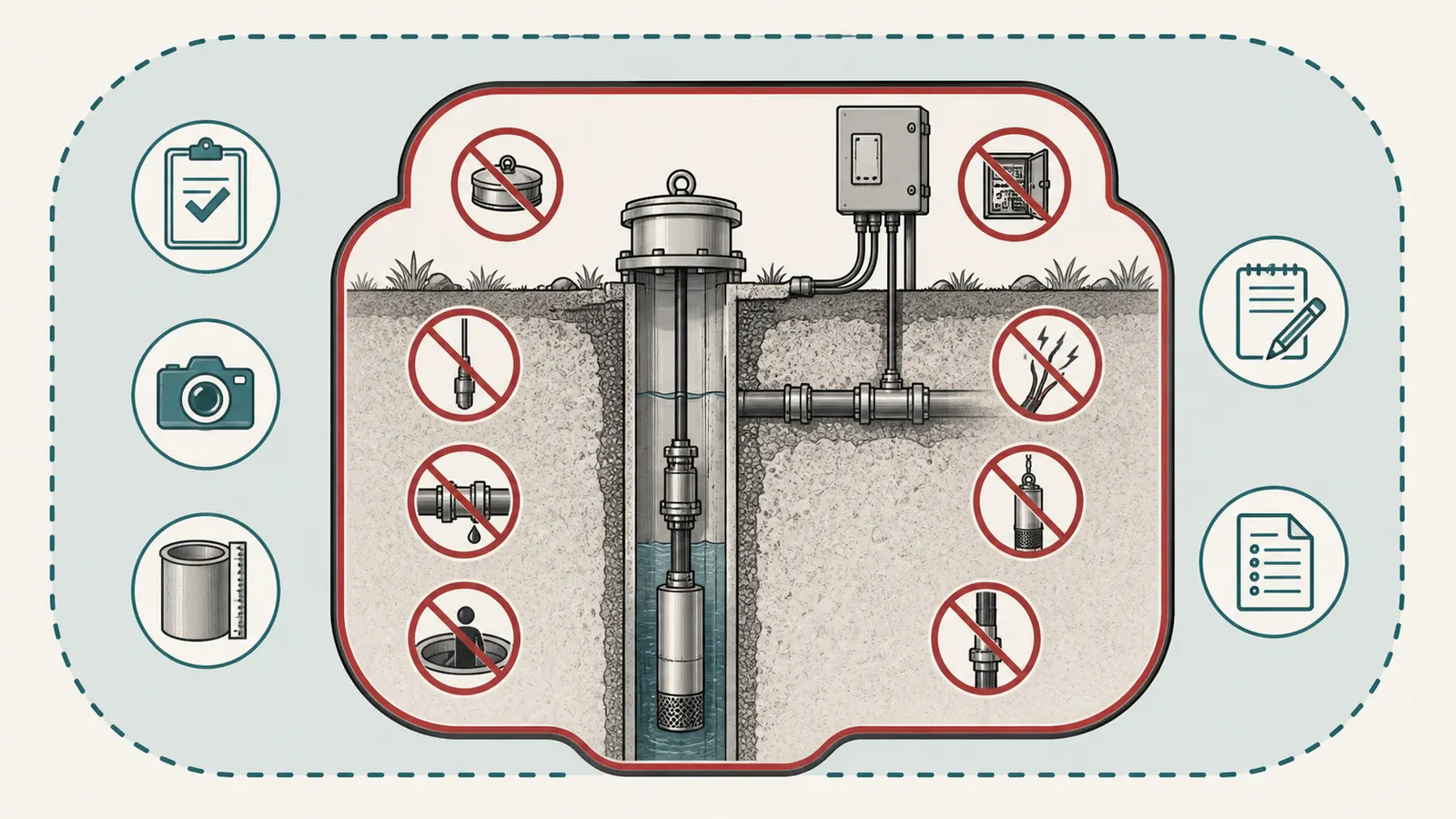
Keep the final record with the well documents. At minimum, save the pump model, pump setting depth, casing ID, drop-pipe material and size, arrestor model and location, cable-protection method, safety-line method, professional name, service date, photographs, parts replaced, and the exact manual or local rule used. If a future pump pull happens, the next homeowner should not have to reconstruct the buried installation from a generic invoice.
The homeowner conclusion is therefore conditional but actionable: flexible polyethylene and rigid PVC make a torque arrestor a strong expectation; steel or galvanized pipe may make it optional for movement control, but does not settle the question; local rules and exact manuals can override the general pattern; and an unknown buried component is best handled as an installation-record and next-service decision.
Sources and scope
Evidence behind this page
- Zoeller — Submersible Well Pump Installation Instructions FM2524
Current Zoeller instructions for the pump models covered by FM2524. This is manufacturer-specific guidance, not a national requirement for every submersible pump installation.
- Zoeller — Submersible Well Pump Installation Instructions FM2524
Zoeller's illustrated plastic-pipe installation procedure. The article uses it to show that location and attachment are model and assembly specific, not to prescribe a universal distance.
- Zoeller — Submersible Well Pump Installation Instructions FM2524
The cable-guard description and spacing are within Zoeller's installation instructions and should not be generalized to another pump, cable system, or accessory.
- Zoeller — Submersible Well Pump Installation Instructions FM2524
Role distinction stated in Zoeller's manual. Rope material, attachment, and local requirements must follow the exact pump and installation instructions.
- Franklin Electric — 4-inch and 6-inch Submersible Pumps Owner's Manual
Franklin manual language for its covered 4-inch and 6-inch submersible pumps. The galvanized recommendation is not evidence that all steel installations need or do not need an arrestor.
- Franklin Electric — 4-inch and 6-inch Submersible Pumps Owner's Manual
Component distinction in Franklin's diagram and installation text. It does not establish that every installation uses the same cable-fastening method or spacing.
- Goulds Water Technology — Residential Water Systems Technical Manual
Goulds/Xylem residential typical-installation material. It explains function but does not make the arrestor mandatory for every well or specify one universal model.
- Goulds Water Technology — 4-inch Submersible Pumps Installation, Operation and Maintenance Manual IM103R03
Xylem IM103R03 installation guidance. The manual defers the arrestor's detailed fit and placement to the accessory manufacturer; it is not a spacing chart.
- Goulds Water Technology — 4-inch Submersible Pumps Installation, Operation and Maintenance Manual IM103R03
Safety boundary from the cited Xylem manual. It supports assigning energized controls and wiring to qualified personnel; it does not define a particular person's license status in every jurisdiction.
- Boshart — What Is the Function of Torque Arrestors in a Well Water System?
Boshart's explanation of its own torque-arrestor models and the listed casing and riser ranges. Do not treat those product ranges as a universal compatibility chart.
- Boshart — What Is the Purpose of a Torque Arrestor?
Product-specific Boshart installation guidance. The distance, quantity, clamp torque, and casing range must not be copied to a different arrestor or pump without its instructions.
- Boshart — What Is the Purpose of a Torque Arrestor?
Boshart's accessory installation warning. It supports an inspection question about cable routing and clamp condition, not a homeowner instruction to handle the assembly.
- OpenTextBC — Rural Water Supply: Pressure Water Supply Systems
Educational plumbing text from British Columbia, Canada. It is used as independent explanatory context, not as U.S. code, a local rule, or a substitute for the pump and accessory manuals.
- New Hampshire Code of Administrative Rules — We 702.05, Water Well Construction
New Hampshire-specific rule text. It demonstrates jurisdictional variation and must not be presented as a national U.S. requirement.
- USDA Natural Resources Conservation Service — Specification 533D, Pumping Plant
A project specification, not a residential national standard. It is cited only to show why a professional's project documents or local requirements may add quantity and spacing conditions.