Do You Need a Flow Sleeve for a Submersible Well Pump?
Use the pump model, motor data, casing ID, operating flow, water temperature, and well inflow to document whether a cooling sleeve is required.
The short answer
Maybe. A flow sleeve is required when the pump-and-motor installation cannot meet the manufacturer's minimum cooling flow over the motor. Confirm the exact motor model, actual casing or sleeve ID, operating flow, water temperature, and whether water enters from above or below. Open water, oversized casing, top-fed wells, and a pump set at or below the screen are common triggers—but the model manual controls.The short answer
Maybe. A flow sleeve—also called a cooling jacket, flow inducer, or flow generator—is not an automatic accessory for every submersible well pump. It is a cooling-control part. Your pump and motor need enough water moving along the motor housing to carry away motor heat. A sleeve can create that path when the well casing, pump position, inflow direction, water temperature, or operating flow would otherwise leave the motor under-cooled. (Grundfos explains the cooling-jacket function, Franklin Electric cooling-sleeve guidance)
The defensible homeowner answer is:
- Sleeve required or strongly indicated: the exact motor documentation says the minimum cooling flow cannot be met in the proposed casing or sleeve, or the installation is one the manufacturer identifies as needing directed flow—such as open water, an oversized casing, top-fed water, or a pump set at or below the screen.
- Sleeve not indicated by the available evidence: the exact motor and pump are identified, the actual inside diameter and operating conditions are documented, and the manufacturer’s cooling-flow requirement is met without a sleeve.
- Documentation incomplete: someone says “you need one” or “you do not need one,” but the model, inside diameter, actual flow, temperature, or pump position is missing. Do not approve or reject the scope on that statement alone.
The model manual controls. A 6-inch Goulds motor, a Franklin motor, and a Grundfos motor may use different minimum velocities, temperature limits, tables, sleeve dimensions, or installation assumptions. For example, the Xylem/Goulds FM Series manual specifies 0.5 feet per second past all parts of its cited 6- and 8-inch motors and supplies a table of gallons per minute by well or sleeve diameter. The Franklin Electric cooling-sleeve sheet gives different minimum velocities for different motor families. Those numbers are examples for named product families, not a universal rule.
This page helps you collect the inputs and challenge an incomplete proposal. It does not tell you to open a well, pull a pump, test live wiring, enter a confined space, or install a sleeve yourself.
1. Start with the motor and pump model, not the casing label
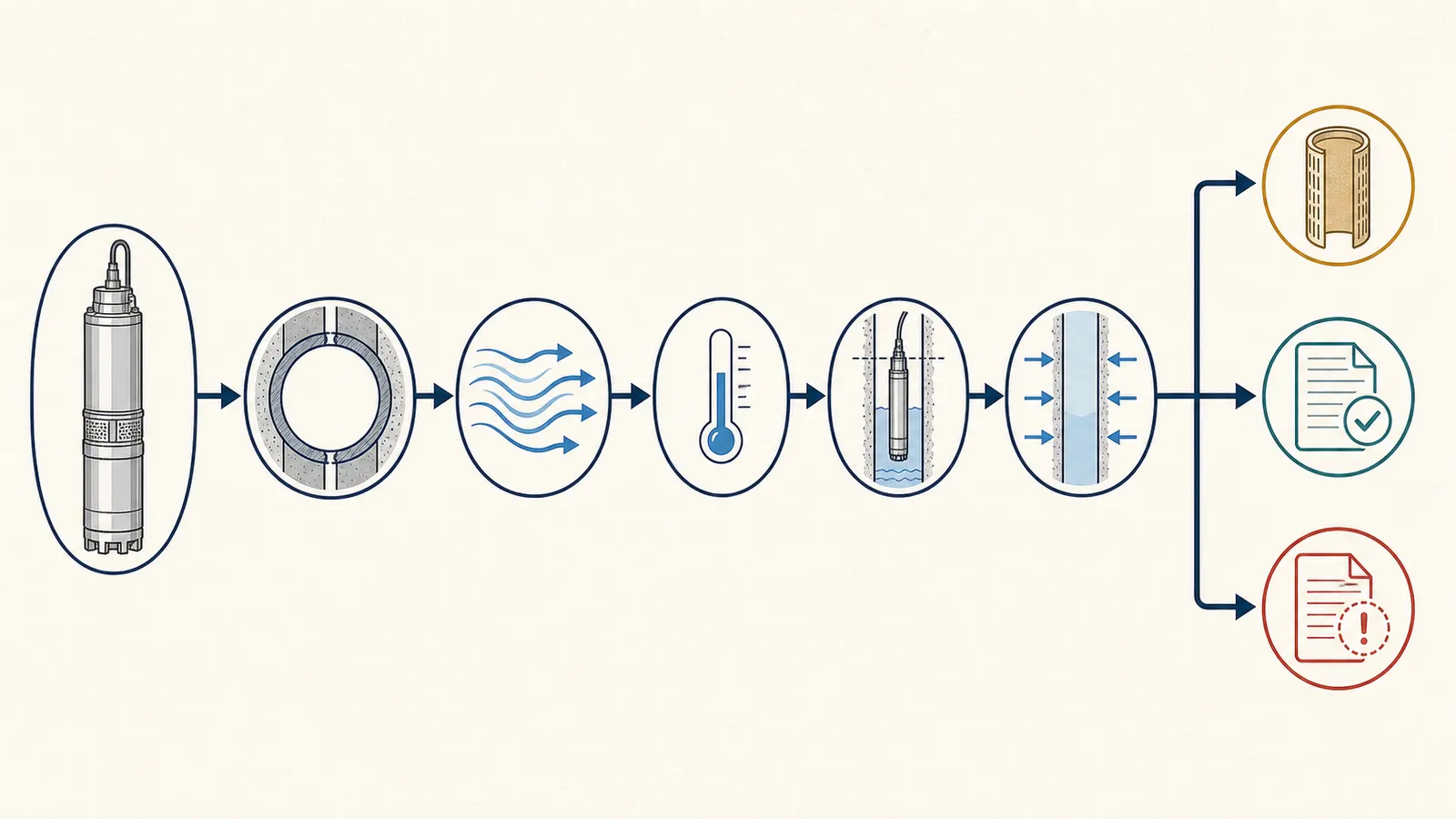
“My well is 6 inches” is not enough. Nominal casing size is not the same as the actual clear inside diameter at the motor, and a pump model alone may not identify the motor’s cooling requirement. Start with the motor nameplate, pump nameplate, installation record, or the installer’s closeout documents. The Xylem/Goulds motor manual tells the installer to record pump and serial information and notes that model and serial numbers may be found on the pump casing. If the equipment is below ground and the record is missing, ask a qualified well professional to identify it; do not pull equipment merely to read a label.
The minimum identification packet
| Input | What to record | Why it changes the sleeve decision |
|---|---|---|
| Motor | Manufacturer, exact model or order number, diameter, horsepower, voltage, phase, and serial number if available | Cooling velocity and temperature limits belong to the motor family, not to the well label alone. |
| Pump | Manufacturer, exact model, stages or trim if shown, and pump curve or duty point | The water flow past the motor depends on the pump-motor assembly and the actual operating point. |
| Casing | Actual inside diameter in the zone containing the motor; note whether the value is measured, recorded, or only nominal | The annular passage between casing and motor controls velocity. A nominal “6-inch well” does not prove a 6-inch clear ID. |
| Sleeve, if proposed | Inside diameter, length, seal location, spacers, strainer, and compatibility with the motor and pump | A sleeve must direct the correct water path without interfering with the intake, cable, screen, or motor. |
| Set position | Pump and motor setting depth, static and pumping water levels if recorded, and distance from screen or perforations | Water entering above the motor can bypass the cooling path; the motor must remain immersed under the manual’s conditions. |
| Water conditions | Maximum or design water temperature, not just the temperature on one cool day | A motor’s allowable flow can depend on water temperature and duty. |
| Inflow | Whether the well is bottom-fed, side-fed, top-fed, cascading, screened around the motor, or unknown | Flow direction determines whether water naturally travels along the motor before entering the pump. |
Do not fill a blank with a guess. Write unknown. “Unknown” is a useful decision state because it tells the installer exactly what must be verified before the scope is approved.
North Dakota State University Extension describes a typical submersible pump as a turbine pump close-coupled to a submersible motor, with the pump above the motor and water entering through a screen between them. It also warns that restricted or inadequate circulation past the motor can overheat and burn it out, and that the casing must be large enough for water to flow past the motor. (NDSU Extension, Irrigation Water Pumps) This is the physical reason the worksheet asks about the complete assembly rather than only the pump’s advertised gallons per minute.
What counts as good evidence
Prefer, in this order:
- The exact motor installation manual or manufacturer cooling-flow table.
- The pump and motor model numbers, matched to the manufacturer’s current documentation.
- A well construction record showing casing, screen or perforation interval, total depth, and pump setting.
- A written operating point from the pump curve: flow at the actual total dynamic head, not a marketing maximum.
- A written field measurement or professional verification of inside diameter and water conditions.
A contractor’s verbal statement can be a useful lead, but it is not the calculation. Ask for the page, table, model, and assumptions that support it.
2. Understand what a flow sleeve changes
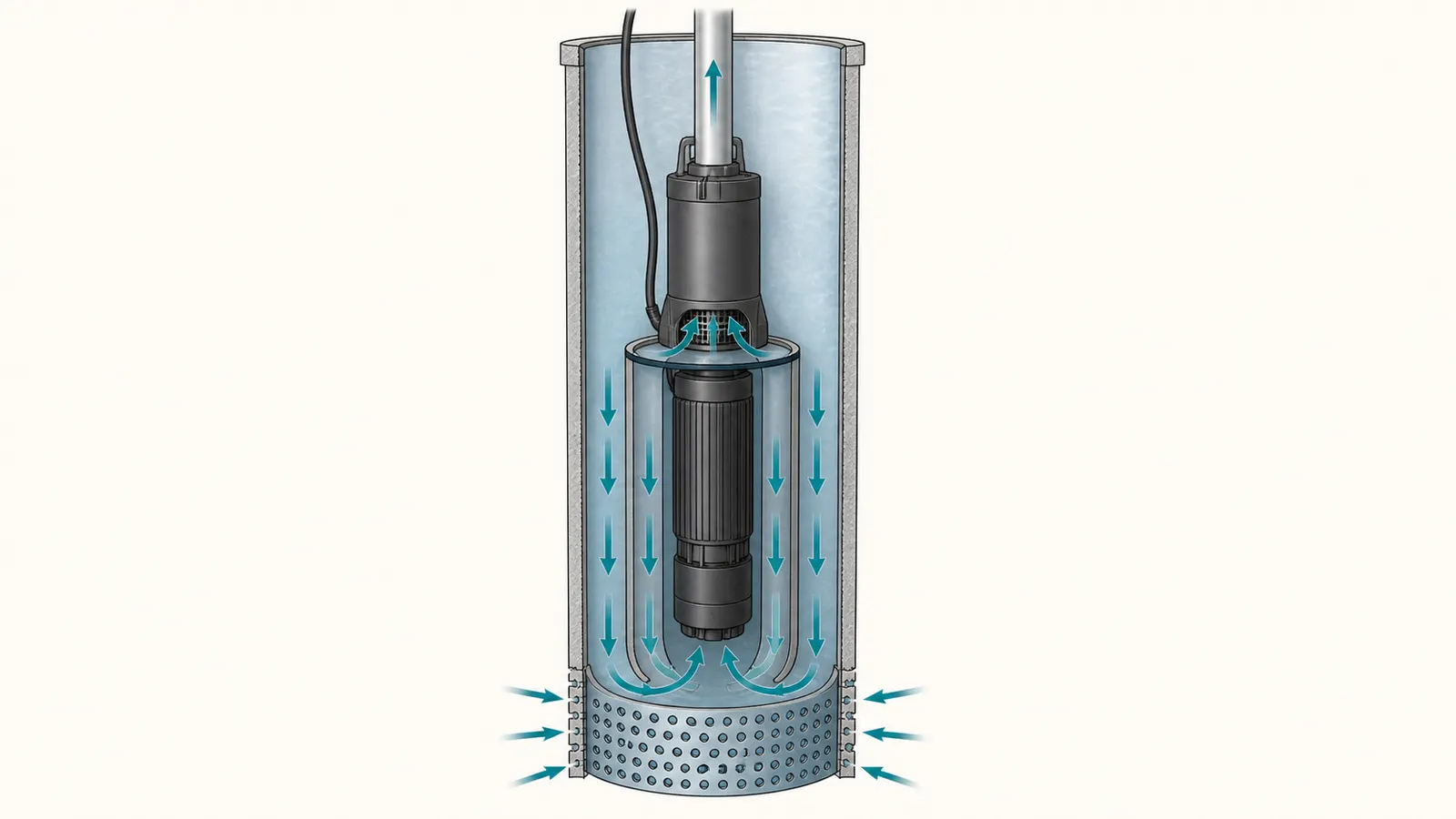
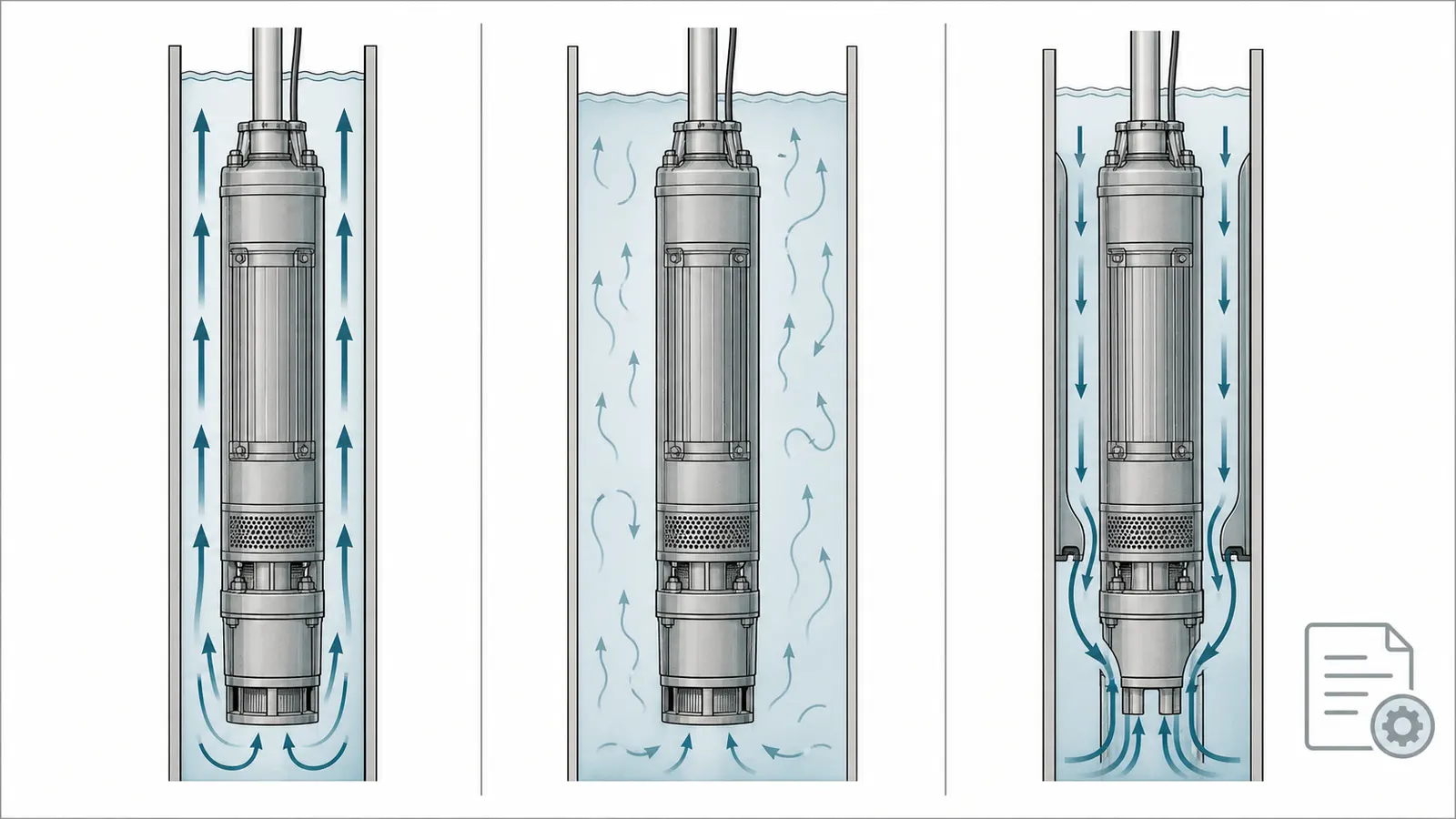
In an ordinary cased-well arrangement, the casing wall can guide water along the outside of the motor toward the pump intake. The Grundfos cooling-jacket FAQ describes that typical path: the pump draws from below, water travels along the well wall and over the motor, and the motor is cooled as the water moves. If the pump is in open water, there are no well walls to create that guided path; Grundfos says a cooling jacket is needed for the open-water condition described on that page.
Franklin describes the sleeve’s role more precisely: its sleeve is sealed above the pump inlet so water is drawn from below and directed past the motor by convection. The same sheet identifies components such as the sleeve tube, sealing ring, motor spacer, clamps, and an optional inlet strainer. (Franklin Electric cooling-sleeve technical sheet) That means a sleeve is not simply a loose tube around a pump. Its diameter, seal, length, centering, intake opening, and compatibility are part of the cooling design.
Situations that deserve an immediate documentation check
Franklin identifies four causes of inadequate cooling: insufficient flow rate, a well diameter that is too large, water inflow from above, and open water such as a lake, reservoir, river, or tank. (Franklin’s cooling-flow guidance) Grundfos groundwater-training material also says the pump should be above the casing screen so water is forced past the motor, and recommends a cooling sleeve when the pump cannot be installed above the screen filter. (Grundfos domestic groundwater training material)
Treat these as triggers for a model-specific check, not as a reason to buy a generic sleeve immediately. A high-flow pump in a large casing may still fail a cooling table if the motor is large or the casing is much larger than the motor. A lower-flow pump may meet a manufacturer’s table in a particular casing. A “top-fed” well may need a sleeve even when the nominal well diameter looks reasonable because water can enter above the motor and bypass the intended path.
What the sleeve does not prove
A sleeve does not prove that:
- the pump is correctly sized for household demand;
- the pump will deliver the expected pressure;
- the motor is receiving correct voltage or overload protection;
- the well yields enough water;
- the well is sanitary or the water is safe to drink;
- the sleeve is compatible with a different motor brand;
- a bad pump, clogged screen, low water level, or electrical fault has been diagnosed.
Cooling is one design question inside a larger well-pump installation. Keep it separate from water quality, pressure-tank sizing, well yield, and electrical troubleshooting.
3. Gather the six inputs that determine the decision
Use this worksheet before you compare quotes. It is designed to expose missing assumptions, not to authorize a pump inspection.
| Decision input | Your record | How to interpret it safely |
|---|---|---|
| 1. Exact motor model and diameter | ______________________________ | If unknown, stop at documentation incomplete. Do not use a generic 4-, 6-, or 8-inch rule. |
| 2. Actual casing or proposed sleeve ID | ______________________________ | Record the clear inside diameter in the motor zone, its source, and whether it is nominal or verified. |
| 3. Motor outside diameter | ______________________________ | Needed to establish the annular passage; use the manufacturer’s dimensional drawing when available. |
| 4. Operating flow at the duty point | ______________________________ | Use the flow corresponding to the actual head and control setting, not the highest number printed in a catalog. |
| 5. Water temperature and motor position | ______________________________ | Record design or maximum temperature, set depth, screen/perforation relationship, and whether the motor stays immersed. |
| 6. Inflow direction and installation type | ______________________________ | Note bottom/side/top feed, open water, tank, reservoir, rock well, or unknown. |
Inside diameter is a measurement question
Ask the installer where the diameter came from. Possible answers include a well log, casing specification, a measured section, or a nominal size. These are not equivalent. A casing can have joints, reducers, liners, screens, gravel-pack effects, deposits, or other restrictions. A sleeve’s inside diameter must also be distinguished from its outside diameter and from the diameter over clamps or spacers.
Do not lower a tape, rod, camera, probe, or homemade gauge into the well. Do not remove the well cap to measure. If the record does not establish the clear passage at the motor, place the burden of verification in the professional scope.
Flow means the cooling flow at the motor
The number on a pump box may be a maximum flow at low head, a test value, or a point that does not match your system. The cooling calculation needs the flow actually moving through the passage around the motor under the intended operating condition. The Xylem/Goulds FM manual pairs cooling requirements with well or sleeve diameter and states that motor cooling depends on water velocity past the motor. NDSU likewise describes pump selection in terms of flow and total dynamic head, not a standalone flow number. (NDSU Extension pump-selection guidance)
If the pump uses a variable-frequency drive, ask for the minimum operating speed and the corresponding cooling requirement. Xylem’s FM guidance says a half-foot-per-second water velocity must be maintained past the motor at the minimum speed in the cited VFD application. Do not assume the pump’s full-speed flow remains available at reduced speed.
Temperature is not a decorative field
Motor cooling is a heat-transfer problem. A flow requirement stated for one water-temperature range may not cover hotter water or continuous duty. The Xylem/Goulds FM manual states that its cited 6- to 8-inch, 5- to 150-horsepower canned motors can operate in water up to 95°F without horsepower derating when the minimum 0.5 feet per second flow is maintained. That is a product-family statement, not permission to apply 95°F or 0.5 feet per second to another motor. (Xylem/Goulds FM Series manual)
If your water is warmer than the motor documentation’s standard condition, ask whether the motor must be derated, upsized, operated at a different flow, or fitted with a manufacturer-approved sleeve or high-temperature design. Do not solve a temperature question by selecting a sleeve from a different product family.
4. Run a cooling-flow screen without mistaking it for approval
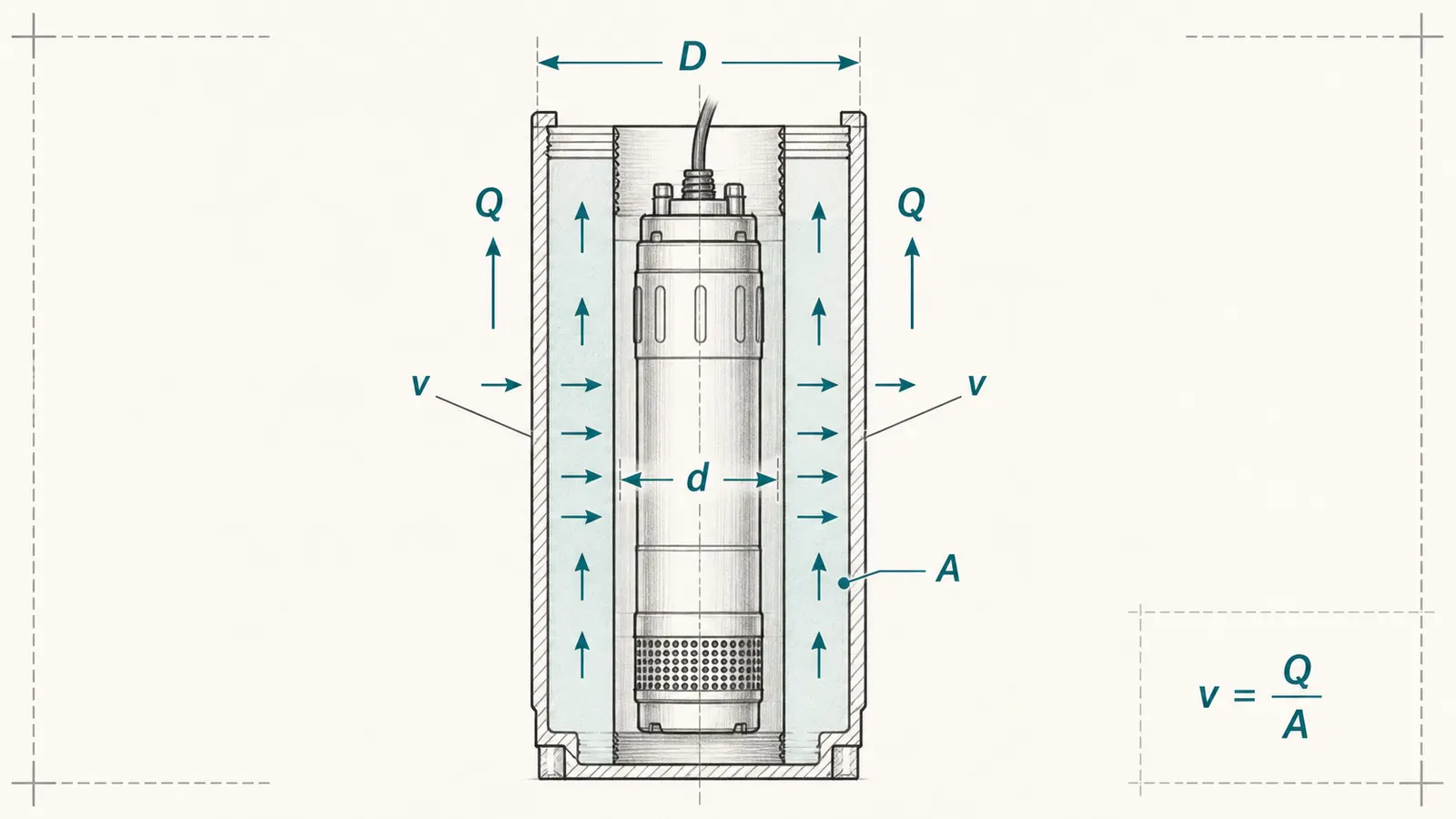
The manufacturer’s table is the primary test. A simple annulus calculation can help you see why casing size matters and can reveal an obviously incomplete proposal, but it does not replace the manual.
The geometry screen
For diameters in inches and flow in gallons per minute, the approximate average velocity through the annular area is:
v (ft/s) = 0.4085 × Q (gpm) ÷ [D² − d²]
Where:
- Q is the flow used for the cooling calculation;
- D is the actual inside diameter of the casing or sleeve;
- d is the outside diameter of the motor;
- D² − d² represents the circular passage around the motor.
The equivalent form in Franklin’s technical sheet uses metric units and delivery rate divided by the ring area between sleeve diameter and motor diameter. (Franklin Electric cooling-sleeve calculation sheet)
A bounded example
Suppose a professional has documented a 6-inch motor with an outside diameter of 5.43 inches, a 10-inch clear casing ID, and an operating flow of 60 gpm. The geometry screen is:
| Step | Calculation | Result |
|---|---|---|
| Annular diameter term | 10² − 5.43² | 70.5 in², approximately |
| Flow numerator | 0.4085 × 60 | 24.5 |
| Average annular velocity | 24.5 ÷ 70.5 | 0.35 ft/s, approximately |
That result is below the 0.5 ft/s value specified in the Xylem/Goulds FM Series manual for the cited FM motor family. The result does not by itself select a sleeve diameter, because changing the sleeve changes the annular area and the sleeve must be compatible with the pump inlet, motor, cable, clamps, and well. It does show why “the pump delivers 60 gpm” is not enough to approve a 10-inch casing installation for that motor family.
The manufacturer-table check
Complete this second table from the exact manual. Do not copy values from the example above.
| Field | Enter the manufacturer-backed value |
|---|---|
| Motor family and exact model | ______________________________ |
| Manual revision and page/table | ______________________________ |
| Water-temperature condition | ______________________________ |
| Minimum cooling velocity or required gpm | ______________________________ |
| Casing/sleeve diameter row used | ______________________________ |
| Required operating flow | ______________________________ |
| Actual or design operating flow | ______________________________ |
| Result: meets / does not meet / cannot determine | ______________________________ |
| If sleeve proposed: sleeve ID, seal, length, spacers, and compatibility evidence | ______________________________ |
The Franklin Electric sheet illustrates why the exact motor family matters: its table lists, for example, 4-inch encapsulated motors at 0.08 m/s, several 6-inch families at 0.16 m/s or 0.5 m/s depending on type and power, and larger or rewindable families with other values. The table is not an invitation to choose the smallest number that looks convenient. Match the row to the actual motor.
Three ways the screen can fail
- The dimensions are unknown. The formula cannot be used responsibly if D or d is guessed.
- The flow is the wrong flow. A nominal pump rating, a faucet bucket test, or a well-yield number may not equal the pump’s operating flow past the motor.
- The path is wrong. An average annular velocity does not prove water travels along the entire motor. Top inflow, screen location, bypass around a sleeve seal, blocked intake, or a partially submerged motor can defeat the intended path.
If any of those conditions is present, the correct result is documentation incomplete, not “probably fine.”
5. Route your installation through the decision matrix
Use this matrix to decide what to request next. It is intentionally conservative because a flow sleeve is a cooling requirement, not a cosmetic upgrade.
| Installation fact pattern | What the evidence suggests | Homeowner decision |
|---|---|---|
| Open water, tank, reservoir, lake, river, or horizontal surface-water installation | There may be no casing wall to guide water over the motor; Grundfos identifies the open-water condition as requiring a cooling jacket on its FAQ, and Franklin lists open water as an inadequate-cooling cause. | Request the exact manufacturer sleeve design, inlet strainer, supports, temperature limit, and operating-flow calculation before approving. |
| Casing or borehole is much larger than the motor | The same pump flow is spread over a larger annular area, reducing average velocity. Both Franklin and NDSU identify inadequate circulation or large clearance as a cooling concern. | Require actual ID, motor OD, operating flow, and the exact cooling table. Do not rely on nominal casing size. |
| Water enters above the motor or the well is top-fed/cascading | Incoming water may bypass the motor rather than travel over it toward the pump intake. Franklin lists top feeding as a cause of inadequate cooling. | Ask the well professional to document inflow and explain how the proposed design forces the required flow path. |
| Pump is at or below the screen/perforated interval | The intended flow direction may not pass over the motor. Grundfos recommends a sleeve when the pump cannot be above the screen filter in the cited groundwater application. | Require a written position-and-cooling calculation; do not approve a generic sleeve solely from a verbal recommendation. |
| Exact model, ID, flow, temperature, and position are all documented; table is met without sleeve | The available evidence does not indicate a sleeve is required for the documented operating case. | Keep the calculation and manual page with the pump record. Ask what changes would invalidate it. |
| Exact model or one of the operating inputs is missing | A yes-or-no answer cannot be audited. | Pause the sleeve decision and request the missing document or professional verification. |
| Motor operates with a VFD or variable flow | Minimum speed may reduce flow past the motor; Xylem specifies a cooling velocity condition in its FM VFD guidance. | Require the VFD minimum frequency, actual duty range, and cooling requirement for that motor. |
| Water temperature exceeds the manual’s standard condition | Heat removal may require a different velocity, derating, motor choice, or manufacturer-approved accessory. | Escalate to the motor manufacturer or qualified designer; do not borrow another product’s temperature limit. |
A sleeve-required finding
You can call the requirement manufacturer-backed when all of these are true:
- the exact motor family is identified;
- the manufacturer’s manual or technical support identifies the minimum cooling flow or the relevant installation trigger;
- the actual casing or proposed sleeve ID is known;
- the operating flow and water-temperature assumption are written down;
- the pump’s position relative to the screen or inflow is understood; and
- the calculation or table comparison shows the no-sleeve arrangement does not meet the requirement, or the manufacturer explicitly requires the sleeve for that condition.
A sleeve-not-indicated finding
You can say only that a sleeve is not indicated by the available evidence when the same fields are documented and the no-sleeve installation meets the exact model requirement. That is a bounded conclusion. It does not mean a sleeve could never be needed after a pump replacement, a change in flow, a lower water level, hotter water, a VFD setting change, or a change in screen or casing conditions.
A documentation-incomplete finding
Use this outcome when a proposal contains phrases such as “all 6-inch wells need sleeves,” “the pump is small so it is fine,” or “the sleeve is standard.” Those phrases may reflect experience with one product line, but they do not substitute for the named model and its cooling table. Ask the proposer to convert the assertion into a line-item calculation.
6. Separate documentation from hazardous work
There is useful work a homeowner can do: collect records, photograph an accessible nameplate without opening equipment, note the proposal’s assumptions, compare the model number to the manual, and request a written explanation. There is also work that belongs to qualified professionals.
Safe homeowner actions
- Photograph the exterior of an accessible pump-control label without opening the enclosure.
- Gather the original pump invoice, well construction report, prior service records, pump curve, and manual.
- Record whether the proposal says casing ID or only nominal casing size.
- Ask where the flow number came from and whether it is the duty-point flow.
- Ask how maximum water temperature and low-water conditions were handled.
- Ask whether the motor is above, within, or below the screen or perforated interval.
- Request the sleeve’s manufacturer part number, inside diameter, length, seal location, spacers, and compatibility statement.
- Keep the final calculation, manual revision, installer name, and completion date in your well file.
Work to assign to a qualified professional
Do not open an energized control panel, test live wiring, change voltage settings, bypass overload protection, pull the pump, open the well cap or a pressurized component, lower instruments, enter a well pit or other confined space, handle damaged wiring, or install clamps and a sleeve around a suspended pump. Do not manipulate pressurized equipment or disconnect piping to “see how it is set.” These tasks can involve electric shock, falling equipment, stored pressure, contamination, entanglement, or confined-space hazards.
The Xylem/Goulds manual begins with serious-injury and property-damage warnings and says its safety instructions must be followed. It also calls for waterproof submersible cable and appropriate protection. NDSU notes that submersible electrical wiring and connections must be watertight. (NDSU Extension pump guidance) These are reasons to keep the decision surface documentary and observational for a homeowner.
If the pump must be pulled to verify a sleeve, the well is damaged or flooded, the control equipment is wet, the well cap is unsafe, or the installation has an unknown electrical modification, stop at the records request and hire the appropriate licensed or qualified professional for your location. A sleeve question is not permission to turn a cooling review into a pump-removal project.
7. Approve a scope only when the record closes the loop
Before approving a replacement, retrofit, or new installation, ask for a one-page answer to the following. The purpose is not bureaucracy; it is to prevent an accessory from being added or omitted without proving the cooling path.
Request this written scope
| Scope item | What the written answer should name |
|---|---|
| Equipment identity | Pump manufacturer/model, motor manufacturer/model, motor diameter, horsepower, voltage, phase, and serial number if available |
| Source requirement | Manual title, revision/date, page/table, or manufacturer technical response used for cooling requirements |
| Geometry | Actual casing ID in the motor zone, motor OD, proposed sleeve ID if applicable, and how each dimension was verified |
| Operating point | Design flow, total dynamic head or control range, minimum VFD speed if applicable, and maximum expected water temperature |
| Water path | Screen/perforation interval, pump and motor setting relationship, inflow direction, and explanation of how water passes over the motor |
| Decision | Sleeve required, sleeve not indicated for the documented case, or a stated unresolved condition |
| If sleeve is used | Exact sleeve part or design, seal location above inlet, length, centering/spacers, strainer, material, drinking-water compatibility where relevant, and installation responsibility |
| Handoff | Who performs pump pulling, well opening, electrical work, measurement, installation, testing, and final verification |
| Recordkeeping | Final model numbers, measured values, manual revision, operating readings, and warranty requirements supplied at closeout |
Do not accept a scope that lists “install flow sleeve” without the reason and design. Do not accept a scope that omits the cooling check because “the pump fits.” The Franklin Electric sheet shows that sleeve kits include multiple geometry and intake components; the accessory is part of a designed flow path, not just a larger tube.
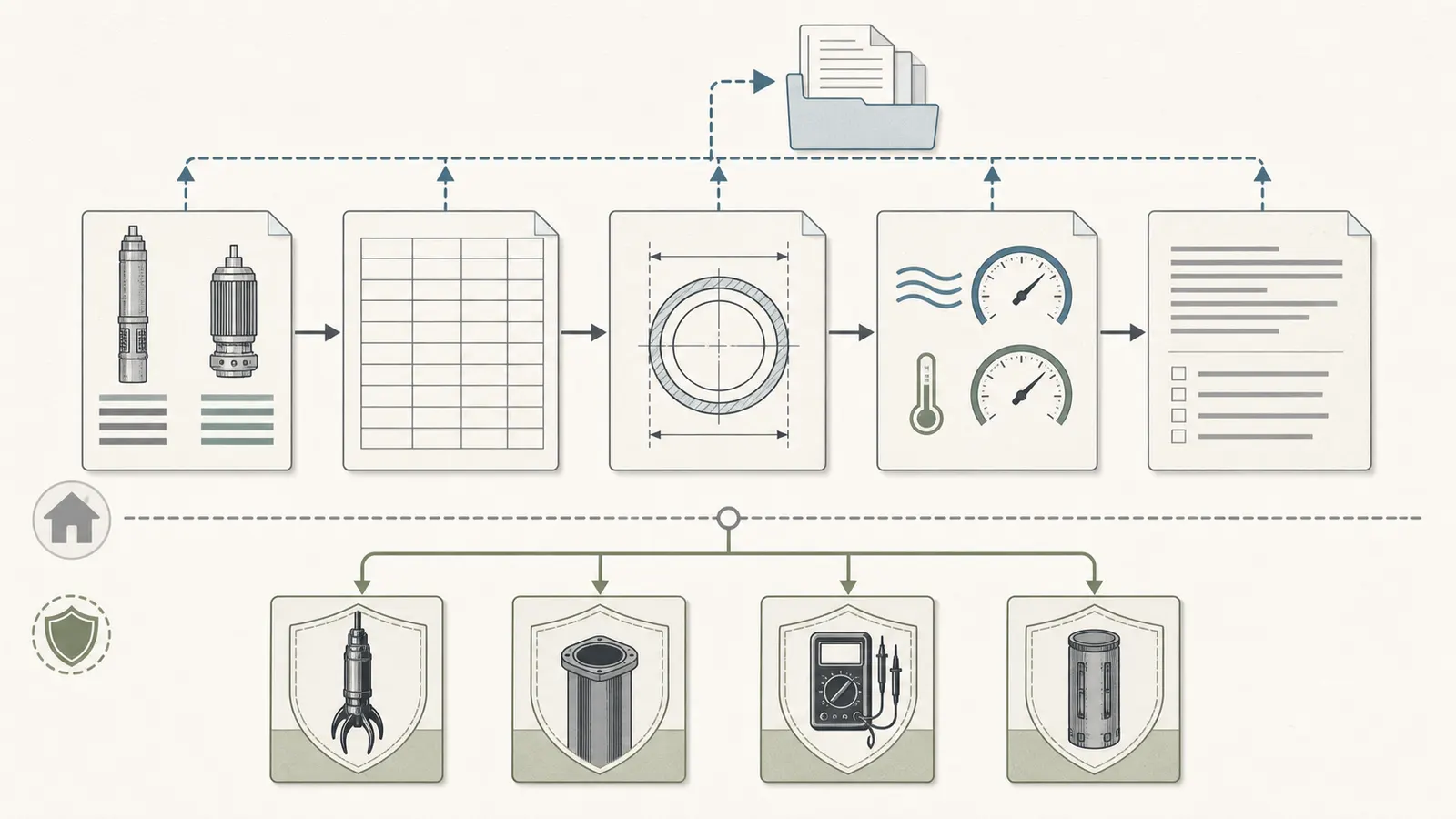
Questions that close common gaps
Ask the proposer:
- “Which exact motor model is this cooling requirement for?”
- “What is the actual clear ID at the motor, and is it measured or nominal?”
- “What flow did you use, at what total head or VFD speed?”
- “What maximum water temperature and minimum water level are assumed?”
- “Is the well bottom-fed, side-fed, or top-fed, and where is the screen relative to the motor?”
- “Which manual page or manufacturer response says the no-sleeve arrangement passes?”
- “If a sleeve is required, what are its ID, seal position, length, spacers, strainer, and compatible model?”
- “Which parts of this scope require pump removal, electrical isolation/testing, well opening, or confined-space work?”
Maintain the decision after installation
Cooling requirements can change when the equipment or operating conditions change. Keep a record of:
- pump and motor model, serial, horsepower, and installation date;
- casing ID, sleeve ID, sleeve design, screen relationship, and set depth;
- design flow, pressure, total dynamic head, VFD range, and water-temperature assumption;
- startup flow and pressure readings supplied by the installer;
- operating current, voltage, insulation-resistance records, alarms, and service dates when obtained by a qualified professional;
- changes in water level, well yield, treatment, piping, controls, or pump duty.
The Xylem/Goulds manual specifically recommends recording operating current and voltage and using flow and pressure information to build a picture of pump and motor performance. That record does not replace a cooling-flow calculation, but it gives a professional useful context if the motor later trips, overheats, or loses performance.
Your final decision
Use the three-state conclusion in your project file:
Manufacturer requirement demonstrated: The exact motor manual or manufacturer response identifies the cooling requirement, the actual dimensions and operating conditions are documented, and the no-sleeve arrangement fails or the installation trigger explicitly requires directed cooling. Approve only the compatible sleeve design and professional installation scope.
Not indicated by available evidence: The exact model, actual inside diameter, operating flow, temperature, and position are documented, and the manufacturer’s requirement is met without a sleeve. Keep the evidence and state what future changes would require a recheck.
Documentation incomplete: One or more material inputs are missing, guessed, or based on a different motor family. Pause the yes-or-no decision and request the manual page, measurements, operating assumptions, or professional verification.
That is the useful answer to “Do I need a flow sleeve?” A sleeve is neither a universal requirement nor an optional decoration. It is justified when the selected pump-motor installation cannot demonstrate the manufacturer’s required cooling path and velocity. Your safest next step is to obtain the model-first written calculation, then assign any pump, well, electrical, pressurized, or confined-space work to a qualified professional.
Sources and scope
Evidence behind this page
- What is a cooling jacket and when should it be used for submersibles?
Grundfos explanation of the cooling function for submersible installations; it does not establish a universal sleeve requirement for every motor or well.
- What is a cooling jacket and when should it be used for submersibles?
Grundfos guidance for the open-water condition described on its FAQ page; it is not a national code rule or a statement about every manufacturer’s product.
- Cooling sleeves and calculation of cooling flow
Franklin Electric technical guidance for its submersible motor applications; the threshold and sleeve design must be matched to the specific motor.
- Cooling sleeve kits for Franklin Electric submersible motor pumps
Franklin Electric cooling-sleeve construction description; it is not a homeowner installation procedure or a compatibility approval for another manufacturer’s pump.
- Cooling sleeve kits for Franklin Electric submersible motor pumps
Franklin Electric values and formula for the motor families listed in the sheet; they must not be substituted for another brand or model’s table.
- FM Series Motors Installation, Operation and Maintenance Instructions
Xylem/Goulds FM Series motor manual, revised February 2023; the table applies to that FM motor family and is not a universal submersible-pump standard.
- FM Series Motors Installation, Operation and Maintenance Instructions
Safety, identification, and maintenance-record guidance in the Xylem/Goulds FM Series manual; it does not authorize an unqualified person to perform electrical or well work.
- Irrigation Water Pumps
NDSU Extension irrigation-pump guidance; residential pump models, well construction, and manufacturer limits can differ.
- Irrigation Water Pumps
NDSU Extension’s general submersible-pump description; it is not a substitute for the electrical and installation requirements of the selected pump and motor.
- Pump sizing and installation in domestic groundwater applications
Grundfos training material for domestic groundwater applications; the recommendation is product and installation dependent, not a universal code requirement.