Selling a House With a Nonworking Well Pump: What to Disclose
A state-aware seller path for documenting a nonworking well pump, separating pump status from water tests, and deciding whether to repair, disclose, or pause.
The short answer
Usually, disclose the known operating condition on the controlling state or local form and describe only what you know: for example, that the pump is disconnected or the system did not operate when observed. Do not guess whether the well is dry, contaminated, or low-yield. Pump repair, well inspection, water testing, and lender approval are separate questions, and the official form, local rule, lender, and closing professionals control.Selling a House With a Nonworking Well Pump: What to Disclose
Usually, you should disclose the known operating condition of a private well and pump on the controlling state or local disclosure form. The safe seller statement is factual: “The pump was disconnected,” “water was not available at the fixtures when observed,” or “the system has not been operated since [date].” Do not turn that observation into an unsupported diagnosis such as “the well is dry,” “the pump is burned out,” “the water is contaminated,” or “the well has no yield.”
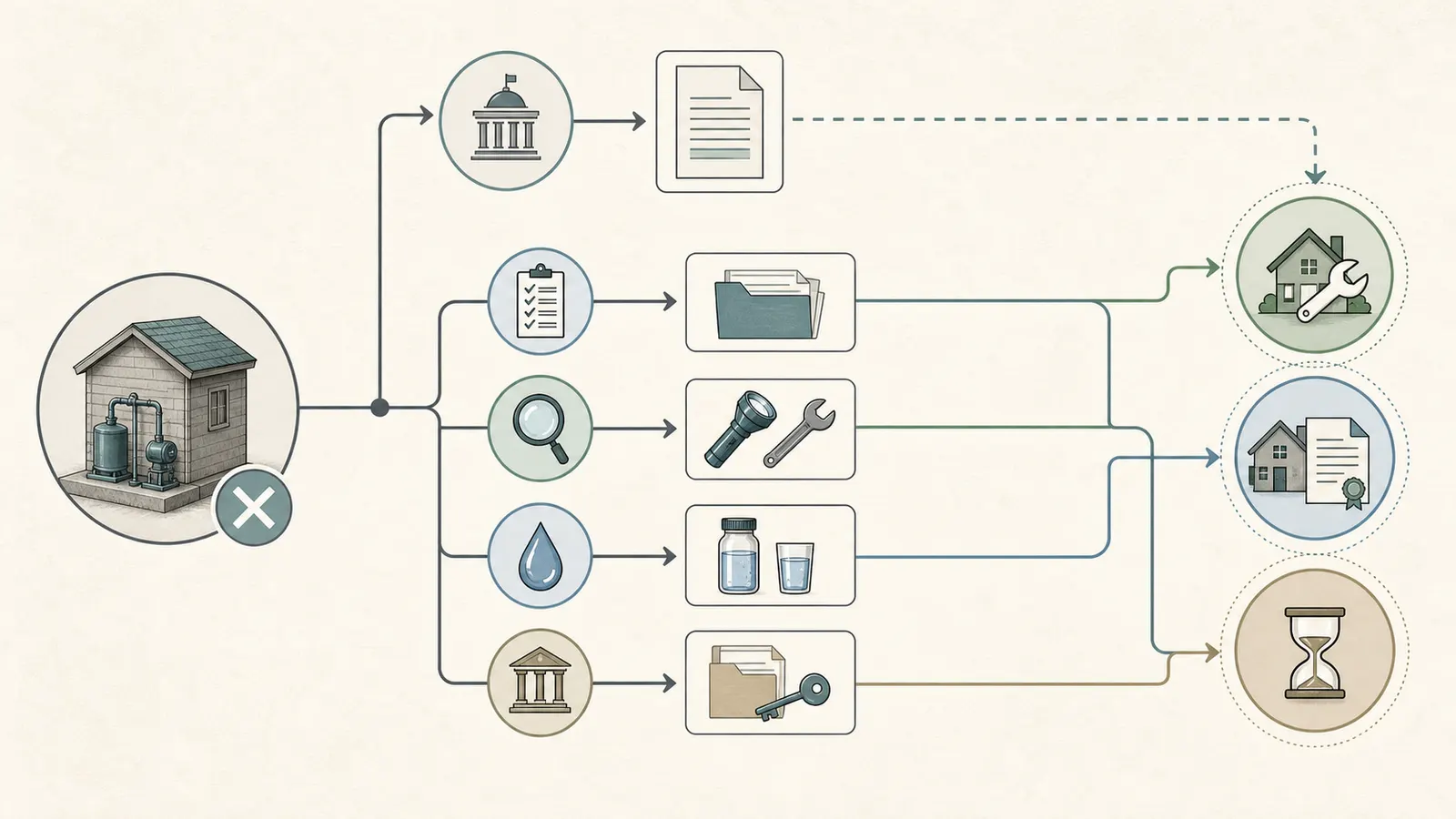
There is no single nationwide seller rule that answers every transaction. In one state, a disconnected pump can determine the well’s statutory status. In another, the form asks directly whether the pumping system works. Elsewhere, the state may not require a transfer inspection, while a locality, buyer, or lender still does. Treat these as four separate questions:
- What must you disclose, and when?
- What is the pump and pressure system doing now?
- What do water testing and well records show?
- Does the buyer’s financing or closing process require repair, inspection, testing, or documentation?
The official form, current local rule, lender instructions, and advice from the closing professionals control. This page is a seller decision surface and evidence worksheet, not a legal opinion or a substitute for a licensed well or pump professional.
The seller answer: disclose the known condition, then verify the rule
If you know the pump is not operating, is disconnected, has no power connection, or has not supplied water for a meaningful period, preserve that fact and bring it to the person preparing the disclosure. If you only know that no water came from a faucet on one occasion, record that narrower observation. If you do not know why, say the cause is unknown.
That approach matters because the legal trigger is not the same everywhere. Pennsylvania’s official seller statement tells a seller to identify the water source, the last water test and result, and whether the pumping system is in working order; it asks for an explanation when the answer is no. The same form says the disclosure is based on the seller’s knowledge and is not a substitute for an inspection or warranty. See the Pennsylvania Code seller property disclosure statement.
New Hampshire’s statute is broader in a different way: for a one- to four-family dwelling, it requires written information about the private water supply’s type, location, malfunctions, installation date, most recent water-test date, and known water-test problems before or during preparation of an offer. If information is unavailable, that lack of information must also be conveyed in writing. Read New Hampshire Revised Statutes § 477:4-d for the controlling text.
Minnesota uses a well-status framework. Its Department of Health says a seller must disclose the location and status of all known wells before signing an agreement to sell or transfer property. Minnesota describes a well as “not in use” when it is not functioning or cannot readily function, including when the pump is disconnected or the well is no longer connected to a power supply. An “in use” designation does not guarantee water quality or yield. Those are Minnesota definitions, not a national label; see Minnesota’s well disclosure guidance and its property-transfer explanation.
So the answer to “Do I need to disclose it?” is generally: disclose the known defect or operating condition when the applicable form or disclosure duty reaches it, but do not assume that one state’s wording, timing, or remedy applies to your property. A disclosure is not the same thing as a repair obligation. It is also not permission to write a confident technical conclusion you have not established.
Find the controlling rule before listing
Start with the property’s state and county or municipality, the current seller disclosure form, and the transaction type. A private well used for drinking water may be treated differently from an irrigation well, a shared well, a well serving multiple dwellings, or an abandoned and sealed well. Your real-estate agent, attorney, title or closing company, and local health or well authority can identify which source governs the transaction.
This compact comparison shows why a national yes-or-no answer is unreliable:
| Location or program | What the official source says | Seller implication |
|---|---|---|
| Minnesota | All known wells and their status must be disclosed; a disconnected or nonfunctioning pump can place a well in the “not in use” category. | Confirm the number, location, and status of every known well before the agreement is signed. Do not call a capped or plugged well “sealed” without the required sealing record. |
| New Hampshire | The private water system’s type, location, malfunctions, installation date, last water-test date, and known test problems are written disclosures for covered one- to four-family transactions. | Gather dates and known malfunctions, and mark unavailable information as unavailable rather than filling gaps with guesses. |
| Pennsylvania | The prescribed form asks whether the pumping system is in working order and asks for an explanation if not. It also asks for water-test timing and results. | Answer the pump question independently from the water-test question and explain the known condition in plain, dated language. |
| Wisconsin | The state does not require a property-transfer well inspection or water testing, but a transfer inspection, if performed, must be by a licensed well driller or licensed pump installer. A lender may impose additional requirements. | A state “not required” answer does not end the review. Ask the buyer’s lender and use a properly qualified inspector if an inspection is ordered. |
| New Jersey | Covered potable-well property sales require testing of untreated groundwater, and buyer and seller must receive and review the results before closing. A failed water test does not itself prohibit the sale, but a lender or local health department may require treatment. | Do not substitute a pump repair for the required water test, and do not assume a failed test automatically means the deal must end. |
| Virginia | State private-well rules do not require transfer inspection or water-quality testing, but localities and lenders may require them. The health department recommends a licensed well service provider for a stand-alone inspection. | Check the locality and lender before deciding that no test or inspection is needed. |
The official pages are Wisconsin DNR’s property-transfer well guidance, New Jersey DEP’s Private Well Testing Act page, and Virginia Department of Health’s real-estate transfer FAQ. The rows describe only the cited state sources. They are not a 50-state survey, and a local ordinance, county health rule, contract provision, or loan condition may add a step.
Ask these questions before listing or accepting an offer:
- What current disclosure form applies to this property, and when must it be delivered?
- Does the locality require a well inspection, water test, well record, abandonment/sealing record, or operating system at transfer?
- Is the well potable, irrigation-only, shared, seasonal, or otherwise limited in use?
- Does the buyer’s lender require a working pump, a pressure-system inspection, a specific test panel, a repair certification, or an escrow arrangement?
- If the pump cannot operate, how should the required water sample be collected, or should the test wait for a professional diagnosis?
- If the system’s condition changes after the form is signed, who must receive an updated disclosure?
Get answers in writing when they affect timing, cost, or the ability to close.
Record what you know about the pump and well
The most valuable seller record is a dated fact record that distinguishes observation from inference. Complete it before you authorize work, while the history is still clear. Mark “unknown” when that is the truth; an unknown is more useful than an invented answer.
| Record this | Example of a safe entry | Do not infer |
|---|---|---|
| Well identifier and location | “One drilled well shown on the 2008 well record, northeast side of house.” | That the record is complete, current, or the only well on the parcel. |
| Water at fixtures | “No water at kitchen cold tap on 2026-08-21; no other fixtures checked.” | That the well is dry or the pump has failed. |
| Pump status | “Pump disconnected from visible supply on 2026-08-21; cause and date unknown.” | That the motor is burned out, the control is defective, or the pump must be replaced. |
| Last known operation | “Owner remembers water service during summer 2024; no dated service record.” | That the system has been continuously unused since then. |
| Pressure or flow | “Pressure gauge not read; no safe operating test performed.” | That the system has adequate pressure, flow, or yield. |
| Repairs and service | “Invoice from ABC Well Service dated 2022-05-14; scope attached.” | That an old repair proves current operating condition. |
| Water quality | “Laboratory report dated 2025-04-03 attached; sample and scope as stated in report.” | That the result represents today’s water or proves the pump works. |
| Well capacity | “No professional yield or capacity report located.” | That a functioning faucet proves sustainable well yield. |
Use neutral wording in the disclosure conversation: “The system did not provide water when observed,” “the pump is disconnected,” “the system has not been tested by a well professional,” or “the reason for the condition is unknown.” If a qualified professional later identifies a failed pressure switch, motor, wire, pump, drop pipe, well obstruction, low water level, or other cause, attach that professional’s written finding rather than rewriting your earlier memory as if you had diagnosed it.
Do not restore power, reconnect a wire, bypass a control, or run a pump simply to make the disclosure look better. If the system becomes operational after a professional visit, keep both records: the earlier nonworking condition and the later dated test or repair. A change in condition may need to be reported to the buyer or closing team.
What to photograph
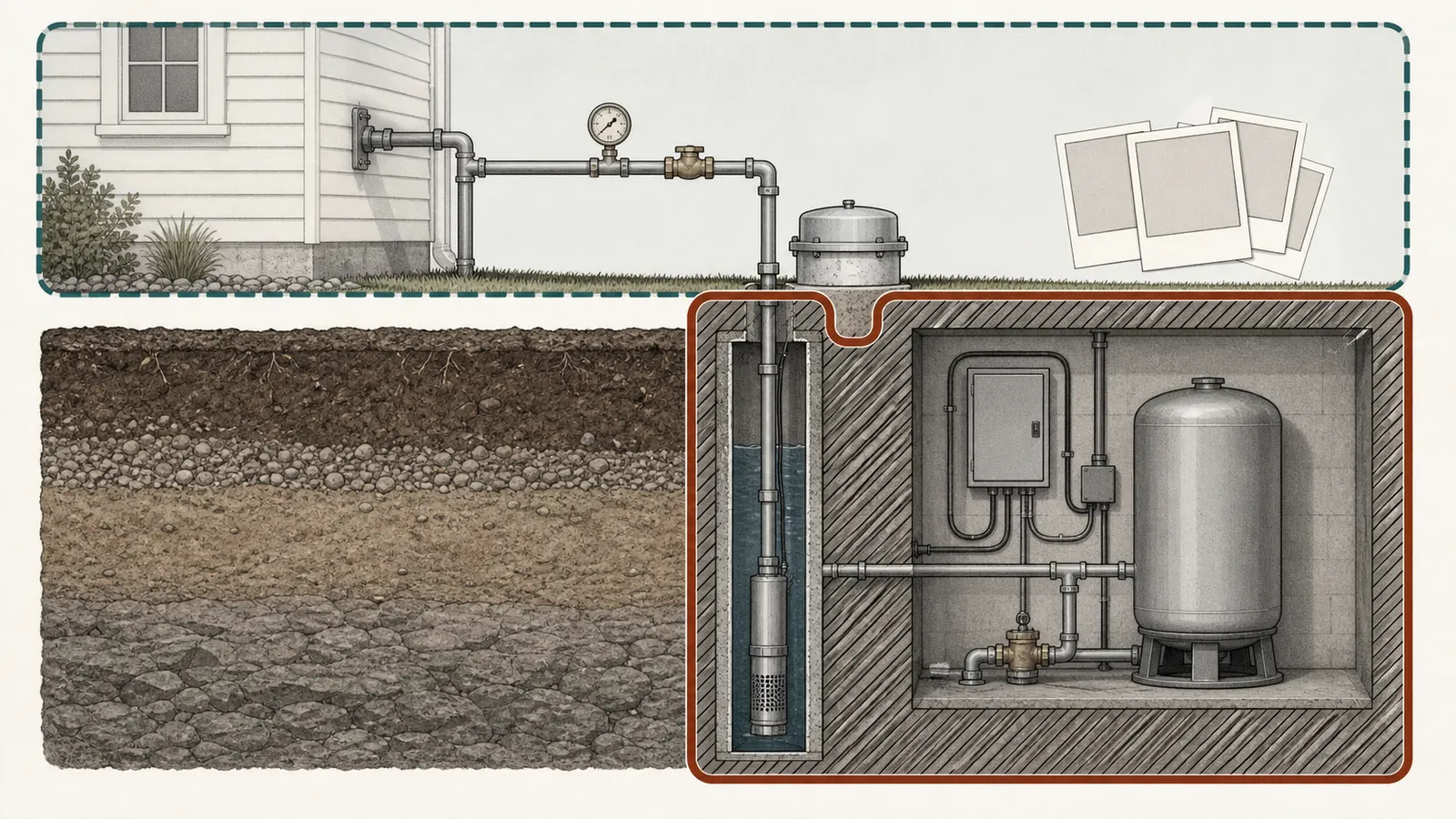
Photographs can preserve visible facts without opening equipment. Take wide and close views of the well location, casing or cap from the outside, pump or control labels that are already visible, pressure tank and gauge, treatment equipment, shutoff valves, visible disconnects, and any posted service tag. Date the files and do not crop out context that would make a connection look different from the actual installation.
Photographs cannot establish a hidden pump failure, water quality, well depth, casing integrity, electrical compliance, or yield. Treat them as evidence of what was visible on a particular date, not as a substitute for the report a licensed professional may be required to provide.
Keep four evidence questions separate
A failed pump can prevent ordinary water use, but it does not answer every question a buyer, regulator, or lender may ask. Use separate evidence lanes:
| Question | Appropriate evidence | What it can establish | What it cannot establish by itself |
|---|---|---|---|
| Does water reach the building through the pump system? | A controlled operating observation or professional pump/pressure-system test | The system’s observed operation under the stated test conditions | A permanent diagnosis, safe electrical condition, water quality, or future reliability |
| Is the well and pressure system constructed or installed acceptably? | Well record, visual inspection, code or transfer inspection by the required qualified person | Visible condition, certain installation features, known noncompliance, and limits of observation | Hidden casing depth, buried conditions, or every plumbing and electrical issue |
| Is the untreated groundwater acceptable for the required use? | Correctly collected sample analyzed by an appropriate certified or approved laboratory | Results for the contaminants and date included in the test | Pump function, sustainable yield, or future water quality |
| Can the well produce enough water for the property’s use? | Professional capacity, yield, recovery, or flow evaluation as required locally | The measured result and conditions of that evaluation | A guarantee that future groundwater levels or pump life will not change |
Wisconsin DNR expressly separates the well and pressure-system inspection from water testing. It says that a transfer inspection addresses compliance and that water results provide information about quality and potential health risks; detecting a contaminant does not by itself mean the well is noncomplying. It also says that well or pump yield may be noted separately and that pump or pressure-tank failure cannot be predicted. See Wisconsin’s inspection, sampling, and performance guidance.
Minnesota makes the same practical distinction from the disclosure side: calling a well “in use” does not guarantee its water quality or available yield. New Jersey’s required transfer sample is untreated groundwater, not a pump-operability certificate; its Private Well Testing Act guidance explains both the untreated-sample requirement and the fact that a failed water result does not itself prohibit a sale.
If the pump cannot run, tell the laboratory, well professional, and closing team before arranging a sample. A sample from a storage tank, treatment line, or another source may not satisfy the local or lender protocol. Do not represent a historical sample as current, and do not claim that a clean result means the pump, pressure tank, electrical controls, and distribution plumbing are safe or functional.
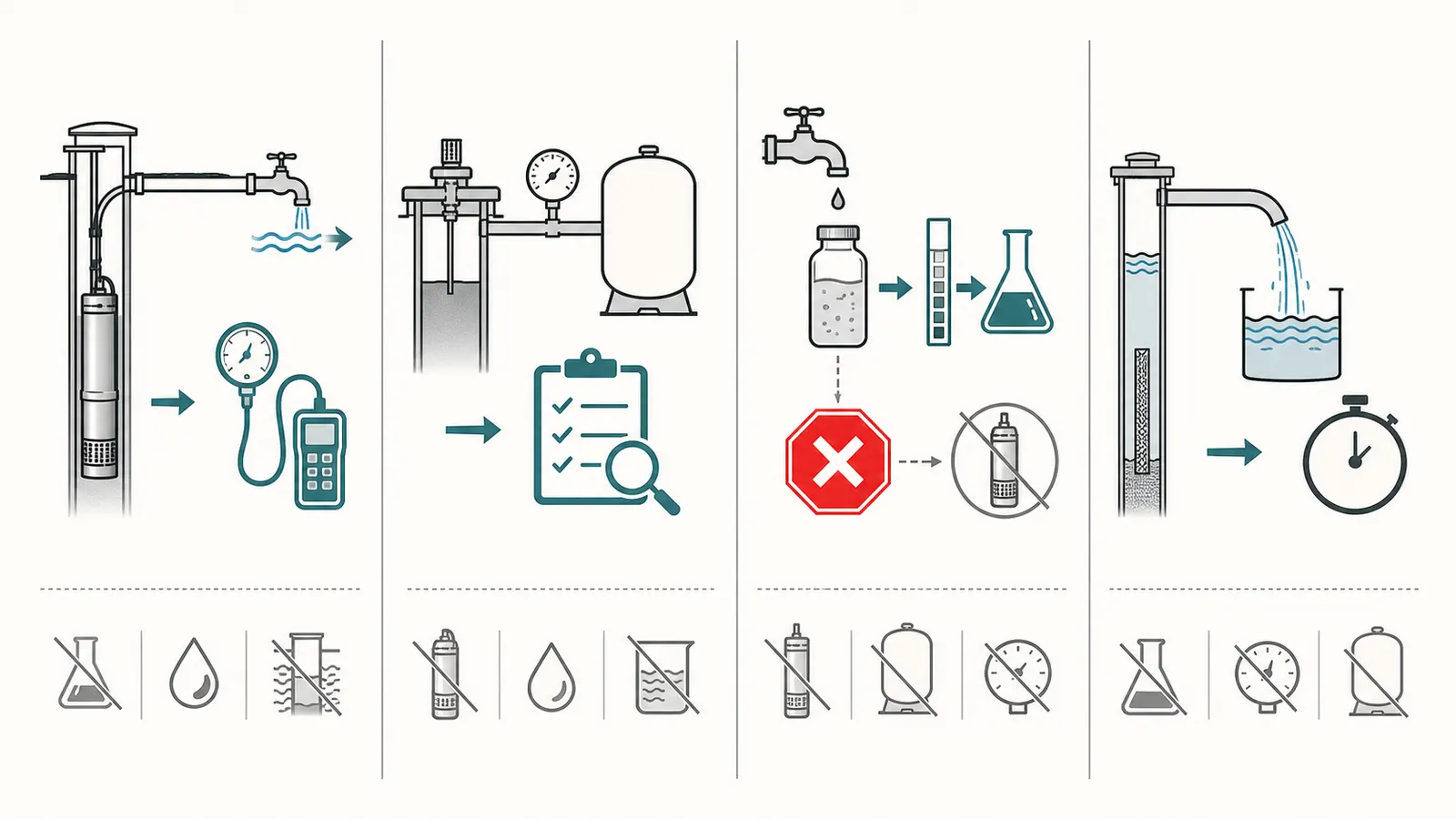
These lanes are useful only when the seller keeps the evidence attached to the question it answers. A pump observation belongs with the operating-status record; a well or pressure-system inspection belongs with construction and compliance findings; a laboratory report belongs with the sample source, date, and test panel; and a yield or capacity result belongs with its measured conditions. If a document does not identify its scope, date, or limitations, mark that gap for the closing team instead of promoting the document into a system-wide certification.
Safe observation boundary
For a homeowner, safe documentation is generally limited to reading existing labels, taking exterior photographs, noting whether water is available without manipulating the system, and gathering records. Stop and assign the work when the requested task involves an energized control, exposed wiring, a live circuit, a pressure switch, a pressurized connection, a well opening, a pump cable, a pump drop pipe, or a confined space.
Do not open an energized control box. Do not test live wiring. Do not open the well, remove a cap, pull a pump, enter a pit or confined space, disconnect pressurized equipment, bypass a pressure switch, or manipulate a pressure tank unless the exact action is demonstrably safe for you and specifically authorized by a qualified professional. A seller trying to create a quick “working” video can cause injury, damage the system, contaminate the well, or create a new disclosure problem.
Build a transaction-ready evidence packet
The packet should let a closing professional distinguish what is known, what was tested, what remains unknown, and which requirements are still awaiting confirmation. Keep original reports unchanged and give each document a date.
Seller evidence checklist
- Property address, parcel identifier, and state, county, and municipality.
- Number and location of every known well, including any unused, irrigation, monitoring, or shared well.
- Current state or local disclosure form, with the delivery deadline identified.
- A dated fact record for pump operation, water availability, disconnected equipment, and last known use.
- Well construction record, well log, permit, sealing record, maintenance permit, or local well-index search, if available.
- Prior pump, pressure-tank, electrical, well, treatment, or plumbing invoices and written diagnoses.
- Prior water-quality reports, including the laboratory, collection date, source point, test panel, and whether the sample was untreated.
- Any capacity, yield, recovery, or flow report, with its test conditions.
- Dated photographs of visible equipment and the well location.
- Any notice of noncompliance, repair estimate, permit, inspection form, or buyer-requested report.
- Written lender and closing instructions: required provider, tests, operating condition, repair timing, credits, escrow, and final verification.
Virginia’s Department of Health gives a useful example of the records that may exist: local-health-department well records, water-testing and maintenance records, and a well construction report or well log. It also warns that older Virginia records may be incomplete or unavailable. Its real-estate transfer FAQ supports a practical rule that applies broadly even where the record source differs: preserve what you have, and identify what you do not have.
When a document is missing, write “not located as of [date]” and identify where you looked. Do not write “none exists” unless the responsible authority confirms that. Do not call a well “sealed” because it has a cap, plug, or disconnected pump. In Minnesota, the Department of Health says a sealed well requires approved sealing work by a licensed contractor and a sealing record on file; a capped or plugged well is not automatically sealed. That is a Minnesota-specific legal distinction, but it is a good warning against using casual labels in any state.
Give each professional a defined question
Avoid ordering a vague “well check” and assuming the report will answer everything. Ask for the scope in writing:
- The well or pump professional: “Can you identify the well and pressure-system components you inspected, state whether operation was actually tested, identify what could not be observed, and separate pump condition, pressure performance, well capacity, and visible compliance concerns?”
- The laboratory or sampler: “What source and collection procedure satisfy the applicable rule or lender, and is the sample untreated?”
- The agent or attorney: “Which facts belong on the form, when must they be disclosed, and how do we update the buyer if the status changes?”
- The lender: “Is an operable private water system required? Which inspection or test provider is acceptable? Are repairs, credits, escrow, or final verification required before closing?”
- The title or closing company: “Are there local well records, sealing certificates, transfer certificates, or county forms that must accompany the deed or closing package?”
Wisconsin gives a sharp example of why the provider matters: at property transfer, only a licensed water-well driller or licensed pump installer may make a compensated statement there about the location, compliance, condition, capacity, or performance of a well and pressure system. A general home inspector may not have that authority. That licensing rule is Wisconsin-specific, but the general workflow—match the professional to the required scope—is sound.
Choose repair, documented sale, or pause
Do not decide based only on the price of a pump quote. Decide based on the controlling rule, the evidence, the buyer’s financing, the timing, and what can be represented truthfully.
| Path | Best fit when | Evidence gate before choosing it | Seller risk to manage |
|---|---|---|---|
| Repair before listing or closing | A qualified professional can define the repair, the property needs working water, or the lender/local rule requires operation or correction. | Written diagnosis and scope; permit or licensed-provider requirement checked; post-repair operating result and any required water test documented. | A new pump does not prove adequate yield, safe water quality, or code compliance. Keep the pre-repair condition in the file. |
| Sell with a documented defect | The official rule permits the transaction pathway, the buyer is informed, and the buyer’s lender and closing team accept the condition and written allocation of work or credit. | Completed disclosure; factual condition statement; professional report or estimate if available; written buyer and lender acceptance where required. | A repair credit or “as-is” clause does not erase a known disclosure duty and does not guarantee that financing will proceed. |
| Pause until requirements are known | The pump status affects a mandatory test, the well cannot be identified, a local inspection is pending, the lender has not answered, or the seller cannot describe the condition accurately. | Written confirmation of the rule, required provider, testing sequence, and closing deadline. | Listing or signing too early can create avoidable amendments, renegotiation, failed testing, or a closing delay. |
Wisconsin’s guidance is a useful example of the middle path: it says there is no state requirement to bring a well and pressure system into compliance to sell property, but a lender may require noncompliance to be corrected and the buyer and seller may negotiate whether to act. That statement should not be copied into another state; it shows why a seller must distinguish state law from financing conditions. See Wisconsin DNR’s after-inspection guidance.
Repair first when the facts and transaction requirements point that way, not because “working” is always legally required. If you do repair, ask the professional to document the as-found condition, the work performed, parts or settings changed, any permit, and what was not evaluated. Then confirm whether the transaction requires a new untreated water test, a pressure or yield test, an inspection form, or a final operating observation.
Selling with a documented defect can be reasonable where the applicable rule and financing allow it. Use precise language: “Seller has not operated the system since [date],” “pump disconnected as observed on [date],” “cause not determined,” “water quality test dated [date] attached,” or “no current yield test located.” Let the contract and closing professionals allocate responsibility. Do not promise that the buyer can simply reconnect the pump, that a stated repair allowance will cover the job, or that a historical water report remains representative.
Pause when the missing answer is a transaction gate. For example, stop and obtain direction if the locality requires a current certificate, the lender requires an operable water supply, the pump cannot run for a required sample, the well’s location is uncertain, or the seller is being asked to sign a form that uses a technical term they cannot support. A short delay to identify the required evidence is often easier to manage than a late discovery after an offer is signed.
Make the handoff safe and complete
At the handoff, give the closing team one organized packet and a short cover note with four headings: “known facts,” “attached evidence,” “unknowns,” and “questions awaiting confirmation.” That format discourages a reviewer from mistaking a photo, invoice, or water test for a complete system certification.
Ask the lender early, especially if the buyer is using a government-backed or specialized loan. Requirements are program-specific. For example, HUD’s Section 184 underwriting chapter requires a private-water-supply test meeting applicable Tribal, state, or local standards and sets a disinterested third-party testing and documentation framework for that program. The same chapter can require a service contract, approved plan, and escrow arrangement when an individual water-purification system is necessary for continuous safe potable water. Those are Section 184 provisions, not a universal rule that every nonworking pump needs an escrow account. They demonstrate why “the lender” is not a single national standard.
Before you sign or update a disclosure, run this final check:
- Have you identified every known well and its location as far as the records support?
- Have you stated the pump’s observed status and date without assigning an unconfirmed cause?
- Have you kept pump operation, well condition, water quality, and well yield as separate evidence questions?
- Have you preserved prior tests and service records without treating them as current proof?
- Have you checked the state, county, or municipal form and timing?
- Have you asked the lender and closing professionals what must be tested, repaired, verified, or escrowed?
- Have you assigned energized electrical work, pressurized equipment, well opening, pump removal, and confined-space work to a qualified professional?
- Have you disclosed newly learned or changed facts to the appropriate transaction professionals?
Edge cases that change the handoff
An intermittent pump is still a condition to describe. “It works sometimes” is not the same as “the system is in working order” unless the applicable form defines the question and a qualified test supports that answer. Record when the failure occurs, what demand was running, whether the system recovered, and whether anyone has evaluated the pressure tank, controls, pump, and well separately. A seasonal or irrigation-only well also should not be presented as a dependable potable supply without evidence for that use.
A shared well adds another document path: identify the agreement, other users, maintenance allocation, and any shared-system inspection or water-test requirement. A property with public water plus a private irrigation well still has a known well to address where the controlling form reaches all wells. An unused well is not automatically harmless because its pump has been removed; ask the local authority whether it must be maintained, located, permitted, or sealed.
If the buyer asks for a “well certification,” ask what that phrase means in the transaction. It could mean a water-quality laboratory report, a licensed pump professional’s operating statement, a county certificate, a well-sealing record, or a lender-specific form. Those documents answer different questions. Obtain the name of the required form or provider before scheduling work, and keep the request with the packet.
The cleanest seller position is not “the pump is fine” or “the well is worthless” when neither statement is established. It is a dated record of what was observed, a clear list of what has been tested, a plain statement of what remains unknown, and a documented answer from the officials and professionals who control this transaction.
Sources and scope
Evidence behind this page
- Minnesota Department of Health — Well Disclosure
Minnesota well-disclosure requirements only; this does not establish a disclosure form, timing rule, or status definition in another state.
- Minnesota Department of Health — What You Should Know About Wells at Property Transfer
Minnesota's statutory well-status framework and MDH explanation; do not use this definition to label a well in another jurisdiction.
- Minnesota Department of Health — What You Should Know About Wells at Property Transfer
Minnesota's well-status and sealing-record framework; the distinction and record requirement must not be generalized to another jurisdiction.
- New Hampshire Revised Statutes § 477:4-d — Notification Required
New Hampshire statute for the stated one- to four-family dwelling transaction; it is not a nationwide seller-disclosure rule.
- Pennsylvania Code § 35.335a — Seller Property Disclosure Statement
Pennsylvania's prescribed seller disclosure statement and its stated scope; the form's questions do not create the same obligation in other states.
- Wisconsin Department of Natural Resources — Buying or Selling a Home or Property with a Private Well
Wisconsin property-transfer well and pressure-system inspection guidance; the licensing and no-state-requirement statements are Wisconsin-specific.
- Wisconsin Department of Natural Resources — Buying or Selling a Home or Property with a Private Well
Wisconsin DNR's property-transfer guidance; it describes Wisconsin's state rule and does not predict a different state's lender or contract requirements.
- Wisconsin Department of Natural Resources — Buying or Selling a Home or Property with a Private Well
Wisconsin's inspection and sampling framework used here to explain the evidence distinction; exact tests and forms vary elsewhere.
- New Jersey Department of Environmental Protection — Private Well Testing Act
New Jersey PWTA requirements and its stated effect of a failed test; it is not a general rule that every state requires untreated-water testing or permits sale on the same terms.
- Virginia Department of Health — Real Estate Transfer FAQ
Virginia Department of Health's statewide FAQ and its local/lender caveat; this is not a statement about every Virginia locality or another state.
- Virginia Department of Health — Real Estate Transfer FAQ
Virginia record-keeping guidance; the practical records checklist is transferable, but the record sources and availability are not guaranteed elsewhere.
- HUD Office of Native American Programs — Chapter 2, Section C: Underwriting the Property
Section 184-guaranteed financing underwriting, not a universal FHA, conventional, VA, USDA, or state rule; use only as an example of why the actual lender must be asked.
- HUD Office of Native American Programs — Chapter 2, Section C: Underwriting the Property
Section 184 program provisions concerning water-purification equipment; it is an example of program-specific underwriting and does not mean a nonworking pump always requires escrow.