Will a Backwashing Water Filter Work With Your Well Pump?
A homeowner go/no-go worksheet for matching a backwashing filter's flow, pressure, cycle volume, drain, septic, and well-pump limits.
The short answer
Usually, but only when the exact filter manual's backwash flow and pressure requirements are met by a repeatable pressure-tank pumping-rate test. Record drawdown, pump cycle time, pressure, backwash duration, and drain volume. A larger media tank is not automatically better: available backwash flow limits tank size. If flow, pressure, drain, septic capacity, or local rules do not clear, choose another treatment scope or obtain a professional design review before buying.Will a Backwashing Water Filter Work With Your Well Pump?
Yes—sometimes. The purchase clears only when the exact filter-and-media combination can get its required backwash flow and pressure for the complete cycle, and the wastewater path can accept the discharge. A pressure-tank pumping-rate test is a useful homeowner screening step, but it is not proof that a low-yield well can sustain the load through changing water levels or peak household demand. The decision is:
GO TO INSTALLATION REVIEW when the manual is complete, the measured flow meets the exact backwash requirement repeatedly, pressure stays within the product range, the drain and air-gap arrangement are acceptable, the septic or wastewater path is cleared, and local requirements do not block the discharge.
NO-GO when any required number is missing or fails: measured flow below the manual's backwash rate, inadequate pressure, an unsuitable drain, an overloaded septic path, a temperature or electrical mismatch, or a local restriction.
PROFESSIONAL DESIGN REVIEW when the result is borderline or variable, the well is known to be low-yield, the pump or pressure system has symptoms, the septic capacity is uncertain, or the seller cannot provide exact model-and-media specifications.
This is a purchase boundary, not a promise that a specific filter will remove a specific contaminant. The filter still has to be matched to current water testing, treatment chemistry, service flow, and the manufacturer's instructions.
Pump/backwash compatibility does not establish microbiological safety or disinfection. Do not treat water from an unknown, contaminated, or otherwise unsafe well as potable based on this worksheet; do not drink it, cook with it, make ice from it, or brush your teeth with it until appropriate testing and a qualified treatment/disinfection review establish a safe plan. EPA recommends certified-laboratory testing and public-health guidance when a private-well contaminant is found, and treatment must be selected for the contaminant rather than assumed from a filter's hydraulic fit. EPA's private-well testing and treatment guidance.
1. Start with the exact filter specification
Do not begin with the tank diameter, horsepower printed on the pump motor, or a seller's phrase such as “whole-house capacity.” Begin with the manual for the exact control valve, tank, media, and model number. A backwashing filter is a hydraulic system: water must move through the media in reverse direction fast enough to expand and clean the bed, then complete any rinse or other programmed steps.
The University of Georgia explains the sizing boundary plainly: a larger media-filter tank generally has a higher service-flow capacity, but the water available for backwashing limits the tank size. Its recommendation is to select the largest tank appropriate for the available backwash rate, not the largest tank that fits the room. University of Georgia Cooperative Extension describes the tank-diameter and backwash-rate relationship.
That distinction matters because service flow and backwash flow answer different questions. Service flow is how much treated water the unit can deliver while the media is filtering. Backwash flow is what the well and plumbing must supply in reverse. A filter can have an attractive service-flow number and still be a poor fit for a weak well if its backwash requirement is higher than the pump can sustain.
Copy these fields before comparing a pump
| Manual field | What to record | Why it controls the decision |
|---|---|---|
| Exact model and control valve | Model number, valve version, tank diameter | Similar-looking tanks can use different flow controls and settings. |
| Media and media volume | Media name, cubic feet, loading instructions | Media density and particle size can change the required backwash rate. |
| Required backwash flow | Minimum or design gpm, including any higher rate for special media | This is the primary pump-compatibility number. |
| Minimum and operating pressure | Minimum inlet pressure, maximum pressure, operating range, pressure-drop information | Flow without adequate pressure may not expand the bed or operate the valve correctly. |
| Backwash and rinse sequence | Minutes at each flow, air draw or other steps, frequency | It establishes how long the pump must support the event and how much water is used. |
| Stated water usage or cycle volume | Gallons per cycle, if supplied | It is the wastewater and well-storage load. |
| Service and peak flow | Continuous, service, or peak gpm | It checks household delivery separately from backwash. |
| Drain requirements | Drain gpm, line diameter, maximum length, air-gap direction, separate drains | The drain must accept the flow without siphoning, restriction, or unsafe discharge. |
| Installation limits | Temperature, freezing, electrical supply, location, pressure-tank position | A hydraulically compatible filter can still be unsafe or out of specification. |
Use the manual's numbers exactly. Do not substitute a generic “well pump flow” number from a product table. For example, the Franklin Water Treatment SBF1 manual lists standard-media backwash rates from 5.3 gpm on its smaller models to 11 gpm on the SBF1-30. It also shows higher rates in parentheses for some media: the SBF1-10 and SBF1-15 can require 7.5 gpm, the SBF1-20 11 gpm, the SBF1-25 13 gpm, and the SBF1-30 15 gpm with the specified higher-flow setup. Those are not interchangeable recommendations for every filter.
The same manual lists model-specific water-usage values from 85 to 176 gallons at standard backwash flow, and 120 to 240 gallons at its higher rates. Its factory default is a single eight-minute backwash and a single eight-minute rinse. Treat those figures as belonging to the SBF1 configuration shown, not as a universal rule for all automatic filters. A different unit can have a different flow-control washer, cycle length, rinse sequence, or media requirement.
Pentair gives a useful second example of why model-specific reading matters. The WaterTrust Pro manual lists a 5 gpm drain flow rate for both its 1.0- and 1.5-cubic-foot iron-reduction models, a minimum pressure of 20 psi, and a stated operating range of 20–80 psi. It also tells a well owner to confirm that the pump can provide the 5 gpm drain flow rate for proper backwash. That does not mean a different 1.5-cubic-foot filter needs 5 gpm.
If the manual does not state the backwash rate, pressure, cycle steps, drain requirement, and media-specific changes, pause the purchase. Ask the manufacturer for the written data for the exact configuration. “The pump is usually enough” is not a specification.
2. Measure the pump at the pressure tank
The useful homeowner measurement is not the pump motor's horsepower and not the flow from a kitchen faucet after the treatment location. It is the rate the well system can replenish the pressure tank under the home's current conditions. The filter is normally installed after that tank on a private-well system, so the tank and pressure-switch behavior are part of the compatibility picture.
Franklin's SBF1 manual provides a practical screening method:
Stop all household water use. Turn off irrigation, hose use, washing machines, ice makers if they are drawing water, and any scheduled treatment cycle. Do not change pressure-switch settings.
Identify the spigot nearest the pressure tank. It must be a normal, accessible outlet that can be operated without opening a control box, tank, wellhead, or pressurized fitting.
Open that spigot and observe the gauge. When the pump starts, close the spigot and measure the time in seconds until the pump turns off and the tank returns to the upper pressure setting. This is the pump-on refill or cycle time for the manual's calculation.
Using a container with a known volume, draw water from the pressure tank. Record the total gallons until the pump turns on again. This is drawdown for this test.
Calculate:
Estimated pumping rate = drawdown gallons × 60 ÷ pump-on refill time in seconds
Repeat the measurement at least once under the same no-use conditions. Record the pressure at pump start and pump stop, whether the pressure rises smoothly, whether the flow sputters, and whether the pump reaches shutoff normally.
The Franklin SBF1 manual gives this drawdown-and-cycle-time procedure and formula. A sample calculation is 8 gallons of drawdown and 65 seconds of pump-on refill time: 8 × 60 ÷ 65 = 7.38 gpm. That is an example of the math, not a result for your home.
What the result does—and does not—tell you
Compare the measured rate with the exact manual's required backwash flow. If the filter requires 7.5 gpm, a test result of 7.38 gpm does not clear that flow gate. If it is above 7.5 gpm, that clears only the first screening comparison; it does not prove the pressure at the filter, well yield, drain, or septic path.
The test is a pressure-tank system measurement during a short pump cycle. It does not directly establish how the water level in the well behaves during a long discharge. Penn State defines well yield as the maximum rate that can be pumped without lowering the water level below the pump intake. It also explains that a low-yield well can appear adequate in daily gallons yet fail during a sustained peak-demand period. A sustained capacity assessment requires a pump test that records water levels while pumping. Penn State Extension explains the difference between a short flow observation and sustained well yield.
This is why “the pump starts the backwash” is not enough. The pressure tank may supply the first part of the event, then the pump must replenish water while the filter is still discharging. If the well cannot keep up, pressure can fall, the cycle can become incomplete, or the pump can run in an abnormal condition. The University of Georgia identifies inadequate backwash flow and insufficient backwash time as failure modes that can lead to media channeling, a clogged underdrain, or incomplete treatment. Read the University of Georgia maintenance and failure guidance.
Do not “fix” a failed flow comparison by installing a larger pressure tank without understanding the well. Penn State says a larger pressure tank provides more stored water but, by itself, does not solve a low-yield well's inability to replenish water at the rate it is withdrawn. See Penn State's pressure-tank boundary for low-yield wells.
Stop conditions for the homeowner test
Stop and arrange professional review if the pump does not shut off normally, the pressure falls instead of recovering, the gauge behaves erratically, the faucet spits air or sediment, the well runs dry, the system has no reliable gauge, or the test would require opening an energized control box or pressurized component. Do not open a well, pull a pump, open a pressure tank, adjust live controls, manipulate wiring, or bypass a safety device to make the number look better.
3. Check pressure, pressure-tank behavior, and the complete cycle
Flow and pressure are coupled. A pump may deliver a published flow at one head and pressure but not at the pressure available at the filter. Friction through the service line, elevation, elbows, valves, a sediment restriction, and the filter's own control valve can reduce pressure at the point of backwash. A gauge at the pressure tank is useful evidence, but it is not necessarily the same pressure at the filter inlet.
Record these values from the manual and the test:
| Pressure question | Homeowner record | Interpretation |
|---|---|---|
| Filter minimum pressure | ___ psi | The measured system must not be below the product's stated minimum during the relevant step. |
| Filter maximum pressure | ___ psi | The system must not exceed the manual's limit. |
| Pump start pressure | ___ psi | Shows the lower pressure at which the tank begins replenishment. |
| Pump stop pressure | ___ psi | Shows the upper pressure reached in the test. |
| Pressure during the event | ___ psi, if safely observable | A falling or unstable reading needs review; do not alter controls. |
| Pressure at filter location | ___ psi, if measured by a professional | Confirms that tank-gauge pressure is not masking line loss. |
For the Franklin SBF1, the manual states a 25–100 psi water-pressure range. It also says the unit should be installed after the pressure tank and that water above 100°F can damage internal components. Those are Franklin SBF1 limits, not universal filter limits. Pentair's WaterTrust Pro has a different 20–80 psi operating range and a minimum of 20 psi. Use the Pentair limits only for that product.
The complete cycle matters as much as the first backwash minute. Write down every step that sends water to the drain: backwash, rinse, fast rinse, or any other water-flow step. For each step, calculate:
Step volume = flow in gpm × minutes in that step
Then add the step volumes to create a planning estimate. If the manual provides a stated cycle-volume number, use it as the controlling specification and preserve the assumptions. Do not count a timed air-draw or pause as gallons unless the manual says water flows during it. Do not convert a backwash-only number into a full-cycle volume without checking the rinse sequence.
Use the result in three ways:
- The well must provide the required flow at the required pressure during the flow steps.
- The pressure tank and well must tolerate the event without abnormal cycling or loss of supply.
- The drain and wastewater system must receive the entire discharge, not just the first step.
If the measured rate is just above the requirement but the well is seasonal, drought-affected, sand-producing, or known to have a long recovery time, treat the result as uncertain. There is no universal homeowner “extra gpm” rule that can replace the equipment manual and a well professional's design judgment. Ask for the manufacturer's required operating margin or obtain a well/pump performance review.
4. Clear the drain, air gap, and wastewater path
A filter can pass the pump test and still be an installation no-go because the discharge has nowhere safe and permitted to go. Backwash is not a small drip. The manual's flow-control value and cycle length determine the peak flow and the gallons released.
For the Franklin SBF1, the manual calls for a floor drain or sump capable of handling the filter's backwash rate, an air gap at the end of the drain line, a drain line 15 feet or less, and no overhead drain. It specifies a different rigid-drain arrangement when backwash flow is above 7.5 gpm. Review the Franklin SBF1 drain instructions for the exact model. Pentair likewise says most local codes require an air gap, gives its own drain-line details, advises separate termination for filter and softener drain lines, and notes that iron-bearing discharge can stain. Review Pentair's model-specific drain diagram and cautions.
Do not turn those instructions into a national code claim. “Air gap” dimensions, indirect waste requirements, permitted discharge locations, dry wells, sewer connections, and outside discharge can vary by state, county, city, plumbing authority, health department, and property conditions. The safe homeowner question is not “Can I connect this to the nearest pipe?” It is “Is this exact drain arrangement allowed and able to carry this exact peak flow and volume?”
If the home has septic
Treat the backwash as an additional wastewater load. The University of Georgia says backwashing adds wastewater to a septic system and recommends confirming that the system can handle the added load using the manufacturer's rate, duration, and frequency. EPA explains that all household water sent down the pipes enters the septic system, and that excess water can interfere with treatment and flood a drainfield. Use the University of Georgia backwash guidance and EPA's septic water-use guidance.
The filter manual cannot certify your septic capacity. Bring the filter's gallons per cycle, peak drain gpm, frequency, household size, septic tank size, permit or design flow if available, recent pumping record, and any history of slow drains or wet drainfield areas to a qualified septic professional or local health department. A system that already shows backups, standing water, odors, or slow drainage is not a place to add an automatic discharge while hoping the timing will solve the problem.
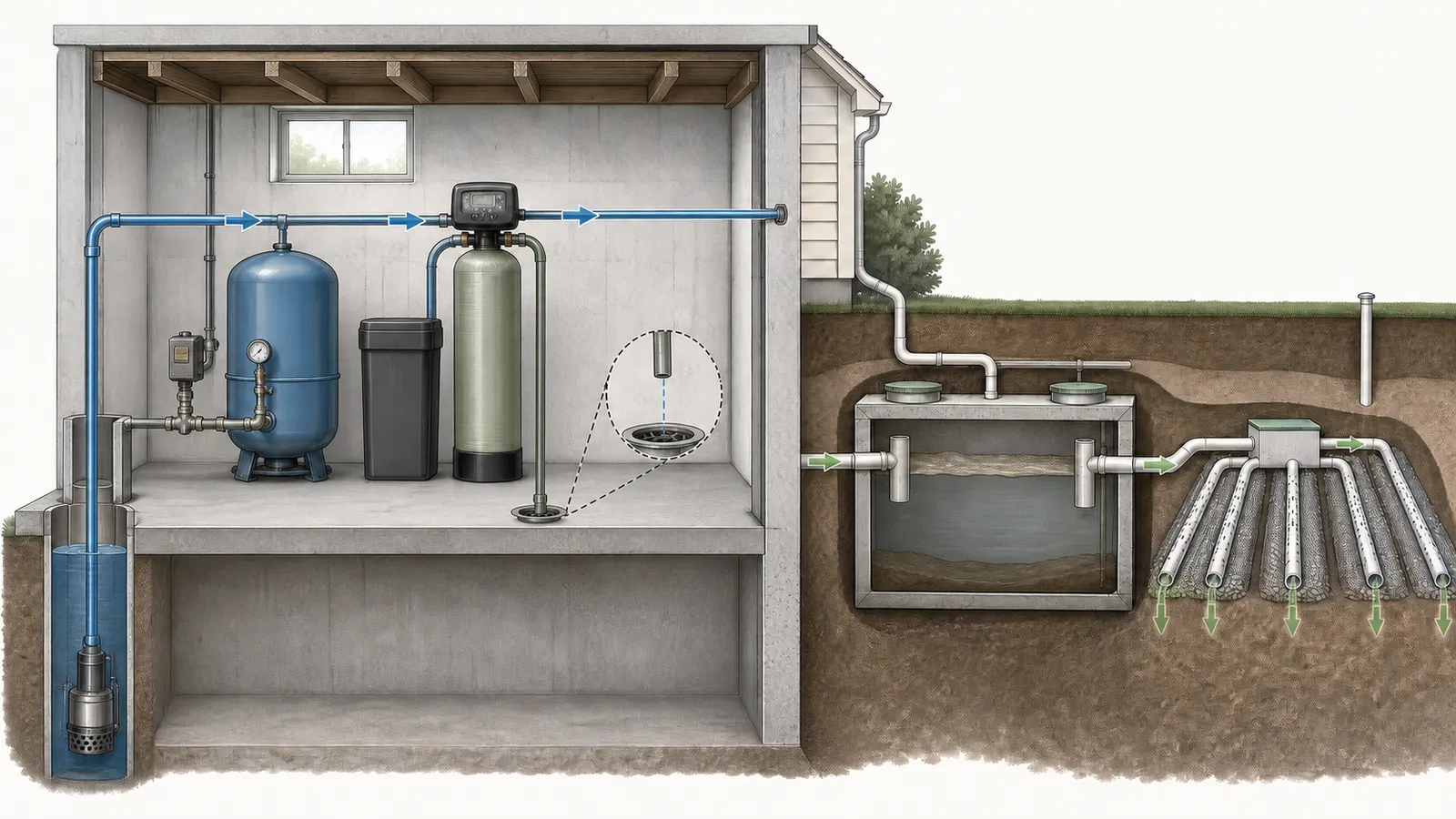
If the discharge is outdoors or to a non-septic route
Do not assume that outside discharge is automatically allowed or harmless. Pentair describes outside use of discharge only in nonfreezing climates and warns that iron can stain walls, vehicles, patios, or other surfaces. Local environmental or wastewater rules may control where treated or untreated water can be discharged. Ask the local authority before installation, and keep written confirmation with the project records.
5. Check temperature, electrical supply, and installation order
Backwash compatibility is not only hydraulic. The control valve has electrical and temperature limits, and the installation location affects both safety and performance.
The Franklin SBF1 manual says water-conditioning equipment should be at least 10 feet before the water heater, water above 100°F can damage the control valve and tank, the system must not freeze, and the control valve requires a 115/120 V, 60 Hz outlet that is not wired to a switch. Use the Franklin SBF1 manual for those Franklin-specific limits. Pentair's WaterTrust Pro states a 40–100°F operating range and uses a supplied transformer. Use the Pentair WaterTrust Pro manual for those Pentair-specific requirements.
For a homeowner, this means observing rather than servicing:
- Confirm the proposed location is on the cold-water side and before the water heater when the manual requires it.
- Record whether the room can freeze or overheat.
- Identify the outlet and whether it is continuously powered, but do not open the receptacle, control valve, transformer, or wiring.
- Keep the filter out of a location where a leak would reach energized equipment or stored belongings.
- Confirm there is enough height and clearance for the tank, valve, drain line, bypass, and future media service.
- Do not install a cartridge or inline restriction upstream if the manual warns that it could reduce backwash flow.
The Franklin manual specifically warns against a cartridge-type filter before the SBF1 because it can restrict the flow and pressure available for backwash. See Franklin's prefilter and flow-restriction warning. A sediment prefilter may be appropriate in another design, but only when the filter manufacturer or water professional has accounted for its pressure loss and maintenance. Never use a prefilter as a way to hide a pump-flow deficit.
Moderate-safety boundary: do not open energized controls, test live wiring, open the well, pull a pump, enter a confined space, or loosen pressurized plumbing. Installation work that requires shutting off pump power, draining or relieving pressure, rewiring, changing a drain connection, modifying a pressure tank, or working on a well belongs to a qualified professional unless the specific task is clearly covered as safe homeowner maintenance by the equipment instructions.
6. Make the go/no-go decision
Use this worksheet after copying the exact manual values and completing the safe screening test.
| Gate | Your evidence | Clear when | Outcome if not clear |
|---|---|---|---|
| Exact manual | Model, valve, media, and revision: ___ | Written backwash flow, pressure, cycle, drain, and installation limits are available | No purchase decision; obtain the manual. |
| Backwash flow | Required ___ gpm; measured ___ gpm | Repeatable measured rate meets the exact requirement at the relevant pressure | No-go for that configuration or professional redesign. |
| Pressure | Minimum ___ psi; start ___; stop ___ | Pressure remains within the manual's range and reaches the required minimum | No-go until pressure/flow diagnosis. |
| Sustained well behavior | Well log/pump test: ___ | No low-yield, drought, recovery, sand, or abnormal-cycle concern, or a professional has designed around it | Professional well/pump review. |
| Cycle volume | ___ gallons per cycle; ___ cycles per week | Well storage, wastewater, and operating plan can accept it | Choose a lower-load design or obtain review. |
| Drain | Peak ___ gpm; line ___; air gap ___ | Exact line and receiving point can carry the peak flow and are permitted | No-go until drain is redesigned and cleared. |
| Septic or sewer | System: ___; capacity evidence: ___ | Local wastewater professional or authority confirms the added load is acceptable | Do not connect the discharge. |
| Temperature/freezing | Location range: ___ | Within the manual's operating range and protected from freezing | Relocate or redesign. |
| Electrical | Required ___; outlet/transformer: ___ | Correct, continuously powered supply is confirmed without unsafe modification | Qualified electrical review. |
| Water-treatment fit | Raw-water test date/results: ___ | Media and treatment process match the contaminant and concentration | Water-treatment design review; pump compatibility alone is irrelevant. |
GO TO INSTALLATION REVIEW
This outcome means the paper-and-measurement gates have cleared. It does not mean “buy any model.” Give the installer the exact manual, media selection, pressure-tank test record, pressure readings, drain plan, septic or wastewater clearance, water test, and photos of the proposed location. Ask the installer to confirm the final pressure at the filter inlet, flow-control part, drain termination, air-gap arrangement, and programmed cycle.
NO-GO
A no-go is appropriate when the measured flow is below the required backwash rate; pressure is below the minimum or above the maximum; the drain cannot carry the peak flow; the septic or wastewater authority has not cleared the load; the unit can freeze or overheat; or the exact media requirement is unknown. Do not solve a no-go by shortening the backwash time, reducing the flow-control size, bypassing the safety valve, or changing the pressure switch without written design approval. Those changes can leave the media dirty or improperly settled.
PROFESSIONAL DESIGN REVIEW
Choose review when the result is close, inconsistent, or dependent on assumptions. The most useful handoff includes:
- well completion report, pump make/model, pump depth if known, and any prior yield or pump-test record;
- pressure-tank size, pressure-switch settings as observed, gauge readings, and the drawdown/cycle-time calculation;
- two or more test runs, including the date, water-use conditions, and any sputtering, sand, or abnormal cycling;
- the filter manual, exact model, media name and volume, required backwash flow, pressure range, cycle steps, and stated water usage;
- drain-line length, diameter, receiving drain, air-gap plan, and whether a softener or other treatment unit shares the route;
- septic permit/design information, tank size, last pumping date, household size, or sewer connection details;
- recent raw-water and treated-water tests, including the contaminant the filter is intended to address.
7. Choose an alternative when the well does not clear
A failed backwash-flow check does not identify the right alternative by itself. It tells you that this automatic media filter, with this media and configuration, is not cleared by the available hydraulic evidence.
Possible design directions for professional comparison include:
- A smaller or different media configuration. A smaller tank may require less backwash flow, but it can also have lower service capacity or a different treatment capability. The treatment professional must confirm that it can handle the household's peak flow and water chemistry.
- A non-backwashing or cartridge approach. Cartridge filters do not use an automatic backwash cycle, but the University of Georgia notes that trapped material gradually reduces flow and cartridges must be cleaned or replaced when flow becomes too slow. A cartridge is not automatically suitable for dissolved contaminants, high sediment loading, or whole-house peak demand. Review the University of Georgia's cartridge and media-filter distinctions.
- Point-of-use treatment or narrower coverage. Treating only drinking and cooking water can reduce the flow and wastewater scope, but it must still be matched to the contaminant and maintained. It does not make untreated whole-house water safe to drink.
- A storage or pump-system redesign. A low-yield well may need a professionally designed storage and pressure arrangement rather than a larger filter. Penn State describes intermediate storage as one possible approach for a well with a limited but steady yield; that is a system-design decision, not a homeowner pressure-tank adjustment. See Penn State's low-yield well options.
- A backwashing service arrangement. University of Georgia notes that some water-treatment dealers offer backwashing service for households that do not have adequate flow. Ask what is included, how often service occurs, where the wastewater goes, and whether the treatment performance is verified.
Finally, verify that the chosen treatment actually works. The University of Georgia recommends testing raw and treated water after installation and continuing annual testing to assess treatment performance and maintenance needs. Use its maintenance guidance as part of the handoff and record.
The practical answer to “Will a backwashing water filter work with my well pump?” is therefore not a horsepower guess. It is a documented comparison: exact backwash flow and pressure versus measured pump behavior, followed by cycle-volume, drain, septic, temperature, electrical, local-rule, and water-treatment checks. If every gate clears, proceed to installation review. If one fails, stop before purchase and choose a design that fits the home's actual well and wastewater limits.
Sources and scope
Evidence behind this page
- University of Georgia Cooperative Extension — Household Water Treatment: Mechanical Filtration Methods and Devices
University of Georgia guidance for household media filters; it is a sizing principle, not a universal gpm value for every tank or media.
- University of Georgia Cooperative Extension — Household Water Treatment: Mechanical Filtration Methods and Devices
University of Georgia discussion of media-filter maintenance and failure modes; it does not diagnose a specific installed unit.
- University of Georgia Cooperative Extension — Household Water Treatment: Mechanical Filtration Methods and Devices
General U.S. homeowner guidance; it does not establish a national prohibition or a local code requirement.
- Franklin Water Treatment, LLC — SBF1 Series Backwashing Filter System Installation Instructions and Owner's Manual
The SBF1 product manual; its test is for that product family and is a screening measurement, not a substitute for a sustained well-yield or pump diagnostic test.
- Franklin Water Treatment, LLC — SBF1 Series Specifications
Pages 16–17 of the SBF1 manual; values apply only to the named model, media, flow-control setup, and factory settings shown there.
- Franklin Water Treatment, LLC — SBF1 Series Installation Instructions
SBF1 installation instructions; the air-gap and plumbing details remain subject to the exact product instructions and applicable local requirements.
- Franklin Water Treatment, LLC — SBF1 Series Pre-installation and Installation Instructions
SBF1 manual safety and installation limits; do not generalize these numbers to another filter model.
- Pentair — WaterTrust Pro Series Whole House Iron Reduction Installation and Owner's Manual
Pentair WaterTrust Pro iron-reduction system; values are product-specific and do not size other filters.
- Pentair — WaterTrust Pro Series Drain Installation Instructions
Pentair product manual; it does not determine what a local plumbing, wastewater, or environmental authority permits at a specific property.
- Penn State Extension — Using Low-Yielding Wells
Penn State guidance on well yield and low-yield systems; it supports escalation when a pressure-tank screening test does not establish sustained capacity.
- Penn State Extension — Using Low-Yielding Wells
Penn State discussion of low-yield well storage; the actual usable drawdown depends on tank type, pressure settings, and installation.
- U.S. Environmental Protection Agency — How to Care for Your Septic System
EPA homeowner guidance for septic systems; it supports a hydraulic-load check but does not calculate capacity for an individual septic design.
- University of Georgia Cooperative Extension — Household Water Treatment: Mechanical Filtration Methods and Devices
University of Georgia maintenance guidance for household media filters; testing frequency may be supplemented by local health guidance and the treatment professional's plan.
- Pentair — WaterTrust Pro Series Whole House Iron Reduction Installation and Owner's Manual
Pentair WaterTrust Pro operating-temperature and electrical instructions; these requirements are product-specific and do not generalize to another filter.
- Franklin Water Treatment, LLC — SBF1 Series Pre-installation and Installation Instructions
SBF1 prefilter warning; it applies to the named SBF1 system and does not prohibit every prefilter in every treatment design.
- University of Georgia Cooperative Extension — Household Water Treatment: Mechanical Filtration Methods and Devices
University of Georgia comparison of cartridge and media filtration; it supports a possible lower-water-use alternative but does not establish suitability for a specific contaminant or household.
- Penn State Extension — Using Low-Yielding Wells
Penn State options for low-yield wells; the appropriate storage, pump, controls, and treatment design depend on the site's sustained yield and professional evaluation.
- U.S. Environmental Protection Agency — Protect Your Home's Water
EPA private-well testing and treatment guidance; it supports the potable-water boundary but does not design a property's treatment or disinfection system.