Why Did My Private-Well Air-Injection Iron Filter Stop Removing Iron?
A safe, evidence-backed path to separate air-draw, backwash, chemistry, media, iron-bacteria, and well-pump causes before service or replacement.
The short answer
Returning rust stains do not prove the media is exhausted. First identify the filter and record when the symptom changed; then observe the programmed cycle, drain behavior, and bypass position without opening pressurized equipment. Compare untreated and treated water with a certified lab test. The next step is usually a model-specific injector or control diagnosis, a chemistry retest, a media evaluation, or a pump-flow check—not an automatic replacement.Why Did My Private-Well Air-Injection Iron Filter Stop Removing Iron?
Returning orange stains are a failure signal, not a diagnosis. An air-injection iron filter can pass iron because the bypass is open, the controller did not complete its cycle, the injector is not drawing air, the backwash is too weak, the well pump cannot supply the required cycle flow, the raw water chemistry changed, iron bacteria are fouling the equipment, or the media has reached a service limit. The first useful question is not “How old is the media?” It is “What changed, and which observation can separate these causes?”
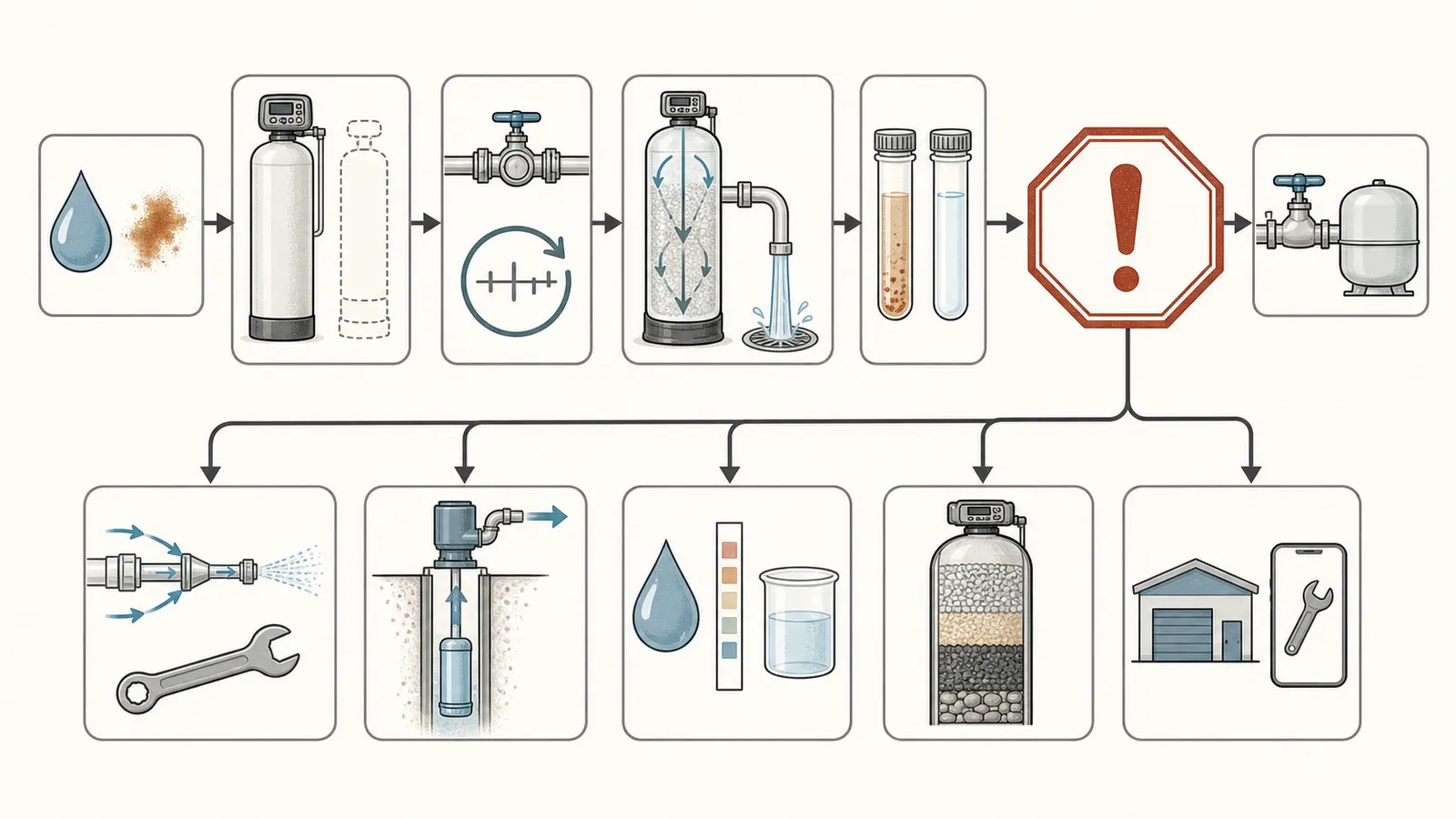
Use this sequence:
- Identify the exact filter, control valve, media, and safe raw and treated sample points.
- Record when the stains, color, taste, odor, pressure change, or drain problem began.
- Observe the controller, bypass position, cycle stages, and accessible drain behavior without opening the equipment.
- Compare untreated and treated water through an accredited or certified laboratory.
- Route the next step to an injector/control diagnosis, backwash and pump-flow check, chemistry retest, media evaluation, or replacement quote.
If the water is microbiologically unsafe or its safety is unknown, do not treat the iron filter as a purifier. Use the well authority or health department and a qualified water professional for the appropriate disinfection and testing path. The Pentair WaterTrust Pro manual, for example, warns against installing its system on water of unknown microbiological quality without adequate disinfection before or after treatment. That is a product instruction, not a universal substitute for local health guidance.
1. Start with the symptom timeline, not the media age
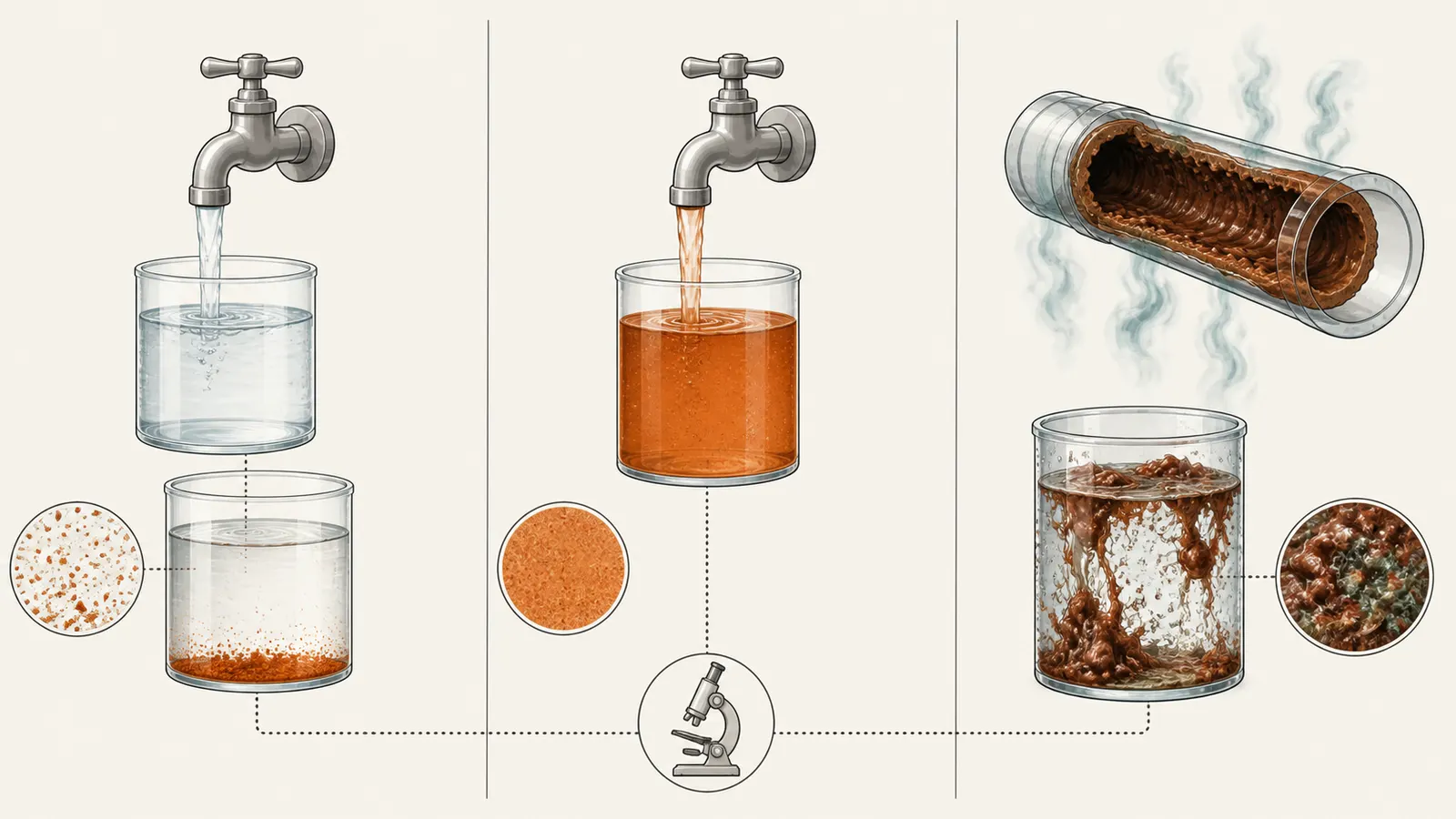
Write down the first day you noticed a stain or color change and what happened just before it: a power interruption, well-pump work, a plumbing repair, heavy water use, a long vacancy, a flood, a new chemical feed, or a change in taste or odor. Note whether the water is clear at the tap and turns orange after standing, or whether it is already yellow, red, or brown when it leaves the faucet. The Minnesota Department of Health’s iron guidance uses that distinction to describe ferrous “clear-water” iron versus ferric “red-water” iron, and recommends testing iron alongside pH, hardness, alkalinity, and iron bacteria.
The timing also matters. A symptom immediately after a cycle may point toward incomplete rinsing, a bypass or valve leak, or water that was still in the untreated plumbing. A symptom that appears only after several days of use may fit a missed or inadequate regeneration, a rising raw-water load, or a pressure problem that occurs during demand. A persistent trickle to the drain is a different branch from a clean drain shutdown with poor treated-water results.
| What you see | What it suggests | What it does not prove | First evidence to collect |
|---|---|---|---|
| Clear water turns orange or brown after standing | Dissolved iron is oxidizing after exposure to air | That the media is exhausted | Matched raw and treated iron results, with collection times |
| Water is red or yellow at the tap | Particulate or ferric iron may already be present | That the air injector failed | Filter type, raw-water appearance, and cycle history |
| Stains returned after a power outage or service visit | A lost schedule, bypass position, or incomplete cycle is plausible | That the outage damaged the media | Controller clock, error history, bypass position, and next-cycle observation |
| Water pressure is lower through the filter | Buildup, a plugged distributor, or a restriction is possible | That the filter is chemically ineffective | Existing inlet/outlet gauge readings under the same demand |
| Water continues to the drain in service | A valve, motor, board, or flapper problem is possible | That backwash is working | Safe external observation, leak location, and manual troubleshooting page |
| Sticky rusty slime or a swampy odor appears | Iron bacteria may be contributing to deposits or clogging | That appearance confirms bacteria | Lab-directed testing and a well/equipment assessment |
The Pentair WaterTrust Pro troubleshooting table illustrates why a stain alone is weak evidence: its listed causes include an open bypass, loss of media, regeneration in progress, excessive water use, failed regeneration, exhausted media, bypass or riser leaks, and valve/timer problems. That list is specific to that product family, but it is a useful reminder to keep several branches open.
2. Identify the installed process and set a safe boundary
An “air-injection iron filter” is not a universal design. Some systems draw air through an injector and maintain an air head in the tank. Others use a separate aerator, an oxidizing media, a chemical feed, or a combination of stages. The process determines what the controller should do, what the drain should carry, and what chemistry the media can tolerate.
Photograph or transcribe, without removing anything:
- filter make, model, serial number, and media name if listed;
- control-valve model and controller display;
- inlet, outlet, bypass, injector or air-draw connection, and drain-line arrangement;
- pressure gauges already installed before and after the filter;
- any air pump, compressor, chemical tank, check valve, alarm, or flow meter;
- installation date, last service, last media change, and the manual revision.
If the filter is leaking, continuously draining, showing an alarm, or leaving visible media in the drain, follow the manual’s emergency-bypass instructions and arrange service. Remember that bypass sends untreated water around the treatment step; do not assume that water is safe to drink merely because it looks clear. Keep a note of when the bypass was used so a later sample is not misread as treated water.
The homeowner-safe boundary is external observation. Do not open the control head, loosen a union, disconnect a drain line, remove an injector, pull a pump, open a well cap, test live wiring, defeat an alarm, or work on a pressurized tank. The SkilledTradesBC water-treatment maintenance text says equipment should be isolated both power-wise and water-wise before disassembly and that manufacturer literature should govern model-specific maintenance. Depressurizing and disassembling the system is therefore a service task unless your exact manual explicitly gives a safe homeowner procedure and you can follow it without exposure to pressure, electricity, or treatment chemicals.
3. Check the air-draw and injector branch
For an air-injection system, the oxidation step comes before the filter bed can capture the resulting particles. Connecticut’s Department of Public Health explains that aeration causes dissolved iron and manganese to precipitate, after which a filter traps the particles. If air is not entering as designed, a clean media bed may still receive poorly oxidized iron.
Use the exact manual to identify the expected air-draw stage and its visible indicator. During a normally scheduled cycle, observe from outside whether:
- the controller leaves service and displays the model’s backwash or regeneration stage;
- the cycle reaches the named air-draw or aeration stage;
- the manual identifies an external air-intake, tube, indicator, sound, or other homeowner-observable confirmation;
- the cycle proceeds to repressurization, rinse, and service rather than stopping or running continuously.
Do not infer that silence means failure or that a sound proves adequate air volume. The useful comparison is between the manual’s expected indicator and what actually happens. If the system has an air pump or compressor, record a normal-status light, alarm, or obvious loss of power only from the exterior. Do not open the electrical enclosure.
The Pentair example is especially clear about model dependence. Its sequence includes backwash, air draw, repressurization, and fast rinse; it says the air-draw stage draws air through the brine port and warns that only a qualified technician should change the default air-draw setting. A clogged injector screen, a check-valve or air-line leak, a failed air component, or an incorrect program can therefore look like exhausted media. Ask for a model-specific injector/control diagnosis before approving a re-bed.
If your own manual identifies a homeowner-safe injector cleaning procedure, follow that procedure exactly after the required water and power isolation. If it does not, record the suspected injector branch and stop. A generic instruction to poke a wire into an orifice, add acid, or change an air-draw time is not a safe substitute for the installed model’s instructions.
4. Watch the complete cycle, backwash, and well-pump demand
Air draw and backwash are separate evidence gates. A filter may draw air correctly and still fail because the bed was not cleaned, the drain flow is restricted, the drain-line flow control is wrong, or the well pump cannot maintain the required flow. Conversely, a strong drain stream does not prove the air stage or media is healthy.
At the next scheduled cycle, record the time and each externally visible stage. Note whether the drain starts and stops when expected, whether its flow is steady or weak, whether the controller returns to service, and whether there is overflow, unusual noise, a pressure collapse, or visible media. Do not force the cycle or advance the valve simply to obtain an observation unless the manual expressly permits that homeowner action.
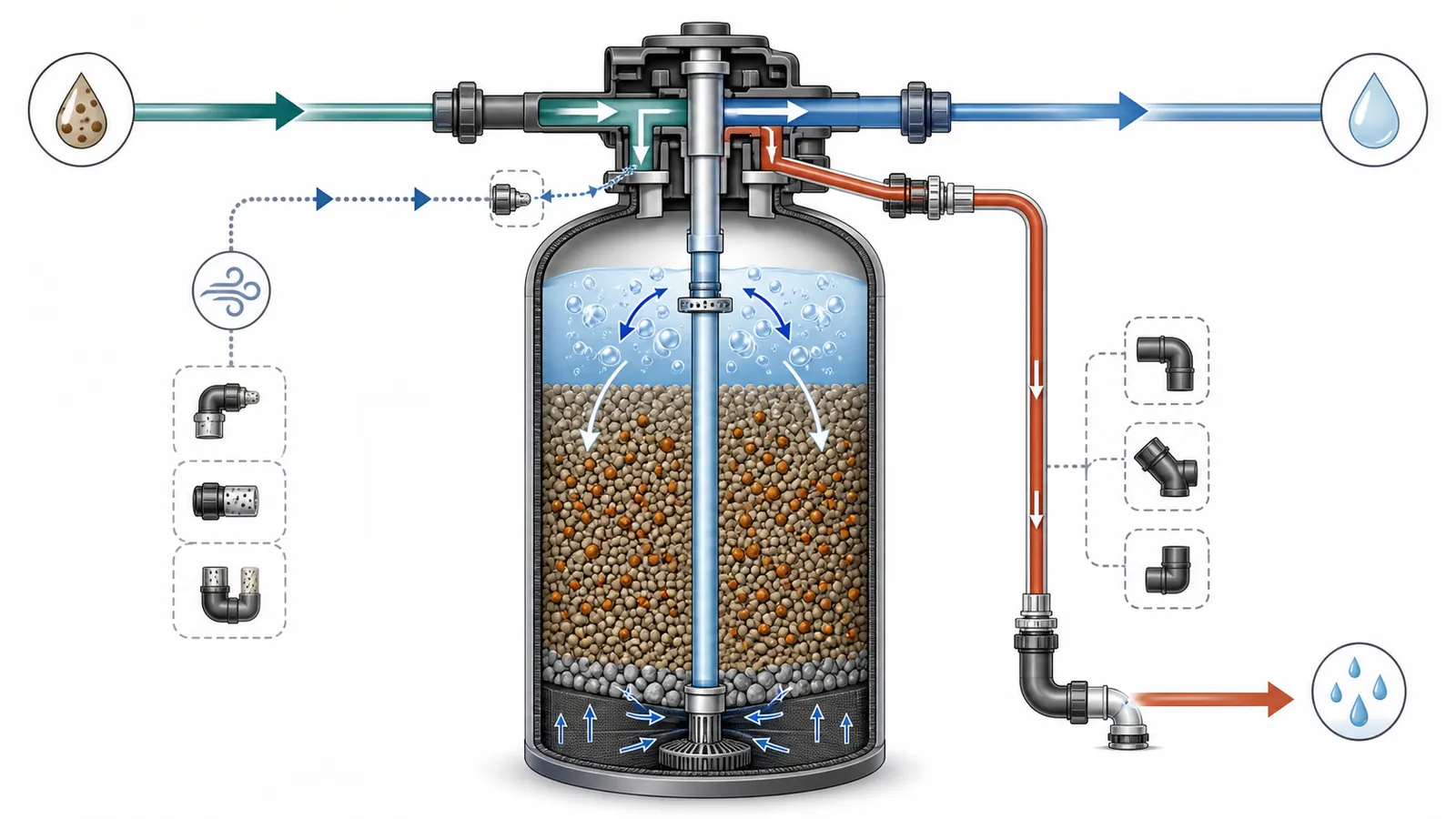
Use only numbers from your own manual for a pass/fail decision. The cited Pentair system lists a 20–80 psi operating range, a 5 gallons-per-minute drain flow rate, and a requirement that a well pump be able to provide 5 gpm for proper backwash. Those are specifications for that system, not a national rule or a safe target for another brand. A different tank, media, drain-line flow control, or pressure system may need a different flow.
If gauges are already present, compare inlet and outlet pressure at the same household demand before the cycle and during service. A new or growing pressure drop points toward fouling, a distributor or riser restriction, or another hydraulic fault. If pressure falls sharply during backwash or the pump cannot recover, the filter and well-pump questions are linked. Do not install a gauge, open a pressure fitting, adjust a pressure switch, or pull a pump as part of this check.
If the drain outlet is an already accessible air-gap or hose end and the manual allows observation there, a qualified helper can time a known container without restricting the outlet. Record the phase, volume, seconds, and whether other water was being used. This is an observed phase flow, not proof of the flow inside the valve or of the whole-cycle volume. Do not disconnect plumbing to create a bucket-test point.
| Observation during the cycle | Most useful next route |
|---|---|
| No expected air-draw indicator, but controller advances normally | Model-manual injector, air-line, check-valve, or air-component diagnosis |
| Air stage appears normal, but drain is weak or pressure collapses | Backwash restriction, drain-flow-control, well yield, pump, or pressure-capacity diagnosis |
| Drain never stops after the cycle | Control-valve, flapper, motor, board, or programming service; do not leave it running unattended |
| Drain is strong, cycle completes, but treated iron remains high | Matched chemistry test, flow/contact-time review, media evaluation, or bypass/leak check |
| Media appears in the drain | Stop routine cycling and request service for flow control, distributor, riser, or media-loss diagnosis |
5. Compare raw and treated water after the symptom appears
Take the filter out of the guessing loop with two samples: untreated water before the iron filter and treated water after it, collected under a documented procedure. Use the same laboratory and sample timing when possible. If there is no safe, accessible untreated tap, record that limitation rather than collecting a sample from an uncertain point.
Ask the certified laboratory or water professional how to collect and preserve the samples. At minimum, ask whether the test should include iron, manganese, pH, hardness, alkalinity, and an iron-bacteria assessment. The Minnesota Department of Health’s iron guidance says a laboratory can determine the amount of iron and identifies hardness, pH, alkalinity, and iron bacteria as useful companion tests. EPA private-well guidance recommends certified laboratories and prompt testing after a water-quality change or well-system repair or replacement.
Interpret the pair conditionally:
- Raw iron increased and treated iron increased: the filter may be beyond its original application, or the chemistry and oxidation demand may have changed. Retest the raw water and compare it with the installation or last-service baseline before replacing media.
- Raw iron is similar but treated iron increased: focus on bypass leakage, the air stage, cycle completion, backwash flow, service flow, and media condition.
- Raw water is already colored or contains particles: an air-injection process may be receiving a different iron form or a higher solids load than the original design assumed.
- pH, manganese, hardness, alkalinity, or organics changed: request an application review against the exact media manual. Do not borrow a pH or iron limit from another product.
- Iron-bacteria clues appeared: treat the slime, deposits, and odor as a reason for professional assessment, not as proof that a chemical treatment should be poured into the well.
The Connecticut DPH aeration guidance explains why a post-treatment filter matters: aeration precipitates dissolved metals, and filtration captures the resulting solids. If the oxidation chemistry or the post-filter capture step no longer matches the incoming water, the same visible stain can recur for different reasons.
For a private well, also consider the broader water-quality change. Do not use a clean iron result to conclude that bacteria, nitrate, or another contaminant is absent.
6. Separate iron bacteria, media exhaustion, and replacement decisions
Iron bacteria can create a rusty slime or sticky deposits that clog well equipment, pumps, and plumbing. The Minnesota Department of Health’s iron-bacteria guidance lists swampy or musty odors, colored water, and red, brown, yellow, or gray slime as clues, and recommends testing for nitrate and coliform bacteria. These clues can coexist with an injector or backwash problem. Do not treat them as a shortcut to chlorine, acid, surfactant, or another chemical dose; the same guidance says difficult treatment should be handled by trained professionals.
Media exhaustion becomes a stronger hypothesis only after the reversible branches have been checked:
- The bypass is confirmed closed and there is no evidence of an internal bypass or riser leak.
- The controller completes the model’s cycle and the air-draw indicator matches the manual.
- Backwash and rinse have the model-required flow, pressure, and duration, or a professional has documented why they cannot.
- Raw-water chemistry and loading are within the media’s documented application range, or the proposal explains the changed condition.
- A matched raw/treated test still shows poor removal after the verified service correction.
The Pentair manual gives one example of this gate: its cited WaterTrust Pro system lists influent pH of 6.8–9.0, maximum iron of 5.0 ppm, maximum manganese of 2.0 ppm, and a three-to-five-year media replacement interval, with earlier replacement possible under high iron. It also says iron bacteria may require frequent service and limit system life. Those figures apply to that product family only. A replacement quote for your filter should identify the exact media, the measured raw-water results, the failed application or maintenance gate, and the reason a re-bed is preferred over a valve, injector, pump-flow, or chemistry correction.
If the proposal says “the media is exhausted,” ask for the evidence in writing: media type and age, raw and treated results, cycle settings, drain-flow observation, pressure readings, and the model’s replacement criterion. A quote that skips those fields may still be appropriate after a technician’s inspection, but it is not yet a transparent diagnosis.
7. Turn the observations into a service-ready decision
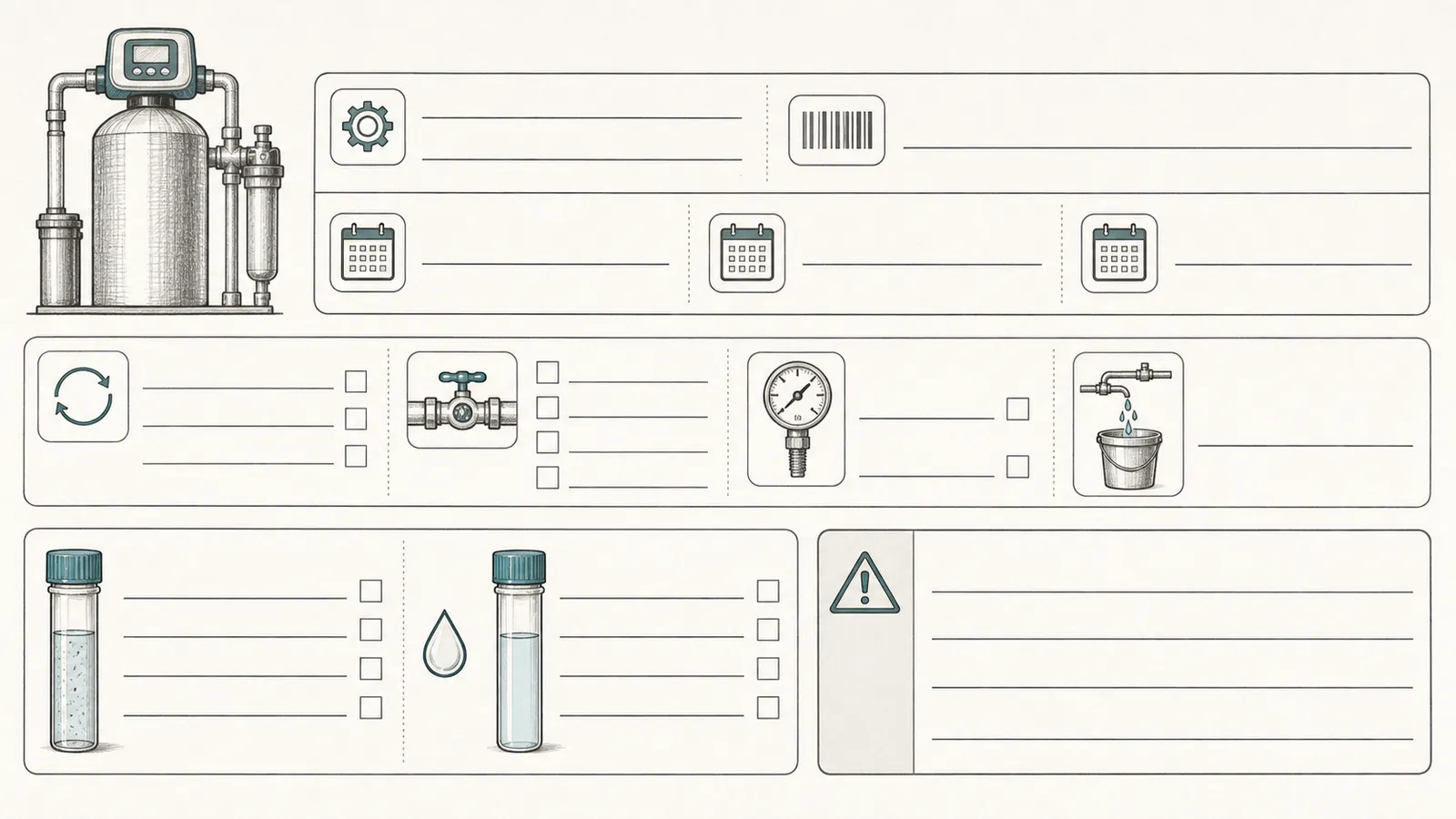
Use this one-page record before calling a water-treatment or well professional:
| Field | Record |
|---|---|
| Filter and control model | Make, model, serial, manual revision |
| Treatment process | Air-injection, aerator, oxidizing media, chemical feed, or unknown |
| Media | Name, amount if documented, install date, last service/change |
| Symptom | Stain, color, taste, odor, pressure loss, drain flow, and first date |
| Bypass | Position observed; date used, if any; whether untreated water was used |
| Controller | Clock, schedule, error, named stages, and return-to-service result |
| Air stage | Manual indicator and what was observed externally |
| Backwash | Start/end time, drain behavior, pressure readings, safe timed flow if available |
| Raw sample | Date, lab, iron, manganese, pH, hardness, alkalinity, bacteria notes |
| Treated sample | Same fields and same collection conditions |
| Well/pump context | Recent pump work, outages, pressure changes, heavy use, flooding, or vacancy |
Then choose the next action:
- Air stage or injector evidence is abnormal: request model-specific injector, screen, check-valve, air-line, and controller service.
- Cycle or drain evidence is abnormal: request a backwash, drain-flow-control, valve, and well-pump capacity diagnosis. Include the model’s required flow rather than a generic gpm target.
- Raw chemistry changed: request a new treatment-design review before media replacement.
- Raw chemistry is stable, the cycle is verified, and treated iron remains high: request a media-condition evaluation and a like-for-like replacement quote.
- Iron-bacteria clues, unsafe water, or a well-system change are present: involve the local health or environmental authority and a qualified well professional, with certified laboratory testing as directed.
Stop the homeowner investigation if you encounter a leak, uncontrolled drain flow, exposed wiring, a pressure-vessel or pump-control issue, visible media loss, chemical handling, a well opening, or a confined-space condition. The goal is a defensible next step, not to make a pressurized treatment system safe by trial and error. Returning stains may end with a cleaned injector, corrected cycle, restored pump flow, chemistry correction, media service, or replacement—but the record should show which gate led there.
Sources and scope
Evidence behind this page
- Iron in Well Water
Minnesota Department of Health homeowner guidance for private wells; use as a diagnostic distinction and testing recommendation, not as a universal treatment limit.
- WaterTrust Pro Series Whole House Iron Reduction Installation and Owner’s Manual
Pentair WaterTrust Pro Series 1.0 and 1.5 whole-house AIO iron systems; manufacturer troubleshooting list, not a claim that every brand uses the same valve or failure modes.
- WaterTrust Pro Series Whole House Iron Reduction Installation and Owner’s Manual
Specific to the cited Pentair control; homeowners should use their own model manual for cycle labels and service limits.
- WaterTrust Pro Series Whole House Iron Reduction Installation and Owner’s Manual
Pentair WaterTrust Pro Series operating and installation specifications; do not transfer the 20 psi or 5 gpm values to another filter without its manual.
- WaterTrust Pro Series Whole House Iron Reduction Installation and Owner’s Manual
Specific application limitations for one Pentair AIO product family; not a general performance guarantee for air-injection filters.
- WaterTrust Pro Series Whole House Iron Reduction Installation and Owner’s Manual
Pentair WaterTrust Pro maintenance instructions; service intervals and warranty conditions vary by model and installation.
- Aeration treatment
Connecticut Department of Public Health educational guidance on aeration treatment; the maintenance and sampling logic is general, while installation details are site-specific.
- Iron Bacteria in Well Water
Minnesota Department of Health guidance for private wells; symptoms are clues and do not confirm iron bacteria without appropriate testing or professional assessment.
- Protect Your Home’s Water
U.S. EPA private-well testing guidance; it does not diagnose an iron-filter fault or prescribe a specific treatment train.
- Describe the Servicing and Maintenance of Water Treatment Systems
SkilledTradesBC/BCcampus training text; used for maintenance and safety principles, not as a substitute for a U.S. manufacturer manual or local code.