What Whole-House Water Filter Cartridge Fits My Housing?
Identify an unknown whole-house filter housing, verify cartridge length, diameter, ends, seals, flow, pressure, and certification before ordering.
The short answer
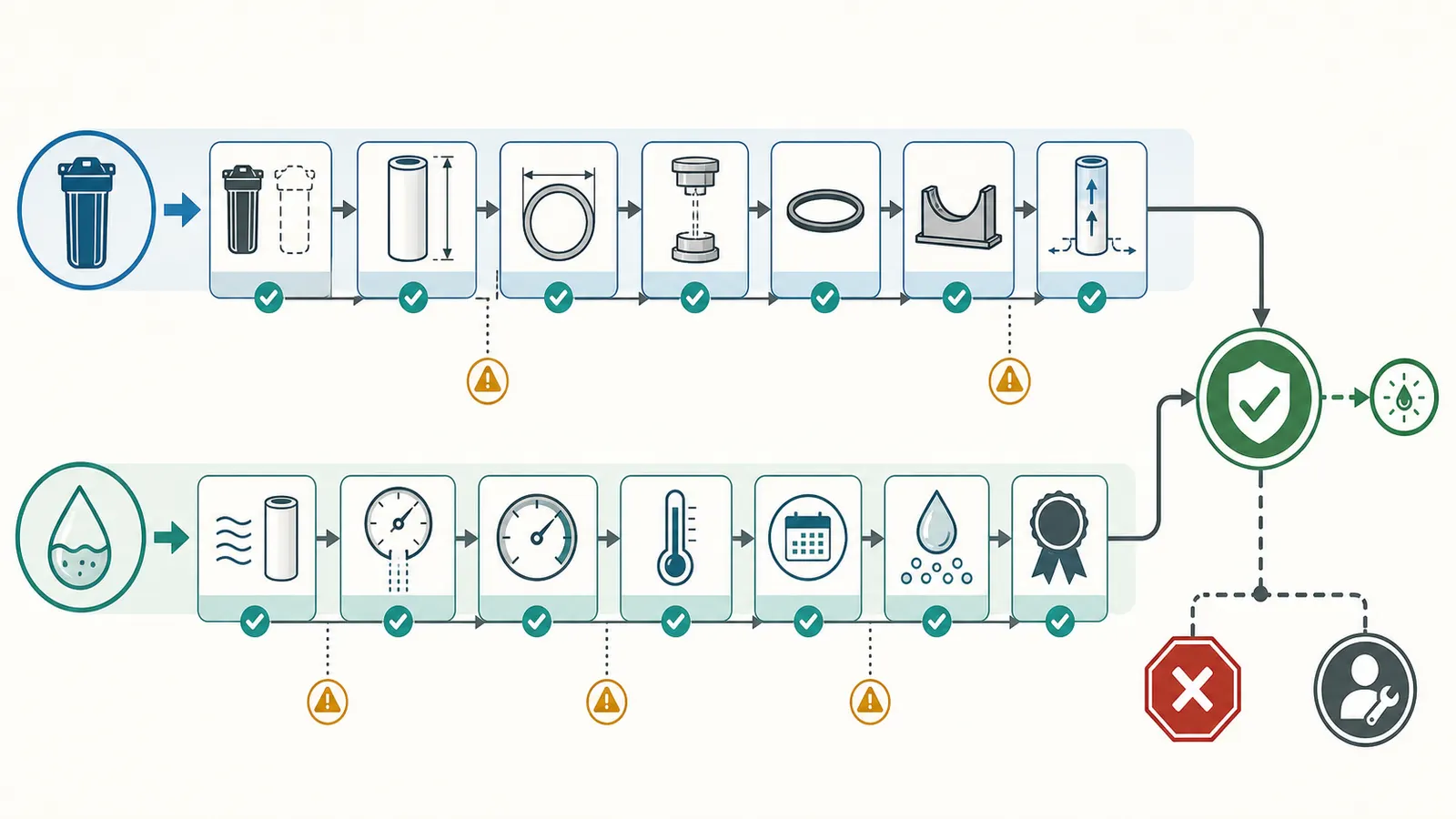
Start with the housing model or a clear label photo; use measurements only as a cross-check. Record nominal length, diameter class, end configuration, seals, and any center post or adapter. Then compare the exact cartridge datasheet with the housing manual for flow, pressure, temperature, service interval, and contaminant claim. If the model or seal arrangement cannot be positively identified, stop and ask the manufacturer or a qualified water professional.What Whole-House Water Filter Cartridge Fits My Housing?
The safest answer is model-first: identify the housing, then use measurements to confirm the cartridge specification. A usable match requires more than “10-inch,” “20-inch,” or “4.5-inch.” Record the housing model, cartridge length class, outside diameter, end configuration, seals, support parts, flow direction, published flow and pressure limits, temperature, service interval, and the exact contaminant claim. If the model or sealing arrangement cannot be positively identified, stop before ordering or installing.
This guide is for a homeowner choosing a replacement drop-in cartridge for a cold-water, whole-house or point-of-entry housing. It is not a substitute for the housing manual, a water-quality test, or local plumbing requirements. “Fits” means the cartridge can be installed and sealed in that housing. It does not mean the cartridge treats the contaminant you care about, supplies enough water, or is safe at your system’s pressure and temperature.
The short answer: identify the housing before the cartridge
Start at the housing, not at a retailer search box. Photograph the front, top, inlet/outlet markings, pressure-relief button, label, model plate, and any cartridge code. Look for a manual or installation sheet that names the replacement cartridge. A readable model number is stronger evidence than a similar-looking sump or a previous cartridge that happened to screw into place.
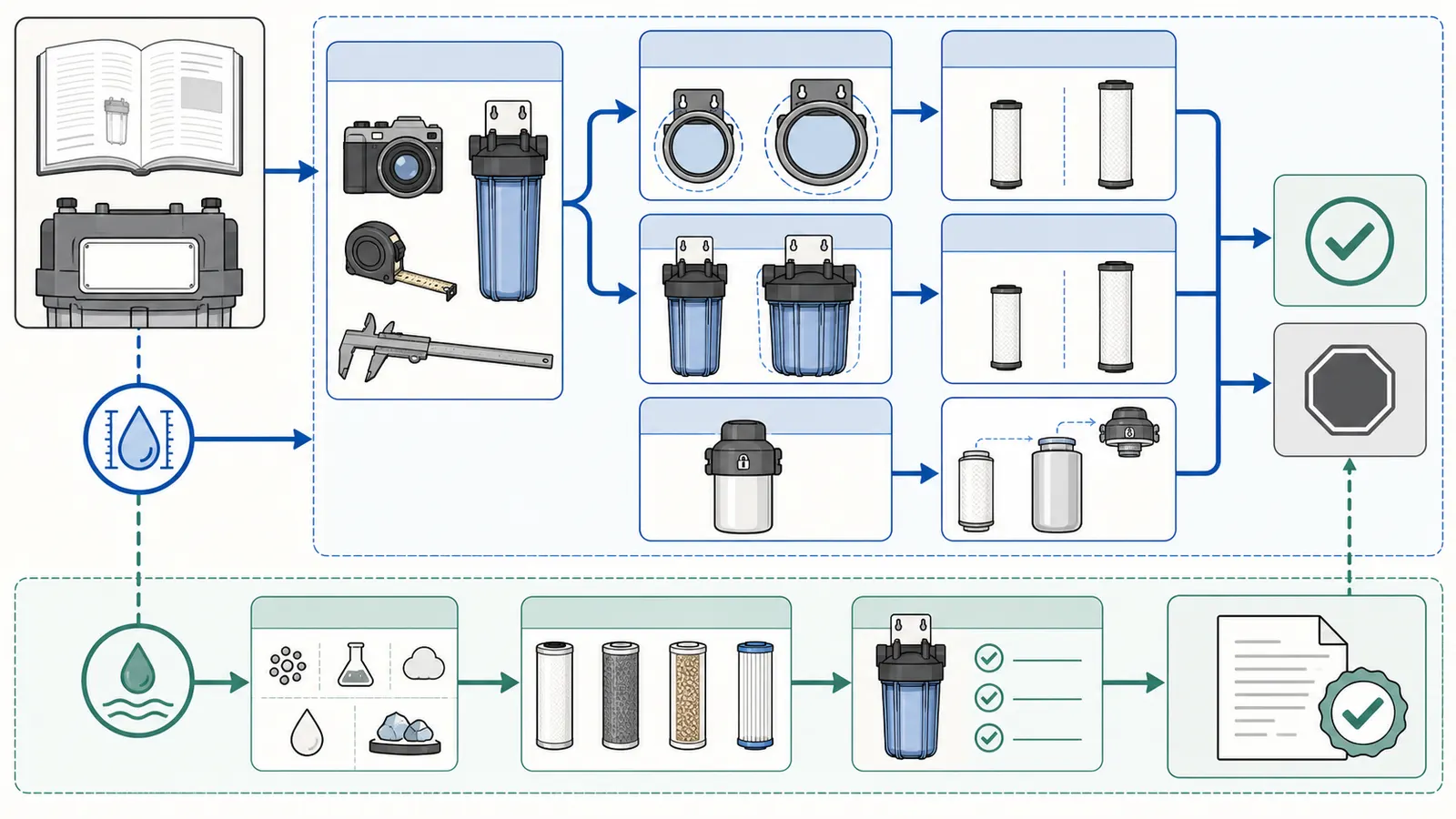
The reason is that manufacturers pair housings and cartridges in specific ways. For example, 3M maps its AP801 whole-house housings to AP810 or AP811 cartridges and its AP802 housings to the longer AP810-2 or AP811-2 cartridges. The same 3M cartridge sheet describes a roughly 4-5/8-inch outside diameter, a 9-3/4-inch class for the shorter cartridge, a 20-inch class for the longer cartridge, and a 100°F maximum operating temperature. Those are useful model-linked facts, not proof that an unidentified housing accepts every cartridge with similar dimensions. See the 3M AP810/AP811 cartridge specification sheet.
Use this stop/go rule:
| What you know | What it allows | What it does not allow |
|---|---|---|
| Exact housing model and current manual | Open the manufacturer’s replacement list and compare the candidate datasheet | Assume an old cartridge or retailer cross-reference is still current |
| Housing model plus a clear photo of the removed cartridge | Use the photo as a cross-check for ends, seals, and support parts | Ignore the model-specific manual |
| Only a nominal length | Search for candidates in that length class | Prove diameter, end geometry, or seal compatibility |
| Only outside diameter | Narrow the field | Prove length, end configuration, flow direction, or treatment claim |
| Unknown housing with no readable label | Measure and photograph for manufacturer or qualified professional review | Order a “universal” cartridge and hope the seal works |
If the housing is a proprietary quick-change system, a cartridge that looks like a standard drop-in may be the wrong part entirely. Some whole-house systems use a keyed head, a twist-lock interface, a center post, a spring, or a cartridge-specific seal. Do not force a cartridge into a head, stretch an O-ring over an incompatible groove, omit a center adapter, or install the sump with a seal that is pinched or displaced.
Whole-home filters are point-of-entry devices: the CDC describes them as filtering water as it enters the home, so the water path from every tap is affected. That makes a wrong replacement more consequential than a single-faucet filter choice. Read the CDC explanation of whole-home filters before treating a cartridge swap as only a shopping decision.
Build the physical-fit record
Create one record for the housing and one for the cartridge. The housing record prevents a plumbing-port measurement from being confused with a cartridge measurement. The cartridge record preserves the details that a product listing often leaves out.
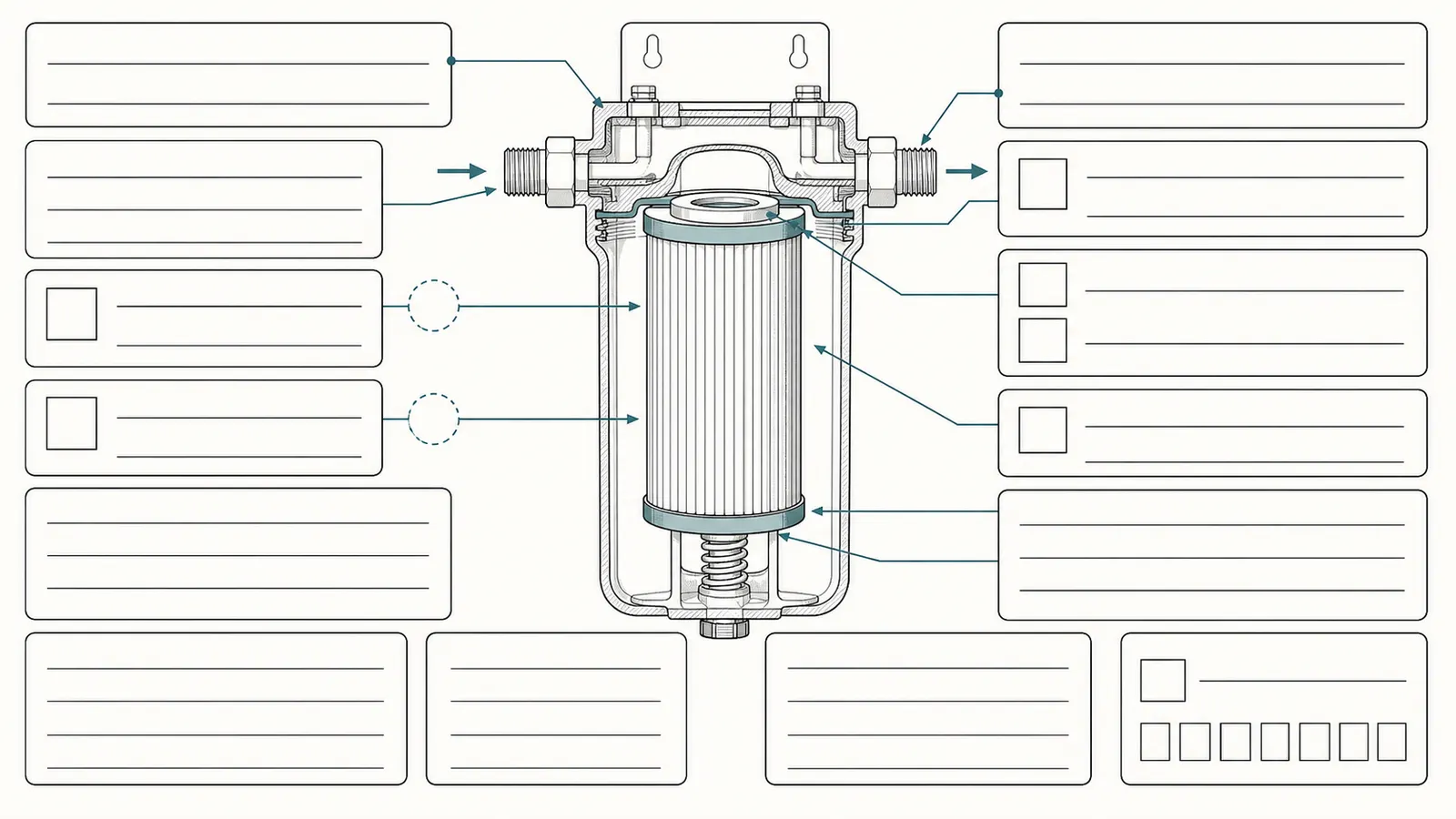
Housing record
Copy these fields exactly as printed:
| Housing field | Record this | Why it matters |
|---|---|---|
| Brand and model | Every letter, number, suffix, and revision | A suffix can identify a different sump length, port size, material, or head |
| Inlet/outlet size | For example, 3/4-inch, 1-inch, or 1-1/2-inch NPT if the manual says so | Port size describes the housing connection and affects flow; it is not cartridge diameter |
| Sump style | Standard, full-flow, Big Blue, clear, opaque, stainless, or quick-change—only if documented | Similar outside shapes can use different cartridge families |
| Nominal cartridge length | 10-inch or 20-inch class, if documented | Length is a first filter, not a complete match |
| Housing limits | Maximum pressure, temperature, and flow | The system limit can be lower than a candidate cartridge’s limit |
| Head features | Pressure-relief button, center post, spring, bayonet, keyed head, or other adapter | These may be part of the seal or support arrangement |
| Direction | “IN” and “OUT” markings and any flow arrow | A reversed housing connection can defeat the intended flow path |
As a concrete example of why these fields belong in one record, Pentair’s Big Blue specification lists 10- and 20-inch sumps, accepts cartridges up to 4.5 inches in diameter, and gives separate maximum pressures for the 10-inch and 20-inch housings. Its table also distinguishes 3/4-inch, 1-inch, and 1-1/2-inch ports and gives approximate initial pressure-drop values at stated flow rates. See the Pentek Big Blue specification sheet. Do not transfer those limits to a different brand, a clear “Big Blue-style” sump, or an unlabeled vessel.
Cartridge record
Record the part number first. Then copy the dimensions and construction from the manufacturer’s datasheet, not from a retailer title:
| Cartridge field | What to capture | Common mistake it prevents |
|---|---|---|
| Part number | Full model, suffix, and pack code | Substituting a visually similar variant |
| Nominal length | The manufacturer’s stated length class | Expecting a nominal 10-inch cartridge to measure exactly 10 inches |
| Outside diameter | Manufacturer’s value and your dry measurement | Confusing a slim standard cartridge with a wider heavy-duty cartridge |
| Center opening | Diameter, closed end, spear, cap, or no opening | Missing a center post or placing a closed end over an outlet |
| Top and bottom ends | DOE, SOE, flat cap, spear, bayonet, keyed, or proprietary | Assuming both ends have the same sealing function |
| Gaskets/O-rings | Location, cross-section, material, and whether included | Reusing a swollen, cut, flattened, or wrong-material seal |
| Support pieces | Spring, core extender, adapter, or coupler | Leaving out a part that keeps the cartridge seated |
| Flow direction | Arrow or manufacturer instruction | Treating a directional media cartridge like an unrestricted sediment pad |
| Rated flow and capacity | Units, test conditions, and whether it is a maximum or service rate | Comparing only micron rating or only gallon capacity |
| Claim and certification | Exact contaminant, standard, certifier, and system/cartridge scope | Turning “tested to NSF 42” into a lead, PFAS, or pathogen claim |
Measure the removed cartridge only after the housing has been isolated and safely depressurized according to its manual. Measure it dry, without squeezing media, and photograph both ends beside a ruler. If the cartridge is swollen, collapsed, cracked, heavily loaded, or missing an end cap, treat the measurement as a clue rather than a specification. A worn cartridge can no longer show the original geometry reliably.
Nominal length is not the same as tape-measured length. In one manufacturer example, 3M calls the shorter AP810/AP811 cartridge 9-3/4 inches and the longer AP810-2/AP811-2 cartridge 20 inches. That is why a retailer listing that says “10-inch” may still be describing a cartridge that measures less than 10 inches. Use the manufacturer’s nominal class and the housing manual together; do not reject a documented match because the tape does not land on a round number.
Separate standard, Big Blue, and proprietary systems
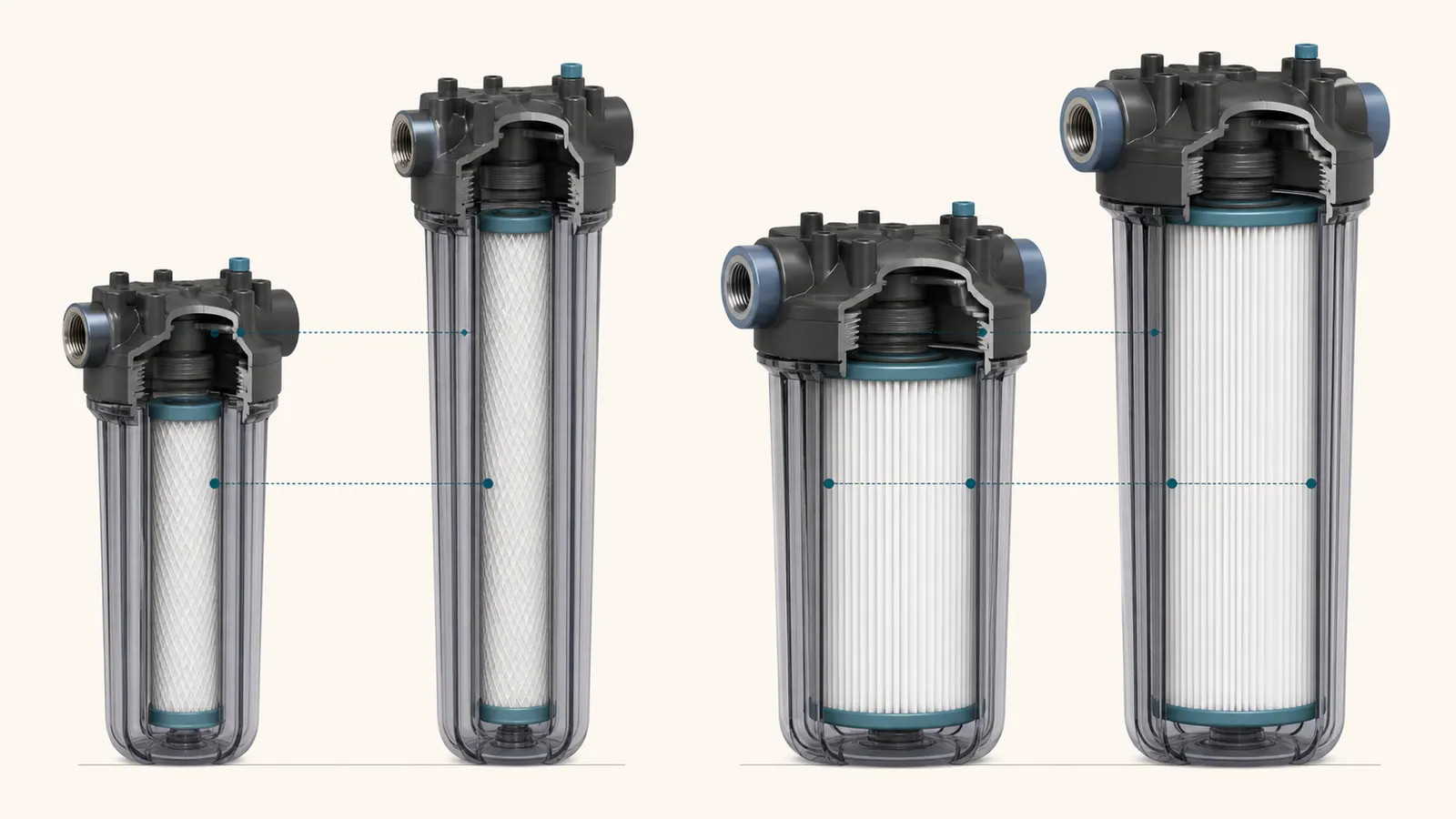
“Standard” and “Big Blue” are useful search terms, but they are not complete specifications. They generally signal different diameter classes and housing capacities. The Watts cross-reference chart, for example, lists standard 10-inch cartridges separately from full-flow whole-house cartridges and also lists 20-inch full-flow options. It includes melt-blown, pleated, wound, granular activated carbon, and carbon-block examples. Read the Watts cross-reference chart as a model-family example, not as a universal interchangeability table.
Standard or slim housing
A standard housing is commonly narrower than a heavy-duty Big Blue housing, but the exact cartridge diameter, length, end type, and support method still come from the housing maker. A standard 10-inch label may describe a sediment cartridge, a carbon cartridge, a specialty cartridge, or a housing that requires a particular center post. A standard 20-inch body is not automatically compatible with a 20-inch Big Blue cartridge.
Big Blue or other heavy-duty housing
Big Blue-style housings are the wider class. Pentair’s Big Blue sheet says its listed housings accept a wide variety of 4-1/2-inch-diameter cartridges and are available in 10- and 20-inch lengths. Pentair’s EP-20BB product page provides a useful example of the specificity required: it identifies that cartridge as 4.5 by 20 inches, gives a 4 gpm flow rate, and says it is designed for 20-inch Big Blue or other 20-inch heavy-duty housings. It also states the product’s NSF/ANSI 42 certification. See Pentair’s EP-20BB specifications.
That example does not mean every 20-inch, 4.5-inch cartridge has the same flow, media, end caps, or certification. Nor does it mean that the port size on the head is 4.5 inches. The housing can have a 1-inch or 1-1/2-inch water connection while the cartridge is several inches wide inside the sump. Keep “plumbing port,” “housing outside diameter,” and “cartridge outside diameter” as three separate fields.
Proprietary or quick-change system
Stop treating dimensions as the primary key when the housing uses a head-and-cartridge interface. A proprietary system may have a cartridge with a molded cap, twist-lock lugs, a built-in shutoff, a spring-loaded seal, or an internal bypass-control feature. In a proprietary system, the exact replacement part number or manufacturer’s compatibility list outranks a retailer’s “fits most” statement.
A useful stop condition is: “I can describe the housing, but I cannot name the cartridge interface.” At that point, take photographs of the head, sump, old cartridge ends, and label; contact the manufacturer or a qualified water professional; and keep the old cartridge until the replacement is confirmed. Do not discard the only evidence and do not install a cartridge by force.
Verify end configuration, seals, and orientation
The ends are where “same size” often fails. DOE means double open end: both ends present an open bore for a housing’s sealing or support arrangement. SOE means single open end: one end has the opening and the other may have an end cap, spring interface, spear, or other closure. Other catalogs use 222 or 226 O-ring arrangements, flat caps, spears, bayonet locks, or end-cap adapters. The 3M Betafine cartridge ordering guide shows several such end modifications; the Pentair 3G Slim Line specification explicitly identifies a housing family that accepts DOE cartridges.
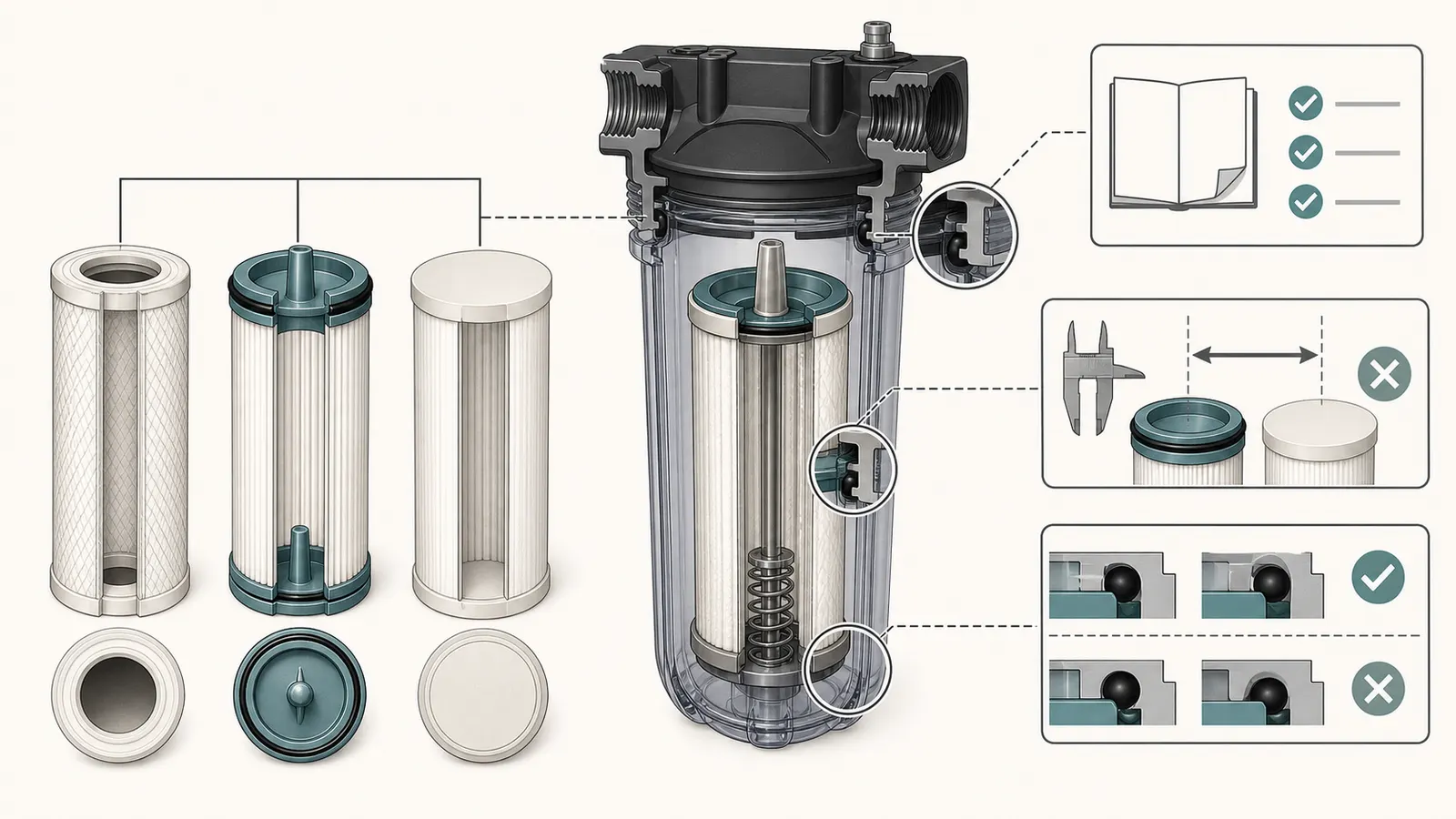
These terms are not permission to infer a match. They tell you what to look for in the manual and at the removed cartridge.
Inspect the removed cartridge
With the cartridge out and the system safely depressurized, photograph:
- Both ends straight-on and from the side.
- Any raised lip, groove, spear, bayonet, flat cap, or center tube.
- The gasket or O-ring location on each end.
- Any spring, spacer, core extender, or adapter that came out with the cartridge.
- The direction arrow or printed “IN/OUT” mark.
Do not infer that a black ring is a generic O-ring, that a flat gasket can replace an O-ring, or that a replacement seal has the same material or cross-section. A seal can be dimensionally close but fail to seat in the housing groove. If the manual specifies a replacement O-ring or lubricant, copy that instruction exactly. If the manual does not identify the seal, the housing model is not yet resolved.
Check the head and sump together
The housing head may contain the actual sealing surface, a center post, or a bypass or relief feature. The sump may have a molded locator or spring seat. A cartridge that appears to fit the sump can still be wrong at the head. Compare the candidate’s end drawing with the full housing assembly drawing, not only the cartridge’s outside dimensions.
Check the following before ordering:
| Gate | Pass condition | Stop condition |
|---|---|---|
| End type | Candidate end drawing matches the manual and removed cartridge | DOE/SOE or cap style is missing, ambiguous, or different |
| Seal | Correct seal location and specified material or replacement part | Seal is absent, cut, flattened, swollen, or improvised |
| Support | Center post, spring, spacer, and coupler are present where required | Candidate leaves unsupported space or requires forcing |
| Direction | Cartridge and head markings agree | Flow arrow or “IN/OUT” cannot be resolved |
| Housing closure | Sump seats fully by hand and manual’s method | Threads bind, gap remains, or wrench force is needed to overcome a misfit |
The safe interpretation of a failed gate is not “tighten harder.” It is “the candidate is unverified.” Stop, keep water off the affected branch if it cannot be safely isolated, and obtain the model-specific instruction.
Check performance suitability before ordering
Once physical fit passes, make a second decision: is this cartridge suitable for the home’s demand and operating conditions? Physical compatibility and performance suitability are separate lanes.
Flow is a published condition, not a promise of household performance
Record the cartridge’s rated or maximum flow, the housing’s maximum flow, and any initial or loaded pressure-drop information. The units and test conditions matter. A carbon block may have a lower service flow than a sediment cartridge in the same nominal housing. A cartridge with a larger advertised capacity may still create an unacceptable pressure drop at peak demand.
The manufacturer examples show why comparison needs numbers. 3M lists AP810/AP811 at 20 gpm and AP810-2/AP811-2 at 45 gpm in its AP800 housing sheet, while AP817 is listed at lower flow than those particulate cartridges in the same table. See the 3M AP800 housing specification sheet for that model-specific table. Pentair’s Big Blue sheet gives approximate initial pressure-drop values for particular housing part numbers at specified flows. These values belong to the cited models and test conditions; they are not a universal household flow guarantee. Compare the exact candidate datasheet with the exact housing specification rather than choosing the smallest micron number or the largest gallon claim.
Use this worksheet:
| Performance field | Home/system value | Candidate value | Decision |
|---|---|---|---|
| Peak simultaneous flow to preserve | ___ gpm | Published ___ gpm at ___ conditions | Candidate must be evaluated at the actual demand, not just a faucet trickle |
| Clean pressure before filter | ___ psi | Housing range ___ to ___ psi | Must be inside housing and cartridge instructions |
| Pressure drop at expected flow | ___ psi available | Published ___ psi at ___ gpm, if provided | Stop if the datasheet does not support the required flow |
| Maximum system pressure | ___ psi | Housing maximum ___ psi; cartridge maximum ___ psi | The lower applicable limit controls |
| Cold-water temperature | ___ °F | Housing ___ °F; cartridge ___ °F | Do not use a cold-water cartridge on hot water |
| Service trigger | Date, gallons, or flow symptom | Manufacturer interval/capacity | Use the more conservative applicable instruction when documented |
Do not manufacture a “safe pressure-drop allowance” from a retailer chart. If the manufacturer gives only a maximum flow and no pressure-drop curve, mark that missing field and ask for the technical sheet. If the candidate’s flow is published for a different housing, different media, or different test setup, do not silently reuse the number.
Pressure, temperature, and installation limits belong to the housing
Pentair’s Big Blue sheet gives a 40–100°F temperature range and maximum pressure of 100 psi for listed 10-inch housings and 90 psi for listed 20-inch housings. 3M’s AP800 housing sheet gives a 40–100°F range and a 30–100 psi pressure range for its AP801/AP802 family. Those differences are enough to reject a universal “whole-house housings are rated to 100 psi” statement.
The 3M AP800 installation manual also says not to install the system on hot-water supply lines, to address pressure above 80 psi with a pressure-limiting valve, and not to install above 100 psi for the cited family. Read the 3M AP800 installation manual for the exact safety language. This is manufacturer-specific guidance, not a national plumbing rule. Your housing manual, local code, and a qualified plumber control if they are more restrictive.
If you do not know the home’s pressure, do not open a pressurized housing to “see what happens.” A professional can measure static and flowing pressure and assess water hammer, thermal expansion, pressure-reducing equipment, bypass arrangement, and the condition of the housing. A cartridge swap is not a reason to adjust a pressure-reducing valve or dismantle a control.
Validate the contaminant claim and service interval
A cartridge can fit perfectly and still be the wrong treatment. Start with the treatment goal, not the media label. EPA WaterSense says to identify treatment goals using water-quality test results, consumer reports, and other information, and notes that homeowners concerned about water quality can use a state-certified laboratory. Read the EPA WaterSense guide before selecting a cartridge for a health-related concern.
Then check the exact claim. NSF explains that NSF/ANSI 42, 53, and 401 cover different areas and specific contaminant-reduction claims, and warns that certification to a standard does not mean a filter reduces every possible contaminant. The NSF standards overview is the right reference for that distinction. CDC likewise recommends looking up a specific product in the NSF database to see what it is certified to remove; see CDC’s filter-selection guidance.
Copy the claim as a complete sentence into the record:
| Claim check | What to verify | What not to infer |
|---|---|---|
| Standard | NSF/ANSI or other standard and certifier | A standard number is not a ranking and does not cover every contaminant |
| Contaminant | Exact named contaminant or effect | “Carbon,” “purifies,” “heavy-duty,” or “multi-purpose” is not an exact claim |
| Scope | Cartridge, housing, complete system, or combination | A certified housing does not automatically certify every replacement cartridge |
| Conditions | Flow, capacity, influent concentration, temperature, and replacement interval | A claim at one flow or capacity is not proof at another |
| Water source | Public supply, private well, or other stated use | A point-of-entry cartridge does not replace a water test or disinfection plan |
| Maintenance | How often and why to replace | A gallon number is not a lifetime guarantee in every home |
For example, Pentair’s EP-20BB page lists chlorine taste and odor and fine sediment reduction, a 4 gpm flow rate, a 44,000-gallon capacity, and NSF/ANSI 42 certification. Those claims are specific to that product page and its stated application. They do not support a lead, PFAS, nitrate, bacteria, virus, or “safe for any unknown water” claim.
If the water is from a private well, or if a recent test shows a health-related contaminant, hold the replacement decision and resolve the treatment goal separately. A sediment cartridge may protect fixtures while leaving dissolved contaminants unchanged. A carbon cartridge may address a documented taste-and-odor goal while having no certified claim for the contaminant that concerns you. If water is microbiologically unsafe or of unknown quality, the 3M AP800 manual warns that its system should not be used without adequate disinfection before or after the system. That warning is specific to the cited system, but it is a useful reason not to treat an unknown-water problem as a routine cartridge purchase.
Service interval is part of suitability. CDC says filters need maintenance to keep working properly and to prevent germs from growing in them; it advises changing them according to the manufacturer’s recommendations, wearing gloves, and washing hands afterward. EPA similarly says all water-treatment systems require ongoing maintenance and that unmaintained systems may make water quality worse. The EPA maintenance section and CDC maintenance guidance support recording the change date, capacity, reason for change, and any flow decline.
Use a safe replacement workflow and stop conditions
The homeowner-safe portion begins with documentation, not disassembly. Before touching the housing, read the exact manual and identify the inlet shutoff, outlet shutoff, bypass, pressure-relief method, and a downstream faucet or drain point. If the installation does not have a way to isolate and depressurize the housing, stop and have a qualified professional evaluate it.
Do not open energized controls, test live wiring, open a well, pull a pump, enter a confined space, cut or reroute pressurized piping, or manipulate a relief valve, pressure switch, or other pressurized equipment unless the exact manufacturer instruction makes the specific action demonstrably safe for a homeowner. Do not use a torch near plastic plumbing or cartridges. Do not work on a hot-water line. If the filter is mounted where a leak could damage electrical equipment, floors, or finished space, arrange a professional service or a monitored isolation plan.
For a model-confirmed, homeowner-serviceable housing, the sequence is:
- Photograph the installed label, head, inlet/outlet markings, and old cartridge before removal.
- Close the inlet and outlet or the manufacturer-approved isolation valves. Do not assume a nearby valve isolates the sump.
- Follow the manual to depressurize. The 3M AP800 manual specifically says to shut off inlet water and depressurize before cartridge removal.
- Keep a towel or pan ready, but treat unexpected continuous flow as a stop signal rather than something to “catch while working.”
- Remove the sump only with the specified wrench or method. Do not extend a wrench for extra leverage on a plastic housing.
- Inspect the old cartridge ends, seals, support parts, and any debris. Photograph before cleaning.
- Compare the new cartridge’s model, length class, diameter, ends, seals, support pieces, and direction with the record and manual.
- Replace seals only with the specified part or documented equivalent. Do not lubricate unless the manual specifies the lubricant and location.
- Seat the cartridge without force, close the sump by the manual’s method, and restore water slowly.
- Check the housing, head, relief button, and nearby joints for leaks while the system is accessible. Flush only as directed by the cartridge or housing manufacturer.
- Record the installation date, cartridge part number, source document, initial pressure or flow observation, and next maintenance trigger.
The 3M manual provides a model-specific example of this sequence: it calls for safe depressurization, correct inlet orientation, O-ring seating, gradual water restoration, a leak check, and flushing. It also says some local codes may require a licensed plumber or certified installer when a potable-water line is disrupted. That is why the sequence should not be generalized into a permission to do plumbing work beyond the manufacturer’s homeowner instructions.
Stop and escalate when any of these occur:
| Observation | Safest next step |
|---|---|
| Model label is missing, unreadable, or contradicts the manual | Photograph the system and contact the manufacturer or a qualified water professional |
| Candidate fits by length but not end shape or seal location | Do not install; obtain the exact part drawing |
| Sump will not close by the documented method | Stop; do not force, cross-thread, or add a second gasket |
| Water continues flowing after the intended isolation | Close the main or use a qualified professional; do not work on the pressurized housing |
| Housing, head, threads, bracket, or sump is cracked | Isolate if safely possible and arrange professional replacement; do not test under pressure |
| Pressure, temperature, or flow is outside the housing manual | Do not install the candidate until the system condition is resolved |
| Water is of unknown quality or a health contaminant is suspected | Use the appropriate alternate-water and testing/disinfection plan; do not rely on a cartridge label |
| Leak, air, noise, or sudden pressure loss appears after replacement | Shut down safely, document the condition, and have the system evaluated |
Make the order only when both lanes pass
Before buying, the decision record should contain one unambiguous line for each gate:
Identity: housing brand, model, suffix, and source manual.
Physical fit: nominal length class, outside diameter, center opening, top and bottom end configuration, seals, support parts, flow direction, and housing closure method.
Operating fit: housing pressure and temperature limits, cartridge limits, published flow at the needed demand, pressure-drop data if available, and cold-water-only restrictions.
Treatment fit: water source, documented treatment goal, exact contaminant claim, certification body and standard, conditions of use, capacity, and replacement trigger.
Service fit: access, safe isolation, depressurization method, leak visibility, disposal plan, and the date the next change will be due.
If a retailer listing gives only “fits 10-inch standard housing,” it has answered one field and left the decision unfinished. If a brand cross-reference lists a substitute, read its warning about differences in flow, performance, and capacity. Watts explicitly warns that those properties can differ between manufacturers and places final selection, testing, and validation on the user. Use that warning as a prompt to open the original datasheet, not as evidence that all listed parts are interchangeable.
The correct answer for an unknown housing may therefore be “not yet identified.” That is a successful homeowner decision: the record tells you exactly what is missing, the next contact has the right photographs and measurements, and no unsupported cartridge has been put into a pressurized potable-water system. Once the housing model, physical interface, operating limits, and contaminant claim are all verified, the replacement becomes a documented specification instead of a guess.
Sources and scope
Evidence behind this page
- About Choosing Home Water Filters
Public-health description of whole-home or point-of-entry filters; does not establish cartridge compatibility or certify a product.
- About Choosing Home Water Filters
Consumer guidance on certification lookup and maintenance hygiene; does not make a universal replacement interval.
- WaterSense Guide to Selecting Water Treatment Systems
U.S. EPA consumer selection guidance; supports treatment-goal and laboratory-selection cautions, not a specific cartridge fit.
- WaterSense Guide to Selecting Water Treatment Systems
General water-treatment maintenance guidance; not a claim about a particular housing or cartridge.
- NSF/ANSI 42, 53 and 401: Filtration Systems Standards
Certification-body explanation of standard scope and claim specificity; not a compatibility or installation instruction.
- Pentek Big Blue Heavy Duty Filter Housings Specification Sheet
Pentair Big Blue and Big Black Heavy Duty housing models listed in the sheet; not a universal rating for other housings.
- Pentek Big Blue Heavy Duty Filter Housings Specification Sheet
Approximate initial pressure-drop table for the listed Pentair housing part numbers; not a cartridge-wide or home-wide pressure guarantee.
- Pentek 20-inch Heavy Duty Water Filter EP-20BB
One Pentair carbon-block cartridge example; its dimensions and performance cannot be generalized to every 20-inch or Big Blue cartridge.
- 3M Aqua-Pure AP800 Series Whole House Filter Housings
3M AP801B/AP801T and AP802B/AP802T housing specifications in the cited sheet; not a universal range for unknown housings.
- 3M AP810/AP810-2/AP811/AP811-2 Cartridge Specification Sheet
3M AP810/AP811 family and listed 3M or competitive housings; manufacturer compatibility language is not proof for an unidentified housing.
- 3M Aqua-Pure AP800 Series Installation Manual
3M AP800 installation manual warning; not a general certification of other products or a substitute for water testing.
- 3M Aqua-Pure AP800 Series Installation and Operating Instructions
Safety and service instructions for the cited 3M AP800 family; do not transfer these limits to another housing.
- Watts Pure Water End Cap and Cross-Reference Guide
Watts' cross-reference chart and its stated limitations; a cross-reference is not a universal fit or performance certification.
- Pentek 3G Slim Line Series Specification Sheet
Pentair 3G Slim Line residential housing family; supports the need to verify end configuration and seal arrangement, not a universal DOE rule.
- 3M Betafine DP Series Pleated Polypropylene Filters
3M Betafine DP cartridge ordering guide; terminology and configurations are illustrative and not a universal residential-housing compatibility table.