Well Water Treatment Operating Cost Calculator: Annual, 5-Year, and 10-Year Cost
Calculate well-water treatment operating cost from your manuals, receipts, utility rates, water use, testing, service, and replacement intervals.
The short answer
Add annual consumables, treatment drain water, electricity, testing, service, and replacement reserves. Use your own manual settings, receipts, meter readings, and utility rates; show defensible low-high ranges for unknowns. Report annual, five-year, ten-year, and cost per 1,000 gallons without treating a national average as your home's cost.Well Water Treatment Operating Cost Calculator: Annual, 5-Year, and 10-Year Cost
For a private-well treatment train, the defensible operating-cost answer is the sum of what your equipment actually consumes:
annual operating cost = consumables + treatment drain water + electricity + testing and service + replacement reserve
Enter the numbers from your model manuals, controller history, receipts, utility bills, meter readings, lab invoices, and service records. Then report three outputs:
| Output | Formula | What it tells you |
|---|---|---|
| Annual cost | Sum of recurring annual line items plus scheduled events due that year | The budget for the next 12 months |
| Five-year or ten-year cost | Add every recurring line item and each replacement due within the selected horizon | The cost of owning the train over a realistic comparison period |
| Cost per 1,000 gallons | Horizon cost ÷ (gallons through the defined treatment boundary ÷ 1,000) | A fairer comparison when homes use different amounts of water |
The result should be a documented range when an input is uncertain. It should not silently substitute a national upkeep average for your hardness, regeneration setting, drain rate, electricity price, or replacement pattern.
Calculate the treatment train’s real annual cost
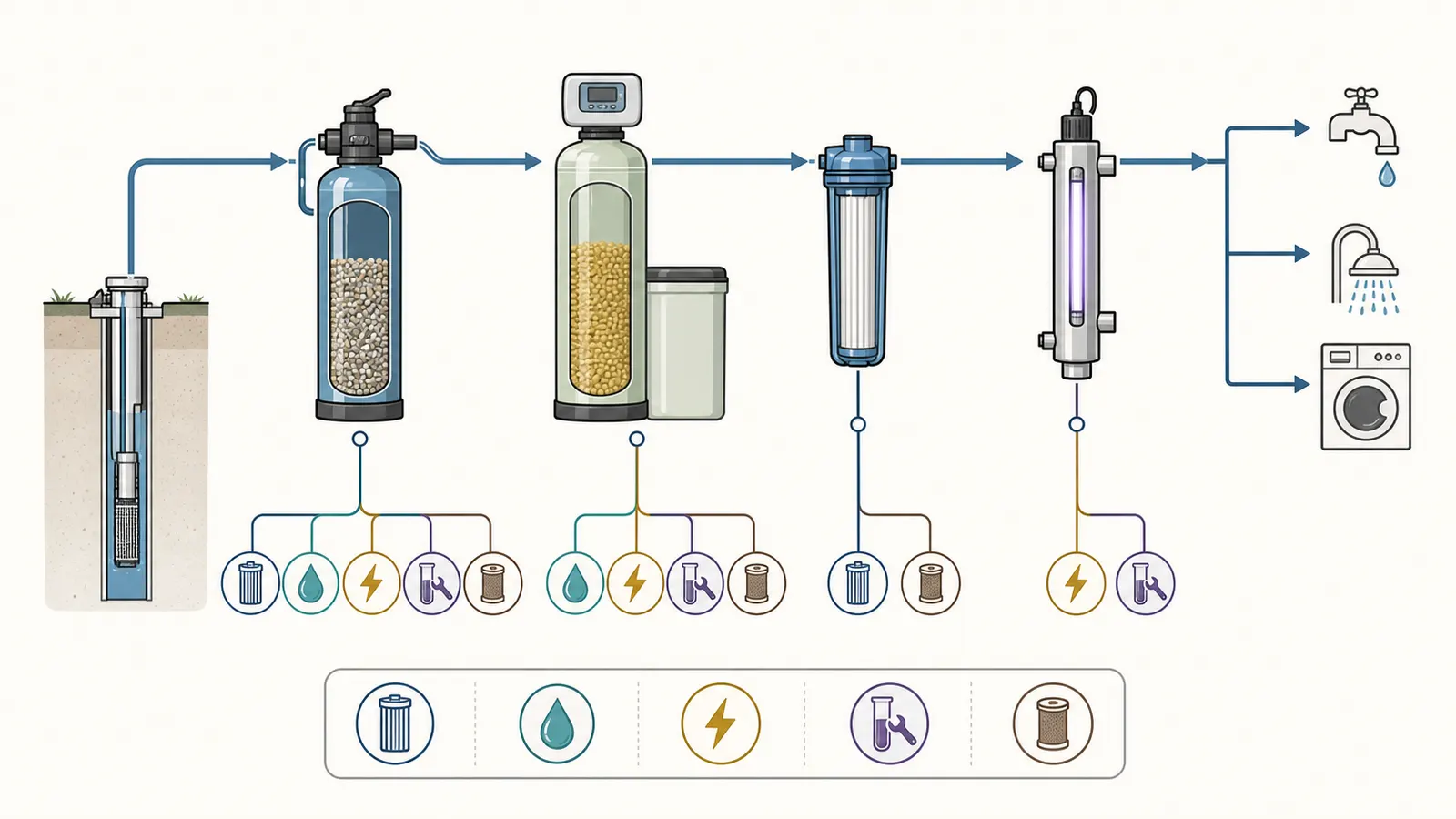
Start by listing every treatment stage between the well pressure system and the household outlets you are evaluating. A typical train may include a sediment or backwash filter, iron or sulfur media, a cation-exchange softener, cartridge filters, ultraviolet disinfection, reverse osmosis at one or more outlets, or a final polishing stage. Your home may have only some of these, or several stages serving different outlets.
The cost surface is not a product-price comparison. It is a ledger of flows, inputs, and scheduled work:
| Cost bucket | What belongs in it | Evidence to enter |
|---|---|---|
| Consumables | Salt, cartridges, prefilters, postfilters, cleaning chemicals, and media top-ups | Receipt price, quantity used, and purchase dates |
| Treatment drain water | Softener regeneration, filter backwash, rinse, brine refill, and any other treatment discharge in scope | Manual cycle times and flow rates, controller history, or a safe accessible measurement |
| Electricity | UV lamp and ballast, control valves, dosing equipment, and other treatment loads | Nameplate watts, measured kWh, run hours, or a dedicated meter |
| Testing and service | Certified laboratory tests, annual service, cleaning, inspections, and ordinary service parts | Lab invoice, service invoice, service interval, and scope |
| Replacement reserve | Lamps, sleeves, media, cartridges, valves, tanks, sensors, or other components replaced on a multi-year schedule | Exact replacement price and model-specific interval |
This boundary is important. Include the treatment system’s own operating cost, but do not mix in a well-pump replacement, pressure-tank replacement, new well, septic repair, or whole-house plumbing repair unless you are intentionally comparing a broader ownership scenario. A softener may be connected to the well system, but this page is about treatment-train operating cost, not the capital cost of the well or pump.
Water and sewer charges also need a declared boundary. A private-well household may pay neither a municipal water charge nor a sewer charge, may pay a flat sewer fee, or may pay a local rate for water used by a connected meter. Enter zero only when the bill or arrangement genuinely makes that line zero. Treatment discharge can still matter operationally even when there is no municipal water bill.
EPA’s technical guidance warns that water softeners are not necessary in every home, that local jurisdictions may have softener requirements, and that sodium and chloride discharge can affect septic systems or community discharge limits. Read the EPA WaterSense technical reference before treating a lower discharge cost as permission to route discharge anywhere you choose. The calculator estimates cost; it does not determine a legal, septic, or environmental disposal method.
Before relying on the drain-cost result, changing a treatment setting, installing or removing a stage, or changing where discharge goes, stop and verify the applicable requirements with the local or state health or environmental authority and the water or sewer utility. Ask the relevant septic authority or designer, plumbing or building department, permit or licensing office, and backflow official what applies to your property; use a qualified, licensed water-treatment or plumbing professional when the answer depends on the installation. Confirm the treatment, discharge destination, septic loading, permits, installer or service licensing, backflow protection, and utility rate assumptions. If an authority or qualified professional says the plan is not allowed, or the requirement is still unclear, do not proceed and do not treat the calculator’s drain-cost output as permission. The local-health and environmental contacts described by EPA are a starting point, not a substitute for confirming your jurisdiction’s rules. EPA notes that local jurisdictions may set softener-discharge requirements and directs well owners to local health or environmental experts.
Set the boundary: what belongs in this estimate
Write one sentence before entering numbers:
“This estimate covers the treatment stages from ______ to ______, for ______ gallons of household water per ______, and includes / excludes municipal water, sewer, and treatment discharge charges.”
That sentence prevents two common errors: counting the same gallons twice and comparing one system’s full train with another system’s drinking-water tap only.
Choose the water-volume denominator
Use the denominator that matches the decision. For a whole-house comparison, use gallons entering the whole-house treatment train. For an under-sink reverse-osmosis comparison, use gallons entering that unit and say so. For an existing well with no reliable flow meter, use a measured or documented range rather than a guessed household average.
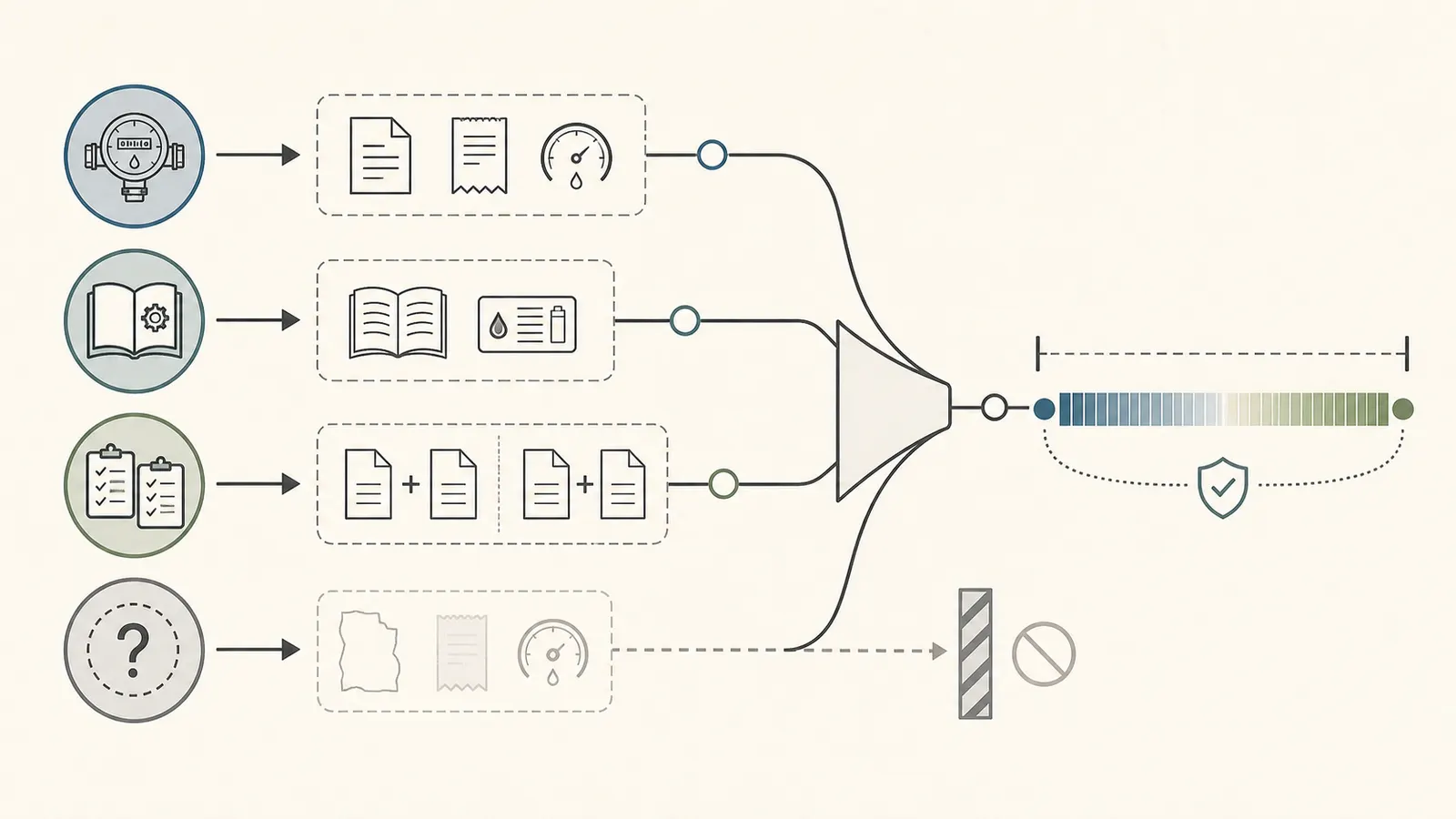
Possible evidence, from strongest to weakest, is:
- A treatment controller’s totalizer or usage history, when the controller measures the relevant flow.
- A whole-house meter or submeter reading taken at two dates with the dates and readings recorded.
- A measured fixture or treatment flow multiplied by observed run time, when the measurement is safe and the duty cycle is known.
- A bounded range from recent utility bills, tank fill records, or a service record that states gallons.
- An unresolved input. Leave the cost-per-1,000-gallons output unavailable rather than manufacturing a denominator.
Pentair’s XTR2 controller documentation lists current and peak flow, a totalizer, last regeneration, daily usage, number of regenerations, regeneration interval, and usage since the last regeneration among its diagnostics. Those fields can be useful source records when your installation actually uses that controller. Do not assume another control valve has the same display, history, or measurement accuracy.
Use the same denominator for the annual, five-year, and ten-year views. If water use changes by season, record a low and high annual volume or use a full year of readings. A five-year cost divided by one unusually dry month will produce a precise-looking but weak comparison.
Separate treated gallons from drain gallons
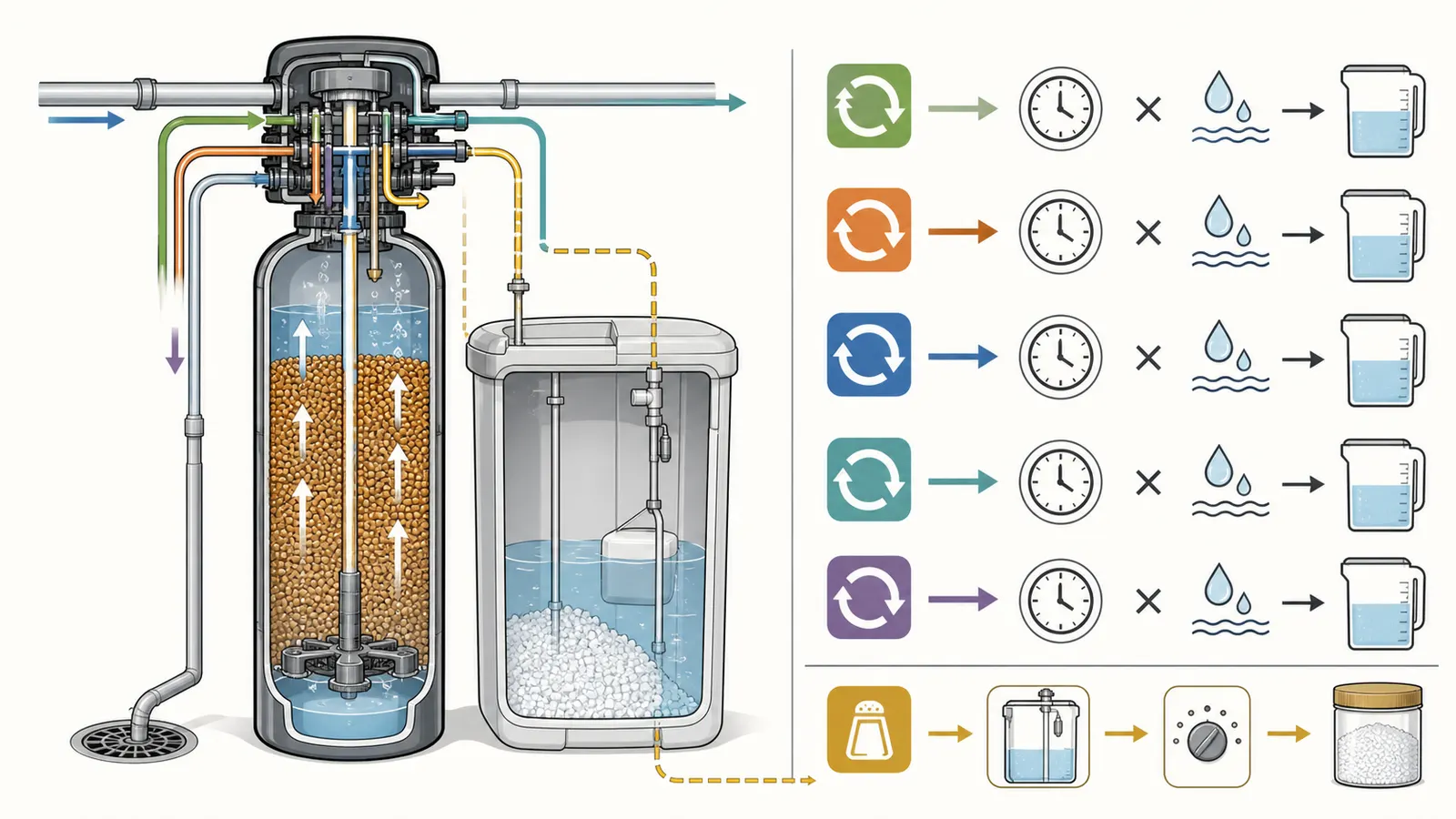
The gallons entering treatment and the gallons sent to a drain are different quantities. A softener can treat household water and periodically send additional water through backwash, brine, rinse, and refill cycles. A backwash filter can have its own cycle. A cartridge filter may have no automatic drain cycle but still create a replacement cost. Keep these as separate rows.
If the equipment manual gives a cycle flow rate and duration, calculate each cycle as:
cycle drain gallons = cycle flow rate in gallons per minute × cycle duration in minutes
Then:
annual drain gallons = drain gallons per event × events per year
For the Fleck 9000/9100/9500 family, the Pentair service manual explicitly works through backwash, brine and rinse, rapid rinse, and brine-tank refill, multiplying each cycle’s minutes by its flow rate and then adding the cycle volumes. Use that model-specific logic when your valve manual matches the equipment.
Do not copy a flow rate from a similar-looking tank. Pentair lists the Fleck 5800 with a 21 GPM service flow rate and a 17 GPM backwash flow rate, but those are specifications for that listed valve family, not a universal residential assumption. Check your exact valve, injector, flow-control, tank, and programmed cycle.
Gather inputs from manuals, meters, bills, and receipts
The worksheet below is the input surface. A blank is not a zero. Mark each value with its evidence type so you can tell whether a result is measured, specified, bounded, or unresolved.
| Input group | Record these fields | Best source |
|---|---|---|
| Household use | Gallons per day or year; meter start and end readings; date range; treatment boundary | Controller totalizer, water meter, submeter, or documented measurement |
| Water and sewer | Water rate per 1,000 gallons; sewer rate per 1,000 gallons; fixed fees excluded or included | Current utility bill or rate schedule |
| Electricity | Effective dollars per kWh; watts or measured kWh; hours or duty cycle; seasonal operation | Electricity bill, equipment label, manual, plug-in energy meter, or installer record |
| Softener | Model and controller; hardness; iron or manganese adjustment if specified; resin volume; salt per regeneration; regenerations per month or year | Lab result, model manual, controller history, settings record, and receipts |
| Backwash or media filter | Model; media type and quantity; backwash and rinse times; flow-control rate; events per year; media replacement interval | Model manual, label, controller history, and service record |
| Cartridges | Filter dimensions and rating; number of housings; price per cartridge; actual replacement dates; pressure or quality trigger | Cartridge label, compatible manual, receipts, and log |
| UV | Lamp and sleeve model; watts; hours energized; lamp replacement interval; replacement price; cleaning or service cost | UV manual, ballast or lamp label, controller, receipts, and service record |
| Other stages | RO membrane and reject ratio if documented; dosing chemical; air-injection or oxidizing equipment; monitoring sensors | Exact manual, label, receipt, and service record |
| Testing | Tests performed; laboratory price; frequency; shipping or collection fee; post-repair tests | State-certified laboratory invoice and local health guidance |
| Service | Annual visit, cleaning, calibration, parts, travel, and emergency visits | Written service scope and invoices |
Read the manual like a cost document
Find the pages titled installation, programming, regeneration, backwash, flow control, maintenance, replacement, or troubleshooting. Capture the model number and revision date before copying a value. A manual may describe several tank sizes, injectors, flow controls, controller variants, or cycle programs; the first number you find may not describe your installation.
For a Fleck 9000/9100/9500 example, the manual says refill time is calculated from brine-line flow rate multiplied by timer setting, and it uses approximately one gallon of fresh water to dissolve approximately three pounds of salt in its programming example. That is a manual-specific programming example, not permission to infer the salt use of another valve or to treat the approximate relationship as a receipt substitute. Use the exact manual for the exact valve and confirm actual salt purchases.
The same manual shows that available gallons depend on resin amount, compensated hardness, and the salt setting, and that regeneration water is subtracted when setting the meter wheel. That is why hardness, resin volume, programmed salt dose, and actual regeneration count belong in separate input cells.
Use receipts to replace assumptions
For salt, cartridges, lamp replacements, media, and parts, use at least two dated receipts when available. Record the quantity, package size, price before or after tax, delivery charge, and whether the item was purchased during a sale. Decide once whether the comparison uses out-of-pocket price including delivery and tax; apply the same choice to every item.
A receipt proves what you paid on that date. It does not prove that the next interval will be identical. If a cartridge lasted four months once and eight months once, enter a six-month planning value only if you label it as a bounded or derived estimate and show the low-high result. If you have only one replacement, keep the interval as provisional.
For a UV lamp, separate lamp price from electricity. A lamp can be energized continuously even when the household uses no water, while a valve motor may run only during a cycle. Use the manual or a measurement for runtime. EIA reports residential electricity prices in cents per kilowatt-hour, the unit needed to convert measured or specified energy use into cost; use your current bill’s effective rate for the homeowner result, with EIA as context rather than a local-price substitute.
Turn each input into annual, five-year, and ten-year cost
Build the estimate as line items. Keep the formulas visible so another person can reproduce the result from the same records.
Recurring consumables
For an item bought at a regular interval:
annual item cost = quantity used per purchase × price per unit × purchases per year
For salt, that becomes:
annual salt cost = pounds per regeneration × regenerations per year ÷ pounds per bag × price per bag
If the manual gives a salt dose but your receipts show a different annual quantity, use the receipts as the operating record and the manual as a diagnostic comparison. A mismatch can reflect a changed setting, a salt bridge, a leak, a different regeneration count, or a purchasing period that is not a full year. The calculator should show the mismatch for investigation; it should not choose whichever number produces the lower cost.
For cartridges:
annual cartridge cost = cartridge price × number installed × replacements per year
If cartridges are not replaced on a calendar interval, use the actual dates and calculate the number of replacement events in the selected horizon. Do not treat a manufacturer’s “replace when needed” instruction as a fixed number of months.
Treatment drain water
First calculate gallons per regeneration, backwash, or rinse event from the exact cycle records. Then convert gallons into the chargeable unit:
annual drain-water charge = annual drain gallons ÷ 1,000 × (water rate + sewer rate)
For a private well with no municipal water or sewer charge, this line may be $0 in the utility-cost view. Keep the gallons visible anyway. The gallons may affect septic loading, discharge planning, or a system-efficiency comparison even when the bill does not price them.
If a rate schedule has tiers, minimums, seasonal rates, or separate wastewater treatment charges, enter the applicable marginal rate or build a low-high range from the actual bill. Do not multiply every gallon by a headline rate if the bill’s first block, fixed charge, or sewer cap changes the marginal cost. If you cannot reproduce the bill’s structure, label the result “utility-rate approximation” and keep the bill for review.
Electricity
For a continuously energized device:
annual electricity cost = watts ÷ 1,000 × hours energized per year × dollars per kWh
For a cycling device:
annual electricity cost = watts ÷ 1,000 × hours per event × events per year × dollars per kWh
Measured kWh from a suitable plug-in meter or submeter is usually easier to audit than a guessed duty cycle. Only measure equipment in a way that does not expose you to water, live wiring, or an opened control enclosure. If the device is hard-wired, wet, or inaccessible, use the label and manual or have a qualified professional measure it.
Treat the electricity rate as an input with a date. A bill can include supply, delivery, taxes, riders, and other charges. Decide whether your effective rate includes all variable charges, then use the same definition across scenarios. The EIA table is useful for understanding the unit and for a broad benchmark, but the local bill controls the homeowner estimate.
Testing and service
annual testing and service = lab tests + scheduled service + ordinary service parts
Keep health or water-quality testing separate from maintenance testing. EPA recommends annual private-well testing for total coliform bacteria, nitrates, total dissolved solids, and pH, with additional testing when conditions or water quality change. EPA also says to use a certified drinking-water laboratory. The calculator can price the testing plan you actually follow, but it cannot decide which contaminants your well requires.
The same EPA guidance lists situations such as replacing or repairing part of the well system or noticing a change in odor, color, taste, or other quality as reasons to test promptly. Treat those as safety and water-quality actions, not optional cost-cutting opportunities. If a result exceeds a health standard, contact the local public-health authority and retest as directed before changing treatment based only on a cost comparison.
Safety stop rule: suspect water is outside the cost calculation
If the well or water may be contaminated, stop using that water for drinking, cooking, or making ice while it is being assessed. This includes flooding, a sewage event, a chemical or fuel release near the well, an abrupt odor, color, taste, or other quality change, and a positive test result that has not yet been interpreted. Use bottled water or another verified safe source, contact the local or state health or environmental authority, and arrange the appropriate inspection and certified-laboratory testing. Do not restart those uses because a softener, filter, UV lamp, or other treatment stage is operating or because the operating-cost estimate is low; CDC says treatment must match the germ or chemical and the water should be tested before it is used again. CDC’s private-well guidance says to avoid suspected contaminated water, use bottled or another safe source, contact the health department, and test after treatment; it also warns that chemical contamination can make water unsafe for any use. This stop-use rule is separate from the calculator and takes priority over every cost result.
Replacement events and reserves
For a component with a known replacement price and interval:
annual reserve = replacement price ÷ interval in years
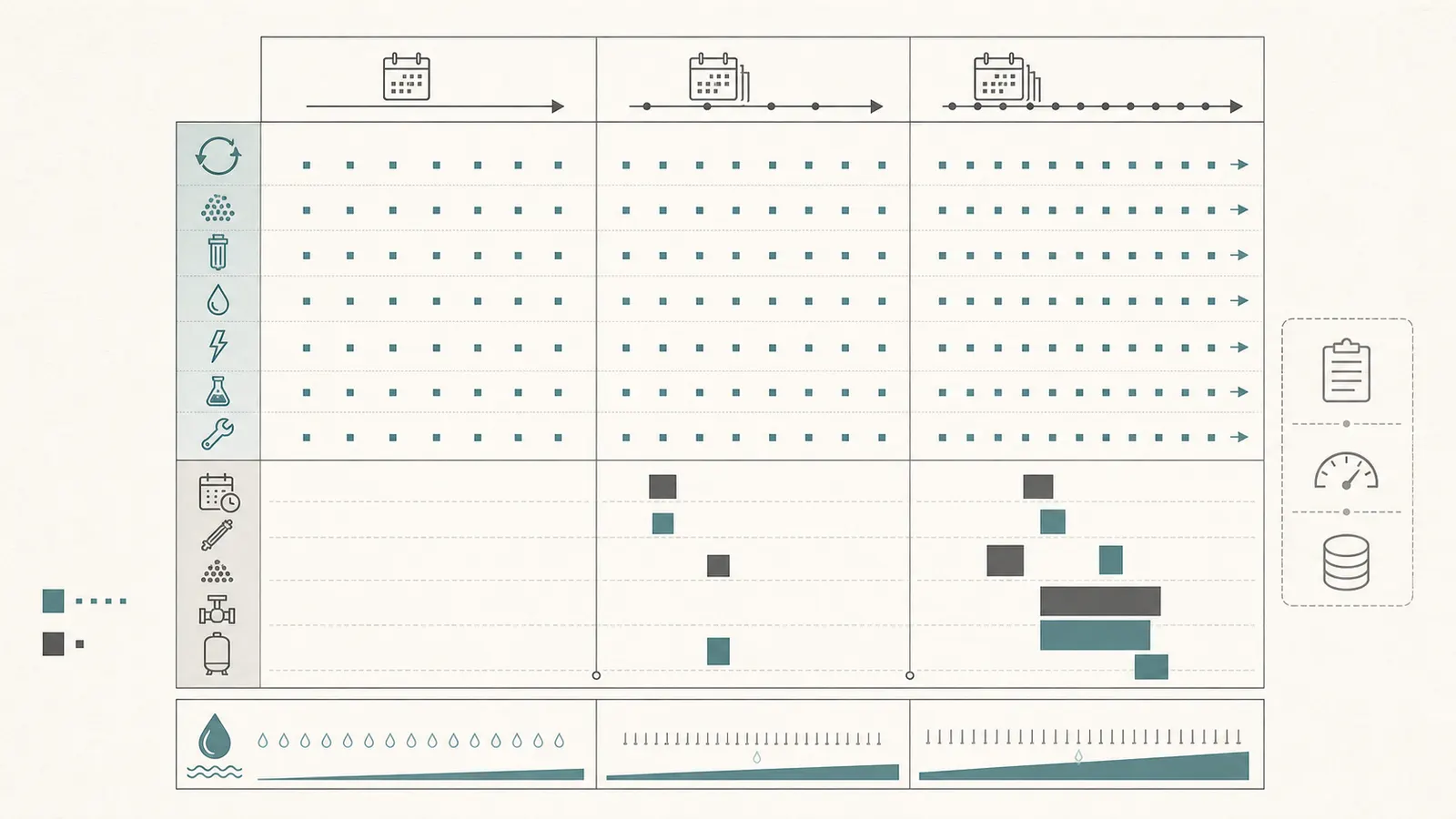
That smooth reserve is useful for budgeting, but the five-year and ten-year totals should also show the actual event years. A lamp that costs $L and is replaced every I years contributes $L in years I, 2I, 3I, and so on. A media replacement due in year seven belongs in the ten-year view, not in the five-year view.
Use two rows when helpful:
| View | How to calculate it |
|---|---|
| Budget view | Add an annual reserve for every known replacement so the household sets money aside evenly |
| Cash-flow view | Add the full replacement price only in the year the part is due, with a low-high range if the interval is uncertain |
Do not call a media bed “ten-year” unless that interval comes from the exact manual, a dated service record, or a bounded professional recommendation for the actual water conditions. Media life can depend on contaminant loading, backwash performance, water use, and treatment target. When the interval is unresolved, the correct output is “replacement not priced” plus a follow-up task.
Produce the three horizon outputs
Use a ledger like this, with one row per stage or service:
| Line item | Annual low | Annual high | Year 1 | Years 1–5 | Years 1–10 | Evidence note |
|---|---|---|---|---|---|---|
| Salt or chemicals | Receipts and actual use | |||||
| Cartridges and filters | Part number, price, dates | |||||
| Treatment drain water | Manual cycle math and rates | |||||
| Electricity | kWh or watts, hours, bill | |||||
| Testing | Certified lab and schedule | |||||
| Service and ordinary parts | Written scope and invoices | |||||
| Replacement events | Interval and event year | |||||
| Total operating cost | Sum of included rows | |||||
| Cost per 1,000 gallons | Horizon total ÷ horizon gallons × 1,000 |
For five- and ten-year totals, either hold prices flat and say “current-dollar comparison,” or enter a user-supplied escalation assumption. Do not bake in inflation, energy escalation, or salt-price growth without labeling it. A flat-dollar comparison is often the cleanest way to compare two treatment designs; a household budget may also want a separate sensitivity view.
Show unknowns as ranges, not made-up averages
Every input should carry one of four labels:
| Evidence label | Meaning | How it affects the result |
|---|---|---|
| Measured | A bill, receipt, meter, controller history, or dated invoice records it | Use as entered, with the measurement date |
| Specified | The exact manual, nameplate, or product label states it | Use only for the matching model and configuration |
| Bounded | Two defensible values create a low and high case | Calculate both cases and show the spread |
| Unresolved | No reliable value or defensible bound exists | Exclude it, mark the total incomplete, and name the next record to obtain |
Build a low-high range responsibly
Use ranges only when both endpoints have a reason:
- Water use: last-year meter readings, or a documented low and high period from bills.
- Salt use: two observed purchase rates, or a manual dose paired with a recorded regeneration range.
- Drain water: the exact manual’s alternate programmed cycles, or a measured range from accessible discharge observation.
- Electricity: measured kWh versus a label-based upper case with documented hours.
- Replacement cost: two current compatible quotes or a low-high range from recent receipts.
- Service: written basic and expanded scopes from the same provider or two comparable invoices.
Do not use “typical family,” “average well,” “standard UV,” or a generic cartridge lifespan as a hidden input. Those phrases may be useful search starting points, but they are not evidence of your home’s volume, price, pressure, hardness, contamination, or duty cycle.
If only one side of an input is known, keep the uncertainty visible. For example, if you know a replacement price but not the interval, show “price known; interval unresolved” rather than dividing by an assumed number of years. If you know the interval but not the local price, show “interval known; price range required.” If a missing line item could materially change the comparison, label the whole result “incomplete for purchase decision.”
Add a confidence note to every result
At the top of the output, record:
- Evidence date: the newest bill, receipt, manual revision, or controller export used.
- System identity: each model number, tank size, media type, and controller version entered.
- Coverage: percentage of annual cost represented by measured or specified inputs.
- Exclusions: pump, pressure tank, new well, capital installation, emergency repair, taxes, fixed utility fees, or other excluded scope.
- Unresolved items: the exact missing input and who can provide it.
This is more useful than a single confidence score. A result can have precise salt and cartridge costs but an unresolved media replacement reserve; the output should say that plainly.
Read the result as a decision, not a verdict
The total is a comparison aid. It does not decide whether a treatment stage is necessary or whether a lower-cost setup protects health. Read the largest line items first:
| If the largest line is… | Investigate | Do not infer |
|---|---|---|
| Salt or chemicals | Regeneration count, dose, receipts, hardness, iron or manganese treatment, leaks, and controller history | That the cheapest salt is automatically the right treatment choice |
| Drain water | Cycle times, flow-control specification, events per year, utility rates, and discharge destination | That lower billed cost means lower water use or acceptable discharge |
| Cartridges | Actual replacement dates, pressure or quality trigger, housing size, and compatible part price | That a longer interval is safe if water quality or pressure has deteriorated |
| UV electricity or lamps | Lamp wattage, hours energized, alarm history, sleeve cleaning, and exact replacement interval | That a dark or quiet lamp is disinfecting water adequately |
| Testing or service | Required testing plan, certified laboratory, service scope, and missed maintenance | That skipping a test proves the water is safe |
| Replacement reserve | Which part is due in which year, exact compatibility, and current price | That an annual reserve is the same as a guaranteed service life |
For softeners, compare both water and salt efficiency. EPA WaterSense explains that regeneration consumes water and salt, and its home-maintenance guidance recommends using incoming hardness and/or flow to program regeneration when possible. It also recommends professional annual service and regular salt checks. These are maintenance and efficiency considerations, not a universal setting recommendation for your valve.
If the result shows unexpectedly frequent regeneration, first verify the input chain: hardness test date, compensated-hardness calculation, household gallons, meter or controller count, salt setting, and any bypass flow. A controller history can reveal a change in usage, but it cannot by itself prove the water-quality target is being met.
If drain water dominates, verify every cycle’s duration and flow-control value against the exact manual. Pentair’s manuals show why a regeneration total is assembled from separate cycle calculations; a single “gallons per regeneration” number without a source is hard to audit. If the programmed cycle, flow control, injector, or discharge connection is unclear, have a qualified water-treatment professional identify it.
If testing dominates the cost, do not remove testing to make a proposal look affordable. EPA says to use certified drinking-water laboratories and to test private wells annually for a baseline group, with additional tests based on local conditions and changes. Use your state or local health department to identify the appropriate scope.
When comparing a proposed replacement with the system you own, hold the water-quality objective and treatment boundary constant. Compare salt, drain water, electricity, testing, service, replacement timing, and unresolved uncertainty side by side. A system with a lower annual estimate but an unpriced media replacement or unsupported drain assumption is not yet a lower-cost system.
Finish with a safe record and professional handoff
Use this sequence for the next 60–90 minutes of homeowner work:
- Photograph or transcribe every model and controller label without removing covers.
- Download the exact manuals and save the revision date or page reference.
- Export controller history if the interface provides it; record the export date.
- Gather one year of salt, cartridge, lamp, media, chemical, lab, and service receipts.
- Copy the current electricity, water, and sewer rates from bills or rate schedules.
- Record accessible meter readings with dates; do not open a well, pull a pump, or disconnect a pressurized line to obtain a number.
- Enter each figure with Measured, Specified, Bounded, or Unresolved status.
- Calculate annual, five-year, ten-year, and cost-per-1,000-gallons outputs.
- Highlight any line item that could change the purchase or replacement decision by itself.
Keep the following safety boundary. Do not open energized electrical controls, test live wiring, open the well, pull the pump, enter a tank or other confined space, or manipulate pressurized plumbing, valves, or treatment vessels to obtain a cost input. Do not defeat an alarm, bypass a safety interlock, or route discharge to a different location as a “test.” A homeowner can read labels, bills, receipts, controller screens, and accessible documentation. A qualified professional should handle energized, pressurized, submerged, confined-space, or uncertain work.
If the treatment or discharge plan changes, repeat the local verification step before work begins: confirm health, environmental, utility, septic, plumbing/building, permit or licensing, backflow, and discharge requirements with the responsible authority or a qualified professional. A cost comparison never overrides those requirements.
Bring this packet to the professional:
- Model and serial photographs for every stage, valve, tank, lamp, cartridge housing, and controller.
- The exact manual pages for cycle times, flow controls, salt settings, replacement intervals, and electrical ratings.
- Water-quality reports with sample dates, laboratory identity, and test scope.
- Controller history showing totalizer, flow, regeneration count, or alarms when available.
- Twelve months of receipts and current utility bills.
- Your annual, five-year, and ten-year ledger, including every excluded or unresolved item.
The final question is not “What does a well-water system usually cost to run?” It is: “Which documented inputs make this home’s treatment train expensive, uncertain, or due for service—and what evidence would change that conclusion?” A transparent ledger can answer that question without pretending that another homeowner’s hardness, rates, settings, or maintenance history belongs to you.
Sources and scope
Evidence behind this page
- Protect Your Home's Water
Private residential wells; testing frequency and events that justify additional testing.
- Protect Your Home's Water
Private well drinking-water testing; laboratory certification and local public-health contacts.
- Guidelines for Treating Well Water
Private-well suspected contamination, alternate safe water, health-department escalation, treatment matching, and post-treatment testing.
- Home Maintenance
Residential cation-exchange water softeners; regeneration, salt checks, programming, and maintenance guidance.
- Technical Reference Manual for WaterSense Labeled Homes
WaterSense labeled homes technical guidance; softener efficiency, discharge, septic, and local-jurisdiction caveats.
- Fleck 9000/9100/9500 Service Manual
The cited Fleck valve family and the manual's worked programming examples; not a universal specification for every treatment valve.
- Fleck 9000/9100/9500 Service Manual
Fleck 9000/9100/9500 programming example; use only when the homeowner's actual valve manual matches the equipment.
- Fleck XTR2 Touch Screen Controller
Pentair Fleck XTR2 controller; available diagnostics vary by controller and installation.
- Fleck 5800 Valve
Pentair Fleck 5800 valve product page; values apply to that listed valve family, not every filter or softener.
- Electric Power Monthly, Table 5.3
U.S. residential electricity-price reporting; national data are a benchmark, not a substitute for the homeowner's bill.