Washable vs. Disposable Whole-House Sediment Filters for a Private Well
A private-well homeowner worksheet for choosing washable or disposable sediment media using water tests, potable-use instructions, pressure, and service records.
The short answer
Choose washable only when the exact synthetic cartridge permits the cleaning method and potable reuse, the well conditions fit the media, and pressure and maintenance can be logged. Choose disposable when reuse is prohibited or unclear, the media is not suited to the well, or replacement is the more reliable routine. If sediment rapidly loads either choice, evaluate upstream separation or a properly sized media filter.Washable vs. disposable whole-house sediment filters for a private well
Short answer: choose washable only when the exact cartridge is synthetic, the manufacturer explicitly permits the proposed cleaning and potable-water use, the well test supports the media, and you will measure loading rather than guess a replacement date. Choose disposable when the instructions prohibit potable reuse, the media is cellulose or otherwise vulnerable to your water, or a clean cartridge gives you a more reliable maintenance routine. If sediment rapidly consumes either option, stop optimizing cartridges and evaluate a separator, spin-down stage, or backwashing media filter.
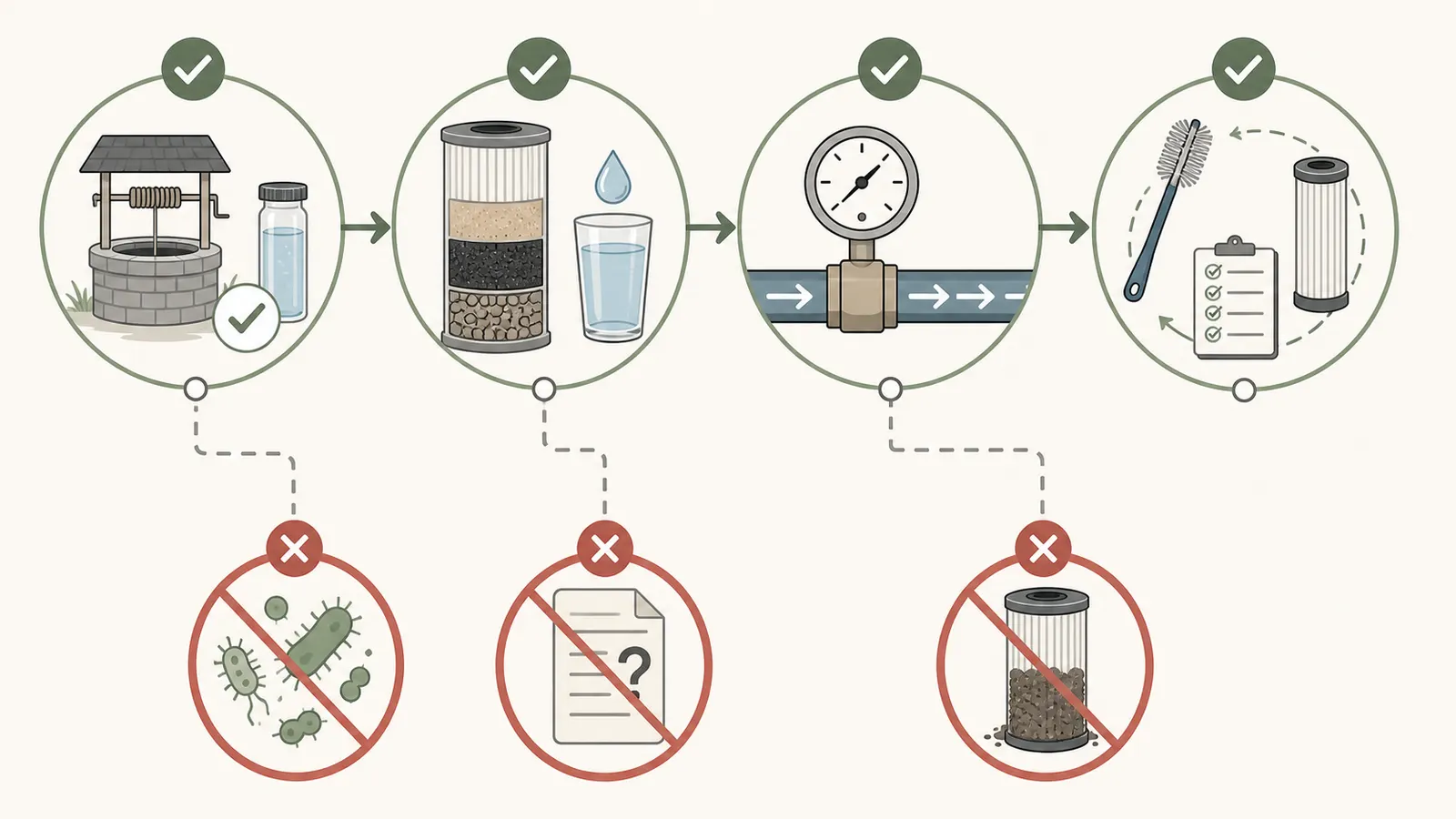
A “washable” label describes a maintenance feature, not a complete drinking-water claim. A defensible private-well choice has to pass four gates:
- Water gate: recent, state-certified well testing and a clear understanding of whether the problem is suspended sediment, bacteria, dissolved chemistry, or a mixture.
- Media gate: the exact media, micron rating, potable-use instructions, and certification or approval information.
- Hydraulic gate: housing size, actual household demand, initial pressure, loaded pressure, and the pressure behavior of the cartridge at the flow you need.
- Maintenance gate: a cleaning or replacement method you will actually perform, with a record of dates, pressure, flow symptoms, and test results.
If any gate is unknown, the next purchase should be information or professional review—not a finer cartridge.
1. Start with the problem your cartridge is allowed to solve
A sediment cartridge is a mechanical screen or depth medium. UGA Extension describes mechanical filtration as trapping suspended particles on the surface or within a filter and says it mostly removes larger suspended material such as sand, silt, clay, loose scale, and organic matter. It does not by itself remove dissolved chemicals or very small particles. UGA Extension’s mechanical-filtration guidance also distinguishes ordinary mechanical filtration from microfiltration membranes, whose pore size and validated claims determine whether microorganisms may be reduced.
That distinction matters on a private well because clear water is not the same thing as safe water. EPA says private wells should be tested annually for total coliform bacteria, nitrates, total dissolved solids, and pH, and sooner after flooding, a repair or replacement, a significant change near the well, or a change in odor, color, taste, or other water quality. EPA’s private-well testing guidance also says to use a certified drinking-water laboratory. CDC gives the same annual testing baseline and notes that federal public-water rules do not regulate or monitor privately owned wells. CDC’s well-testing guidance is the useful safety boundary: a cartridge comparison cannot stand in for a well test.
Record these inputs before shopping:
| Input | What to record | Why it changes the decision |
|---|---|---|
| Raw-water test | Date, lab, pH, total coliform, E. coli if tested, nitrate, TDS, and any locally relevant contaminants | A sediment cartridge is not a bacteria or dissolved-contaminant treatment plan. pH and bacteria context also affect cellulose media. |
| Visible or measured solids | Whether the issue is sand, silt, clay, rust, scale, organic debris, or intermittent cloudy water; turbidity if available | Particle size and solids loading determine whether a cartridge will pass water or clog quickly. |
| Existing equipment | Well pump, pressure tank, softener, oxidizing or iron treatment, UV or chlorination, and filter location | Upstream sediment can protect downstream equipment; a cartridge can also become the bottleneck. |
| House demand | Simultaneous showers, toilets, appliances, irrigation, and the flow the system must deliver | A catalog flow number is not automatically the flow your home receives. |
| Filter identity | Brand, model, media, nominal or absolute rating, dimensions, housing, instructions, and certification marks | “Washable,” “5 micron,” and “whole house” are not interchangeable claims. |
If a well test shows bacteria or a health-related contaminant above the applicable health benchmark, pause the washable-versus-disposable decision. EPA recommends contacting the public health department for specific steps and retesting to confirm the contaminant and concentration; it identifies disinfection and filtration as possible on-site processes depending on the contaminant, concentration, and well condition. EPA’s treatment guidance does not say that a typical sediment cartridge makes contaminated well water safe to drink.
Do not infer that a filter is a disinfection device because it is installed on the main line, has a small micron number, or makes the water look clearer. Ask for the exact reduction claim and the conditions under which it was tested. NSF explains that standards and certifications are tied to specific claims and that certification to one standard does not mean a system reduces every possible contaminant. NSF’s standards overview is the right reference for interpreting a certification mark without over-reading it.
2. Use the media—not the marketing label—as the first comparison
“Washable” can mean at least three different things: the cartridge can be rinsed without immediately falling apart; the manufacturer expects periodic cleaning; or the manufacturer supports reuse for the intended potable-water application. Those are different statements. The third is the one a homeowner needs.
UGA’s current Extension bulletin gives a useful media screen. Pleated paper is not reusable, is sensitive to water with pH below 6.5 or above 8.5, and should be used only when the water contains no active bacteria; it recommends testing pH, total coliform, and E. coli to assess suitability. Cotton-and-polyester pleated cartridges can be cleaned and reused several times when pH is between 4 and 9. Pleated polyester-and-polypropylene cartridges can be rinsed and reused repeatedly, although UGA notes that smoother fibers may retain particles less effectively. These are educational media characteristics, not permission to ignore a specific product manual. Read the media-specific guidance from UGA Extension.
The manufacturer instruction can be more restrictive than the general media description. Pentair’s American Plumber sediment-cartridge flyer describes its pleated polyester cartridges as durable and reusable and suitable for well-water applications, then adds an explicit footnote: “Reuse not recommended for potable water applications.” The same flyer identifies its pleated cellulose products as designed for municipal/chlorinated water and not recommended for well-water applications. See Pentair’s sediment-cartridge flyer.
That example creates a practical rule:
If the exact product documentation says reuse is not recommended for potable water, do not convert the cartridge into a reusable drinking-water component because the fiber looks durable or a retailer calls it washable.
The reverse is also important. A manufacturer’s “washable and reusable” feature does not, by itself, prove potable-water approval. Watts lists its WPC40 as a washable, reusable, cellulose-free synthetic 5-micron pleated sediment filter. Its product page separately says to consult the product-specific specification sheet or a Watts representative for approval or certification information. Watts’ WPC40 specification page therefore supports “the cartridge is marketed as washable,” not “every installation may reuse it for drinking water.”
Use this evidence hierarchy when comparing two cartridges:
| Question | Pass | Stop or escalate |
|---|---|---|
| Is the media identified? | Exact fiber or material, construction, model, dimensions | Listing says only “sediment” or “reusable” |
| Does the manual permit cleaning? | Method, water temperature, tools, and inspection limits are stated | No cleaning procedure, or cleaning is only a retailer suggestion |
| Does it permit the intended potable use? | Manufacturer documentation and applicable certification or approval match the use | Reuse is prohibited, not recommended, or approval is unclear |
| Does the well fit the media? | pH and bacteria context fit; no contradiction with well-water instructions | Cellulose on an untested well, pH outside the stated range, or active bacteria concern |
| Can the family maintain it? | Safe isolation, pressure relief, rinse/disposal method, and a spare plan are practical | Filter is hard to access, cleaning is messy, or a missed service would affect the whole house |
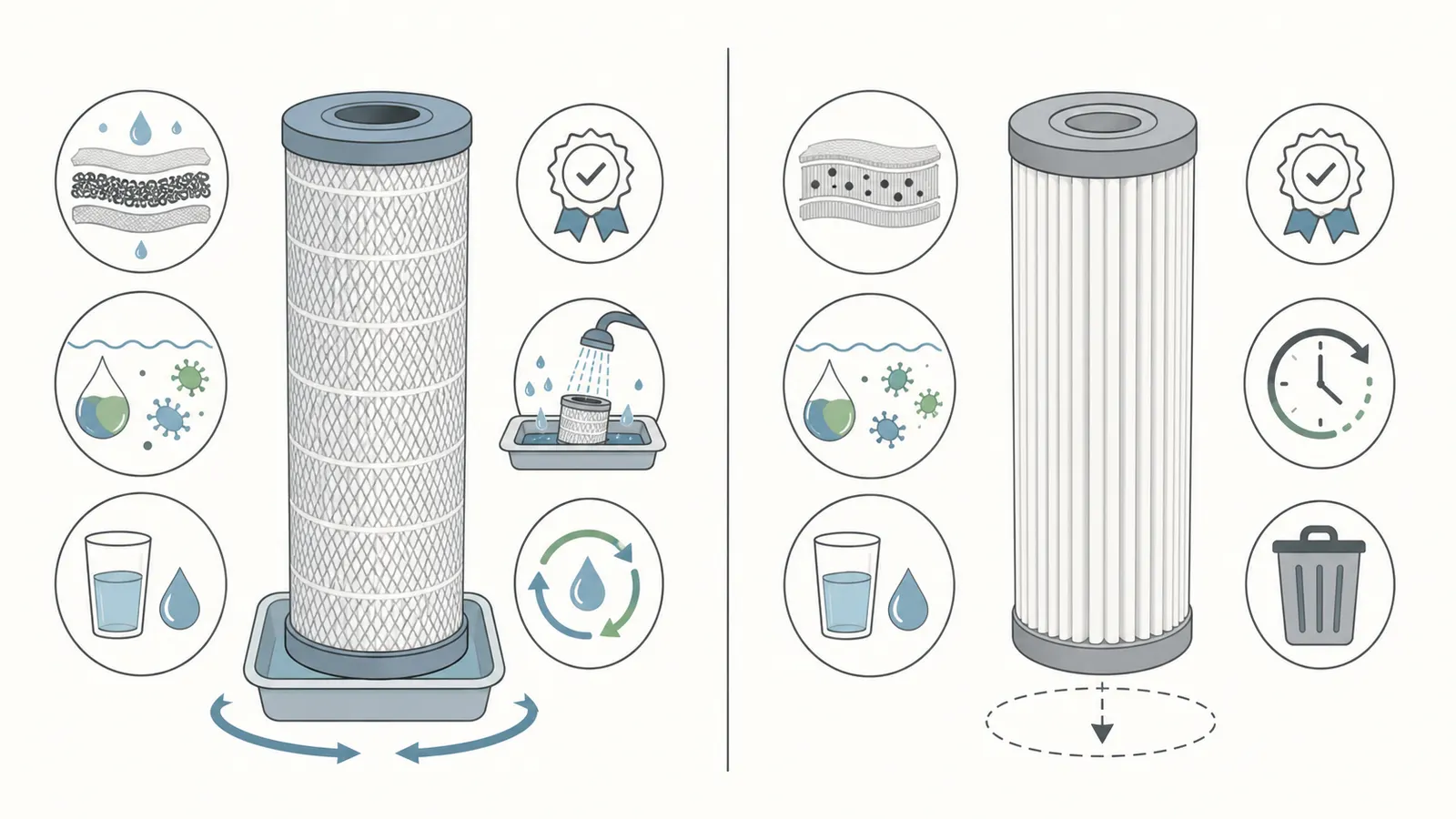
A disposable cartridge is not automatically the safer choice, either. It still needs a potable-use and compatibility check, correct installation, and timely replacement. Its advantage is narrower: replacing the loaded medium gives you a known new element rather than asking whether a rinse removed trapped material without damaging the media or seal.
3. Make pH, bacteria, and certification explicit before choosing reusable
For a private well, the washable decision should not begin with “How much will I save on cartridges?” It should begin with “What water will this material see, and what happens if I clean it incorrectly?”
Use the latest lab report and the manufacturer’s instructions together:
- pH: compare the measured value with the media’s stated operating range. UGA’s ranges for paper and polyester blends are not a universal specification for every cartridge.
- Bacteria: at minimum, use the annual total-coliform result. If cellulose is under consideration, UGA specifically calls for total-coliform and E. coli testing to assess suitability. A positive or unresolved result is a health decision, not a cartridge-maintenance decision.
- Dissolved contaminants: iron, manganese, arsenic, nitrate, salt, hardness, and other dissolved substances may require a different treatment process. A sediment cartridge may capture particles formed after oxidation, but it does not make dissolved contaminants disappear. UGA describes mechanical filtration as useful after a separate oxidation process converts dissolved iron, manganese, or hydrogen sulfide into particles; that is a designed treatment train, not a reason to put a fine cartridge on untreated water and hope.
- Certification or approval: check the exact model and claim. NSF says residential drinking-water systems may be evaluated under NSF/ANSI 42 for specific aesthetic effects, with claims varying by product, and that the applicable claim—not just the logo—matters. NSF’s filtration-media certification explanation explains why material safety and application suitability need to match the use.
The phrase “potable water” also needs a precise scope. A component can be made from a material commonly used in drinking-water systems without the complete cartridge being certified for the claim you care about. A cartridge can reduce particulate without reducing bacteria. A housing can be pressure-rated without its cartridge being approved for potable reuse. A washable element can be acceptable for irrigation or process water while its manufacturer discourages reuse for potable water.
A conservative go/no-go rule
Choose washable only if all of these are true:
- The exact model is identified and its instructions explicitly allow the cleaning method you will use.
- The manufacturer does not exclude potable water reuse, and any applicable certification or approval matches the intended point-of-entry use and claim.
- The well test is current enough for the decision and does not show an unresolved bacteria or contaminant problem that the cartridge is not designed to address.
- The measured pH and water conditions fit the media instructions.
- You can isolate and depressurize the housing safely, inspect the cartridge and seals, dispose of rinse water appropriately, and record the service.
- A clean cartridge or repaired treatment train is available if the element cannot be returned to service.
Choose disposable when the media is paper or another non-reusable construction, when the manufacturer prohibits or discourages potable reuse, when the exact approval is unclear, or when the household is more likely to replace a cartridge correctly than to clean and inspect one consistently.
Choose neither as the first fix when the test result, well condition, or solids source is unresolved. A sudden change after flooding, well work, construction, or a damaged cap deserves well and water-quality investigation. EPA advises inspecting exposed well components and using qualified well help for new well construction, modification, abandonment, or post-flood cleaning and disinfection. EPA’s private-well protection guidance is not a substitute for state-specific requirements, but it is a useful reason to stop treating a new sediment event as a routine cartridge expense.
4. Compare micron and flow claims on the same terms
A lower micron number is not automatically the better choice. It may capture smaller particles, but UGA says finer media traps more particles and must be changed more often; if the pore size is too small or the suspended-solids concentration is too high, the filter can clog easily. If the rating is too large, suspended solids may pass through. UGA’s cartridge-selection section also warns that a 20-micron cartridge may trap sand but not smaller clay and some silt.
Record whether the rating is nominal or absolute, and do not compare the numbers as if they were the same test. In Pentair’s published table, the micron ratings are explicitly marked nominal. The same table lists different flow rates for the same cartridge family depending on the housing; for example, its 30- and 50-micron pleated polyester cartridges are listed at 12 gallons per minute in the referenced housing table. Pentair’s cartridge table also notes that flow rates are calculated according to the housing in which the cartridge is used.
Watts gives a second illustration. The current WPC40 page describes a 40-inch, 5-micron pleated sediment filter, a lower-pressure-drop design, and a maximum water pressure of 40 psi. It does not turn those specifications into a guaranteed household flow for every installation. Watts’ WPC40 page says the product-specific approval information is in the specification sheet or available from Watts.
Use a like-for-like comparison table before buying:
| Comparison field | Cartridge A | Cartridge B | What you are trying to learn |
|---|---|---|---|
| Media and construction | Does the material support the proposed cleaning and water use? | ||
| Rating type | nominal / absolute | nominal / absolute | Are the micron claims comparable? |
| Rated micron | What particles may pass, subject to the test method? | ||
| Flow test condition | gpm at ___ psi / housing | gpm at ___ psi / housing | Is the number measured in a similar installation? |
| Max operating pressure | Does the housing and cartridge fit the pressure range? | ||
| Clean inlet pressure | Your starting reference | ||
| Loaded inlet-to-outlet drop | Your service trigger, not a catalog promise | ||
| Potable-use and reuse language | Is the intended use actually supported? | ||
| Manufacturer cleaning or replacement trigger | The instruction-based maintenance rule |
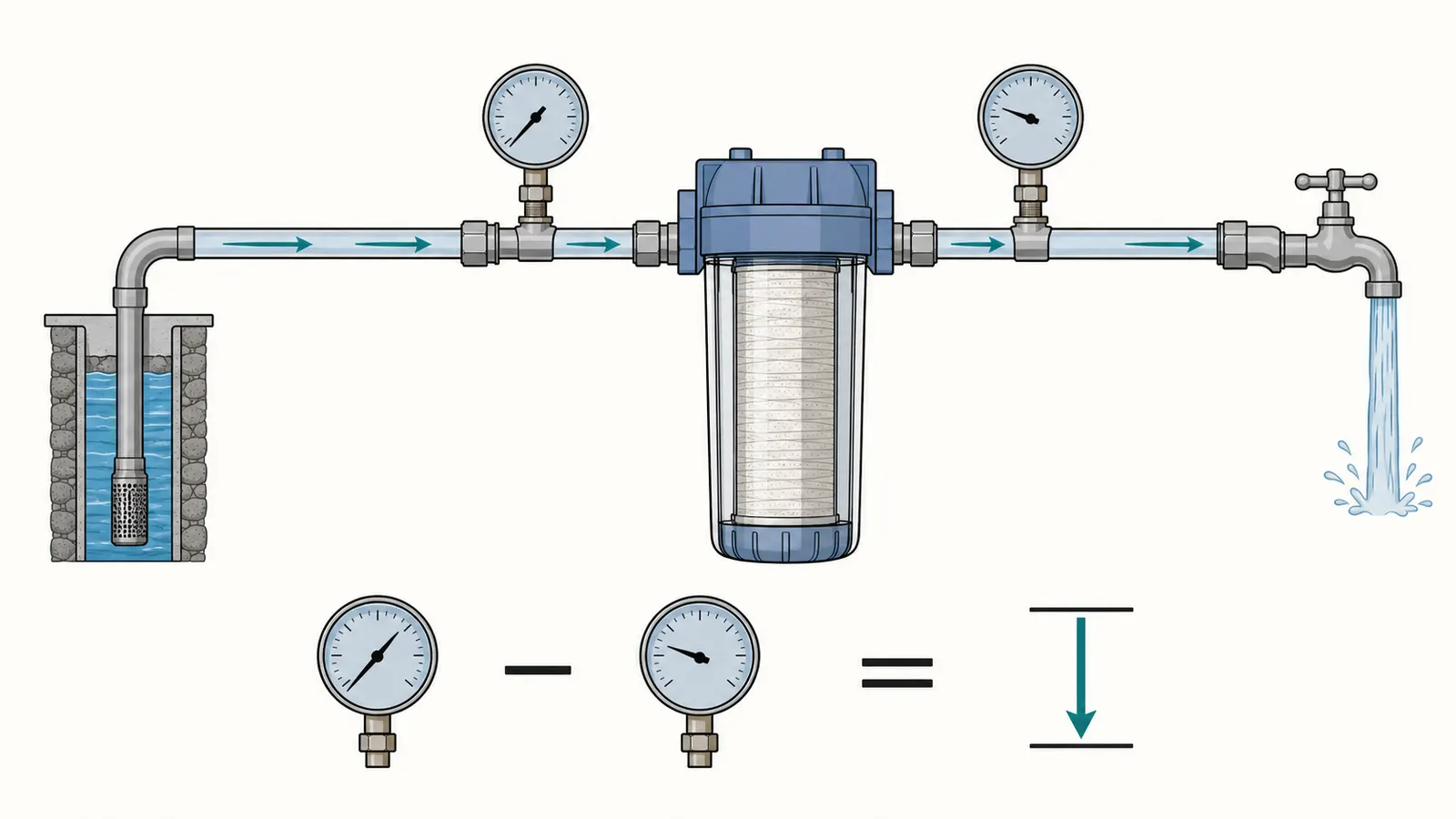
A simple field calculation makes the hydraulic impact visible:
Filter pressure drop = pressure before the housing − pressure after the housing.
Illustration with sample readings: if the inlet gauge reads 58 psi while the house is drawing water and the outlet gauge reads 48 psi under the same draw, the filter drop is 58 − 48 = 10 psi. Do not compare readings taken at different flow conditions. A static pressure reading with no fixture open is not the same as the pressure while a shower, hose bib, or appliance is flowing.
The useful baseline is your own clean-cartridge reading at a repeatable flow. The maintenance trigger is the manufacturer’s limit if one is provided, or a repeatable, noticeable loss of usable flow that occurs before the home’s fixtures become unreliable. Watts’ jumbo-housing manual, for example, instructs users to add a downstream gauge to observe differential pressure and lists a maximum sediment change-out differential for that housing; it also says its flow rates are guidelines affected by micron rating and solids content. See the Watts jumbo-housing manual. Those values belong to that housing and manual, not to every whole-house filter.
5. Turn the first cartridge into a measured service interval
Do not promise yourself “every three months” or “every 1,000 gallons” before you have observed the well. UGA says gallon capacities are only helpful guidelines because the type and amount of contaminants make treatment life difficult to predict. It recommends noting when flow drops and cleaning or replacing as needed. UGA’s maintenance guidance also recommends keeping a logbook of water tests, equipment maintenance, and repairs.
Use this first-cycle record:
| Event | Record before touching the housing |
|---|---|
| Installation or clean start | Date, model, media, rating, housing, cartridge condition, well-test date |
| Baseline | Inlet and outlet pressure while a repeatable fixture flow is running; note which fixture and whether pump is running |
| Weekly or normal-use check | Any cloudiness, grit, pressure complaint, unusual pump cycling, or change in flow |
| Cleaning or replacement trigger | Date, inlet/outlet pressure, observed flow problem, reason for service |
| After service | Cleaning method or replacement model, seal/O-ring condition, leaks, rinse or flush completed, new baseline |
| Water-quality follow-up | Raw and treated sample results when treatment performance or well conditions change |
For a washable cartridge, the record should answer more than “I rinsed it.” Note whether the rinse was permitted by the manual, water temperature if specified, direction or method of cleaning, visible damage, pleat collapse, loose fibers, discoloration, odor, cracks, and seal condition. If the media cannot be returned to its original shape or the housing leaks after service, replace the element or call the installer. Do not treat a visibly damaged cartridge as reusable because it still passes some water.
For a disposable cartridge, record the reason for replacement. “Low flow after 37 days” is more useful than “changed monthly.” If the next element loads in half the time, investigate a change in source water or a failed upstream component rather than automatically moving to a smaller micron rating.
A clean-versus-loaded comparison can be calculated as a percentage, but it is a trend tool—not a universal pass/fail rule:
Flow loss percentage = (clean flow − loaded flow) ÷ clean flow × 100.
If a repeatable test is 9 gpm after a clean start and 6 gpm when the cartridge is loaded, the observed loss is (9 − 6) ÷ 9 × 100 = 33%. Use the manufacturer’s pressure or service trigger if it specifies one. If it does not, use the point at which household service is no longer adequate, provided the readings are repeatable and the system is not being starved by a pump, pressure tank, valve, softener, or another restriction.
Cleaning is not automatically a reset. Trapped material can remain in the media; aggressive brushing can damage fibers; a housing can be reassembled with a displaced O-ring; and a dirty rinse can recontaminate the work area. The manufacturer’s procedure controls. If it does not state that the cartridge may be cleaned and returned to potable service, the defensible action is replacement.
Keep a spare disposable element even when you choose washable. It makes the system recoverable after a failed clean, a torn pleat, a contaminated cartridge, a damaged O-ring, or an unexpected sediment pulse. The cost of one spare is part of the maintenance design, not evidence that washable failed.
6. Recognize when a cartridge is the wrong sediment stage
A cartridge filter is a poor first stage when it is acting as a shovel for an ongoing sand or silt problem. Signs include:
- the cartridge clogs in days rather than a practical service interval;
- pressure collapses during ordinary simultaneous use;
- the filter loads with coarse grit or visible sand before the fine media has had a chance to work;
- cleaning or replacement has become the household’s main water task;
- the water becomes cloudy after pump cycling, heavy rain, flooding, construction, or well work;
- a downstream UV, chlorination, softening, or other treatment device is being protected by a cartridge that is too small for the solids load.
UGA says media-filter selection depends on the amount and size of suspended solids and the rate at which water must be filtered. It describes media filters as point-of-entry devices that can remove turbidity, can serve as pretreatment for UV or chlorination, and can be backwashed and reused. It also says a media filter may be more economical when a cartridge requires replacement too often. UGA’s media-filter comparison is the basis for this escalation rule.
The upstream options are not interchangeable:
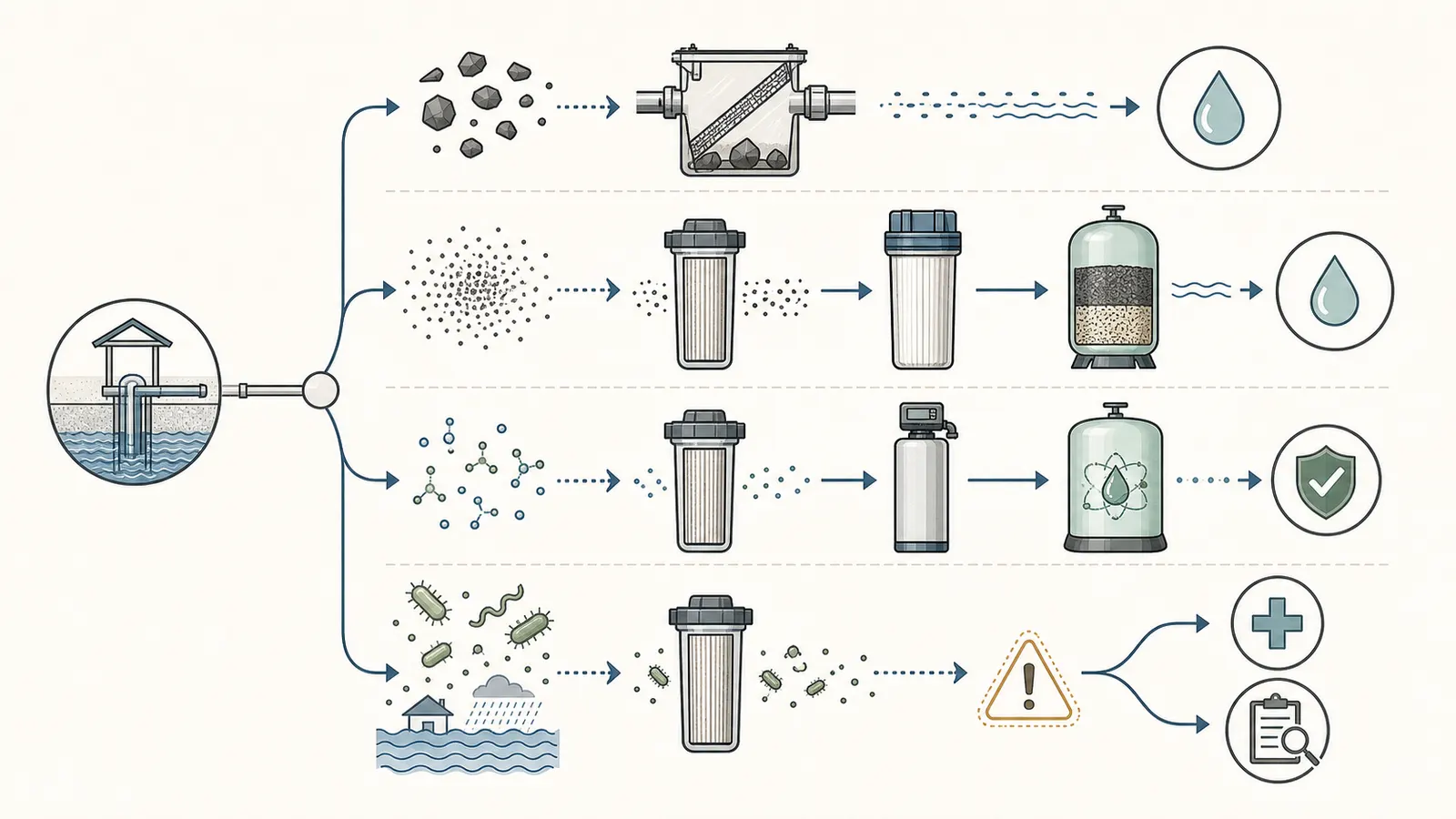
| Observed load | More appropriate conversation |
|---|---|
| Occasional coarse sand or grit | A properly selected coarse separator or spin-down stage ahead of the cartridge, with a drain and a service method suitable for the installation |
| Persistent suspended sediment with house-wide demand | A larger point-of-entry cartridge train or a backwashing single- or multimedia filter sized for the available flow and backwash water |
| Fine clay or turbidity that defeats ordinary cartridges | Water-treatment design based on particle size, turbidity, flow, and disposal/backwash constraints; do not assume a smaller nominal cartridge solves it |
| Iron, manganese, or hydrogen sulfide that appears as particles after treatment | A designed oxidation-plus-filtration train, with testing and professional sizing |
| Bacteria, nitrate, arsenic, or another dissolved or health-related contaminant | A treatment method validated for that contaminant, plus well and laboratory follow-up; a sediment cartridge is not the answer |
A backwashing media filter has its own constraints. UGA notes that tank diameter affects flow rate, available backwash flow limits tank selection, and backwashing adds wastewater to a septic system. It also warns that inadequate or irregular backwashing can lead to channeling, a clogged underdrain, or incomplete treatment. That means “move to a media filter” is not a universal upgrade; it is a request for a properly sized treatment design and a realistic backwash plan.
Before adding a separator or media filter, bring a professional:
- the raw-water laboratory report and any treated-water report;
- photographs or a clean sample showing the sediment, without claiming that appearance identifies its chemistry;
- the existing cartridge model, micron rating, housing size, and installation date;
- clean and loaded pressure readings, fixture-flow observations, and service interval;
- well depth and construction records if available, pump and pressure-tank information, and any recent well work;
- the available drain route, septic constraints, electrical service, and space for treatment equipment.
Do not open the well, pull a pump, or disturb the well casing to investigate sediment. A well driller or pump professional can determine whether the source is construction, well condition, pumping behavior, or groundwater. The filter is often the messenger.
7. Install and maintain the choice without creating a new hazard
A whole-house filter treats the incoming line, so a mistake affects showers, appliances, and drinking-water fixtures. The filter should be installed where it is accessible, protected from freezing and impact, and supported by shutoffs, pressure indication, and the exact housing and cartridge instructions. Do not generalize a pressure limit from one model to another. Watts’ current WPC40 page, for example, publishes a 40-psi maximum water pressure for that product; a different housing may have a different rating, and the cartridge and housing must be treated as one system.
Before service, follow the manual’s isolation and pressure-relief sequence. Watts’ jumbo-housing manual specifically warns not to remove the lid while the housing is under pressure and instructs the operator to close the valves and relieve pressure first. Read the manufacturer’s pressure-relief procedure.
For a homeowner, the safe boundary is narrow:
- Reading an installed gauge, observing flow at a fixture, photographing the cartridge label, and recording a service date are low-risk information tasks.
- Opening a filter bowl or lid is appropriate only when the exact manual provides an isolation and pressure-relief procedure you can follow, the system is accessible, and you can verify that pressure is relieved. Stop if a valve will not close, the gauge is absent or unreliable, the housing is damaged, or water continues to move.
- Never open energized pump controls, test live wiring, open the well, pull a pump, enter a confined space, or manipulate pressurized equipment without qualified help. Electrical shock, stored pressure, flooding, structural failure, and contamination are not cartridge-maintenance problems.
- After any service, check for leaks slowly, flush according to the cartridge or system instructions, and do not assume the water is safe from appearance alone.
- If the well has flooded or may be microbiologically contaminated, do not drink or wash from it until the health department or qualified well professional gives a safe plan. EPA advises well or pump-contractor assistance for cleaning and disinfecting after a flood.
The homeowner decision worksheet
Complete this before ordering:
- Latest private-well test: lab/date recorded; annual total coliform, nitrate, TDS, and pH results reviewed.
- Any E. coli, bacteria, health-related contaminant, flooding, repair, or unexplained water-quality change has been escalated instead of treated as routine sediment.
- Sediment source and appearance documented; turbidity or particle information added when needed.
- Exact cartridge model, media, dimensions, rating type, micron number, flow test conditions, pressure limit, and housing compatibility recorded.
- Potable-use and reuse language copied from the manufacturer’s current instructions or specification sheet.
- Certification or approval checked for the exact product and claim; a logo alone was not treated as proof.
- Clean baseline pressure and a repeatable flow observation recorded before the cartridge loads.
- Maintenance trigger selected from the manual or a repeatable loss of usable flow; calendar and gallon estimates are treated as starting points only.
- Safe shutoff and pressure-relief method verified; spare element, seal, and rinse/flush plan available.
- If service is frequent, coarse solids are staged upstream or a qualified water professional is evaluating a media-filter design.
The final choice is therefore simple to state but not to shortcut: washable wins only when the exact reusable media, potable-water instructions, well conditions, hydraulic fit, and maintenance record all agree. Disposable wins when replacement is the supported and repeatable way to keep the system in service. Neither wins when the sediment load or water-quality problem calls for a different treatment stage.
Sources and scope
Evidence behind this page
- Mechanical Filtration Methods and Devices
University of Georgia Extension guidance for household mechanical filtration; used to define what an ordinary sediment cartridge can and cannot be expected to treat.
- Mechanical Filtration Methods and Devices
Media-specific educational guidance from UGA Extension; it does not override a specific cartridge manufacturer’s potable-use or cleaning instructions.
- Mechanical Filtration Methods and Devices
General cartridge selection and maintenance guidance; no universal replacement interval is inferred.
- Mechanical Filtration Methods and Devices
Escalation from cartridge filtration to single- or multimedia filtration for high suspended-solids loads; sizing remains application-specific.
- Protect Your Home's Water
U.S. EPA private-well homeowner guidance; the article does not convert this federal guidance into a state-specific legal requirement.
- Guidelines for Testing Well Water
CDC health guidance for private-well owners; it establishes the safety context for evaluating a filter choice, not a filter-performance claim.
- Sediment Cartridges Sales Flyer
Specific Pentair/American Plumber pleated polyester cartridge line; not a universal statement about all polyester cartridges.
- Sediment Cartridges Sales Flyer
The published American Plumber cartridge and housing table; values are not generalized to other housings or installations.
- WPC40 40 IN Pleated Sediment Filter
Specific Watts WPC40 product page; the page supports a washable feature claim, not a blanket potable-reuse approval for every installation.
- NSF Standards for Water Treatment Systems
NSF consumer guidance on interpreting drinking-water treatment standards and claims; it is used to prevent over-reading a certification mark.
- Jumbo Cartridge Filter Housing Installation, Operation and Maintenance Manual
Specific Watts PWWJCHSG housing manual; pressure and change-out values are not generalized to other filter housings.