How to Verify a Whole-House Well-Water Filter Claim Before Buying
Audit a well-water filter by lab result, exact model, certifier listing, named contaminant claim, flow, pressure, pretreatment, and maintenance limits.
The short answer
Start with a current certified-lab result from your private well. Then search the exact model or SKU in the certifier’s directory and confirm that the named contaminant claim applies to the complete system, at the published flow, capacity, pressure, temperature, and maintenance conditions. If any field is missing or mismatched, treat the claim as unverified; a whole-house filter may be the wrong scope for a drinking-water problem.How to Verify a Whole-House Well-Water Filter Claim Before Buying
The defensible purchase is the one you can audit from your water test to the exact model: the contaminant in the lab report, the named claim in the certifier's listing, the complete-system or component scope, and the published flow, pressure, capacity, pretreatment, and maintenance conditions. If one of those links is missing, the claim is unverified—not “probably fine.” A private-well filter can be certified for one named reduction and still be the wrong treatment for nitrate, bacteria, dissolved minerals, iron, a changing source, or a point-of-use drinking-water concern.
This is a pre-purchase evidence workflow for U.S. homeowners. It does not certify your water, select a treatment train for a particular property, or replace a state-certified laboratory, local health department, well professional, licensed plumber, or qualified electrician.
1. Start with the well result, not the badge
Write down the problem you are actually buying treatment for before looking at products. A whole-house filter advertisement often begins with a technology, a micron number, or a certification logo. Your decision should begin with a dated water result and a defined use: drinking and cooking, all household fixtures, or both.
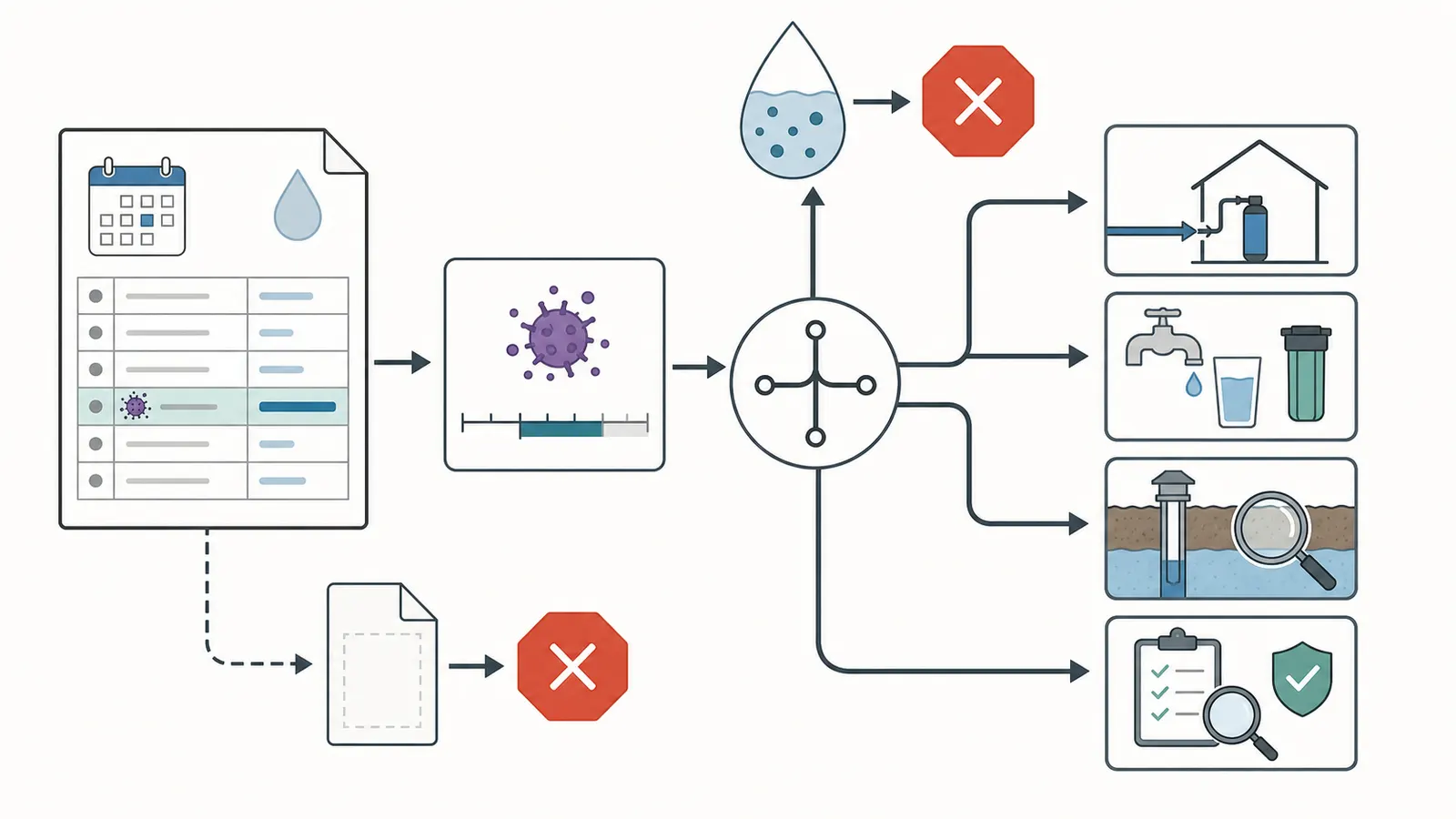
Build the contaminant brief
For the result you have, record:
| Field | What to capture | Why it changes the purchase |
|---|---|---|
| Sample identity | Date, location, tap or raw-water point, and whether treatment was bypassed | A treated kitchen sample cannot prove what the well source contains, and a raw sample cannot prove the finished water at the tap. |
| Laboratory | State-certified laboratory, report number, method, and reporting limit | A sales test kit or visual impression is not the same evidence as a laboratory result with a defined method. |
| Contaminant | Exact name, not a category such as “chemicals” or “metals” | Certification claims are named. “Heavy-metal reduction” is not a substitute for a lead, arsenic, or other specific claim. |
| Result and units | Concentration, qualifier, and applicable comparison value | The treatment goal depends on what was measured and at what level. Do not turn a non-detect into proof that a filter would remove the contaminant. |
| Intended use | Drinking and cooking, whole-house use, or a quality-of-life issue such as staining or odor | Point-of-entry treats water for the building; point-of-use can be the more focused scope for drinking water. |
| Source context | Well repairs, flooding, nearby agriculture, fuel, mining, septic, or a recent taste, odor, or color change | A changing source may need investigation or a new sample before a treatment purchase. |
EPA recommends annual testing of a private well for total coliform bacteria, nitrates, total dissolved solids, and pH, and says to test immediately after conditions such as flooding, land disturbance, well-system repair, or a noticeable water-quality change. Its list is a baseline, not a universal panel for every property. Nearby activities, regional geology, and household conditions can justify additional analytes. See EPA's private-well testing guidance and bring the property's context to the laboratory or local health department.
EPA's WaterSense guide says well homes should have water periodically tested by a state-certified lab and use the results to identify treatment goals. That sequence matters: EPA's treatment-selection guide treats the lab result as an input to treatment selection, not as an optional confirmation after buying.
The first pass/fail gate
Pass only if you can answer all three questions:
- What exact contaminant or water-quality characteristic is the system supposed to address?
- Where and when was that condition measured?
- Is the intended scope drinking water, every fixture, or both?
If the answer is “the water tastes bad,” “the seller says it handles everything,” or “the box says 0.5 micron,” stop at this gate. Taste, odor, color, and sediment are useful observations, but they do not identify a health contaminant or prove a reduction claim. Order the appropriate test and define the treatment goal first.
If harmful contamination is suspected or confirmed, do not use this buying workflow as permission to drink the water. Follow the laboratory, health-department, and treatment professional's instructions for a safe alternative and for confirming that water is suitable for use again.
2. Search the exact model in the certifier's directory
Ask the seller for the complete product identity before comparing price:
- manufacturer and brand;
- exact model, SKU, or ordering code;
- included housing, cartridge, media tank, UV chamber, controller, and fittings;
- replacement cartridge or lamp model;
- current performance data sheet and installation manual;
- certifier name and the applicable standard; and
- the claim the seller says matches your lab result.
Do not search only the product family name. A family can contain different sizes, cartridges, flow paths, or revisions. A replacement cartridge can have a different claim from the housing. A component can be listed for material safety while the assembled system has no named contaminant-reduction listing. Your audit is about the thing you will buy and install, not the closest-looking entry.
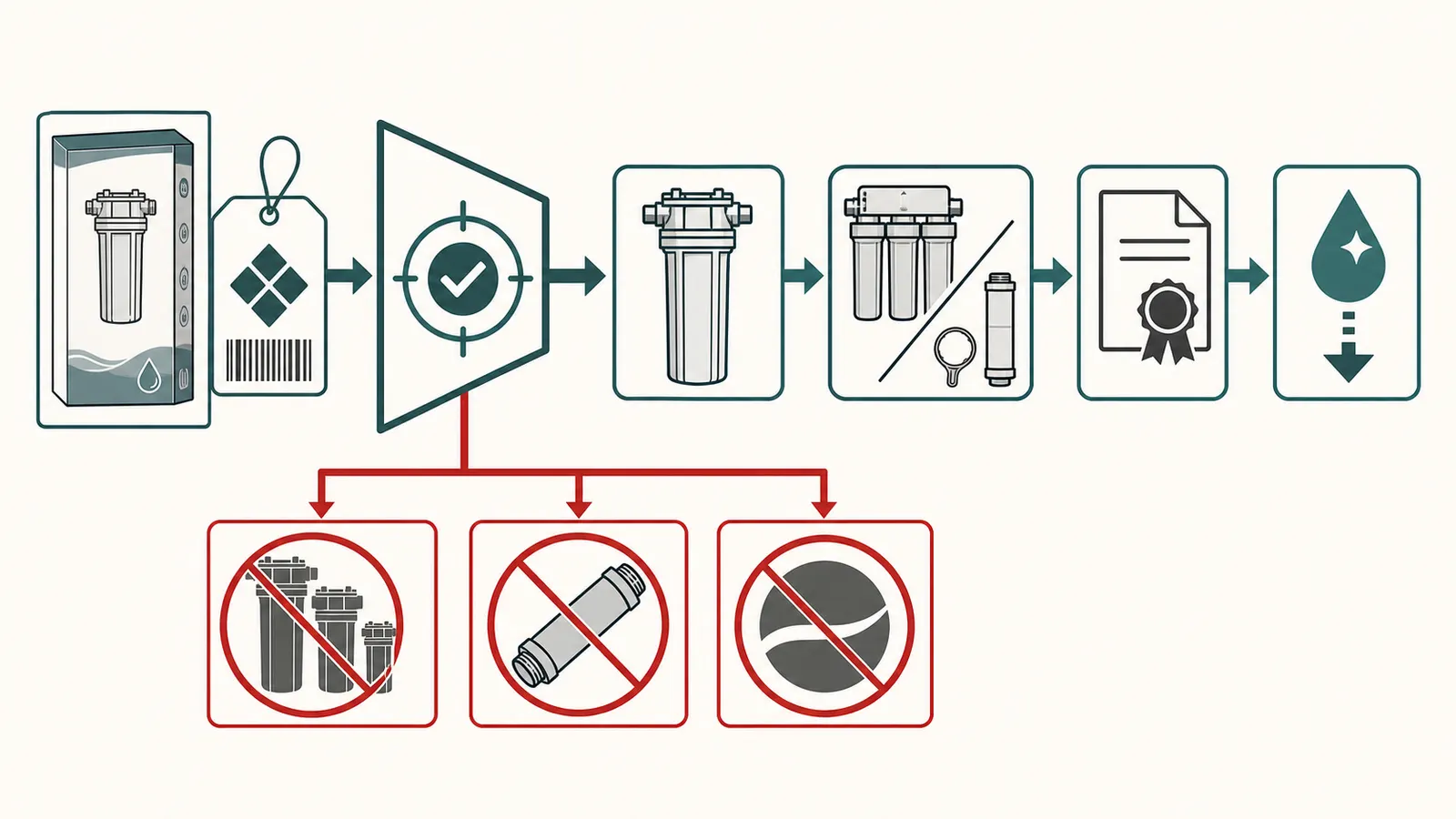
Use the directory as the identity check
The NSF Drinking Water Treatment Unit directory provides fields for manufacturer, brand or model, product standard, product type, and named reduction claim. Search the model first, then filter or inspect the entry for the contaminant from the lab brief. Save the listing URL or a dated copy of the result with your purchase records because directory status can change.
NSF's own water-filter FAQ says a mark on packaging is not the final check: consumers should verify current third-party certification on the certification body's website. A logo, “tested to,” “uses NSF components,” or “NSF media” phrase is not equivalent to an exact whole-system listing for your contaminant.
Classify the listing before reading the percentage
Mark one of these in your worksheet:
| Listing type | Evidence it can support | What it cannot prove by itself |
|---|---|---|
| Complete-system listing | The named assembled system, in the listed configuration, has the listed certification scope | That every cartridge or future replacement, every flow, and every installation condition will match the listed configuration |
| Component or material listing | A named housing, valve, media, cartridge, UV reactor, or other component meets the stated component or materials scope | That the installed train, assembled system, or another model reduces your well contaminant |
| Materials-safety listing | The listed product or material meets requirements related to substances imparted to drinking water | Removal of lead, nitrate, bacteria, PFAS, arsenic, or any other contaminant already in the incoming water |
| Manufacturer or laboratory performance claim | The claim and test conditions reported in the cited sheet or report | Independent certification, field performance at your well, or a claim broader than the test scope |
The phrase “certified components” should therefore trigger a second question: certified for what, and at what level of assembly? The product listing, performance sheet, and manual should agree on the same model and configuration. If they do not, record “unverified” and ask the manufacturer or certifier for a written clarification before paying.
3. Translate the standard number into a limited promise
A standard number is a category of requirements, not a universal water-cleaning grade. The claim must name the contaminant or performance objective.
| Badge or standard in the evidence | What it may establish in this audit | What it does not establish alone |
|---|---|---|
| NSF/ANSI 42 | A drinking-water treatment unit's aesthetic-effects claim, such as a listed taste, odor, or chlorine reduction | Reduction of a health contaminant merely because the product also displays “NSF” |
| NSF/ANSI 53 | A health-effects claim only for the contaminant or contaminants named in the listing or performance sheet | Removal of every health contaminant, or a whole-house claim at an unstated flow |
| NSF/ANSI 55 | A UV water-treatment standard; the system still needs the applicable class, flow, dose, pretreatment, and maintenance evidence | Chemical removal such as heavy metals or organics; EPA specifically lists UV as not effective against those chemicals |
| NSF/ANSI 61 | Health-effects requirements for chemical contaminants and impurities indirectly imparted by components and materials that contact drinking water | Reduction of a contaminant already present in the well water |
| NSF/ANSI/CAN 372 | Lead-content compliance for the product or component under the standard's methodology | Lead reduction in incoming water, or a complete-system reduction claim |
The EPA WaterSense comparison identifies 42 and 53 for filtration, 55 for UV, and explains that typical filtration does not remove nitrates, bacteria, or dissolved minerals. That is a technology-level boundary; the exact certified product can have a narrower or different claim. For the materials distinction, NSF's description of NSF/ANSI 61 says the standard does not establish performance, taste and odor, or microbial-growth-support requirements. NSF's 372 technical requirements state that 372 addresses lead content only.
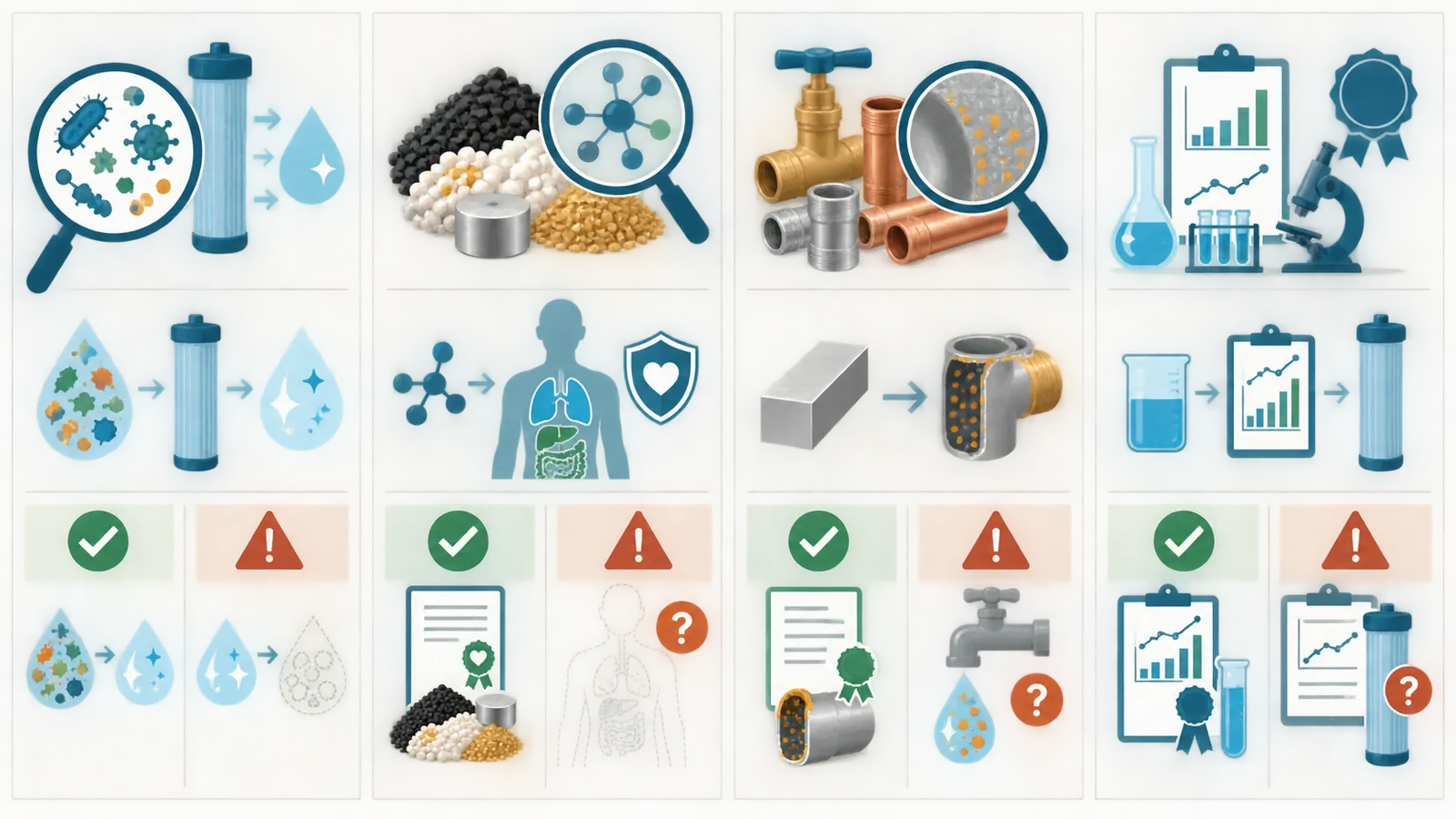
A certification pass requires a named match
For each contaminant in your lab brief, write the result as a sentence:
“The exact [model/SKU] is listed by [certifier] for reduction of [named contaminant] under [standard], in the [complete system/component] configuration.”
If you cannot complete the sentence from the certifier's current listing and the model's performance sheet, the claim fails verification. “Lead-free” or “meets NSF 372” can be valuable materials evidence, but it does not complete the sentence “reduces lead in my well water.” “NSF 53” also does not complete it until the listing names which 53 claim applies.
4. Reconcile the performance sheet with the well system
A named claim can still be a poor purchase if the system cannot deliver the required water at the pressure and flow your household needs. Read the performance sheet as a test boundary, not a headline.
Record each item separately:
| Performance field | Evidence to copy exactly | Decision question |
|---|---|---|
| Rated service flow | Gallons per minute and whether it is a rated, peak, or maximum value | Does the published test flow cover the flow you need while preserving the named reduction? |
| Pressure drop | Clean and/or loaded pressure loss at a stated flow | Will the filter leave usable pressure at the farthest fixture and through the rest of the treatment train? |
| Capacity | Gallons, liters, time, or another trigger, plus the flow and influent conditions | Is the capacity tied to the named contaminant and test conditions, or is it only a generic cartridge-life estimate? |
| Influent range | Starting contaminant concentration, water chemistry, turbidity, temperature, or other limits | Does your lab result fall within the tested or published operating range? |
| Operating pressure | Minimum and maximum pressure, static or flowing if stated | Is the well pressure system inside the equipment's limits at both low and high cycles? |
| Temperature | Minimum and maximum water temperature | Is the equipment installed on the intended cold-water line and within its limit? |
| Configuration | Housing, media volume, cartridge, UV lamp, controller, fittings, and flow direction | Is the listing for the exact assembly, not an optional or smaller part? |
| Pretreatment | Sediment, iron, manganese, hardness, carbon, softening, or other required upstream treatment | Can the system remain within its tested conditions as the well water changes? |
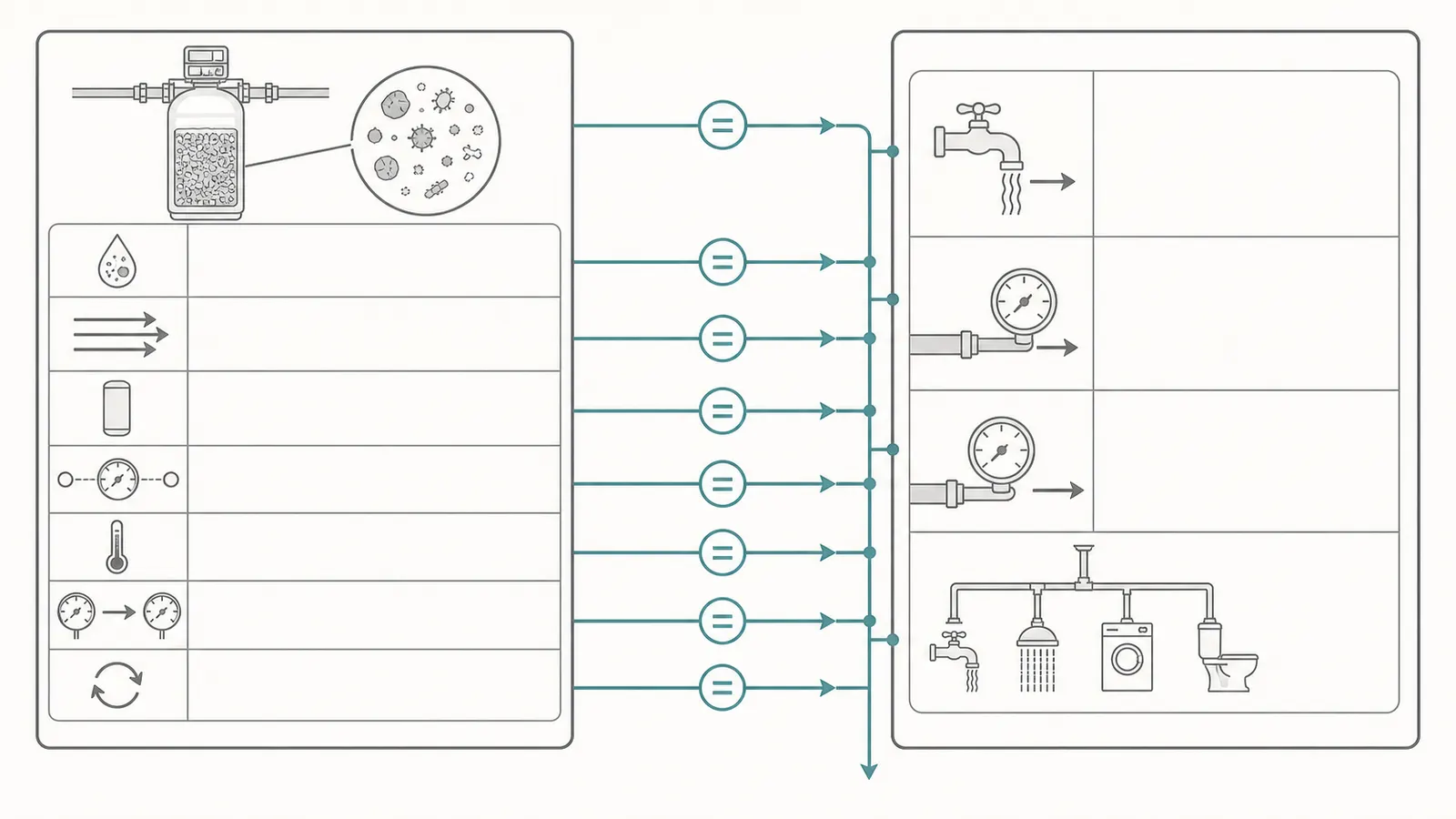
One manufacturer sheet illustrates why this detail matters. Aquasana's EQ-OPTM performance data names model EQ-OPTM, a rated lead capacity and flow of 106,750 gallons at 4.82 GPM, a peak-flow entry of 8.54 GPM, minimum and maximum operating pressure of 20 and 125 psig, and minimum and maximum operating temperature of 34 and 120°F. The same sheet says the system was tested and certified by IAPMO R&T against NSF/ANSI 53 for lead, cysts, and materials safety, while also warning that actual performance depends on influent quality, flow rate, system design, and application and that operating, maintenance, and replacement requirements must be followed.
That is the shape of useful evidence: model, claim, test flow, capacity, operating range, configuration, and conditions in one place. It is not permission to copy 4.82 GPM, 8.54 GPM, 20 psig, or the stated capacity to a different product.
Measure the household demand without pretending it is a certification test
If you already have safe, readable inlet and outlet gauges, record them at the same time as a known flow. Do not remove covers, open a control box, loosen pressurized fittings, or install gauges on a live system as a casual experiment. Ask a qualified water professional to add measurement points when they are absent or when the system's pressure behavior is unclear.
For a simple outlet observation, measure a known volume and time it:
flow in GPM = gallons collected × 60 ÷ seconds
Example: if a safe-to-use fixture fills 2 gallons in 30 seconds, the observed fixture flow is 2 × 60 ÷ 30 = 4 GPM. Label this as an observed fixture flow, not the home's certified peak demand. A whole-house decision must also account for simultaneous fixtures, well-pump delivery, pressure-tank cycling, treatment backwash or flush events, and the flow required by any UV unit. Have the installer reconcile the final design flow with the equipment manual.
For pressure drop, use paired readings under the same flowing condition:
observed pressure drop = inlet pressure − outlet pressure
Do not compare a static inlet reading with a flowing outlet reading and call the difference filter loss. If the product sheet does not publish pressure drop at a comparable flow, record “not reconciled.” A smaller micron number or higher reduction percentage is not a free performance upgrade; it can change flow, loading rate, maintenance frequency, or pretreatment requirements.
5. Audit pretreatment and the replacement trigger
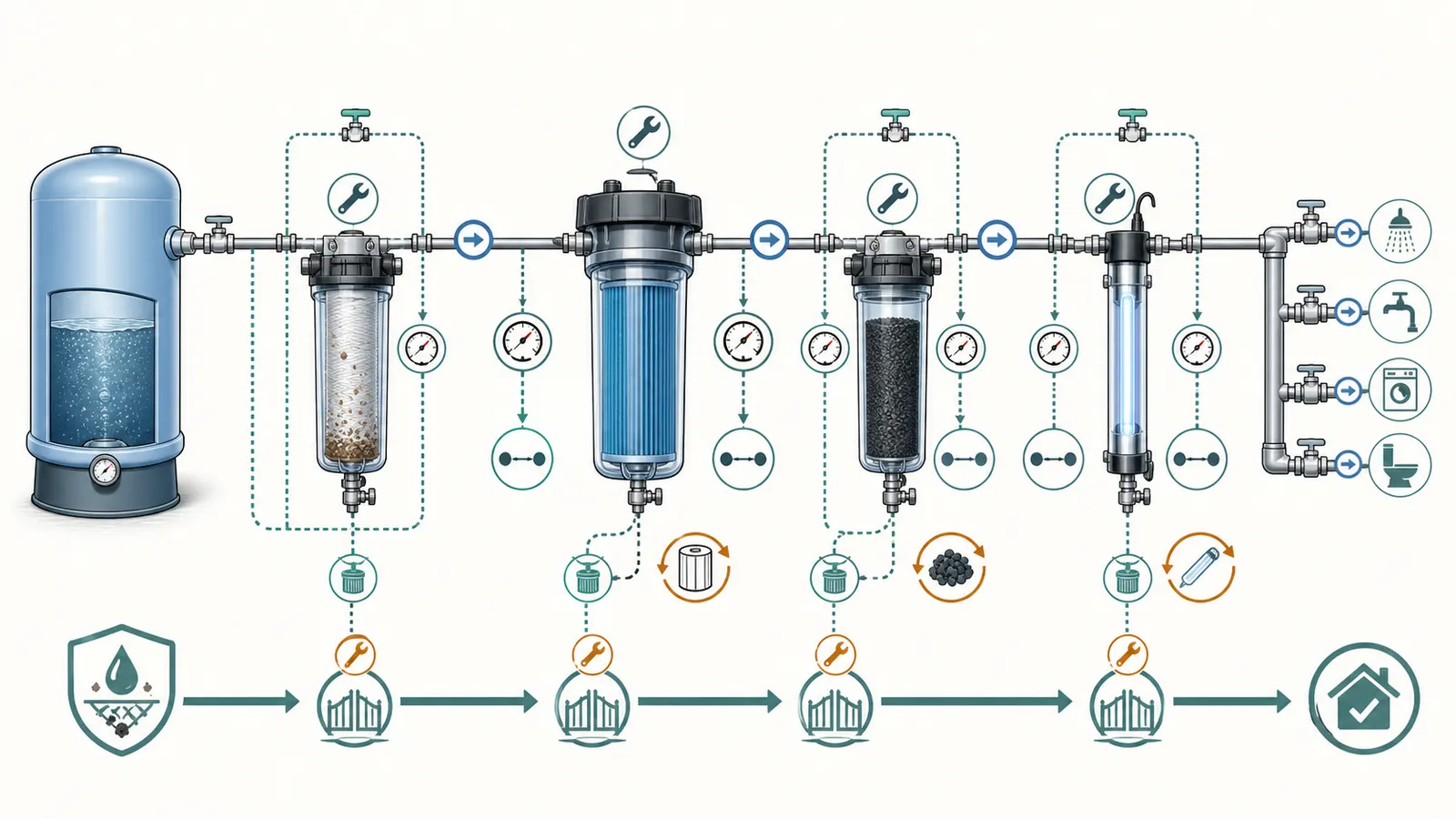
Whole-house treatment is a chain. A main filter can be correctly certified and still be a poor installation if sediment plugs it, iron coats a UV sleeve, hardness fouls a membrane or treatment surface, or the replacement trigger is ignored.
Look upstream and downstream
Draw the water path from the pressure tank to the fixtures. For each stage, record what it is supposed to do and what it is not supposed to do:
| Stage | Verify | Do not infer |
|---|---|---|
| Sediment screen or cartridge | Particle target, construction, flow, pressure drop, cleaning or replacement trigger | That sediment filtration removes nitrate, bacteria, dissolved metals, or a chemical contaminant |
| Carbon or specialty media | Named contaminant, capacity, contact or service flow, influent limits, and exhaustion trigger | That the media lasts a fixed number of months regardless of concentration and household use |
| Softener or conditioning stage | Hardness target, regeneration or salt/water requirements, discharge rules, and model-specific certification | That “conditioned” means a health contaminant was removed |
| UV | Standard, class or dose evidence, rated flow, lamp status, sleeve condition, upstream water-quality requirements, and alarm behavior | That UV removes chemicals or continues protecting water when the lamp is off or the sleeve is fouled |
| Final drinking-water stage | Point-of-use claim, flow, capacity, and replacement trigger | That a whole-house quality-of-life filter is sufficient for the kitchen tap |
The Pentek Dura-Series manual is a helpful example of separated fields. Its cartridge table lists filtration rating, construction, maximum flow rate and pressure drop, filter life, and reduction categories as different specifications. It lists, for example, whole-house cartridges with different nominal micron ratings and different flow, pressure-drop, and service-life entries. Treat a product table the same way: a micron value does not stand in for a flow rating, a capacity, or a contaminant reduction claim.
The same manual gives a 30–125 psi range for its listed 3/4-inch housing and warns that it must not be used with microbiologically unsafe or unknown-quality water without adequate disinfection. Those values are for that named housing, not a universal whole-house limit. The manual also instructs the user to shut off supply, relieve pressure, and check for leaks during cartridge service. Use the exact manual for the product you are considering.
If a treatment train includes UV, maintenance is part of the safety claim. VIQUA's FAQ says most of its UV lamps have an approximately 9,000-hour useful life and require annual replacement in a full-time residence; it also says the quartz sleeve must be kept free of hardness or iron deposits and that pretreatment equipment requires proper maintenance. That is manufacturer-specific guidance, but it demonstrates the decision rule: a UV label without a lamp, sleeve, alarm, flow, and pretreatment plan is incomplete evidence.
Convert “capacity” into an actionable trigger
A capacity number is only useful if someone knows when to replace or service the equipment. Record the trigger in operational language:
- gallons treated, if a reliable meter is present;
- calendar interval, if the manufacturer specifies one;
- pressure-drop threshold, if the manual gives one;
- lamp hours or alarm state for UV;
- media exhaustion, test result, or service interval; and
- a re-test plan after installation or replacement.
Do not invent a replacement interval from a product's warranty or from another home's experience. If the sheet says “capacity varies with water conditions” but gives no homeowner-observable trigger, ask the manufacturer or installer how exhaustion will be detected. If the answer is only “replace when it smells bad” for a health claim, treat the health protection as unverified.
6. Decide whether whole-house is the right scope
Whole-house point-of-entry treatment is not automatically the safer or more complete answer. It treats water at the building entry for toilets, showers, laundry, and drinking uses, so it must process much more water than a kitchen point-of-use system. EPA describes point-of-entry systems as best suited to consistent and significant contamination challenges and notes that installation may require plumbing alterations and professional maintenance.
Use this scope test:
| Situation | Scope question | Safer decision posture |
|---|---|---|
| A health contaminant is confirmed in raw well water | Must every fixture be treated, or is the exposure limited to drinking and cooking? | Compare a complete point-of-entry train with a certified point-of-use option; do not assume a sediment or taste filter addresses the health contaminant. |
| The issue is odor, staining, scale, or visible sediment | Is the problem source-specific, fixture-specific, or present throughout the house? | Investigate the well and plumbing; select treatment only after identifying the cause and the maintenance burden. |
| Bacteria or surface-water influence is suspected | Can the system provide the required disinfection performance at the actual flow, with functioning pretreatment and maintenance? | Involve the health department and a qualified treatment professional before relying on a whole-house device. |
| Nitrate, dissolved minerals, or another dissolved contaminant is present | Does the proposed technology address that named contaminant? | A conventional sediment or carbon filter is not enough merely because water passes through it; evaluate an appropriate certified technology and scope. |
| Water quality changed after flooding, repair, or nearby activity | Is the source stable enough to size treatment? | Re-test and investigate the well condition before committing to a large system. |
EPA's guide says filtration does not remove nitrates, bacteria, or dissolved minerals in its typical technology comparison, while reverse osmosis has its own reject-water, pressure, maintenance, and scope considerations. The point is not that one technology always wins; it is that “whole-house filter” is a location and delivery description, not a contaminant diagnosis.
When a whole-house claim is the wrong purchase
Mark the purchase as “wrong scope” when any of these is true:
- the lab result names a contaminant absent from the product's reduction listing;
- only a component or materials listing is available for a complete-system promise;
- the treatment is designed for taste, odor, or sediment but the goal is a health contaminant;
- the system's rated flow or pressure conditions do not cover the household demand;
- required pretreatment is missing, undersized, or not maintained;
- the replacement trigger cannot be observed or documented; or
- the well condition is changing and no updated lab result or source investigation exists.
That result is useful. It tells you whether to investigate the well, choose a different technology, limit treatment to drinking water, or request a professional design rather than buying a high-capacity box on the strength of a badge.
7. Complete the claim-audit worksheet
Copy this table into your home records or use it while comparing two models. A pass means the evidence is attached or linked and matches the exact item you would buy. A blank is not a pass.
| Evidence field | Model under review | Pass / fail / unverified | Evidence location or question |
|---|---|---|---|
| Lab contaminant and result | Report page, sample point, date, units, and lab method | ||
| Intended use and scope | Drinking/cooking, whole house, or quality-of-life objective | ||
| Exact manufacturer and model/SKU | Product label, quote, data sheet, and manual all agree | ||
| Certifier and current directory entry | Direct listing URL or saved dated record | ||
| Product type | Complete system, cartridge, housing, media, UV reactor, or other component | ||
| Applicable standard | Standard number plus product-specific listing | ||
| Named contaminant-reduction claim | Exact wording; do not substitute “NSF” or “lead-free” | ||
| Test flow | Rated or peak flow at which the named claim was tested | ||
| Capacity | Gallons or other capacity tied to contaminant, flow, and conditions | ||
| Pressure range | Minimum and maximum operating pressure; static/flowing basis if stated | ||
| Pressure drop | Clean and loaded loss at a comparable flow | ||
| Temperature range | Product limit and actual cold-water installation | ||
| Influent limits | Starting concentration, turbidity, hardness, iron, or other conditions | ||
| Pretreatment | Required sediment, iron, hardness, carbon, or other upstream stage | ||
| Maintenance trigger | Gallons, pressure loss, lamp hours, test result, calendar, or alarm | ||
| Replacement parts | Exact cartridge, media, lamp, housing, and availability | ||
| Post-installation verification | Lab re-test, commissioning record, and date for follow-up | ||
| Professional questions | Flow, pressure, well yield, local requirements, and installation exclusions |
The five-minute decision result
After filling the worksheet, classify the proposal:
Verified for the stated purchase goal: every mandatory identity, claim, scope, and operating-condition field is supported, and the well result is within the documented treatment and installation conditions.
Conditionally plausible, not yet verified: the technology appears relevant, but a listing, model match, influent limit, pressure-drop value, pretreatment requirement, capacity, or replacement trigger is missing. Ask for that evidence before buying.
Not verified: the model is absent from the certifier directory, the named contaminant is absent from the listing, the evidence applies only to a component, or the seller broadens a materials or laboratory claim into whole-house contaminant removal.
Wrong scope or escalate: the issue is health-critical, the water is currently unsafe or changing, the equipment cannot meet flow or pressure, or the design needs source correction, disinfection, or a professional treatment train.
8. Stop safely and hand over the right evidence
High-safety water work has two separate risks: unsafe water and unsafe equipment service. Do not open energized pump or UV controls, test live wiring, open a well, pull a pump, enter a confined space, or manipulate pressurized equipment to complete this worksheet. Do not bypass an alarm, relief device, or treatment stage to make a sales claim appear to work. Cartridge replacement is only a homeowner task when the exact manual makes the isolation, pressure relief, electrical state, spill control, and leak check demonstrably safe; otherwise assign it to a qualified professional.
Bring this packet to the next professional conversation:
- the complete lab report and sample location;
- the exact model/SKU, performance sheet, manual, and certifier listing;
- the contaminant-to-claim sentence for each treatment goal;
- the household flow observations and any existing inlet/outlet pressure readings;
- the well, pressure-tank, pump, plumbing, and treatment history;
- the proposed pretreatment, service, replacement, and re-test plan; and
- the worksheet rows marked fail or unverified.
Ask the installer or water professional to state in writing what is included and excluded: source investigation, well-yield or pump evaluation, plumbing alterations, electrical work, bypasses, drainage, disinfection, commissioning, laboratory re-test, and recurring maintenance. Local plumbing, electrical, health, wastewater, and discharge requirements are jurisdiction-specific; neither an NSF mark nor this worksheet replaces them.
The final rule is simple: buy the claim you can trace. A current well result identifies the target. An exact certifier listing identifies the scope. A performance sheet defines the conditions. A manual defines the operating and maintenance limits. If those four documents do not agree, your most evidence-backed decision is to pause, ask a precise question, or change the treatment scope.
Sources and scope
Evidence behind this page
- Protect Your Home's Water
U.S. private domestic wells; testing guidance is not a treatment-performance guarantee or a complete contaminant panel for every property.
- WaterSense Guide to Selecting Water Treatment Systems
EPA consumer guidance for residential water treatment; the guide does not select a product for a specific private well.
- WaterSense Guide to Selecting Water Treatment Systems
General U.S. residential point-of-entry treatment guidance; installation cost and local requirements vary.
- WaterSense Guide to Selecting Water Treatment Systems
EPA's technology comparison describes typical technologies and limitations, not every product or every certified configuration.
- NSF Certified Drinking Water Treatment Units Listing
NSF's public listing interface and currently listed treatment categories; the exact listing must be checked for the product under review.
- Water Filters FAQs
NSF consumer guidance for checking certification and selecting a product-specific contaminant claim.
- NSF/ANSI Standard 61: Drinking Water System Components — Health Effects
NSF's educational description of the component-materials standard; it supports a materials-safety distinction, not a contaminant-removal claim.
- NSF/ANSI/CAN 372 Technical Requirements
NSF's technical description of lead-content compliance; it does not establish reduction of lead already present in the incoming water.
- Performance Data for the OptimH2O Whole House Water Filter — Model EQ-OPTM
One manufacturer's complete-system performance sheet for one named model; its values cannot be transferred to another model, cartridge, or installation.
- Pentek Dura-Series Water Filter Installation and Operating Instructions
Pentek Dura-Series housing and listed cartridges; the table is product-family-specific and not a cross-brand performance rule.
- Pentek Dura-Series Water Filter Installation and Operating Instructions
The named Pentek housing manual only; other housings, media tanks, UV systems, and installations can have different limits and procedures.
- VIQUA FAQs
VIQUA UV guidance and product family; it is not an annual replacement rule for every UV system.