How to Test an RO Membrane’s Rejection Rate: A Homeowner Worksheet
Measure comparable RO feed and permeate TDS, calculate rejection, and separate a membrane issue from tank, pressure, prefilter, or blending problems.
The short answer
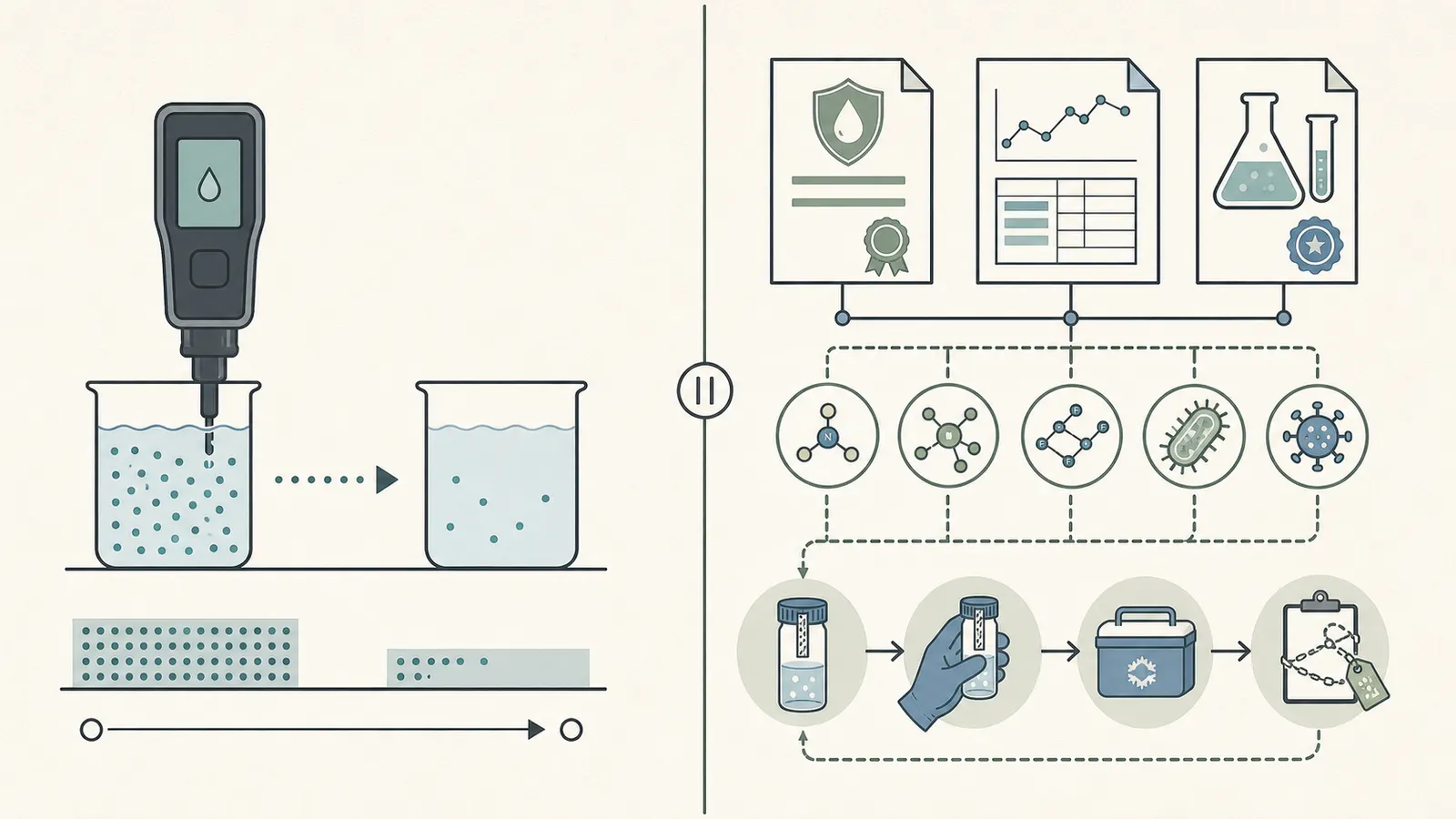
Use the same calibrated TDS meter to test feed water before treatment and membrane permeate after the system is flushed and any storage tank, blending valve, or remineralizer is accounted for. Calculate [(feed TDS − permeate TDS) ÷ feed TDS] × 100. Record temperature, pressure, tank state, sample points, and filter age. A low result screens for a system issue; it does not prove removal of nitrate, arsenic, PFAS, bacteria, or another named contaminant.How to Test an RO Membrane’s Rejection Rate: A Homeowner Worksheet
If you want to screen whether a point-of-use reverse-osmosis membrane is still reducing dissolved solids, compare two samples collected at comparable points: feed water entering the RO process and membrane permeate leaving the membrane. Use the same TDS meter, record temperature and pressure, and identify whether a storage tank, blending valve, or remineralizer sits between the membrane and your sample. Calculate:
Rejection rate (%) = [(feed TDS − membrane-permeate TDS) ÷ feed TDS] × 100
That percentage is a maintenance signal, not a health clearance. A high rejection result does not prove removal of nitrate, arsenic, PFAS, bacteria, viruses, or another named contaminant. Those claims require a model-specific certification or performance data sheet and, when you need to know what is actually in your water, the right laboratory test.
The safest useful outcome is a defensible record: what you measured, where you measured it, under what operating conditions, and what the result does—or does not—justify doing next.
1. Know what this test can—and cannot—answer
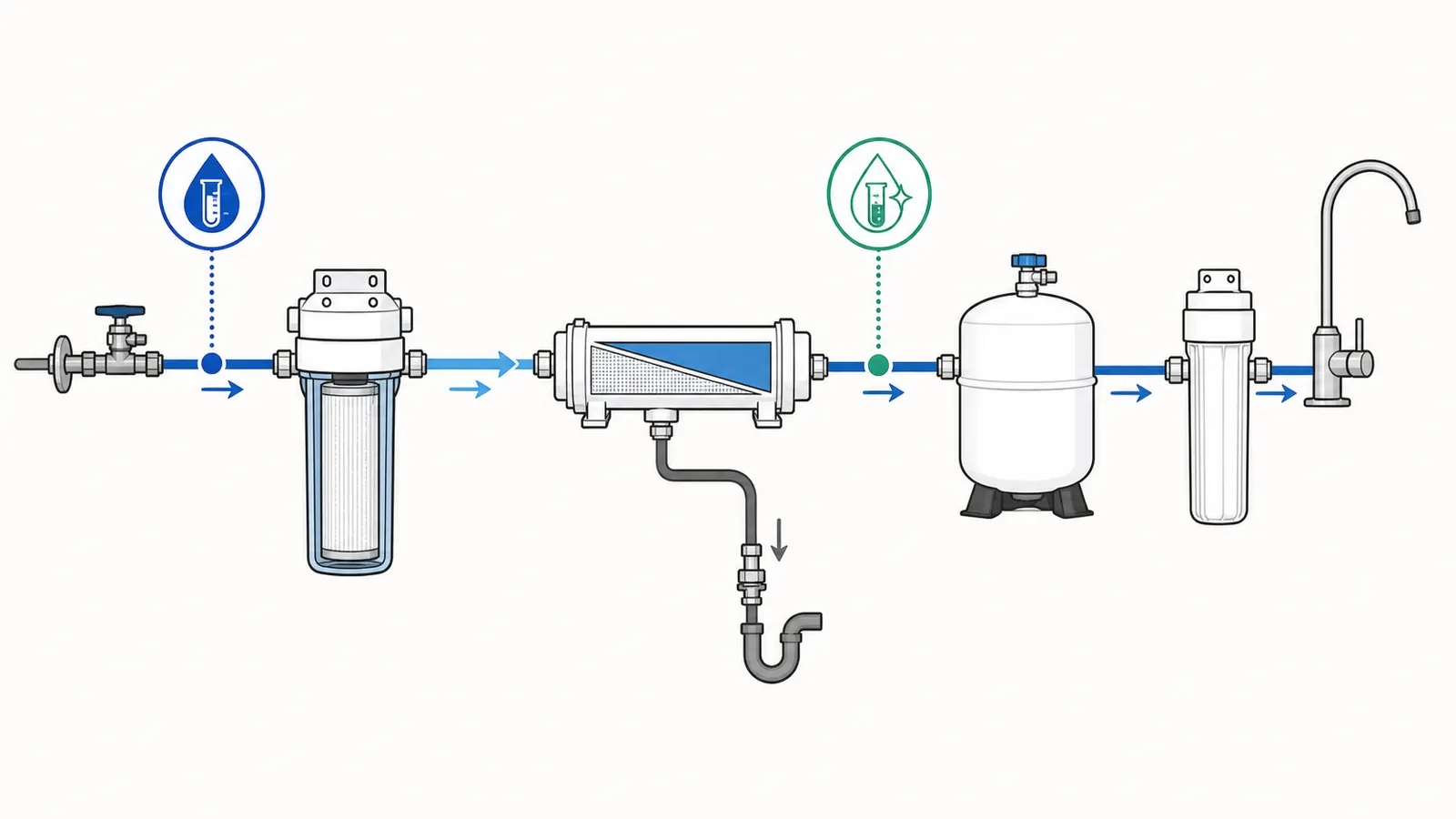
Reverse osmosis uses pressure to move water through a semipermeable membrane. The water that passes through is called permeate; the concentrated stream sent away from the membrane is called reject, concentrate, or brine. That distinction matters because an RO faucet may deliver water that has already passed through a storage tank, postfilter, remineralizer, or blending valve. It is not automatically a direct membrane-permeate sample. EPA describes the two RO streams and the point-of-use process here.
TDS means total dissolved solids. Brictale measurement boundary: For this worksheet, treat a handheld TDS meter’s ppm or mg/L display as an instrument estimate based on electrical conductivity, not a direct inventory of substances. USGS notes that conductivity can approximate dissolved-solids content, but the relationship varies with the type and concentration of ions in the water. That measurement boundary is explained in the USGS water-quality tables. The meter is useful for comparing the system with itself over time. It is not a laboratory identification of which substances are present. Similar displayed TDS readings can therefore conceal different dissolved substances, and a named contaminant can matter even when it contributes little to the overall TDS reading.
The result can answer a narrow maintenance question:
“Under these recorded conditions, did this RO path reduce the meter’s dissolved-solids reading by roughly the amount I expected compared with my prior record or the manufacturer’s stated performance?”
It cannot answer any of these questions by itself:
- Is the water safe to drink?
- Has the system removed nitrate, arsenic, PFAS, lead, bacteria, viruses, or another specific contaminant?
- Is the membrane certified for the contaminant in my water?
- Is the result comparable to a catalog rating taken at a different temperature, pressure, feed TDS, recovery, or sample point?
- Should I replace the membrane before checking pressure, filters, tank state, blending, and reject flow?
NSF explains that NSF/ANSI 58 covers TDS reduction but also has separate claim categories for contaminants such as arsenic, nitrate/nitrite, lead, and other substances. The presence of a TDS claim is not the same as the presence of every optional contaminant claim. See NSF’s overview of NSF/ANSI 58 claim types.
EPA’s WaterSense specification makes the distinction explicit for labeled systems: if a listed contaminant has no verified reduction claim, the system has not been verified to remove that contaminant under NSF/ANSI 58. Use the product’s performance data sheet or a certification listing for the exact model. Read the WaterSense documentation requirement.
2. Prepare the measurement without changing the system
Identify the water path
Before opening a cabinet, take a photo of the tubing labels and write down the brand, model, membrane part number if visible, installation date if known, and the age of the prefilter, carbon filter, postfilter, and remineralizer. Note whether the unit is:
- tankless;
- a tank system with a dedicated RO faucet;
- connected to a refrigerator or ice maker;
- fitted with a permeate pump or booster pump;
- fitted with a blending valve or remineralizer; or
- connected to a water softener or other pretreatment.
Find the owner’s manual before touching a valve, tank, cartridge, electrical plug, or tube. The manual should identify the feed connection, membrane permeate line, reject line, tank connection, sample valve, flush mode, and any service interval. If the manual does not provide a homeowner-accessible sample point, do not disconnect tubing just to create one.
The 3M TFS450 manual is a useful example of why model information matters. It has a sample valve, pressure gauges, a blending valve, a storage-tank connection, and a TDS monitor; its troubleshooting table treats prefilter restriction, membrane fouling, tank air charge, feed pressure, product TDS, and reject flow as separate checks. That is evidence for a troubleshooting sequence, not a universal design for every residential RO system. Use your own model’s manual first; the 3M example is here.
Set a safe boundary
This worksheet is for observation, external sampling, and arithmetic. Do not open energized controls, test live wiring, open a well, pull a well pump, enter a confined space, or manipulate a pressurized tank, pressure switch, booster pump, or plumbing connection unless the owner’s manual gives a specific homeowner-safe procedure and you can follow it without exposing yourself to water, electrical, or stored-pressure hazards. Assign those tasks to a qualified plumber, water-treatment professional, or electrician as appropriate.
Do not remove a cartridge housing or membrane vessel under pressure. Do not loosen a tube fitting to “get a sample.” Do not use a handheld TDS reading to decide that microbiologically unsafe or unknown-quality water is safe. The cited 3M manual, for example, warns against using microbiologically unsafe or unknown-quality water without adequate disinfection and requires shutoff and depressurization before cartridge removal. See the manual’s safety instructions.
Jurisdiction boundary: State and local plumbing codes, permits, sampling requirements, and water-quality authority rules can differ. If you are unsure what applies, stop before altering plumbing, bypassing a device, or collecting a sample in a way that could conflict with those requirements. Contact the local building or plumbing authority, water-quality authority, or a qualified licensed professional.
Gather simple tools
Use:
- the same TDS meter for both samples;
- fresh batteries if the meter uses them;
- the meter’s calibration solution, if specified by its instructions;
- two clean, rinsed cups or sample containers;
- a thermometer or the meter’s temperature display, if available;
- the system manual;
- a pressure gauge only if the system has an owner-accessible gauge or the manual gives a safe connection method; and
- this record, with a pen or a phone camera.
Rinse the cups with the water being sampled. Avoid soap residue, dusty measuring cups, hot water, and containers that previously held cleaners. Follow the meter manufacturer’s instructions for calibration, rinsing, stabilization, and temperature compensation. If the meter reading drifts, record “unstable” instead of forcing a number.
3. Collect comparable feed and permeate samples
The sample point is part of the measurement. Write it down in plain language, such as “cold feed tee before prefilter,” “documented membrane-permeate sample valve,” “empty tank after manual flush,” or “dedicated faucet after postfilter and remineralizer.” “Kitchen faucet” is not enough.
Sample A: feed water
Use the cold-water line that supplies the RO, before the system’s prefilter whenever the plumbing and manual provide a safe, accessible point. If the only safe point is downstream of pretreatment, record that fact; it is still useful as a trend record, but it is not raw household feed water.
Run or flush the point according to the system instructions. Do not use hot water. Collect enough water to immerse the meter’s probe as instructed, avoiding contact with the cup. Let the display stabilize, then record TDS and temperature. Rinse the meter with the next sample or clean water as directed by its instructions.
Sample B: membrane permeate
The preferred permeate sample is from a documented membrane-permeate or product-water sample valve located before any blending valve, remineralizer, postfilter, or storage-tank treatment that could add or mix dissolved material. Many homeowners will not have that point. If you do not, use the safest accessible point and label exactly what it includes.
For a tankless unit, the dedicated faucet may be close to membrane permeate, but it may still have a postfilter, remineralizer, or automatic flush cycle. Record those components and follow the manufacturer’s flush instructions. For a tank unit, the first faucet draw may reflect stored water made earlier under different feed conditions. It can be a useful “water delivered to the glass” test, but it is not a clean membrane test unless the tank state and downstream components are controlled.
Storage tanks: flush, isolate, or label
EPA describes tank systems as storing RO-treated water so it is available without waiting for real-time treatment. That convenience creates a measurement problem: the sample can represent water produced over a period of time, not the membrane’s current output. EPA’s WaterSense product search explains the tank and tankless distinction.
Use one of these paths:
- Documented permeate sample point. Use it, and record that the sample bypassed the tank and downstream treatment.
- Documented tank-bypass or tank-flush procedure. Follow the manual exactly. Use only the valves or controls named by the manufacturer. Record whether the tank was empty, filling, full, or bypassed when the sample was taken.
- No safe bypass or sample point. Test the water at the normal faucet after a consistent draw or flush procedure and label it “delivered-water TDS, tank included.” Use it for a repeatable trend, not as proof of membrane rejection.
Do not depressurize or adjust a tank merely because an online article recommends a pressure value. Tank precharge, pressure limits, and valve arrangements vary. The 3M manual gives a model-specific empty-tank procedure and pressure range; that is not permission to apply the range to another tank. A professional should handle a leaking, damaged, waterlogged, or inaccessible pressurized tank.
Blending and remineralization
A blending valve intentionally allows some less-treated water to mix with RO water. A remineralizer can add dissolved minerals after the membrane. Either can raise the final faucet TDS even when the membrane is performing normally. A postfilter can also change the final sample’s chemistry without being evidence that the membrane failed.
If the manual provides a documented “no blend” or membrane-permeate position, use it for the membrane screen and return the setting to the normal manufacturer-recommended position afterward. If it does not, do not remove a cartridge, bypass a safety device, or turn a locked adjustment by guesswork. Label the faucet sample as blended or remineralized and compare it only with prior readings collected in the same configuration.
4. Calculate rejection and record the conditions
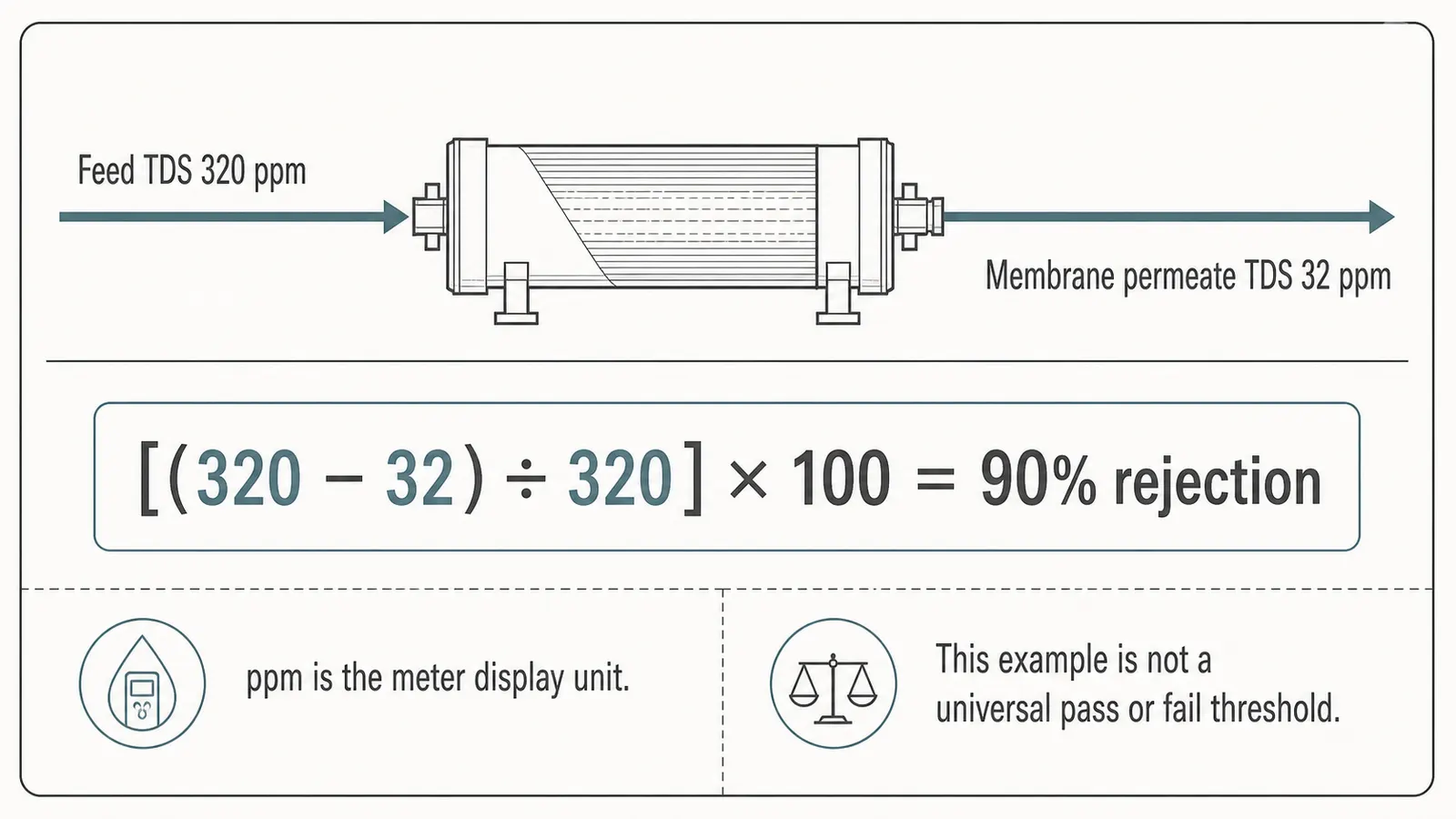
Use the feed and permeate readings from the same session. Keep the units the same; if the meter displays ppm for both, use those readings directly.
Rejection rate (%) = [(feed TDS − permeate TDS) ÷ feed TDS] × 100
Example:
| Reading | Value |
|---|---|
| Feed TDS | 320 ppm |
| Membrane-permeate TDS | 32 ppm |
| Difference | 288 ppm |
| Calculation | (288 ÷ 320) × 100 |
| Rejection rate | 90% |
If the permeate reading is greater than the feed reading, stop and check sample identity, cup cleanliness, meter condition, blending, and whether the two samples were taken under different conditions. Do not report a negative “membrane failure” percentage without resolving the sampling problem.
Record at least:
- date and time;
- system brand and model;
- membrane and pre/postfilter age, if known;
- feed sample point;
- permeate sample point;
- tank state and flush or draw procedure;
- blending or remineralization state;
- feed pressure while producing, if safely visible;
- water temperature for both samples;
- feed TDS and permeate TDS;
- meter model, calibration date or check, and whether readings stabilized;
- faucet flow or production symptom; and
- the action taken afterward.
Temperature and pressure belong in the record because published RO performance is tested under defined conditions. ASTM D5615-23 describes a short-term Standard Practice for home RO operating characteristics and notes that results may not represent natural waters or solutes other than sodium chloride. It also says the practice is not intended for system design. That is why a catalog percentage should be treated as a reference under its stated conditions, not as a promise that every household reading will match it. See the active ASTM D5615-23 scope and limitations.
For a WaterSense-labeled system, EPA requires at least 75% TDS reduction in the specified certification test. That figure is useful context, but it is not a universal homeowner cutoff: a non-WaterSense model may have a different manufacturer rating, the sample may include a tank or blend, and field conditions may differ from the test. See the WaterSense TDS criterion.
5. Interpret the result as a decision surface
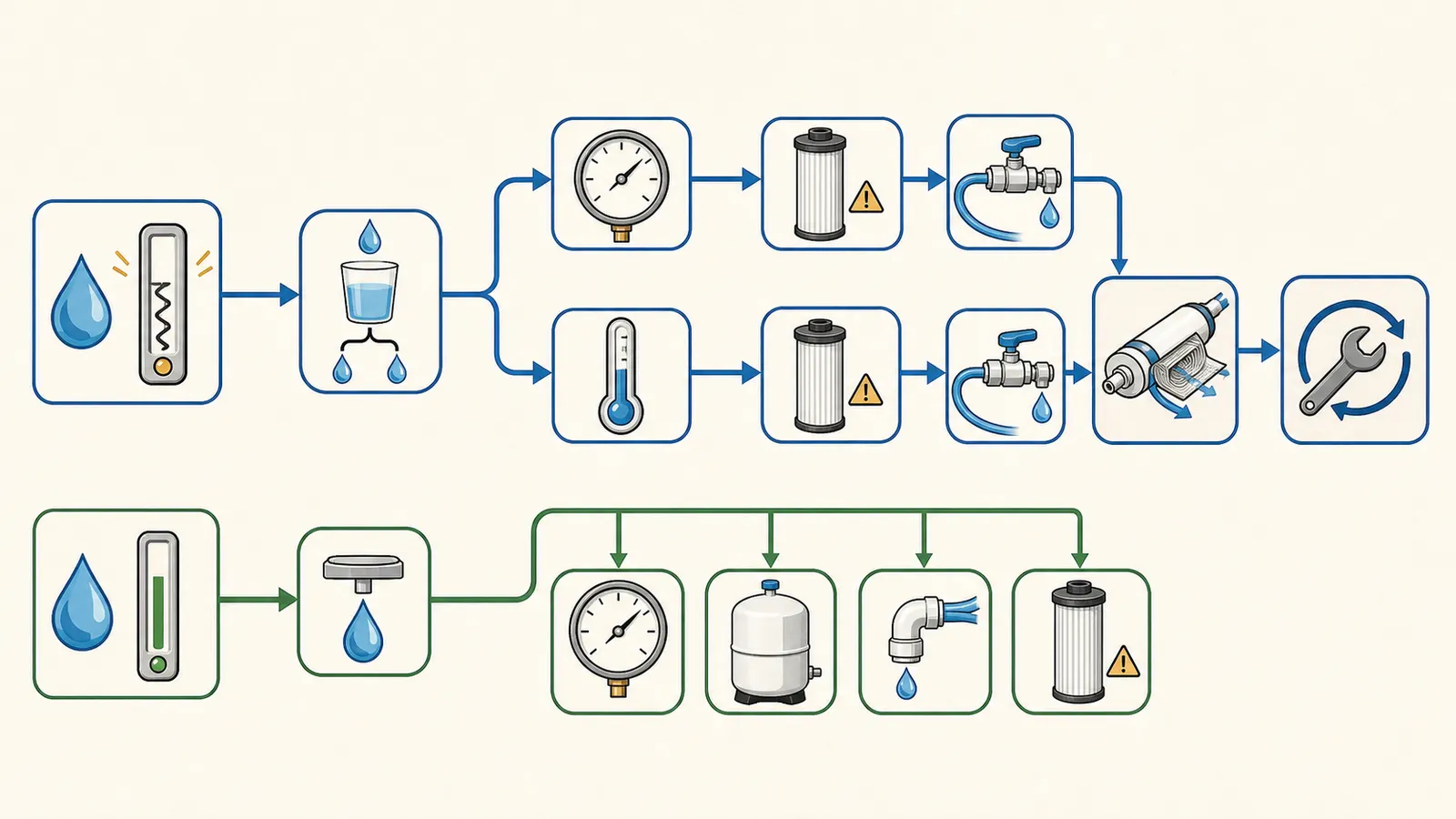
Use the reading together with the flow symptom and sample conditions. One isolated number is weak evidence; a repeatable record is stronger.
| Observation | More likely explanations to check first | Safest next step |
|---|---|---|
| Low rejection at a documented membrane-permeate point, with stable meter readings | Membrane age or fouling; feed pressure or temperature outside the manual’s conditions; chemical exposure or compatibility issue; incorrect membrane installation | Repeat once with the same points and conditions. Then compare with the model data sheet and have a qualified service person evaluate membrane and feed conditions before replacement. |
| Low rejection only at the faucet | Tank history, blending valve, remineralizer, postfilter, or sample-point mismatch | Test a documented pre-blend permeate point if available. If not, record the faucet result as delivered-water TDS and do not diagnose the membrane from it. |
| Normal rejection but very slow faucet flow or long refill time | Plugged prefilter or postfilter, low pressure, tank back-pressure or low drawdown, leak, kinked tubing, or restricted reject flow | Check only external, owner-approved indicators and the manual. Have a professional handle pressure, tank, tubing, or pump work. |
| Feed TDS changes sharply between sessions | Different supply source, softener or pretreatment state, flushing history, temperature, or meter problem | Repeat paired samples and record pretreatment and temperature. Do not compare percentages without the feed context. |
| Product TDS and flow both worsen after a service event | Wrong cartridge, incorrect tubing connection, closed valve, disturbed blend setting, or incomplete flush | Stop using improvised connections. Recheck the manual’s labels and startup procedure; correct leaks or installation errors professionally if the system must be opened. |
| TDS looks acceptable but water quality is in question | TDS does not identify the suspected contaminant or microbiological condition | Use a certified drinking-water laboratory and the correct contaminant-specific test. Do not use the TDS number as a safety release. |
The cited 3M manual specifically tells its operator to check feed pressure, temperature, production flow, and reject flow before replacing a membrane. It also lists low feed pressure, fouled membranes, storage-tank air charge, plugged pre/postfilters, leaks, and a kinked or plugged reject line as separate causes of low production or poor results. The exact values and parts are model-specific, but the sequence is broadly useful: verify the measurement, then the operating conditions and other flow restrictions, before buying a membrane. Read the manufacturer troubleshooting example.
When a low result is not enough to replace the membrane
Do not replace a membrane solely because the faucet TDS is higher than a vendor calculator’s example. First ask:
- Was the feed sample taken before the RO pretreatment and the product sample before blend or remineralization?
- Was the tank empty, bypassed, or included—and was that state repeatable?
- Did the meter stabilize and was it used on both samples?
- Was feed pressure recorded while the RO was producing, not just static house pressure?
- Are the prefilter and postfilter within the manufacturer’s service interval and free of an obvious flow symptom?
- Is the reject line visibly kinked or restricted, without disconnecting it?
- Is the membrane the correct part and installed in the correct direction according to the manual?
If the answer to several questions is “unknown,” the result is an incomplete diagnosis. Buy the missing information with a repeatable measurement or a service visit; do not buy parts by arithmetic alone.
When a high result still deserves attention
A high rejection percentage can coexist with poor household performance. A membrane may reject TDS but produce very little water because of low pressure, a blocked prefilter, a tank problem, a leak, or a restricted reject path. A tank may provide a good first glass and then recover slowly. A normal percentage therefore does not clear the whole system. Pair rejection with flow, refill time, leaks, and the age of each replaceable component.
6. Set the contaminant and health boundary
Treat this test as a system-performance screen unless your question is only “has the meter reading changed?” Do not use it to certify drinking water.
For a named contaminant, start with the water source and the treatment claim. CDC advises testing water and choosing a filter for the specific germs or chemicals of concern, checking the product label for those substances, and maintaining the filter according to the manufacturer’s recommendations. See CDC’s home-filter guidance.
Then check the exact model’s certification or performance data sheet. Look for the contaminant name, the reduction claim, the test or certification standard, and any stated capacity, feed conditions, pretreatment, or replacement limit. “Reverse osmosis” as a technology label is not the same as a verified claim for every contaminant in every system.
If you rely on a private well, EPA recommends routine testing and says to use laboratories certified for drinking-water testing. EPA also says to test for other contaminants when there is reason to suspect them and to contact the public health department if a contaminant exceeds a health standard. Read EPA’s private-well testing guidance.
Use a laboratory rather than a handheld TDS meter when:
- a lab, utility, health department, well history, flood, nearby land use, or prior result points to nitrate, arsenic, PFAS, lead, bacteria, or another contaminant;
- someone in the household is medically vulnerable and the treatment question is health-related;
- a new or changed water source is being evaluated;
- the system’s certification claim is unclear; or
- a TDS result conflicts with a lab result, a utility report, or a professional assessment.
For microbiologically unsafe or unknown-quality water, follow public-health and manufacturer instructions. Do not interpret a low TDS number as evidence that disinfection is adequate. Do not change a filter yourself if a healthcare provider or public-health professional has told you that handling the contaminated filter could expose you to risk; CDC specifically calls out this concern for people with weakened immune systems. See CDC’s filter-maintenance safety note.
7. Printable RO rejection worksheet
Print this section or copy it into a maintenance log. It is a homeowner record, not an official inspection, laboratory report, certification, or code document.
System identity
| Field | Record |
|---|---|
| Date and time | ______________________________ |
| Brand and model | ______________________________ |
| Membrane part or rating | ______________________________ |
| Prefilter age / last change | ______________________________ |
| Postfilter age / last change | ______________________________ |
| Remineralizer or blend valve? | ☐ No ☐ Yes: __________________ |
| Permeate pump or booster pump? | ☐ No ☐ Yes: __________________ |
Sample conditions
| Field | Record |
|---|---|
| Feed sample point | ______________________________ |
| Permeate sample point | ______________________________ |
| Tank state | ☐ none ☐ empty/bypassed ☐ filling ☐ full ☐ included at faucet |
| Flush or draw procedure | ______________________________ |
| Blend/remineralizer state | ______________________________ |
| Feed pressure while producing | __________ psi / unknown |
| Feed temperature | __________ °F / °C |
| Permeate temperature | __________ °F / °C |
| Meter and calibration/check | ______________________________ |
| Readings stable? | ☐ Yes ☐ No; repeat required |
Readings and calculation
| Measurement | Value |
|---|---|
| Feed TDS | __________ ppm |
| Membrane-permeate TDS | __________ ppm |
| Feed minus permeate | __________ ppm |
| Rejection: [(feed − permeate) ÷ feed] × 100 | __________ % |
| Flow symptom or refill time | ______________________________ |
Decision
☐ Repeat the test. The sample point, tank state, blend setting, temperature, pressure, or meter stability was not controlled.
☐ Record and monitor. The result is repeatable, the sample point is understood, and there is no meaningful flow or water-quality concern. Compare the next reading under the same conditions.
☐ Check upstream or system conditions. Look for an owner-documented filter interval, pressure indication, leak, kink, reject-flow issue, tank symptom, or blend/remineralizer setting. Do not open pressurized equipment to investigate.
☐ Review the model data sheet or certification. Confirm whether the system has a verified claim for the specific contaminant of concern and whether the membrane and other cartridges are the correct parts.
☐ Use a certified laboratory or contact public health. TDS cannot answer the contaminant or safety question.
☐ Call a qualified professional. Bring this worksheet, photos of the plumbing labels, the model and part numbers, service dates, both readings, pressure and temperature, tank state, and the exact symptom.
8. What to bring to a service decision
A good service conversation starts with a record rather than a single number. Bring the paired readings and the sample-point description. Add a photo of the unit with tubing labels visible, the owner’s manual, the performance data sheet, the filter and membrane part numbers, and any water-quality or utility report. State whether the goal is taste, scale control, a specific contaminant, or general maintenance.
Ask the professional to distinguish among four separate decisions:
- Measurement problem: Can the two samples be made comparable and repeatable?
- Hydraulic problem: Is pressure, pretreatment restriction, tank back-pressure, a leak, or reject flow limiting production?
- Membrane problem: After the conditions and sample points are verified, is the membrane’s rejection or capacity outside the manufacturer’s documented expectation?
- Water-quality problem: What contaminant-specific test or certified treatment claim is needed?
That separation protects both the household and the budget. A membrane screen can tell you that the treatment record changed. It cannot turn a TDS meter into a contaminant laboratory, and it cannot make an unsafe water source safe by arithmetic.
Sources and scope
Evidence behind this page
- Point-of-Use Reverse Osmosis Systems
EPA description of point-of-use RO process and terminology; applies to the system concept, not a specific homeowner model.
- WaterSense Specification for Point-of-Use Reverse Osmosis Systems, Version 1.0
WaterSense certification criterion under defined test conditions; not a universal field pass/fail cutoff for every RO system.
- WaterSense Specification for Point-of-Use Reverse Osmosis Systems, Version 1.0
EPA labeling and documentation requirement; does not establish that a TDS reading proves a named-contaminant reduction.
- NSF/ANSI 58: Reverse Osmosis Drinking Water Treatment Systems
NSF overview of the standard’s required and optional claim categories; specific claims remain model and certification dependent.
- D5615 Standard Practice for Operating Characteristics of Home Reverse Osmosis Devices
ASTM stated significance and scope; the homeowner worksheet is an operational screen, not a substitute for the purchased standard or a certified performance test.
- National Water Conditions: Water-Quality Tables
USGS measurement context for the worksheet’s boundary around conductivity-based TDS displays; it does not turn a handheld display into a contaminant-specific laboratory result.
- Protect Your Home's Water
EPA private-well guidance; the certified-lab boundary applies to drinking-water contaminant testing, not to a handheld TDS meter check.
- About Choosing Home Water Filters
CDC consumer guidance for selecting and maintaining home filters; not a membrane-specific field acceptance test.
- 3M TFS450 Reverse Osmosis Water Filtration System Owners Manual
A manufacturer-specific troubleshooting example; use the homeowner’s own manual for model-specific pressures, service intervals, and safe procedures.
- 3M TFS450 Reverse Osmosis Water Filtration System Owners Manual
Safety and maintenance instructions for the cited 3M TFS450 model; not a universal interval or installation rule for all RO systems.