Should Outdoor Hose Bibs Be Before or After a Whole-House Water Filter?
Decide where outdoor hose bibs belong by treatment goal, well-water risk, outdoor demand, filter limits, bypass behavior, and backflow protection.
The short answer
There is no universal side. Put outdoor bibs after the filter when the filter's certified health treatment must cover that water. Put them before it when outdoor water is irrigation or wash water and the filter is for drinking, taste, or fixture protection—only if the manual and local plumbing rules allow it. Map the branch, size the filter for actual demand, and add backflow protection.Should Outdoor Hose Bibs Be Before or After a Whole-House Water Filter?
There is no universal before-or-after rule. Put an outdoor hose bib after the filter when the filter's certified health treatment must cover that water. Put it before the filter when outdoor water is irrigation or wash water and the filter is intended for drinking, taste, or fixture protection—only if the exact manual and local plumbing rules allow it. Map the branch, check real demand against the filter's limits, and add backflow protection.
The decision is about more than whether a spigot looks convenient on one side of a tank. A private-well homeowner needs to answer four separate questions:
- What problem is the treatment system meant to solve?
- Does outdoor water need that same treatment?
- Can the filter handle the outdoor flow without violating its operating limits or consuming service capacity too quickly?
- Can a hose, sprayer, irrigation connection, or pressure washer create a reverse-flow path?
If any answer is unknown, the safe decision is hold the plumbing scope and document the missing fact, not to assume that “whole-house” means every branch is treated or that an upstream hose bib is automatically harmless.
The decision in one minute
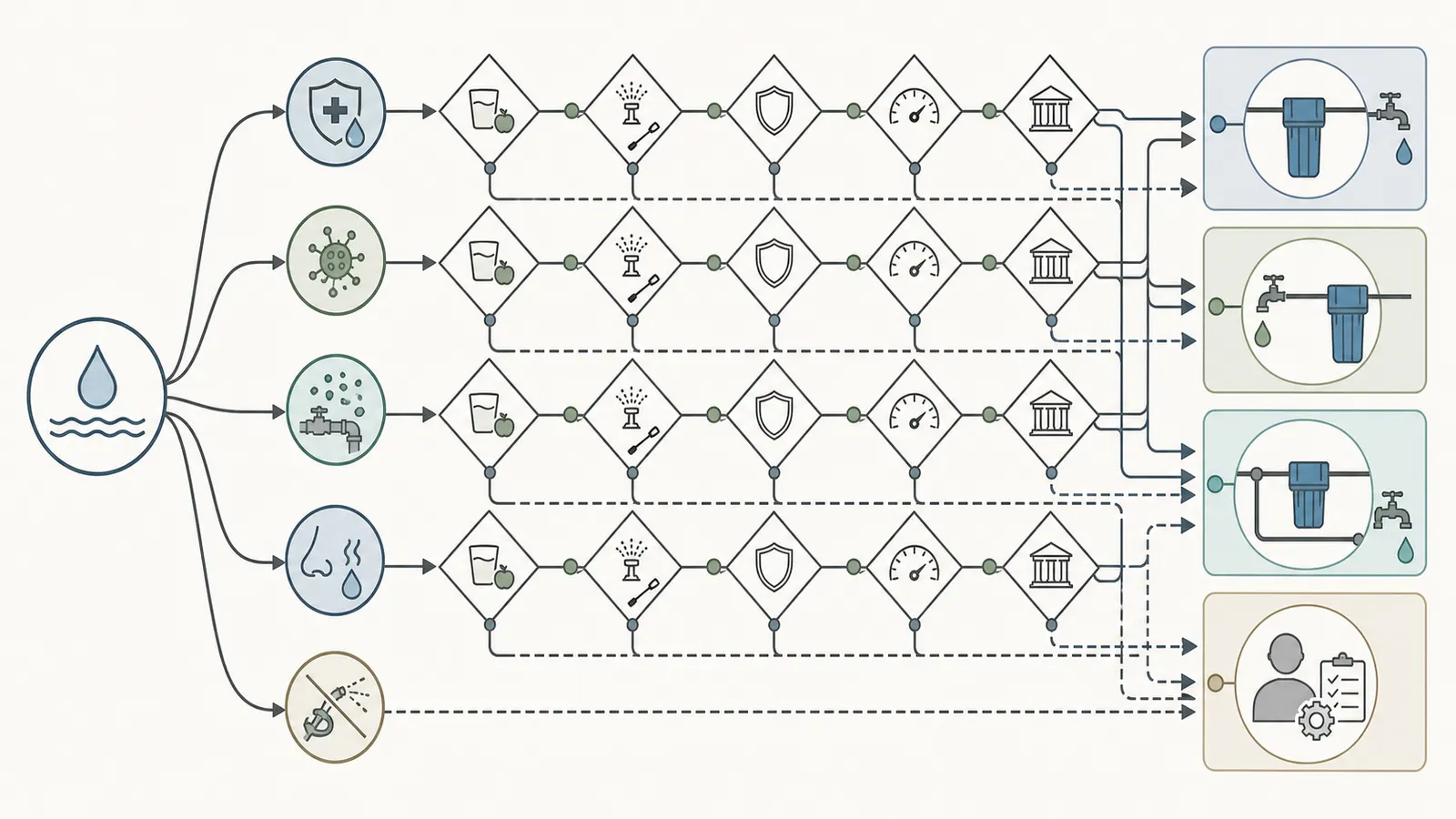
Use this first-pass matrix to place the branch. It is a screening tool, not a substitute for the equipment manual, the water test, or the authority having jurisdiction.
| What the outdoor bib will do | Default direction to investigate | Why | Stop or escalation condition |
|---|---|---|---|
| Fill a drinking-water container, livestock trough, or outdoor kitchen supply | After the filter | The same health-related treatment goal may apply at that use point | The filter is not certified for the actual contaminant, the water is microbiologically unsafe, or outdoor demand exceeds the system's rating |
| Wash hands, rinse produce, fill a child’s water toy, or supply another use where ingestion is plausible | After the filter | The homeowner cannot reliably treat an outdoor tap as “not for drinking” if the use is likely to involve contact or ingestion | The filter manual excludes the use, requires a different treatment train, or the treated branch cannot maintain required flow |
| Irrigate lawn or ornamental plants | Before the filter may be reasonable | EPA’s point-of-entry illustration includes an irrigation branch, and irrigation can consume a large volume that does not need the same treatment goal | The filter is intended to remove a health contaminant throughout the property, the local rule requires otherwise, or the branch would expose people or animals to untreated water |
| Pressure-wash a driveway, deck, or vehicle | Before the filter may be reasonable | Avoids sending a high-demand, non-drinking use through a filter that has a finite flow or capacity rating | The hose is used with chemical injectors, the system manual prohibits the arrangement, or backflow protection is missing |
| Protect indoor fixtures from sediment or scale | After the filter for the protected fixtures; outdoor branch depends on the goal | A sediment or scale objective may be limited to the indoor distribution system | The filter is also the only barrier for a health contaminant, or the outdoor branch feeds a connected use that must be treated |
| Remove nitrate, arsenic, PFAS, pathogens, or another health-related concern from private-well water | After the validated treatment train | An untreated bib remains untreated water; an upstream branch defeats coverage for that outlet | The exact filter has no applicable contaminant claim, no certified performance data, or no capacity and flow information for the branch |
“Before the filter” means the branch leaves the source side of the treatment system. The water at that bib is untreated by that filter. It does not automatically mean unsafe, and “after the filter” does not automatically mean safe. It means only that the water has passed through that component. CDC explains that different home treatment systems remove different germs or chemicals and recommends testing water and choosing a system that addresses the specific concern. NSF likewise says certification to a standard does not mean a system reduces every possible contaminant.
The cleanest homeowner outcome is a labeled branch record: outdoor bib A — upstream, untreated by filter; outdoor bib B — downstream, filtered by model X; backflow protection — device and date recorded. That record prevents a future owner, child, gardener, or service technician from guessing.
Start with the treatment goal, not the pipe
The phrase “whole-house water filter” covers very different devices. A sediment cartridge, activated-carbon tank, iron filter, UV system, reverse-osmosis system, and treatment train with several stages do not have the same purpose or operating limits. The placement decision should start with the water-quality problem and the intended users, then move to the pipe layout.
Health-related treatment is the stop gate
For a private well, begin with the evidence about the water, not with color, odor, or a sales label. Oregon State University Extension recommends annual testing of household well water for coliform bacteria and nitrate, with additional tests when other contaminants are suspected. EPA’s WaterSense guide also tells well owners to use a state-certified laboratory and to identify treatment goals from water-quality results or a specific concern.
If the treatment goal is nitrate, arsenic, PFAS, a pathogen, or another health-related contaminant, an upstream hose bib is not covered by that filter. That may be an intentional design only when the homeowner has made a documented decision that the bib will never be used for drinking, food preparation, livestock, bathing, child play, or another exposure route—and when the system instructions and local requirements allow it. A warning label alone does not turn untreated water into treated water.
For a health concern, ask these questions before accepting a branch:
- What contaminant was found, and on what date?
- Is the filter or treatment train certified or otherwise documented for that exact contaminant?
- Does the performance data apply to the installed water chemistry, flow, pressure, temperature, and capacity?
- Does the claim cover point-of-entry flow, or only a point-of-use faucet?
- Will the outdoor bib ever fill a jug, animal trough, pool, tank, sprayer, or toy?
- What happens when the filter is in bypass, out of service, exhausted, or overdue for replacement?
If the answer to the second or third question is “the installer says it should,” pause. EPA says filtration technologies have different benefits and limitations and identifies NSF/ANSI 42, 53, and 401 as different filtration testing standards. The standard number alone is not the whole claim; the product must be certified for the contaminant and reduction claim that matters to the household.
Aesthetic or fixture-protection treatment is a different decision
Sediment, chlorine taste and odor, staining, scale, and fixture protection can be important without requiring every gallon used outdoors to pass through the same treatment. EPA advises homeowners to think about where treated water is needed and how much water requires treatment, and cautions against oversizing systems. Its guide notes that many water-consuming activities do not require additional treatment, while point-of-entry systems treat large quantities.
That creates a legitimate reason to consider an upstream irrigation branch: the homeowner may want filtered water for showers, laundry, indoor fixtures, and drinking while keeping high-volume lawn irrigation or pressure washing off the filter. The branch is not “wrong” simply because it is before the filter. It is a declared untreated-use branch.
But this exception narrows quickly. If the same outdoor faucet is used for a garden sprayer, a livestock trough, an outdoor sink, or a hose that someone regularly drinks from, the treatment goal has changed. A sediment-only filter also should not be described as a pathogen or chemical barrier merely because the water looks clearer after filtration.
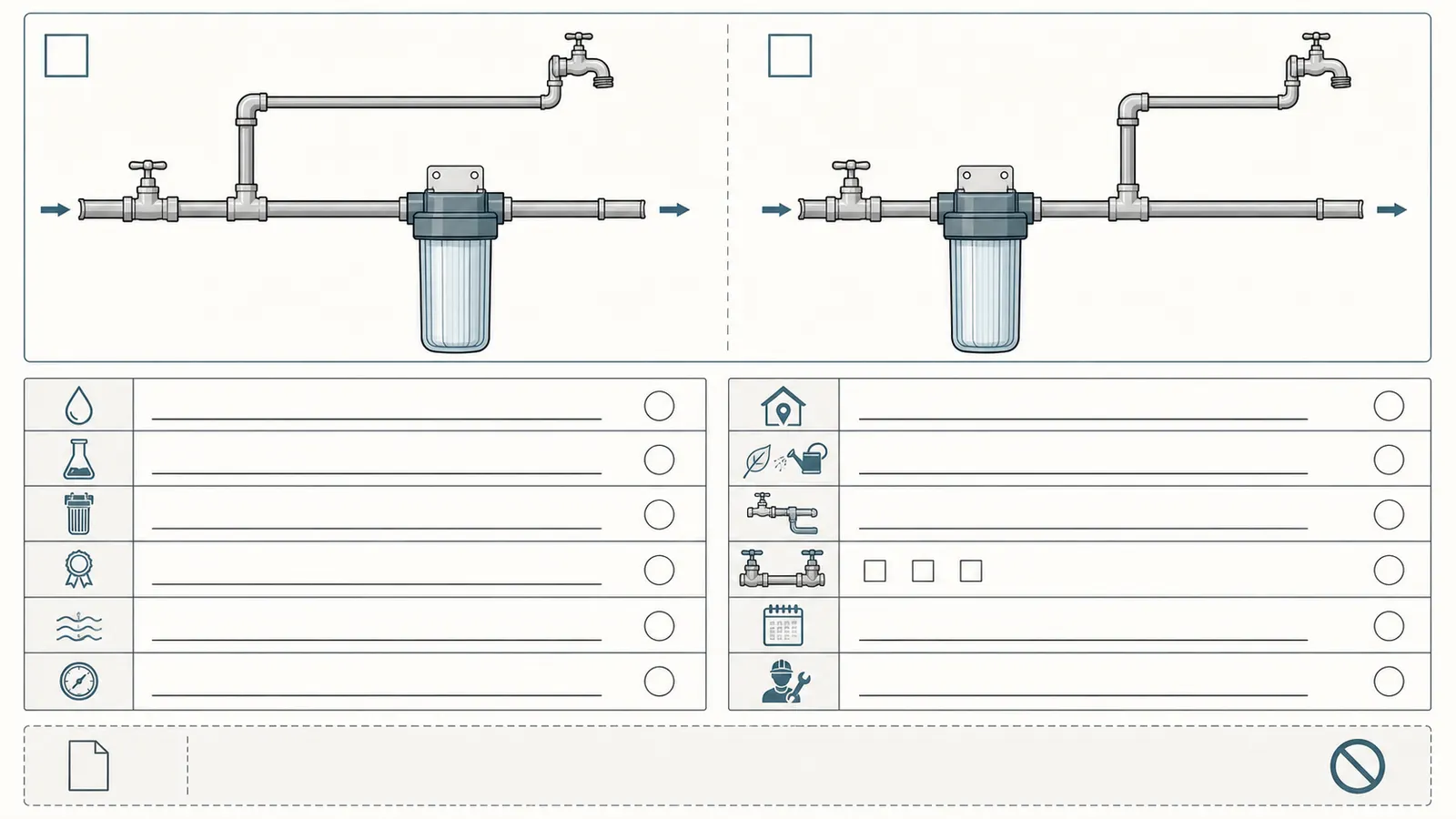
Map the two legitimate branch layouts
Draw the system from the well toward the house before discussing fittings. A useful map includes the well or incoming supply, pressure tank, shutoff, sampling point, filter stages, bypass, indoor manifold, each outdoor bib, irrigation, and any pressure-washing connection. Do not rely on where the filter tank sits visually; a pipe may cross behind a wall or branch at a manifold.
Layout A: the outdoor bib is downstream
The simplified path is:
Well or service entry → pressure tank → filter or treatment train → indoor and outdoor distribution → hose bib
This is the natural layout when the filter is intended to treat most or all water entering the building. EPA describes a point-of-entry system as being installed where water enters the building so treated water can be distributed throughout it. The EPA diagram also shows an irrigation branch in relation to the distribution system; the important lesson is to trace the actual branch rather than infer it from the word “whole-house.”
Advantages of a downstream bib include consistent treatment coverage and a simpler message for the household: the outdoor tap is part of the treated distribution. The tradeoffs are equally important:
- Irrigation and pressure-washing flow pass through the filter.
- A cartridge or media tank may reach its service limit sooner.
- A restrictive or clogged filter can affect outdoor pressure and may be noticed first at a hose nozzle.
- The filter must be rated for the peak simultaneous demand, not just the average indoor use.
- If the filter is bypassed, the outdoor bib may receive untreated water unless the plumbing has a separate arrangement.
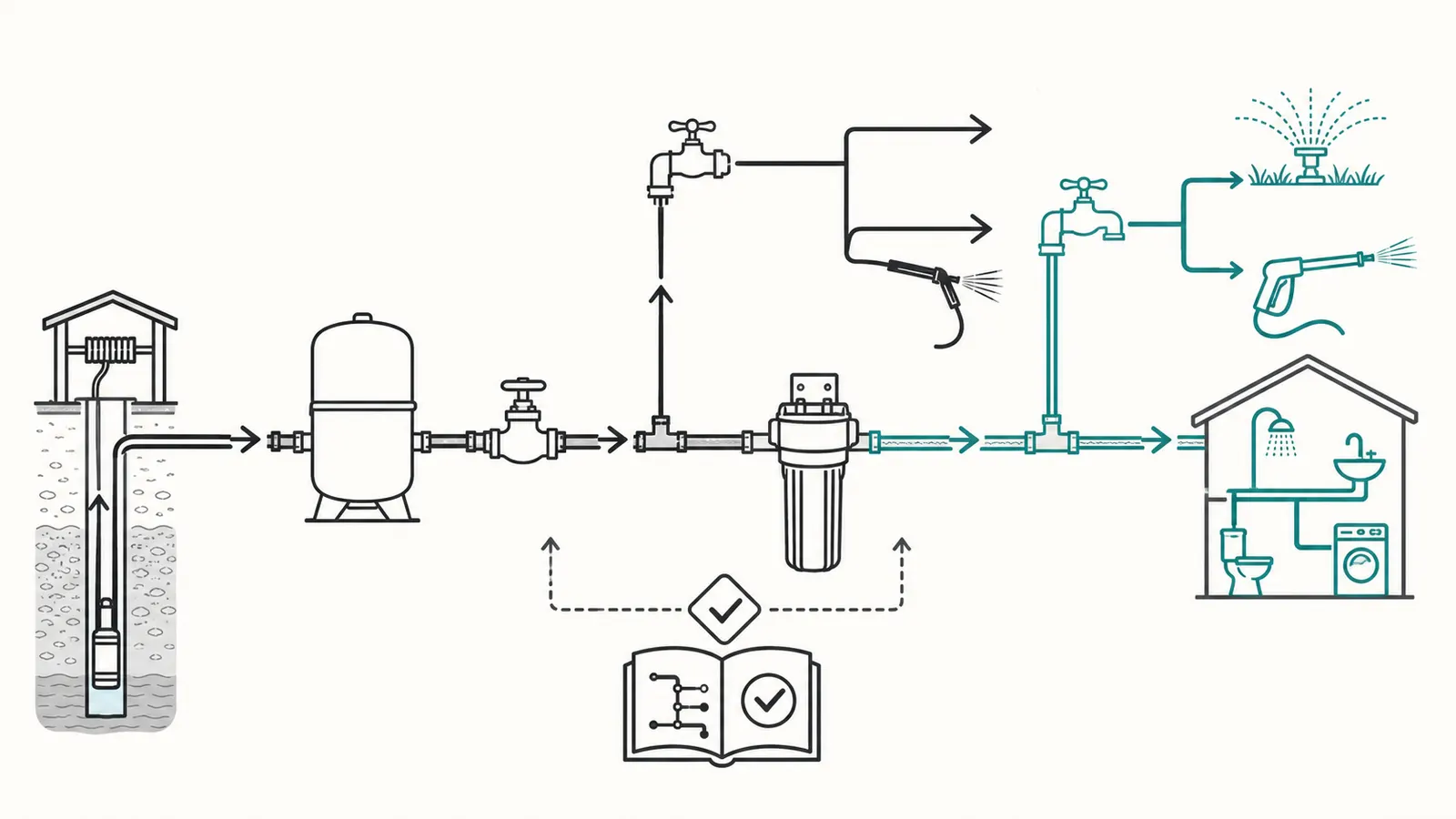
This layout still requires a backflow review. A downstream filter is not a backflow preventer, and the hose bib can remain a cross-connection hazard even if the water is filtered during normal flow.
Layout B: the outdoor bib is upstream
The simplified path is:
Well or service entry → pressure tank → branch to outdoor bib or irrigation → filter or treatment train → indoor distribution
This layout can be sensible for high-volume outdoor water that does not need the indoor treatment goal. EPA’s WaterSense guide illustrates the concept of a separate irrigation branch in its point-of-entry diagram. The branch should be visibly mapped and labeled, because a future owner may otherwise assume that “whole-house” covers it.
Advantages include preserving filter capacity for the uses that need it and protecting indoor pressure from outdoor peak demand. Tradeoffs include:
- The hose bib water has not passed through the filter.
- A person can use the bib for drinking or food contact without realizing that it is untreated.
- Outdoor contaminants can be drawn backward through the hose toward the well or pressure system if backflow protection is missing.
- The filter’s bypass handle does not change the status of an upstream branch; it is upstream in normal, bypass, and service states.
- A pressure-washing chemical injector or submerged hose makes the backflow review more serious, not less.
An upstream branch therefore needs a clear purpose, a physical map, a label that survives ownership changes, and backflow protection. It should not be used as a way to avoid treating a health-related exposure that the homeowner actually intends to permit.
Layout C: separate outdoor treatment or a dedicated point of use
Sometimes neither simple layout is sufficient. A private-well system may need one treatment train for indoor drinking and another for a defined outdoor use. Or an outdoor sink may need a dedicated treated line while irrigation remains upstream. CDC describes point-of-use systems as treating water at a single tap and point-of-entry systems as treating most or all water entering the home; those categories can be combined in a documented design.
Use this third option when the treatment claim is health-related but the full irrigation load is too large, when the filter is approved only for a particular tap or flow, or when outdoor water will be consumed intermittently. The design needs more than an extra filter name: it needs the certified claim, sample point, flow requirement, maintenance responsibility, and a backflow plan for every connection.
Check demand, pressure, and filter service limits
The filter’s placement decision is also a demand decision. A hose bib can ask for more flow than a shower or kitchen faucet, and a pressure washer or sprinkler may run for much longer. The relevant comparison is the filter manufacturer’s published rating and installation limits against the actual outdoor demand.
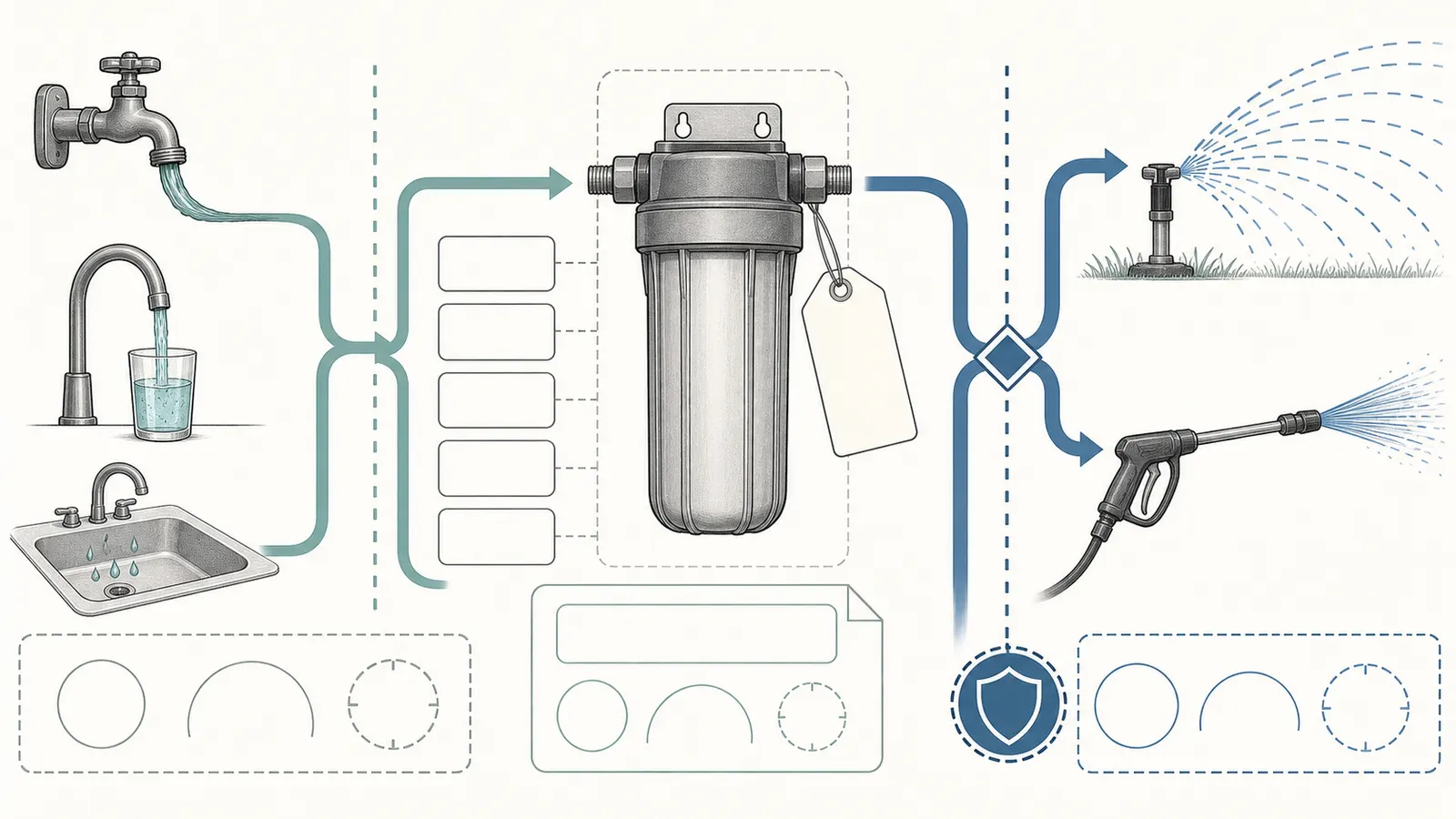
Use the exact model, not a category average
Manufacturer specifications show why no universal number is safe to borrow. Pentair’s WF4-P/WF8-P product page publishes a maximum flow of 10 GPM for its WF4-P iron-and-manganese system and 15 GPM for its WF8-P. Water-Right’s HomeShield specifications list a 5.7 GPM rated flow and a 25–100 psi pressure range, along with a required 5-micron prefilter and installation-sequence notes. These are examples of model-specific constraints, not a recommendation to size every home to 5.7, 10, or 15 GPM.
Record the following from the exact manual or performance sheet:
| Field | Why it changes the branch decision | What to record |
|---|---|---|
| Rated or maximum flow | Determines whether a sprinkler, hose nozzle, or pressure washer can pass through the treatment path | Value, units, and whether it is rated flow, maximum flow, or a test condition |
| Minimum and maximum pressure | A filter may need a pressure range to operate correctly; a restriction can be more noticeable during outdoor use | Pressure range, pressure-reducing requirement, and location of any gauge |
| Capacity | Carbon, media, and cartridge systems have finite service capacity; high-volume outdoor use can consume it faster | Gallons, contaminant capacity, or a manufacturer replacement trigger |
| Temperature and water type | Some systems are for cold potable water and may exclude hot, microbiologically unsafe, or unknown-quality water | Water type, temperature range, and exclusion language |
| Flow direction and orientation | Certain tanks or cartridges must be installed in a specified direction or after another treatment stage | Arrow, downflow/upflow instruction, and required prefilter |
| Bypass behavior | Bypass may send untreated water to the building; a service state may require flushing or rinsing | Handle positions, what each branch receives, and return-to-service steps |
| Maintenance interval | A missed replacement can change performance and pressure | Manufacturer schedule, actual date, and responsible person |
As a bounded example, the 3M AP902/AP903/AP904 instructions describe a point-of-entry potable-water system, require qualified professional installation and state and local code compliance, and warn about pressure, freezing, water hammer, backflow-related thermal expansion, and depressurization before cartridge removal. That is the kind of specificity to look for in the manual. It is not permission to transfer the AP900 limits to another filter.
Estimate outdoor demand without turning it into a filter approval
If a professional asks for a first-pass flow estimate, a homeowner can observe an exposed, safe outlet with a container and a timer:
Estimated flow in GPM = gallons collected ÷ seconds × 60
For example, 5 gallons collected in 30 seconds is approximately 10 GPM. This is arithmetic, not a certified test. It can be distorted by the hose nozzle, pressure cycling, a partially open valve, a clogged screen, the well pump, or a pressure tank that is charging during the observation. Record the outlet, nozzle, duration, whether another fixture was running, and whether the pressure changed.
Do not open a pressure tank, well head, pump control, filter housing, energized control, or pressurized fitting to obtain a number. If measuring at a hose bib requires removing a device, loosening a connection, or exposing wiring, stop and have a qualified professional perform the measurement.
Interpret the result conservatively:
- If the observed outdoor demand is well above the filter’s published rating, do not route that demand through the filter without a professional design.
- If the result is near the rating, treat it as a design question because simultaneous indoor use and startup surges may matter.
- If the result is below the rating, that does not prove contaminant capacity, pressure adequacy, or certification.
- If pressure falls sharply only when the bib is open, the cause could be the well, pump, pressure tank, pipe, valve, filter, or nozzle. Do not diagnose the filter from one observation.
Account for service life, not just instant flow
Outdoor water can increase the number of gallons through a filter even when the pressure looks acceptable. EPA says all water treatment systems require ongoing maintenance, that an unmaintained system may make water quality worse, and that filters should be replaced according to the manufacturer’s instructions and schedule. A branch decision that routes irrigation through a carbon or specialty media system should therefore include who will track capacity and how the homeowner will know the claim remains current.
If the intended goal is only taste and odor indoors, sending every irrigation gallon through the same media may create cost and maintenance work without adding value. If the intended goal is a health contaminant throughout the property, routing irrigation upstream may defeat the coverage goal. The right answer depends on the treatment claim and the use, not on a generic preference for fewer branches.
Treat every outdoor hose connection as a backflow review
The hose connection is a separate safety question from filter placement. OSU Extension warns that water can siphon backward through a hose and down a well, especially when a chemical sprayer is attached or the hose end is underwater. It specifically highlights irrigation, livestock troughs, chemical mixing, and pressure washing as uses where outdoor-faucet backflow protection is especially important.
A filter does not replace a backflow device. If the bib is downstream, reverse flow may put the filter, indoor distribution, or other connected equipment in the contamination path. If the bib is upstream, reverse flow can threaten the well-side plumbing and the source water. The location changes which components are exposed; it does not remove the hazard.
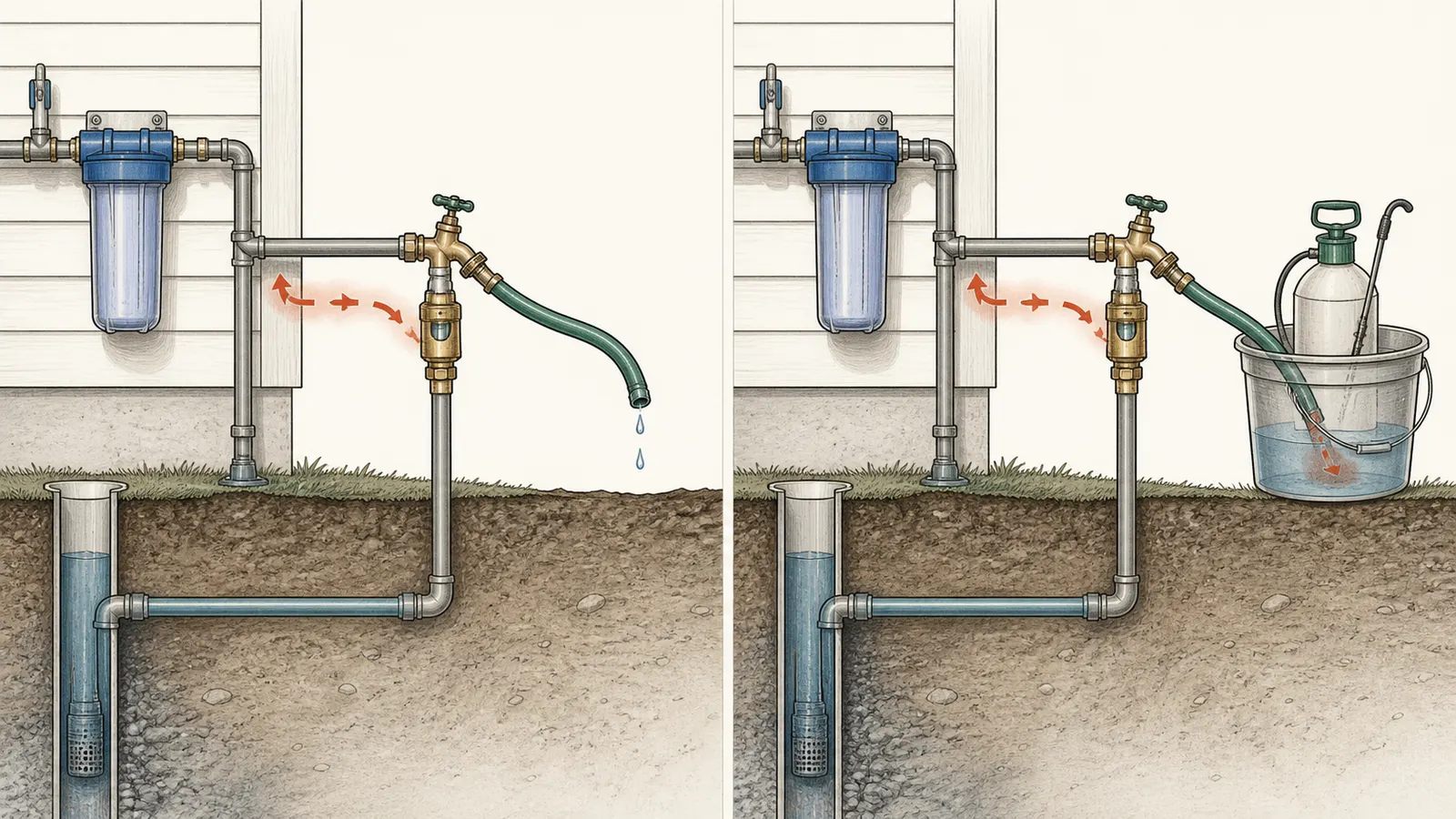
Inspect the exposure, not just the faucet body
For each outdoor bib, record whether it has:
- A hose attached during normal operation.
- A hose that can reach a bucket, pool, animal trough, pond, or drain.
- A chemical injector, fertilizer mixer, pesticide sprayer, or detergent connection.
- A sprinkler, irrigation manifold, pressure washer, or livestock connection.
- A visible backflow or vacuum-breaker device, with its make and model if readable.
- A location where freezing, damage, or later hose replacement could defeat the device.
Do not assume a screw-on device is the correct protection for every installation. OSU’s page gives a screw-on brass atmospheric pressure breaker as an inexpensive example when backflow protection is absent, but it is not a complete national code specification. The local plumbing rule, well program, hazard level, device listing, and installation orientation may control. Ask a qualified plumber or the authority having jurisdiction when the bib feeds a fixed irrigation system, chemical equipment, livestock, commercial use, or another high-hazard connection.
Make the untreated state obvious
If the bib is intentionally upstream, place a durable label that says what is true, such as “UNTREATED BY WHOLE-HOUSE FILTER — DO NOT USE FOR DRINKING”, only after confirming that the local rule and the treatment plan support that restriction. Do not label water “unsafe” based solely on its position; the label should describe the plumbing fact and the intended use. Record the branch in the household well ledger and tell everyone who uses the hose.
If the bib is downstream, label the filter model and contaminant purpose in the equipment record. Do not write “safe for all uses” unless the exact treatment system, water test, certification, and local requirements support that statement. “Filtered” is not a universal health claim.
Verify the exact model, bypass, and local installation rules
A branch can be correctly positioned for normal flow and still be wrong during service. The final decision should include four verification gates.
Gate 1: identify the equipment and the claim
Photograph the filter head, model label, cartridge or media name, bypass valve, flow arrow, and any performance-data sheet. Record whether it is a cartridge filter, backwashing filter, carbon tank, iron filter, UV system, or a treatment train. Write the contaminant claim in the same words used by the manufacturer or certification listing.
Avoid substituting the name of a media for a performance claim. “Carbon,” “5 micron,” “whole house,” and “well-water filter” do not by themselves establish reduction of nitrate, arsenic, bacteria, viruses, PFAS, or another health contaminant.
Gate 2: trace the real branch
With water off only where a homeowner-accessible shutoff is clearly identified, observe and photograph pipe routing. Do not remove covers or fittings. Mark the branch point relative to the filter inlet, outlet, bypass, and pressure tank. If the pipe disappears into a wall or ceiling, mark it as unverified rather than guessing.
Use a simple notation:
| Record item | Example entry |
|---|---|
| Bib ID | HB-01, north side |
| Branch point | Between pressure tank and filter inlet |
| Filter status at bib | Untreated by model PC1000-P |
| Intended uses | Lawn irrigation only |
| Prohibited or controlled uses | No drinking, livestock, chemical mixing |
| Backflow protection | Device present; model and date to verify |
| Filter bypass effect | No effect on HB-01 because it is upstream |
| Evidence | Photo filename, contractor drawing, or inspection note |
Gate 3: read the bypass instructions
Do not infer bypass behavior from handle direction or from another brand. The Water-Right IMP filter manual, for example, describes a normal state in which water flows through the control valve, a bypass state in which untreated water supplies the building, and a diagnostic state that also allows untreated supply water to the building. It also says the system must be rinsed before returning to normal operation.
That is a useful example of the questions to ask:
- Does the downstream outdoor bib receive untreated water in bypass?
- Does the upstream outdoor bib change at all in bypass?
- Does service isolation shut off the outdoor branch or leave it live?
- Does the system require a rinse, flush, disinfection step, or performance check before normal service?
- Who is responsible for telling the household that treated coverage is temporarily interrupted?
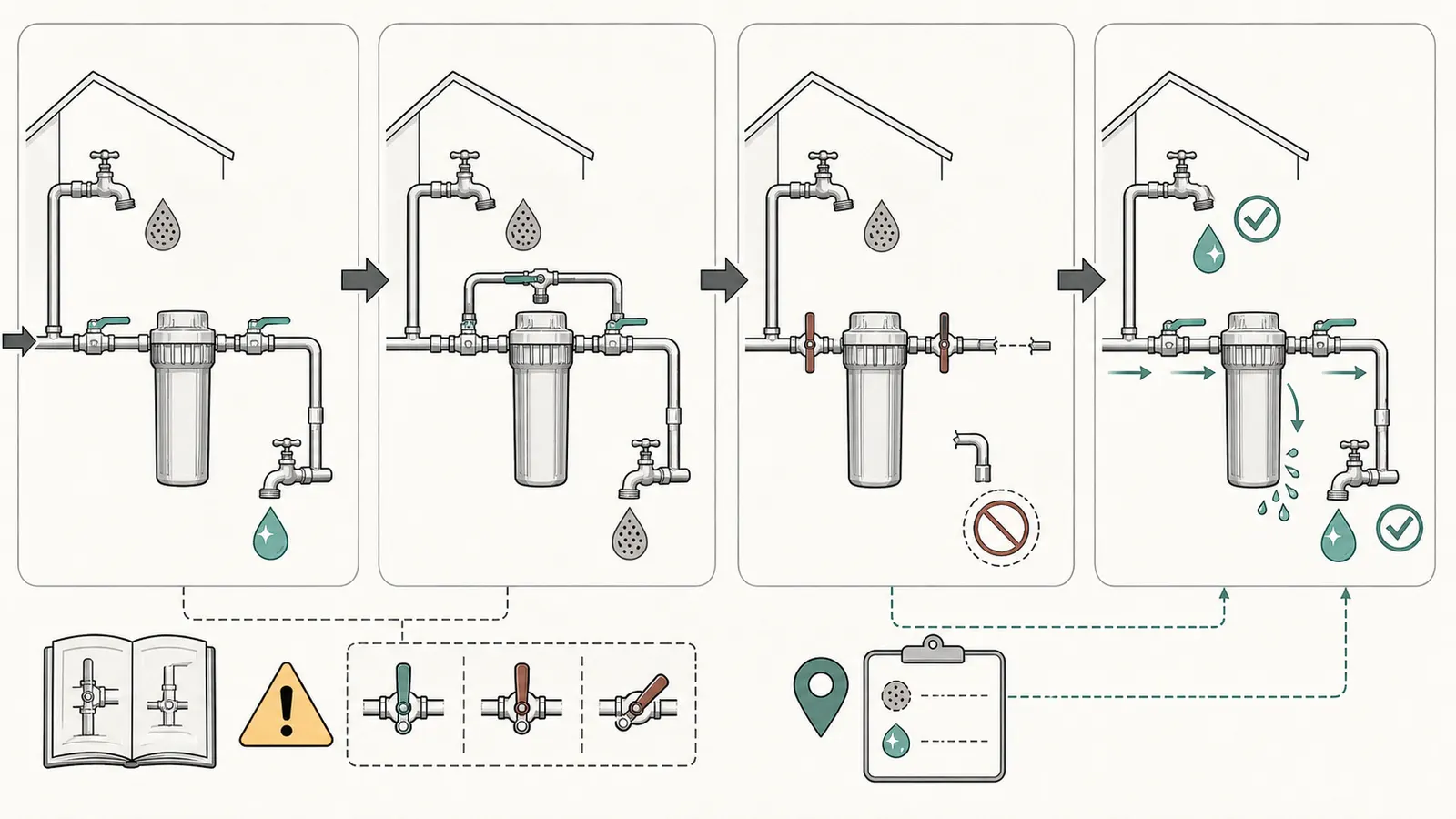
If the answer is not printed in the manual or documented by the installer, leave the field unresolved. A bypass valve is a service convenience, not proof that the treated and untreated branches are interchangeable.
Gate 4: identify local plumbing and well requirements
The plumbing layout, cross-connection protection, permit requirement, and treatment discharge rules can vary by jurisdiction and use. EPA’s point-of-use and point-of-entry resource is a guidance gateway, not a universal hose-bib rule. Ask the local authority or a qualified plumber whether the proposed upstream branch, backflow device, irrigation tie-in, and filter installation comply at that address.
Bring the following to that conversation:
- Well test results and sample dates.
- Filter model, manual, performance data, and certification listing.
- A one-page branch map with filtered and untreated labels.
- Outdoor uses and any chemical, livestock, irrigation, or pressure-washing connections.
- Filter flow, pressure, temperature, and maintenance limits.
- Photos of each bib, hose connection, branch point, and backflow device.
- Whether the project is new plumbing, a relocation, or a replacement.
Do not let a local statement become a national rule. A municipal page, state code, or installer’s standard detail can be authoritative for its scope while saying nothing about another state, another device, or a private-well use.
Record, test, and hand off the finished decision
The finished decision should be inspectable without reopening the plumbing. Use this homeowner record with the well equipment ledger.
Branch and treatment record
- Well or service source and pressure-tank location recorded.
- Most recent well test date recorded; annual coliform and nitrate testing status noted.
- Contaminant or treatment goal written in plain language.
- Filter model, media or cartridge, certification claim, and performance sheet attached.
- Filter inlet, outlet, bypass, and normal flow direction identified.
- Every outdoor bib and irrigation branch has an ID and location.
- Each bib is marked upstream/untreated by this filter or downstream/treated by this filter.
- Intended use is written: irrigation, pressure washing, hand washing, drinking, livestock, outdoor sink, or other.
- Rated flow, pressure range, temperature range, and capacity are copied from the exact manual.
- Outdoor demand was observed or professionally measured, with method and limitations noted.
- Backflow device type, model, installation date, and inspection or test responsibility are recorded.
- Bypass and service states are documented for both indoor and outdoor branches.
- Filter replacement, media service, backwash, or disinfection schedule is recorded from the manual.
- Permit, inspection, or local authority answer is attached when applicable.
- The installer’s final drawing identifies all branch points and valves.
What to observe after installation
Ask the installer to demonstrate normal operation and explain the bypass state without asking the homeowner to manipulate pressurized equipment. The handoff should answer:
- Which bibs are filtered in normal operation?
- Which bibs are untreated by the filter at all times?
- What happens to each bib during bypass or service?
- What outdoor flow was used to verify the installation, and was indoor demand also considered?
- What maintenance event changes the treatment claim: cartridge replacement, media change, lamp replacement, backwash, disinfection, or water testing?
- What backflow device protects each bib, and who maintains or tests it?
Watch for visible leaks, unexpected spray, hose movement, or a backflow device that is damaged, missing, or installed in a way the manual does not show. Do not treat a clean-looking outlet, normal pressure at one moment, or a successful bucket test as proof of contaminant reduction.
For a moderate-safety water-system decision, limit homeowner work to reading labels, taking photographs, observing an exposed branch, documenting uses, and making a non-invasive measurement only when the action is clearly safe. Do not open energized controls, test live wiring, remove an electrical cover, attempt opening a well, pull a pump, enter a confined space, disconnect pressurized equipment, remove a cartridge under pressure, manipulate a stuck valve, or change a treatment setting that the manual assigns to a professional. A filter bypass handle should not be moved casually if the system is leaking, frozen, electrically abnormal, or under uncertain pressure.
The final answer for the homeowner
Choose after the filter when the outdoor water must carry the same validated health-related treatment as the indoor distribution, and the exact system can handle the outdoor flow and use. Choose before the filter when the outdoor branch is intentionally for irrigation or washing, the filter is for a narrower indoor goal, the manual and local requirements permit the branch, and the bib has backflow protection. Choose a separate or professional design when the contaminant goal, outdoor demand, bypass state, certification, or local rule cannot be reconciled.
The decision is complete only when “before” or “after” is written against a specific hose bib, a specific filter model, a specific treatment purpose, a specific outdoor use, and a specific backflow-protection record. That is the difference between a whole-house label and a homeowner decision that remains understandable years later.
Sources and scope
Evidence behind this page
- EPA WaterSense Guide to Selecting Water Treatment Systems
EPA consumer guidance for point-of-entry treatment; it describes the intended whole-building coverage concept but does not prescribe a universal hose-bib branch layout or guarantee that every outdoor branch is downstream.
- EPA WaterSense Guide to Selecting Water Treatment Systems, Figure 1
EPA's illustrative diagram; it supports the possibility of a separate irrigation branch, not a national requirement that irrigation or hose bibs must be upstream.
- EPA WaterSense Guide to Selecting Water Treatment Systems
EPA consumer selection guidance; the statement about limitations is technology- and product-dependent and must not be used to infer performance for an unnamed filter.
- EPA WaterSense Guide to Selecting Water Treatment Systems
EPA general consumer maintenance guidance; it does not supply a replacement interval for a specific cartridge, media tank, or private-well system.
- CDC — About Home Water Treatment Systems
CDC public-health guidance; the treatment scope depends on the exact system, label, and contaminant claim.
- Oregon State University Extension Service — Twelve simple things you can do to protect your well water
OSU Extension well-water guidance; the annual testing recommendation is educational guidance and local health departments or state programs may add requirements or different testing schedules.
- Oregon State University Extension Service — Twelve simple things you can do to protect your well water
OSU Extension guidance for protecting private wells; it is not a complete national plumbing-code specification for backflow device type, installation, or testing.
- NSF — Standards for Water Treatment Systems
NSF consumer explanation of standards and certification; certification scope is product- and contaminant-specific.
- Pentair — WF4-P and WF8-P Iron and Manganese Filter Systems
Pentair product-page specifications for the cited models; the ratings are not a universal flow allowance and do not establish the capacity of another filter or a home's plumbing.
- Water-Right — HomeShield Whole House Water Filter
Water-Right product specifications and installation notes for HomeShield; these values and sequence instructions are model-specific and are not a universal filter rule.
- 3M Aqua-Pure AP902/AP903/AP904 Installation and Operating Instructions
3M instructions for the cited AP900 series; the professional-installation, pressure, temperature, and safety provisions must not be generalized to other products.
- Water-Right — IMP Filter Manual
Water-Right manual for its IMP filter valve; bypass handle behavior and rinse requirements are product-specific and must be checked against the exact installed system.
- EPA — Point-of-Use and Point-of-Entry Treatment Devices
EPA program page last updated October 23, 2025; it is a gateway to guidance rather than a model-specific installation manual or a nationwide hose-bib rule.