How to Identify Unknown Well-Water Treatment Equipment
A safe, evidence-backed field guide to mapping an unfamiliar well-water treatment train, identifying components, and knowing what appearance cannot prove.
The short answer
Photograph the complete water path, record every label, valve, bypass, drain, tank, cartridge, and service clue, then match model numbers to primary manuals. Use the layout to form a tentative equipment class—not a treatment claim. Confirm contaminant performance with an independent well-water test and the exact certification or performance data. If identity, chemical feed, pressure, or electrical status is unclear, stop and give the record to a qualified professional.How to Identify Unknown Well-Water Treatment Equipment
Start with a record, not a guess. Photograph the complete water path from the pressure tank toward the house, assign every tank and enclosure an ID, copy every readable label, and mark the inlet, outlet, bypass, drain, brine, cartridge, and electrical clues. Then match the exact model or control valve to a manufacturer manual. Treat the result as a tentative equipment identity until an independent well-water test and the device’s exact performance or certification evidence show what the system can reduce.
Do not open an energized control box, test live wiring, loosen pressurized plumbing, open the well, pull a pump, enter a well pit or other confined space, handle an unknown chemical feed, or change an unknown valve setting to see what happens. A device can be correctly identified and still be empty, bypassed, exhausted, incorrectly sized, improperly maintained, or unsuitable for the contaminant in your water.
1. Set the safety and evidence boundary first
An undocumented treatment train is a documentation problem before it is a repair problem. Work only from a dry, accessible position and record what is visible without removing covers, disconnecting tubing, opening tanks, or changing controls. If there is standing water near electrical equipment, a chemical odor or unlabeled liquid, a leak, a damaged pressure vessel, an alarm, exposed wiring, or a blocked path to a safe working position, stop and call a qualified well or water-treatment professional.
Before doing anything beyond photographing and recording, check the requirements in your state and locality. Re-plumbing, electrical work, well or treatment work, chemical handling, drinking-water sampling or laboratory use, and backwash or drain disposal may each be regulated differently. If you cannot tell which health, building, plumbing, electrical, or environmental authority has jurisdiction, stop and ask the relevant local or state office—or use a licensed well, water-treatment, plumbing, or electrical professional. EPA notes that it does not regulate individual private wells or provide individual-well standards, so this identification guide is not permission to alter the system or dispose of waste.
The goal of the first visit is not to make the water better. It is to answer four narrower questions:
- What units and connections are physically present?
- In what direction does water appear to flow?
- Which labels and manuals identify the hardware?
- What remains unknown about treatment, condition, and water safety?
Use the word observed for a fact in front of you, probable for a class suggested by several clues, and verified only when the model documentation and an independent result support the statement. For example, “tall media tank with a Fleck 2510 SXT control valve” is a useful observation. “Iron filter” is a hypothesis until the installed media, programming, service record, and water test support it.
EPA recommends annual private-well testing for total coliform bacteria, nitrate, total dissolved solids, and pH, with additional tests based on local conditions; it also recommends testing after a well-system repair or replacement or a noticeable water-quality change. Use a laboratory certified for drinking-water testing, not a visual inspection of the equipment, to decide whether the water is safe. EPA’s private-well testing guidance also explains that the suitable response depends on the contaminant, concentration, and well condition.
2. Map the complete water path before naming a unit
Begin at the well-side piping or the point where the supply enters the room. University of Minnesota Extension describes private-well water entering the home through a pressure tank, which helps separate that supply component from treatment equipment. The actual sequence varies, so use the observed pipe route rather than assuming that every tank is treatment equipment.
Take one wide photograph that includes the whole train, then take a close photograph of each item from at least two angles. Include enough surrounding pipe to show which connection is upstream and which is downstream. Do not rely on a single photograph taken from the front: a drain line, brine tube, UV controller, or bypass may be visible only from the side or rear.
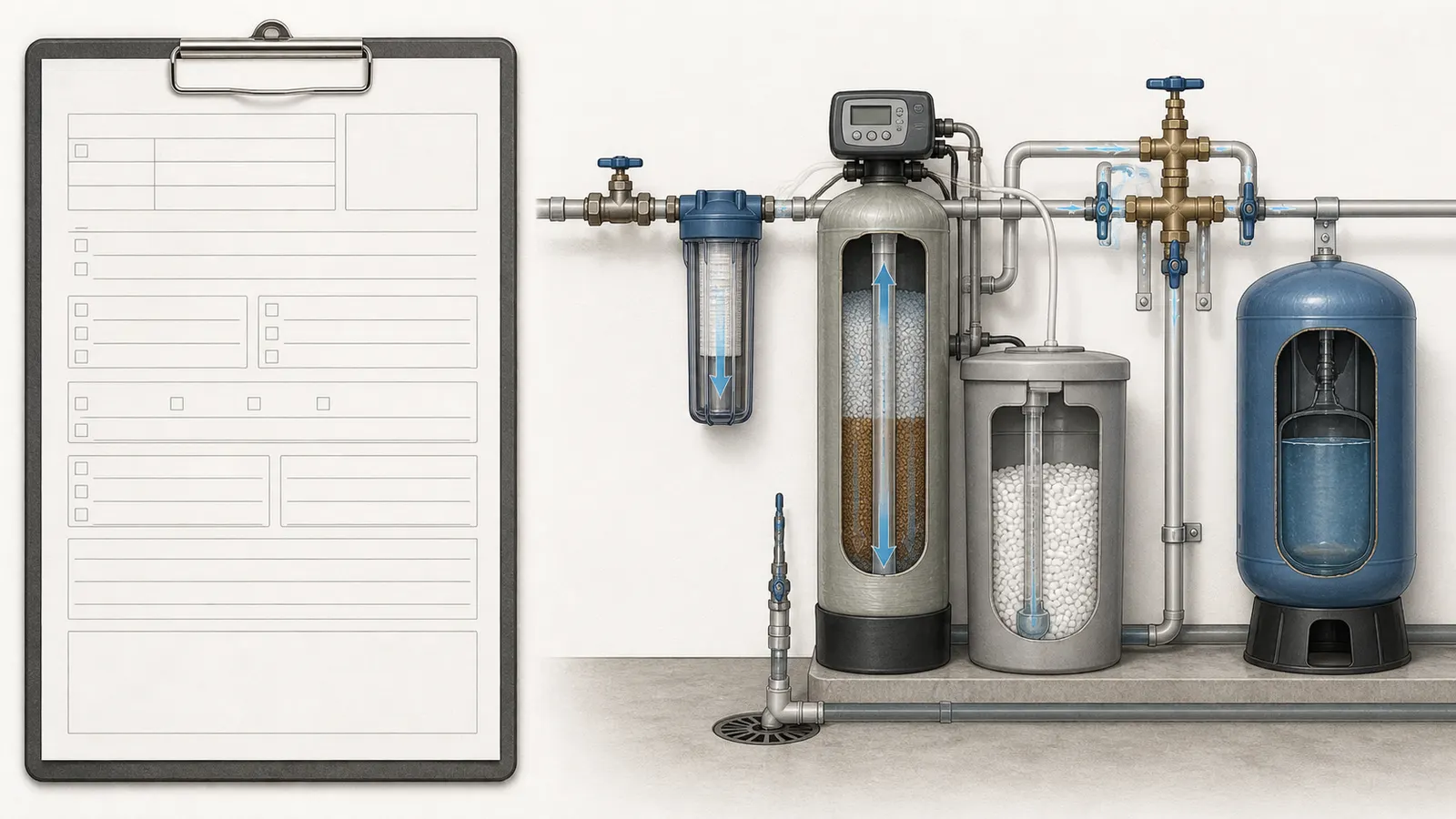
Assign IDs in flow order: WT-01, WT-02, WT-03 and so on. On a rough sketch or the worksheet below, record:
- the room and wall location;
- the apparent inlet and outlet, with arrows only when the pipe route makes that direction clear;
- pressure gauge, pressure switch, pump, and pressure-tank locations;
- every bypass, isolation valve, check valve, drain line, air gap, and floor drain;
- power cord, controller, indicator light, transformer, or visible sensor;
- a salt/brine tank, chemical tank, float assembly, or injection tubing;
- cartridge-housing count and any clear bowl or label;
- the faucet or branch served by an under-sink reverse-osmosis unit; and
- any pipe that disappears into a wall, floor, well pit, or ceiling.
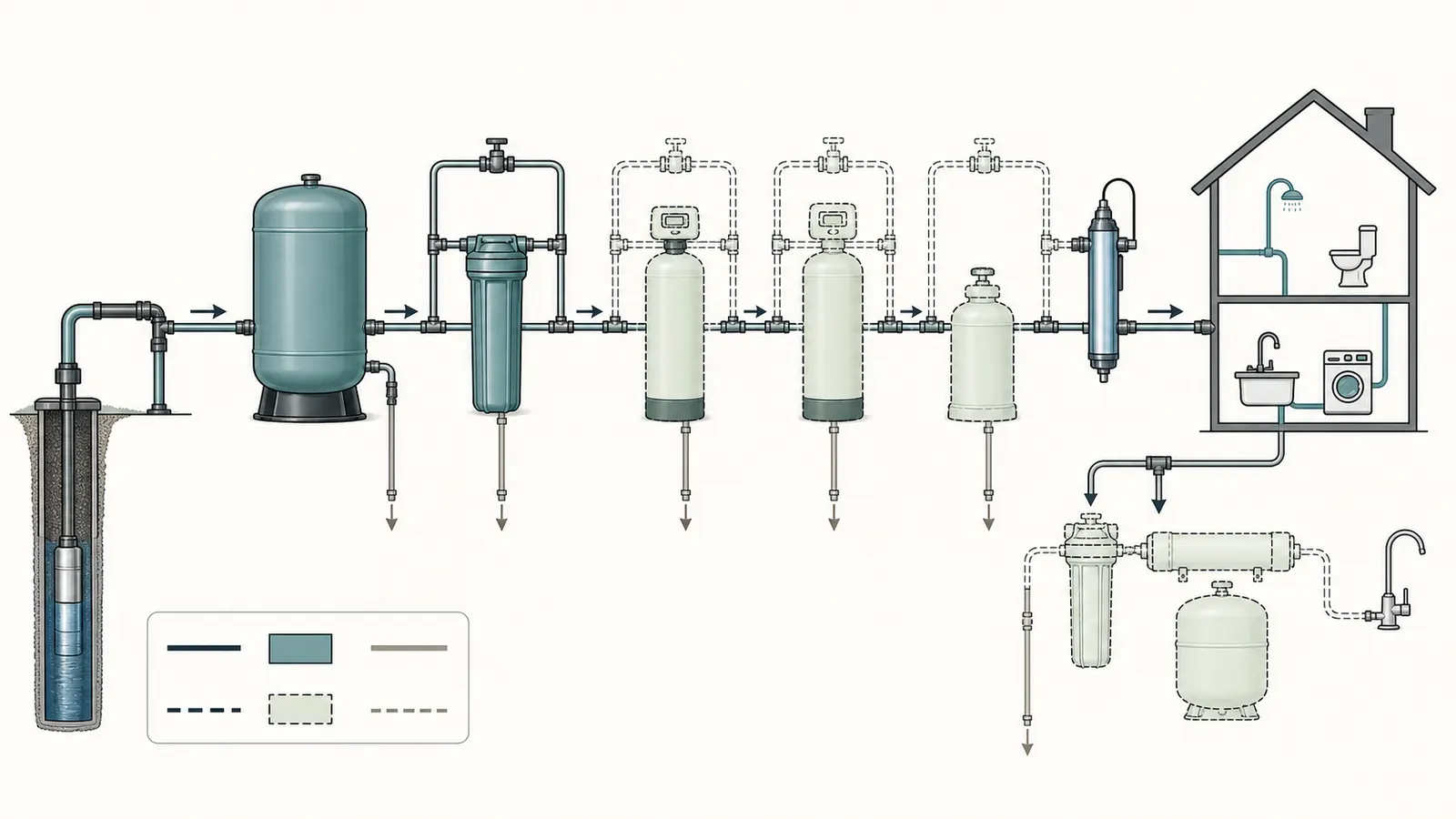
| Unit ID | Observed location and flow order | Record these clues | Do not infer yet |
|---|---|---|---|
| WT-01 | Before or after pressure tank? | Tank shape, gauge, switch, pipe size | That it filters water |
| WT-02 | Whole-house line or branch? | Control head, model plate, bypass, drain | The media inside |
| WT-03 | Near a faucet or appliance? | Clear housing, cartridge label, separate faucet | A contaminant claim |
| WT-04 | Wired chamber or controller? | Lamp, alarm, flow sensor, sleeve | That UV is operating |
| WT-05 | Tank with a small tube or injector? | Chemical label, tubing, level, pump | Chemical identity or dose |
If you cannot determine the direction, record “flow direction unknown.” Do not turn a handle, start a regeneration, unplug a controller, open a drain, or bypass a unit just to test the hypothesis. A professional can establish the flow path with the correct isolation and pressure procedure.
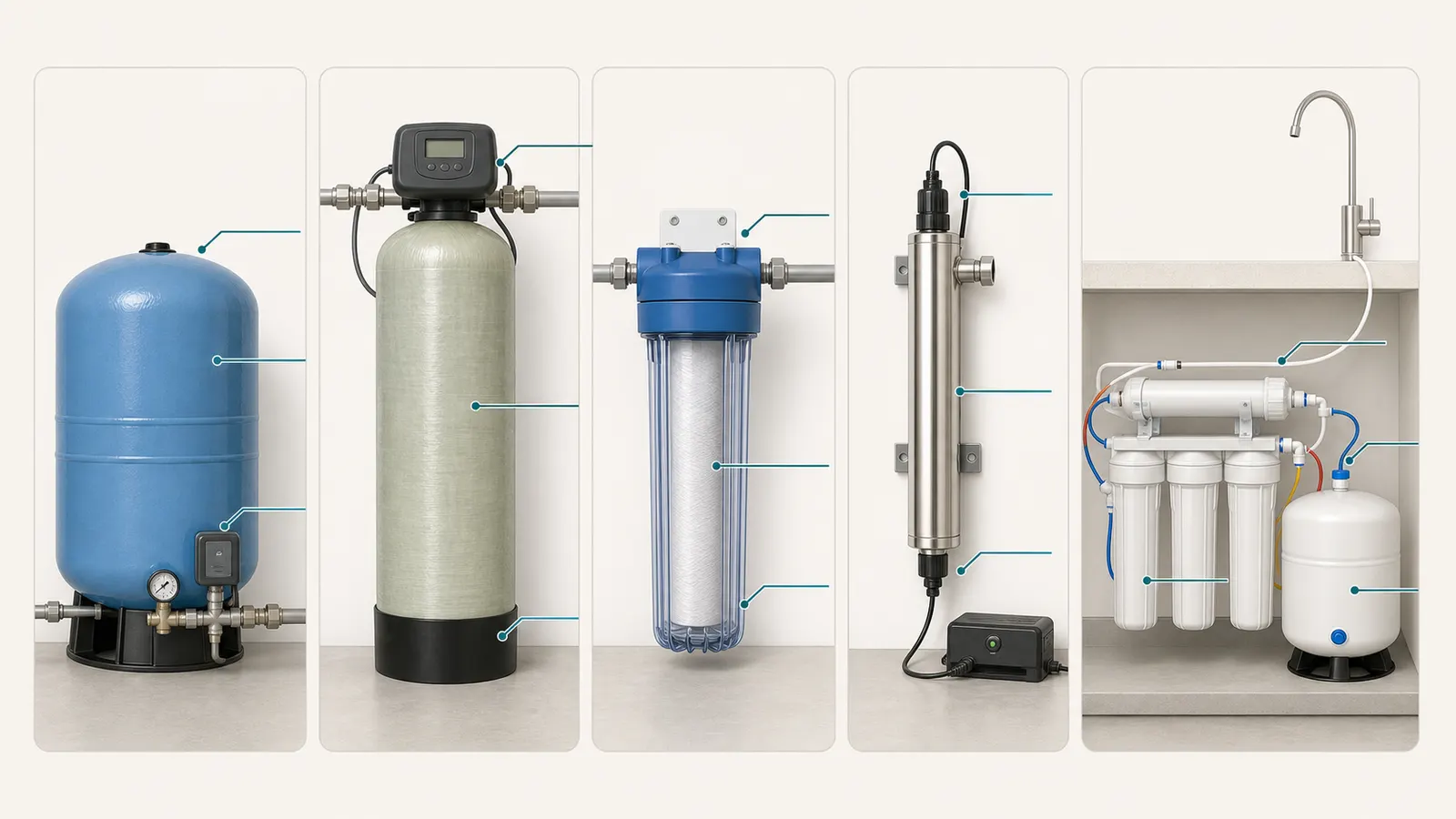
3. Use physical clues to assign a tentative equipment class
The purpose of visual clues is to choose the next record to find, not to prove what the unit treats. The following distinctions are useful starting points.
Pressure tank
A pressure tank is usually a large vessel associated with a pressure gauge, pressure switch, pump wiring, or the well supply. Treat it as part of the pressurized supply, not automatically as a filter or softener. Record the tank nameplate, size, serial number, visible pressure settings if printed, and the nearby gauge or switch. Do not remove a valve cap or test precharge unless the exact manufacturer procedure and a qualified person’s safe isolation plan are available.
Cartridge filter housing
A cartridge housing often has a clear or opaque bowl, a cap with inlet and outlet ports, and a replacement cartridge or micron designation on the label. It may be a sediment, carbon, specialty, or empty housing. Record the cartridge part number, any printed micron rating, housing model, arrows, pressure-relief button, and whether a spare cartridge or change date is present. A carbon cartridge is not proof of microbiological safety; NSF specifically notes that carbon systems may carry a warning about microbiologically unsafe or unknown water.
Softener or media tank
A tall tank with a programmable control head may be a softener, carbon filter, oxidizing filter, neutralizer, or another media system. A separate brine tank and small brine line are strong clues for a salt-regenerated softener, but the absence of a brine tank does not identify the media. Salt in a brine tank shows that salt is present; it does not show that the connected vessel is correctly regenerating or that hardness is the only problem.
Do not pour in salt, add cleaner, start a manual regeneration, or open the valve to look for media. Record the control-head display, printed valve model, injector or drain connection if visible, the brine tank label, and the service record instead.
Iron or sulfur filter, carbon filter, and neutralizer
These classes can share the same tall tank and automatic valve. A drain line and a programmed backwash or rinse cycle may indicate a backwashing filter, but they do not identify the media. Dark or tan particles, a mineral layer, or a claim written on a sticker is only a clue. A neutralizer may be associated with calcite or other alkaline media, but do not identify it by color or by tapping the tank.
Use the water test and the exact media or installation record to distinguish a treatment purpose. The EPA’s Drinking Water Technologies overview frames treatment selection around source-water chemistry and turbidity and points to contaminant-specific performance, operating, and waste-disposal considerations. It is useful orientation, but it does not identify the contents of an undocumented vessel.
Ultraviolet unit
A UV system commonly has a narrow chamber, an electrical controller, a lamp-status indicator, and sometimes an audible alarm or flow sensor. Record the controller and chamber model, lamp and sleeve replacement date, alarm state, and whether the unit is located on the whole-house line or a branch. Do not remove the lamp, unscrew the chamber, or treat a green indicator as a water test. UV performance depends on the installed system, maintenance, water quality, and the manufacturer’s operating limits.
Reverse osmosis system
An RO system is often point-of-use: look under a kitchen sink for multiple small cartridges, a storage tank, a drain connection, and a dedicated faucet. NSF distinguishes point-of-use systems such as RO from point-of-entry systems installed near a well’s pressurized storage tank. Record the membrane and cartridge labels, storage-tank nameplate, faucet served, drain connection, and any replacement dates. Do not assume that an under-sink RO treats every tap or that a membrane is still effective because water comes from the faucet.
4. Read labels, control heads, and bypasses as separate evidence
Photograph the manufacturer name, complete model number, serial number, electrical rating, replacement-component number, flow arrows, warning labels, and any certification mark. Transcribe the characters as printed, including dashes, suffixes, and decimal points. A partial model such as “2510” is weaker than “2510 SXT” plus the item or configuration number.
A control valve identifies a control platform, not necessarily the media tank’s contents. For example, Pentair describes the Fleck 2510 SXT as usable for both filtration and softener systems and lists filter and softener applications. That means a 2510 SXT photograph can narrow the search to the valve family, but it cannot by itself prove whether the attached vessel contains softening resin, carbon, oxidizing media, or something else. Compare the full label and configuration with Pentair’s 2510 SXT product information and, when the match is exact, the Fleck 2510 service manual. Obtain the exact manual rather than relying on a similar-looking image.
The same caution applies to Clack valves. Clack’s WS1 product and specification page lists both water-softener and water-filter tank applications, as well as backwash and bypass options. That narrows the control platform but does not prove which media the installer selected. The WS1/WS1.25 service manual can explain ports, cycles, and service parts without proving the media or complete system. Save the manual URL, revision or publication date, and the page that matches the observed valve. Do not treat a generic manual as the installation record.
Record bypass position as observed, such as “handle appears aligned with service” or “position unclear.” Do not move it. A bypass may send water around a unit, isolate a leak, or be part of the valve assembly. If the plumbing route does not make the position obvious, leave the interpretation open for the professional.
The strongest identity package for each unit is:
- wide and close photographs;
- manufacturer and exact model;
- serial or installation date, if present;
- inlet/outlet and drain or brine connections;
- control-head display or programming label, without changing it;
- media, cartridge, lamp, or membrane record supplied by the owner or installer;
- original manual, service invoice, warranty, or laboratory report; and
- unresolved questions written next to the evidence gap.
5. Verify the treatment claim separately from the hardware identity
Identification answers “what product or component is this?” Verification answers “does this installed system reduce the contaminant we care about, under the conditions that apply here?” Those are different questions.
First, obtain an independent water test from a certified drinking-water laboratory. Select the panel based on well history, local conditions, symptoms, nearby land use, and prior results; do not choose a filter because a tank resembles one in a photograph. EPA’s private-well testing guidance lists examples such as bacteria, nitrate, metals, volatile organic compounds, hardness, and hydrogen sulfide for different conditions. NSF’s home-treatment guidance likewise says to test private-well water independently, decide which contaminants need reduction, and match the exact contaminant claim to the treatment system.
Second, locate the exact performance data. NSF’s label and literature guidance says a data plate may identify the manufacturer, system model, and replacement components. A performance data sheet may also list rated service flow, service cycle, maintenance requirements, the testing organization, and the specific contaminants for which performance was validated. Record those fields rather than writing “certified” in a blank column.
Third, compare the evidence to the installed configuration. Ask:
| Verification question | Evidence that answers it | Safe conclusion if missing |
|---|---|---|
| What is the contaminant? | Dated independent laboratory result | Treatment need is unknown |
| What exact unit is installed? | Complete data plate and manual match | Identity remains probable only |
| What does it claim to reduce? | Performance data for the exact model and contaminant | Do not assign a treatment claim |
| At what flow and cycle? | Rated service flow, capacity, and operating limits | Capacity and contact assumptions are unknown |
| Is it maintained? | Cartridge, lamp, resin/media, salt, and service records | Condition is unverified |
| Does water actually pass through it? | Confirmed flow path and bypass status | Whole-house coverage is unknown |
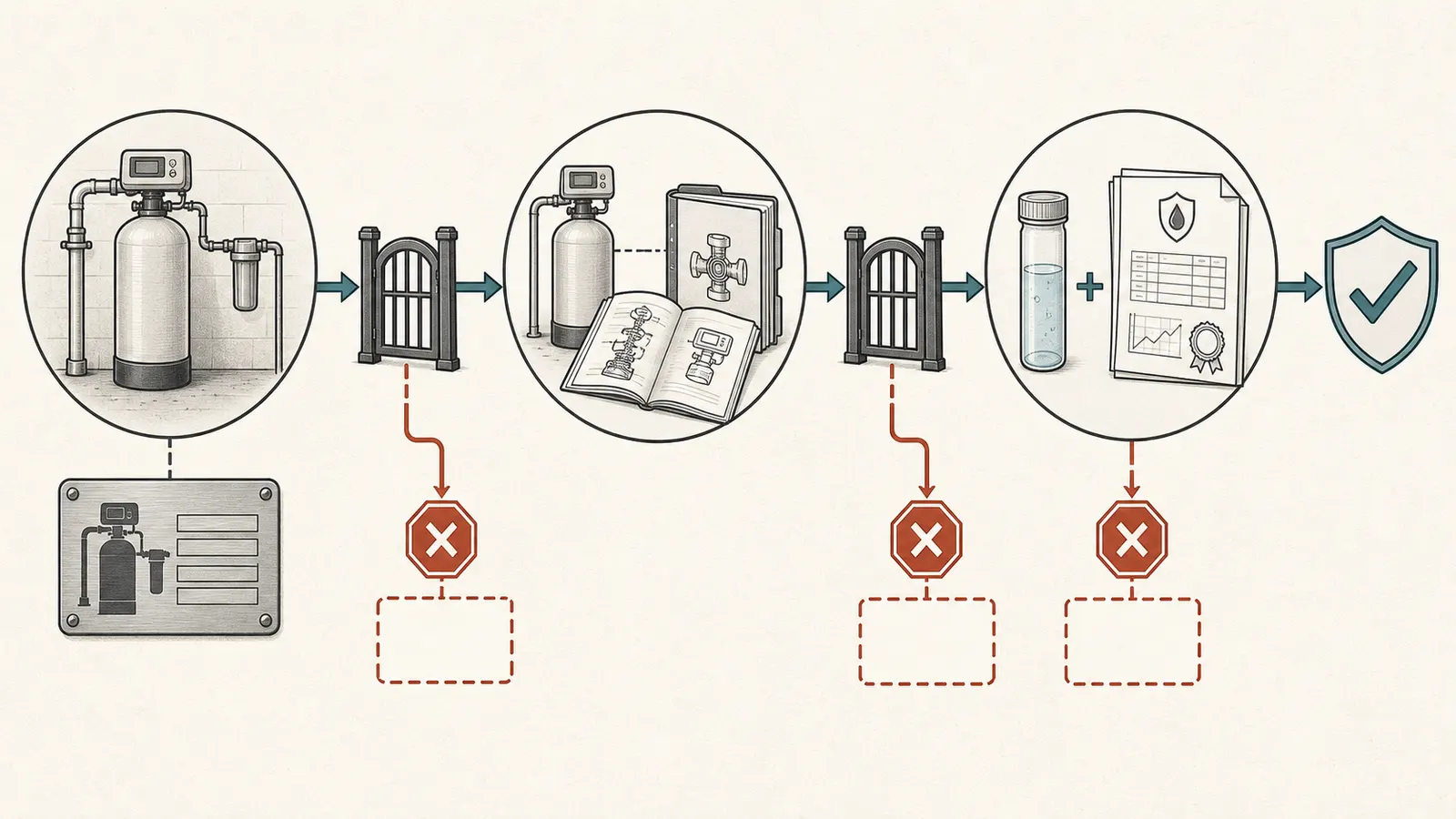
A test result before treatment and a result after treatment can help a professional evaluate performance, but one sample does not certify an installation for all future conditions. EPA notes that treatment suitability depends on the contaminant, concentration, and well condition, and that another water source may be necessary in some cases. Do not tell household members that water is safe merely because a softener, carbon tank, UV chamber, or RO faucet has been identified.
6. Finish a service-ready inventory and decide when to stop
Create one row per physical unit and one folder of matching photographs. Use this compact inventory, leaving unknown fields blank or writing “unknown” rather than guessing:
| Field | Record |
|---|---|
| Unit ID and room/location | __________________________________ |
| Apparent flow order | __________________________________ |
| Equipment class | observed / probable / verified: __________________ |
| Manufacturer, model, serial | __________________________________ |
| Control valve and configuration | __________________________________ |
| Inlet, outlet, bypass, drain | __________________________________ |
| Brine, chemical, cartridge, media, lamp, or membrane clue | __________________________________ |
| Power/controller/alarm observation | __________________________________ |
| Last service or replacement date | __________________________________ |
| Water test, contaminant, and laboratory | __________________________________ |
| Manual, data sheet, certification, or invoice | __________________________________ |
| Open question for professional | __________________________________ |
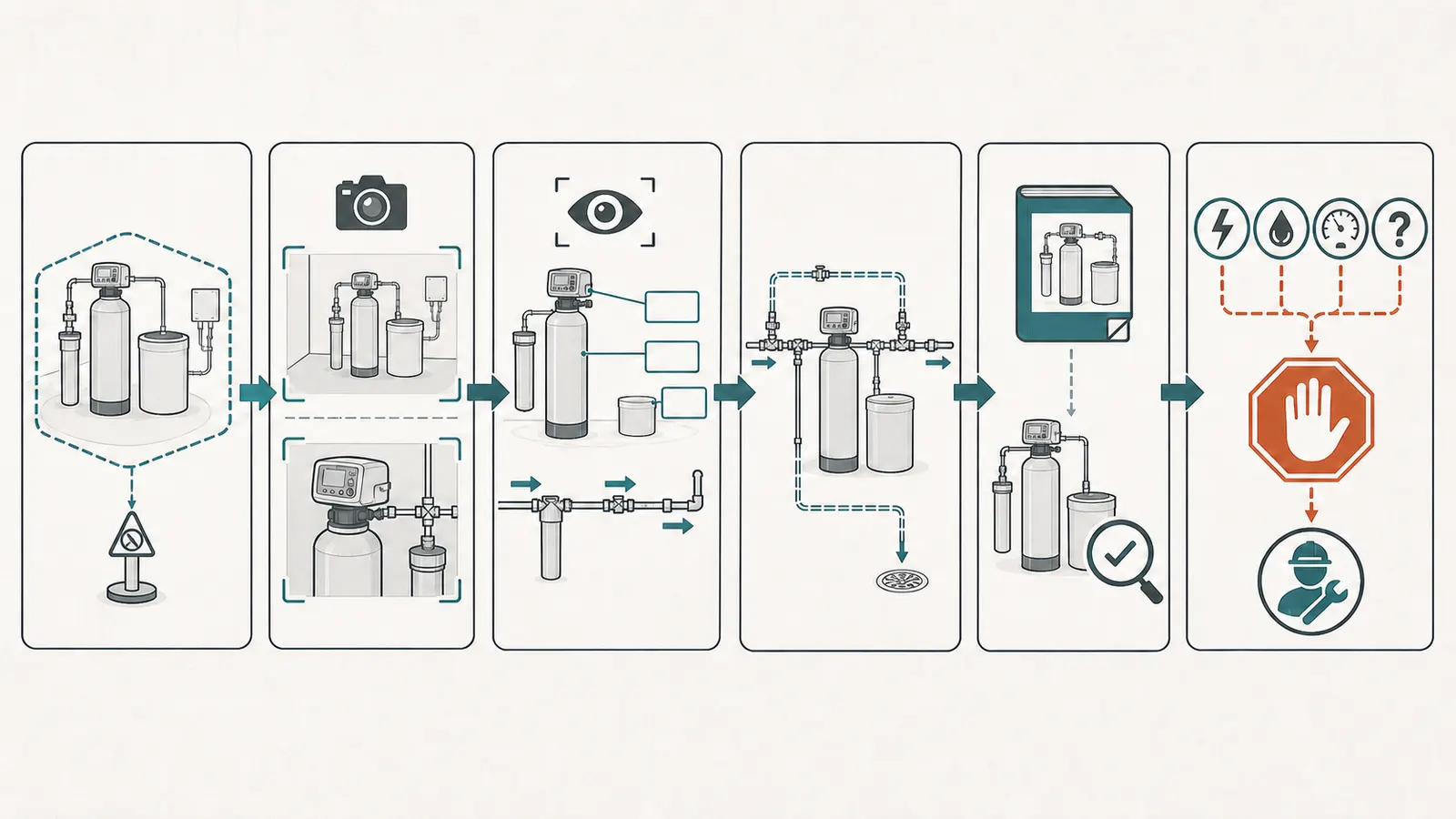
Before a service visit, add the wide flow-path photograph, close label photographs, recent laboratory reports, well construction or pump records if available, service invoices, cartridge or lamp receipts, salt or chemical product labels, and a list of changes in taste, odor, staining, pressure, flow, or alarms. Keep the original files; do not crop out model suffixes or warning labels.
If a test detects bacteria or a contaminant of health concern, stop treating the unknown equipment as potable-water protection. Use an alternative safe drinking and cooking source as appropriate, and obtain instructions from the local or state public-health authority and a qualified well-water professional. Follow their direction for confirmation testing, disinfection, treatment, or a replacement water source; EPA says that a contaminant above a health standard requires public-health guidance and retesting, and that some conditions may require a new water source. Do not make a household safety decision from a tank shape, a green UV light, a softener salt level, or a model match alone.
Stop the identification exercise and escalate when any of these is true:
- the identity of a chemical, tank, or electrical component is unknown;
- a vessel, fitting, UV chamber, or cartridge housing leaks or appears damaged;
- the pressure condition or flow direction cannot be established safely;
- wiring, controls, a well cap, a pump, a confined space, or pressurized equipment would need to be opened or tested;
- a manual regeneration, bypass change, drain test, or chemical adjustment would be required to confirm the guess;
- a laboratory result shows bacteria or a contaminant of health concern and the household has not received public-health or qualified well-professional guidance; or
- the household needs a safety decision but the treatment claim, maintenance state, or water test is missing.
The finished record should let a qualified professional say, “This is the unit, this is the water path, this is the documented claim, and these are the gaps.” It should never turn a visual match into permission to adjust an unknown valve or into proof that the water is safe.
Sources and scope
Evidence behind this page
- Protect Your Home's Water | U.S. EPA
Federal guidance for private wells; supports the article's independent testing and retest boundary, not a claim that every state has the same testing rule.
- Protect Your Home's Water | U.S. EPA
Federal private-well guidance; supports the source and escalation recommendation.
- Protect Your Home's Water | U.S. EPA
Federal guidance; supports the article's warning that equipment appearance cannot establish suitability or safety.
- Drinking Water Technologies | U.S. EPA
Accessible current EPA overview; used only to orient treatment selection and disposal questions, not to identify the contents of an undocumented vessel or establish a local requirement.
- Protect Your Home's Water | U.S. EPA
Federal private-well testing guidance; supports examples of contaminant-specific testing considerations, not a universal test panel or a claim that any listed contaminant is present at this home.
- Protect Your Home's Water | U.S. EPA
Federal private-well guidance; supports the article's testing, local-authority, recordkeeping, and professional-handoff boundaries, not a claim that every jurisdiction uses the same rules.
- Product Label and Literature Claims | NSF
NSF consumer guidance for certified water-treatment products; supports what to photograph and record, not a claim that every older or uncertified device has a data plate.
- Product Label and Literature Claims | NSF
NSF consumer guidance; supports the verification fields and the distinction between a model identity and a contaminant-specific claim.
- Home Water Treatment System and Solutions | NSF
NSF consumer guidance; supports the article's no-inference boundary for safety and treatment performance.
- Home Water Treatment System and Solutions | NSF
NSF consumer guidance; supports using position in the flow path as a clue, not as proof of a device's function.
- Fleck 2510 SXT Valve | Pentair
Pentair product information for this valve family; supports the valve-versus-system distinction for an exact model, not every Fleck valve or installation.
- Fleck 2510 Service Manual | Pentair
Pentair primary service documentation; supports manual matching and service-record capture for a Fleck 2510, not homeowner servicing of a live system.
- Drinking Water Technologies | U.S. EPA
EPA's current overview supports the federal-versus-local boundary; the article routes homeowners to the relevant state or local authority rather than asserting a uniform permit rule.
- WS1 Water Specialist Valve | Clack Corporation
Clack's current product/specification page; supports the valve-platform and option distinction, not the media or complete installed system.
- WS1 and WS1.25 Drawings and Service Manual | Clack Corporation
Clack OEM manual; supports the boundary between a control-valve manual and the installed media/system, not homeowner servicing of live equipment.
- WS1 and WS1.25 Drawings and Service Manual | Clack Corporation
Clack OEM technical documentation; supports the article's no-opening, no-live-service boundary.
- Drinking water in Minnesota | University of Minnesota Extension
University extension overview; supports the pressure-tank location clue without assigning a national installation sequence.
- Owner's Guide to Wells | Minnesota Department of Health
Minnesota public-health guidance; supports maintaining a service-ready record, not a nationwide legal recordkeeping requirement.