Do I Need a Sediment Prefilter Before a Whole-House Carbon Filter on a Private Well?
A test-first private-well worksheet to decide whether sediment before carbon is necessary, optional, or the wrong treatment for your water.
The short answer
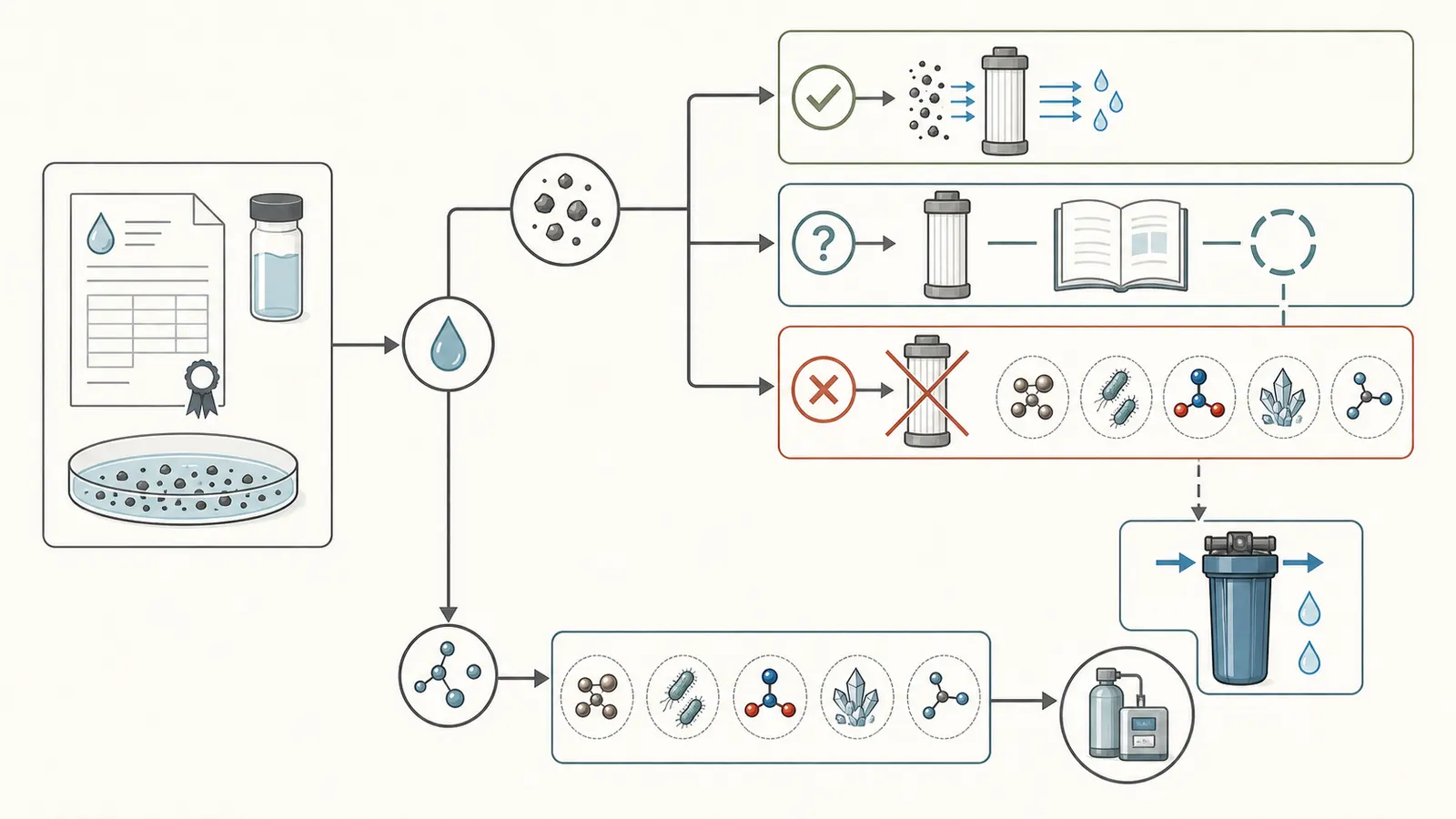
Usually, add sediment protection when visible or settled particles, solids on a cartridge, or pressure loss consistent with particulate loading are documented. Rapid carbon loading alone is not enough; check dissolved contaminants, adsorption capacity, and the unit’s claim data. It is optional only when water is clear and the exact manual permits it, and wrong for bacteria, nitrate, hardness, or dissolved iron and manganese.Do I Need a Sediment Prefilter Before a Whole-House Carbon Filter on a Private Well?
Usually, yes when the well sends visible particles, turbidity, grit, rust, or soil into the house. A sediment stage can keep particles from clogging carbon and shrinking the carbon’s contact area. But “usually” is not the same as “always,” and rapid loading alone is not proof that sediment is the cause: support the sediment branch with visible or settled solids, solids on the cartridge, or pressure loss consistent with particulate loading. Without those signs, investigate dissolved contaminants, exhausted adsorption capacity, and the carbon unit’s claim or capacity data before adding a stage. A prefilter is optional only after the exact carbon unit’s manual, pressure data, and raw-water condition are checked. It is the wrong remedy when the real problem is bacteria, nitrate, hardness, or dissolved iron and manganese.
Use this decision surface:
- Necessary: particles are observed or the well report and service history show a particulate burden that can foul the carbon unit. Choose a housing and cartridge that the carbon manufacturer permits, then verify flow and pressure.
- Optional: the water is consistently clear, there is no visible or settled particulate burden, and the carbon manual does not require upstream protection for that raw-water condition. Keep a way to monitor pressure and add a stage later if the evidence changes.
- Wrong remedy: the test points to bacteria, nitrate, hardness, dissolved iron, manganese, hydrogen sulfide, fuel-related chemicals, or another contaminant that needs a different process. Do not use a sediment cartridge to create false confidence about health protection.
The rest of this worksheet shows how to reach one of those outcomes using a well report, observations, the chosen carbon unit’s manual, and a post-install test.
1. Start with the well report, not the shopping cart
Private wells are the homeowner’s responsibility, and a clear glass of water is not a safety report. EPA recommends annual testing for total coliform bacteria, nitrates, total dissolved solids, and pH, with additional testing when local conditions or water quality change. EPA also says to use a laboratory certified for drinking-water testing. EPA’s private-well testing guidance is the right starting point for the baseline, but the basic panel may not cover every contaminant relevant to your property.
Before comparing prefilters, collect:
- The latest laboratory report, including units, detection limits, sample date, and whether the sample was raw well water or treated water.
- The well type if known: drilled, dug, or bored; the well log or completion record if available; and any recent pump, pressure-tank, plumbing, or well work.
- The target carbon model and its current installation manual, specification sheet, certified claims, minimum and maximum pressure, rated service flow, temperature range, connection size, and published pressure drop.
- The household’s peak simultaneous demand: for example, a shower plus a toilet refill, laundry, or another fixture. This is not a universal flow requirement; it is the demand your designer or installer must compare with the unit’s rated service flow.
- A simple history of what you actually see: sand at a faucet aerator, rusty water after the pump starts, cloudy water that settles, a brown cartridge, repeated cartridge plugging, or pressure that falls as the filter loads.
NDSU Extension advises testing before purchasing filtration equipment because the type and amount of contaminant determine whether one filter, different equipment, or a combination is appropriate. Its household filtration publication also cautions that proper sampling and handling differ by contaminant. Do not treat an inexpensive strip test or a visual jar check as a substitute for a certified laboratory report when the question involves health.
What the report can and cannot tell you
A laboratory result such as iron, manganese, nitrate, hardness, or total dissolved solids describes water chemistry. It does not automatically tell you the particle-size distribution that a cartridge must catch. Conversely, visible grit does not prove that the well has a dangerous chemical contaminant. Keep the observations and the laboratory results as separate evidence streams until a water professional connects them.
If the report shows a contaminant above a health standard, pause the filter purchase. EPA advises contacting the public health department and retesting to confirm the result; treatment depends on the contaminant, its concentration, and the condition of the well. EPA’s treatment guidance describes disinfection, filtration, or other actions as condition-dependent, not interchangeable. If flooding, an open or unknown-quality wellhead, construction or repair, pump work, or an unexplained odor, color, or seasonal change raises a contamination concern, stop using the well water for drinking, cooking, brushing teeth, ice, and other ingestion until the local health authority or a qualified well-water professional gives testing and return-to-use direction. A sediment prefilter or carbon unit does not make potentially contaminated well water safe.
2. Separate particles from dissolved contaminants
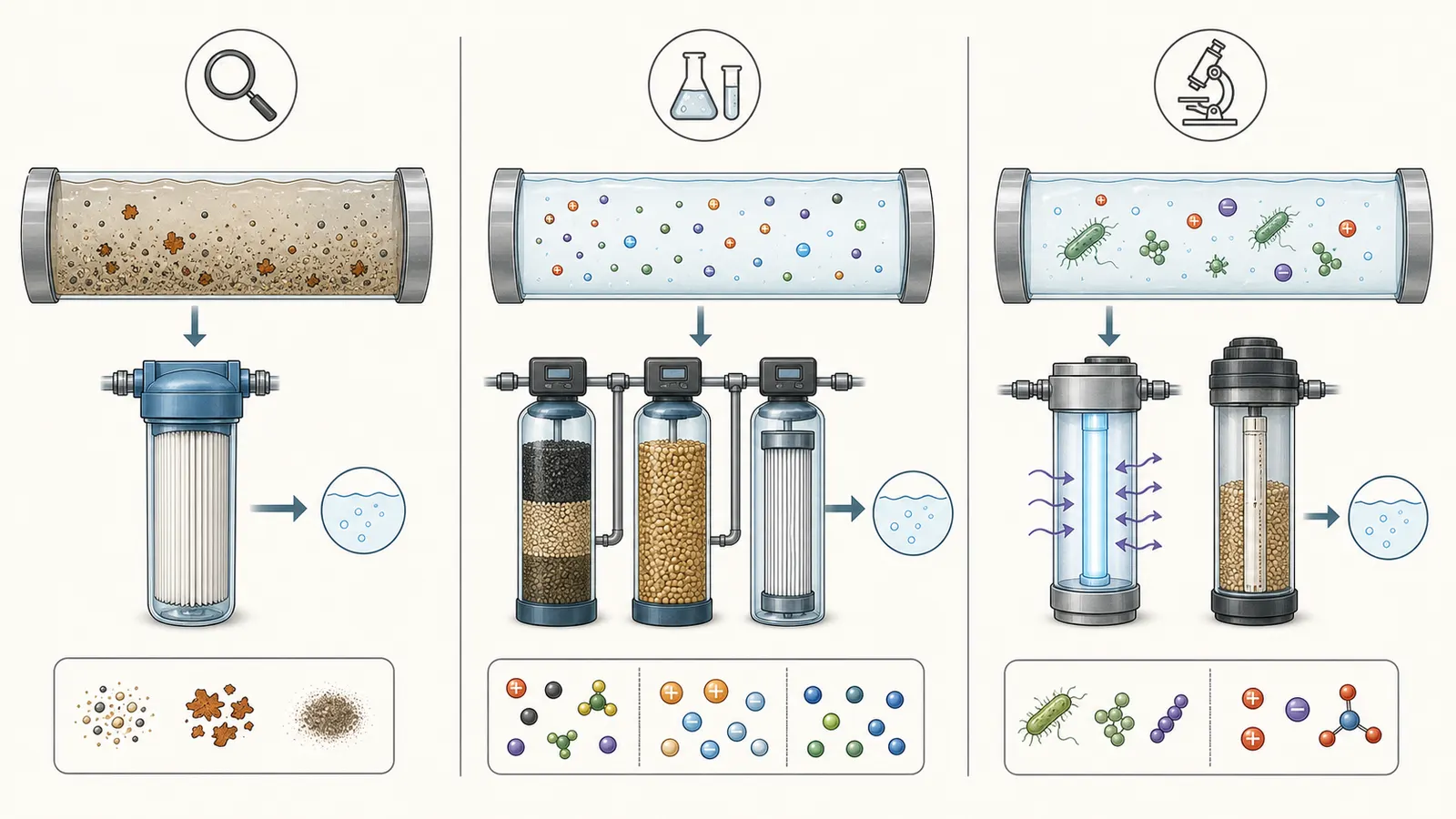
The most important branch is not “5 micron versus 20 micron.” It is “particle problem versus water-chemistry or microbiological problem.” A sediment prefilter is a physical barrier for particles. Activated carbon is an adsorption or catalytic medium whose performance depends on the contaminant, contact time, flow, media, and certified claim.
| What you observe or measure | What it may indicate | What a sediment prefilter can do | Safest next move |
|---|---|---|---|
| Sand, grit, rust, soil, or a cartridge visibly packed with solids | Particulate loading | Capture some particles before the carbon stage | Confirm particle burden, housing size, micron choice, and pressure data |
| Cloudiness that settles, or fine clay after well disturbance | Suspended solids; particle size is still unknown | Reduce the load only if the cartridge is rated for the particles and flow | Ask the laboratory or water professional what testing is appropriate; do not jump to the finest cartridge |
| Orange or black staining with iron or manganese on the report | Often a dissolved or oxidized-metal treatment problem, not ordinary sediment alone | May catch already-formed particles, but does not establish dissolved-metal removal | Follow the carbon manual and use contaminant-specific iron/manganese treatment when indicated |
| Rotten-egg odor or hydrogen sulfide on the report | Dissolved gas or sulfur chemistry | Not a general sediment solution | Use the selected equipment’s specific claim and professional design guidance |
| Total coliform or other bacteria detected | Microbiological safety concern | Does not make unsafe water safe | Stop relying on carbon; contact the health department or qualified water professional and follow disinfection guidance |
| Nitrate, hardness, sodium, or another dissolved result | Chemistry requiring a matched process | Does not remove the dissolved contaminant merely because water passes through a cartridge | Select treatment certified or specified for that contaminant, then verify with testing |
NDSU specifically says activated carbon does not remove or reduce microbes, sodium, nitrates, fluoride, or hardness. It also says a bacteriostatic carbon filter is not adequate for microbiologically unsafe water. Read the extension’s capability and safety limits before treating a carbon bed as a health barrier.
The same caution applies to certification. NSF explains that NSF/ANSI 42 generally covers aesthetic effects, while NSF/ANSI 53 covers health-effect contaminant reduction, and that certification does not mean a product reduces every possible contaminant. NSF’s standards explanation says to verify the exact contaminant claim for the exact product. “NSF certified” without the standard, contaminant, model, and capacity is not a complete buying decision.
3. Decide whether sediment protection is necessary or optional
Use the following gate. A “yes” in the first column does not select a micron rating by itself; it tells you whether upstream particle control deserves a place in the design.
| Gate question | Yes | No |
|---|---|---|
| Do you see grit, sand, rust, soil, settling solids, or repeated particulate loading at the house entry? | Treat sediment protection as necessary to investigate. | Continue to the next gate. |
| Has flooding, an open or unknown-quality wellhead, construction or repair, pump work, or an unexplained odor, color, or seasonal change raised a contamination concern? | Stop using well water for drinking, cooking, brushing teeth, ice, and other ingestion. Do not use a bypass or untreated branch for drinking. Contact the local health authority and a qualified well-water professional; test and follow their return-to-use direction before choosing a prefilter. | Continue to the particle and equipment gates. |
| After that safety screen, do you see grit, sand, rust, soil, settling solids, solids on a cartridge, or pressure loss consistent with particulate loading? | Treat sediment protection as necessary to investigate. | Continue to the next gate; rapid carbon loading alone is not enough evidence. |
| Does the carbon manual require a sediment stage, limit incoming particles, or show that its own media is not intended to carry a heavy solids load? | Install the specified upstream protection. | Continue to the next gate. |
| Is pressure already marginal at the pressure tank or at the home during peak use? | A fine cartridge may be harmful; measure before choosing one and have the system evaluated. | Continue to the next gate. |
| Is the water consistently clear, the carbon manual permissive, and the carbon unit sized for the household’s demand? | A prefilter may be optional, with monitoring and a future bypass or upgrade path. | Do not buy on assumption; obtain the missing report or manual data. |
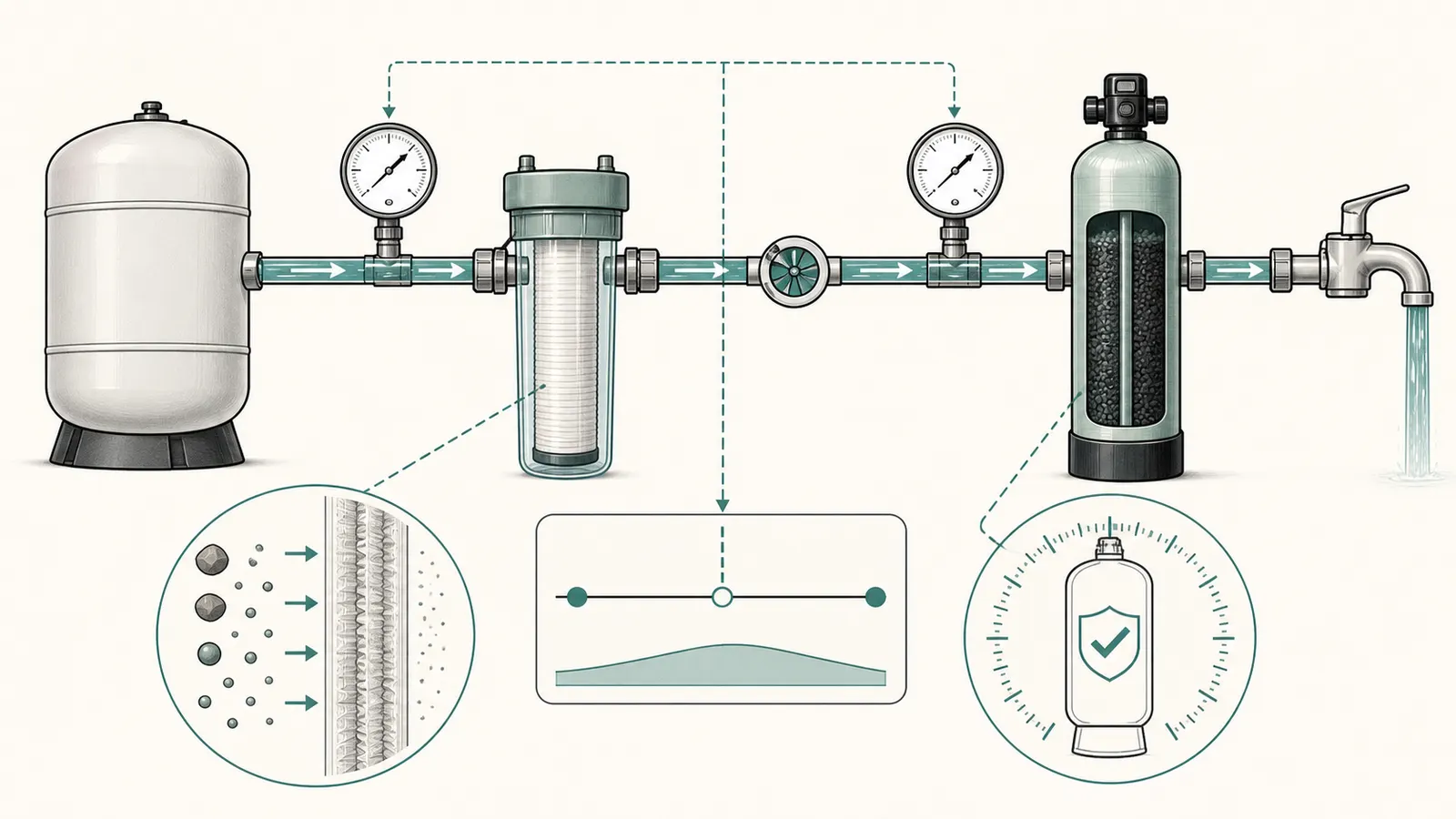
NDSU describes a sediment filter as the first device on a private-water supply after the pressure tank and says a sediment stage ahead of carbon can prolong the carbon unit’s life. That is a strong sequence when particles are present, but it is not permission to install the most restrictive cartridge available. The same publication says 2- to 5-micron filters require more pressure, and that private-well examples vary by well construction and particle burden. Use NDSU’s particle-size discussion as context, not as a universal prescription.
A practical observation protocol
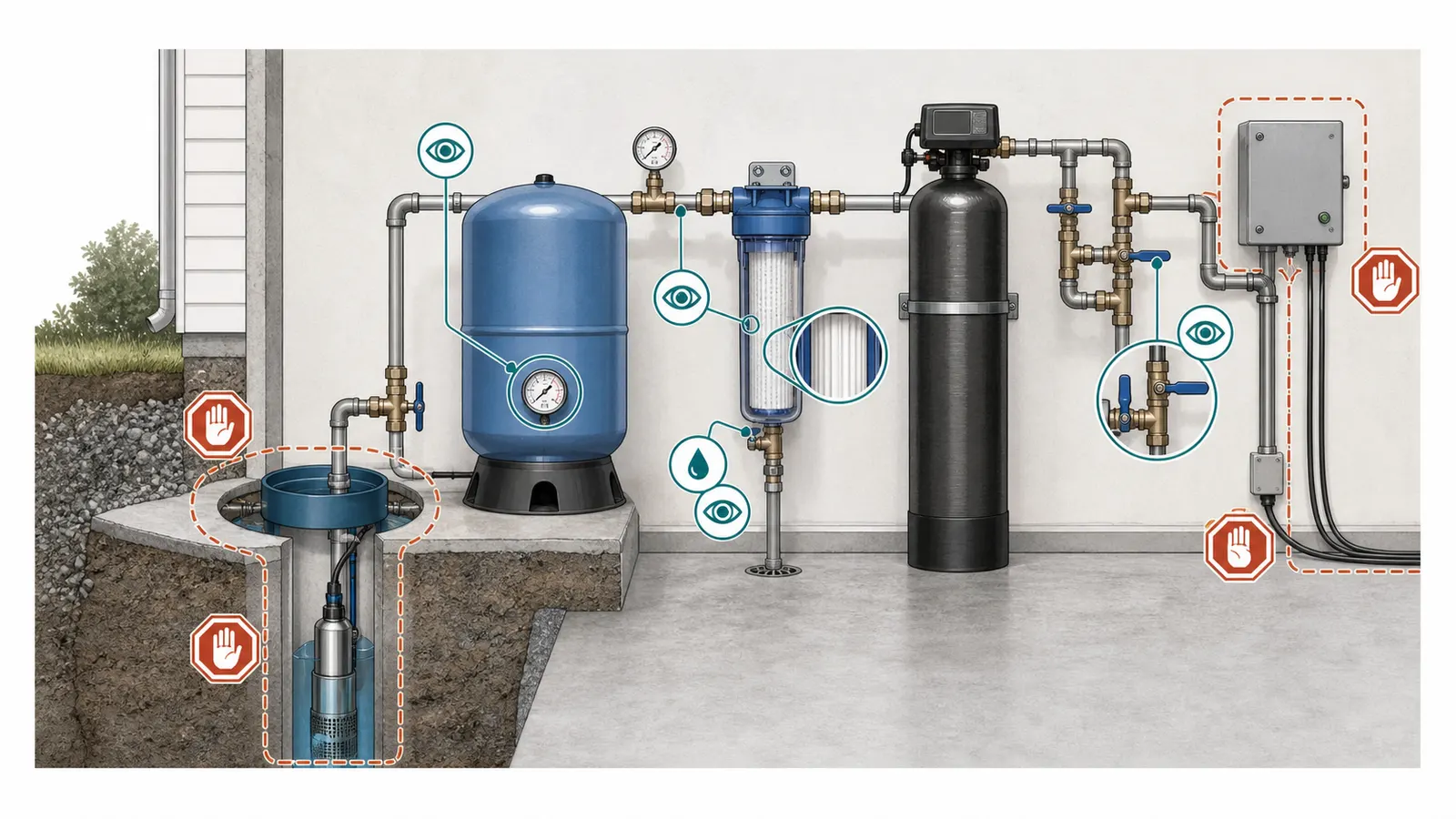
Without opening the well or changing pressurized equipment, record the following over several normal uses:
- Run a cold-water fixture into a clean, light-colored container after the water has been unused overnight. Record whether solids settle and how long that takes.
- Repeat after a normal high-flow event, such as a shower or laundry cycle, if safe and convenient. Note whether the water changes after the pump has run.
- Photograph the outside of the cartridge housing and record the installation date and any visible discoloration when a cartridge is replaced. Do not infer a contaminant concentration from color alone.
- Record pressure at the installed gauge before and during a repeatable fixture demand. A single static pressure reading does not describe pressure loss through a treatment train.
- If the water has changed after flooding, construction, well repair, pump work, an open or unknown-quality wellhead, or a new odor, color, or seasonal shift, stop using it for drinking, cooking, brushing teeth, ice, and other ingestion. Do not switch to a bypass or untreated branch for drinking. Contact the local health authority and a qualified well-water professional, arrange testing, and follow their return-to-use direction; a sediment prefilter does not make potentially contaminated water safe.
Do not open a well, pull a pump, enter a confined space, open an energized control enclosure, touch live wiring, loosen a pressurized housing, or manipulate a pressure-relief device as part of this observation protocol. Those actions belong to a qualified well, plumbing, or electrical professional.
4. Match the prefilter to the carbon unit’s real limits
The extra stage is only successful if the whole train still delivers the required flow at safe pressure. Ask for five numbers from the exact manuals or data sheets:
- Housing pressure and temperature rating. The housing, cap, cartridge, fittings, and seals must each be suitable for the well system. Do not assume that a cartridge marketed for a point-of-use filter belongs in a whole-house housing.
- Cartridge micron rating and construction. A nominal or absolute rating has a defined meaning only in the manufacturer’s documentation. A lower micron number can capture smaller particles but may load faster and create more pressure loss.
- Rated flow at a stated pressure drop. “Maximum flow” without its test condition is incomplete. Record the flow and pressure-drop conditions together.
- Carbon service flow and pressure drop. Carbon needs adequate contact time, and the whole-house unit still has a finite service-flow rating. Compare the combined train, not the carbon tank alone.
- Connection size and bypass arrangement. A smaller connection, restrictive valve, or badly positioned bypass can become the real bottleneck.
Pentair’s 37298 manual is a useful example of why model specificity matters. It documents a 20–120 psi operating range and a 20 psi minimum, then lists different service flows and pressure drops for its 1.0, 1.5, and 2.0 systems: 11.6 GPM with 10 psi drop, 11.9 GPM with 15 psi drop, and 13.2 GPM with 14 psi drop at the stated service flow. See the Pentair manual’s operation table. These are not safe universal numbers for another carbon tank, cartridge, or home.
The same manual says its documented systems were tested and certified for material safety and lead-free compliance only, not contaminant reduction or structural integrity. That distinction matters: the physical product can be suitable for a water line without proving a health-contaminant reduction claim. Use the selected unit’s certification listing and performance claim for the contaminant you actually need to reduce.
The pressure-drop check
Use a repeatable demand, not a faucet trickle:
observed stage loss = upstream pressure − downstream pressure
Take the readings at the same time and with the same fixture demand. If the system has only one gauge, a professional can add temporary or permanent measurement points; do not loosen a pressurized fitting to improvise one. Record the clean-cartridge baseline and repeat the reading as the cartridge loads.
There is no honest universal “the prefilter may lose exactly X psi” rule for every home. A stage is acceptable only when the measured or documented combined loss leaves enough pressure for the carbon unit’s minimum, household fixtures, and any required backwash or control operation. If the pump is already struggling, a finer cartridge may trade cleaner water appearance for poor shower performance, pump cycling, or nuisance low-pressure events.
5. Choose a micron rating without over-restricting the house
Start coarse enough to protect the carbon unit and then tighten only when evidence requires it. This is a design principle, not a universal micron prescription. NDSU gives example guidance for private drilled wells and dug or bored wells, but the publication also makes clear that smaller pores need more pressure. Review those examples before selecting a cartridge.
Pentair’s current BB10-P and BB20-P Sediment Prefilter System page presents both SKUs with product specifications, replacement-finder support, and a local-professional flow. It describes 5-micron cartridges; the 10-inch model has a 1-inch connection and a listed estimated life of 6–12 months, while the 20-inch model has a 1.5-inch connection and a listed estimated life of 12 months. Pentair recommends the prefilter for whole-house filter and softener systems, but those estimated lives depend on source water, use, and installed size. Use the page as a current, model-specific comparison, not as a universal prescription. Verify the exact product’s current manual, flow curve, pressure rating, dimensions, and local availability before buying. See Pentair’s current BB10-P/BB20-P specifications and support.
Do not copy that 5-micron number into a different housing without checking the cartridge’s flow curve, dimensions, pressure rating, and end-cap fit. NDSU notes that filters are housed in manufacturer-specified containers so water flows through the media rather than bypassing it. A cartridge that physically fits can still be the wrong hydraulic or contaminant match.
When a spin-down stage is a better first question
If the burden is coarse sand or grit, ask whether a cleanable spin-down or other coarse separator belongs before a disposable cartridge. If the burden is fine clay, a coarse screen will not solve it. The correct sequence may be a coarse separator, a suitably sized cartridge, and then carbon—but only when the pressure, flow, drain, and maintenance plan support it. Have a professional size any stage that affects a low-yield well, pump protection, or automatic backwash.
6. Install for observation, bypass, and safe maintenance
The useful treatment train is more than “well pipe → filter → house.” Draw the actual sequence and label raw water, treated water, outside faucets, drains, gauges, shutoffs, and bypass paths before work begins.
Pentair’s manual describes a bypass for emergency leaks, service calls, and outdoor water use, recommends bypassing outside faucets where possible, and specifies raw water at the bypass inlet and treated water at the outlet. Use the Pentair installation section as a model-specific reference. A bypass is a service/layout feature, not a safety treatment: if contamination is suspected, do not send bypassed or otherwise untreated well water to drinking fixtures. The manual also says to follow applicable state and local laws and regulations; it does not replace local plumbing requirements.
For a homeowner handoff, require these labels and records:
- “Raw well water” before treatment and “treated household water” after treatment.
- Cartridge model, micron rating, housing size, installation date, and supplier.
- Carbon model, media type, certified contaminant claim, rated flow, pressure range, and manual revision.
- Gauge locations and the demand used for the baseline pressure readings.
- Bypass position for normal service, service work, and outside watering.
- The shutoff location and the person responsible for cartridge changes.
- A drain or discharge arrangement that follows the applicable manual and local requirements.
The pressure tank, well pump, electrical controls, and pressurized filter housings are not good places for improvisation. Do not open energized controls, test live wiring, open the well, pull the pump, enter a confined space, or disassemble a pressurized housing. If a cartridge housing leaks, the pressure does not recover, the pump runs continuously, the tank or control cycles abnormally, or a relief device discharges, shut down only using a known-safe homeowner shutoff procedure and call a qualified professional.
7. Verify the result and keep the decision alive
The prefilter decision is not complete when water first looks clearer. It is complete when the system remains within its documented operating envelope and the water-quality objective is verified.
Commissioning checklist
- Confirm the cartridge, housing, carbon unit, fittings, and seals match their manuals.
- Flush the new cartridge and carbon unit exactly as instructed by the product manual. Do not assume the first water is ready for drinking.
- Record static pressure, pressure during the repeatable demand, and flow before and after the treatment train when a safe measurement method is available.
- Confirm there are no visible leaks and that normal and bypass positions are unambiguous.
- Use a certified drinking-water laboratory for any health-related verification. If the goal is contaminant reduction, compare raw and treated samples using the laboratory’s sampling instructions and the carbon product’s certified claim.
- If bacteria, nitrate, or another health contaminant was previously elevated, follow the public health or qualified treatment professional’s return-to-use instructions; do not decide that a clear cartridge or good taste proves safety.
EPA recommends retesting after a significant water-quality change and specifically calls out testing after replacement or repair of a well-system part and after a change in odor, color, or taste. See EPA’s triggers for additional testing. For an installed treatment system, Brictale’s practical recommendation is to document a commissioning sample and retain the raw-water baseline so later results can be compared. That is a recordkeeping recommendation, not a universal legal interval.
Maintenance log
| Date | Cartridge and carbon status | Static pressure | Repeatable-demand pressure | Flow or fixture observation | Action |
|---|---|---|---|---|---|
| Install | New cartridge; carbon commissioned | Record | Record | Record baseline | Flush, label, and save manuals |
| Monthly or when symptoms change | Color, solids, leaks | Record | Record | Note shower or fixture change | Investigate a new pressure loss or odor |
| Cartridge change | Old cartridge condition and model | Record | Record | Compare with baseline | Replace with the same approved fit or reassess the design |
| Annual well review | Report date and raw-water results | Record | Record | Compare to prior year | Test the private well and review treatment claims |
| After well or plumbing work | New sample and work description | Record | Record | Do not infer safety visually | Retest before relying on the system |
NDSU notes that carbon-filter life estimates are not guarantees and that falling pressure can indicate particle saturation. Its replacement guidance supports using pressure and returning symptoms as maintenance signals, while the exact replacement schedule must come from the carbon and cartridge manuals. Do not extend a cartridge indefinitely because the water still tastes acceptable; some health-related performance is not visible or taste-detectable.
What to bring to a professional
Bring the well report, well log, photos of the old cartridge and sediment, the exact carbon manual, cartridge packaging, pressure readings, household peak-demand notes, installation sketch, and the maintenance log. Ask the professional to answer four bounded questions:
- Is the material actually particulate sediment, or is dissolved iron, manganese, hydrogen sulfide, or another process producing the appearance?
- What cartridge rating and housing size meet the carbon manufacturer’s protection and flow requirements without starving the house of pressure?
- Does the treatment train address the reported contaminant with a certified or documented claim, or is another treatment or disinfection step required?
- How will raw and treated water be sampled and retested, and what observation or pressure change triggers service?
The final answer for most private-well homes is therefore precise: put sediment before carbon when sediment is evidenced or the chosen unit requires protection; leave it optional only when the raw water and manual support that choice; and stop the purchase when the test identifies a contaminant that carbon or sediment filtration is not designed to solve.
Sources and scope
Evidence behind this page
- NDSU Agriculture Extension — Filtration: Sediment, Activated Carbon, and Mixed Media
Household filtration guidance from a university extension publication; it supports the protective rationale for a prefilter but does not make a prefilter mandatory for every private well or every carbon product.
- NDSU Agriculture Extension — Filtration: Sediment, Activated Carbon, and Mixed Media
The publication's general particle-size and private-well examples; the examples are not a substitute for particle testing, a housing rating, or the exact manufacturer's flow data.
- NDSU Agriculture Extension — Filtration: Sediment, Activated Carbon, and Mixed Media
General activated-carbon capability and safety boundary in a university extension publication; contaminant reduction must still be checked against the selected product's certified claim.
- U.S. EPA — Protect Your Home's Water
EPA homeowner guidance for private wells in the United States; it is not a state-specific testing schedule or a guarantee that this basic panel covers every local contaminant.
- U.S. EPA — Protect Your Home's Water
EPA's treatment and retesting guidance for private-well contamination; it does not prescribe a single treatment train or establish local code requirements.
- NSF — NSF Standards for Water Treatment Systems
NSF's consumer explanation of voluntary residential treatment standards; standard numbers are not a substitute for checking the exact certified contaminant claim and model.
- Pentair — Whole House Carbon Filtration System Manual 37298
The 1.0, 1.5, and 2.0 Pentair rotary-valve carbon systems documented in the manual; these values must not be generalized to another model or another manufacturer's system.
- Pentair — Whole House Carbon Filtration System Manual 37298
Pentair's pre-installation, raw-water, and certification statements for the documented rotary-valve carbon systems; it is not a diagnosis of every carbon product or private well.
- Pentair — Sediment Prefilter System BB10-P / BB20-P
Pentair's current product page for the BB10-P and BB20-P cartridge prefilter systems; use these specifications only as an illustrative, model-specific comparison, not as a universal prescription. Estimated life depends on source water, use, and installed size and is not a universal maintenance interval.
- Pentair — Whole House Carbon Filtration System Manual 37298
Installation and bypass guidance for the Pentair rotary-valve carbon systems; local plumbing rules and the chosen system's current manual control the actual installation.