Can I Remove the Flow Restrictor From My Well-Water UV System?
A homeowner decision surface for a well-water UV flow restrictor: identify the control, check rated flow and dose, and choose a safe next step.
The short answer
Usually no. A flow restrictor may be the safeguard that keeps water within the UV unit’s validated flow and dose. Remove it only when the exact manual says it is optional and your measured maximum flow remains within the model’s rating. If the restrictor is missing, clogged, or blamed for low pressure, stop guessing: identify the model, verify flow, and restore or resize the treatment under the manual.Usually, do not remove the flow restrictor from a well-water UV system. Treat it as part of the disinfection design until the exact model manual proves otherwise. A restrictor can keep the water below the unit’s rated or validated maximum flow; exceeding that condition can reduce the treatment margin. VIQUA says a restrictor may be needed where the recommended maximum flow could be exceeded, and the Washington State Department of Health says excessive flow reduces the time water is exposed to UV radiation. VIQUA’s homeowner FAQ and Washington’s UV operations guidance support the same practical boundary.
Removing it is reasonable only in the narrow case where all of the following are true: the exact manual says the restrictor is optional; you know the unit’s rated flow and dose conditions; your measured maximum normal flow is at or below that rating; and no alarm, shutoff, certification, or installation instruction depends on the component. If the restrictor is missing, damaged, clogged, or blamed for low pressure, identify the model and verify flow before changing it. A larger UV unit may be the correct answer to a flow-demand problem. Removing a treatment-control component is not automatically an upgrade.
1. Make the decision from the model, not the fitting
The first decision is not “does this little fitting look restrictive?” It is “what does the manufacturer’s documentation require for this model, suffix, and application?” A UV chamber may look similar to another model while having a different lamp, sensor, flow path, certification basis, or rated dose.
Use this decision table before touching the plumbing:
| What you can verify | Decision | Safest next action |
|---|---|---|
| The manual lists the restrictor as required, supplies a part number, or shows it in the validated installation | Leave it installed or fit the exact specified replacement | Do not remove, drill, enlarge, or substitute it. If it is missing, treat the system as not verified until the correct part and installation are confirmed. |
| The manual says the restrictor is optional for your exact model and the measured maximum flow stays within the model’s rating | Removal may be permitted by that manual, but it is not required | Preserve the manual’s flow, alarm, and water-quality conditions. If low pressure is the reason for removal, diagnose that issue separately first. |
| The model, suffix, rated flow, or dose is unknown | Do not remove it | Photograph the label and plumbing, locate the manual, and ask a UV-qualified service provider or the manufacturer to identify the configuration. |
| The restrictor is missing or has already been removed | Do not assume the UV is still operating within its validated conditions | Restore the specified part or have the unit resized and verified. Use the manufacturer’s instructions for drinking-water precautions while treatment is uncertain. |
| Flow is low and the restrictor is being blamed | Do not use removal as the first test | Check pretreatment, valves, pressure conditions, and the actual flow path. A clogged sediment cartridge can create a restriction upstream of the UV. |
| A UV alarm, lamp-out indication, or shutoff has occurred | Follow the manual’s alarm and water-use instructions | Do not defeat the alarm or bypass for drinking water unless the manual and health authority instructions make the next step clear. |
There is no national homeowner rule that every UV system must have an external restrictor. The evidence is more precise than that. The VIQUA D4/E4/F4 manual describes a flow restrictor that limits flow to maintain adequate dose and marks it optional for non-validated models but required for its listed “-V” validated models. The Pentair PUV7/PUV14 manual calls its restrictor optional for those two models and specifies an outlet location and flow direction. Those are manufacturer-specific instructions, not permission to generalize across brands.
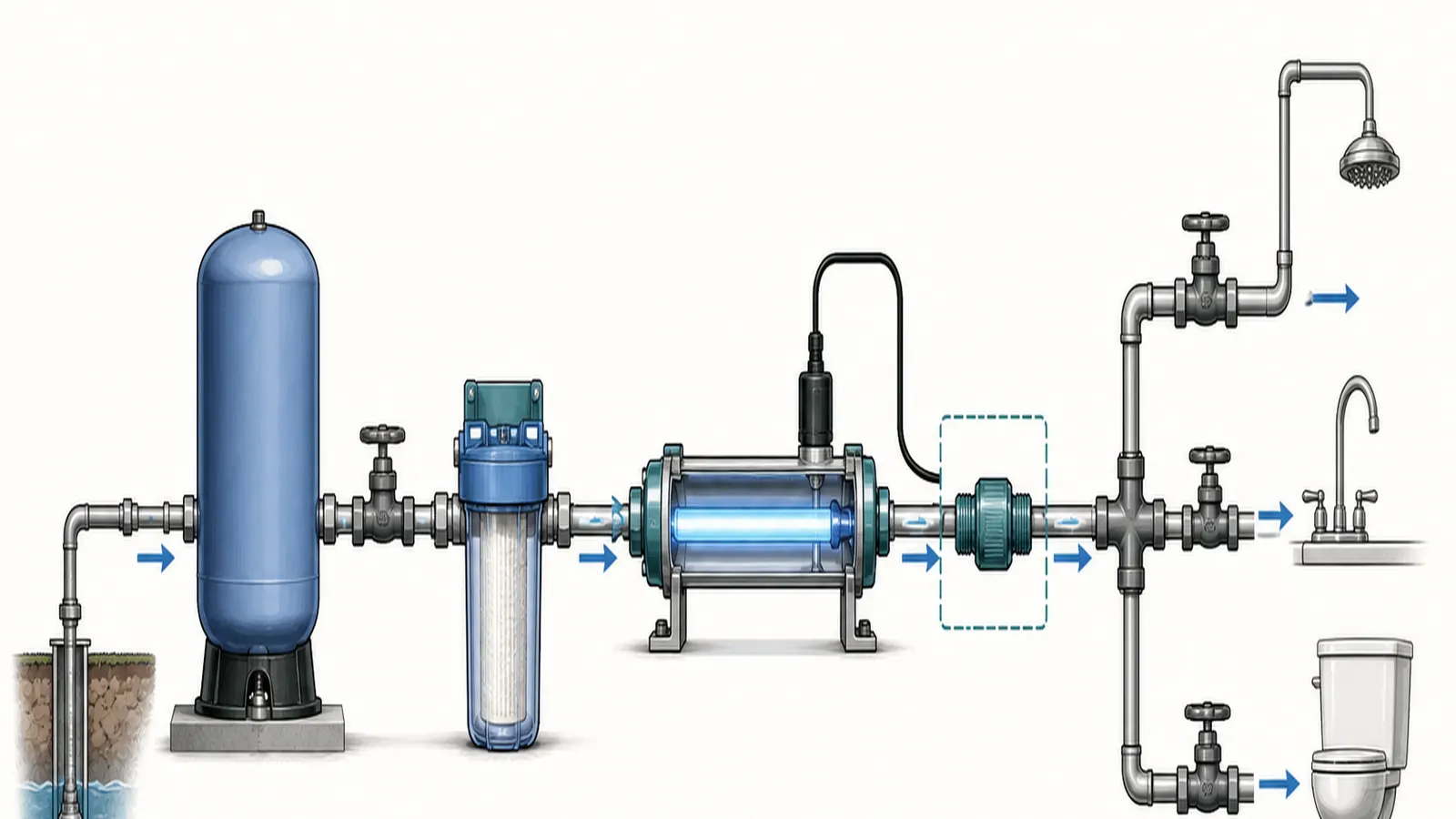
2. Understand what the restrictor protects
A UV system does not disinfect by making water “pass through a filter.” It exposes water to ultraviolet energy as the water moves through the reactor. Dose is a treatment result affected by the lamp’s output, the water’s ability to transmit UV, and the hydraulic conditions through the chamber. VIQUA describes UV dose as energy imparted to water as it flows through the system and notes that its published flow rates rely on stated UV-transmittance assumptions. Read the VIQUA explanation of dose, UVT, and flow.
At a homeowner level, the important relationship is:
flow demand → time and hydraulic conditions in the reactor → dose condition the model was rated or validated to deliver.
If water moves faster than the permitted maximum, you cannot conclude that the lamp simply “works harder” to compensate. The lamp may be on and visibly blue while the treatment condition is outside the published rating. EPA’s UV technical guidance describes validated operation as staying within the flow range used during validation and lists flow, UV intensity, and UV transmittance as common inputs to calculated-dose monitoring. See the EPA UV Treatment Toolkit.
Washington’s operations guide puts the homeowner version plainly: excessive flow reduces the time water is in contact with UV radiation, and a flow-control device should keep flow from exceeding the unit’s capacity. The Washington Department of Health guide is written for operations, not as a nationwide residential code. Its value here is the underlying treatment principle.
Do not confuse four different things:
- A rated maximum flow. This is a manufacturer’s limit for a particular model and stated dose or certification condition.
- A validated flow range. This is the range in which the reactor’s performance was tested and used to establish its dose-monitoring or setpoint basis.
- The pump’s possible output. A pump or pressure system may be capable of more flow than the UV unit should receive.
- The flow you happen to see at one faucet. This may be lower because of a filter, pressure drop, fixture aerator, hose, or simultaneous demand elsewhere.
The restrictor, when the design uses one, is a passive guard against the first two limits being exceeded. It is not proof that every other part of the water system is correctly sized. It also does not diagnose a low-pressure complaint. A restrictor can be functioning exactly as intended while an upstream sediment filter is plugged, the pressure tank is misadjusted, a shutoff is partly closed, or the well and pump cannot deliver the expected flow.
3. Identify external, integrated, and unknown flow control
Before looking for a replacement part, create a simple equipment record. Write down the brand, full model number, suffix, controller model, serial number if available, lamp type, sensor or “monitored” status, and any flow-restrictor part number. Take overview photographs of the plumbing and close photographs of every label. Do not remove covers or disconnect wiring to find a label.
External restrictor
An external restrictor is usually a small inline fitting in the pipe leaving the UV chamber. It may have an arrow, a molded flow direction, a color or part number, or a specific installation position. The Pentair PUV7/PUV14 manual specifies its restrictor on the outlet port and says it is directional. That means a similar-looking or reversed fitting is not an equivalent installation.
The VIQUA manual’s installation diagram identifies the flow restrictor as a separate component and describes its function as preventing flow above the maximum NSF-certified rate. On those model families, the manual also distinguishes restrictor status by model suffix. Use the actual VIQUA manual, not a generic parts photograph.
Integrated or manufacturer-defined control
Some designs may control flow through the reactor geometry, an internal assembly, a specified valve, a monitored controller, or a combination of components. A homeowner should not infer “integrated” simply because no small external fitting is visible. The absence of a loose part may mean the system was installed without a required part, the part is inside a service assembly, or the model never used an external restrictor.
The only reliable confirmation is a manual diagram, parts list, installation instruction, certification listing, or manufacturer support response that names the model. If documentation uses terms such as “maximum rated flow,” “flow control,” “validated flow,” “NSF flow rate,” “high-flow alarm,” or “solenoid shutoff,” capture the exact wording in your record.
Unknown configuration
Unknown is a real state, not a reason to experiment. If a previous owner modified the pipe, a label is unreadable, or the chamber and controller are from different series, stop at identification. A professional needs the model label, approximate household demand, prefilter type and condition, pressure readings if already available, photos of the plumbing, and a description of when the pressure problem occurs. That information is more useful than reporting that “the restrictor feels too small.”
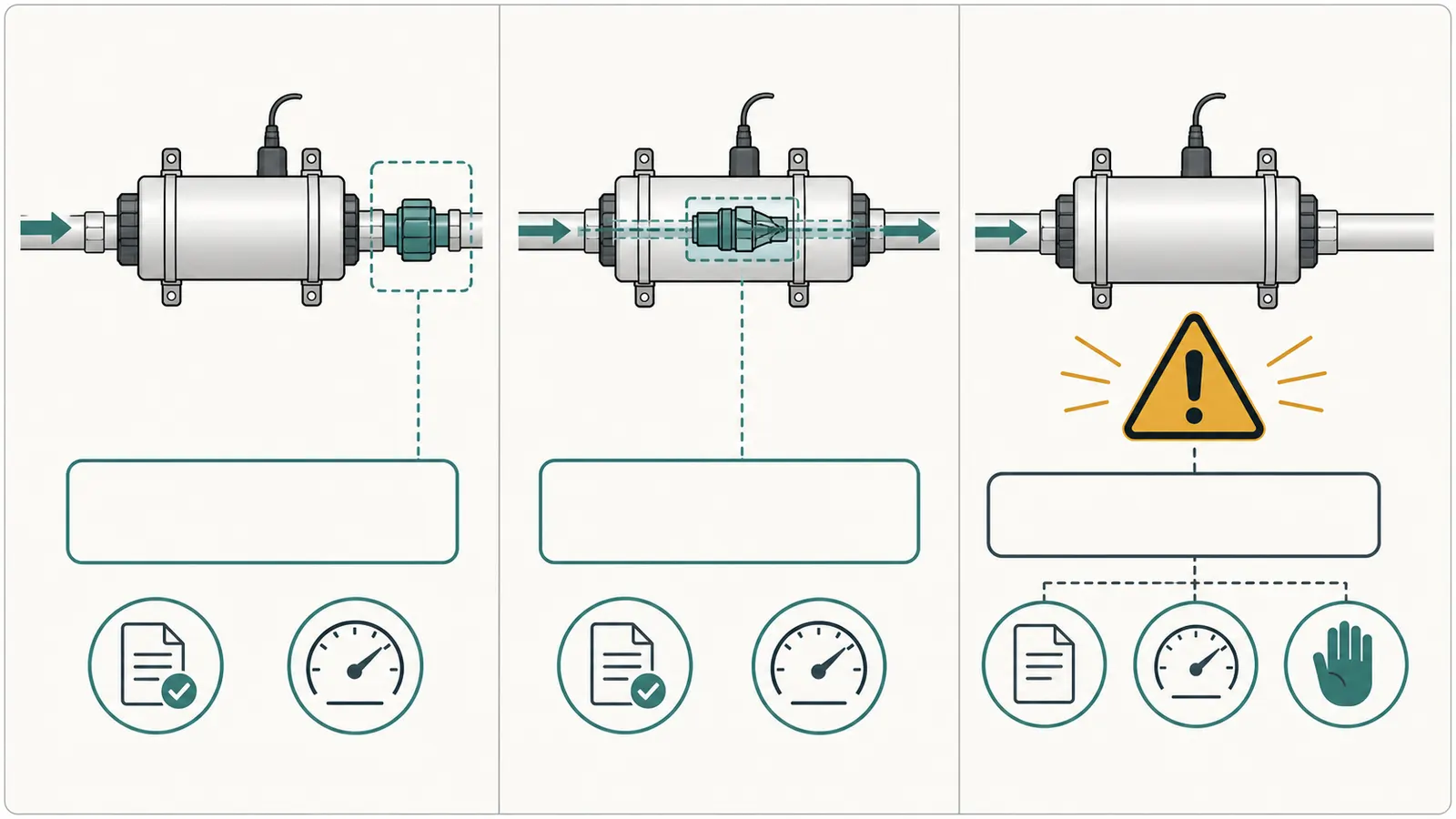
4. Read the manual as a treatment specification
Do not search only for the phrase “flow restrictor.” Read the manual for the complete set of conditions that travels with the flow number. Record the following fields:
| Manual field | What to record | Why it changes the decision |
|---|---|---|
| Full model and suffix | Every letter, number, and “+” or “-V” marking | Two visually similar units may have different flow-control and monitoring requirements. |
| Maximum rated flow | Gallons per minute and the associated dose or certification | A flow number without its dose basis is incomplete. |
| UV transmittance or water-quality basis | UVT, turbidity, iron, manganese, hardness, tannins, or other listed limits | Cloudy, colored, or mineral-laden water can change the stated performance conditions. |
| Restrictor status | Required, optional, included, external, internal, outlet-only, directional, or not listed | “Optional” must apply to your exact model, not merely the product family. |
| Monitoring and alarm behavior | Lamp-out, UV sensor, low dose, high flow, solenoid, or shutoff | An alarm may warn of a problem, but an alarm is not automatically present or able to detect high flow. |
| Pretreatment and installation | Sediment rating, order of equipment, bypass instructions, and isolation valves | A dirty prefilter or incorrect equipment order can create low flow or compromise treatment. |
| Maintenance | Lamp, sleeve, sensor, filter, and calibration requirements | A low-flow symptom may be maintenance-related, not a restrictor-sizing issue. |
VIQUA’s current FAQ says UV should be the last treatment system after prefiltration and that a high-quality 5-micron filter is recommended to remove particles that can shield microbes. It also says a sediment cartridge may need replacement when there is a noticeable drop in pressure or flow. These points do not make every 5-micron cartridge correct for every home, but they do give a useful diagnostic order: inspect the documented pretreatment before declaring the UV restrictor the problem. See VIQUA’s pretreatment and maintenance guidance.
The certification label also needs context. NSF describes NSF/ANSI 55 Class A as covering systems intended to inactivate or kill bacteria, viruses, and cysts in contaminated water, while Class B covers reduction of non-disease-causing bacteria in disinfected drinking water. Certification does not mean a unit addresses every contaminant in well water. NSF’s consumer standards explanation is a useful reminder to keep UV’s microbial purpose separate from iron, hardness, nitrate, arsenic, fuel, or other water-quality questions.
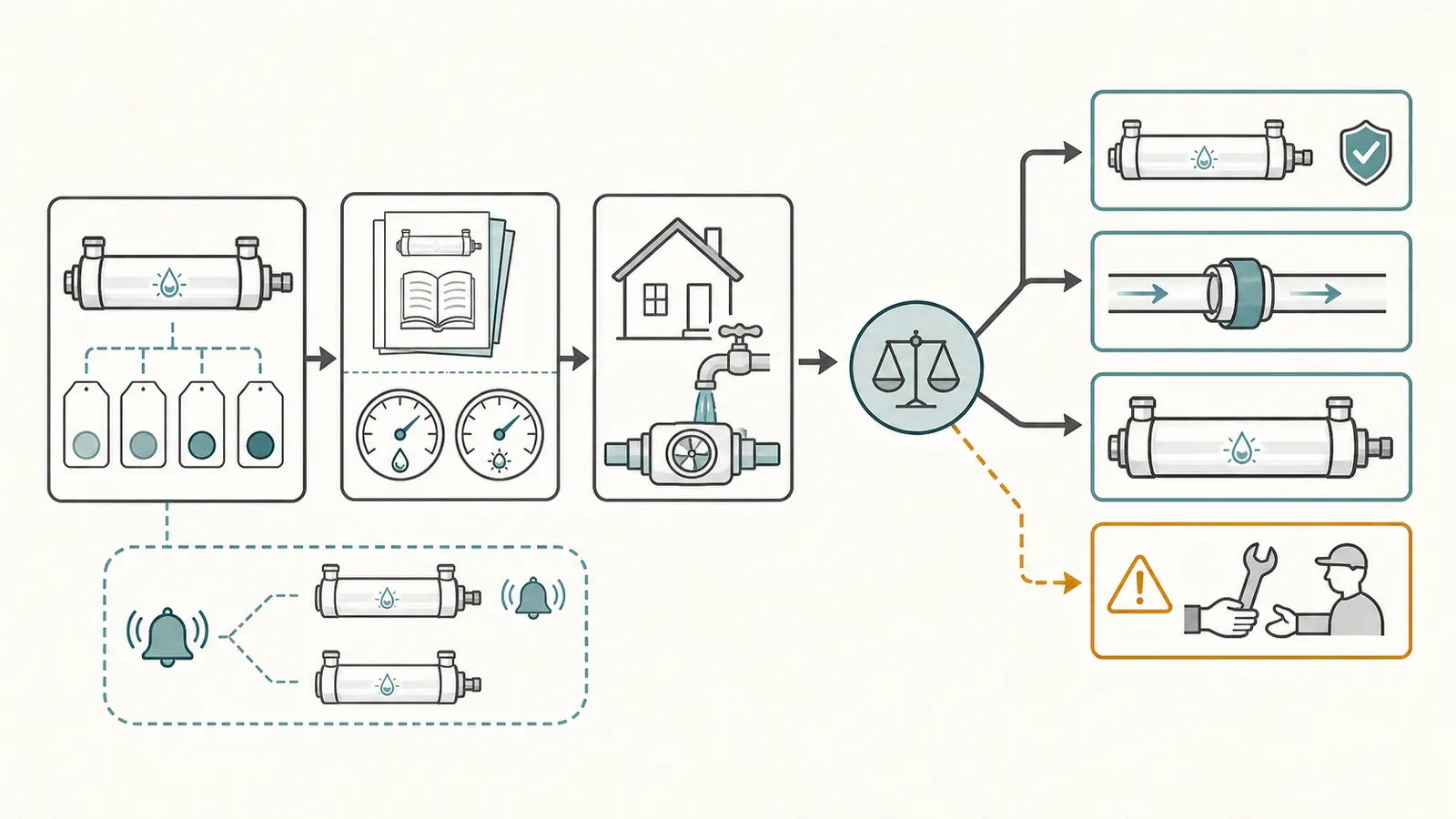
5. Measure household flow without opening the system
The homeowner-safe measurement is a flow observation at an ordinary fixture. It is not a substitute for a service technician’s verification of the entire installation, but it can tell you whether removal would obviously move the system toward an over-flow condition.
Bucket-and-stopwatch procedure
- Find the UV model and rated flow before testing. If you cannot find those, perform the measurement for the service record but do not use it to authorize removal.
- Choose a fixture supplied by the UV system. A hose connection or utility sink may reveal more flow than a small faucet, but do not assume it is the home’s maximum unless the plumbing layout supports that conclusion.
- Use a container with a known volume. A container marked “2 gallons” is useful only if the mark is trustworthy; do not use a random bucket and call the result exact.
- Open the fixture normally and measure the time to collect the known volume. Keep hands, cords, and electrical equipment away from splashing water.
- Calculate approximate flow with gallons per minute = gallons collected × 60 ÷ seconds. A hypothetical 2-gallon fill in 15 seconds is 8 gpm; that is an arithmetic example, not a measurement of your home.
- Repeat the test. Then test the highest normal demand you actually use, such as two fixtures at once, if the plumbing arrangement makes that safe. Record the pump pressure or gauge reading only if it is already visible; do not remove a gauge or open a pressure control.
- Compare the highest observed normal flow with the exact manual’s rated maximum. If observed flow is above the rating, do not remove the restrictor. If it is close, treat the comparison as uncertain and have the installation checked rather than relying on a single bucket test.
The measurement has limits. A bucket test at one tap does not prove the pump’s maximum capacity, the flow through the UV while several fixtures open, the internal hydraulic behavior of the chamber, or the UV dose at the water’s actual UVT. A pressure gauge reading also does not equal gallons per minute. Conversely, a low bucket result does not prove the restrictor is clogged: a dirty prefilter, partly closed valve, weak pump, pressure-tank problem, narrow pipe, aerator, or hose can all lower the observed flow.
Do not disconnect the restrictor to compare “before” and “after.” That turns a diagnostic question into an unverified treatment change. If the manual explicitly provides a homeowner maintenance procedure for removing and inspecting that part, follow the full isolation, depressurization, power-down, leak-check, and restart sequence. If it does not, assign the work to a qualified UV or water-treatment professional.
6. Separate low pressure from a treatment-control problem
A pressure complaint is the most common reason a homeowner considers removing a restrictor. Use the pattern of the symptom to decide what to investigate, not the fact that water feels slower at the tap.
| Observation | What it may point toward | What it does not prove | Safest next step |
|---|---|---|---|
| Pressure is low at every fixture, including fixtures before treatment if known | Well supply, pump, pressure tank, main valve, or a whole-system restriction | It does not prove the UV restrictor is the cause | Have a well/pump professional evaluate pressure and flow; leave UV flow control unchanged. |
| Pressure was normal until a sediment cartridge or carbon stage loaded | Pretreatment restriction or cartridge sizing/maintenance | It does not prove the UV chamber is oversized | Replace or service the cartridge only as the manual allows, then remeasure flow. |
| Pressure falls only when several fixtures run | Demand exceeding what the well, pump, piping, or UV system can deliver | It does not prove removing the restrictor will create safe additional capacity | Compare simultaneous flow demand with the UV rating and pump capability; consider system resizing. |
| A new sharp restriction appears immediately at the UV outlet | Wrong, reversed, damaged, or obstructed external restrictor; closed valve; plumbing debris | It does not prove the restrictor should be removed | Isolate and service the component under the manual or use a qualified technician. |
| Flow is low but no UV alarm appears | Restriction elsewhere, or a controller that does not monitor that condition | No alarm is not proof of adequate dose | Verify model monitoring features, actual flow, pretreatment, and maintenance. |
| UV alarm, lamp-out warning, or automatic shutoff appears | Lamp, sensor, water quality, power, temperature, or other off-specification condition | It does not identify the restrictor as the cause | Follow the exact alarm procedure; do not defeat the alarm or assume treated water is available. |
| The restrictor is absent after prior plumbing work | A changed installation with unknown flow control | The UV is not automatically safe because the lamp still turns on | Restore the specified configuration or have the unit and flow demand re-evaluated. |

The first repair for a low-flow complaint is commonly the part of the system that actually changed. If pressure fell after a filter replacement, inspect the cartridge orientation, micron rating, housing seals, shutoff valves, and sediment load. If pressure fell after a UV service, inspect whether the correct lamp, sleeve, O-rings, fittings, and valves were returned to service—but do not open the chamber or controller unless the manual explicitly assigns that task to a homeowner.
High-safety boundary: do not open energized controls, look at an exposed UV lamp, open a well, pull a pump, enter a confined space, test live wiring, or manipulate a pressurized vessel or pressure-control assembly as part of this diagnosis. UV systems combine electricity, water, pressure, hot water, glass, and invisible radiation. The VIQUA owner’s manual specifically warns about electrical shock, pressure, hot water, UV exposure, and depressurization, and directs users to authorized service for repairs outside its expressly described maintenance and troubleshooting procedures.
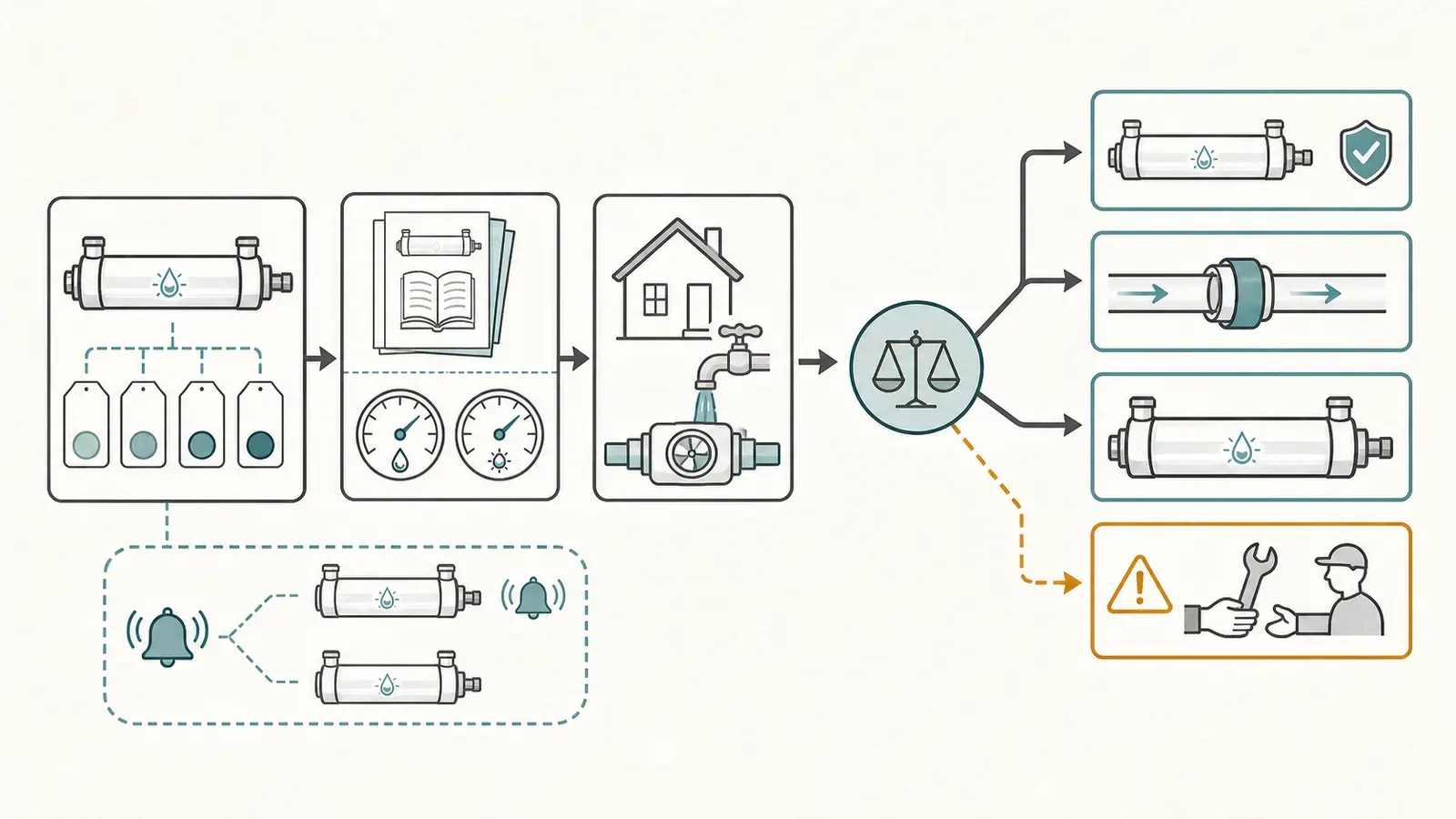
7. Choose the correct remedy: leave, restore, resize, or stop
Once the model and measured demand are documented, the decision has four useful outcomes.
Leave the restrictor installed
Choose this when the manual requires it, when the model is unknown, when flow approaches the rating, or when the pressure complaint has not been isolated. This is the default for a functioning system. A restrictor that makes the UV system’s maximum safe flow visible is doing a treatment job, even if it is inconvenient at a high-demand fixture.
Fit the exact specified restrictor
Choose this when the part is missing, damaged, installed backward, or replaced with an unknown fitting. Match the model, flow rating, connection, and direction. Do not drill a hole larger, stack fittings to approximate a size, substitute a generic orifice, or move an outlet restrictor to the inlet because it looks easier. The Pentair manual is an example of why location and direction matter.
Resize the UV system
Choose this when the household’s real maximum flow is greater than the current unit’s rating, when future demand will exceed it, or when the restrictor is being used to compensate for an undersized treatment system. VIQUA recommends choosing a system sized for maximum possible present and future flow and warns against undersizing. Resizing may mean a larger chamber, a different monitored system, altered pretreatment, or a professionally designed parallel arrangement. It is a treatment-design decision, not simply a plumbing-part swap.
Stop and use qualified service
Choose this when the label is missing, the installation was modified, the restrictor is internal or inaccessible, a sensor or solenoid is involved, the system alarms, the water is being used for drinking while treatment is uncertain, or the work requires depressurizing equipment beyond the manual’s homeowner procedure. Give the professional this handoff packet:
- full model, suffix, controller, and serial photographs;
- the manual page that states rated flow, dose, UVT, restrictor status, or alarm behavior;
- the bucket-test volumes, times, fixtures, and pressure observations;
- filter type, installation date, and recent pressure or flow changes;
- a sketch or photo showing the order of well equipment, pretreatment, UV, bypass, and household branches;
- the exact symptom: low everywhere, low only at demand, low after a service, or alarm-related.
Edge cases that change the answer
A shallow, dug, or surface-influenced well deserves extra caution because the water may not match the UV-transmittance assumption used for a drilled-well installation. VIQUA says UVT varies with water quality and that water from drilled wells can have different UVT characteristics from dug wells or surface sources. That does not mean a shallow well automatically needs a particular restrictor or a particular lamp. It means the manual’s UVT basis and the water test belong in the decision, especially if the water is colored, cloudy, or changing seasonally.
Also check whether every household branch actually passes through the UV. A bypass, outdoor spigot, irrigation connection, untreated rental-unit branch, or later plumbing addition may sit outside the treatment path. Increasing flow through the treated branch will not make an untreated branch safe, and a restrictor at one outlet cannot control a branch that leaves the piping upstream. If the plumbing layout is uncertain, draw the flow path with the valves closed and open states identified, then have it reviewed before relying on the system for drinking water.
Finally, do not treat a pressure improvement after restrictor removal as proof of safe disinfection. It proves only that the hydraulic restriction changed. The system still needs the model’s permitted flow, lamp and sleeve condition, water-quality conditions, and alarm state to be within the documented operating envelope. EPA’s guidance treats those variables as part of validated operation, not as interchangeable substitutes. A faster tap and a passing lamp indicator are therefore not enough evidence to close the repair.
If the system is bypassed, disconnected, or outside its known treatment conditions, do not assume the water is disinfected. The Pentair PUV7/PUV14 manual explicitly says water used during bypass is not disinfected and gives model-specific instructions for preventing consumption until the system is sanitized and returned to service. For another model, follow that model’s instructions and local health-department guidance; do not transplant Pentair’s timing or procedure to a different system.
8. Keep a small record so the decision stays safe
The flow decision is not finished when a fitting is installed. Record what was changed and confirm that the system returned to its documented operating condition.
Before service
- Photograph the model label, controller, chamber, restrictor, valves, filters, and bypass.
- Record lamp age, sleeve condition if already visible through the documented maintenance process, filter age, and any active alarm.
- Write down the manual’s rated flow, dose, UVT basis, restrictor status, and alarm/shutoff conditions.
- Record measured fixture flow with the date, container volume, seconds, fixtures open, and pressure observation.
After an allowed maintenance action
- Confirm the exact restrictor part and flow direction, if the manual specifies both.
- Check for leaks with the water supply restored slowly and the area dry enough to observe safely.
- Confirm the controller’s normal status and that no alarm has been muted or bypassed.
- Flush according to the manual before normal drinking use, especially after lamp, sleeve, filter, sanitization, or bypass work.
- Recheck the same fixture flow and note whether the change affected pressure, flow, or only the symptom at one tap.
- Keep the old part and packaging until the installation is verified, unless the service provider takes responsibility for disposal.
Maintenance consequences
Flow control cannot compensate for a neglected UV system. VIQUA says most of its standard lamps have an approximately 9,000-hour useful life and require annual replacement in a full-time residence, while sleeves need cleaning to remove mineral or iron deposits. Its FAQ also says filter replacement depends on water quality and a noticeable drop in pressure or flow. Those intervals are VIQUA guidance, not a universal schedule; use the manual for the installed model. Review the manufacturer’s maintenance guidance.
The practical homeowner conclusion is stable even when the hardware varies: identify the exact model, locate the documented flow-control function, read the rated flow together with its dose and water-quality conditions, measure the home’s real demand, and then choose the least disruptive remedy that keeps the system inside those conditions. If the answer requires defeating a control, guessing at a restrictor size, or working around live electricity and pressurized water, the safe decision is to stop and have the unit restored, verified, or resized by qualified service.
Sources and scope
Evidence behind this page
- VIQUA UV System FAQs
Manufacturer guidance for VIQUA UV systems; do not treat it as a universal requirement for every brand or model.
- VIQUA UV System FAQs
General explanatory information on VIQUA residential UV systems; the exact dose-flow relationship is model- and water-quality-specific.
- VIQUA D4 Premium, E4, F4 and Validated Models Owner’s Manual, MNL520351-R RevE
Only the VIQUA models and suffixes covered by this manual; it is not a rule for other UV systems.
- VIQUA D4 Premium, E4, F4 and Validated Models Owner’s Manual, MNL520351-R RevE
The manual’s model table; numbers must not be transferred to an unlisted unit.
- VIQUA UV System FAQs
VIQUA homeowner guidance; filter and lamp intervals vary with water quality and model.
- Pentair Water Solutions PUV7 & PUV14 UV Systems Manual
Pentair PUV7 and PUV14 only; “optional” here does not authorize removal from another Pentair or non-Pentair model.
- Pentair Water Solutions PUV7 & PUV14 UV Systems Manual
Pentair PUV7 and PUV14 bypass procedure; follow the exact manual and local health guidance for other systems.
- Operations and Maintenance — Ultraviolet Disinfection
Washington State operations guidance; it is not a nationwide residential code or a substitute for the equipment manual.
- Ultraviolet Treatment Toolkit: Technical Resource for States Using EPA’s UV Disinfection Guidance Manual
EPA technical guidance primarily written for public-water-system review and operation; used here for the underlying validation principle, not as a residential code mandate.
- Ultraviolet Treatment Toolkit: Technical Resource for States Using EPA’s UV Disinfection Guidance Manual
EPA technical explanation of UV validation and dose monitoring; individual residential controllers may use different monitoring strategies.
- NSF Standards for Water Treatment Systems
NSF’s consumer-level description of standard scope; certification does not mean every system treats every contaminant.
- VIQUA D4 Premium, E4, F4 and Validated Models Owner’s Manual, MNL520351-R RevE
Safety instructions for the VIQUA models covered by the manual; the same hazards are not assumed to have identical procedures on another model.