How to Bypass Water Treatment Equipment Before Shock-Chlorinating a Private Well
A model-first homeowner guide to deciding which treatment branches can be bypassed, and which pressure-tank or water-heater steps require a manual or professional.
The short answer
Identify every treatment component and read its exact manual first. Put point-of-entry filters, media tanks, softeners, RO units, and UV systems in bypass or out of the chlorine path only as the manufacturer allows; do not improvise a pressure-tank bypass. For each branch, sanitize, flush, regenerate, or replace equipment as its exact manual requires, then restore it only after the chlorine-clear, lab, and equipment gates pass. Use an alternative water source until the well passes the required lab retest.How to Bypass Water Treatment Equipment Before Shock-Chlorinating a Private Well
The safe answer is not “put everything in bypass.” First identify every component, find its exact model manual, and classify it as a documented bypass, an isolated or removed cartridge, a manual-specific sanitation job, or equipment that should not be manipulated by a homeowner. Virginia Tech warns that concentrated chlorine can damage pressure tanks, softeners, filters, filter media, and other treatment devices, so a generic well-shock recipe is incomplete. Virginia Tech’s current private-well procedure says to consult each component manufacturer before shock chlorinating.
Use an alternative water source during contact, flushing, and evaluation. If the well may contain fuel, pesticides, sewage, or other chemicals, stop: CDC says chemical contamination is not made safe by boiling or disinfection. Contact the local or state health department and a qualified well or pump professional.
1. Set the safety and authority gates before touching a valve
This page is a decision surface for a homeowner who is organizing a well disinfection job. It is not a universal shock-chlorination dose, a substitute for local health guidance, or permission to open a well, pump, control box, pressure vessel, filter housing, or water heater. The concentration, contact time, water volume, discharge route, and sample timing must come from the applicable health department or extension procedure and the exact equipment manuals.
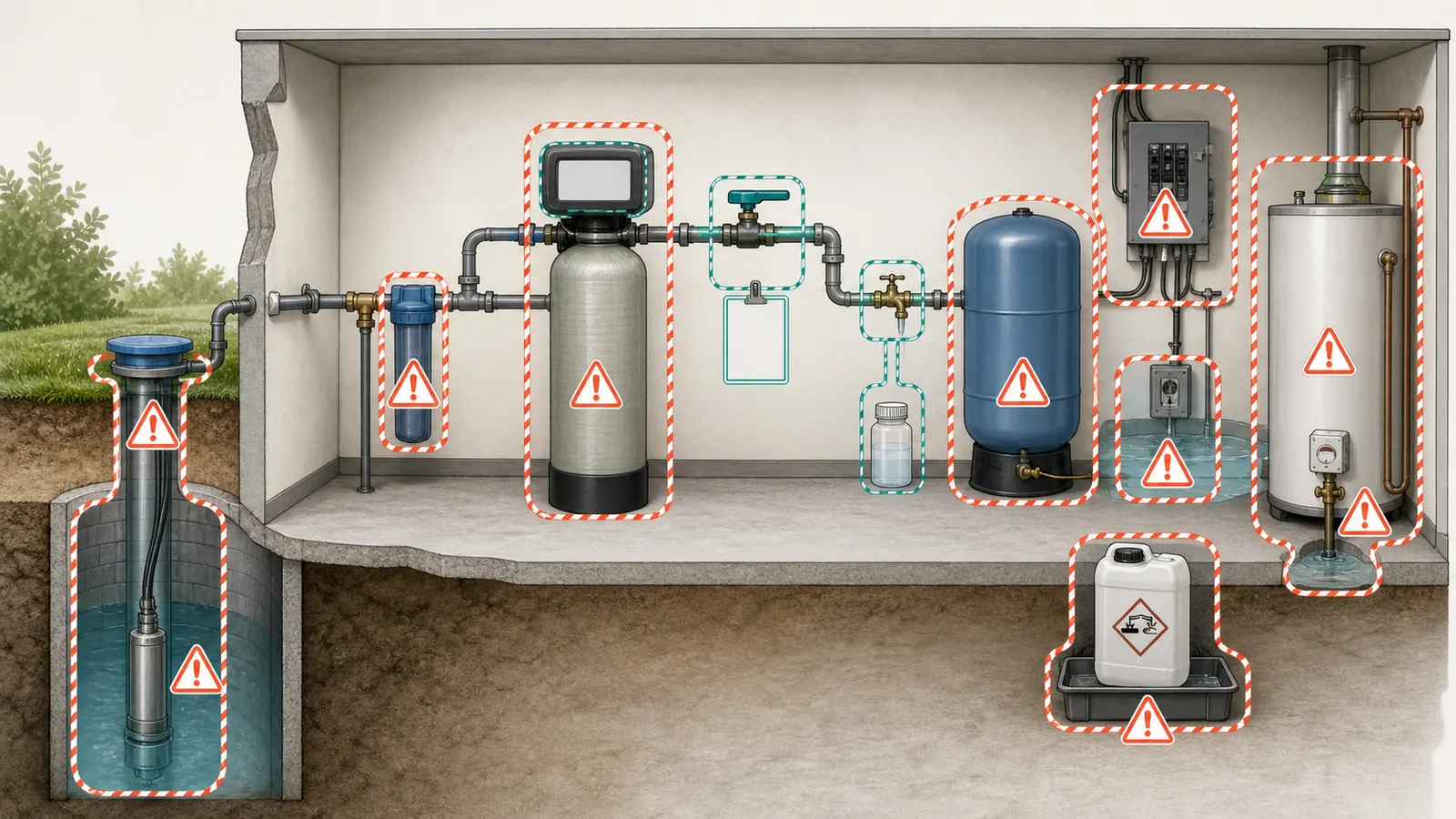
Stop before starting if any of these are true
- The wellhead, pump, controls, wiring, or treatment area has been flooded, wet, damaged, or contaminated by debris.
- You smell fuel or chemicals, see an unusual sheen, or suspect pesticides, solvents, sewage, or industrial contamination.
- You cannot identify the equipment model, the direction of flow, or the purpose of a valve.
- A treatment tank has no visible bypass and isolating it would require cutting, loosening, or disconnecting pressurized piping.
- A cartridge housing, RO vessel, UV chamber, pressure tank, or water heater would need to be opened without the exact depressurization and shutdown procedure.
- The equipment manual limits chlorine exposure and you do not know whether the proposed shock exceeds that limit.
- The system cannot be flushed without sending chlorinated water into a septic system, stream, pond, wetland, garden, or other sensitive area.
CDC warns that well work after an emergency can be hazardous, says not to enter a well pit, and calls for a qualified electrician, well contractor, or pump contractor to check wiring before power is restored when damage is possible. Do not open energized controls or test live wiring. Do not open the well or pull a pump. Do not enter a confined space. Do not manipulate a pressurized tank, pressure switch, relief valve, or filter housing as a learning exercise.
What “bypass,” “isolate,” “remove,” and “empty” mean here
These words are not interchangeable.
| Action | Meaning in this guide | Homeowner boundary |
|---|---|---|
| Bypass | Use the equipment’s labeled bypass valve or documented bypass position so source water does not flow through the treatment vessel | Operate it only when the manual identifies the valve and the action can be completed without opening plumbing or exposing you to pressure |
| Isolate | Close a documented inlet, outlet, feed, or appliance valve to keep high-chlorine water out of a branch | Do not guess which valve is which; do not force a stuck valve or disconnect a line |
| Remove | Take out a cartridge, membrane, or other replaceable element as the model manual directs after shutdown and pressure relief | Do not open a housing or RO vessel unless the exact manual gives a safe, unpressurized procedure; “remove” may be a professional task |
| Empty | Drain water or media from a component as part of a model-specific service or sanitation procedure | Do not empty a pressure tank, media tank, RO storage tank, or water heater by improvisation; draining can involve pressure, electricity, gas, heat, or heavy components |
| Leave in service | Do not operate or reconfigure the component solely because a generic shock guide did not mention it | This does not mean chlorine exposure is safe; it means the component needs a manual or professional decision before the shock |
The Water Quality Association’s residential sanitation guidance uses the same important qualification: point-of-use and point-of-entry equipment is typically put in bypass where possible, while cartridges and membranes are usually removed from the high-disinfectant path and separately sanitized or replaced before return to service. “Where possible” is the protection against turning a broad principle into a hazardous universal instruction.
2. Build the model-first equipment record
Walk the water path without opening anything. Start at the well and trace the incoming line. Photograph or write down each label, model number, valve position, electrical connection, drain line, and normal flow direction. Include equipment that treats only one branch, such as a kitchen RO unit, refrigerator feed, or UV unit near the end of the line.
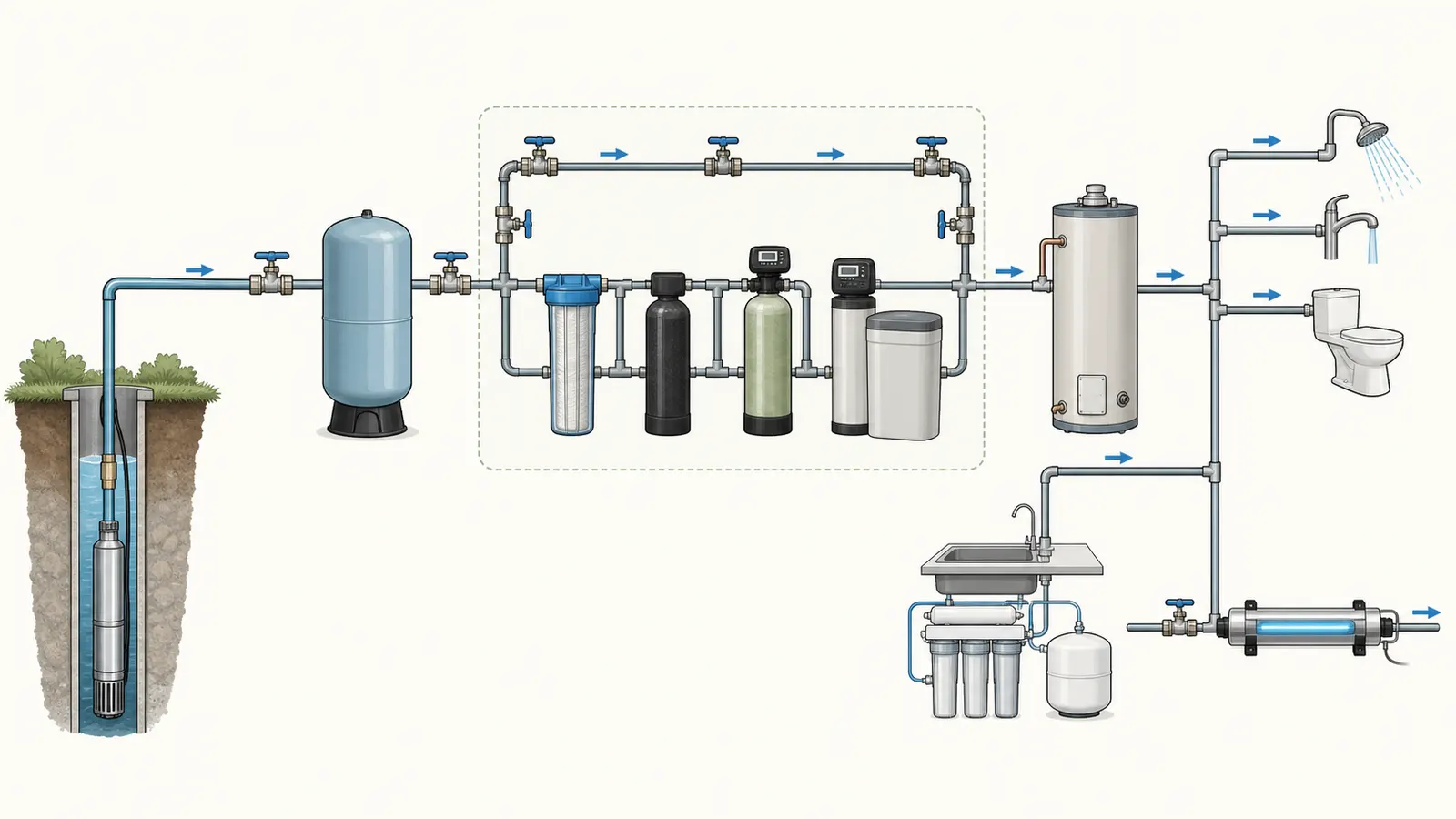
Record this before changing a valve:
- Component name and location.
- Manufacturer, model, serial number if available, and manual URL or paper manual location.
- Inlet and outlet direction.
- Whether the unit has a labeled bypass, separate shutoff valves, a drain, an electrical supply, or a cartridge housing.
- Media or cartridge type: sediment, carbon, iron, manganese, softener resin, RO membrane, UV lamp/chamber, or unknown.
- Whether the component is upstream or downstream of the pressure tank, water heater, and other treatment.
- The manual’s chlorine exposure limit, sanitation procedure, cartridge replacement instruction, and return-to-service test.
- A before-state photo of each handle and any control setting.
Use one line per component. If you cannot fill in the model or valve state, mark it unknown—do not restore rather than guessing. The contribution of this record is simple: the shock is not complete when the faucet stops smelling like bleach; it is complete when every component has a known state, chlorine is cleared, the well retest gate is satisfied, and the restoration instructions are followed.
3. Decide equipment by equipment
The matrix below gives the conservative default. It is not permission to apply one manufacturer’s procedure to another brand. When the model manual is stricter than this table, the manual wins. When the manual is missing or contradictory, stop and ask the manufacturer, a certified water-treatment professional, or a qualified well/pump professional.
| Equipment | Before the high-chlorine step | During contact and flushing | Restore only when |
|---|---|---|---|
| Whole-house sediment cartridge | Put the housing in documented bypass or isolate it. If the manual says the cartridge must be removed, do that only after safe shutdown and pressure relief. | Keep a cartridge that may load with well sediment out of the path unless the manual allows exposure. Do not open a pressurized housing. | The manual’s sanitation or replacement instruction is complete; the housing is reassembled without leaks; and the flush is clear and chlorine-free. |
| Carbon cartridge or carbon media | Bypass or isolate. Treat a carbon cartridge that was exposed to a flood or contaminated water as a replacement question, not an item to rinse by guesswork. | Keep carbon out of a high-chlorine path unless the exact manual permits it. Carbon may consume chlorine and become exhausted; downstream equipment can still be exposed if the path is not isolated. | The exact manual says whether to sanitize or replace it, the branch has been flushed, and the new or retained cartridge is seated and leak-free. |
| Iron, manganese, oxidizing, or other media tank | Use the labeled bypass if present. Do not empty, backwash, add chemicals, or change a control setting unless the model procedure explicitly calls for it. | Leave the media tank out of the shock path unless the manual and water professional specify a compatible chlorine exposure and regeneration/backwash sequence. | The media-specific manual says how to rinse, regenerate, or recondition it; drain discharge is acceptable; and the unit’s normal service checks pass. |
| Water softener resin and brine tank | Close the softener valves or put its documented bypass in bypass. Do not start a regeneration merely because the system has been bypassed. | Keep chlorine and shock debris out of the resin unless the exact model procedure says otherwise. A current Whirlpool instruction says bypass protects resin media, then flush until bleach odor is gone and water tests safe before returning to service. Read it here. | Chlorine is cleared, the well test gate is met, and the model instruction says to reconnect or return the handle to service. A different model may require regeneration or separate sanitation. |
| Reverse osmosis | Close the RO feed and any connected ice-maker or refrigerator feed using the documented appliance valves. Do not assume a whole-house bypass protects a point-of-use RO branch. | Keep the RO membrane and storage tank out of the high-chlorine path unless the exact RO manual provides a sanitation procedure. Watts explains that carbon prefilters protect the RO membrane from chlorine; a model manual may require a special dose, isolation, flush, and filter replacement. | The RO-specific sanitation/startup sequence is complete, storage tank water has been discarded as directed, filters or membrane are replaced if required, and the product-water branch is flushed. |
| UV system | Use its documented bypass if installed. Do not improvise an electrical disconnect or run the lamp without water if the manual prohibits it. | Bypass does not disinfect water. The current VIQUA VT1-series manual says water in bypass is untreated and calls for supplementary disinfection and a do-not-consume notice until the system is sanitized and returned to service. | The lamp/chamber and bypass arrangement meet the exact model procedure, the untreated-water warning is removed only when the UV is operating correctly, and the water-safety gate is met. |
| Pressure tank | Do not improvise a bypass. Virginia Tech specifically warns that pressure tanks can be damaged by concentrated chlorine. Leave pressure-tank service to the well/pump professional or exact tank/system procedure. | Treat it as part of the source and plumbing system only if the well professional and component instructions allow the exposure. Do not adjust precharge, remove a valve, open the tank, or test a live pressure control. | A qualified person confirms the tank, pressure switch, pump, piping, and electrical system are safe and operating normally. |
| Water heater | There is usually no simple treatment bypass. Do not drain it or operate a relief valve as a shortcut. Keep its normal hot-water path in the planned plumbing flush unless the water-heater manual or professional directs isolation. | Flush hot and cold branches as directed. If draining is required, shut off gas or electricity first and follow the exact heater procedure; Virginia Tech warns that chlorine can be difficult to remove from a water heater. | The heater is full before power or gas is restored, hot fixtures are flushed, no chlorine remains at the required check, and no leak or scald/pressure hazard is present. |
This distinction matters because “filter” describes very different things. A sediment cartridge can load with particles. Carbon can be consumed by chlorine. Iron-media and softener tanks contain media whose limits depend on chemistry, valve design, and the manufacturer’s sanitation process. RO membranes are chlorine-sensitive in many residential designs. UV is a disinfection appliance, not a chlorine bypass. The pressure tank and water heater are storage and plumbing components, not interchangeable filter housings.
4. Prepare and run the shock without sending chlorine through protected equipment
Use the well-disinfection procedure supplied by your state or local health department, extension service, or qualified well professional. The sources do not agree on one universal dose or contact time for every well condition: well diameter, water depth, plumbing volume, chlorine strength, flood history, and local instructions matter.
Before adding chlorine
- Secure an alternative water supply for drinking, cooking, brushing teeth, bathing, ice, and any use your health authority restricts. Virginia Tech calls for a 12–24 hour supply of nonchlorinated water, and CDC says to use bottled or another known-safe source while contamination is suspected.
- Get the lab’s sample bottles and instructions before starting. Ask when the sample may be collected after the chlorine is flushed and which tests are required.
- Print or save the exact manuals for every component. Mark the relevant pages for bypass, sanitization, cartridge replacement, flushing, and startup.
- Photograph the normal state of every handle, switch, control setting, cartridge label, and drain route.
- Trace the flow path and confirm which branch supplies the RO, refrigerator, UV, water heater, and outside faucets. Do not infer that one bypass valve isolates every branch.
- Identify a safe discharge area. CDC directs chlorinated water to an area without vegetation and away from open water. Local septic, stormwater, environmental, or health requirements may be stricter.
- Put documented bypasses or isolations into their pre-shock state. Write down the time and take a second photo.
The Alabama Cooperative Extension System’s flooded-well procedure explicitly says to put water softeners and household filters into bypass or out-of-service mode before the shock, then disinfect and reconnect them according to their manufacturers’ instructions. Its procedure also says not to drink until the water has been tested. That is a useful cross-check, but a flood-damaged well still needs local evaluation and may not be safe for a homeowner-led procedure.
During contact time
Follow the approved procedure for mixing, circulating, contacting, and shutting down the well. Do not mix chlorine with acids, ammonia, or other cleaners. Use the specified protective equipment and ventilation. Do not use any water from the system during the contact period.
Virginia Tech’s procedure uses a 12–24 hour contact period after chlorine has been circulated through the well and plumbing; CDC’s emergency sequence specifies at least 12 hours. Virginia Tech’s step sequence is evidence for that procedure, not a universal instruction that overrides your local authority or equipment manual.
During this period, do not:
- Move a bypass handle back to service because a tank “needs water.”
- Start a softener regeneration or media backwash without the model instruction.
- Open filter housings, RO vessels, UV chambers, pressure-tank fittings, or the well.
- Use the shower, bath, dishwasher, washing machine, refrigerator, ice maker, or faucets unless the approved procedure specifically requires a fixture to be opened during circulation.
- Run chlorinated water onto plants, into a pond or stream, or into a septic system beyond what the local procedure permits.
5. Clear chlorine through the plumbing and pass the chlorine-free gate
Flushing is a sequence, not a single faucet check. The goal is to remove the disinfectant from the source, plumbing, hot-water branch, protected equipment branches, and any temporary hoses or fixtures that will be used after restoration.
Flush in the directed order
- Start at the outside faucet or discharge point closest to the well, if the approved procedure directs that route. Keep the discharge away from vegetation and open water.
- Continue flushing until the chlorine odor is no longer noticeable, then measure free chlorine. A suitable well-disinfection procedure says to pump to waste until chlorine is no longer detectable and that the absence is best determined with an available-chlorine residual test kit. See the San Diego County procedure.
- Flush indoor cold-water fixtures one at a time. Include fixtures that were not used during the shock.
- Flush hot-water fixtures as directed. Virginia Tech warns that flushing chlorine from a water heater can be difficult, so do not treat a short cold-water branch’s result as proof that the hot branch is clear. Do not drain a heater unless its safe manual procedure is being followed. See the source guidance.
- Keep treatment equipment in bypass or isolated until its own manual says it may be sanitized, flushed, or returned to service.
- Record the date, time, fixture, flush destination, chlorine test method, result, and whether the water was clear of odor or residual.
Make the chlorine-clear result measurable
Use a fresh free-chlorine DPD comparator or colorimeter, follow that kit’s sample volume and reaction time, and read it immediately at the point of use. EPA describes DPD as a common colorimetric method for free-chlorine residual and says disinfectant-residual tests are analyzed on site. For this guide, pass means 0.00 mg/L (ppm), or “not detected” at the kit’s stated reporting limit, whichever wording the kit uses. Record the numeric result or the reporting limit; “no smell” is not a pass result.
Test at all of these locations before a lab sample or equipment restoration:
- the closest well-side/outside faucet after the source and main plumbing flush;
- the farthest or least-used indoor cold-water outlet; and
- the farthest hot-water outlet after the hot branch has been flushed.
For every bypassed or isolated treatment branch, also test the nearest accessible outlet after that branch has been flushed under its own manual. If the component is still isolated, do not infer its outlet is clear from the main-line result. Strategic samples near the well, at well connections, and before and after treatment devices can be needed to locate a contamination problem. The University of Iowa lists those locations for troubleshooting.
If any required location reads above 0.00 mg/L or above the kit’s stated “not detected” limit, has a persistent chlorine odor, or cannot produce a valid reading, fail the gate: keep the affected equipment isolated, continue only the flushing allowed by the procedure and manual, and do not restore equipment or collect the laboratory sample. A pass only clears chlorine; it does not make the well safe to drink. The lab’s own sample location, bottle, timing, and preservative instructions still control.
Virginia Tech says to start with outside faucets, limit chlorinated water entering a septic system, then run indoor and outdoor faucets until chlorine odor is no longer noticeable. It also says a free-chlorine test kit may be used after flushing. See the full procedure. CDC likewise says to drain outside until the odor disappears, then run indoor faucets, and says sampling cannot occur until all traces of chlorine have been flushed.
The stop gates
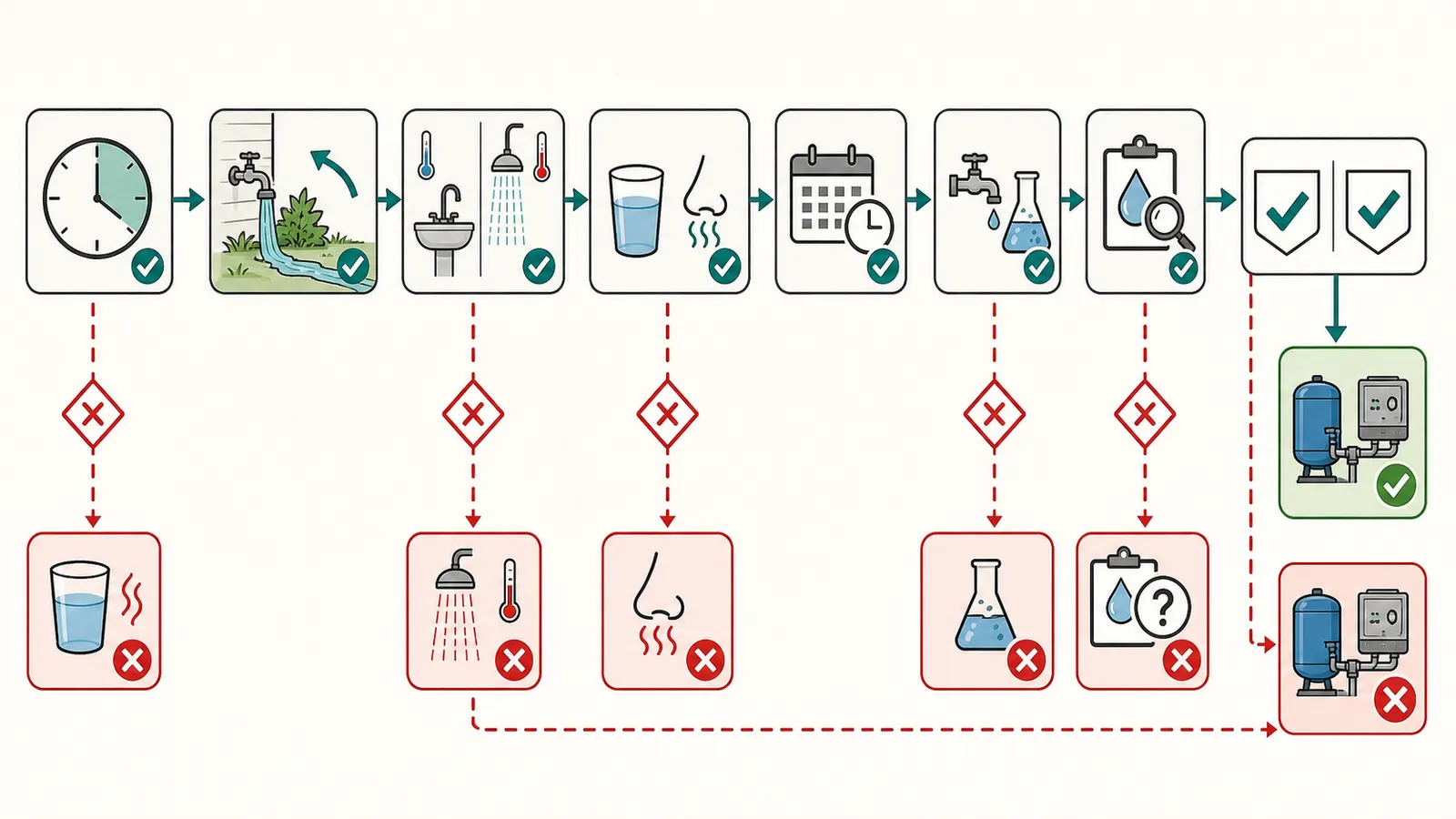
Stop and do not restore equipment if:
- A required DPD result is above 0.00 mg/L or above the kit’s stated “not detected” limit, or the test is invalid.
- Chlorine odor persists in a branch, especially the hot-water branch or a low-use fixture.
- You cannot tell whether a protected filter, softener, RO unit, or UV unit received the high-chlorine water.
- The water is still cloudy, oily, chemically odorous, or otherwise abnormal.
- The well or pump loses pressure, cycles abnormally, leaks, or shows electrical damage.
- The laboratory or health department has not confirmed the correct sample date.
Do not use “the bleach smell is gone” as a drinking-water clearance. CDC says to boil well water or use another alternative source until the well has been tested, and the Alabama Extension procedure says not to drink until testing is complete. Chlorine odor also cannot identify fuel, pesticides, metals, nitrates, or other contaminants.
6. Sanitize and restore each branch in the manual’s order
Restoration is a second job. A treatment unit that was bypassed may still contain old water, flood debris, bacteria, exhausted carbon, or contaminated cartridges. A unit that was exposed may require a separate sanitation or replacement process. WQA advises that cartridges and membranes are commonly removed from the high-disinfectant path and separately sanitized or replaced before return to service.
Softener and media tanks
The model manual may call for a regeneration, backwash, resin sanitation, media replacement, or simple return to service after a separate flush. Do not choose among those based on the presence of a bypass handle. A current Whirlpool instruction says to bypass the softener, run cold water until bleach odor is gone and the water tests safe, then return the handle to service. That sequence belongs to the referenced Whirlpool design; it is not a universal handle instruction.
For a different softener or an iron-media tank, ask:
- Is the media compatible with the chlorine concentration and contact time?
- Should the unit be regenerated or backwashed before service?
- Does the drain route accept the disinfectant and backwash water?
- Should the resin or media be replaced after exposure or contamination?
- What hardness, iron, manganese, pH, or chlorine result confirms normal operation?
If you cannot answer those questions from the manual, leave the unit bypassed and call a qualified water-treatment professional.
Carbon and sediment cartridges
A cartridge exposed to contaminated or heavily sedimented well water is a replacement decision. Do not assume flushing restores its capacity. A carbon cartridge may have consumed chlorine, and a sediment cartridge may be plugged while appearing intact. If the housing must be opened, follow the exact pressure-relief, sanitation, gasket, and startup steps. Never loosen a filter bowl under pressure.
When the unit returns to service, check for leaks, flush to the manufacturer’s specified volume or time, and record the new cartridge date and part number. Do not use a carbon cartridge as evidence that the well is safe; it may change taste or odor without removing every contaminant of concern.
Reverse osmosis
RO is often overlooked because it may be under the kitchen sink rather than on the main line. Watts describes residential RO as a sequence that commonly includes sediment and carbon prefilters before the membrane, and says chlorine that reaches the membrane can damage it. The Watts RO FAQ supports keeping chlorine out of a typical membrane path unless the exact manual says otherwise.
Do not reuse a generic RO sanitization recipe for a well shock. For example, the Watts H2O-DWRO300 manual gives a model-specific sequence involving feed shutdown, storage-tank drainage, a measured bleach introduction into a disconnected tube, a short contact period, three full tank flushes, and granular activated-carbon replacement. That is evidence of model variation, not a suggestion to open your RO system for a whole-house shock. If the RO feed was exposed to chlorine or questionable water, keep it isolated until its own manual or service professional clears it.
UV systems
UV equipment does not remove chemical contamination and does not make bypass water safe. The current VIQUA VT1-series manual recommends a bypass for off-line maintenance, says water in bypass is untreated, and requires a do-not-consume warning until the system is sanitized and returned to service. It also says the complete water system must be cleaned again before return after bypass. The exact lamp, sensor, controller, chamber, and flow arrangement matter. Do not run a UV lamp dry, defeat an interlock, or open the chamber without the manual’s shutdown procedure.
Before restoration, confirm the lamp is within service life, the quartz sleeve and sensor are handled as the manual directs, the chamber is full of water, the unit indicates normal operation, and the previously untreated branch is not used for drinking until the water-safety gates are complete.
Pressure tank and water heater
The pressure tank is a boundary, not a homeowner bypass project. It sits in the well system’s pressurized path, and Virginia Tech names pressure tanks among the components that concentrated chlorine may damage. The conservative inference is to let only a qualified well or pump professional decide whether the tank is included, isolated, inspected, or serviced. Do not adjust air precharge, open a relief valve, disconnect piping, or open the tank to “empty” it.
The water heater is also not a generic filter to bypass. Whole-house shock procedures commonly reach hot-water piping, and Virginia Tech says draining may help remove chlorine but requires the electricity or gas to be turned off before draining. State Water Heaters’ chlorination bulletin likewise starts by turning off the gas or electric supply. Draining, removing an anode, opening a drain valve, and restoring heat can involve scalding, pressure, electrical, gas, and equipment-damage hazards. Use the exact heater procedure or assign the work to a qualified professional.
7. Retest, document, and hand off the decision
The final decision is not “the water looks clear.” It is a record with three separate gates:
- Chlorine-free gate: the approved flush is complete and the DPD check reads 0.00 mg/L (ppm), or not detected at the kit’s stated reporting limit, at the well-side, farthest cold, farthest hot, and each affected treatment-branch outlet. Any measurable or invalid result stops restoration and laboratory sampling.
- Water-safety gate: the well is sampled at the laboratory-directed time and the result is interpreted by the laboratory, health department, or qualified professional. CDC says to wait at least 7–10 days after disinfection before sampling; Virginia Tech says 1–2 weeks. Follow the instruction that applies to your location and procedure.
- Equipment gate: each bypassed or isolated component has completed its own manual-specific sanitation, cartridge or membrane replacement, regeneration, flush, leak check, and normal-operation check.
The homeowner handoff record
This is a homeowner handoff record, not an official inspection or laboratory form. It does not replace the exact equipment manual, laboratory instructions, or a qualified professional’s assessment.
| Field | Record before restoration |
|---|---|
| Well event | Reason for shock, date started, procedure source, contact time |
| Water source | Alternative water used; any suspected flood, sewage, fuel, pesticide, or chemical exposure |
| Component | Location, manufacturer, model, media or cartridge, manual location |
| Pre-shock state | Bypass or isolation state, valve photo, cartridge/media status |
| Exposure | Whether chlorine could have reached the component; uncertainty must be marked |
| Flush | Outside and indoor fixture sequence, hot-water flush, discharge route |
| Chlorine check | Test method, location, date/time, result, and required pass condition |
| Lab test | Laboratory, sample date, tests ordered, report date, result, interpretation |
| Restoration | Manual step completed, replacement part, leak check, operating check, date/time |
| Escalation | Professional contacted, question asked, advice received, unresolved risk |
If the lab result is positive for coliforms, the water is still chemically abnormal, or the equipment cannot be returned to a known state, do not keep repeating shock cycles without finding the cause. Virginia Tech notes that persistent contamination can indicate an ongoing pathway such as a septic problem, loose well cap, or cracked casing, and that continuous disinfection may be required when coliforms remain after retesting. That is an escalation point, not a reason to increase chlorine or contact time on your own.
Bring the model record, photos, prior lab reports, valve states, chlorine-check results, and the full lab report to the well contractor, water-treatment professional, health department, or equipment manufacturer. The most useful question is not “what should I bypass?” It is: “Here is every component, its exact model, the chlorine procedure used, the measured chlorine-clear result, and the lab retest. Which component-specific restoration steps are still required?”
Sources and scope
Evidence behind this page
- Virginia Tech — Shock Chlorination: Disinfecting Private Household Water Supply Systems
Virginia Cooperative Extension guidance for private household water systems; it establishes a component-damage warning and model-manual boundary, not a universal bypass configuration.
- CDC — How to Disinfect Wells After an Emergency
CDC emergency well-disinfection guidance; the explicit valve instruction is for water softeners, while other equipment requires its own manual-specific decision.
- CDC — How to Disinfect Wells After an Emergency; Virginia Tech — Shock Chlorination
The sources describe public-health flushing and retest gates for private wells. Local health departments or laboratories may specify different sampling instructions; odor alone is not a laboratory clearance.
- CDC — How to Disinfect Wells After an Emergency
CDC emergency guidance; it supports stop-work boundaries for flooded, damaged, electrically hazardous, or confined-space conditions and does not authorize a homeowner to service live or pressurized equipment.
- Whirlpool Water Solutions — I'm shocking my well. How do I prepare my water softener?
Current Whirlpool-licensed-partner instructions for the referenced softener design; the handle direction and sequence must not be generalized to another model.
- Alabama Cooperative Extension System — Flooded Wells: Shock Chlorination
Alabama Extension procedure for flooded wells; it is a regional extension protocol and is not a substitute for local health-department guidance or an exact equipment manual.
- Water Quality Association — Guidance for Sanitizing Residential Drinking Water Treatment Systems
WQA guidance for residential treatment-system sanitation; 'where possible' and the separate-sanitization language preserve the model-specific exception.
- Watts — Reverse Osmosis Frequently Asked Questions
Watts' description of modern residential RO configurations; membrane chemistry and permitted sanitization vary by model, so it supports isolating the RO branch unless the exact manual says otherwise.
- Watts — H2O-DWRO300 Reverse Osmosis System Installation, Operation and Maintenance Manual
One Watts residential RO model manual; it demonstrates why the homeowner must use the exact RO manual rather than apply a generic whole-house chlorine instruction.
- VIQUA — VT1 Series UV System Owner's Manual, MNL520074
VIQUA manual language for its UV system installation; the bypass layout and electrical steps vary by model, and bypassing UV does not make untreated water safe.
- Virginia Tech — Shock Chlorination: Disinfecting Private Household Water Supply Systems
Virginia Tech's guidance supports treating the water heater as a hot-water flushing and model-procedure decision, not as a generic treatment-equipment bypass. Draining, anode work, gas, electricity, pressure, and scald hazards require the specified manual or a qualified professional.
- State Water Heaters — Technical Bulletin 23: Chlorination Procedure
State Water Heaters' chlorination procedure for its water-heater equipment; it is not a universal instruction to drain or chlorinate another heater model.
- San Diego County — Flood Disaster 1-22-2024 Water Well Disinfection
A county well-disinfection procedure supporting a conservative non-detectable chlorine-clear gate; local health-department and equipment-manual requirements may be stricter or otherwise different.
- EPA — Sampling Procedures: Sampling and Colorimetric Analysis for Disinfectant Residuals
EPA sampling-method guidance for disinfectant residual analysis; it supports the test method and immediate reading, not a universal well-equipment chlorine tolerance.
- University of Iowa State Hygienic Laboratory — Private Well Water
University laboratory guidance for diagnosing private-well contamination; it supports branch-aware sampling locations and does not replace the laboratory's instructions for a post-shock compliance sample.
- Virginia Tech — Shock Chlorination: Disinfecting Private Household Water Supply Systems
Virginia Tech's component warning; it does not provide a universal pressure-tank bypass method, so the decision surface treats the tank as a professional/manual-specific boundary.
- Virginia Tech — Shock Chlorination: Disinfecting Private Household Water Supply Systems
Virginia Tech's private-household shock procedure; contact times, chlorine amounts, discharge method, and sampling requirements must be reconciled with local health guidance and the exact well conditions.
- CDC — How to Disinfect Wells After an Emergency
CDC emergency contamination guidance; chemical contamination requires health-department evaluation and is outside the scope of a homeowner shock-chlorination workflow.