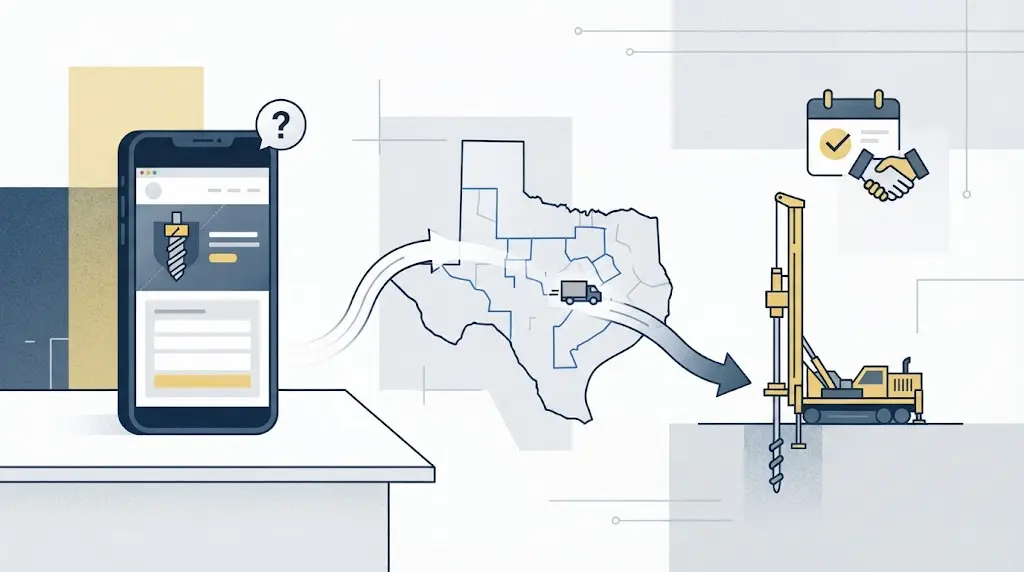
A quiet phone does not tell you which part of the marketing system is broken. The website may be invisible for the services you want, attracting searchers outside your territory, asking the right visitor to work too hard, or sending calls into a handoff nobody owns.
That is why the first move should not be “buy more traffic.” Diagnose the path.
What does “not generating calls” actually mean?
It means the business has observed a gap between its website presence and the phone conversations it expects, but the symptom alone does not identify the cause. You need to separate search visibility, page conversion, phone tracking, call quality, and booked-job follow-through.
An owner might say “the website gets no calls” when any of these is true:
- The website receives almost no qualified visits for drilling or pump work.
- The site receives visits, but the page does not say what service is available in the searcher's area.
- The visitor sees a generic homepage instead of a page for pump repair, replacement, drilling, testing, or rehabilitation.
- The number is hard to find, not tappable, wrong, disconnected, or routed to a full voicemail.
- The phone is ringing, but the business has no reliable record of where the calls came from.
- The calls are being answered, but they are unqualified, outside the territory, or not followed into estimates and jobs.
These are different operating problems. They need different fixes.
A quiet phone is a diagnosis, not a budget decision.
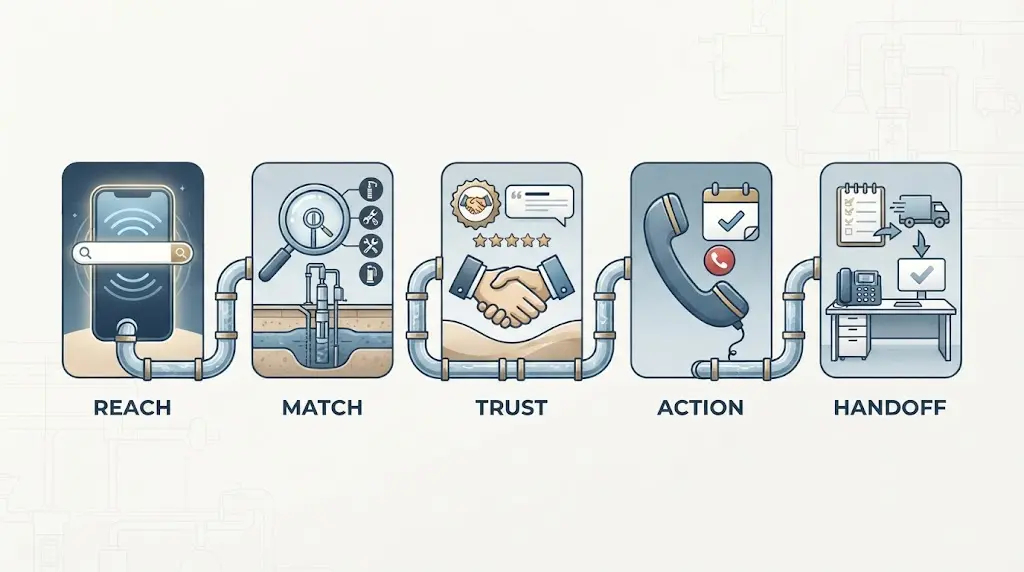
Brictale uses the Call Gap Ladder to keep the diagnosis in order:
| Stage | Owner-level question | Evidence to check | Typical first move |
|---|---|---|---|
| Reach | Can the right searcher find us for this service and territory? | Search Console queries, impressions, indexed pages, Business Profile searches and views | Repair service and territory visibility |
| Match | Does the result and landing page answer the need that produced the visit? | Search query, title, page heading, service wording, service area, landing page | Send each intent to a specific useful page |
| Trust | Does the page give a serious buyer enough reason to call? | Real project evidence, service detail, qualifications, reviews, process, photos | Put relevant proof near the next action |
| Action | Can a qualified visitor call or request the next step without friction? | Mobile test, tap-to-call test, form test, phone consistency, page speed | Repair the contact path and first screen |
| Handoff | Does the office catch, classify, and follow up on the inquiry? | Call log, answered calls, recordings where lawful, CRM stages, estimate and job status | Assign ownership and measure outcomes |
The ladder is a Brictale operating framework, not a list of official Google ranking factors. It tells you where to look first. A page cannot convert a visitor who never arrives, and a high-ranking page cannot rescue a phone path that nobody answers.
Could the problem be that qualified people never reach the site?
Yes. If relevant searchers do not see the company for the work and places it wants, changing button color or rewriting the homepage will not create demand. Start by proving whether Reach is weak before treating the site as a conversion failure.
What does your actual search data say?
Open Google Search Console and choose a useful comparison period. Look at queries, pages, impressions, clicks, and average position. Google describes Search Console as a way to analyze the queries bringing users to a site, review impressions and clicks, inspect URLs, and monitor Core Web Vitals. Search Console is therefore the first evidence source for organic visibility, not a rank screenshot from one location.
Filter the report by pages that matter to the business. The homepage is only one page. Include any drilling, pump repair, pump replacement, pressure tank, well inspection, testing, rehabilitation, commercial, agricultural, or service-area pages that are real parts of the offer.
Then classify queries into four buckets:
- Wanted service, wanted territory. This is the best signal. The page is being shown for work the company can profitably handle.
- Wanted service, wrong territory. The site may be attracting demand the crew cannot serve efficiently.
- Related but wrong service. For example, a page may appear for homeowner troubleshooting while the company wants installation or repair work.
- Brand or irrelevant queries. These can be useful for reputation, but they do not prove new-demand reach.
Do not use total impressions as a proxy for opportunity. A large number of irrelevant impressions can make the report look healthy while the drilling pages remain invisible.
Are the right service pages indexed?
Search Console's URL Inspection tool can show how Google sees a specific page. Check the URLs that should produce calls, not just the homepage. Confirm that the page is indexable, has a canonical URL that makes sense, and contains visible text describing the service.
Google's current AI-feature guidance says a page must be indexed and eligible to appear with a Search snippet to be eligible as a supporting link in AI Overviews or AI Mode. It also says there are no additional technical requirements beyond the normal Search foundations. Google's AI features guidance supports a simple conclusion: an answer-engine strategy does not replace a crawlable, useful service page.
If the page is not indexed, investigate the technical reason before writing five more pages. If it is indexed but has no relevant impressions, the problem may be service clarity, territory fit, authority, competition, or the fact that the search demand is not where you assumed it was.
Does your Google Business Profile show the right kind of demand?
For a verified profile, Google provides searches, views, calls, website clicks, directions, messages, and other metrics that apply to the business. Google's documentation defines profile calls as clicks on the call button and website clicks as clicks on the website link. Business Profile performance and insights lets you choose a date range and compare activity.
That distinction gives you a useful first split:
- Low profile views and low website clicks: likely a Reach issue, though seasonality and demand must be considered.
- Profile views but few calls or website clicks: likely a profile presentation, service fit, trust, or Action issue.
- Website clicks but no website call clicks: likely a page or phone-path issue, unless tracking is missing.
- Profile calls but no office records: likely a tracking or Handoff issue.
The metrics are not a full sales funnel. They do not tell you whether the caller had a profitable project or booked work. They give you a starting point for separating discovery from action.
Could distance and service area be limiting calls?
Local visibility is not a flat national competition. Google says local results are mainly based on relevance, distance, and prominence. Relevance is how well the profile matches the search, distance is how far the business is from the searcher, and prominence includes signals such as links and reviews. Google's local ranking guidance makes this explicit.
That matters for a well contractor with a large service radius. A site may say “serving the whole state,” but a searcher may still see closer companies for a local job. A drilling project, pump repair, or inspection may also have a different practical service radius depending on crew, equipment, response time, and travel cost.
Build the diagnosis around the territory you actually want. Do not assume that more towns always means more good calls.
Is the site clear about the service and territory that produced the visit?
If the right person lands on the wrong page, the website makes the visitor translate the company for itself. Match is the stage where a search impression becomes a relevant visit and a relevant visit becomes a plausible call.
The most useful unit of analysis is service plus territory, not the homepage.
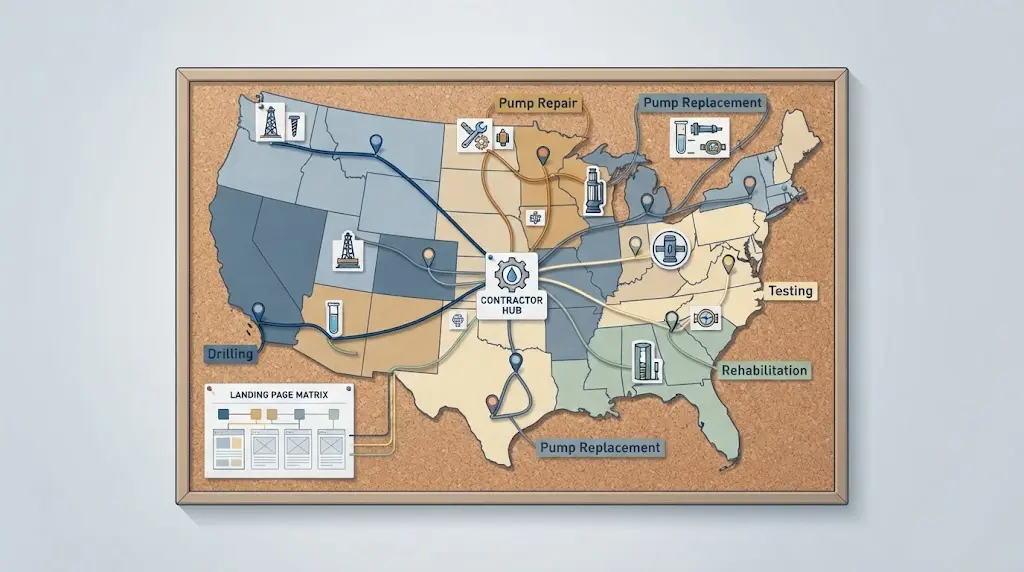
What does a service-territory matrix reveal?
Create a simple matrix before changing copy. Use the jobs you want, the places you can serve, and the page that should receive the visitor.
| Service line | Best-fit buyer problem | Territory decision | Page that should answer it | Call qualification needed |
|---|---|---|---|---|
| New well drilling | Need a new water source or replacement well | Areas where the rig, permits, geology, and crew economics make sense | Well drilling service page | Property location, project type, timeline, existing well context |
| Pump repair | No water, low pressure, noisy or failed equipment | Response area the company can reliably cover | Pump repair page | Symptoms, system type if known, location, urgency |
| Pump replacement | Aging or failed pump system | Area where installation and parts support are practical | Pump replacement page | Existing pump, well depth if known, pressure system, location |
| Well inspection or testing | Transaction, compliance, troubleshooting, or due diligence | Counties or customers the company actually accepts | Inspection or testing page | Reason for inspection, timing, documentation needed |
| Rehabilitation | Low yield, sediment, or performance problem | Territory where the crew has the right equipment and scope | Well rehabilitation page | Well history, symptoms, prior work, site access |
| Commercial or agricultural work | Larger or specialized water need | Territory and project type the company is equipped to quote | Commercial or agricultural page | Site type, volume, schedule, decision maker |
This is not a keyword list. It is a routing map. If the company does not want a certain type of work, the website should not make that work the dominant promise simply because the phrase has search volume.
Does the search result promise what the page delivers?
A result can fail before the visitor sees the page. Check the title and description that searchers see, then compare them with the first screen of the destination page.
For a pump-repair query, the page should not open with a broad statement about being a family-owned water company and require the visitor to hunt for repair information. For a commercial drilling query, a page built only around emergency residential pump service is a mismatch even if it mentions wells somewhere below.
The page should answer four questions quickly:
- What service does this company perform?
- What kind of customer or project does it handle?
- Where does it work?
- What should the visitor do next?
This does not mean every first screen needs a paragraph about every service. It means the first screen should make the intended path obvious for the query that brought the visitor there.
Google's SEO Starter Guide says users may use different words for the same subject and that Google's language systems can understand related queries without every variation being repeated. Google's SEO Starter Guide is a reason to write a clear service page, not a reason to generate dozens of near-duplicate pages.
Is the homepage doing work that belongs on a service page?
The homepage should orient a new visitor. It should not be the only page expected to convert every service.
A useful service page gives the visitor a narrower promise:
- The job the company handles.
- The territory or service conditions that matter.
- The process or next step.
- The evidence that the company is equipped for this kind of work.
- The phone or estimate path.
The page does not need a dramatic sales pitch. It needs enough specificity to let the right caller self-identify and the wrong caller self-select out.
Could the website be attracting homeowners instead of business opportunities?
Some well-related searches are consumer questions. A page may earn visits for “why is my well pump losing pressure” while the company wants pump replacement work or qualified service calls. That traffic is not automatically worthless, but it can distort the owner's perception of website performance.
Look at search queries, landing pages, and the calls they produce. If a page attracts consumer troubleshooting searches but has no clear route to the service the company sells, either improve the commercial path or stop treating that page's traffic as a success metric.
The primary reader of this article is the contractor decision maker. The same discipline applies to the contractor's website: measure the audience that can become a qualified opportunity, not just the audience that can be counted.
Does the page earn enough trust for a serious buyer to call?
Trust is not decoration. A visitor is deciding whether to share a location, explain a water problem, schedule a site visit, or invite a company to quote work. The page must answer the risk behind the call.
What proof matters for well and pump work?
The right proof depends on the job. A generic five-star badge is weaker than evidence tied to the service and decision.
Useful proof can include:
- Real project photographs that show the work without exposing private customer details.
- A clear explanation of the service process, from first conversation to site visit, inspection, repair, or installation.
- The types of equipment or systems the company works on, when the information is accurate and current.
- Licenses, certifications, permits, or association memberships where they apply and can be verified.
- Reviews that mention the relevant service, location, communication, or result without editing the meaning.
- Service limitations, such as project types the company does not take or areas it does not routinely cover.
- A recognizable business name, phone number, hours, and physical or service-area information that agrees across the site and profile.
Do not turn this into a claim that the company has done work it has not documented. Use actual evidence. If the business is new, say what can be verified and make the next step clear.
Is the page specific enough to feel real?
“We provide complete water solutions” may be true, but it is not a strong answer to a buyer with a failed submersible pump or a new well project. Specificity lowers uncertainty.
The page should use the words the business and its buyers actually use, then explain them in plain language. A page about pump replacement might mention the pressure tank, pressure switch, control box, or constant-pressure system if those components are genuinely part of the company's work. A page about drilling may need to explain the initial qualification, site conditions, permitting responsibility, or what information the company needs before a quote.
The point is not to insert technical terms for appearance. The point is to help a qualified visitor recognize that the page understands the job.
Are reviews being asked to do too much?
Reviews help a visitor reduce perceived risk, but they cannot replace a clear service page, an accurate territory, or a working phone path. A strong review about pump repair does not prove that the company accepts a large commercial drilling project. A review from one county does not prove that the company is the right fit for a distant county.
Place proof close to the action, but keep its scope honest. The visitor should be able to tell what the proof supports.
Does the page make a credible promise about the next step?
Avoid vague calls to action such as “learn more” when the buyer needs to speak with someone. Avoid promising a response time, quote, price, or availability unless the operation can keep that promise.
Better next steps describe the exchange:
- “Call to discuss a pump problem and your location.”
- “Request a drilling project conversation.”
- “Send the service area and project details for an initial fit check.”
The language should match the work. A drilling company may need a project qualification call, not an instant online booking calendar. A pump repair company may need an urgent call path and a clear after-hours rule. The page should not force one generic conversion action onto every service.
Google's people-first guidance asks whether content provides original information, substantial value, clear expertise, and a satisfying experience. Google's helpful content guidance is not a formula for a testimonial section. It is a useful quality test for whether the page gives a buyer enough information to make a decision.
Can a qualified visitor call without hunting?
The Action stage is simple to test and often neglected. Use a mobile phone, open the page from a real search result, and try to call as a first-time visitor would. Do not judge only from a desktop browser or a design mockup.
What should the first mobile screen show?
For an important service page, the first screen should make these points easy to find:
- The service or job type.
- The location or territory cue.
- The next action.
- A trust signal relevant to the service.
The phone action should be visible and tappable. If the company uses a tracked number, verify that it routes to the intended office. If the service is not available after hours, state the next step accurately instead of implying a 24-hour response.
The first screen is not the whole page. It is the handrail. A visitor who already knows what they need should not have to scroll through brand history to find the number.
Does every important page have a working contact path?
Test the pages that receive real traffic, not only the contact page:
- Homepage.
- Drilling page.
- Pump repair page.
- Pump replacement page.
- Inspection, testing, or rehabilitation page.
- Any page used in an ad or linked from a Business Profile.
Tap every phone number. Submit every important form with a test message. Check the confirmation page, email routing, voicemail, and office notification. If the form asks for ten fields before a person can explain a pump problem, reduce the first request to what the team actually needs to route the inquiry.
Is the phone number consistent enough for a person and a crawler?
The number on the website, Business Profile, ad landing page, email signature, and directory listings should not create a guessing game. A tracking setup can use dynamic numbers for attribution, but it still needs to route correctly and preserve a clear business identity.
Google's documentation on local business structured data identifies telephone as a business phone number intended to be the primary contact method, and the structured data should agree with visible content. Local Business structured data can help Google interpret business details, but it does not make a wrong number correct.
Google also says contact and location pages are common places where business phone information appears and can be surfaced. Google's contact and local information guidance supports a practical check: make the business name, phone, service area, hours, and contact path easy to find in visible page content.
Could page performance be adding friction?
A slow page can make a visitor wait before the service and phone action become usable. It is worth checking, but do not let a performance score become a substitute for diagnosis.
Google's Core Web Vitals report uses real-world usage data and groups URLs by status. Google recommends prioritizing URLs marked Poor, especially important URLs, and testing fixes after changes. The Core Web Vitals report is more useful than obsessing over a single laboratory score from a page nobody visits.
Check the mobile experience on the actual priority pages. Look for oversized hero images, layout shifts that move the call button, scripts that delay interaction, and forms that fail on small screens. Fix the page that carries qualified demand first.
A phone number that exists is not the same as a phone path that works.
The earliest broken stage deserves the first repair, even when a later stage looks more visible.

Are you sure the website is not generating calls?
Before making a design decision, reconcile the different numbers in the system. “No calls” often means the business is looking at one report while the calls appear in another, or it is counting clicks as if they were conversations.
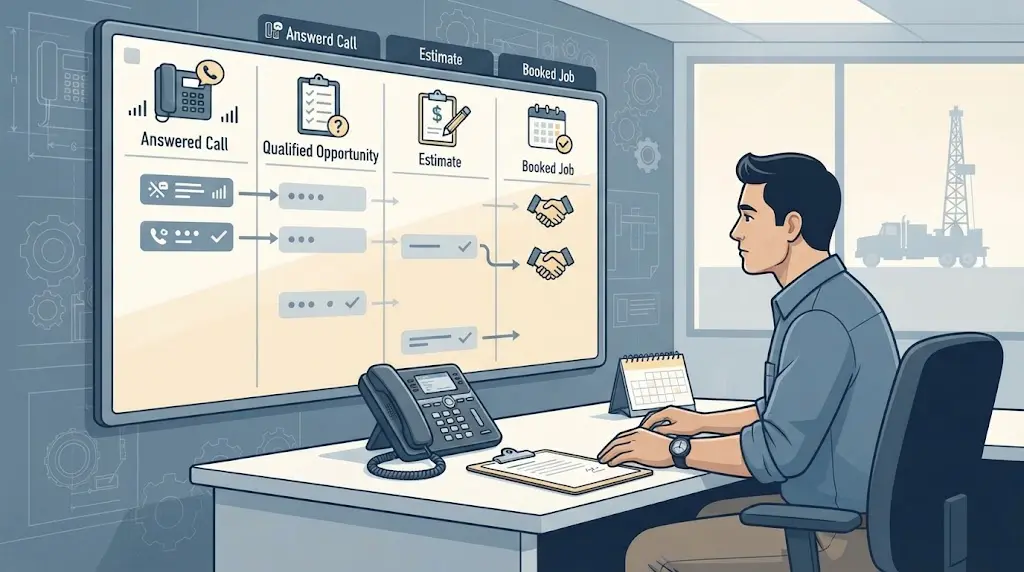
Which call numbers should you separate?
Use a vocabulary everyone in the office can understand.
| Metric | What it tells you | What it does not tell you |
|---|---|---|
| Business Profile call clicks | Someone clicked the call button in the profile | Whether the call connected, was relevant, or booked |
| Business Profile website clicks | Someone clicked from the profile to the site | Whether the page produced a call |
| Website phone clicks | Someone tapped a number or call link on the site | Whether the phone was answered or the caller was qualified |
| Tracked inbound calls | A call reached a tracked number | Whether the source classification is perfect or the call was useful |
| Answered calls | Someone at the business picked up | Whether the caller wanted a service the company sells |
| Qualified opportunities | The call passed the company's service, territory, and timing rules | Whether the estimate was won |
| Estimates or site visits | The business advanced the opportunity | Whether the job was booked or profitable |
| Booked jobs | The sales path reached a scheduled job | Whether the marketing channel was the only cause |
Google Ads officially supports several phone conversion methods, including calls from ads, calls to a website number, mobile number clicks, and imported call conversions from another system. Google's phone call conversion documentation is written for ads, but the measurement lesson applies more broadly: decide which call event counts as valuable before you call the campaign successful.
What should a minimum call log contain?
For each inbound call, record the date, source if known, service requested, location, answered or missed status, qualified or not, next step, estimate status, and booked-job status. Add a reason for disqualification such as outside territory, wrong service, duplicate, vendor, homeowner looking for a service the company does not provide, or no response after a defined follow-up process.
Do not use the log to create fake precision. If the source is unknown, mark it unknown. If the job is still open, do not call it booked. Clean categories are more valuable than a dashboard full of confident guesses.
What if all the tracking is missing?
Start with a baseline rather than waiting for a perfect attribution system. Count inbound calls from the main number, record the page and source whenever it is known, and add a simple “How did you hear about us?” question to the office process. Then implement more precise measurement in stages.
For website call clicks, verify the analytics event and the actual phone routing. For paid search, verify the platform's tag, minimum call duration settings, and import process when qualified or booked status is available. For profile calls, use Business Profile performance data and reconcile it with the phone system as far as the available records allow.
Do not delete a channel because it has no attributed calls when the tracking cannot see the calls. Fix measurement first.
What would prove a conversion problem?
The evidence is not a universal conversion-rate threshold. It is a pattern:
- The site receives qualified visits for a target service and territory.
- The page clearly has an intended next action.
- The phone or form path is technically available.
- Visitors engage with the page or reach the contact path.
- Calls or forms remain low compared with the quality and volume of the visits.
At that point, test Match, Trust, and Action. Do not compare the company with a generic home-service benchmark without knowing the service mix, urgency, geography, and page type.
Could the office handoff be losing the calls?
Yes. A website can produce a real inquiry while the business experiences the result as “the website does not work.” The Handoff stage starts when the visitor presses call and ends when the company knows what happens next.
Who owns the first response?
Write down the owner for each call window:
- During office hours.
- When the owner is on a rig or in the field.
- During dispatch periods.
- After hours.
- On weekends or holidays.
- When the caller leaves a voicemail.
If the answer is “whoever hears it,” the process has no owner. That is not a criticism of a busy crew. It is a visibility problem inside the business. A missed call can look like a website failure because no system tells the owner where the path stopped.
What should the first conversation establish?
The exact questions depend on the service, but the first conversation should quickly establish the fit:
- What do you need help with?
- Where is the property or project?
- Is this a repair, replacement, new installation, drilling project, inspection, testing, or another service?
- What is the timing or urgency?
- What is the agreed next step?
For a pump problem, the caller may not know the system type. The goal is not to force a technical diagnosis over the phone. It is to route the inquiry to the right person and capture enough context for the next action.
For a drilling project, the first call may need a project location, property type, timeline, and whether there is an existing well or water source. Again, the questions should serve routing, not create an unnecessary interrogation.
Are missed calls being treated as leads?
A missed call is an event, not a qualified opportunity. Track whether it was returned, whether contact was made, whether it fit the territory and service, and whether the next step happened.
If the business has a high number of missed calls, do not respond by changing the hero image first. Fix routing, voicemail instructions, backup coverage, and follow-up ownership. The website cannot answer a call after it has done its job.
When should after-hours service be stated?
State the actual operating rule. If the company responds to emergency pump failures after hours, give the correct route. If it only responds during specified hours, say so. If the office reviews web forms the next business day, set that expectation without inventing a response-time promise.
Clear constraints can improve call quality. They also prevent the website from attracting a type of urgent demand the operation cannot responsibly handle.
Which stage of the Call Gap Ladder is broken?
Use the table below as a triage tool. Choose the earliest stage with convincing evidence. Later-stage changes cannot repair an earlier break.
| Observed pattern | Most likely stage | Fastest test | Fix first | Do not do first |
|---|---|---|---|---|
| No relevant impressions or profile discovery | Reach | Search Console queries, indexed service pages, Business Profile searches | Clarify and build priority service coverage; correct profile information | Redesign the homepage |
| Impressions exist, but wrong service or distant locations dominate | Reach or Match | Classify queries by service and territory | Rework targeting, service pages, and honest territory language | Buy broad traffic |
| Relevant clicks arrive at a generic page | Match | Search the query and inspect the landing page first screen | Build a page that answers that service and territory | Add more generic blog posts |
| The page says what you do but shows no relevant proof | Trust | Ask a neutral person what they can verify in 30 seconds | Add accurate, service-specific evidence near the action | Add vague claims or fake badges |
| Visitors reach the page but phone and form paths fail | Action | Tap, call, submit, and check routing on mobile | Repair number, forms, layout, and priority-page performance | Rewrite every page |
| Calls exist but no one can show source or outcome | Handoff or measurement | Reconcile profile actions, phone logs, analytics, and CRM | Create a shared call and opportunity log | Cancel channels based on missing data |
| Calls are answered but mostly outside the territory or service mix | Match or Reach | Add location and service qualification to the log | Narrow the promise and route to the right page | Celebrate raw call volume |
| Qualified calls happen but estimates do not | Handoff or sales process | Review response, qualification, next step, and estimate follow-up | Fix ownership and follow-up | Blame rankings without checking the office |
The table is a recommendation framework. It does not diagnose a specific company without that company's data.
How can an owner run a 45-minute triage?
Use this procedure with one target service and one practical territory. Do not try to audit every page and every town at once.
- Choose the unit. Write down one service, such as pump repair or new well drilling, and the territory the company genuinely wants to serve.
- Run the search. Search the service and location from a neutral browser or device. Record whether the company appears, what page or profile appears, and which competitors or directories appear instead.
- Check Search Console. Filter for relevant queries and pages. Note impressions, clicks, average position, and whether the priority page is indexed.
- Check Business Profile. Review searches, views, calls, and website clicks for the same period. These are profile interactions, not booked jobs.
- Open the landing page on mobile. Give yourself ten seconds. Can you identify the service, territory, proof, and next action?
- Test the phone path. Tap the number, verify the destination, and document who receives the call. Test the form and its notification path if one exists.
- Review a call sample. Use the available call log or CRM. Classify a small recent sample by service, territory, answered status, qualification, next step, estimate, and booked status.
- Name the earliest break. Choose Reach, Match, Trust, Action, or Handoff. Write the evidence beside it.
- Choose one fix. Pick the smallest change likely to improve the broken stage and define how you will measure it.
- Set a review date. Use a date that gives the system time to collect comparable evidence. Do not change five major variables and then claim you know which one worked.
This procedure produces a working diagnosis, not a guarantee. It is valuable because it changes the next action from “do more marketing” to a testable decision.
Fix the earliest broken stage first.
Do Google Maps and the website need separate fixes?
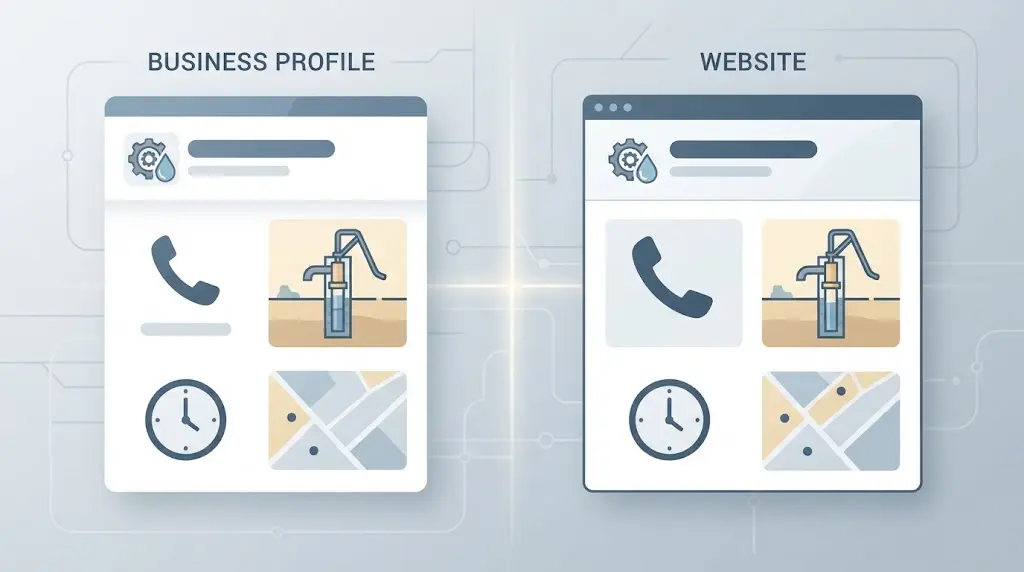
They often need coordinated fixes because they are different surfaces. A Business Profile can generate a call without a website visit. A website can rank organically while the profile is incomplete or misaligned. The owner should compare the two paths rather than assuming one report explains both.
What should be checked in the Business Profile?
Check the business name, primary category, phone, hours, service area, website link, services, photos, and profile status. Use the categories and services that accurately represent the company. Do not add place names to the business name or create a profile for an office that does not exist.
Google says local results are mainly based on relevance, distance, and prominence, and that complete business information helps Google understand relevance. It also says there is no way to request or pay for a better local ranking. Google's local ranking guidance is a useful guardrail against promises that imply a guaranteed position.
What should a service-area business do about location?
Google's service-area documentation says a service-area business can have one profile for the whole area it serves, can specify up to 20 service areas using cities or postal codes, and should keep the overall area generally within about two hours of driving time from its base. Google's service-area guidance also says the service area cannot be set as a radius distance and should be specific and accurate.
That does not mean a well contractor must accept every job within a two-hour drive. It means the profile should represent the real business accurately. The website can explain narrower service limits by service, project type, crew, or response expectation.
Google's representation guidelines also restrict virtual offices for service-area businesses and require accurate business information. Business Profile representation guidelines should be checked before creating a location page or changing the profile address.
What should the website and profile agree on?
At minimum, make the following consistent:
- Business name.
- Primary phone path.
- Website destination.
- Core services.
- Actual service area.
- Hours and availability language.
- Business identity and contact information.
Consistency does not mean copying the same paragraph everywhere. It means the searcher, Google, and the office are not receiving contradictory instructions.
How should service pages and territory pages be organized?
Build pages around real decisions, not a grid of place-name variations. The site should help a buyer understand a service and help the company focus on the work it can actually deliver.
Which page types usually deserve priority?
Start with pages that match high-value services and clear business capacity:
- Well drilling.
- Pump repair.
- Pump replacement or installation.
- Pressure tank or constant-pressure work if offered.
- Well inspection or testing.
- Rehabilitation or abandonment if offered.
- Commercial, agricultural, or builder-facing work if distinct from residential work.
- A contact or service-area page that explains the actual footprint.
The list is not a requirement to create every page. If the company does not perform the work, the page should not exist. If two services have the same buyer, process, proof, and next step, they may belong together. If they require different qualification and evidence, separate pages are more useful.
When does a territory page earn its place?
A territory page should add real information about the service in that place. It might explain the company's actual coverage, project types accepted, travel boundary, local operating context, or how the first conversation works. It should link to the service page and provide a useful next step.
A thin page that swaps one town name for another creates little value. Google says useful content should be unique, current, helpful, and people-first, and its Search Essentials emphasize using words people use in prominent, descriptive places. Google's Search Essentials supports descriptive writing, not mass-produced location pages.
What should a page say about a territory?
Say what the company can verify:
- The cities, counties, or area types it actually serves.
- The services available in that area.
- Any different response or project rules.
- What information the caller should have ready.
- The next step for confirming fit.
Do not imply a permanent office, staff, or local project history that does not exist. Do not promise “same-day” service, “free estimates,” or 24-hour response unless the operation provides it.
How does this connect to the existing Brictale plan?
The broader well drilling SEO guide covers the relationship between service pages, local visibility, proof, and measurement. This article adds the diagnostic order for a site that is already suspected of being quiet. If the immediate problem is a broader channel mix or booked-job system, the owner should use the evidence here to identify the next question rather than treating this page as a replacement for every marketing decision.
What does an answer engine need to understand about the company?
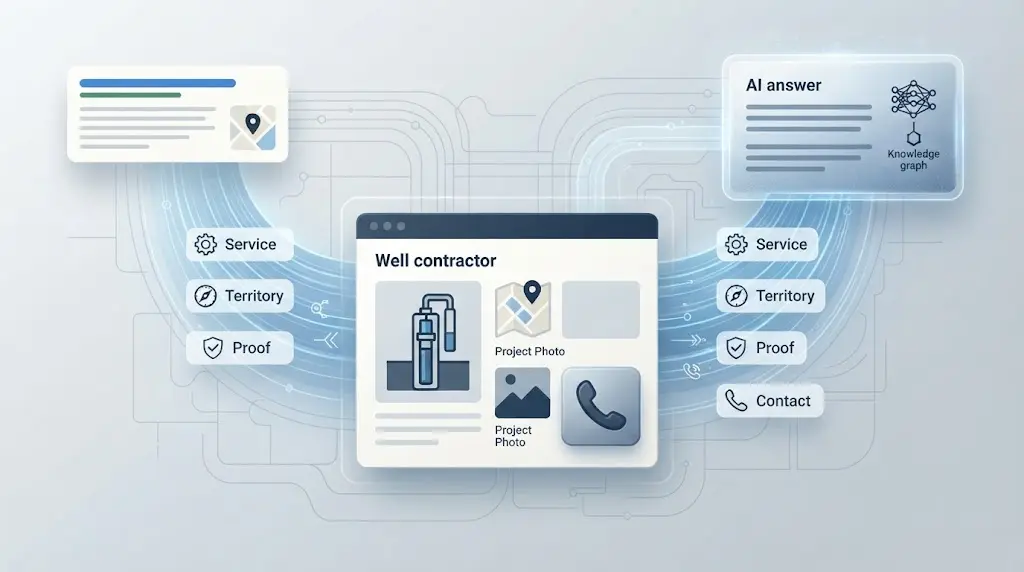
For answer-engine visibility, the page should make the company, services, territory, evidence, and next step unambiguous. There is no need to create a separate “AI version” of the website.
Google says AI Overviews and AI Mode use relevant web links, may use query fan-out across related searches, and rely on the same foundational SEO practices. It says a page must be indexed and eligible for a Search snippet to be eligible as a supporting link, with no additional technical requirements. AI features and your website is the current platform guidance.
For a well contractor, that means:
- Use a direct service heading instead of a slogan that hides the work.
- State the service area accurately.
- Answer common qualification questions in visible text.
- Use named services and equipment terms only when they are accurate.
- Connect proof to the service it supports.
- Keep the phone, business identity, and hours consistent.
- Link related pages with descriptive anchor text.
- Cite external facts when the page makes a factual claim.
The page can be easy for a person to scan and easy for an engine to retrieve. Those are not opposing goals.
If the owner wants to understand the wider answer-engine context, Brictale's guide to getting a brand mentioned in ChatGPT explains the difference between live retrieval and a remembered brand mention. The call-generation diagnosis still begins with ordinary website, profile, and office evidence.
What quote should an owner remember about rankings?
Google's SEO Starter Guide says:
"There are no secrets here that'll automatically rank your site first in Google."
- Google Search Central, SEO Starter Guide
That is a useful warning for this problem. A ranking position is not a booked-job guarantee, and a website fix should be judged by the stage it is meant to improve.
Which mistakes keep a well drilling website quiet?
The following mistakes recur because they look like marketing activity while leaving the broken stage untouched.
Mistake 1: Buying more traffic before checking existing traffic
If relevant visitors cannot find a phone action, more clicks can increase waste. Check the current path first. If the site has no qualified visibility, then address Reach. If qualified visits already exist, improve Match, Trust, Action, or Handoff before scaling traffic.
Mistake 2: Sending every service to the homepage
The homepage cannot carry every service explanation, qualification rule, proof point, and territory detail equally well. Use service pages when the visitor's question is specific enough to deserve one.
Mistake 3: Using one vague promise for every job
“Full-service water contractor” may be accurate, but it does not help a visitor decide whether to call about drilling, a failed pump, low pressure, an inspection, or a commercial project. Clarify the job categories the company wants.
Mistake 4: Expanding the service area until every call is unprofitable
A broad territory can create more impressions and worse work. Compare travel, crew capacity, job value, and response expectations by service. The right territory for pump repair may not be the right territory for a drilling rig.
Mistake 5: Creating fake local presence
Do not publish a page that implies an office or staff in a place where the company has neither. Google says service-area businesses should represent their real service area and does not permit a virtual office simply to appear local. Fix the service-area language and build useful territory information instead.
Mistake 6: Treating a call click as a qualified call
A profile call click, website phone click, answered call, qualified opportunity, estimate, and booked job are different events. Name them separately or the report will reward the wrong behavior.
Mistake 7: Hiding proof below the conversion path
If the visitor has to scroll through generic company history before seeing relevant service proof, the page is making the decision harder. Put the proof needed for this service near the next action, then explain the company in more depth below.
Mistake 8: Asking for too much information too early
A long form can be useful for a complex commercial project, but it can be a poor first step for a caller who needs to explain a pump problem. Ask only for the information required to route the first conversation, then collect more when the next step is clear.
Mistake 9: Rebuilding without a baseline
If the old site is replaced before the business knows which pages, queries, calls, forms, and territory signals matter, the owner loses a comparison point. Capture the baseline, preserve useful URLs and redirects, and define the next measurement before a rebuild.
Mistake 10: Publishing generic advice to compensate for missing commercial pages
More blog posts do not automatically fix a missing pump repair page, an unclear service area, or a broken phone route. A post should support a business decision. It should not substitute for the page a qualified searcher needs.
Should you rebuild the website now?
Usually not as the first diagnostic move. A rebuild is a major change, and the owner should know what it is meant to repair.
When a targeted repair is the better first move
Start with a targeted repair when:
- The site is indexed and receives relevant visits.
- The core service information is present but difficult to find.
- The number or form fails on one or more priority pages.
- The Business Profile points to the wrong page or has incomplete information.
- The office has no shared call and opportunity log.
- A few priority service pages can be rewritten without changing the whole platform.
These fixes are easier to isolate. They also produce useful evidence for a later redesign.
When a rebuild is justified
Consider a rebuild when the existing platform cannot reliably support the work:
- Important content cannot be crawled or edited.
- Mobile phone paths and forms cannot be made reliable.
- Service and territory architecture cannot represent the business honestly.
- URLs, redirects, page templates, or analytics are unmanageable.
- The site has no workable way to preserve or improve priority pages.
- The design or technical structure creates repeated failure across the whole site.
Even then, write a migration brief around the Call Gap Ladder. List the priority service-territory pairs, their pages, phone paths, forms, proof, tracking events, and success measures. A new color palette is not a growth plan.
What should survive a rebuild?
Preserve evidence, not just visuals:
- The query and page data from Search Console.
- The Business Profile and service-area configuration.
- The phone and form events that can be measured.
- The service pages with relevant impressions or leads.
- The reviews, photos, proof, and business details that remain accurate.
- The URL mapping and redirects needed to avoid losing useful paths.
Google's SEO Starter Guide says links help users and search engines discover pages and understand how they relate. Google's guidance on links and site organization is a practical reminder to treat the architecture as an asset during a rebuild.
What should a 30-day repair plan look like?
Use a short cycle with one or two priority service-territory pairs. The goal is to remove uncertainty and improve the earliest broken stage, not to make every marketing asset perfect at once.
Days 1 to 3: establish the baseline
- Record the current service mix and the work the company wants more of.
- Define the practical territory for each priority service.
- Export or note Search Console queries, impressions, clicks, positions, and priority URLs.
- Record Business Profile searches, views, calls, and website clicks for a comparable period.
- Test the mobile phone and form paths.
- Reconcile a recent call sample with the office or CRM.
- Write the first Call Gap Ladder diagnosis with evidence.
Days 4 to 10: repair the earliest break
If Reach is broken, fix indexability, profile completeness, service naming, internal links, and priority page coverage. If Match is broken, send relevant searches to the right service page and make territory language accurate. If Trust is broken, assemble real service-specific proof. If Action is broken, repair phone and form paths. If Handoff is broken, assign ownership and create the call log.
Do not make a large batch of unrelated changes. Keep a change record with the page, change, reason, date, and expected effect.
Days 11 to 20: improve the chosen path
Review the priority page on mobile. Check the first-screen service message, territory cue, proof, phone action, and form. Make the page answer the exact buyer problem without repeating a generic company introduction.
If the page is a service-area page, confirm that it contains useful local information and does not imply a false office. If the Business Profile is the primary discovery path, make sure its website link sends the visitor to a page that answers the profile's promise.
Days 21 to 30: measure business outcomes
Compare the same stages again. Look at relevant impressions and clicks, profile actions, website calls, answered calls, qualified opportunities, estimates, and booked jobs. Record what is still unknown.
If traffic improved but calls did not, inspect Action and Handoff. If calls improved but booked jobs did not, inspect qualification, service fit, response, and follow-up. If qualified visibility remains weak, keep working on Reach or Match instead of judging the site as a conversion failure.
At the end of the month, decide whether to keep the targeted repair, expand it to another service, or prepare a rebuild brief. The evidence should determine the next move.
What should you ask a marketer or agency before hiring them?
Ask questions that force a diagnosis and a measurement plan.
- Which service and territory will you analyze first?
- How will you separate visibility, website actions, answered calls, qualified opportunities, estimates, and booked jobs?
- What will you inspect in Search Console and Business Profile?
- How will you verify that the phone and form paths work on mobile?
- How will you represent a service-area business without creating fake offices or thin city pages?
- What changes would you make if the problem is office follow-up rather than website copy?
- What evidence will you preserve before a redesign?
- Which claims in the plan are facts, which are observations, and which are recommendations?
- How will you report what remains unknown?
Be cautious when a provider starts with rankings, promises a fixed number of calls, or recommends a new website before asking which services, territories, and outcomes matter. A serious plan can explain what it will measure and what it cannot guarantee.
Brictale's broader well drilling SEO page explains the visibility system behind this diagnosis. The page you are reading is narrower: it is for the moment when the owner sees a quiet phone and needs to locate the break. If the evidence is unclear across a territory, the free territory audit is the sensible next step because it can compare competitors, service coverage, Maps visibility, page friction, and tracking gaps in the actual market.
What is the verdict?
Your well drilling website may not be generating calls for five different reasons, and only one of them is “the website needs more traffic.” Work through Reach, Match, Trust, Action, and Handoff in order. Choose one service and one territory, collect evidence, test the phone path, and fix the earliest broken stage.
If you cannot tell whether the problem is visibility, page conversion, or office follow-up, request Brictale's free territory audit. The useful output is not a promise of rankings or a guessed number of lost jobs. It is a defensible diagnosis of what a contractor can improve next.